“So, what’s the Army got you doing these days?” he asked, loud enough for our uncle Pete to hear from across the yard.
I said something vague about training coordination, the kind of answer I’ve given a hundred times to people who don’t actually want the real one.
Ryan laughed before I’d even finished the sentence.
“Training coordination,” he repeated, grinning at the table like he’d caught me in something. “That’s a nice way of saying paperwork. You know what my little sister’s actual job is?”
He looked around, gathering the room the way he always does, waiting until every fork stopped moving.
“She sits on a base somewhere and lets the government pay her rent. Meanwhile, Mom and Dad still send her care packages like she’s twelve years old.”
A few people chuckled uncertainly, the kind of laugh people give when they’re not sure if something is actually a joke. My mother’s face tightened. My father stared at his plate.
I didn’t say anything.
There’s a particular kind of quiet you learn to hold on to in this job, a stillness that has nothing to do with weakness and everything to do with knowing that the loudest person in the room is rarely the one who understands what’s actually happening. I’ve held that stillness through worse rooms than my brother’s dining table.
I held it now, and I reached for my water glass instead of a response.
That only encouraged him.
“No, seriously,” Ryan said, turning to our cousin’s husband, a man named Greg whom I’d met maybe twice in my life. “She’s never had a real job. Not one. Straight out of high school into the Army,” he snorted, “and she’s been letting Uncle Sam and Mom and Dad take care of her ever since. Meanwhile, I built a company from the ground up.”
He gestured at himself, at his watch, at the catering spread behind him, like it was evidence in a trial only he was allowed to argue.
“But sure, let’s all pretend she’s doing something impressive out there.”
Someone near the drink table asked, not unkindly, if I was still active duty.
I nodded.
Ryan cut back in before I could add anything.
“Barely,” he said. “She’s basically on an extended vacation with a paycheck.”
My mother started to say something, but my father put a hand on her arm the way he does when he’s decided a fight isn’t worth having in front of guests. I understood that. I’ve made the same calculation more times than I can count—when to let a comment die in the air rather than give it the oxygen of a response.
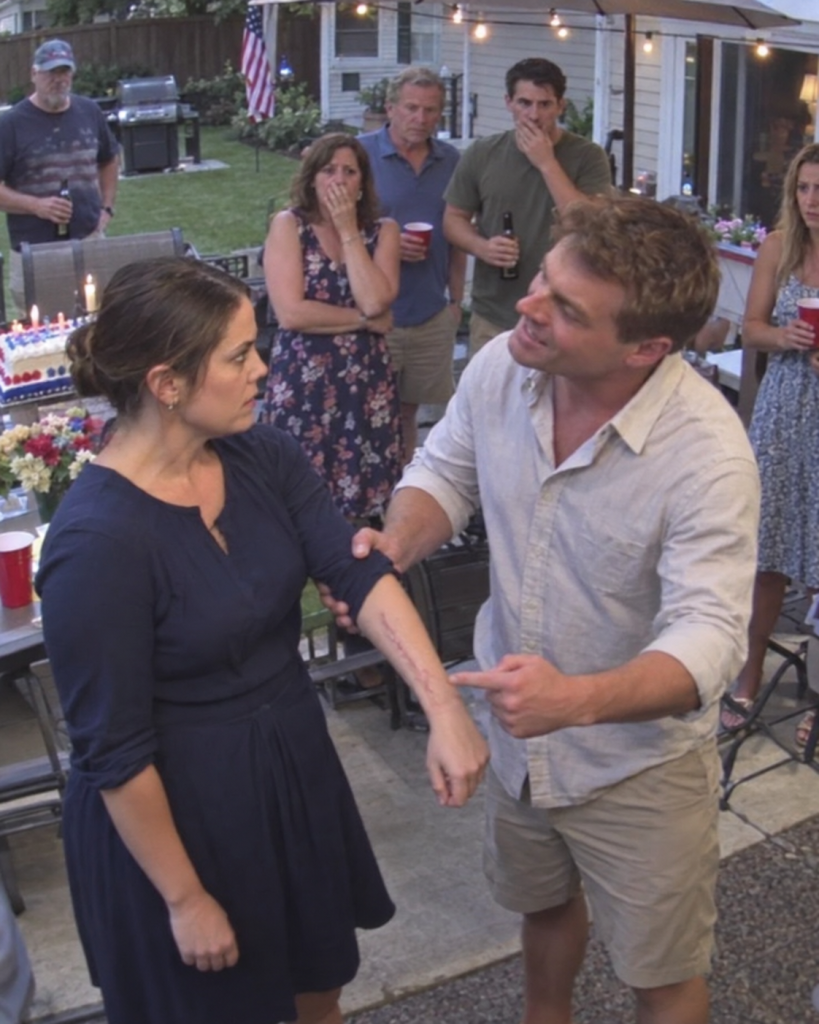
I reached for the linen napkin folded beside my plate, and as I unfolded it across my lap, my sleeve slid up an inch past my wrist.
It wasn’t deliberate.
I don’t think about the scar much anymore. It’s just part of my arm, the way a scar becomes part of anyone’s arm after enough years.
But someone at the far end of the table noticed.
I felt it before I saw it—a shift in attention, a stillness that didn’t match the rest of the room’s noise. I glanced over and found Daniel Brooks watching me.
Ryan’s oldest friend. His best man at the wedding eleven years ago. A broad-shouldered guy who’d said maybe six words to me all afternoon beyond a polite hello.
He wasn’t looking at my face.
He was looking at my wrist, at the long pale line that ran from just below my palm toward my elbow.
And something had changed behind his eyes.
Recognition, or the beginning of it. The look of a man doing math he didn’t expect to be doing at a birthday party.
Ryan kept talking. Something about property values. About how people who serve get treated like heroes for doing what he called a government job with better marketing.
I stopped listening.
I was watching Daniel instead, watching him set his drink down slowly on the table behind him, watching him glance once more at my arm and then, without a word to anyone, turn and walk toward the side gate that led out to the driveway.
Nobody else seemed to notice him leave.
My mother was refilling drinks. My father was still holding his fork without eating. Ryan was still talking, still building the version of me he needed the room to believe in.
I didn’t know yet what Daniel was about to set in motion.
I only knew that, for the first time all afternoon, someone in that yard had actually looked at me and seen something true.
Daniel Brooks didn’t walk out to the driveway to get air. He walked out there to make a phone call, and I wouldn’t understand the weight of that call until much later that evening.
I found out afterward what he’d been thinking in those first few minutes, standing by his truck with his phone in his hand, staring at the screen without dialing.
Before Ryan’s construction company, before eleven years of Sunday barbecues and fantasy football leagues, Daniel had spent six years in the 75th Ranger Regiment. He’d left the service the way a lot of guys do, quietly and without much fanfare, trading deployments for a job managing warehouse logistics and a life that looked, from the outside, entirely ordinary.
But some things don’t leave you just because you’ve left them behind.
A scar like mine has a shape to it that most people never learn to read.
Daniel had learned.
He’d seen it on men he served beside, on friends who didn’t come home the same, and once, years ago, secondhand in a story that had circulated through certain circles the way stories do among people who understand what they cost.
The story was about a young officer, a logistics captain at the time, who’d been riding in a convoy near a forward operating base when an IED went off under the second vehicle. Most versions of the story Daniel had heard were fragments—a name half remembered, a unit designation, the kind of detail that gets passed along at reunions and dinners until it becomes more myth than memory.
But one detail had stuck with him clearly.
The officer had gone back into the wreckage twice, past the point anyone would have blamed her for stopping, to pull two soldiers out before the vehicle caught fire.
She’d taken shrapnel across her forearm doing it.
The name attached to that story, the one Daniel had heard repeated with a kind of reverence reserved for people who don’t tell it themselves, was Audrey Cooper.
He told me later that he almost convinced himself it was a coincidence.
Cooper isn’t an unusual name. But the scar was unusual, and the timeline was unusual, and something in the careful, unbothered way I’d sat through Ryan’s insults all afternoon reminded him of men he’d known who carried real weight and never once mentioned it at a party.
So instead of getting back in his truck, he came back inside.
He found me near the kitchen helping my mother wrap the leftover cake in foil, and he asked if he could speak with me for a moment.
His voice was quieter than I’d heard it all day. None of the easy, backslapping tone he used with Ryan.
“This is going to sound strange,” he said. “But were you ever stationed at Fort Campbell around eight or nine years ago?”
I told him yes.
He asked if I’d served with the 101st Sustainment Brigade.
“Yes.”
Again, he asked carefully, almost like he didn’t want to be right, whether I’d been part of a convoy that hit an IED outside a forward base in Regional Command East.
I didn’t answer right away.
There are things I don’t talk about, not because I’m ashamed of them, but because talking about them doesn’t change what happened, and it tends to make other people uncomfortable in ways I’ve stopped having the patience for.
But something in Daniel’s face told me he wasn’t asking out of curiosity.
He was asking because he already knew, and he needed to hear it confirmed by the person it happened to rather than from a rumor that had traveled through years and hands until it barely resembled the truth.
“Yes,” I said. “And that was me.”
He exhaled like he’d been holding his breath since the driveway.
Then he asked me two more questions, small details, the kind only someone who’d actually served nearby would think to ask: the call sign of the unit we’d been operating with, the approximate date.
I answered both.
Each answer seemed to land on him like another piece of a picture locking into place.
He didn’t say much after that. He thanked me, which struck me as an odd thing to say, and then he excused himself and stepped back outside.
I went back to wrapping the cake, assuming that was the end of it. An old story confirmed. A strange little moment of recognition between two people who’d once worn the same uniform in different corners of the world.
I didn’t realize Daniel had pulled out his phone again until much later.
He called a friend still on active duty, someone he’d stayed close with since leaving the Rangers, a man now working logistics coordination out of a battalion staff office.
Daniel kept his voice low, standing near the fence line where the party noise wouldn’t carry.
“I need you to confirm something for me,” he said. “A name. Audrey Cooper. Major. I think Sustainment Brigade, formerly Fort Campbell.”
There was a pause on the other end, longer than Daniel expected.
He told me afterward that the silence itself was strange. Not confusion, but something closer to caution, like the person on the other end was deciding how much he was allowed to say over an open line.
Finally, the voice came back.
“Where are you right now?”
Daniel gave the address without thinking much of it, still assuming this was just a formality, a way of closing the loop on a story he’d wondered about for years.
“Don’t go anywhere,” the voice said. “Stay right there.”
Daniel stood by the fence for a moment after the call ended, phone still in his hand, looking back toward the house where Ryan’s laughter carried out through the open windows, where I was still inside pretending the last ten minutes hadn’t happened at all.
He didn’t know exactly what was about to happen.
But something in that voice told him it wasn’t nothing.
And for the first time since he’d walked into that backyard, Daniel Brooks felt like he needed to stay close and watch.
Ryan had no idea anything had shifted.
He was still holding court by the dessert table, recycling the same jokes about my government vacation to anyone who hadn’t heard them the first time, refilling his glass, basking in the kind of attention he’s always mistaken for respect.
I moved through the party the way I usually do at these things—present, but peripheral—helping my mother keep the food trays full and answering questions with as few words as I could manage.
I didn’t know Daniel had made a phone call.
I didn’t know anyone was coming.
What I noticed gradually was Daniel himself.
He’d come back inside after his conversation by the fence, but he wasn’t the same relaxed guy who’d been trading stories with Ryan an hour earlier. He kept checking his phone. He kept glancing toward the front of the house, toward the street, in a way that had nothing to do with the party happening around him.
Twice I caught him watching me from across the yard.
Both times he looked away too quickly, like a man trying not to stare at something he wasn’t sure he was allowed to see yet.
I’ve spent enough years around people under pressure to recognize the signs even when they’re trying to hide them.
Daniel’s shoulders had gone rigid. His jaw was set in a way that didn’t match small talk at a birthday party.
I almost asked him if something was wrong, but before I could, his phone buzzed again and he stepped away from the crowd to answer it, cupping his hand around the screen like he didn’t want anyone reading it over his shoulder.
I didn’t hear most of that second call.
I caught fragments as I passed near the side yard with a tray of empty glasses—an address repeated back, a confirmation of some kind, a short “Understood” that sounded more like something you’d say to a superior officer than to a friend.
Daniel’s posture had changed entirely by the time he hung up.
He wasn’t fidgeting anymore.
He was still—the particular stillness of someone who has just been given instructions and is now simply waiting to carry them out.
Ryan noticed it too eventually, though he read it completely wrong.
“Hey, you good?” he called out, waving his drink toward Daniel with the easy confidence of a man who assumes every problem in the room is smaller than his own. “You’ve been on that phone for twenty minutes. Everything okay with the business?”
Daniel looked at him for a second too long before answering.
“Everything’s fine. Just handling something.”
“You’re being weird, man,” Ryan said, laughing as he already turned back toward the group of cousins he’d been entertaining. “Come get a beer. You look like you saw a ghost.”
Daniel didn’t move toward the cooler.
He stayed near the edge of the patio instead, close enough to the driveway that I understood without being told that he was watching for something.
I went back to clearing plates, telling myself it was none of my business, that whatever had rattled him wasn’t connected to me.
Looking back now, I think some part of me already suspected otherwise.
There was a way he kept glancing at my wrist, quick and involuntary, that told me this wasn’t unrelated at all.
My mother asked me to help carry the cake back out for a second round of coffee, and I was balancing the tray on one arm when I heard it—the low, distinct rumble of engines pulling up outside.
More than one vehicle, moving with a kind of coordinated precision that civilian traffic doesn’t have.
My father’s house sits on a quiet cul-de-sac.
Cars don’t usually arrive there like that.
Ryan heard it too.
“What’s going on out there?” he asked, half amused, already assuming it was nothing more than a neighbor’s landscaping crew or a delivery truck taking up too much road.
He looked toward Daniel, still grinning, still certain the afternoon belonged entirely to him.
“Seriously, what’s with you today?”
Daniel didn’t answer him.
He was already moving toward the front of the house.
I set the tray down on the counter and followed, not because I understood what was happening, but because every instinct I’d built over more than a decade of service was telling me that something had changed in the air.
The way the pressure shifts before a storm breaks.
My mother followed behind me, drying her hands on a dish towel, confusion written plainly across her face. My father stood up from his chair for the first time in an hour.
Ryan trailed after us, still holding his drink, still wearing the loose, unbothered smile of a man who has never once in his life had to prepare himself for a moment he didn’t control.
“Seriously, who’s out there?” he asked again, laughing under his breath and glancing at Daniel like he expected him to be in on some joke.
Daniel reached the front door first.
He didn’t answer Ryan.
He just looked back at me once with an expression I hadn’t seen on him all day. Something between apology and awe, like a man who wasn’t sure if he’d just done the right thing or opened a door that couldn’t be closed again.
“You’ll see,” he said quietly.
Then he opened it.
Outside, the driveway and the curb in front of it were no longer empty.
Fifteen minutes had passed since that second phone call.
Fifteen minutes.
And now there was a knock at the door that hadn’t come yet, but was already unmistakably on its way.
Two black SUVs sat at the curb in front of my father’s house, engines still running, government plates catching the afternoon light. A third vehicle pulled in behind them as I stepped out onto the porch.
For a moment, the entire party seemed to hold its breath in unison.
Thirty relatives crowded toward the windows and the front door, drinks forgotten in their hands.
Ryan pushed past his own guests to get a better look, and I heard him mutter, mostly to himself, that someone must have the wrong address.
It was a reasonable assumption.
Nothing about our quiet cul-de-sac with its trimmed hedges and inflatable birthday balloons tied to the mailbox suggested it belonged in the same sentence as vehicles like that.
The doors opened.
Two men stepped out first, both in dress uniform, both moving with the unhurried, deliberate pace of people who do this often enough that urgency has been replaced by precision.
I recognized the insignia before I recognized either man’s face—a full colonel, and beside him a lieutenant colonel I didn’t know personally, but whose bearing I understood immediately.
Behind them, a third figure remained near the vehicle, clearly waiting, clearly there in a supporting role rather than a leading one.
The chatter behind me died completely.
My mother’s hand found my father’s arm.
Ryan had gone very quiet, the kind of quiet that comes from a man recalculating something in real time and not liking any of the numbers.
The colonel came up the front walk first, scanning the small crowd gathered at the door with the kind of practiced attention that misses nothing.
His eyes found me almost immediately, and something in his expression settled, like a man confirming a detail he’d already been fairly certain of.
“Major Audrey Cooper,” he said.
It wasn’t quite a question.
“Yes, sir,” I answered, stepping forward.
What happened next unfolded in a way that made my chest tighten, though I kept my face as composed as I’ve trained myself to keep it in rooms far more difficult than this one.
Both officers came to a stop in front of me and extended their hands.
Not the casual half-handshake people give in social settings, but something with actual weight behind it. The kind of greeting reserved for people whose service means something to the person offering it.
“Ma’am,” the colonel said, “I apologize for interrupting your family’s afternoon. This couldn’t wait, and given the circumstances, we felt it was better handled in person than over the phone.”
He handed me a sealed folder.
I could feel the eyes of everyone on that porch locked onto the exchange, onto the deference in his posture, onto the folder now in my hands with a classification marking visible along the edge.
“We need your signature and your input today,” he said. “There’s a situation developing that requires your assessment specifically. Given your background with the program, there wasn’t another option.”
I nodded, already scanning the first page, already shifting without meaning to into the version of myself I don’t often bring home.
Somewhere behind me, I heard my aunt whisper something to my uncle, low and startled. I heard Megan’s quiet voice asking Ryan if he’d known about any of this.
I heard nothing at all from Ryan.
I glanced up once, just briefly, and found the entire party frozen in a kind of stunned recalibration.
The cousin who’d laughed loudest at Ryan’s jokes an hour earlier was now staring at me like she was seeing a stranger standing in my clothes. Greg, who’d chuckled along about my extended vacation, had gone pale near the punch bowl.
My father stood absolutely still in the doorway, his mouth slightly open, looking at me the way you look at someone you thought you already knew completely.
The lieutenant colonel spoke next, addressing me with the same formal weight.
“We can step somewhere private if that’s easier for the family,” he offered, glancing briefly past me into the house, clearly aware of the audience we’d drawn.
I appreciated the offer, but there wasn’t much point in pretending anymore that this could be smoothed over quietly.
I asked my father if we could use his study, and he nodded, still too stunned to form words, then led the way without a single question.
As I turned to follow, I caught Ryan’s face for just a second.
Whatever performance he’d been running all afternoon had drained completely out of him.
He looked smaller somehow, standing there in his own doorway, his drink hanging forgotten in his hand, staring at the space where two military officers had just addressed his sister with more respect in thirty seconds than he’d shown her in years.
I didn’t say anything to him.
There wasn’t time, and honestly, I wasn’t sure yet what I would have said if there had been.
Inside the study, the colonel laid out the details of what had prompted the visit: a scheduling conflict involving a logistics assessment I’d been overseeing remotely, one that had escalated faster than expected and required my signature before the end of the day, regardless of where I happened to be.
It was, in the end, a matter of paperwork and protocol, nothing dramatic in itself.
But paperwork carried by two colonels to a birthday party, delivered with that particular formality, said something no explanation needed to spell out.
Through the study door, I could hear the party outside slowly finding its voice again.
Hushed conversations rippled through the yard, my mother’s voice rising above the rest as she tried and failed to explain something she herself didn’t fully understand yet.
Whatever version of me my brother had built for that room over the years, it had just been quietly, irreversibly replaced by something closer to the truth.
Signing the paperwork took less than ten minutes.
What took longer was walking back out into a party that had transformed entirely in my absence, the air thick with a kind of charged silence I’d never once experienced in my parents’ backyard.
The colonel and lieutenant colonel didn’t leave right away.
My father, still visibly shaken, insisted they at least have coffee before driving back, and to my surprise, they accepted.
I think some part of him needed the extra minutes, needed proof that this wasn’t some strange hallucination brought on by too much wine and an overwhelming week.
We settled at the patio table, the four of us, while the rest of the party hovered at a respectful distance—close enough to listen, careful not to look like they were listening.
It was the colonel who brought it up, not me.
I wouldn’t have volunteered it.
“I imagine your family knows about Kandahar,” he said, stirring his coffee and glancing at me with an expression that assumed far more than was true.
When I didn’t answer right away, something shifted in his face.
“They don’t know,” he said, not quite a question this time either.
My mother set her cup down carefully.
“Know what?”
The colonel looked at me for permission.
I gave a small nod, more out of resignation than anything else.
There’s a particular exhaustion that comes from having spent years keeping something folded up small and private, only to have it unfold itself in front of you regardless of what you wanted.
He told them in the measured, economical language officers use for things that matter too much for embellishment.
He told them about a convoy hit by an IED outside a forward operating base. About a logistics officer who’d gone back into a burning vehicle not once but twice to pull out two wounded soldiers before the flames made it impossible to go back a third time.
He mentioned the scar on my arm without dramatizing it, the way you’d mention any documented detail in an official account.
He mentioned a commendation that had been awarded afterward, one I’d accepted quietly without a ceremony, without telling anyone beyond my direct chain of command.
My mother’s hand went to her mouth.
My father sat completely still, his coffee cooling untouched in front of him, staring at me like he was trying to reconcile the daughter he’d raised with the version of events now sitting across the table from him.
Daniel, standing a few feet back near the edge of the patio, nodded slowly through the whole account, confirming with his silence that this matched exactly what he’d pieced together hours earlier from nothing more than a scar and a half-remembered story.
“Why?” my mother finally asked, her voice thin. “Why would you never tell us any of this?”
I thought about that question for a moment before answering because it deserved a real answer rather than a deflection.
“Because it wasn’t a story to me,” I said. “It was just the job. And because the two soldiers I pulled out that day didn’t get to go home and tell their families anything. One of them still can’t walk without help. I never felt like it was something to be proud of in front of people. It just felt like something I had to live with.”
The patio had gone entirely silent by then.
The rest of the party was listening openly now, no longer pretending otherwise.
I could see my aunt’s eyes glistening. I could see Greg staring at the ground, clearly replaying his earlier laughter in his head. I could see Megan watching Ryan, waiting for some reaction that hadn’t come yet.
Ryan, for his part, was standing near the sliding door with his arms crossed.
And I watched something stubborn settle over his features, the particular expression he gets when reality refuses to match the story he’s already decided to believe.
“Okay, this is a lot,” he said finally, forcing a short laugh that didn’t land anywhere near the way he wanted it to. “I mean, come on. Two colonels show up at a birthday party with folders and medal talk, and everyone’s supposed to just believe this whole secret hero thing.”
He looked around at the rest of the family like he expected someone to back him up.
Nobody did.
“I’m not saying you’re lying,” he added, quieter now, though the words still carried an edge. “I just think maybe this is a bit much for a Saturday afternoon.”
The colonel’s expression didn’t change, but something in his posture straightened slightly, the kind of shift I recognized from years of watching him handle skepticism from far higher-ranking people than my brother.
“I understand this is unexpected,” he said evenly. “But I can assure you, sir, nothing about this is theater. Major Cooper’s file isn’t something we discuss lightly, and we wouldn’t have made this drive for anything less than an operational necessity.”
Ryan didn’t respond to that directly.
He just looked at me instead, and for the first time all day, I saw something other than smugness in his expression. Something closer to disbelief mixed with a flicker of unease, like a man standing on ground he’d assumed was solid and suddenly feeling it shift beneath him.
My father finally spoke, his voice rough.
“All these years,” he said, mostly to himself, “and we had no idea.”
He reached over and took my hand, something he hadn’t done since I was a teenager, and held it for a long moment without saying anything else.
I didn’t know yet how much further this was going to unravel, or how much of Ryan’s certainty about who I was—and who he was by comparison—was about to come apart entirely before the afternoon was over.
The colonel stayed only a little longer after that, long enough to finish his coffee and answer a few careful questions from my parents.
But before he left, he said something that shifted the entire afternoon in a direction none of us saw coming.
“I should mention,” he said, setting his cup down and glancing briefly at Ryan, “Major Cooper’s current role goes beyond her field record. She’s been serving on the technical evaluation board for a defense logistics modernization program for the past two years. Contracts, infrastructure assessments, vendor capability reviews, that kind of work.”
He said it plainly, the way you’d mention any other detail of someone’s job, with no idea what those words would do to the man standing near the sliding door.
I watched Ryan’s face change in real time.
It was subtle at first, a small tightening around his eyes, the particular stillness of someone doing rapid math they didn’t want to be doing.
I knew immediately what he was thinking because I’d known for over a year, ever since a name had crossed my desk during a routine review cycle and I’d recognized it instantly.
Cooper Builders.
Submitting a bid on a regional infrastructure contract, a project that would have meant everything to a company as overextended as his.
I hadn’t said anything to him then.
I hadn’t said anything to anyone, actually, because the review process is supposed to be exactly that—a process insulated from who you happen to be related to.
His company’s bid had come in with structural documentation that didn’t hold up under technical review. Unrelated to price. Unrelated to reputation. Just a straightforward engineering shortfall that any evaluator would have flagged, regardless of whose name was on the paperwork.
I’d recused myself from that particular file the moment I recognized it, exactly as protocol required, and passed it to a colleague instead.
I never told Ryan that.
I never told anyone in the family.
It wasn’t my story to tell.
And more than that, I didn’t want him to think even for a second that I’d had any hand in what happened to his bid, good or bad.
But now, standing on the patio with two colonels and half our extended family listening, the coincidence was laid bare in front of him without any of that context attached, and I could see him assembling the worst possible version of events in his head.
“Wait,” he said slowly, his voice dropping into something quieter and more dangerous than his usual bluster. “You’re telling me my sister had something to do with reviewing government contracts? The same year my company got denied on the Meridian Ridge project?”
He looked at me now, and the expression on his face had shifted entirely, confusion curdling fast into something closer to accusation.
“Did you do that? Did you have something to do with us losing that bid?”
“No,” I said, keeping my voice level, though the unfairness of the question stung more than I expected it to. “I recused myself the second I saw your company’s name on the file. I never touched your bid. I never spoke to anyone about it. That’s not how the process works. And even if it were, I never would have done that to you.”
Ryan didn’t look like he believed me. Not entirely.
But I also don’t think he wanted to argue the point directly in front of a colonel who could presumably confirm every word I’d just said.
Instead, something else in him seemed to give way, some final piece of the story he’d told himself for years finally cracking under its own weight.
“So this whole time,” he said, quieter now, almost to himself. “You knew exactly what was happening with the company. You knew what I was going through, and you never said a word.”
“What would I have said, Ryan?” I asked.
For the first time all day, I let a little more of what I was actually feeling into my voice.
“You never once asked me what I actually do. Not this year, not five years ago, not ever. You’ve spent years deciding what my life looked like without ever checking if any of it was true. I didn’t hide anything from you. You just never asked.”
He didn’t have an answer for that.
I watched him open his mouth and then close it again, the practiced confidence that usually filled every room he walked into nowhere to be found.
Around us, the party had gone almost completely silent, the kind of silence that settles over people who realize they’re witnessing something they shouldn’t interrupt.
My mother reached out and touched Ryan’s arm gently, the way she used to when we were kids and one of us had gone quiet after a fight.
He pulled away, not unkindly, just instinctively, the way a person does when they need a moment alone with their own thoughts rather than comfort from someone else.
He walked a few steps toward the edge of the yard and stood there with his back to the rest of us, staring out at nothing in particular.
The colonel, sensing the moment had turned into something private, thanked my parents for the coffee and told me quietly that he’d follow up on the paperwork through normal channels.
He shook my hand again before he left, and this time he added, almost as an afterthought, “For what it’s worth, Major, the Army’s lucky to have officers who keep their heads down and let the work speak for itself. Not enough people left who do that.”
I thanked him, though the words landed strangely in the middle of everything else happening around us.
As the two SUVs pulled away from the curb, I glanced over at Ryan, still standing alone at the edge of the yard, shoulders tight, staring at a version of his sister he’d apparently never once considered might exist.
I didn’t go to him yet.
Some things need a little space before they can be said honestly, and I could tell neither of us was ready.
The party didn’t really recover after that.
Guests drifted out in small groups over the next hour, offering quiet, awkward goodbyes to my parents, the kind of exit people make when they’ve witnessed something too personal to comment on directly.
By the time the last car pulled out of the driveway, the backyard looked strange in its emptiness. Folding chairs were still arranged in loose circles. Half-finished plates of cake sat out in the fading light. Balloons drooped slightly against the fence.
I found Ryan sitting alone on the back steps, elbows on his knees, staring at the grass like it owed him an explanation.
I sat down beside him without saying anything at first.
For a while, neither of us spoke.
It had been a long time since we’d shared a silence that wasn’t loaded with something unspoken underneath it, and this one oddly felt different.
Not comfortable exactly, but honest in a way our conversations rarely were anymore.
“I don’t even know where to start,” he finally said, not looking at me. “I’ve spent years telling people you don’t do anything real. I said it so many times, I actually started believing it myself.”
He shook his head slowly.
“And the whole time you were out there doing that, saving people, getting hurt doing it, I was standing at parties making jokes about you living off Mom and Dad.”
I let him sit with that for a moment before I answered.
“You don’t need to relitigate every conversation we’ve ever had,” I said. “That’s not why I told the colonel it was fine to talk in front of everyone.”
I paused, choosing the next part carefully because it mattered more to me than anything about the medals or the file or the scar.
“The thing that actually hurt today wasn’t what you said at the party. People say careless things all the time, and I’ve gotten good at letting that roll off me. What hurt was realizing you’ve believed it for years. That you built an entire idea of who I am and never once thought to check if it was true.”
Ryan didn’t argue.
That, more than anything, told me how much the afternoon had actually landed on him.
The old Ryan would have found some way to defend himself by now, some angle to argue that made him the reasonable one.
Instead, he just sat there quietly, turning something over in his head that looked less like a rebuttal and more like the beginning of an actual reckoning.
“I think,” he said slowly, “I needed you to be the one who didn’t have it figured out. It made it easier to feel okay about my own mess. If you were just coasting, then it didn’t matter that the company’s barely holding on, or that Megan and I have been fighting about money for a year, or that I lost that Meridian Ridge bid and I still don’t fully understand why. It was easier to make you the problem than to look at my own.”
He finally looked over at me, and for the first time in longer than I could remember, there wasn’t a trace of performance in his expression.
“I’m sorry. Not just for today. For a long time before today.”
I didn’t offer him an easy absolution because I didn’t think that was what he actually needed from me.
“I appreciate you saying that,” I told him. “But this isn’t something that gets fixed with one conversation on a back step. It’s going to take longer than that for me to trust that you actually see me differently now, and not just because two colonels showed up unannounced.”
He nodded, accepting that, which itself felt like progress.
My parents came out a little while later, and my mother sat down on Ryan’s other side, resting her head briefly against his shoulder before turning to me.
“We should have asked more questions over the years, too,” she said quietly. “We let your brother’s version of things fill up all the space in this family. That’s on us as much as it’s on him.”
My father, standing behind us with his hands in his pockets, nodded in agreement, though he didn’t trust himself to say much more than that.
Daniel found me by my car as I was getting ready to leave.
He looked lighter than he had all afternoon, like a weight he hadn’t realized he was carrying had finally set itself down.
“I’ve heard that story for years,” he said. “Never had a face to put with it. Kind of strange finding out the woman from the story was standing in Ryan’s backyard the whole time getting mocked over potato salad.”
He extended his hand, and I shook it.
“Thank you for your service. I don’t say that lightly, and I don’t think you hear it enough.”
“I just did my job.”
I gave the same answer I always give, though this time it felt a little less like deflection and a little more like the plain truth it actually was.
I drove home as the sun dropped low over the tree line, the day settling into something quieter than it had started.
Ryan had a long road ahead of him if he wanted to actually change, not just apologize once and consider the matter closed.
But something had shifted that day that couldn’t be undone.
The version of me he’d built out of assumption and convenience had finally collided with the truth, and he was going to have to live with that collision for a while before he came out the other side of it, if he ever fully did.
I thought about the two soldiers I’d pulled out of that convoy all those years ago. About how neither of them ever asked me to explain myself. About how the people who understand real cost rarely need the story spelled out for them.
Maybe that’s the lesson in all of this.
Respect shouldn’t require proof.
It shouldn’t take a colonel showing up with a folder to make someone finally look at the people closest to them and wonder if they’ve been getting the story wrong all along.
I want to know what you would have done in my shoes, sitting through all those years of being underestimated by someone who should have known better. Leave a comment below and let me know where you’re watching from tonight.
We’ve got so many more stories like this one to share with you, so make sure you subscribe so you don’t miss what’s coming next.
Let’s keep this journey going.