Twelve relatives watched it happen.
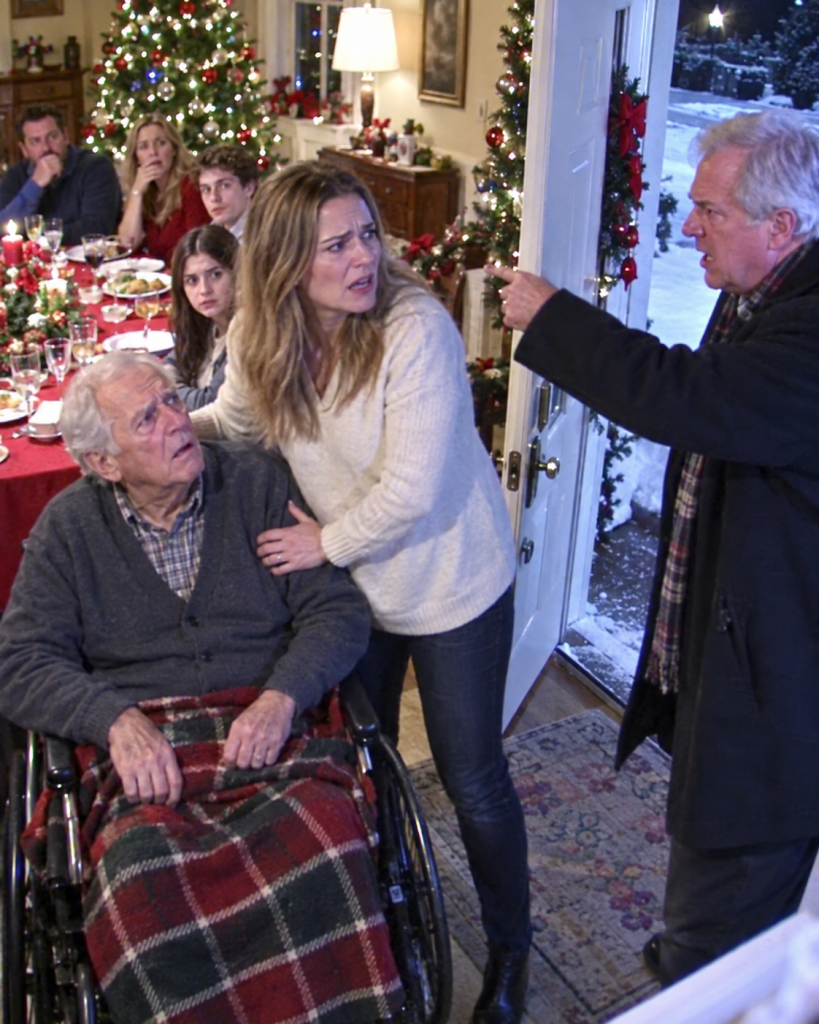
My mother stood beside the open front door of our Hailwood home while my father stared at me with the confidence of a man who had never believed anyone there would challenge him.
“You don’t get a seat at this table,” he said.
Then he looked at my grandfather in his wheelchair.
“Either of you.”
My cheek burned, but I didn’t raise my voice.
I put my hand on my grandfather’s shoulder because he was trying to push himself upright on a leg that no longer worked.
He was 78, thin from illness, wearing the flannel shirt I had pressed that morning.
My mother opened the door wider.
“Out,” she said. “Both of you. We’re done carrying dead weight.”
Nobody stopped her.
Not my sister Brooke.
Not my uncle.
Not the relatives who had spent dinner eating prime rib while my grandfather sat in the corner with cold ham because my mother said his wheelchair made the room “look like a hospital.”
So I turned his chair toward the door.
“If he goes, I go.”
My father followed us onto the porch to make sure we left.
Then the door shut.
The deadbolt turned.
And the people who shared our last name went back to Christmas dinner.
I had spent years being the reliable daughter, working restaurant kitchens, taking double shifts, and learning that keeping the peace usually meant swallowing what I wanted to say.
My grandfather Walter was different.
After his stroke, I called every Sunday and drove out twice a month with soup.
He had lost strength in one leg, but his hands were always moving—repairing something, carving something, turning scraps of wood into tiny birds.
My parents treated him like an expense that had overstayed its welcome.
That Christmas night, I stopped trying to understand why.
The path outside hadn’t been salted.
His wheelchair caught on ice and tipped sideways into the snowbank by the mailbox.
I had him upright in seconds.
His sleeve was soaked.
I wrapped my coat around his knees, got him into my car, and drove him back to my one-bedroom apartment.
He took my bed.
I took the couch.
For the next several weeks, I helped him dress before work, paid for his medication, picked up extra shifts, and learned how far one paycheck could stretch over two lives.
My mother offered to let me come home under one condition.
“If you ditch the old man, you can come back.”
I hung up.
Brooke sent a photo of her new watch and wrote, “Enjoy your charity case.”
I blocked all three of them.
Then small things began happening.
At a hardware store, an older man saw my grandfather in the lumber aisle and stopped dead.
“You look exactly like a man I worked for a lifetime ago,” he said. “Best in the business.”
My grandfather smiled and changed the subject.
Later, while fixing his wheelchair, I found two letters carved into the wooden armrest.
W and O.
When I asked what they meant, he only said, “An old habit.”
Then a certified cream envelope arrived.
The return address read Crane and Holloway Trustees.
Inside was a formal letter addressed to Walter R. Foster.
Halfway down the page was a reference to something called the Asheford Mill site.
When I showed him the letter, his hands stopped moving.
His hands never stopped moving.
“Old paperwork,” he said.
I searched Asheford Mill during a break behind the restaurant.
What appeared on my screen was not an abandoned building.
It was a massive operating industrial complex an hour north of the city—acres of buildings, loading docks, hundreds of cars, a furniture manufacturer hidden behind a holding company.
That night, I asked him again.
He took my hand.
“Hillary, I am not in trouble,” he said. “I am exactly where I chose to be.”
Then he asked me to leave it alone.
I did.
Weeks later, pneumonia put him in the hospital.
My parents arrived telling the nurses how much they had “done for him.”
Then the nurse walked away.
My mother’s voice changed.
“Where are his papers?”
That was when I understood.
They weren’t there to say goodbye.
They were looking for something.
My grandfather died before dawn with my hand in his.
But hours before, he pressed two things into my palm.
The cream trustee letter.
And one of the tiny wooden birds he had carved all his life.
“Keep these together,” he whispered. “Then call Tom Crane.”
Nine days after the funeral, I walked into a law office on the thirty-first floor of a downtown glass tower.
My parents were already seated at the conference table.
My father looked bored.
My mother looked prepared.
Brooke was filming the skyline.
They still thought my grandfather had died with almost nothing.
Then I saw the hallway walls.
Framed photographs of handcrafted furniture.
Factories.
Long oak tables.
And one small bird logo I recognized immediately.
W and O.
My hand closed around the carving in my pocket.
Inside the conference room, attorney Tom Crane placed a thick file on the polished table.
Beside him sat my grandfather’s old wheelchair.
My father gave a small laugh.
“This shouldn’t take long.”
Tom Crane looked at him.
Then he opened the folder.
He read the first line.
My father’s smile disappeared.
My mother lowered her chin.
And for the first time, I watched both of them realize that the quiet old man they had thrown into the snow had left behind something neither of them understood…
Part 2
I’m Hillary Foster, and at 32, I watched my own father tip my grandfather’s wheelchair into a snowbank on Christmas night.
The chair landed on its side.
The wheel kept spinning, ticking in the cold like a clock that didn’t know it was supposed to stop.
My grandfather was 88 pounds of stubborn dignity in a wet wool coat, and the people who shared his last name shut the door on him without blinking.
I’d spoken up.
That was the whole crime.
I defended an old man at a dinner table, and my father’s open hand caught me across the face in front of 12 relatives who suddenly found their plates fascinating.
I thought that was the night we lost everything.
Ten weeks later, a lawyer slid a folder across a polished table and told me what my grandfather had really been carrying all those silent years.
And the number did not fit on one line.
Welcome back to Calm Drama Stories, where ordinary families meet the moment that decides who they really are, and the quiet ones finally get the last word.
If stories about dignity, justice, and standing up for the people the world overlooks stay with you, then you are in the right place tonight.
Drop a comment and be sure to subscribe.
Let me back up to before the snow.
I cook for a living.
Twelve years in kitchens, the last four as sous-chef at a farm-to-table place downtown.
And that February, the owner had finally said the word I’d worked toward since culinary school.
Chef.
My own line, my own menu, my name on the chalkboard.
The word “Chef” had barely settled in my mind when Tom Crane turned another page.
He didn’t look at my parents.
He looked at me.
“Hillary, your grandfather asked me to wait until after the funeral before telling you the truth.”
My father leaned back.
“The truth about what?”
Tom ignored him.
“Walter R. Foster was not a retired carpenter.”
My mother gave a nervous laugh.
“Everyone knows what Walter was.”
“No,” Tom said quietly. “You knew the man who lived in a small house and repaired wooden chairs.”
He opened another folder.
“The rest of the world knew Walter Foster as the founder of Whitmore & Oak.”
The room went silent.
I stared at the small wooden bird in my hand.
W and O.
Whitmore & Oak.
The furniture company I’d seen on my computer.
The factories.
The warehouses.
The acres of land.
My grandfather had built all of it.
My father finally sat forward.
“That company was sold years ago.”
“Parts of it were,” Tom said.
“Not all of it.”
He placed a document on the table.
“Walter retained controlling interests through a series of private trusts.”
My mother’s face had gone pale.
“How much?”
Tom looked at me.
“Do you want me to tell them?”
I swallowed.
“Yes.”
He turned another page.
“At the time of Walter’s death, the combined value of his holdings was approximately one point one billion dollars.”
Nobody moved.
Not even Brooke.
The woman who had once sent me a picture of her new watch and called my grandfather a charity case suddenly lowered her phone.
Tom continued.
“One hundred properties across six states. Industrial buildings. Timberland. Commercial real estate. Residential properties. Warehouses. And several parcels that have increased dramatically in value over the last twenty years.”
My father stared at the papers.
“That’s impossible.”
Tom slid a photograph across the table.
It showed a younger Walter standing in front of a massive factory.
Beside him was another man.
My father.
Except my father was barely twenty years old.
I looked at him.
“You knew.”
He didn’t answer.
My mother did.
“He didn’t know everything.”
Tom closed the folder.
“He knew enough.”
My father’s face hardened.
“Walter abandoned us.”
Tom’s voice remained calm.
“No. Walter separated his business from his family because he believed money had already changed the way his children treated one another.”
My father slammed his palm onto the table.
“He was selfish!”
I flinched.
Tom didn’t.
“He also wrote something specifically about you.”
My father froze.
Tom pulled out a handwritten page.
“Walter said, and I quote, ‘If my son ever believes he is entitled to what I built, give him nothing until he understands that inheritance is not a reward for cruelty.’”
My father’s mouth opened.
No words came out.
Then Tom turned to me.
“Your grandfather left the majority of his estate to you.”
I couldn’t breathe.
“Me?”
He nodded.
“Subject to one condition.”
I looked at the document.
“What condition?”
“You must continue your career for five years without using the inheritance to fund it.”
I almost laughed.
Even dead, my grandfather knew me.
He knew I wanted the kitchen.
The restaurant.
The work.
Not the money.
Tom smiled faintly.
“He also established a foundation.”
I looked up.
“For what?”
“For elderly people with disabilities who have been abandoned by their families.”
My throat tightened.
“The first property is already purchased.”
He slid one final photograph toward me.
It was a large old house surrounded by trees.
A wheelchair ramp ran across the front porch.
Above the entrance was a wooden sign.
Walter House.
I covered my mouth.
My grandfather had spent his final months in a small apartment because he refused to let anyone know what he owned.
He hadn’t been hiding his wealth from the world.
He had been hiding his wealth from people who believed it belonged to them.
My father stood.
“This is ridiculous. I’m his son.”
Tom looked at him.
“You were his son.”
The room went still.
“You were also the man who allowed your father to be thrown into the snow.”
My mother suddenly started crying.
Brooke whispered that she hadn’t known.
I looked at her.
“You knew enough to laugh.”
She looked down.
For years, I had imagined what it would feel like to finally have power over them.
I thought I’d scream.
I thought I’d make them beg.
Instead, I felt tired.
Very tired.
I stood and picked up the wooden bird.
“I don’t want revenge.”
My father looked at me.
“Then what do you want?”
I thought about Christmas night.
The cold.
The snow.
My grandfather’s wet sleeve.
His trembling hands.
And the way he had still told me not to hate anyone.
“I want you to live with the choices you made.”
I walked toward the door.
Behind me, my mother whispered my name.
I stopped.
She said, “Can you help us?”
I turned around.
“Do you remember what you told me?”
She wiped her eyes.
“What?”
“If I ditched the old man, I could come home.”
Her face crumpled.
I nodded toward the hallway.
“I didn’t ditch him.”
Then I left.
Three months later, I stood in a new restaurant kitchen with my name painted across the wall.
HILLARY FOSTER.
Chef.
The first table in the dining room was reserved for twelve people.
Not my relatives.
Twelve elderly guests from Walter House.
They arrived in wheelchairs, walkers, and with canes.
Some had children.
Some had no one.
I served them myself.
At the end of the night, an old man with silver hair reached across the table and squeezed my hand.
“Your grandfather would have been proud.”
I smiled.
“I hope so.”
On the wall behind him hung a single wooden bird.
W and O.
The same little carving Walter had pressed into my palm before he died.
I kept it there as a reminder.
Not of the billion dollars.
Not of the one hundred properties.
Not of the family that had walked away from us.
But of the one thing my grandfather had left me that money couldn’t buy.
The courage to stand beside someone when everyone else had decided they were worthless.
And every Christmas after that, I left one empty chair at my table.
Not for the people who had abandoned us.
For anyone who needed a place to sit.
Because my grandfather had taught me something that no will could ever put into numbers.
Family isn’t the name on the door.
It’s the person who opens it when you’re standing outside in the cold.