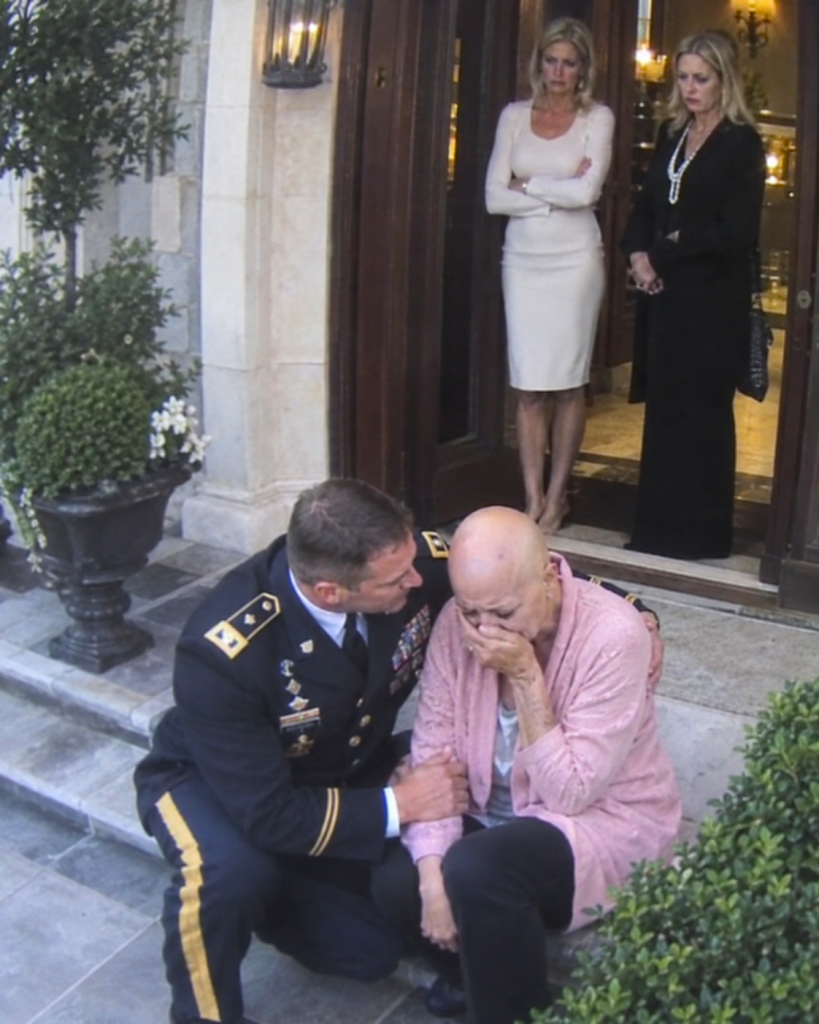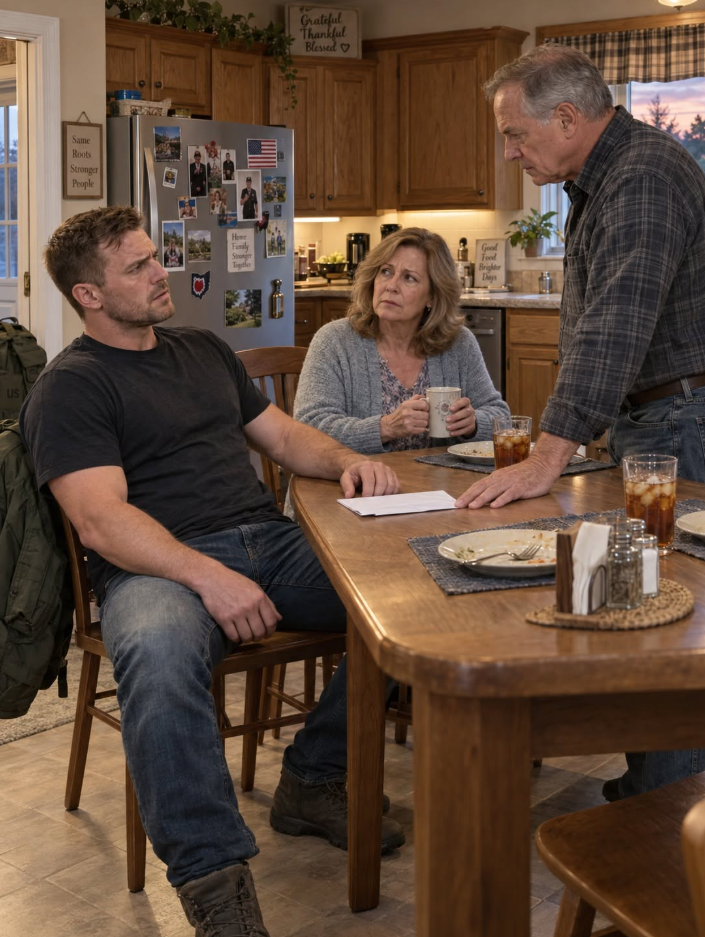
Jason answered on the fourth ring.
“You’re alive.”
“Apparently.”
He laughed.
“Mom said you’re still waking up at four in the morning.”
“Mom says a lot of things.”
There was a pause.
I heard machinery in the background.
“You at the yard?”
“Yeah.”
“I need to see you.”
Another pause.
This one was longer.
Then he said, “They told you.”
Not asked.
Told.
That answered one question.
“Twenty minutes.”
Jason’s fencing business operated out of a gravel lot behind an old machine shop in Huber Heights.
When I pulled in, he was standing beside a white work truck with the passenger door open.
He looked older than he had on video calls.
Not dramatically older.
Just worn around the eyes.
There were two trailers parked near the fence, stacks of cedar boards under tarps, and a compact loader sitting beside a shed.
I had been there before my deployment.
Back then, the place felt busy.
Now it felt like somebody had left a party early.
Jason shut the truck door.
“You look terrible.”
“I’ve been home two days.”
“Exactly.”
We hugged.
A real hug.
That made the next part harder.
I pulled Dad’s folded page from my pocket.
Jason’s expression changed before I opened it.
“I told them not to do that.”
“Do what?”
He rubbed a hand over his face.
“Go after your savings.”
I stared at him.
“So you knew.”
“They asked me if you could help.”
“When?”
“About a month ago.”
“I was still overseas.”
“I know.”
“And my own parents were discussing my bank account with you.”
“I told them no.”
There was enough irritation in his voice that I believed him.
I handed him the paper.
He opened it.
His mouth tightened.
“This isn’t even right.”
“Which part?”
“The total.”
That got my attention.
“You’re not thirty-eight thousand in debt?”
“I am.”
He pointed at two lines.
“But this supplier balance is current now. Dad doesn’t know that. The credit line is worse.”
“How much worse?”
“Thirty-four by itself.”
I stared at him.
He gave me a tired smile.
“See? Better already.”
I didn’t smile back.
“Start from the beginning.”
Jason leaned against the truck.
Three years earlier, his business had been simple.
One crew.
One truck.
Residential fences, decks, small repairs.
He made a decent living.
Then Dad started talking to him about growth.
Dad had spent thirty-one years carrying mail and had retired with a pension, a neat lawn, and a deeply held belief that owning a business was the closest thing America had to proof that a man had made something of himself.
Jason listened.
He added a second crew.
Then a third.
Bought another truck.
Financed the loader.
Started bidding larger jobs for builders putting up entire subdivisions.
For a while, it worked.
Then one development ran six weeks late.
Another builder changed specs halfway through a job and disputed the additional labor.
Material prices jumped.
Jason used the business credit line to cover payroll while waiting for invoices to clear.
“They did clear, right?” I asked.
“Some.”
“Some?”
“One builder still owes me seventeen grand.”
“Can you collect?”
“I’m trying.”
“What about the other work?”
“Underbid.”
“By how much?”
“Enough.”
I shook my head.
“That’s not a number.”
“Because I don’t need my little brother doing an after-action review on my bad decisions.”
I looked at him.
“You need somebody doing one.”
He laughed without humor.
“Fair.”
We walked toward the office.
Inside, the air conditioner rattled in the window.
Jason had invoices spread across a folding table beside a laptop.
No dramatic hidden documents.
No secret second family.
No mysterious theft.
Just a small business that had grown faster than the man running it understood how to manage.
I sat down.
“What happens if you don’t get thirty-eight grand?”
“I don’t need thirty-eight grand.”
“Mom and Dad think you do.”
“Mom and Dad think the only acceptable ending is keeping all three crews running.”
There it was.
“What do you think?”
Jason looked toward the yard.
“I think I should’ve stayed small.”
I waited.
He sat across from me.
“I can sell the second truck.”
“How much?”
“Maybe sixteen.”
“The loader?”
“Another eleven or twelve after the loan balance.”
“One trailer?”
“Five if I’m lucky.”
I did the math.
“That gets you close.”
“It gets the bank interested in talking instead of suing.”
“So why haven’t you done it?”
He looked down.
“Dad.”
I almost laughed again.
“You’re thirty-nine.”
“I know how old I am.”
“Then why does Dad get a vote?”
Jason leaned back.
“Because he spent the last three years telling everyone this company was finally becoming something.”
“It’s your company.”
“I know.”
“You keep saying that.”
He looked at me.
“Do you know what he tells people about you?”
I didn’t answer.
“He says you’re the disciplined one.”
That sounded familiar.
“He tells people I’m the builder.”
I looked around at the folding table, late invoices, and yard full of financed equipment.
Jason smiled bitterly.
“Turns out both of us got assigned a job.”
I sat with that.
The disciplined one.
The builder.
Dad hadn’t meant to hurt either of us.
He had simply repeated the labels long enough that everybody started behaving as if they were obligations.
“What does Amy think?”
Jason stared at the floor.
“She wants me to shut it down.”
“All of it?”
“She wants health insurance that doesn’t depend on whether three homeowners pay me on time.”
That was reasonable.
“I got offered a foreman job with Keller Fence.”
I knew the company.
Large commercial contractor.
Steady work.
Benefits.
“You taking it?”
“Probably.”
“Then why are we even talking about my money?”
His jaw tightened.
“Because Dad thinks taking a job for somebody else means I failed.”
“And you?”
Jason thought about it.
“I think making Amy spend another year checking the bank balance before buying groceries would be failing.”
That was the first thing he had said all afternoon that sounded settled.
I leaned back.
“So what do you want from me?”
“Nothing.”
“That’s not helpful.”
He smiled.
“I want you to go home and buy your house.”
I looked at him.
“Seriously.”
“You’re not writing a check, Matt.”
“You could keep more of the business alive.”
“That’s exactly why I don’t want it.”
He tapped the table.
“If you hand me thirty-eight grand, I don’t have to make the decision I’ve been avoiding.”
That sentence bothered me because it was true.
Money would not solve Jason’s problem.
It would delay the moment when he had to admit the business he built no longer fit the life he wanted.
“What do Mom and Dad know about the foreman job?”
“Mom knows.”
“Dad?”
Jason shook his head.
“Why not?”
“Because I wanted to enjoy one week without hearing the word quitter.”
I stood.
“He’s going to love this conversation.”
“You don’t have to be there.”
“Apparently I’m the one who fixes things.”
Jason groaned.
“Please don’t say that to him.”
“I absolutely am going to say that to him.”
We met at my parents’ house Sunday afternoon.
Jason brought Amy.
The kids stayed with her sister.
Mom knew something was happening because she had put out enough food for twelve people even though there were six of us.
Dad knew something was happening because he refused to sit.
He stood near the kitchen counter while Jason explained his plan.
Sell the second truck.
Sell the loader.
Sell one trailer.
Finish current residential jobs.
Stop bidding new work.
Negotiate the remaining credit balance.
Take the foreman position.
Close the company by the end of October.
Dad listened without interrupting.
When Jason finished, he said, “No.”
Jason blinked.
Amy looked at me.
I looked at Mom.
Mom closed her eyes briefly.
Jason said, “What do you mean, no?”
“You don’t burn down seven years of work because you had one bad season.”
“It wasn’t one bad season.”
“You have contracts.”
“I have debt.”
“You have a brother who can help.”
There it was.
Jason’s face changed.
“Leave Matt out of it.”
Dad looked at me.
“You already talked him into this?”
I almost answered too fast.
Then I remembered how many times Jason and I had both reacted to Dad instead of speaking for ourselves.
“No.”
Jason stood.
“I talked myself into it.”
Dad stared at him.
“Because you’re embarrassed.”
“Yes.”
That stopped him.
Jason continued.
“I’m embarrassed I grew too fast. I’m embarrassed I didn’t understand the margins on those builder jobs. I’m embarrassed I kept borrowing because I thought next month would fix last month.”
Amy reached for his hand.
Jason let her take it.
“But I’m more embarrassed that my wife has been carrying this stress for a year while I worried about whether you’d still brag about me.”
Dad’s face lost some color.
Mom said quietly, “Jason.”
He shook his head.
“No, Mom. We need to say it.”
Dad looked at me.
“And you’re just going to let him do this?”
I felt my shoulders tighten.
That word.
Let.
As if Jason were still nineteen and I had somehow been promoted to second parent.
“It’s his business.”
“Family doesn’t stand by while family loses everything.”
Jason laughed.
“I’m not losing everything.”
Dad pointed at him.
“You built that company.”
“I built a business that doesn’t work anymore.”
“You fix it.”
“I’m trying.”
Dad turned to me.
“Then help him.”
I had rehearsed several versions of what I wanted to say.
None survived the moment.
So I said the simplest one.
“I am helping him.”
Dad gestured sharply.
“By watching him sell equipment?”
“By not paying him to avoid a decision.”
Mom looked at me.
“What if there is still a balance after he sells everything?”
“There will be.”
Her face tightened.
“Then what?”
Jason answered.
“I make payments.”
Dad shook his head.
“You’ll ruin your credit.”
“Maybe.”
“You’ll lose the business.”
“Yes.”
“And you’re okay with that?”
Jason swallowed.
“No.”
That was the difference.
He wasn’t pretending the choice didn’t hurt.
He was choosing it because the alternative hurt more.
Dad looked at me again.
“How much are you willing to give him?”
“Nothing.”
Mom’s chair scraped lightly against the floor.
Dad stared at me.
“Nothing?”
“Not toward this debt.”
“You have fifty thousand dollars sitting in an account.”
“Fifty-two.”
His mouth tightened.
I hadn’t meant to correct him.
But something about saying the exact number mattered.
Fifty-two thousand dollars.
Not abstract family money.
Mine.
Years of overtime.
Missed trips.
Deployment checks.
Saturday shifts.
Used furniture.
A ten-year-old pickup.
Mom said, “Matt, nobody is saying it isn’t yours.”
“Every sentence tonight says exactly that.”
“That’s not fair.”
I turned to her.
“You told me Jason has a wife and children like that makes my future optional.”
Her eyes filled.
“I didn’t mean it that way.”
“I know.”
And I did.
That mattered.
My parents weren’t monsters.
They loved both of us.
They simply understood Jason’s needs more easily because his needs had names.
Amy.
Connor.
Emily.
Mortgage.
Payroll.
My future was quieter.
A house I hadn’t bought yet.
A life I hadn’t built yet.
Quiet things are easy to spend on someone else’s emergency.
Dad sat down at last.
He looked exhausted.
“I pushed you to expand.”
Jason stared at him.
Dad rubbed both hands over his face.
“I kept telling you the second crew was the answer.”
Jason said nothing.
“I told you to take the subdivision work.”
“You did.”
“I thought I was helping.”
“I know.”
Dad looked at the table.
For the first time, I understood why he had been so desperate for me to write the check.
If Jason sold the equipment and closed the company, Dad had to admit something too.
His advice had cost his son money.
Not all thirty-eight thousand.
Jason had signed every loan.
Jason had made every bid.
But Dad had been in his ear the whole time telling him bigger meant better.
A check from me would not only preserve Jason’s business.
It would preserve Dad’s story about himself.
I leaned back.
“Helping doesn’t mean making sure nobody ever has to admit they were wrong.”
Nobody answered.
Amy squeezed Jason’s hand.
Mom got up and started clearing plates even though half of us hadn’t eaten.
That was how the meeting ended.
Not with shouting.
Not with anyone storming out.
Just four adults standing around a kitchen while two brothers finally stopped performing the roles their parents had given them.
The next three weeks were ugly.
Jason sold the white work truck for less than he wanted.
The loader brought more than expected.
The trailer took twelve days to move.
His bank agreed to convert the remaining balance into a fixed repayment schedule once the equipment sales hit the account.
He closed one job at a loss just to be done with it.
He took the foreman position.
The first morning he wore a company shirt with somebody else’s logo on the chest, he sent me a picture.
Under it he wrote:
Dad hasn’t spoken to me since Thursday.
I replied:
He’ll survive.
Jason wrote:
Will I?
I typed back:
Probably. You get dental now.
He sent me a middle-finger emoji.
That was the most normal conversation we’d had in years.
My parents did not forgive me quickly.
They never said they were cutting me off.
They simply stopped calling as much.
Mom sent shorter texts.
Dad became busy whenever I came by.
I had expected to feel relieved once I held the boundary.
Instead, I felt guilty.
That surprised me.
At night, in my apartment, I would open the banking app and see the fifty-two thousand still there.
Some part of me would imagine Jason’s stress.
Amy’s face.
My parents’ disappointment.
Then I’d picture the house listings I had been saving.
For the first time, I understood that saying no did not always feel powerful.
Sometimes it just felt like carrying your own decision without applause.
A month after Jason closed the business, I found a small brick ranch in Kettering.
Three bedrooms.
One bathroom.
A detached garage with a workbench somebody had built in the 1980s.
Nothing impressive.
The kitchen cabinets were old.
The driveway had a crack running almost the full length.
I loved it immediately.
I made an offer.
The seller accepted.
I didn’t tell my parents until after the inspection.
Mom was quiet on the phone.
Then she said, “That’s wonderful.”
There was a pause.
“Your father is outside.”
I knew what that meant.
“He doesn’t want to talk to me.”
“I didn’t say that.”
“You didn’t have to.”
Closing was on a Friday morning.
Jason met me afterward with two coffees and an old pickup borrowed from his new company.
“Don’t get excited,” he said. “I have to return this by four.”
We spent the afternoon moving my mismatched furniture into a house that was finally mine.
Around three, Jason carried an old dining chair through the front door and looked around.
“You know what’s funny?”
“What?”
“If you’d given me the money, you couldn’t have bought this.”
“I had figured that out.”
“No, I mean really figured it out.”
He set the chair down.
“I would’ve taken the money.”
I looked at him.
“Even after telling me not to?”
“If you’d put thirty-eight grand in front of me back then?”
He nodded slowly.
“Yeah. I probably would’ve convinced myself I could turn it around.”
“And then?”
“I might owe you fifty by Christmas.”
We both laughed.
There was no bitterness in it.
Just recognition.
At four thirty, someone knocked.
I assumed it was the internet installer.
It was Dad.
He stood on the porch holding my old metal toolbox.
The one I had left in his garage before deploying.
For a second neither of us spoke.
Then he lifted it slightly.
“Figured you’d need this.”
I stepped aside.
He walked in.
His eyes moved around the living room.
Bare walls.
Secondhand couch.
Boxes everywhere.
Jason came out of the kitchen.
Dad looked at him.
Jason looked back.
Nobody made a speech.
Dad set the toolbox near the wall.
“How’s the new job?”
Jason shrugged.
“Good.”
“They treating you right?”
“So far.”
Dad nodded.
Then he looked at me.
“Rate decent on this place?”
“Six and a quarter.”
He winced.
“Terrible.”
“Welcome to 2026.”
That got the smallest smile.
He walked to the front window.
For a while he just stood there looking at the yard.
Then he said, “Your mother said I was being stubborn.”
Jason coughed.
Dad turned.
“Don’t enjoy this.”
“I didn’t say anything.”
“You were thinking loudly.”
Jason grinned.
Dad looked at me again.
“I shouldn’t have counted your money before you spent it.”
That was as close to an apology as my father usually came.
I didn’t rescue him from it.
I let the silence sit.
Finally I said, “No. You shouldn’t have.”
He nodded.
Another silence.
Then he tapped the toolbox with his shoe.
“Garage door sticks?”
“Bottom left corner.”
He rolled up his sleeves.
“Show me.”
The three of us spent the next hour adjusting a garage door.
No debt.
No business.
No discussion about which brother had succeeded and which one had failed.
Just three men passing tools back and forth.
Jason finished paying off the remaining business balance the following summer.
He never reopened the company.
He also stopped checking his phone at dinner because a customer might call.
Amy told me that mattered more than the business ever had.
My parents eventually stopped treating the closure like a funeral.
Dad never admitted he had been wrong about expansion in one clean sentence.
He didn’t need to.
He started telling people Jason supervised commercial crews now.
He said it with pride.
As for me, I kept the house.
The old cabinets too.
At least for a while.
A few months after moving in, Mom came over for Sunday dinner and stood in the kitchen while I made coffee.
She looked toward the living room where Dad and Jason were arguing about a football game.
“You know,” she said, “when we said only you could fix it…”
I waited.
She looked embarrassed.
“We didn’t realize we were asking you to make sure nothing had to change.”
That was exactly what they had been asking.
I handed her a mug.
“Things needed to change.”
She nodded.
Including me.
For years, I had quietly taken pride in being the person who could handle more.
More work.
More distance.
More family emergencies.
More delay.
It made me feel dependable.
Useful.
Strong.
What I hadn’t understood was that if you never tell people where your limit is, eventually they stop believing you have one.
Two days after I came home, my parents thought the answer to my brother’s $38,000 problem was my bank account.
For a while, I thought the choice was between helping my family and protecting myself.
It wasn’t.
The real choice was whether I would keep confusing rescue with love.
Jason lost his company.
Dad lost the version of success he had built around it.
My parents lost the certainty that I would always say yes.
And I lost some of their approval.
None of those losses felt good.
But one Saturday morning, standing in my own garage while Jason helped me build shelves and Dad complained that we were both measuring wrong, I realized something had finally changed.
Nobody was asking me to fix the family.