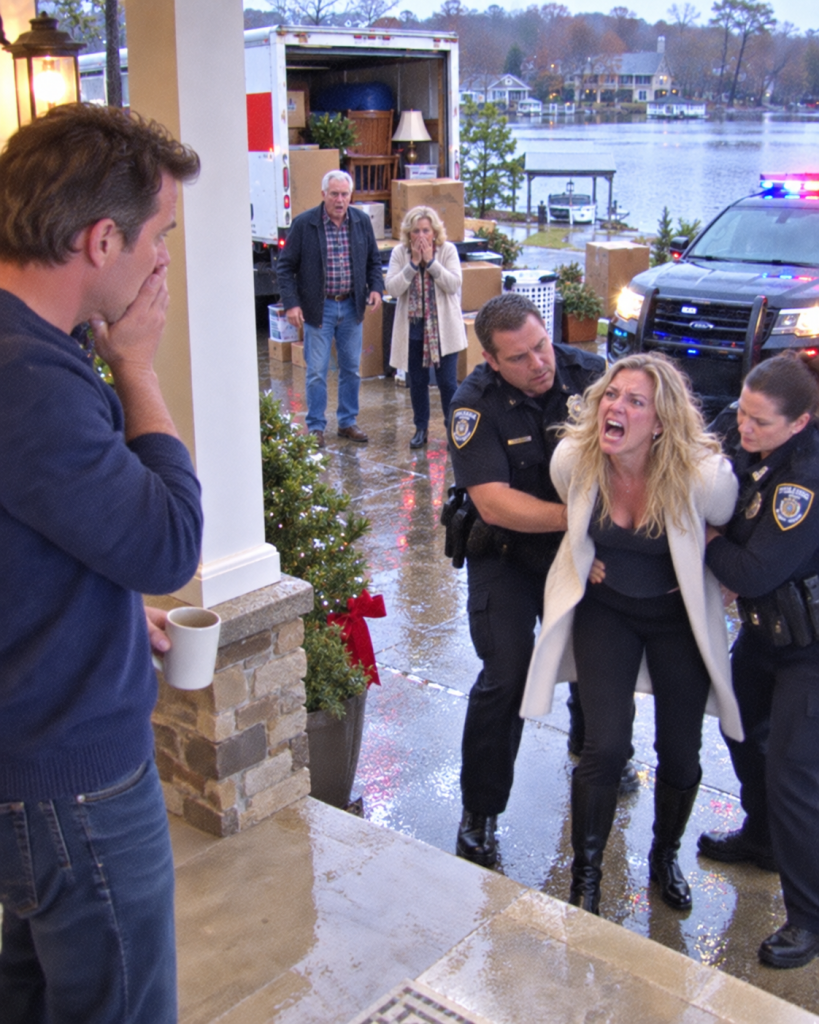
My parents sold their fully paid-off house to rescue my sister from debt, then arrived at my lake house with a moving truck like they already had the right to live there.
“We’re your parents,” my father snapped. “We don’t need your permission to stay here.”
But when I found a handwritten note pushed under my front door, I realized this was not just another family crisis.
It was something much more dangerous.
Rain was slicing sideways across the windows when a pair of bright headlights swept across the ceiling of my vaulted living room.
At first, I thought some delivery driver had made a wrong turn.
My house sits at the end of a quarter-mile gravel road, hidden between thick pine trees and the cold gray edge of Lake Superior. Nobody finds that driveway by mistake.
Then I saw the twenty-six-foot U-Haul blocking the entrance.
Behind it sat my father’s beige Buick.
And there was Dad, standing in the freezing rain, pointing at my front door as if the house already belonged to him.
I had not invited them.
I had not spoken to them in three weeks.
My phone had been on Do Not Disturb while I finished an architectural rendering for a client in Chicago.
When I finally picked it up, I saw fifteen missed calls and twelve messages from my parents.
Mom’s first text read:
“Almost there. Traffic is terrible.”
The next said:
“Hope the driveway is cleared.”
That was when I understood.
They were not coming to visit.
They were coming to move in.
My name is Carter.
I am thirty-six, unmarried, and I built that lake house after ten years of eighty-hour workweeks, skipped vacations, and denying myself every comfort I could not yet afford.
Every lock, every window, every quiet morning inside that place meant one thing to me:
I had finally built a safe place my family could not force their way into.
For years, I had been the one expected to absorb every problem.
My younger sister, Chloe, was the golden child.
When Chloe failed, I was expected to rescue her.
When Chloe wasted money, I was expected to cover it.
When Chloe created a mess, I was expected to clean it up.
So when I opened the front door that stormy night, I did not move aside.
“Dad. Mom,” I said. “What is going on?”
Arthur climbed the soaked porch steps like he had every right to be there.
“Carter, thank God. Put on a coat. We need to unload before the mattresses get ruined.”
I stared at him.
“What mattresses?”
“We’re moving in,” he said flatly. “Obviously. Now move.”
That was when Dad told me they had sold their house in Ohio earlier that afternoon.
The four-bedroom house they had lived in for thirty years.
The house that had been completely paid off.
Mom started crying and said they had done it to save Chloe from crushing debt.
“So let me understand this,” I said slowly. “You sold your paid-off house to bail out Chloe, and your plan was to move into mine?”
Dad’s expression hardened.
“You have four bedrooms. You live here alone. It’s wasted space.”
They had not come to ask for help.
They had already decided.
My home was their backup plan.
Then Dad placed both hands against my chest and tried to push past me.
I pushed him back.
“No,” I said, my voice turning cold. “You are not bringing one box into this house.”
His face twisted with anger.
“We are your parents! We don’t need your permission!”
I stepped back inside, slammed the heavy oak door, and locked the deadbolt.
By midnight, my parents had reclined the seats in the Buick and were sleeping in my driveway, clearly hoping guilt and discomfort would break me down.
Meanwhile, relatives flooded my phone with messages calling me cruel, selfish, and heartless.
But as I watched my parents through the security cameras, one question kept bothering me.
The numbers did not make sense.
They had sold a house that was fully paid off.
Even after helping Chloe, they should have had hundreds of thousands of dollars left.
So why were they sleeping in a freezing car outside my home?
I opened my laptop and searched the county property records.
Then I checked Chloe’s public Instagram.
What I found made my blood run cold.
They had not simply saved Chloe from foreclosure.
And when a crumpled handwritten note slid under my front door, I finally understood this had never been a family emergency.
It was a hostile takeover.
And I was about to fight back.
Part 2 — The Money Was Never Gone
I stared at the county property records until my eyes began to burn.
The first document showed exactly what I already knew.
My parents had sold their Ohio house that afternoon.
Sale price: $487,000.
No mortgage.
No outstanding lien.
The property had been completely paid off for more than a decade.
I leaned closer to the screen.
There should have been a substantial amount of money left after closing costs and taxes.
Even if they had used every dollar they claimed to have used to save Chloe, there was no logical reason they should have arrived at my lake house with nothing but a moving truck and an old Buick.
I opened the next document.
It was the transfer history.
The buyer had purchased the house through an LLC.
I copied the LLC name into a search engine.
My stomach tightened.
The registered address belonged to a commercial office building in Columbus.
I kept digging.
The LLC had been created only eleven days earlier.
And its registered agent was a man named Derek Sloan.
I knew that name.
Not personally.
But I had seen it before.
Chloe had tagged him in an Instagram post six months earlier.
“Finally surrounded by people who believe in me,” she had written beneath a photograph of herself standing beside a black Mercedes.
At the time, I had ignored it.
Now I opened Chloe’s Instagram again.
The post was still there.
So were dozens of photographs I had never seen.
Luxury dinners.
A private club.
A new designer handbag.
A beach resort in Florida.
A photograph of Chloe standing beside a woman holding a champagne glass.
And then I saw something that made me stop breathing.
A photograph from three weeks earlier.
Chloe was standing in front of a house.
Not my parents’ house.
Not mine.
A massive white colonial with black shutters.
The caption read:
“Sometimes you have to protect the future you deserve.”
I zoomed in.
The house number was visible.
I searched it.
The property was owned by an LLC.
The same LLC that had just purchased my parents’ house.
I sat back slowly.
Chloe had not simply fallen into debt.
She had purchased another property.
And my parents had sold their fully paid-off home to help finance it.
But that still didn’t explain why they were now sleeping in my driveway.
I opened the handwritten note again.
It was only one sentence.
The paper was damp around the edges.
The handwriting was shaky.
Carter, don’t let them inside. Ask where the $312,000 went.
No signature.
I read it three times.
Three hundred and twelve thousand dollars.
That was too specific to be a guess.
I looked through the security camera feed.
My mother was sitting in the passenger seat of the Buick, staring toward my house.
My father was outside smoking beneath an umbrella.
He looked angry.
Not frightened.
Not desperate.
Angry.
Like I was inconveniencing him.
My phone buzzed.
It was my aunt Linda.
I answered.
“Hello?”
“Carter, what is wrong with you?”
I closed my eyes.
“What did they tell you?”
“That you threw your parents out in the rain.”
“They came here without asking.”
“They’re your parents.”
“They sold their house.”
“Yes, because Chloe needed help.”
“Do you know how much they sold it for?”
Silence.
“Why?”
“Because I found something.”
Another pause.
Then she whispered, “What did you find?”
“I don’t know yet.”
That was the first moment Aunt Linda stopped yelling.
“Carter,” she said quietly, “you need to be careful.”
My eyes opened.
“What does that mean?”
“I shouldn’t have called.”
“Aunt Linda.”
“Don’t ask me questions over the phone.”
She hung up.
I stared at the screen.
Then my phone rang again.
This time, it was my mother.
I almost ignored it.
Instead, I answered.
“Mom?”
Her voice trembled.
“Carter, please.”
“Please what?”
“Let us inside.”
“No.”
“We’re freezing.”
“You should have thought about that before bringing a moving truck to my property.”
“We didn’t know where else to go.”
“You sold a house worth almost half a million dollars.”
She went silent.
I continued.
“So where did the money go?”
Her breathing changed.
“Your father handled it.”
“That’s not an answer.”
“Carter, your sister was going to lose everything.”
“Everything?”
“Yes.”
“What did she owe?”
“It’s complicated.”
“Then explain it.”
“Not over the phone.”
“Then explain it tomorrow.”
“Please don’t make this harder.”
I looked through the camera.
Dad was watching my front door.
Mom was watching Dad.
Something about that image bothered me.
“Mom,” I said quietly.
“Yes?”
“Did Dad tell you what he was doing with the money?”
She didn’t answer.
“Mom?”
“I have to go.”
The call ended.
I remained at the window.
A minute later, Dad’s phone rang.
He answered.
His body stiffened.
Then he walked away from the Buick.
He looked around the driveway before speaking.
I couldn’t hear the conversation, but the security camera microphone picked up fragments.
“…he found the records…”
Pause.
“…I told you this would happen…”
Another pause.
Then Dad said something that made my blood turn cold.
“He doesn’t know about the signature.”
I froze.
Signature?
Whose signature?
I replayed the recording.
Then again.
And again.
My father had been speaking to someone named Derek.
I knew then that I needed professional help.
I called my attorney, Melissa Grant.
She had handled the purchase of my lake house seven years earlier.
I sent her the county records.
Then I sent her photographs of the handwritten note.
She called me back twenty minutes later.
“Carter,” she said, “don’t let anyone inside.”
“I wasn’t planning to.”
“Good.”
“Do you know what this means?”
“Not yet.”
“What about the signature?”
“What signature?”
I told her what I had heard.
There was silence.
Then she said, “Do you have any reason to believe your parents have access to your property documents?”
“No.”
“Are you sure?”
I thought about it.
My father’s eyes.
The moving truck.
The certainty with which he had arrived.
The way he’d said, We don’t need your permission.
Then I remembered something.
Three months earlier, Mom had asked me for a copy of my lake house deed.
She said she wanted it for their estate-planning file.
I had emailed her a PDF.
I had completely forgotten about it.
“Melissa,” I whispered.
“What?”
“I sent my mother a copy of my deed.”
“When?”
“Three months ago.”
“Why?”
“She said she needed it for estate planning.”
Melissa’s voice became very serious.
“Forward me every email you have from her.”
I did.
Five minutes later, she called again.
“Carter.”
“What?”
“The PDF you sent her isn’t the problem.”
“What is?”
“She forwarded it.”
“To whom?”
“Your father.”
I stared at my screen.
“Why?”
“I don’t know.”
“Can they do anything with it?”
“Not by itself.”
“Then what’s the signature?”
“That is what we need to find out.”
At 1:13 a.m., Melissa sent me another message.
I found something. Don’t confront them yet.
I waited.
Three minutes later, another message appeared.
Your parents filed a document with the county last month.
My heart stopped.
“What document?”
She sent me a screenshot.
I opened it.
The title was:
Quitclaim Deed.
My hands began shaking.
The document claimed that I had transferred partial ownership of my lake house to my parents.
I read the legal description.
It was my property.
My address.
My parcel number.
Everything was correct.
Except one thing.
The signature.
The document contained a signature that looked like mine.
But it wasn’t mine.
I had never signed it.
I had never agreed to transfer anything.
And beneath the signature was a notary stamp.
Melissa called.
“Carter, this is potentially very serious.”
“Can they own my house?”
“No.”
“Then why did they file this?”
“Because someone wanted a paper trail.”
“For what?”
“I don’t know yet.”
I looked outside.
Dad was still awake.
He was standing beneath the porch light.
Staring directly at my security camera.
Then he raised his phone.
A message appeared on my screen.
Dad: Open the door. We need to talk.
I didn’t respond.
Another message came.
Dad: This can be handled quietly.
Then another.
Dad: Don’t make this a legal matter.
I stared at those words.
And suddenly, the entire night made sense.
They weren’t here because they had nowhere to go.
They were here because they believed they had already secured a legal claim to my house.
The moving truck wasn’t a desperate act.
It was part of the plan.
If they could establish physical possession, they could later claim I had agreed to let them live there.
If they could convince relatives that the house belonged to the family, they could pressure me into backing down.
And if that forged deed held up long enough, they might have been planning something much bigger.
I called Melissa again.
“What should I do?”
“Stay inside.”
“That’s it?”
“No.”
She paused.
“Tomorrow morning, we’re going to find out exactly where your parents’ money went.”
I looked at the note on my kitchen counter.
Three hundred and twelve thousand dollars.
And suddenly I knew where we had to look.
Chloe.
At 7:02 the next morning, a black SUV pulled into my driveway.
Melissa stepped out.
Behind her was another man.
He was wearing a dark coat and carrying a leather folder.
“This is Daniel Ross,” Melissa said when I opened the door.
“Bank fraud investigator,” he said.
My stomach dropped.
“Why is a bank investigator here?”
Daniel looked at me.
“Because the $312,000 didn’t go to your sister’s debt.”
He opened his folder.
“It went somewhere else.”
He placed a printed bank statement on my kitchen table.
The account belonged to my father.
Three transfers.
$75,000.
$87,000.
$150,000.
All sent within forty-eight hours.
All to the same LLC.
The same LLC that bought my parents’ house.
I stared at the page.
“Who owns it?”
Daniel looked at Melissa.
Then back at me.
“That’s what we’re here to determine.”
My phone buzzed.
It was Chloe.
For the first time in years, my sister had sent me a message directly.
We need to talk. Alone.
I didn’t answer.
A second message appeared.
Carter, Dad lied to you.
Then a third.
He lied to me too.
I looked at Melissa.
She nodded.
“Save everything.”
I did.
Then Chloe sent one final message.
If you want to know why they are really there, ask Dad about the $150,000.
I looked through the window.
My father was awake.
And for the first time since he arrived, he looked afraid.
I knew the truth was finally beginning to crack through.
Part 3 — The House Was Never Theirs
Chloe arrived at 9:18 a.m.
She came alone.
No Mercedes.
No designer clothes.
No makeup.
She looked exhausted.
When I opened the door, she stood on the porch without moving.
“Can I come in?”
I looked at Melissa.
She gave me a small nod.
I stepped aside.
Chloe walked into the house she had once called “Carter’s little cabin.”
She stopped in the living room.
Her eyes moved across the windows overlooking Lake Superior.
“I forgot how beautiful it is.”
I said nothing.
She swallowed.
“Dad told me you wouldn’t let them in.”
“They’re not coming in.”
“I know.”
She looked at me.
“Because you finally figured it out.”
I folded my arms.
“Start talking.”
She sat down.
For several seconds, she stared at her hands.
“I’m not the reason they sold the house.”
My eyebrows rose.
“Mom said you were drowning in debt.”
“I was.”
“How much?”
“About eighty thousand.”
I stared at her.
“Eighty thousand?”
She nodded.
“Credit cards. Medical bills. Business debt. Some bad investments.”
“And they sold a $487,000 house to pay eighty thousand?”
“I never asked them to.”
“Then what happened?”
Chloe’s eyes filled with tears.
“Dad told me he could fix everything.”
“How?”
“He said he had a buyer for their house.”
I looked toward Melissa.
“Go on.”
“He told me they would sell the house, pay my debts, and put the rest into an investment that would make enough money for all of us.”
“What investment?”
“I don’t know.”
“You never asked?”
“I did.”
“What did he say?”
“He said it was private.”
I almost laughed.
“Private.”
Chloe nodded.
“Then three weeks ago, he told me I had to sign something.”
“What?”
“A power-of-attorney document.”
My entire body went still.
“Why?”
“He said it was so he could negotiate my debts.”
“Did you sign it?”
“Yes.”
“Did you read it?”
“I thought I did.”
Melissa leaned forward.
“Did you give him access to your bank accounts?”
Chloe looked at her.
“I don’t know.”
Daniel opened his folder.
“You did.”
Chloe’s face went pale.
“You’re Chloe?”
“Yes.”
“Then I need you to understand something.”
He placed another document on the table.
“Your father transferred money into an account under your name.”
“How much?”
“$150,000.”
Chloe stared at him.
“What?”
“Then that money was transferred again.”
“To where?”
Daniel looked at me.
“To an account connected to the same LLC.”
Chloe covered her mouth.
“No.”
I stood up.
“Why would Dad move $150,000 through your account?”
“I don’t know.”
“Think.”
“I am thinking!”
She started crying.
“I didn’t know.”
I softened slightly.
“Chloe, I’m not accusing you.”
She looked at me.
“I know.”
Then she whispered:
“Dad told me you were going to sell this house.”
My blood ran cold.
“What?”
“He said you were planning to move to Chicago.”
“I never said that.”
“I know that now.”
“What else did he tell you?”
“He said you were tired of the lake house.”
I stared at her.
“He told me you wanted to sell it but didn’t know what to do with it.”
“That was a lie.”
“Yes.”
“Why would he say that?”
Chloe wiped her face.
“Because he needed me to believe the house would eventually become mine.”
Silence filled the room.
Melissa’s expression hardened.
“What did he promise you?”
Chloe hesitated.
“He said after you sold the lake house, he would buy me a house.”
I felt something inside me break.
Not because Chloe had believed him.
Because my father had built an entire plan around my property without ever asking me.
“What house?”
Chloe gave me an address.
I searched it.
The white colonial from her Instagram appeared on the screen.
The property was worth $720,000.
I looked at her.
“That’s the house you bought?”
“I thought I bought it.”
“You didn’t?”
“No.”
She shook her head.
“Dad told me it was an investment property.”
Daniel spoke.
“It wasn’t.”
He opened another document.
“The purchase contract lists Chloe as the intended occupant, but the funding came from your father’s account.”
Chloe looked horrified.
“So the house isn’t mine?”
“No.”
“Then whose is it?”
Daniel turned the document toward her.
“The LLC.”
Chloe’s voice dropped.
“And who owns the LLC?”
“We’re still tracing that.”
I suddenly remembered Derek Sloan.
“Dad talked to someone named Derek.”
Daniel nodded.
“We found him.”
“Who is he?”
“Your father’s former business partner.”
I stared at him.
“Former?”
“Twenty years ago, they owned a construction company together.”
I remembered my father’s stories.
The company had failed.
He always blamed Derek.
“He said Derek stole money.”
Daniel looked at me.
“That is what your father claimed.”
“What actually happened?”
“Derek says your father disappeared with company funds.”
Chloe looked up.
“Dad never told me that.”
“Of course he didn’t,” I said.
Daniel continued.
“According to the records, the two men had a dispute over $300,000.”
I felt the number hit me.
“$300,000?”
Daniel nodded.
“Approximately.”
I looked at the handwritten note.
$312,000.
Suddenly everything clicked.
My father hadn’t sold the Ohio house to save Chloe.
He had sold it to cover an old financial obligation.
And he had used Chloe as the story because it made the transaction easier to explain.
But there was still one question.
“Why my house?”
Melissa answered.
“Because your father couldn’t afford to keep paying.”
“For what?”
“The investment.”
“What investment?”
She looked at Daniel.
Daniel opened another folder.
Inside was a series of documents.
The LLC had purchased properties.
Three in Ohio.
One in Michigan.
And one near Lake Superior.
Mine.
Or at least, they had tried to make it mine.
They had created a paper trail suggesting that my father had been helping me financially for years.
They had forged my signature on the quitclaim deed.
Then they had apparently planned to use that document as collateral.
My father’s goal was not simply to live in my house.
He wanted to leverage it.
Sell it.
Or borrow against it.
And if everything went according to his plan, I would have been left fighting a legal battle over my own property.
I sat down.
“What about the note?”
Daniel picked it up.
“We’re testing the handwriting.”
“Do you know who wrote it?”
He looked at me.
“We have a pretty good idea.”
The front door suddenly shook.
Everyone jumped.
Dad was outside.
“Carter!”
I stood.
“Don’t open it,” Melissa said.
Dad pounded again.
“Carter! We need to talk!”
I walked toward the door but stopped several feet away.
“What do you want?”
“I want my family back!”
“You mean my house.”
Silence.
Then Dad said:
“You don’t understand what you’re doing.”
“I understand perfectly.”
“You’re throwing your parents onto the street.”
“You sold your house.”
“For your sister!”
“No.”
I looked at Chloe.
“For yourself.”
Dad became silent.
I continued.
“You sold the house because you needed money.”
“That’s not true.”
“You moved $150,000 through Chloe’s account.”
His voice changed.
“Who told you that?”
I smiled bitterly.
“That’s your answer?”
He didn’t respond.
Then Mom appeared behind him.
She was crying.
“Arthur,” she whispered.
Dad turned.
“Go back to the car.”
“No.”
He stared at her.
“Go.”
Mom shook her head.
“I’ve done what you told me for thirty years.”
Her voice broke.
“I’m not doing it anymore.”
Dad looked stunned.
Mom stepped toward the door.
“Carter.”
I unlocked it but kept the chain secured.
“Mom?”
“I wrote the note.”
I stared at her.
Dad closed his eyes.
Mom continued.
“I didn’t know how else to warn you.”
“Why didn’t you just call me?”
“Because your father was listening.”
My chest tightened.
“You knew?”
“I knew something was wrong.”
“When?”
“The night before we sold the house.”
Mom looked at Dad.
“He told me the money would save Chloe.”
She shook her head.
“But I saw the documents.”
“What documents?”
“The ones about your house.”
Dad stepped forward.
“Enough.”
Mom flinched.
I opened the door just enough for her to speak.
She whispered:
“He had already planned everything.”
“What?”
“He said once you let us move in, he would establish residency.”
Melissa’s face hardened.
“Residency for what purpose?”
Mom looked at her.
“To make it harder for Carter to remove us.”
The room went silent.
Mom continued.
“He said if Carter resisted, we’d tell the family that he had promised us the house.”
I felt sick.
“He was going to make everyone believe I abandoned you.”
“Yes.”
Dad shouted from the porch.
“That’s enough!”
Mom turned around.
“No, Arthur.”
Her voice was suddenly steady.
“It isn’t.”
She reached into her coat pocket.
Then she pulled out a small envelope.
“I kept this.”
She handed it to me through the opening.
Inside was a photocopy of a handwritten agreement.
I recognized my father’s handwriting immediately.
The document described my lake house as a future family asset.
It claimed that my parents had contributed financially toward its purchase.
That was a lie.
I had purchased the property entirely myself.
But the document was dated six years earlier.
Before my parents had even visited the lake house.
I looked at Mom.
“Why did you keep this?”
“Because I knew someday you’d need proof.”
I looked at Dad.
“You planned this for six years?”
He didn’t answer.
That silence was enough.
Melissa took the document.
“This is significant.”
Dad suddenly became desperate.
“Carter, listen to me.”
I didn’t.
“You’re my son.”
I stared at him.
“And you’re my father.”
“Then act like it.”
“I am.”
I pointed toward the driveway.
“That’s why I’m not calling the police right now.”
Dad froze.
“But I will if you don’t leave my property.”
He looked at me with something between rage and disbelief.
“You would do that to your own father?”
I answered quietly.
“You did this to your own son.”
That was the moment he knew he had lost.
Not the house.
Not the money.
The control.
He walked back toward the Buick.
Mom remained on the porch.
“I’m coming with you,” she said.
Dad turned.
“No.”
“Yes.”
“You’re my wife.”
“And he’s my son.”
Dad stared at her for several seconds.
Then he got into the Buick.
Mom stayed.
Chloe stayed too.
The U-Haul remained in the driveway.
I looked at it.
“Take it.”
Mom shook her head.
“No.”
“Why?”
“Because it’s not ours.”
For the first time in years, I saw my mother smile.
It was small.
But it was real.
Three weeks later, the legal battle was over.
The county rejected the forged quitclaim deed.
The notary whose stamp appeared on the document had already reported that the signature was not witnessed by her.
The bank froze the accounts connected to the LLC.
The $312,000 transaction was investigated.
And the evidence showed that my father had been using Chloe’s identity and accounts to move money between properties.
The house in Ohio was gone.
The money was mostly gone too.
But my lake house remained mine.
Every document proved it.
Every payment.
Every tax record.
Every mortgage statement.
Every bank transfer.
There was nothing my father could claim.
Chloe eventually moved into a small apartment.
She sold the luxury car she couldn’t afford and began paying back the debts she had actually created.
For the first time in her life, she had to live without our parents fixing everything.
She hated it at first.
Then she admitted something to me.
“I think it’s the first time I’ve ever known what my own life costs.”
I didn’t know how to respond.
So I hugged her.
Mom moved into a small rental near Columbus.
She started working part-time at a local garden center.
She called me every Sunday.
Sometimes we talked for an hour.
Sometimes neither of us knew what to say.
But she kept calling.
And I kept answering.
As for Dad, he disappeared from our lives for a while.
Then one afternoon, I received a letter.
No return address.
Inside was a single sheet of paper.
His handwriting.
I thought you owed me.
I read it twice.
Then I turned the page.
There was only one more sentence.
I was wrong.
I folded the letter and put it away.
I didn’t forgive him that day.
Maybe I never would.
But I finally understood something I’d spent thirty-six years refusing to accept.
Being someone’s child does not mean surrendering your boundaries.
Being someone’s parent does not give you ownership of their life.
And family does not mean someone gets to take what you built simply because they believe you should give it to them.
Six months later, winter returned to Lake Superior.
The first heavy snow covered the gravel road.
I stood on the porch with a cup of coffee and watched the lake disappear beneath a sheet of white.
The house was quiet.
Safe.
Mine.
Then I noticed something beneath the front door.
A small envelope.
My heart stopped for a second.
I picked it up.
This time, there was no threat.
No legal document.
No demand.
Just a photograph.
It was old.
A picture of me as a little boy, sitting on my father’s shoulders beside the Ohio house.
On the back, Mom had written:
You were never the problem, Carter. We were just too afraid to admit we had become one.
I stood there for a long time.
Then I placed the photograph inside the blue wooden box where I kept the deed to my house.
Not because I wanted to forget.
Because I wanted to remember exactly why I had fought.
The house was never about four bedrooms.
It was never about money.
It was never even about property.
It was about the moment I finally understood that love without boundaries can become control.
And sometimes, protecting your home means protecting the part of yourself that your family taught you to give away.
I looked out at the frozen lake.
For the first time in years, I didn’t feel guilty.
I felt free.
And behind me, every lock on every door remained exactly where it belonged.
On my house.
My life.
My choice.