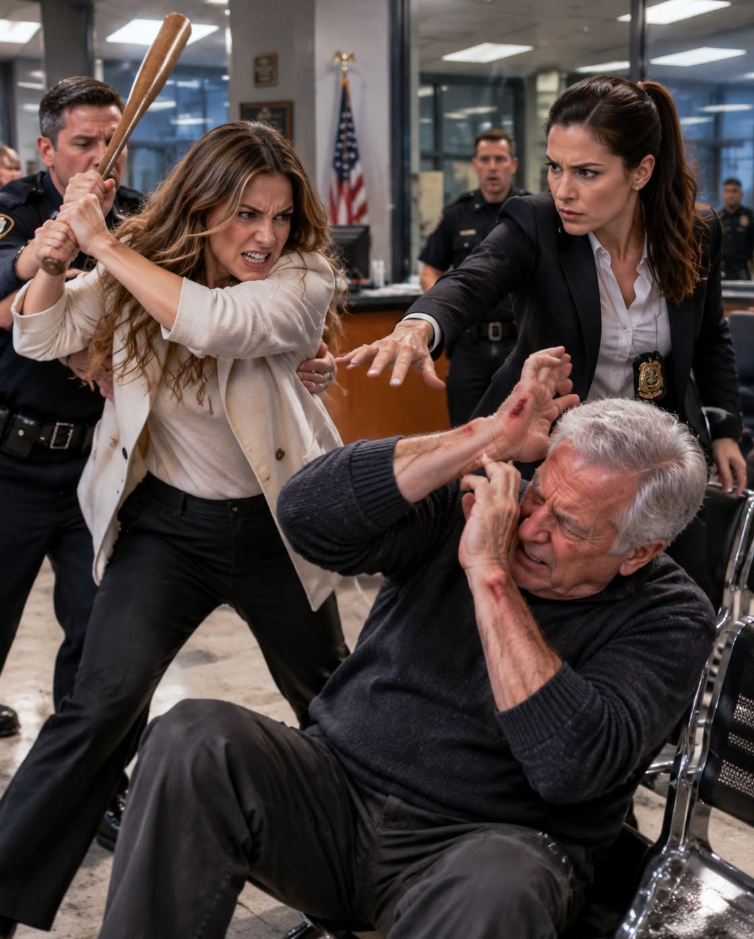
For twelve years, I served as a federal agent.
I questioned violent offenders.
Broke apart organized criminal networks.
Faced people capable of unimaginable cruelty.
But nothing in my career prepared me for seeing my own father sitting alone in a police station just before three o’clock in the morning.
The moment I stepped through the heavy glass entrance of the Marion County Police Department, my heart sank.
He sat hunched on a hard plastic chair, trembling beneath the harsh fluorescent lighTS.
In just a few hours…
He seemed to have aged a decade.
Across the room, my sister-in-law, **Vanessa**, was putting on the performance of a lifetime.
She clutched a tissue dramatically while fake tears streamed down her face.
Pointing to a faint red mark on her shoulder, she cried loudly,
“”You don’t understand, Officer!””
“”He completely lost control!””
“”You have to have him committed before he hurts someone!””
It was obvious what they were trying to do.
She and my brother had carefully staged a false mental-health crisis.
If they convinced the authorities my father was unstable…
They could take control of his estate.
There was only one problem.
Neither of them remembered what I did for a living.
Ignoring Vanessa completely, I walked straight to the front desk.
“”I want every statement she makes from this moment forward recorded under penalty of perjury.””
Officer Davis barely looked up.
He leaned back in his chair and smirked.
“”Ma’am, why don’t you sit down and let local law enforcement handle a simple domestic dispute?””
I didn’t argue.
Instead…
I reached inside my jacket.
Removed my leather credential wallet.
And placed it on the counter.
The gold federal badge caught the overhead lighTS.
“”I wasn’t making a request, Officer Davis.””
My voice became calm and unmistakably firm.
“”Stop this circus immediately.””
His expression changed in an instant.
He shot to his feet, grabbed his radio, and suddenly became far more interested in following procedure.
Without wasting another second, I hurried to my father.
I wrapped an arm around his shoulders to help him stand.
The moment he tried to rise…
His knees gave way.
He cried out in pain.
I caught his arm before he collapsed.
The sudden movement pulled back the sleeve of his heavy wool sweater.
What I saw beneath it…
Made every drop of blood in my body turn cold.
Dark bruises.
Fresh cuTS.
Deep fingerprints wrapped around his thin forearm.
Injuries that no accidental fall could ever explain.
At that moment…
This stopped being a family dispute.
It became a criminal investigation.
(I know you’re curious about the next part, so please be patient and read on in the comments below.
Thank you for your understanding of the inconvenience.
please leave a ‘HEIR’ comment below and give us a “Like ” to get full story )
My Father Was Framed at 2:27 A.M., but One Recorded Lie Exposed the Scheme That Nearly Stole His Home, Freedom, and Future From Us All
PART 2
I had spent twelve years learning not to react to what I saw first.
Scenes could lie.
People could lie.
Even injuries could tell the wrong story if you looked at them without context.
Evidence was different.
Evidence had no loyalty.
And as I stared at the marks on my father’s forearm beneath the fluorescent lights of that police station, every instinct I had developed over more than a decade told me the same thing.
Something was terribly wrong.
“Dad,” I whispered.
“Don’t explain anything yet.”
His eyes lifted to mine.
“But she told them—”
“I know.”
I squeezed his hand carefully.
“From this moment forward, we do this correctly.”
Across the room, Vanessa had stopped crying.
That interested me.
Thirty seconds earlier, she had been loud enough for everyone in the lobby to hear how frightened she supposedly was.
Now she was staring at me.
My brother, Eric, stood beside her.
He looked worse.
Not injured.
Afraid.
And Eric had always had one particular habit when he was nervous.
He rubbed the side of his wedding ring with his thumb.
He was doing it now.
Officer Davis returned with Sergeant Miller, the night supervisor.
Unlike Davis, Miller didn’t immediately speak.
He looked at my credentials.
Then at my father.
Then at Vanessa.
Finally, he said, “Everyone needs to remain separated until we understand what happened.”
“Good,” I replied.
Vanessa immediately stood.
“I already told you what happened! Walter attacked me.
My husband saw everything.”
Eric nodded too quickly.
“That’s right.”
I looked at him.
My own brother couldn’t hold my gaze.
Sergeant Miller motioned toward two separate interview rooms.
Then I asked the first question that changed everything.
“Where is the baseball bat?”
Silence.
Vanessa blinked.
“What?”
“The bat.”
Her face tightened.
“I don’t know.”
“You told officers my father attacked you.
My father says you struck him with a bat.
Either way, the bat is evidence.
Where is it?”
Officer Davis looked down at his notes.
For the first time, his confidence disappeared.
“Mrs. Bennett said there was no weapon involved.”
My father stared at him.
“What?”
Vanessa turned pale.
I said nothing.
I didn’t need to.
Davis continued reading.
“According to the initial statement, Mrs. Bennett alleged Mr. Walter Bennett grabbed her shoulder and shoved her against the kitchen counter.”
My father slowly shook his head.
“She told me she’d tell you I came at her with a bat.”
Every person in the lobby went quiet.
Eric suddenly interrupted.
“Dad is confused.”
There it was.
Not concern.
Not shock.
Not even a question about his father’s injuries.
Just the sentence they had apparently prepared.
Dad is confused.
Vanessa recovered quickly.
“Exactly.
That’s what we’ve been trying to explain.
Walter has been forgetting things for monThS. He’s paranoid.
He accuses us of stealing.
He hides things and then says we took them.”
I turned toward Sergeant Miller.
“Was my father medically evaluated before anyone accepted the claim that he’s cognitively impaired?”
Miller’s jaw tightened.
“No.”
“Was an ambulance called after officers observed his injuries?”
Another silence.
“No.”
“Were photographs taken?”
“Not yet.”
“Then please start there.”
Miller immediately called for medical assistance.
That was when Vanessa made her first serious mistake.
She reached for Eric’s arm and whispered something.
It was only four words.
But I heard them.
“We need to leave.”
I turned.
“No.”
She glared at me.
“You don’t control me.”
“No, Vanessa.
But you gave a statement regarding an active incident, and officers are now documenting potentially significant injuries on the person you accused.
Walking out before they finish asking questions would be something you’d probably want to discuss with counsel.”
Her mouth opened.
Then closed.
For the first time that night, she seemed to understand that confidence wasn’t the same thing as control.
Paramedics arrived eleven minutes later.
When they helped Dad remove his sweater, even Sergeant Miller’s expression changed.
The visible marks on his arm were only part of it.
There were older bruises along his upper back.
Another fading mark near his ribs.
And swelling around his left wrist.
The paramedic asked gently, “Sir, how long has this been happening?”
Dad looked toward Eric.
My brother stared at the floor.
“About four months,” Dad whispered.
Something inside me cracked.
But I kept my voice steady.
“Four months?”
Dad nodded.
“After your mother died, I wasn’t doing well.
Eric said I shouldn’t be alone.
He and Vanessa moved in.”
Mom had died fourteen months earlier.
Cancer.
She and Dad had been married fifty-one years.
After the funeral, I had asked him repeatedly whether he wanted me to come home more often.
He always said no.
Eric is here.
I’m fine.
Those words returned to me now like an accusation.
Dad continued.
“At first, they helped.”
He swallowed.
“Then Vanessa started asking about the house.”
I looked at Eric.
He still wouldn’t look at me.
“She wanted to know how much it was worth,” Dad said.
“Then my retirement accounTS. Then your mother’s life insurance.”
Vanessa snapped, “We were helping you organize your finances!”
Dad flinched at the sound of her voice.
That tiny reaction told Sergeant Miller more than any speech could have.
He immediately stepped between them.
“Mrs. Bennett, do not address him.”
Dad continued.
“Three months ago, they brought papers for me to sign.”
“What papers?”
“I thought they were insurance documenTS.”
“Did you sign them?”
“No.”
Eric finally looked up.
His face was gray.
“Dad—”
“Don’t.”
My father’s voice was weak.
But it stopped him.
“You don’t get to call me Dad right now.”
Eric’s face crumpled.
Vanessa rolled her eyes.
And that single expression destroyed whatever sympathy she might still have expected.
Dad turned back to me.
“I read the first page.
It was about transferring authority over my finances.”
A power of attorney.
Now the shape of the scheme was becoming clear.
“I refused.”
“What happened after that?”
His hands trembled.
“Things changed.”
His car keys disappeared.
Then his phone.
Vanessa told neighbors he had stopped driving because his memory was failing.
Eric began attending doctor’s appointments with him.
At one appointment, Eric apparently told the physician Dad was wandering outside at night.
Dad denied it.
No formal diagnosis was made.
But that wasn’t what Eric and Vanessa needed.
They only needed a trail.
A story.
A collection of little claims that could later be presented as evidence that Walter Bennett was no longer capable of managing his own affairs.
Then Dad told us something worse.
“Last week, Vanessa brought another document.”
“What was it?”
“I don’t know.
I wouldn’t sign.”
He looked at me.
“She said if I kept making things difficult, they’d find another way.”
Vanessa laughed nervously.
“This is ridiculous.”
Sergeant Miller turned.
“Mrs. Bennett, I have already instructed you not to interrupt.”
She folded her arms.
Then Dad said, “Tonight I found my phone.”
“Where?”
“Eric’s office.”
My brother closed his eyes.
Dad had gone looking for a flashlight during a power flicker and found his missing phone inside a locked desk drawer that hadn’t fully latched.
Beside it were copies of bank statemenTS.
Property records.
And a printed draft of a petition seeking emergency guardianship over him.
The petition described Walter Bennett as confused, aggressive, financially irresponsible, and dangerous to himself and others.
It also named Eric as the proposed guardian.
I felt sick.
“Did you take anything?”
Dad nodded.
“My phone.”
“And?”
“A folder.”
Vanessa’s head snapped toward him.
That was mistake number two.
Not fear.
Recognition.
I saw it.
So did Sergeant Miller.
“Where’s the folder?” I asked.
Dad pointed weakly toward the property bag behind the desk.
“When they brought me here, they took everything from my pockeTS.”
Officer Davis retrieved Dad’s belongings.
Wallet.
Keys.
Phone.
A folded handkerchief.
And a thin blue folder.
Vanessa stepped forward.
“That belongs to us.”
Sergeant Miller looked directly at her.
“You should sit down.”
Inside were copies of financial statements and draft legal documenTS.
But one page mattered more than the others.
A real estate valuation.
Dad’s house had recently been appraised at $1.46 million.
And clipped behind it was an unsigned document proposing that the property be transferred into a family-managed trust.
Eric was listed as trustee.
Dad stared at the paper.
“I’ve never seen that.”
Eric finally spoke.
“It was only a draft.”
I looked at him.
“Then why was it hidden with Dad’s phone?”
He had no answer.
The paramedics wanted Dad transported to the hospital.
Before he left, I asked Sergeant Miller whether his phone could remain preserved.
He agreed.
Dad looked confused.
“My phone?”
“Yes.”
“Why?”
I held it carefully.
“Because you once told me Mom taught you never to trust a phone that does too many things.”
For the first time that night, the corner of his mouth moved.
“She did.”
“And that’s why I set yours up.”
His eyes widened.
Three years earlier, after Dad had repeatedly forgotten how to open his recording application, I had configured a simple voice shortcut.
One phrase started an audio recording.
Another stopped it.
Dad stared at me.
Then he whispered, “Oh.”
Vanessa went completely still.
I asked him one question.
“Did you use it tonight?”
He nodded.
The room changed.
Sergeant Miller obtained Dad’s permission before anyone accessed the file.
The recording began at 12:41 A.M.
At first there was only movement.
A door opening.
Footsteps.
Then Dad’s voice.
“Give me my phone back.”
Vanessa answered.
“You shouldn’t have been snooping.”
Eric said, “Dad, calm down.”
Then Dad asked the question that shattered their story.
“Why are you trying to have me declared incompetent?”
Silence on the recording.
Then Vanessa spoke.
Her voice was unmistakable.
“Because you won’t cooperate.”
Nobody in the station moved.
The recording continued.
Dad demanded that they leave his house.
Eric tried to persuade him to sign the documenTS.
Dad refused.
Then Vanessa said something I will never forget.
“If you call the police, who do you think they’ll believe? The grieving old man we’ve been documenting for months, or the two people taking care of him?”
Officer Davis lowered his eyes.
Dad’s voice came next.
“You planned this.”
Vanessa replied, “We planned to protect this family from you giving everything away.”
Dad shouted that it was his property.
A crash followed.
Then his frightened voice.
“Put that down.”
What followed wasn’t something I needed to hear twice.
Sergeant Miller stopped the recording.
No one spoke for several seconds.
Then he looked at Vanessa.
Her fake tears were gone.
Completely.
She pointed at Eric.
“This was his idea.”
My brother’s head snapped toward her.
“What?”
“You told me the house would be ours!”
“You said we needed the guardianship!”
“You were the one talking to the lawyer!”
And just like that, their united story collapsed.
Not dramatically.
Not heroically.
Just two frightened people turning against each other the moment accountability arrived.
I didn’t feel victorious.
That surprised me.
I felt tired.
Deeply, painfully tired.
Because one of those people was my brother.
The boy who had once slept on the floor beside my bed during thunderstorms.
The teenager who taught me to drive a manual transmission.
The man who carried Mom’s casket beside me fourteen months earlier.
Somewhere along the way, resentment and money had become more important to him than the father who raised us.
The investigation that followed lasted monThS.
And I stayed out of it professionally.
That mattered.
I was Walter Bennett’s daughter, not the investigator assigned to his case.
I provided my observations, disclosed my relationship, and allowed independent detectives and prosecutors to handle everything else.
What they uncovered was worse than I expected.
There were emails discussing Dad’s property.
Messages about obtaining medical documentation.
Draft petitions.
Attempts to persuade him to change beneficiary information.
There were also security-camera files from the neighbor across the street showing Dad repeatedly trying to leave his own house while Eric or Vanessa stopped him.
Most importantly, Dad received a full independent medical evaluation.
He was grieving.
He was anxious.
He had been under extraordinary stress.
But he was not incompetent.
He understood his finances.
He knew where he was.
He knew the date.
He understood his property and legal righTS.
The story Eric and Vanessa had been building around him began falling apart.
Dad spent two nights in the hospital.
I stayed beside him.
On the second morning, sunlight came through the blinds and landed across his blanket.
He stared at it for a long time.
Then he said, “I should have called you sooner.”
I pulled my chair closer.
“Why didn’t you?”
His answer broke my heart.
“Because he’s my son.”
I understood.
“And I thought if I told you, I’d destroy your relationship with your brother.”
“Dad.”
“I kept thinking he’d stop.”
His eyes filled.
“I kept remembering him at seven years old.”
He smiled faintly.
“He used to follow me everywhere.
Even into the garage.
He’d sit on that red toolbox and ask a thousand questions.”
I took his hand.
“You were remembering who he had been.”
Dad nodded.
“And ignoring who he’d become.”
For a while neither of us spoke.
Then he asked, “Am I stupid?”
“No.”
“Weak?”
“No.”
“Then what am I?”
I looked at him.
“A father who loved his son longer than his son deserved in that moment.”
Dad cried quietly.
So did I.
But healing didn’t happen in that hospital room.
Healing took time.
Dad didn’t return to the house immediately.
He stayed with me for six weeks while locks were changed, financial accounts were secured, and his attorney reviewed every document.
Dad also made a decision I didn’t expect.
He sold the house.
Not because Eric and Vanessa had won.
Because Dad realized the building had stopped feeling like home.
“I don’t want to spend my remaining years walking past rooms where I was afraid,” he told me.
So he bought a smaller place.
A bright two-bedroom cottage twelve minutes from my house.
It had a porch.
A garden.
And a detached workshop.
The first thing Dad put inside that workshop was his old red toolbox.
Three months later, he planted tomatoes.
Six months later, he joined a woodworking club.
Eight months later, he took a train trip across the country with two friends he’d known since college.
Every Sunday, we had dinner together.
Sometimes he cooked.
Sometimes I did.
Sometimes we ordered pizza and pretended it counted as cooking.
Slowly, Walter Bennett became himself again.
As for Eric, accountability came differently.
He eventually admitted that financial pressure had started everything.
He and Vanessa had accumulated debts they hadn’t told anyone about.
Instead of asking for help, they began looking at Dad’s house as their solution.
Then they convinced themselves they deserved it.
Eric later wrote Dad a letter.
Thirty-seven pages.
Dad didn’t read it for almost two monThS.
When he finally did, he sat alone on his porch.
Then he folded it carefully and placed it inside a drawer.
“What did he say?” I asked.
Dad looked toward the garden.
“That he’s sorry.”
“Do you believe him?”
Dad considered the question.
“I believe he’s sorry about many things.”
That was all he said.
He didn’t rush forgiveness.
He didn’t confuse forgiveness with access.
And he didn’t allow guilt to erase boundaries.
That became one of the most important lessons our family learned.
Love does not require surrendering your safety.
Forgiveness does not require pretending something never happened.
And being family does not give someone ownership over your peace.
A year after that terrible 2:27 A.M.
phone call, I was sitting on Dad’s porch when a car stopped near the curb.
Eric stepped out.
Alone.
Dad stiffened beside me.
“He asked if he could come,” Dad said quietly.
I turned toward him.
“You invited him?”
“For ten minutes.”
Eric walked slowly toward the porch.
He looked different.
Older.
Humbled.
He stopped at the bottom step.
“Hi, Dad.”
Dad didn’t answer immediately.
Then he said, “Hello, Eric.”
My brother looked at me.
I gave him nothing.
This wasn’t my conversation.
He turned back toward Dad.
“I don’t expect forgiveness.”
Dad nodded.
“Good.”
Eric swallowed.
“I just wanted to tell you face-to-face that what I did was wrong.”
No excuses followed.
That mattered.
“I let money become more important than you,” Eric continued.
“And when I had opportunities to stop what was happening, I didn’t.”
Dad’s hands tightened around his coffee mug.
Eric’s voice shook.
“You were my father, and I was supposed to protect you.”
Dad looked at him for a long time.
Then he said, “You were supposed to love me.”
Eric lowered his head.
“I know.”
Silence stretched between them.
Finally Dad said, “I’m not ready to have you back in my life the way you want.”
“I understand.”
“But I’m willing to believe you can become better than the man you were that night.”
Eric started crying.
Dad didn’t hug him.
Not that day.
But he gave him something harder.
A possibility.
Eric thanked him and left.
For months afterward, their contact remained limited.
Short letters.
Occasional supervised conversations.
No financial access.
No keys.
No authority over medical decisions.
Trust, Dad said, wasn’t a light switch.
It was a bridge.
And if someone burned it down, saying sorry didn’t magically rebuild the boards.
You rebuilt it one piece at a time.
Vanessa never returned to Dad’s life.
Their marriage eventually ended.
I never celebrated that.
There had already been enough destruction.
I simply hoped everyone involved would eventually learn something from what happened.
Two years later, Dad turned eighty.
We held his birthday in my backyard.
Nothing extravagant.
Twenty people.
Barbecue.
Music.
A chocolate cake with far too many candles.
Dad wore a ridiculous blue party hat.
At sunset, I found him standing near the fence watching everyone laugh.
“You okay?” I asked.
He nodded.
“Better than okay.”
Then he reached into his pocket.
For one terrifying second, I thought he was about to show me another legal document.
Instead, he handed me an old photograph.
Eric and me as children.
Dad stood behind us.
Mom was laughing beside him.
“Found it while cleaning,” he said.
I studied the picture.
“We looked ridiculous.”
“You were ridiculous.”
I laughed.
Then Dad became serious.
“You know what bothered me most about that night?”
I waited.
“I thought losing control of my house would mean losing my life.”
He looked around the yard.
“But a house isn’t your life.”
“No.”
“Money isn’t your life either.”
“No.”
He nodded toward the people gathered around the table.
“That is.”
Family.
Friends.
Safety.
Choice.
Dignity.
The freedom to wake up without fear.
Dad slipped the photograph back into his pocket.
“I spent years worrying about what I’d leave you children.”
He smiled.
“I should’ve worried more about what I was teaching you while I was still here.”
I leaned my head against his shoulder.
“You taught me plenty.”
“Like what?”
I thought about that police station.
About the fluorescent lighTS.
The blue folder.
The recording.
The frightened man who had believed nobody would believe him.
Then I thought about the man standing beside me now.
Eighty years old.
Independent.
Laughing again.
Planting tomatoes badly.
Building crooked birdhouses in his workshop.
Learning that boundaries could coexist with love.
“Never confuse being quiet with being powerless,” I said.
Dad smiled.
“That sounds like your mother.”
“She was smarter than both of us.”
“Absolutely.”
Someone called us over for cake.
Dad started walking toward the table, then stopped.
He looked back at me.
“One more thing.”
“What?”
“That night at the station, when you walked through the door…”
He paused.
“I knew I was safe.”
I couldn’t answer immediately.
So I hugged him.
And this time, when I wrapped my arms around my father, he didn’t tremble.
He didn’t flinch.
He didn’t look over his shoulder.
He simply hugged me back.
That was the moment I understood what justice had really given us.
It wasn’t revenge.
It wasn’t the satisfaction of watching someone’s lies collapse.
It wasn’t money, property, punishment, or winning.
It was this.
My father standing beneath an open summer sky without being afraid.
His home was his.
His choices were his.
His future was his.
And most importantly, his voice was his again.
At 2:27 that terrible morning, Dad had called me believing he was about to lose everything.
Two years later, surrounded by people who respected him, he finally understood the truth.
They had tried to take his independence.
They had tried to rewrite his reality.
They had tried to convince strangers that his voice no longer mattered.
But they had failed.
Because the truth had survived.
And so had he.
Dad blew out eighty candles while everyone applauded.
Then he looked directly at me and winked.
“Not bad for a mentally unstable old man, huh?”
I laughed so hard I nearly dropped my plate.
“Careful, Dad.”
He grinned.
“Why?”
“I’ve got twelve years of federal experience.”
He lifted his slice of cake.
“And I’ve got the recording button.”
That made everyone laugh.
And for the first time, even Dad laughed about that night.
Not because what happened had become funny.
But because it no longer owned him.
The fear belonged to the past.
The life ahead belonged to Walter Bennett.
And nobody was ever going to take it away from him again.