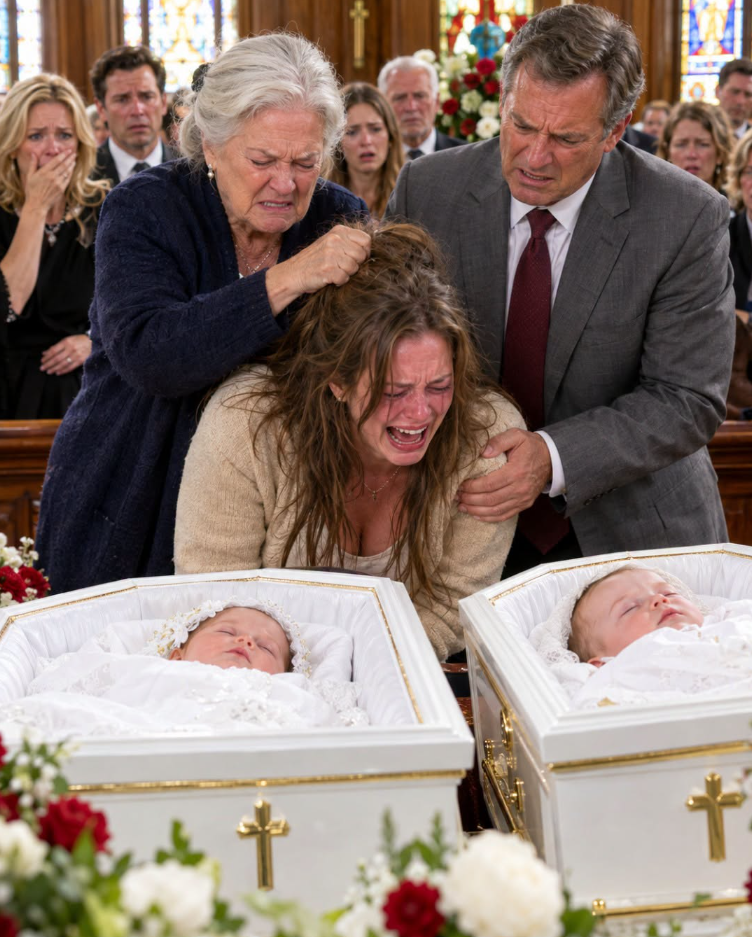
My mother-in-law stared at my twins’ white coffins and said the one sentence no grieving mother should ever have to hear.
“God took them because He knew what kind of mother they had.”
“Can you please be quiet today?” I asked.
Before I could move away, Miriam crossed the room. Her hand struck my face, then she seized my hair and drove my head against the wooden edge of the coffin.
Pain exploded through my skull. I staggered, and she leaned close enough that nobody else could hear her.
“Shut up,” she whispered, “or you’ll end up in there too.”
Someone suddenly grabbed my arms. For one hopeful second, I believed somebody had stepped in to protect me.
Then I realized it was Trevor.
He restrained me while Miriam remained beside the coffin she had just shoved me against. Rather than confronting his mother, he blamed me for creating a scene.
Something inside me shattered at that moment—not because his reaction surprised me, but because I finally saw the truth clearly. Trevor would always choose the comfort of avoiding Miriam instead of protecting the people she harmed.
Emma had witnessed everything. She stood there in her navy coat, her crooked headband sliding sideways, watching the adults who had refused to intervene.
Then she ran.
Not to me. Not to her father.
She rushed toward the pastor, caught hold of his sleeve, and stared up at him with tears streaming down her cheeks.
“Pastor,” she cried, “do I have to tell everybody what Grandma put in the babies’ bottles?”
The entire room fell silent.
Every trace of color vanished from Miriam’s face. My father-in-law let his rosary fall from his hand. Trevor stared between Emma and his mother as though he suddenly didn’t recognize either one.
“Emma,” Miriam said sharply, “what are you talking about?”
Emma was already shaking her head.
“I saw Grandma in the kitchen. She was putting white powder in special jars. She said she was going to fix everything.”
My breath stopped.
Memories of that final night rushed back: Miriam insisting that I rest, the bottles she had prepared herself, the strange smell I had dismissed because I was exhausted. I remembered how deeply my boys had slept afterward.
Trevor moved forward. “Emma, no.”
Desperation filled his voice, but Emma continued.
“Grandma said the children would be better off in heaven. She said Mommy couldn’t handle them.”
Miriam started toward her, but the pastor immediately stepped between them.
“Don’t take another step.”
Emma cried even harder. “Grandma gave me cookies and said it was a secret. She said Dad would be happy when everything was fixed.”
Holding one hand against my bleeding forehead, I stared at Miriam. For years, everyone had described her as difficult, controlling, impossible.
But my daughter had just exposed something far darker.
The pastor turned toward one of the funeral attendants.
“Call the police.”
Miriam looked toward the exit.
Then she ran.
Part 2: The Evidence Miriam Thought Was Gone
The police arrived at the funeral home before Miriam managed to escape. Two officers intercepted her near the hallway while a paramedic treated the cut on my forehead. Another officer brought Emma into a quiet office with juice, coloring pages, and a child-interview specialist.
Trevor attempted to approach me, but I backed away.
“At the coffin,” I said, “you held me down while she hurt me.”
He looked shattered. “I didn’t understand what was happening.”
“You understood enough to protect her.”
Investigators questioned everyone about the same things: who had been there during the twins’ final night, who had prepared their bottles, who had gone into the kitchen, and whether anyone remembered Miriam behaving strangely.
My father-in-law, David, repeatedly insisted that she had only wanted to help. First, he suggested vitamins. Then supplements. Then some kind of herbal sleep remedy.
Every new explanation sounded worse than the one before it.
The pastor remained near Emma while she carefully described what she had witnessed in the kitchen. She talked about the pale containers, Miriam’s phone conversation, and the cookies she had received in exchange for keeping quiet.
“What did Grandma say?” the specialist asked gently.
Emma twisted the sleeve of her coat. “She said Mommy was tired and Dad needed help. She said the babies made everything hard.”
Police secured the twins’ bottles and requested that the medical examiner reconsider the cause of death. They also obtained a warrant to search Miriam’s home before anyone had the opportunity to remove anything she might have left behind.
I was taken to the hospital for treatment of my head injury. Sitting alone in the examination room, I found myself replaying that final night with unbearable clarity.
Miriam had insisted that I lie down after dinner because I looked exhausted. She had prepared the bottles herself, smiling while telling me that a grandmother should know how to help.
Afterward, the twins had slept far more deeply than usual.
At the time, exhaustion had kept me from questioning it. Now, remembering how completely I had trusted her felt like reopening the same wound again and again.
By that evening, Detective Alvarez returned with preliminary results. Investigators had detected a sedating substance in residue from one bottle, and matching containers had been recovered from a trash bin behind Miriam’s house.
The room seemed to tilt beneath me.
“Are you saying she did this?” I asked.
“We’re saying the evidence requires a full investigation,” he replied. “And your daughter’s statement may be crucial.”
Outside my room, Trevor sat with his tie loosened, his hands locked together between his knees. When I finally agreed to let him come inside, he started crying before saying anything.
“I didn’t know.”
I believed that he hadn’t known the entire truth. But that couldn’t erase all the years he had spent pretending Miriam’s cruelty was harmless.
“You knew she hated me,” I said. “You knew she crossed every boundary. You just kept asking me to tolerate it.”
“I thought ignoring her kept the peace.”
“It kept your peace.”
His head dropped.
Neither of us spoke again.
Two days later, a brief video from the funeral surfaced online. Among the messages of sympathy in the comments, one account posted something that turned my blood cold:
Check Miriam’s other children. This isn’t the first time she used calming powders on babies.
I immediately forwarded the comment to Detective Alvarez.
Within hours, investigators started reopening old family records.
And I began to understand that discovering the truth about my sons might only be the beginning.
Part 3: The Family History Nobody Wanted to Face
Detective Alvarez made no promises that the anonymous comment would uncover anything. Memories faded with time, old records disappeared, and grief sometimes caused families to reshape the past.
But less than a week later, he contacted me.
“We found two infant deaths connected to Miriam’s extended family,” he said. “Both were ruled unexplained at the time.”
One involved a baby cousin who had died while visiting Miriam’s home in 1998. The other concerned a nephew who had spent weeks hospitalized after what relatives described as a “crib accident.”
Neither case established that Miriam had done anything. Even so, both contained eerily similar details: a child becoming unusually sleepy, a grandmother volunteering to help, and adults who were too afraid to ask difficult questions.
As investigators continued examining my twins’ deaths, the rest of the family began tearing itself apart. Some relatives called Miriam evil. Others insisted she was mentally unwell, as though that somehow changed the damage she had caused.
I hated hearing people call it a family tragedy.
A tragedy is a storm, a disease, an accident nobody could prevent. What happened to my sons came from choices, secrets, and years of people deciding that challenging Miriam was more difficult than keeping her satisfied.
Emma began attending therapy twice each week. At first, her drawings showed bottles beneath dark clouds and tiny blue stars hovering over our house.
Then, one afternoon, she drew the funeral.
In the picture, I stood beside two white coffins with a red mark across my forehead. Emma had drawn herself next to the pastor, her mouth forming an enormous circle.
“I told,” she said quietly.
“You did,” I answered.
“Was Grandma mad?”
“Yes, sweetheart. But being angry never makes it wrong to tell the truth.”
Emma thought about that for a moment before placing the drawing in my lap. I wanted to tell her how brave she was, but the words caught in my throat.
No four-year-old should ever need courage simply to be heard.
Trevor began therapy as well. After I told him Emma and I needed space, he moved into an apartment across town without arguing.
One evening, he asked whether I believed our marriage could survive.
“I don’t know,” I said.
He nodded, his eyes filling. “I should have protected you.”
“You should have believed me before there was a crime scene.”
He looked down. “I thought ignoring her kept the peace.”
“It kept you comfortable,” I said. “It left Emma and me alone with her.”
A month later, the medical examiner confirmed that the substance discovered in the bottle was consistent with the twins’ deaths. Miriam was formally charged, and police also added assault charges for what she had done to me at the funeral.
As officers escorted her from the courthouse, she stared directly at Trevor.
“I did it for you,” she called. “They were destroying your life.”
Trevor stopped.
For years, he had defended her with excuses.
This time, he said nothing.
He simply turned away.
Then Detective Alvarez approached me with another development. Investigators had discovered the identity of the person who posted the online comment.
It was Miriam’s younger sister.
And she said she had been waiting thirty years for someone to finally ask what she knew.
Part 4: The Sister Who Had Stayed Silent for Thirty Years
Miriam’s younger sister, Elaine, entered the police station carrying a cardboard box secured with old yellowed tape. She was seventy-two, carefully dressed, and visibly frightened, keeping both hands wrapped tightly around her purse.
“I should have spoken years ago,” she told Detective Alvarez. “I was afraid of what she would do to me.”
The box contained old correspondence, a diary, and photographs taken during family visits Miriam had hosted decades before. Some notes mentioned babies becoming “too sleepy,” disputes about doctors, and one letter Miriam had written following a nephew’s death.
The letter contained no direct confession.
But it revealed something about Miriam’s thinking.
Some children ruin families before they are old enough to understand it, Miriam had written. Sometimes someone has to restore order.
Elaine explained that Miriam had always viewed children as extensions of the adults responsible for them. Whenever a baby created stress, required too much attention, or disrupted her son’s routine, Miriam treated that child as a problem requiring control.
“She never said she wanted anyone hurt,” Elaine said. “She said she wanted them quiet. She said exhausted mothers made bad decisions.”
The prosecutor did not rely on decades-old suspicions to build the case. The strongest evidence remained the laboratory findings, the prepared bottles, Miriam’s words at the funeral, and Emma’s protected interview.
But Elaine’s records demonstrated that Miriam’s behavior wasn’t simply one isolated episode caused by grief or confusion. It belonged to a pattern of control that people had allowed to continue unchecked for far too long.
When the trial started, I sat beside my attorney while Trevor remained several rows behind us. He had received supervised visits with Emma, but he no longer expected me to make anything easier for him.
Emma was spared from facing Miriam directly. Her interview was played from another room, and the courtroom became completely silent as her small voice described what had happened in the kitchen.
“She said it was our secret,” Emma said. “She said Dad would be happy.”
Miriam remained motionless as she watched the screen.
Then prosecutors played the recording from the funeral. Everyone heard her shout that the twins had been “ruining everything,” and everyone heard her tell Trevor that she had “freed” him.
Her attorney argued that Miriam had been overwhelmed and mentally unstable.
The prosecutor responded with one simple question.
“Did she understand that adding an unknown substance to infant bottles was dangerous?”
There was no way around the answer.
Yes.
Three weeks later, the verdict arrived. Miriam was convicted on charges connected to my twins’ deaths, along with assaulting me at their funeral.
When the judge announced the decision, I felt no relief.
Relief would have meant something had been restored.
Nothing could restore my sons.
Outside the courtroom, Trevor stood beside me while reporters waited beyond the doors.
“I’m sorry,” he said.
I looked at him. “I know you are.”
“Is there any way back?”
I thought about the funeral. About Emma running toward the pastor. About every time Trevor had asked me to simply ignore his mother.
“There is a way forward,” I said. “But it will not look like the life we had.”
Then I took Emma’s hand and walked away.
For the first time, neither of us turned around.
Part 5: The Truth My Daughter Never Had to Carry Again
The verdict didn’t erase our grief. It only ended Miriam’s ability to remain protected by the family she had controlled for so many years.
During the months afterward, I learned that healing wasn’t one dramatic moment. It was made up of hundreds of small choices: getting out of bed each morning, answering Emma’s questions truthfully, continuing therapy, and allowing myself to remember my sons without letting those memories destroy everything that remained of my life.
Three months after the trial, I filed for divorce from Trevor.
He didn’t contest it. He signed the documents, agreed to supervised parenting therapy, and respected every boundary I established for Emma.
For the first time, he seemed to understand that simply being her father wasn’t enough. He needed to become someone around whom she could genuinely feel safe.
Emma still loved him.
I never wanted her carrying the burden of our marriage or believing she had to choose one parent over the other.
What happened between Trevor and me was an adult matter. His future relationship with Emma would depend on whether he could be present, listen to her, and protect her without hiding behind excuses.
One afternoon, while we were driving home from therapy, Emma stared through the car window for a long time before finally speaking.
“Mom?”
“Yes, sweetheart?”
“If someone says I have to keep a secret, can I still tell you?”
“Always.”
“Even if they say you’ll get mad?”
“Especially then.”
She nodded slowly. “What if it’s a birthday surprise?”
Despite everything we had endured, I smiled. “You can keep that one for a little while.”
Emma laughed.
The sound filled the car so unexpectedly that I had to pull over.
I sat behind the wheel and cried quietly while she reached forward from the back seat and held my hand.
“I’m okay, Mommy,” she said.
“I know,” I told her. “I’m just happy to hear you laugh.”
A year later, Trevor came home from a visit carrying a folded drawing. She set it on the kitchen table and waited while I opened it.
She had drawn herself standing between us. Above our heads were two bright stars, each marked with one of her brothers’ names.
“Who is this?” I asked, pointing gently.
“That’s Dad,” she said. “He doesn’t live with us.”
“No, he doesn’t.”
“But he’s still my dad.”
“Yes.”
Then she touched the two stars. “And they’re still my brothers.”
My throat tightened.
“Always.”
We placed her drawing on the refrigerator.
It wasn’t the picture of family life I had once imagined, but it was truthful—and after everything we had survived, truth felt far safer than perfection.
On the twins’ birthday, Emma and I went to the cemetery carrying white flowers. By then she was six, taller and steadier, and slowly beginning to understand that none of what happened had ever been her fault.
She placed a flower beside each headstone before looking up at me.
“Do you think they know I told?”
“I don’t know what they can know,” I said softly.
“I think they do.”
“Maybe they do.”
She slipped her hand into mine as we headed back toward the car.
Behind us were two small graves and a past I would never be able to repair.
Ahead of us was a life governed by different rules.
No more dismissing cruelty as someone’s personality.
No more protecting adults by demanding silence from children.
Emma had believed she was carrying a terrible secret.
What she had really been carrying was the truth.
And on the day she finally spoke it aloud, she freed herself from a silence that had already lasted far too long.