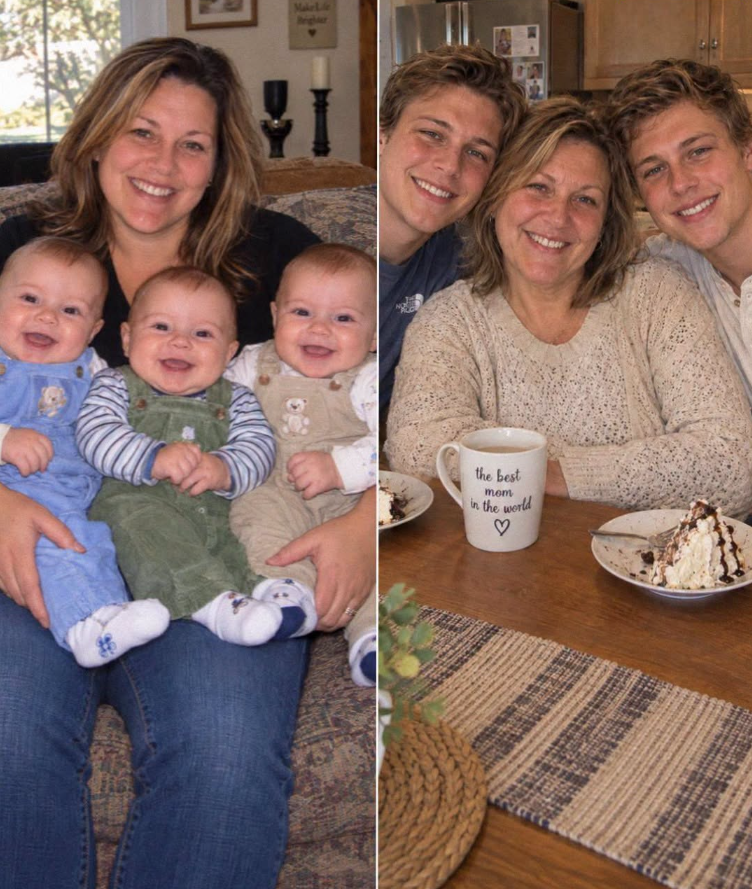
I thought I had spent eighteen years grieving one of my triplet sons.
Then, on the night of their eighteenth birthday, a small brown box appeared on my doorstep.
Across the top, written in black marker, were four words:
“Happy Birthday, Brothers!”
Inside was a hospital bracelet bearing the name of the son I had been told was dead.
And a note that led me back to the hospital, back to my mother, and toward a truth I had never been meant to discover.
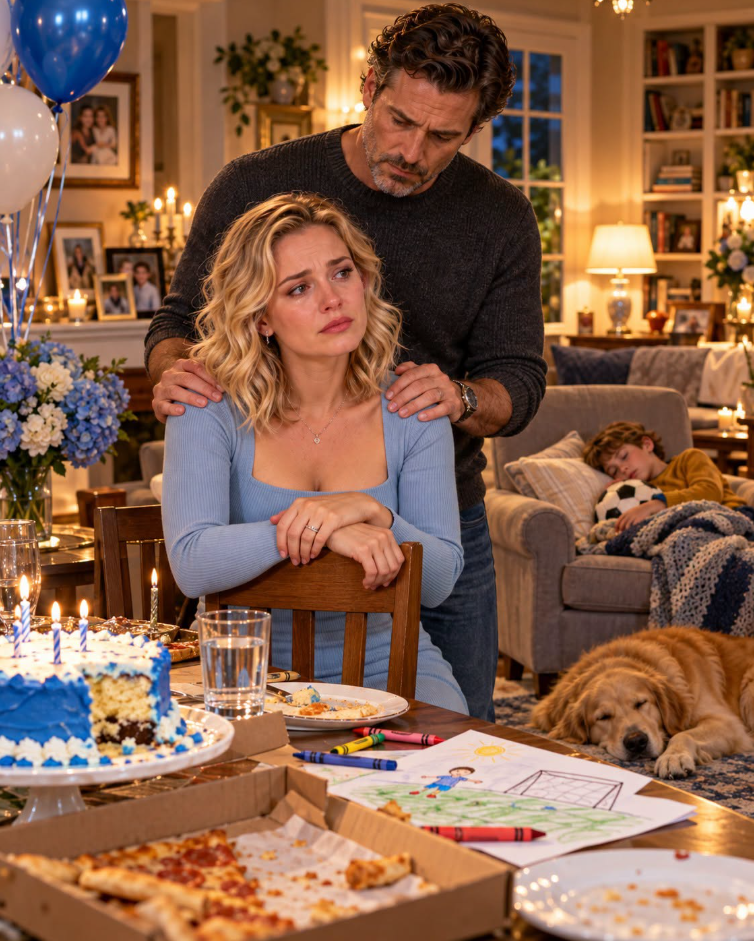
I had just gone inside to frost the birthday cake.
Through the open kitchen window came the sounds of the party in the backyard—music playing, teenagers shouting over one another, and the kind of loud, careless laughter that seemed to belong only to eighteen-year-old boys.
My husband, Watson, walked into the kitchen and kissed the side of my head.
“You okay?”
“I’m fine.”
He looked at the cake sitting on the counter.
Two large candles rested beside it.
One.
And eight.
For everyone else, it was a celebration of two sons turning eighteen.
For me, there had always been three.
Behind the flour tin, hidden where only I could see it, was the tiny white candle I lit every year for Rowan.
Watson followed my eyes.
“I’ll light it with you later,” he said quietly.
“After everyone leaves.”
He nodded.
We had never allowed Riley and Rex to forget their brother.
Rowan wasn’t a secret in our house.
He was one of my sons.
We had simply brought home two babies instead of three because Doctor Jefferson had told us Rowan had died before he was strong enough to leave the hospital.
That was how I had counted them ever since the day they were born.
Two boys growing up in my home.
And one boy I believed I had lost.
Then the doorbell rang.
“I’ll get it, hon,” I said, wiping frosting from my thumb.
Watson glanced toward the backyard.
“Probably another kid who forgot which gate to use.”
I smiled faintly and walked to the front door.
I expected to find another teenager standing there with a gift bag, grass stains on his shoes, and an embarrassed excuse for arriving late.
But when I opened the door, no one was there.
There was only a small brown box sitting on the welcome mat.
There was no shipping label.
No stamp.
No return address.
Just a message written across the top in black marker.
“Happy Birthday, Brothers.”
My entire body went cold.
“Who is it?” Watson called from the kitchen.
“No one.”
I picked up the box.
It was surprisingly light.
Something shifted softly inside.
Watson stepped into the hallway.
His eyes immediately went to the words on the lid.
“Happy Birthday, Brothers.”
“Maybe one of the boys ordered something,” he said.
“No.”
My voice sounded strange even to me.
“I’m taking it to our room. I don’t want them opening some cruel joke in front of everyone.”
Watson’s expression changed.
He understood immediately.
I carried the box upstairs, closed our bedroom door, and sat on the edge of the bed.
For several seconds, I simply stared at it.
Then I opened the lid.
On top was a folded piece of paper.
I unfolded it.
The first line made my heart stop.
Dawn,
Please don’t show this to anyone until you finish reading.
Then came the sentence that made the room seem to tilt around me.
Don’t trust Grandma.
I stopped breathing.
Under the note was a tiny hospital bracelet.
It was old, yellowed slightly around the edges.
I turned it over.
The printed name was unmistakable.
Rowan.
My hands began to shake.
Beneath the bracelet was a photograph.
A young man stood beside a lake.
I stared at his face.
He had Riley’s mouth.
Rex’s height.
Watson’s jaw.
And my eyes.
A sound escaped my throat—something between a gasp and a cry.
“Dawn?”
Watson knocked on the bedroom door.
“Dawn?”
I couldn’t answer.
“Dawn, open the door.”
My fingers shook as I unlocked it.
Watson stepped inside.
Then he saw the box.
I held up the bracelet.
“It says Rowan.”
Watson went completely white.
His eyes moved from the bracelet to the photograph.
Then he sat down hard beside me.
“No.”
I handed him the letter.
“Read it.”
He shook his head.
“Watson. Read it.”
His voice broke as he read the first line.
“My name is Rowan. I was told you loved my brothers but couldn’t love all three of us.”
Watson covered his mouth.
I took the letter back and forced myself to keep reading.
“I didn’t believe that at first.
Then I found papers with your signatures. I don’t know if you gave me away or if someone made that choice for you. But I need the truth before I spend the rest of my life hating the wrong person.
I found your address in a locked folder my adoptive parents kept with my bracelet, placement papers, and your signed forms.”
I looked at Watson.
“I didn’t give him away.”
“I know.”
“I would’ve crawled through fire for him.”
“I know, Dawn.”
“Then why does he have our signatures?”
Watson stared at the box.
“What else is in there?”
I pulled out another document.
It was a copied form.
The words blurred in front of my eyes.
Medical release.
Placement.
Best interest.
Extended care.
At the bottom was my signature.
It was thin, crooked, and barely looked like mine.
Beside it was Watson’s.
“I don’t remember signing this,” I whispered.
Watson took the page.
His hands began to tremble.
“I remember a clipboard.”
I looked at him.
“What?”
“At the hospital, sweetheart.”
His voice was barely audible.
“Your mother handed it to me. She said you had already signed. She said they needed my signature so Rowan wouldn’t suffer.”
My stomach twisted.
“What?”
“Peggy said that?”
He nodded.
“She said you couldn’t face it. She said I had to be strong enough for both of us.”
Suddenly, fragments of a night I had spent eighteen years trying not to remember began forcing their way back into my mind.
For eighteen years, I had remembered that hospital night in pieces.
Doctor Jefferson walking toward us.
My mother wrapping her arms around me.
Someone telling me, “He’s gone, Dawn.”
I remembered being sedated.
Broken.
Unable to stand.
Unable to think.
Too weak to hold a pen without help.
And then nothing was clear anymore.
I had always assumed the emptiness in my memory was grief.
Now I wondered if someone had counted on it.
“I need the old folder,” I said.
Watson looked at me.
“Now?”
“Right now.”
We went to the hall closet while the birthday music continued thumping downstairs.
I pulled down the old plastic storage bin and dumped years of hospital papers across the bedroom floor.
Watson knelt beside me.
“What are we looking for?”
“Proof that Rowan died.”
His hands stopped moving.
I searched through everything.
Riley’s discharge papers.
Rex’s feeding chart.
Condolence cards.
Old hospital instructions.
And the funeral receipt my mother had handled because I had barely been able to stand at the time.
But there was one thing missing.
Rowan’s death certificate.
I stared at the empty space in the folder.
My mother had always told me the official paperwork was safely stored in her fireproof box.
“Watson.”
He looked at me.
“There’s nothing.”
“Maybe Peggy kept it.”
“Of course she did.”
Then I found something else.
An old card from Doctor Jefferson.
On the back, written in his handwriting, were the words:
“I hope one day you find peace with the decision made for Rowan.”
Watson read it twice.
“Decision?”
“That’s what I thought.”
We looked at each other.
Then at the copied placement form.
I grabbed my keys.
“We’re going to Doctor Jefferson.”
Watson stood.
“Now?”
“Right now.”
Doctor Jefferson looked much older than I remembered.
His receptionist initially tried to stop us.
But I held up Rowan’s hospital bracelet.
“Tell him it’s about the baby he told me was dead.”
A minute later, after the receptionist showed him the bracelet, Doctor Jefferson opened his office door.
I walked in and placed the bracelet on his desk.
“Where did this come from?”
His expression changed instantly.
“Where did you get that?”
“From my son.”
He looked at the copied form in my hand.
“I want Rowan’s records.”
“There are procedures, Dawn.”
“Then get me the form.”
“Dawn, I can’t discuss this without proper paperwork.”
I stepped closer.
“I want Rowan’s records.”
He hesitated.
Then I asked the question that had haunted me since opening that box.
“Fine. Answer one question.”
I leaned forward.
“Did Rowan die?”
Doctor Jefferson slowly sat down.
“Rowan was critically ill.”
“That wasn’t the question.”
He folded his hands.
“Rowan stabilized after the transfer.”
My fingers tightened around the edge of his desk.
“You told me he died.”
“I was told you understood the placement option. Your mother said the private placement had already been discussed with the social worker.”
My stomach dropped.
“Rowan was critically ill.”
He looked away.
I understood.
“By me?”
Silence.
“By my mom,” I whispered.
Right?
Doctor Jefferson didn’t answer.
He didn’t need to.
Watson’s voice broke behind me.
“We buried him.”
Doctor Jefferson swallowed.
“Your mother arranged the memorial. I was told you and Watson understood there would be no viewing.”
“We buried him.”
His eyes dropped.
“The family?” I asked.
Then I corrected myself.
“Or her?”
Silence filled the room.
I stared at him.
“Did you ever ask me, without my mother in the room, if I wanted my son placed with another family?”
Doctor Jefferson looked down.
“No.”
“Did you ask Watson?”
“No.”
“Then you never confirmed our consent,” I said.
“You had a grieving woman’s signature and my mother’s version of grief.”
Doctor Jefferson lowered his eyes.
“I told myself Rowan needed a stable home.”
“He had one,” Watson said.
His voice cracked.
“It was ours.”
I picked up the bracelet.
“I’m filing for every record. Every page. Every note. And then I’m filing complaints wherever I need to.”
Doctor Jefferson nodded.
But I wasn’t finished.
“You don’t understand,” I said.
“But you will.”
Watson looked at the doctor.
“Where is he?”
Doctor Jefferson hesitated.
“I don’t know now. The couple moved years ago.”
I held up the photograph.
“He found us first.”
When we pulled back into our driveway, the birthday party was still going.
Music was still playing.
Riley and Rex were still laughing in the backyard.
And my mother’s car was parked near the curb.
Watson reached for my hand.
“Let me go in first.”
“No.”
I looked at him.
“He found us first.”
Then I squeezed his hand.
“We’re going in together.”
We climbed the porch steps.
And there, standing near the railing, was a tall young man.
He looked as though he had been trying to decide whether to knock on the door or run away.
When he saw us, his expression changed.
“I’m sorry,” he said.
“I left the box and walked away. But then I heard them laughing out back, and I couldn’t leave.”
I knew.
Somehow, before he said another word, I knew.
“Rowan.”
His eyes filled with tears.
“I don’t know what I’m supposed to call you.”
My heart broke.
“You don’t have to call me anything yet.”
He looked at Watson.
“Are you angry?”
Watson made a broken sound.
“At you?”
He shook his head.
“Never.”
Rowan looked back at me.
“I just needed to know if I was unwanted.”
“No.”
I stepped toward him, then stopped.
“Can I?”
He didn’t move away.
I gently touched his cheek with two fingers.
He was warm.
Real.
Breathing.
Alive.
“You were wanted every second, my boy.”
Then the patio door slid open behind us.
My mother stepped outside carrying a bright gift bag.
“Dawn? Why are you standing out front? I brought the boys their presents.”
Then she saw him.
Her entire body froze.
The color drained from her face.
“Dawn,” she whispered.
I stepped between her and my son.
“Which boys, Mom?”
Her mouth opened.
No sound came out.
“You brought gifts for Riley and Rex,” I said.
“But you knew there were three.”
Watson stood beside me.
“You told us Rowan died.”
My mother stared at Rowan.
Her hand tightened around the gift bag.
“Not now,” she said. “Let’s do this later, when the backyard isn’t crawling with teenagers.”
“No.”
My voice was calm.
“Let’s do it now.”
The backyard gradually fell silent.
Riley came through the patio door first.
Rex followed closely behind him.
“Mom?”
Riley looked from me to Watson, then to the stranger standing on the porch.
“What’s going on?”
Watson’s voice broke.
“Boys, this is Rowan.”
The two brothers stared at him.
Rex’s face changed.
“Our brother?”
For several seconds, nobody moved.
Rowan looked down.
“I didn’t come here to take anything from you.”
Riley stepped forward.
“You’re not taking anything.”
Rowan’s jaw trembled.
“I spent my whole life thinking I was the one nobody could keep.”
“No,” I said.
“That was never true.”
Riley moved closer.
“You’re not taking anything.”
My mother started crying.
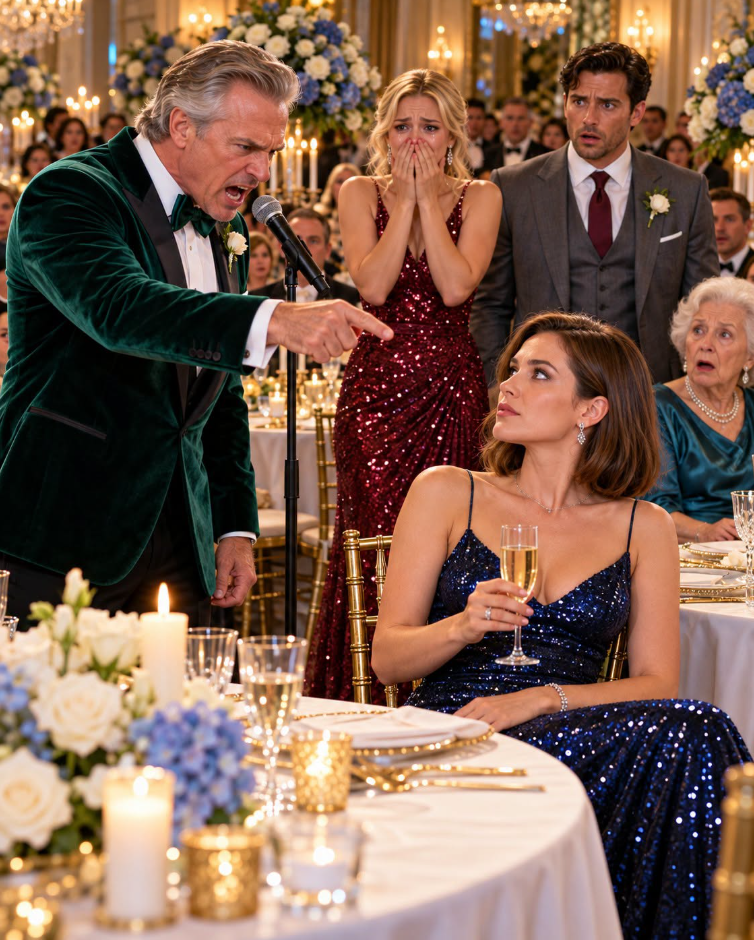
“You were falling apart, Dawn.”
She looked at me desperately.
“Two babies at home. Bills. Machines. No sleep. I arranged the funeral because you couldn’t look at the tiny coffin.”
My stomach turned.
“You told me not to.”
“I wanted you to remember him happy. Not like that.”
“You put his framed baby picture on a sealed coffin and said Rowan was too fragile to view.”
I stared at her.
“But it was empty.”
She began crying harder.
“I was protecting you.”
“No.”
My voice shook.
“You were hiding what you’d done.”
“You were falling apart, Dawn.”
I shook my head.
“No. You were hiding what you’d done.”
Watson wiped his face.
“We buried an empty box because you decided grief was easier to manage than the truth.”
My mother looked at Rowan.
“I found you a good home. Parents who loved you before they met you. They had money. They could focus just on you.”
Rowan flinched.
“You told them I wasn’t wanted.”
His voice was quiet.
“You told them my parents had given me up because they didn’t want another mouth to feed.”
My mother looked at me.
“I said your mother couldn’t raise you.”
“I could have,” I said.
“Tired mothers are still mothers.”
Riley looked at our mother.
“Grandma, did you know he was alive this whole time?”
She didn’t answer.
Rex stepped backward when she reached for him.
“Don’t.”
“Rex, honey—”
“No.”
His eyes filled with tears.
“You don’t get to touch us right now.”
I pointed toward the side gate.
“Leave.”
“Dawn, please.”
“All contact goes through a lawyer.”
She stared at me.
“You’re cutting me off from my family?”
“No.”
I looked at her.
“You did that eighteen years ago.”
After she left, Rowan remained near the porch steps.
The silence felt strange.
Not empty.
Just unfamiliar.
Riley glanced toward him.
“Do you like chocolate cake?”
Rowan gave a small, broken laugh.
“I don’t know. I usually had vanilla.”
Rex wiped his eyes.
“That’s tragic.”
He managed a smile.
“We’ll fix that first.”
I brought the cake outside.
Then I lit three small candles.
One for each of my sons.
For eighteen years, I had lit one tiny candle in secret.
That night, for the first time, I lit three.
Watson stood beside me.
“Make a wish.”
I looked at my sons.
We weren’t magically healed.
We weren’t suddenly whole.
There were eighteen missing years between us.
There would be questions.
Anger.
Records to uncover.
Lawyers to speak with.
Memories to rebuild.
But for the first time, all three of my sons were standing in the same light.
“I already got mine back,” I said.
“Now we learn how to keep it.”
Later that night, when the party had quieted, Rowan and I sat together on the porch steps.
For the first time, there was no hospital room between us.
No coffin.
No lie.
Just the two of us sitting under the night sky, trying to understand how eighteen years could disappear and still somehow lead us back to one another.
“I’m not asking you to pretend I raised you,” I told him.
“And I’m not asking you to call me Mom before you’re ready.”
He looked down at his hands.
“I don’t know what I’m ready for.”
“That’s okay.”
I smiled through the tears in my eyes.
“You get to choose the pace.”
I paused.
“But I need you to know one thing.”
He looked at me.
“There has always been a place for you in this family. Even when I thought you were gone.”
His mouth trembled.
“I spent so long thinking I was the baby nobody could keep.”
I shook my head.
“No.”
My voice softened.
“You were the baby someone took choices away from.”
He was quiet for a moment.
Then he reached over and placed his hand on my arm.
“Thank you for fighting for me, Dawn.”
My chest tightened when he said my name.
It hurt.
But it was honest.
And after eighteen years of living inside a lie, honest was more than I had ever had.
“I’m requesting every record,” I told him.
“Then I’m speaking to a lawyer. Doctor Jefferson and my mother don’t get to hide behind eighteen years of silence.”
Behind us, Riley suddenly shouted from the backyard.
“Rowan! Rex says vanilla cake counts as a personality flaw!”
Rowan laughed under his breath.
I watched him stand.
Then he walked toward his brothers.
For eighteen years, I had believed my son was buried.
I had mourned him.
I had lit a candle for him.
I had taught his brothers to remember him.
I had carried an empty space in our family because I thought that was the price of losing a child.
But my mother hadn’t just stolen a son from me.
She had stolen eighteen years from all of us.
No lawyer could hand those years back.
No apology could make them disappear.
But that night, something changed.
My son was no longer a secret.
He was no longer a lie.
He was no longer an empty place at the table.
He was standing beside his brothers.
He was laughing.
He was alive.
And finally, after eighteen years, he was home.