Three hours after I gave birth without my husband beside me, my mother texted:
“Your sister’s kids expect new phones for their birthday. Send $2,000.”
When I did not answer, she used the emergency bank card I had trusted her with after my father died.
She thought I was still the daughter who would stay quiet.
She did not know the bank had already flagged the card in her purse or what my father had left inside a sealed folder.
My husband, Derek, had flown to Tucson three days earlier after his father collapsed at a construction site.
He promised he would be back before the baby came.
He meant it.
Our daughter did not wait.
At 5:15 Friday morning, my water broke.
Derek’s phone went straight to voicemail because he was inside a hospital waiting for news about his father’s emergency surgery.
My neighbor Leah drove me through the rain while I gripped the door handle and tried not to scream.
Eight hours later, I was holding a six-pound baby girl named Clara against my chest.
There was no husband beside the bed.
No mother.
No sister.
Just a nurse adjusting my blanket and my phone glowing on the tray table.
Mom: “Brenda picked out the phones. Four of them come to about $2,000.”
Mom: “The kids have had a hard year.”
Mom: “Do not embarrass your sister by making her ask twice.”
I stared at the messages while Clara slept beneath my chin.
I had paid Brenda’s overdue electric bill two months earlier.
Before that, her transmission.
Before that, school clothes for all three children.
My mother always called it helping family.
She never noticed that I was family too.
I typed, “I just had the baby.”
Then I deleted it.
The nurse saw my hands shaking.
“Bad news?” she asked.
“Same news,” I said.
Twenty minutes later, another message appeared.
Mom: “Giving birth does not make you the only person with responsibilities.”
I turned my phone facedown.
At 6:42 that evening, it buzzed again.
This time it was not my mother.
BANK ALERT: $2,037.64 purchase declined. Electronics retailer. Card ending 4418.
That card had been locked inside my mother’s wallet for almost six years.
I had given it to her after Dad’s funeral for groceries and medical emergencies.
She swore she would never use it without calling.
I opened the banking app.
The first attempt had failed.
The second had gone through.
Four phones.
Cases.
Activation fees.
Delivery address: Brenda’s house.
I did not cry.
I called the bank.
The fraud specialist asked whether I knew the person who had used the card.
I looked down at Clara’s tiny fist curled around my hospital gown.
“Yes,” I said.
“I know exactly who it was.”
The bank froze the account.
Then the specialist asked me to check my credit report.
That was when the $2,000 request became something much worse.
There was another phone account in my name.
A utility account I had never opened.
And a recent inquiry connected to the small house where my mother had lived since Dad died.
I worked insurance claims.
I knew what patterns looked like.
This was not one desperate mistake.
It was a system.
Derek returned the next afternoon, exhausted and devastated that he had missed Clara’s birth.
His father was stable, but still in intensive care.
I handed him my phone.
He read every message without speaking.
Then he reached the bank alert and looked up at me.
“What are you going to do?”
For once, I did not say I would handle it quietly.
“I’m going to find out how much she took.”
Through my employer’s legal-assistance program, I contacted an attorney named Nina Patel.
She pulled probate records, account records, and documents from the safe-deposit box my father had opened before he died.
Inside that box was a sealed folder with my name on it.
The folder contained the trust holding my mother’s house.
The house was not hers.
My father had placed it in trust for me, allowing Mom to live there without rent as long as she paid the taxes and never used my identity, credit, or property to support Brenda.
My mother had signed the agreement herself.
There was also a termination clause.
Financial abuse against me ended her right to live there.
Nina sent the required notice.
The bank opened a fraud investigation.
The phone company froze every account connected to my Social Security number.
I said nothing to Mom.
A week after Clara was born, Derek and I came home from her first pediatric appointment.
I had barely set the diaper bag down when the front door opened.
My mother walked in using the spare key she had never returned.
Her face was red.
A folded legal notice shook in her hand.
“How could you?” she shouted.
“You are throwing your own mother out over a few phones?”
Clara startled in my arms.
Derek stepped between us.
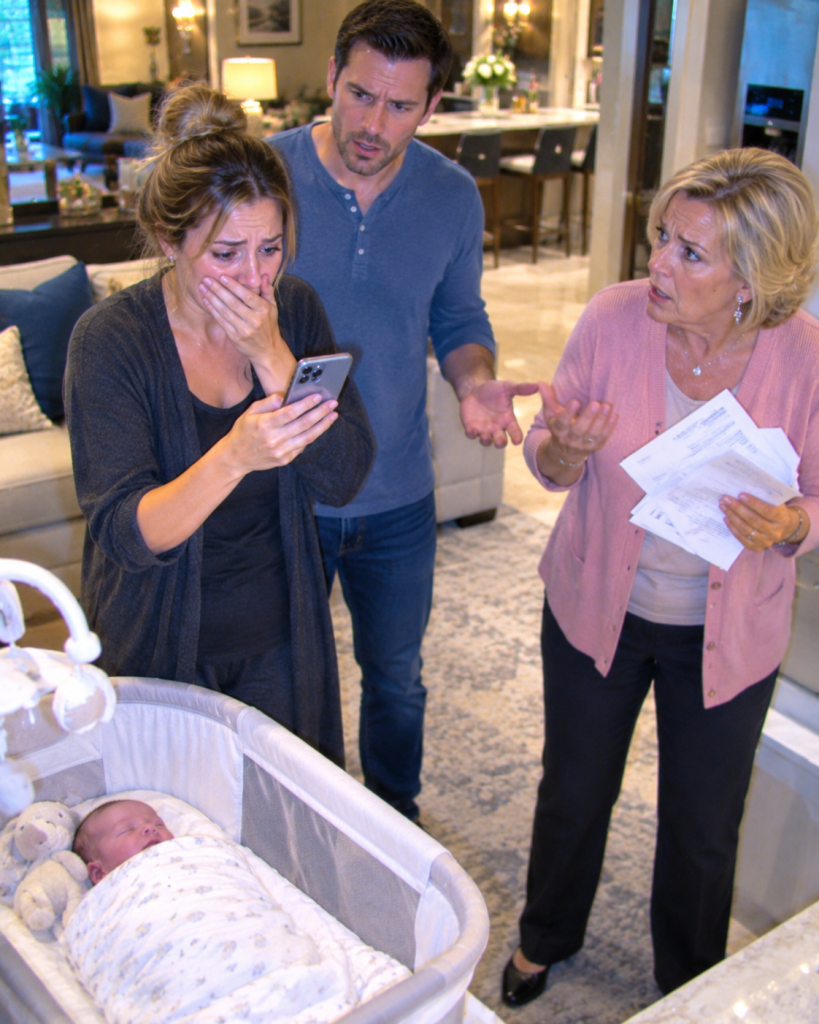
Mom looked past him and saw Nina sitting at our dining table beside the sealed folder.
Her anger vanished.
“You opened that?” she whispered.
I placed Clara safely in her bassinet.
Then I sat down across from the woman who had treated my bank account like an inheritance and my silence like permission.
“You used my card while I was alone in the hospital,” I said.
“You opened accounts in my name.
“And you tried to borrow against a house that was never yours.”
Mom’s eyes flicked toward the door.
Nina opened the folder to page four.
My mother saw her own signature beneath my father’s handwritten note and went completely pale.
Part 2 — The Folder My Father Left Behind
My mother saw her own signature beneath my father’s handwritten note and went completely pale.
For several seconds, nobody spoke.
Then she reached for the folder.
Nina calmly pulled it away.
“You can read it,” she said. “But you cannot take it.”
Mom stared at her.
“You’re her lawyer?”
“Yes.”
Mom looked at me.
“You hired a lawyer against me?”
“No,” I said quietly.
“I hired a lawyer because I finally realized I needed someone who would protect me.”
Her face tightened.
“I am your mother.”
“And I am your daughter.”
I pointed toward the bassinet where Clara was sleeping.
“And I almost let my daughter grow up believing that being family meant letting people hurt you.”
Mom flinched.
Derek remained beside me, his hand resting gently on my shoulder.
Nina turned the folder around and tapped the fourth page.
“Your husband established this trust before his death. You signed it voluntarily.”
Mom shook her head.
“He told me it was just paperwork.”
“It was very specific paperwork,” Nina replied.
She turned another page.
“Your right to remain in the house depended on three conditions. Paying the property taxes. Maintaining the property. And never using your daughter’s identity, credit, or property for someone else’s financial benefit.”
Mom said nothing.
Nina continued.
“The bank records show unauthorized charges. The credit report shows accounts opened under your daughter’s identity. And there is documentation showing an attempt to use the property as collateral.”
Mom’s eyes filled with tears.
“That was for Brenda.”
I stared at her.
“You tried to put my house at risk for Brenda?”
“She needed help.”
“So did I.”
My voice cracked.
“I was lying in a hospital bed after giving birth to your granddaughter, and you were buying four phones.”
Mom looked down.
“I thought you would understand.”
I almost laughed.
Not because it was funny.
Because after all those years, she still believed my understanding was something she was entitled to.
“You never asked me to understand,” I said.
“You just expected me to pay.”
The room became silent again.
Then my mother whispered something I had never heard from her before.
“I was afraid.”
I looked at her.
“Afraid of what?”
“That Brenda would hate me.”
That answer hurt more than the lies.
For years, I had believed my mother favored my sister because she loved her more.
Now I understood something different.
Mom had spent years avoiding conflict with Brenda by transferring the consequences to me.
Every unpaid bill.
Every emergency.
Every favor.
Every apology.
They had all landed on my shoulders because I was the daughter who rarely said no.
Until now.
My mother wiped her eyes.
“I didn’t think it had gone this far.”
Nina opened another document.
“It went further.”
Mom froze.
Nina placed a printed transaction history on the table.
“There were nineteen charges over the last fourteen months.”
I stared at the pages.
Groceries.
Gas.
Hotel rooms.
Online purchases.
Medical bills.
And payments to a credit card belonging to Brenda.
My stomach turned.
“How much?” I asked.
Nina looked at me.
“Twenty-seven thousand, four hundred and eighty-two dollars.”
Derek slowly exhaled.
I closed my eyes.
Twenty-seven thousand dollars.
Money I had thought was disappearing because life was expensive.
Money I had blamed myself for not saving.
Money I had cut vacations for.
Money I had worked overtime for.
It had been going somewhere.
To them.
Mom began crying.
“I was going to pay it back.”
“When?”
She had no answer.
Then Nina placed one final document on the table.
“This is the part you should read carefully.”
Mom stared at it.
It was a notice from the bank.
The attempted loan against the house had been denied.
Not because the bank had rejected my mother.
Because the property legally belonged to the trust.
My mother had never owned it.
She had only been allowed to live there.
Mom sank into the chair.
“So I’m losing my house.”
I shook my head.
“No.”
She looked at me with desperate hope.
“You’re losing the house you tried to steal from me.”
Her expression collapsed.
Derek looked at me.
I knew what he was asking without saying it.
Was I really going to do this?
Was I really going to let my mother leave?
I looked at Clara.
My daughter was sleeping peacefully, completely unaware of the fight happening ten feet away.
And suddenly I remembered the first message my mother had sent after I gave birth.
Send $2,000.
Not congratulations.
Not, How are you feeling?
Not, Is the baby healthy?
Money.
That had been the first thing she wanted from me after I became a mother.
I stood up.
“You have thirty days to move out.”
Mom stared at me.
“Please.”
I swallowed hard.
“I can’t.”
“You’re my daughter.”
“And Clara is my daughter.”
I walked over to the bassinet and gently touched my baby’s tiny hand.
“I have to teach her something.”
Mom’s voice broke.
“What?”
“That love does not mean allowing someone to destroy you.”
My mother covered her face.
For a moment, I almost went to her.
Almost.
Then I remembered the nineteen charges.
The secret accounts.
The attempted loan.
The six years of lies.
And I stayed where I was.
Two weeks later, the bank investigation confirmed the unauthorized transactions.
Brenda was contacted.
She denied knowing anything about the credit accounts.
Then the investigators showed her the delivery records.
The phones had gone directly to her house.
She stopped answering their calls.
My mother moved into a small apartment across town.
The trust remained in my name.
The house was repaired, the locks were changed, and the spare key was gone.
For the first time in six years, I slept without wondering who had access to my finances.
Derek and I also opened a separate savings account for Clara.
Not because we were wealthy.
Because we finally understood that boundaries were not cruelty.
They were protection.
Three months later, my mother came to see Clara.
She stood on our porch holding a small pink blanket.
No demands.
No envelopes.
No shopping list.
Just a blanket.
“Can I come in?” she asked.
I looked at Derek.
Then at Clara.
Finally, I opened the door.
Mom stepped inside.
She held the blanket out.
“I made this.”
I took it.
“Thank you.”
She looked at the baby.
“She looks like you.”
I smiled faintly.
“She has your stubbornness,” Derek said.
Mom laughed through her tears.
For the first time in years, it sounded genuine.
She sat beside the bassinet and watched Clara sleep.
Then she whispered,
“I know you may never forgive me.”
I didn’t answer immediately.
Forgiveness was not something I owed her.
Trust wasn’t either.
But I finally understood that I didn’t need hatred to protect myself.
“I don’t know what happens next,” I said.
“But if you want to be part of Clara’s life, you have to learn how to be part of mine without taking from me.”
Mom nodded.
“I will.”
I believed she meant it.
But this time, I didn’t promise anything.
I had spent years believing that being a good daughter meant saying yes.
Now I knew better.
Being a good mother meant showing my daughter that she never had to earn love by sacrificing herself.
And when I looked down at Clara sleeping peacefully beneath the pink blanket her grandmother had made, I realized something my father had understood long before I did.
Sometimes the most important inheritance isn’t money.
It’s the courage to stop repeating the same family story.