The judge finished reading my name, and the courtroom seemed to lose all its air.
Gregory Parker had entered that room believing he was defending his house from an ungrateful daughter.
Now he stood beside his attorney with one hand pressed against the table, staring at the deed as though the paper had personally betrayed him.
“That is impossible,” he said.
The judge looked over his glasses.
“Sit down, Mr.Parker.”
“My father would never have given her the house.
She was a child.
He was sick.
That signature is fake.”
Elena Ruiz remained seated beside me, calm enough to make his panic look even louder.
“The grantee was nineteen when the deed was executed,” she said.
“The document was signed before two witnesses and notarized by a licensed notary.
We also have proof of delivery.”
My mother began crying behind him.
It was not the quiet crying of someone grieving a family fracture.
Diane cried theatrically, shoulders shaking, one hand pressed to her chest while she looked around to see who was watching.
“We raised her,” she said.
“We gave her everything.”
I thought of the garage apartment with mold beneath the kitchen sink.
I thought of the envelopes of rent I had handed her every month.
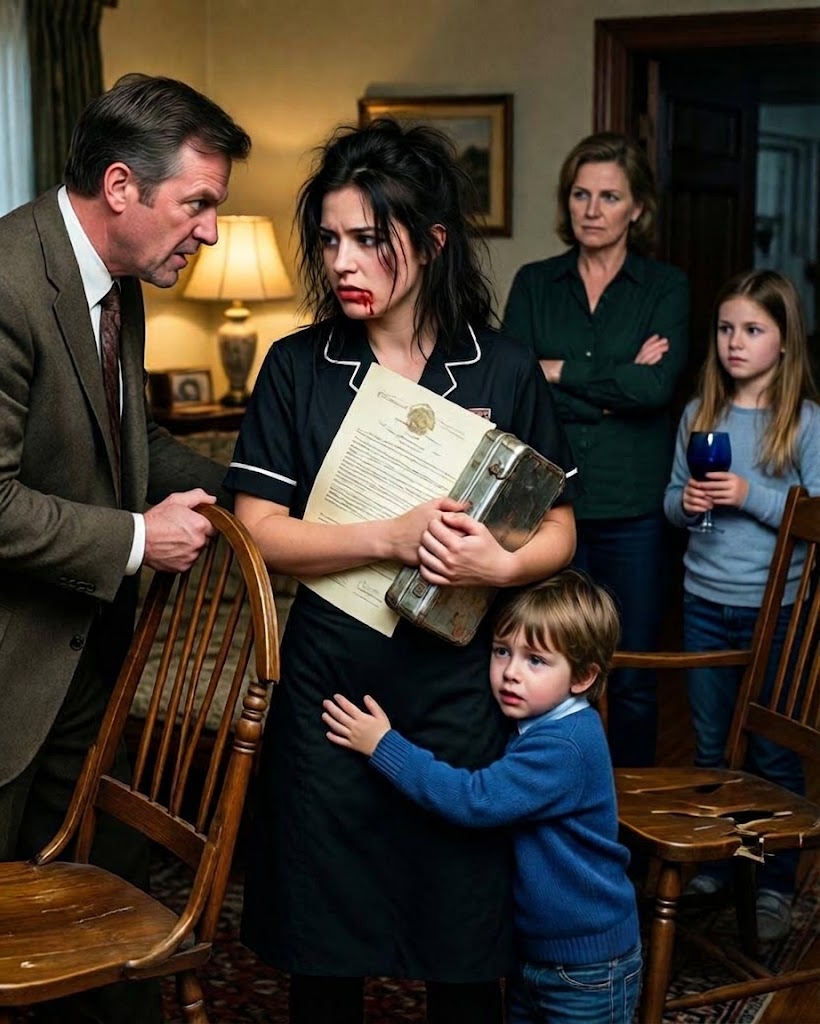
I thought of Liam’s small body trembling against mine while blood ran down my chin.
I said nothing.
Elena opened the sealed county file and removed a thick notary ledger.
The original entry listed the date, the property’s legal description, Grandpa’s identification number, and the names of two witnesses.
One witness had been his accountant.
The other had been the attorney who prepared the deed.
Then Elena produced the delivery receipt.
It was signed by me.
I remembered the day immediately.
Grandpa had called me to his office eight years earlier.
I had been nineteen, frightened, and newly pregnant.
My parents had just told me I had disgraced the family and that no respectable man would ever want me.
Grandpa had not asked who Liam’s father was or why the relationship ended.
He had simply made tea, pushed the dented metal box across his desk, and told me to keep it somewhere safe.
“For the day someone tries to convince you that you have nowhere to go,” he had said.
I signed a paper confirming that I had received the box.
I assumed it contained old photographs, perhaps a little money, maybe one of Grandma’s rings.
I never opened it because doing so felt like admitting I expected my family to abandon me.
Grandpa had known better.
Dad’s lawyer examined the ledger and requested time to verify it.
The judge denied his request to dismiss the case but allowed a brief recess.
Dad turned toward me the moment the judge left.
“You knew,” he hissed.
A court officer stepped between us.
I looked at my father from several feet away.
Without a chair in his hands and a house surrounding him, he seemed smaller than I remembered.
“I learned the night you hit me.”
Mom hurried forward, clutching her folder of family photographs.
“This has gone far enough,” she whispered.
“Tell your lawyer to stop.
We can work something out privately.”
“You called me a pig while I was bleeding.”
Her eyes hardened.
The tears vanished so quickly it was almost impressive.
“You were provoking him.”
Elena touched my elbow before I could answer.
“Do not speak to them without me present,” she said.
Harper stood near the courtroom doors.
She had arrived in a cream coat and expensive boots, dressed as though the hearing were a social event.
For the first time that morning, she was not smiling.
“Where are they supposed to live?” she demanded.
I looked at her.
“You told me to watch what happened when you called Dad.”
Her face tightened.
“I didn’t tell him to hit you.”
“You watched him do it.”
“I was in shock.”
“You posted online that I attacked him.”
“Mom told me that was what happened.”
“You were standing there.”
Harper opened her mouth, but no words came out.
The court officer ordered everyone back to their places.
When the judge returned, Elena placed a small flash drive on the evidence table.
“The attorney who prepared the deed retained a recorded statement from the grantor,” she explained.
“Mr.Parker requested that it be released if the transfer was ever challenged by his son.”
Dad’s attorney objected.
The judge allowed the video provisionally.
The courtroom screen flickered.
Grandpa appeared behind his old walnut desk.
He looked healthier than he had near the end of his life, but his hands were already thin.
A clock ticked softly somewhere outside the camera’s frame.
He stated his full name, the date, and the address of the property.
Then he looked directly into the lens.
“Gregory,” he said, “if this is being played, you finally did what I feared you would do.”
Dad stopped breathing beside his lawyer.
Grandpa explained that he had purchased the house decades earlier and had never transferred it to my father.
Gregory and Diane had been allowed to live there, manage expenses, and present it socially as their own, but ownership remained with Grandpa until the deed was delivered to me.
“My granddaughter has spent her life being told that gratitude requires obedience,” Grandpa continued.
“It does not.
A roof offered with one hand cannot be used as a weapon in the other.”
My eyes burned.
I had spent years believing Grandpa had not noticed.
He had seen every forced apology, every family dinner where Harper’s cruelty became a joke, every envelope of rent my mother accepted while calling me a burden.
On the screen, Grandpa lifted a copy of the deed.
“I am transferring this property freely and while fully competent.
My granddaughter may occupy it, lease it, sell it, or remove any person living there.
No promise was made to Gregory or Diane.
Their continued residence depends entirely upon her consent.”
My father pushed back his chair.
“He hated me,” he said.
The judge warned him again.
Grandpa’s final words were softer.
“My hope is that she never needs this protection.
But hope is not a plan.”
The screen went black.
For several seconds, no one moved.
Then Dad’s lawyer asked for a private conference with his clients.
The evidence did more than establish the deed’s authenticity.
County tax records showed that the property had remained in Grandpa’s name until his death because the deed had not yet been recorded.
Elena explained that recording protected ownership against later claims, but delivery had already completed the transfer between Grandpa and me.
The receipt, video, ledger, witnesses, and original document made Dad’s forgery accusation nearly impossible to sustain.
Elena had recorded the deed two days after I left the hospital.
She had also served my parents with a formal notice terminating their permission to occupy the property.
They ignored it.
Dad tore the notice in half in front of the process server.
Mom sent me twenty-three voice messages in one night.
Some were threats.
Others were prayers.
In one, she said she forgave me.
In the next, she promised every relative would know I was trying to make my parents homeless.
Harper launched her own campaign.
She posted photographs of Mom’s garden, Dad repairing the porch, and childhood Christmases in the living room.
She described the house as my parents’ only asset and me as a vindictive waitress exploiting an old man’s confusion.
She did not post the hospital photographs.
She did not mention the broken chair.
She did not mention that I had paid rent to people who did not own the property.
Elena told me not to respond publicly.
Instead, she collected everything.
Every post, voicemail, threat, and admission went into a file.
At the next hearing, Dad changed strategies.
He no longer claimed the deed was forged.
He argued that Grandpa had promised him the house verbally.
His attorney presented years of repair receipts and property tax payments as proof that Dad believed he was the owner.
Elena asked whether paying expenses created ownership when a valid deed named someone else.
It did not.
Then she presented my rent receipts.
Each envelope had been marked in my mother’s handwriting: GARAGE RENT.
For three years, my parents had collected rent from the legal owner while pretending they were rescuing me from homelessness.
Mom claimed the payments were contributions for food and utilities.
Elena produced text messages in which Mom threatened late fees and eviction if I did not pay by the first of the month.
The judge read one message aloud.
“Your child is not an excuse.
Rent tonight or Dad changes the garage lock tomorrow.”
My mother stared down at her hands.
Dad’s attorney requested another recess.
Outside the courtroom, Harper cornered me near the elevators.
“Mia has a bedroom in that house,” she said.
“She stays there every weekend.
You’re hurting a child.”
I felt the old reflex rise inside me, the instinct to absorb blame before anyone could throw it.
Then I remembered Liam calling for me after the chair struck.
“My child watched Dad hit me,” I said.
“You used your child as an excuse to start the argument, and now you’re using her as a shield from the consequences.”
Harper’s cheeks reddened.
“You’re enjoying this.”
“No.”
That was the truth.
Winning did not feel joyful.
It felt like surgery without anesthesia.
Necessary, precise, and painful.
“I am ending it,” I said.
The assault case moved separately.
Dad initially told police I had rushed at him and he had grabbed the chair in self-defense.
Harper repeated that version in a written statement.
The living room security camera destroyed it.
Dad had installed the camera months earlier to watch a new television he believed delivery workers might steal.
He forgot it recorded sound and automatically stored footage online.
The video showed me standing near the door with Liam beside me.
It captured Dad demanding my keys, my refusal, the chair rising, and my mother calling me a pig while I lay on the floor.
It also captured Harper saying, “She should have listened.”
When investigators confronted her, Harper withdrew her statement and blamed our parents for pressuring her.
Dad accepted a plea agreement rather than face trial.
He received probation, mandatory anger-management treatment, a no-contact order, and financial responsibility for my medical care.
The conviction also strengthened the protective order covering Liam and me.
Mom was not charged for watching, but the recording followed her into every room where she tried to rewrite the story.
Relatives who had condemned me began calling with awkward apologies.
I accepted none of their excuses.
They had not needed the security video to know my family was capable of cruelty.
They had simply needed proof strong enough to make continued silence embarrassing.
Six months after the night of the assault, the property court issued its final order.
The deed was valid.
I was the sole legal owner.
My parents’ permission to occupy the house had been properly terminated.
They were given a final deadline to leave.
Dad refused.
On the last morning, two sheriff’s deputies arrived with the court order.
Elena stood beside me on the sidewalk while movers hired by my parents carried boxes through the front door.
Mom cried loudly enough for the neighbors to hear.
Dad accused the deputies of participating in theft.
Harper filmed until one deputy warned her not to interfere.
I did not enter the house while they were inside.
I waited beneath the maple tree Grandpa had planted when I was born.
Liam held my hand and watched his grandparents’ furniture pass us piece by piece.
“Are we going to live here?” he asked.
“Not yet.”
“Is Grandpa Gregory mad?”
I crouched beside him.
“His feelings are not your job.”
The sentence felt unfamiliar in my mouth.
It was something I should have heard as a child.
When the final truck pulled away, Dad stood at the end of the driveway.
He looked older than he had in court.
“Your grandfather would be ashamed of you,” he said.
I glanced at the brass key in my hand.
“We both saw his video.”
His jaw tightened, but the deputy stepped closer before he could answer.
Mom left a family photograph on the porch.
It showed Harper and me as children standing between our parents at Christmas.
I was smiling toward the camera while Dad’s hand rested heavily on my shoulder.
I carried the photograph inside, removed it from the frame, and placed it in a drawer.
I was not ready to destroy it.
Keeping evidence of the past was different from allowing the past to control the house.
The rooms smelled of furniture polish and stale perfume.
The broken chair was gone, but a pale mark remained on the carpet where my blood had been cleaned.
Elena asked whether I wanted to change the locks immediately.
“Every one of them.”
For the next month, I repaired the garage apartment first.
I replaced the moldy cabinet, repainted the walls, and removed the lock my father had once threatened to change.
Then I rented it to a nursing student at a fair rate under a real lease.
I did not move Liam into the main house right away.
We stayed in the small apartment Elena had helped us find after the hospital.
It was not luxurious, but it was quiet.
No one pounded on the ceiling.
No one demanded my keys.
Liam stopped sleeping in his shoes because he no longer believed we might have to run during the night.
I decided to sell the house.
Some relatives called that decision wasteful.
They said keeping it would prove I had won.
But I did not want to raise my son in rooms that remembered fear.
Ownership gave me the right to choose, and my choice was not to build a future inside my family’s battlefield.
The sale paid my legal expenses, cleared my medical debt, created a college fund for Liam, and allowed me to buy a modest home near his preschool.
It had a blue front door, a small yard, and a kitchen window that caught the morning sun.
Three days after we moved in, someone knocked.
Through the glass, I saw my parents standing on the porch.
Dad wore the same dark coat he had worn to court.
Mom held a suitcase.
They had been staying with Harper, but Harper’s landlord discovered the unauthorized occupants and threatened eviction.
Other relatives had offered temporary couches, not permanent rooms.
For the first time in my life, they had come to my door because they had nowhere else to go.
I kept the chain fastened.
Mom pressed both hands together.
“We made mistakes,” she said.
“Families forgive.”
Behind me, Liam was building a tower on the living room rug.
Dad looked past my shoulder, measuring the hallway and the size of the house.
“We only need a room for a few weeks,” he said.
“You owe us that much.”
There it was.
Not remorse.
Not love.
A new demand dressed as surrender.
Mom began to cry.
“Please.
We are your parents.”
I remembered lying on the carpet while she looked down at me.
I remembered waiting for one flicker of compassion and finding none.
“When I was bleeding,” I said, “you told me I deserved it.”
She lowered her eyes.
“I was upset.”
“When Liam was screaming, neither of you helped him.”
Dad’s voice hardened.
“Are you really going to leave us outside?”
I looked at the suitcase, the anger beneath his shame, and my mother’s tears that appeared only when consequences reached her own door.
“Yes.”
Dad stepped forward, but the chain held.
I raised my phone where he could see it.
“The protective order is still active.
Leave now.”
For a second, his old expression returned.
The one that had filled doorways and silenced rooms.
Then he noticed the camera above my porch and stepped back.
Mom whispered my childhood nickname.
I closed the door.
My hands shook after the lock clicked, but I did not reopen it.
I stood there until their footsteps faded and their car pulled away.
Liam came into the hallway carrying two wooden blocks.
“Who was it?”
“People who cannot stay here.”
He considered that, then placed one block in my hand.
“You can help with my tower.”
We sat together on the rug.
Outside, the porch was empty.
Inside, sunlight spread across the floor of a home where no one had to earn safety through obedience.
For years, my family had taught me that power sounded like shouting, threats, and furniture breaking against skin.
Grandpa had left me a different lesson.
Sometimes power is a deed kept in a metal box.
Sometimes it is evidence placed quietly before a judge.
And sometimes it is a woman closing her own front door and knowing no one on the other side can force it open again.