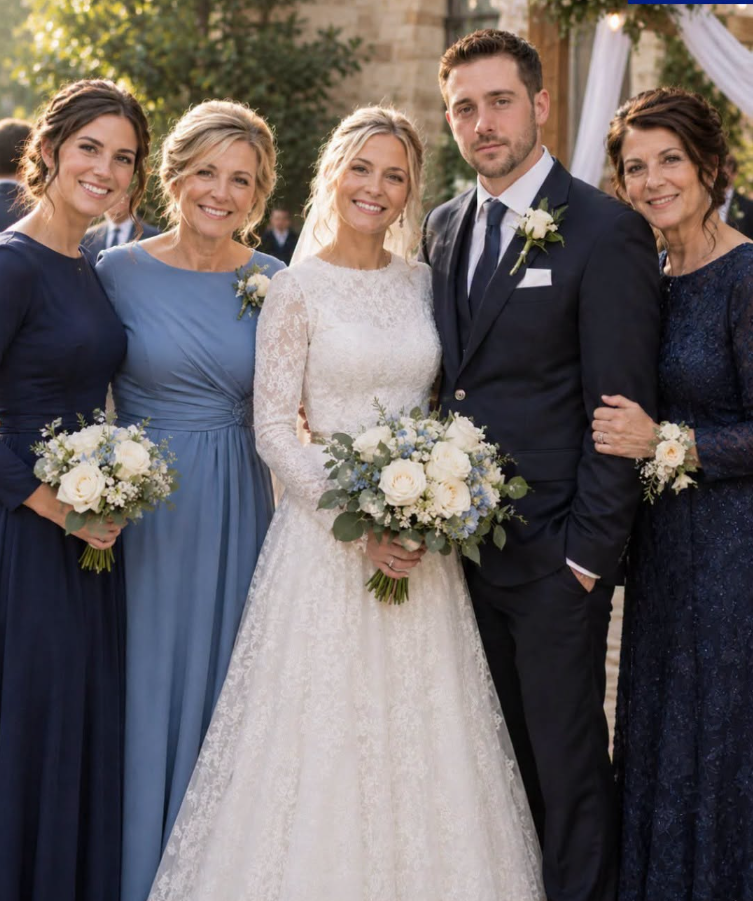
My son’s fiancée asked me not to wear blue to their wedding.
Then I walked into the venue and saw her mother wearing it.
For a few seconds, I honestly wondered whether I had misunderstood the conversation.
But I hadn’t.
I remembered Vanessa’s exact words.
And suddenly, the expensive dress I had bought for her wedding felt like the least important part of what was happening.
My name is Joan, and my son Grant has always been the calm one.
He has never been someone who enjoys arguments. He rarely raises his voice, even when he is angry, and if there is a disagreement, his first instinct is usually to find a compromise.
That is simply who he is.
Vanessa, on the other hand, has always been different.
She is outspoken, confident, and very direct about what she wants.
When Grant first introduced her to me, I actually thought their differences were a good thing.
I believed she pushed him to be more confident.
And I thought his calm nature helped soften some of her sharper edges.
For a long time, I believed they balanced each other perfectly.
Then, one week before their wedding, Vanessa called me.
“Joan, could you please not wear blue to the wedding?”
I was confused.
I had already bought my dress.
It was navy, elegant, and cost me $240.
“Why?” I asked. “Is something wrong with it?”
“No, no,” she quickly replied. “It’s beautiful. Blue is just part of the wedding palette, and I don’t want it to look strange in the photographs.”
I remember staring at the dress hanging in my closet while she explained.
I could have argued.
I could have told her that navy was hardly some outrageous choice.
I could have asked why the color mattered so much.
But I didn’t want to create tension one week before my son’s wedding.
So I told myself it wasn’t worth the fight.
I bought another dress.
It cost me more money, but I convinced myself it was a small sacrifice for Grant’s happiness.
Then the wedding day arrived.
I walked into the venue.
And stopped dead.
Vanessa’s mother was wearing blue.
Not just any blue.
She was wearing a beautiful, floor-length blue gown that immediately stood out in the room.
For a moment, I genuinely thought I had somehow walked into the wrong wedding.
I had spent another $240 because Vanessa specifically told me not to wear blue.
And now her own mother was standing there dressed in exactly that color as if nothing were unusual.
I looked around.
Then I noticed two of Vanessa’s aunts.
They were wearing blue too.
And they weren’t dressed randomly.
Their dresses coordinated.
They even had matching corsages.
Suddenly, I felt something shift inside me.
This wasn’t about the wedding photographs.
It had never been about the photographs.
I found Vanessa before the ceremony.
“You told me no one was supposed to wear blue.”
She shifted uncomfortably.
“Not exactly.”
“Then why did you tell me not to?”
Before Vanessa could answer, her mother stepped closer.
“Blue is for family.”
I stared at her.
“I’m the groom’s mother.”
She gave me a tight little smile.
It wasn’t an apology.
It wasn’t even an explanation.
It was a smile that told me exactly where she believed I belonged.
Outside.
Separate.
Not part of the family they were presenting to the world that day.
I turned toward my son.
“Grant?”
He wouldn’t meet my eyes.
“Mom,” he whispered. “Please. Not now.”
I looked at him for a long moment.
Then I stepped back.
Fine.
I wasn’t going to start an argument on my son’s wedding day.
But once I knew what I was looking at, I began noticing things I hadn’t noticed before.
The little moments.
The interruptions.
The way Vanessa spoke to Grant.
The way Grant reacted.
At one point, Grant suggested taking a photograph with just the two of us.
Just mother and son.
Something I had been looking forward to for months.
Vanessa immediately shook her head.
“We don’t have time for that.”
Grant looked at her.
“Maybe just one—”
“Grant. We have a schedule.”
He went quiet.
I watched him lower his eyes.
It was such a small moment that someone else might not have noticed.
But I did.
I was his mother.
And I knew my son.
Later, during dinner, Grant started telling his uncle about their honeymoon plans.
He barely got through a few sentences before Vanessa interrupted him.
“No, honey. That’s not what we’re doing anymore. Remember?”
A few people laughed.
Grant laughed too.
But his face turned red.
It wasn’t the red of embarrassment from a harmless joke.
It was the look of someone swallowing words he wanted to say.
I waited until I had a chance to pull him aside.
“What is going on?”
“Nothing.”
“Grant.”
He looked away.
“Mom, it’s fine.”
“Forget the blue dress. I’m talking about you.”
He sighed.
“It’s our wedding day.”
“I know.”
“She’s stressed.”
“Grant, I’ve watched her shut you down all day, and you haven’t said a word.”
He didn’t answer.
“Look at me.”
He finally raised his eyes.
I asked him the question I had been afraid to ask.
“Are you actually happy?”
For a moment, something changed in his face.
He looked like he wanted to tell me something.
Something important.
Something he had been holding inside.
But before he could speak, Vanessa appeared.
“There you are!”
She looked at Grant.
“Seriously? I’ve been looking everywhere. We have a schedule.”
Then she turned toward me and laughed.
“And Joan, could you please stop stealing my groom?”
A couple of people nearby laughed.
Grant didn’t.
He simply followed Vanessa back inside.
I stood there alone for a moment.
I was furious.
Part of me wanted to grab my son by the arm, take him outside, and demand that he tell me what was really happening.
But this was his wedding day.
So I returned to my table.
And I kept my mouth shut.
For the next twenty minutes, I watched Vanessa laugh with her family as if nothing unusual had happened.
Grant barely spoke.
He sat beside her, smiling when expected to smile, answering when spoken to, but looking more uncomfortable with every passing minute.
Then I heard it.
A sharp clink.
A spoon against a champagne glass.
I looked up.
Grant was standing.
My heart skipped a beat.
Vanessa looked at him, clearly surprised.
Grant held the champagne glass in one hand.
His tie was slightly loosened.
His face was red.
And his grip on the glass was so tight that for a second I thought he might break it.
I had never seen my quiet, peaceful son look like that.
Not once.
Then he spoke.
“I’d like to make a toast.”
The room gradually became quiet.
Grant looked around.
Then his eyes found mine.
And that was when I understood.
This wasn’t going to be an ordinary wedding toast.
“I need to say something,” he began.
Vanessa’s expression changed.
“Grant…”
He didn’t look at her.
Instead, he looked at me.
“I owe my mother an apology.”
Nobody moved.
Grant took a breath.
“Three days ago, I found messages on Vanessa’s tablet.”
Vanessa’s face went pale.
Grant continued.
“There was a group conversation about the wedding. And in that conversation, I read what was said about my mother.”
The room became completely silent.
Grant explained that Vanessa had referred to me as “the other mother.”
Then she had explained why she didn’t want me wearing blue.
She didn’t want me matching the people who were going to appear in what she called the “real family pictures.”
I felt my chest tighten.
So that was the reason.
It wasn’t about the color.
It wasn’t about photographs.
It was about drawing a line.
A line between her family and mine.
Between the people she considered part of the “real” family and the woman who had raised the groom.
Grant looked at me.
“I knew about the dress three days ago.”
I stared at my son.
“Why didn’t you tell me?”
His eyes dropped.
“Because I thought I could handle it.”
He paused.
“I thought keeping the peace was the right thing to do.”
Vanessa stood.
“This is unbelievable.”
Grant finally looked at her.
“No. What’s unbelievable is that I kept pretending everything was fine.”
Her expression hardened.
“You’re humiliating me in front of everyone.”
“I know,” he said quietly. “And I’m sorry. But I’ve been humiliated privately for a long time.”
The room remained silent.
Grant began talking about things that went far beyond the dress.
He said Vanessa had started making decisions without him.
Plans would change, and he would find out afterward.
Financial decisions were sometimes made without discussing them with him first.
When he disagreed, conversations often ended because Vanessa simply decided they were over.
And slowly, without even realizing it, Grant had stopped expressing what he wanted.
He had convinced himself that avoiding conflict was the same thing as building a peaceful marriage.
But it wasn’t.
He had started to feel invisible.
He admitted he had even begun worrying about their new mortgage, wedding insurance, shared investment accounts, and how important financial and estate decisions would be handled in the future if he continued allowing himself to disappear inside the relationship.
Then he said something that made the room even quieter.
“I thought keeping the peace made me a good husband.”
His voice shook.
“But somewhere along the way, I disappeared.”
I looked at my son.
And for the first time that entire day, I saw him standing up for himself.
Not angrily.
Not cruelly.
Just honestly.
Vanessa accused him of destroying their wedding.
But Grant remained calm.
“I didn’t destroy this wedding,” he said. “I’m finally telling the truth about what has been happening.”
She shook her head.
“You could have talked to me privately.”
“I tried.”
He paused.
“Every private conversation ended whenever you decided it was over.”
Vanessa looked around the room.
For the first time, her confidence seemed to disappear.
Then her mother spoke.
“It was only a dress.”
Grant turned toward her.
“No. It wasn’t.”
He looked at me.
“It was never about blue.”
And he was right.
The blue dresses had simply made everything visible.
They had taken something that could have been dismissed as a small wedding preference and turned it into a symbol of everything Grant had been refusing to confront.
Eventually, Vanessa’s anger began to fade.
She admitted that the coordinated dresses had been cruel.
She apologized for treating me as though I did not belong.
I listened.
But I didn’t immediately embrace her.
Some wounds need more than one apology.
Grant didn’t announce that the marriage was over that night.
Instead, he and Vanessa went outside.
They were gone for nearly an hour.
People sat quietly, unsure what to say.
I stayed where I was.
I didn’t know what would happen next.
Eventually, Grant returned.
His eyes were swollen.
But his shoulders looked lighter.
For the first time all day, he looked like himself again.
He walked over to me.
“Mom,” he said quietly, “I’m coming home with you.”
I put my hand on his shoulder.
Vanessa eventually approached me.
She apologized again.
This time, there was no attitude in her voice.
No smile.
No attempt to explain it away.
Just an apology.
I accepted her words.
But I still didn’t offer her an immediate embrace.
Forgiveness, I had learned, doesn’t always happen in one moment.
Sometimes people have to prove that they understand the damage they caused.
Outside, in the parking lot, Grant stood beside my car.
For a moment, neither of us said anything.
Then he looked at me.
“Did I ruin my wedding?”
I opened the car door.
“No,” I told him.
He looked surprised.
I smiled sadly.
“I think you finally showed up for it.”
He lowered his head and let out a long breath.
The wedding had not gone the way anyone expected.
The photographs would never tell the whole story.
People would probably remember the toast.
They would remember the uncomfortable silence.
They would remember the bride crying.
They might even remember the blue dresses.
But I knew what those dresses had really done.
They were meant to separate families.
They were meant to make it clear who belonged and who didn’t.
Instead, they forced my son to see something he had spent months trying not to see.
Love should never require someone to disappear.
Compromise should never mean surrendering your voice.
And keeping the peace isn’t always the same as creating a peaceful life.
Sometimes, the bravest thing a quiet person can do is finally say, “This isn’t okay anymore.”
That day, the blue dresses were supposed to mark the boundaries of a family.
Instead, they reminded my son that he had a right to belong in his own life.


