The silverware stopped moving when Sienna looked across my family’s dinner table and laughed at my clothes.
“Honestly, Ella, I don’t know why you even bother coming to these dinners,” she said. “You look like a tired mid-level secretary who wandered into the wrong mansion.”
Nobody laughed.
Not one person.
The autumn dinner had begun politely enough.
Our suburban estate was filled with extended relatives, business associates, and longtime family friends. Warm chandeliers cast a soft glow over the long dining table, while antique silver from my late mother’s collection rested beside every plate.
Catering staff moved quietly between the guests, carrying dishes and refilling glasses.
Then Sienna arrived thirty minutes late.
She walked into the dining room wearing an expensive designer coat, complained loudly about traffic, and tossed the coat over a vintage chair as though the furniture belonged to her.
During the first course, she repeatedly spoke down to the staff.
By the main course, she had apparently decided that I was her next target.
“It must be embarrassing,” she continued, smiling across the table, “living here like a charity case while my mom runs the household.”
The atmosphere changed instantly.
I could feel the discomfort spreading around the table.
My father, Charles, cleared his throat.
Then he looked down at his plate.
I slowly placed my fork beside the silver dinner plate and folded my linen napkin.
“Sienna,” I said calmly, “you’re a guest in this house. Treat the staff with respect and mind your manners at this table.”
Her smile disappeared.
She opened her mouth to answer.
But she never got the chance.
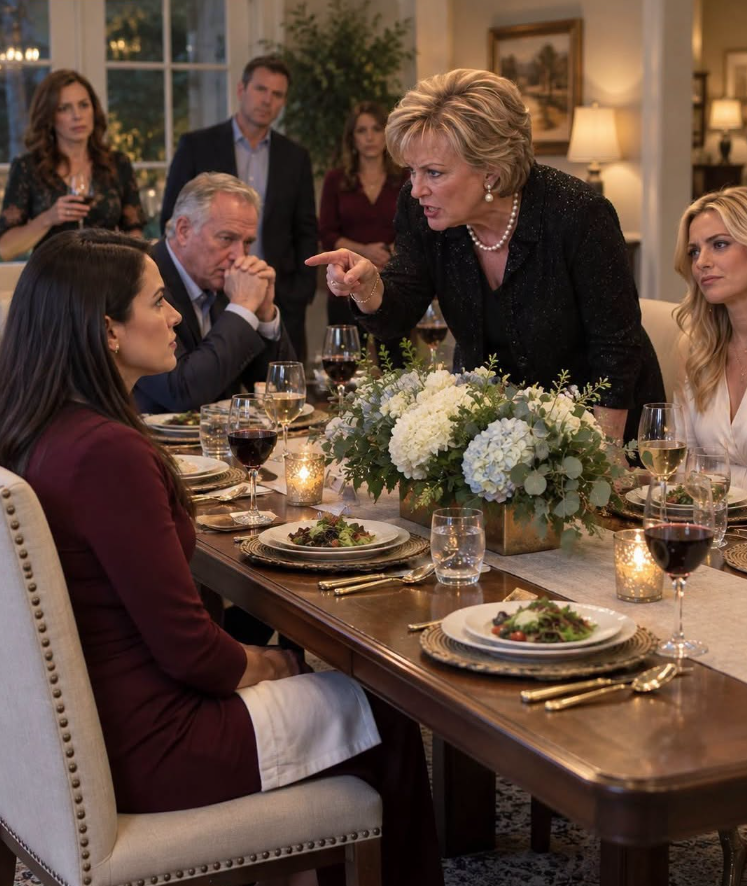
Brenda shot up from her chair.
My stepmother planted both hands against the polished table. Her face was flushed with anger as she leaned toward me.
“How dare you speak to my daughter like that?”
Several relatives froze with their glasses halfway to their mouths.
Brenda pointed directly at me.
“Sienna is a young woman of stature. You will not talk down to her in front of this family.”
I held her stare.
Then she said the words that changed everything.
“She is not your sister. Don’t tell her what to do.”
For a few seconds, nobody moved.
The only sound I could hear was the faint hum of the chandelier overhead.
Sienna leaned back in her chair with a satisfied smile.
Brenda seemed to believe she had finally put me in my place.
What she didn’t understand was that she had just made something very clear to me.
And once I understood it, I couldn’t unlearn it.
For the previous eighteen months, Brenda and Sienna had been enjoying a life they barely understood.
My father had met Brenda through the country-club social circle.
After they married, Brenda moved into our estate with her nineteen-year-old daughter, Sienna.
I welcomed them.
Not because I needed another family member.
Because my father was happy.
After losing my mother, Claire, I wanted Charles to have companionship and a chance at a peaceful life again.
So I made room for them.
I kept my own life deliberately quiet.
I worked long hours as a managing director. I wore simple business clothes. I drove a modest sedan. I rarely talked about money.
Brenda saw those things and made assumptions.
She saw the mansion.
She saw the staff.
She saw my father’s comfortable lifestyle.
And because Charles looked like the traditional patriarch of the family, she assumed he was the person paying for everything.
She never asked.
Sienna never asked either.
Instead, they filled in the blanks themselves.
What neither of them understood was how much of my adult life had been shaped by my late mother.
Claire had spent decades building Sterling Heights Holdings into a major commercial real-estate and asset-management company with properties across three states.
I had worked beside her.
I learned the business from her.
I learned contracts.
I learned ownership structures.
I learned how money moved between companies, trusts, investments, and operating accounts.
And after she died six years earlier, I remained closely involved in the business.
Eventually, the responsibility became mine.
Our family had never treated money like something to brag about.
It was something to manage carefully.
I knew exactly which expenses came from which accounts.
I knew which signatures carried authority.
I knew who legally owned what.
And I knew exactly how much money was being spent to maintain the lifestyle Brenda and Sienna had become accustomed to.
I simply didn’t talk about it.
That silence made them comfortable.
Then it made them arrogant.
Sienna’s luxury BMW was paid through an arrangement I had approved.
Her private-school tuition cost roughly $60,000 a year.
She also had spending money and access to household privileges that most nineteen-year-olds could only dream about.
Brenda received a $15,000 monthly allowance.
There were secondary cards, household expenses, staff access, and countless small luxuries that slowly became normal to them.
I never demanded gratitude.
I didn’t expect them to bow to me.
I didn’t even need them to know exactly how the money was being handled.
I wanted one thing.
Respect.
Apparently, that was too much to ask.
For more than a year, I ignored Sienna’s comments.
She criticized my clothes.
She mocked my work schedule.
She made jokes about how little interest I showed in parties and social events.
Brenda regularly told her friends about the wonderful life she had married into.
I let it go.
I told myself it was easier to ignore.
My father had already lost enough.
If Brenda made him happy, I could tolerate some unpleasantness.
But that night was different.
She had humiliated me in front of our entire family.
And when I finally defended myself, Brenda didn’t simply disagree.
She drew a line.
“She is not your sister.”
Then she told me I had no right to tell Sienna what to do.
I looked at my father.
He still hadn’t said anything.
That silence hurt more than Brenda’s words.
I looked at Sienna.
She was smiling.
She thought she had won.
I could have explained everything right there.
I could have told them whose name appeared on the estate documents.
I could have explained who controlled Sterling Heights Holdings.
I could have told Sienna exactly who had been paying her tuition and BMW lease.
I could have reminded Brenda where her monthly allowance came from.
But I didn’t.
Instead, I smiled.
It wasn’t a big smile.
Just enough to make Brenda’s expression flicker.
“Fine,” I said.
One word.
That’s all.
I stood from the table, gave our stunned guests a polite nod, and walked out of the dining room.
Nobody stopped me.
My heels clicked against the marble floor as I crossed the foyer and walked up the grand staircase.
I didn’t turn around.
By the time I reached the second floor, my anger was gone.
What remained was something much more useful.
Clarity.
Brenda had told me exactly where I stood.
Sienna wasn’t my sister.
I had no authority over her.
Fine.
I walked into my private suite, closed the double doors, and locked them.
Across from the windows sat my executive desk.
I opened my laptop.
The accounts were neatly organized.
There was the vehicle agreement.
The tuition account.
The secondary card.
The monthly transfers.
The access permissions.
Every privilege had a name attached to it.
And every privilege could be changed.
Downstairs, I imagined Brenda and Sienna were probably still talking about the dinner.
They probably believed I had walked away because I had lost the argument.
They had no idea what was happening upstairs.
I picked up my phone.
There were three people I needed to contact.
I found the first name in my contacts and pressed call.
The line connected almost immediately.
“Good evening, Miss Marshall,” a familiar voice said.
I glanced at the account displayed on my laptop.
Then I leaned back in my chair.
“I need you to make a change tonight.”
The first call concerned Sienna’s BMW.
I instructed our legal officer to terminate the financial arrangement and begin the process of recovering the vehicle.
The second call went to the university.
I withdrew my financial sponsorship.
The third call went to the bank.
Brenda’s secondary card was to be frozen, and the monthly transfer into her personal account was to end.
There was no shouting.
No dramatic threats.
No revenge speech.
Just three quiet decisions.
By midnight, the lifestyle they had taken for granted was gone.
And they had no idea.
At 6:30 the next morning, Sienna’s screams echoed across the estate.
She ran barefoot onto the driveway just as a flatbed truck began lifting the white BMW from the pavement.
“What are you doing?” she shouted.
The driver simply followed the instructions he had been given.
Sienna stood there in disbelief as the car disappeared down the driveway.
But that wasn’t the end.
Minutes later, another notification arrived.
Her university enrollment had been suspended because an unpaid semester balance of $30,000 was now outstanding.
For the first time, Sienna realized that the money she had always assumed would simply appear was no longer coming.
Brenda’s discovery came later that morning.
She tried to use her card to reserve a $5,000 resort vacation.
The transaction was declined.
She tried again.
Declined.
She called the bank.
Then she stormed into my father’s study.
“This is a mistake,” she told Charles. “You need to call an attorney.”
Charles looked at her.
For the first time, he couldn’t protect her from a reality he had avoided himself.
“It’s not a banking error,” he said.
Brenda stared at him.
Charles explained what I had never bothered to explain to them.
After Claire died six years earlier, her estate had passed to me.
The family trust was under my control.
The mansion belonged to me.
The controlling investments belonged to me.
Sterling Heights Holdings was under my authority.
Charles had no ownership interest that would allow him to restore Brenda’s benefits.
He didn’t have mortgage authority over the estate.
He couldn’t simply walk into a bank and reverse my decisions.
The comfortable life Brenda believed came from marrying Charles had never actually belonged to Charles.
It had been built on Claire’s work and placed under my responsibility.
Brenda and Sienna finally understood.
They had mistaken access for ownership.
And they had mistaken generosity for obligation.
By that afternoon, both women came to my office.
Their anger was gone.
They were pleading now.
Sienna said she didn’t realize what she had said had been so serious.
Brenda insisted that dinner had been an emotional moment and that nobody had really meant what they said.
I listened.
Then I reminded them of the sentence that had started everything.
“She is not your sister.”
I looked at Brenda.
“You were very clear.”
She lowered her eyes.
I continued.
“You told me I have no right to tell her what to do. I accept that. But if she isn’t my sister and I have no responsibility toward her, then I also have no responsibility to finance her life.”
Neither woman had an answer.
I told them the payments were permanently canceled.
Then I gave them until evening to leave my property.
My security team escorted them out.
The situation became even clearer when Brenda’s attorney reviewed the prenuptial agreement she had signed before marrying Charles.
The agreement protected my mother’s assets and prevented Brenda from claiming property that had never belonged to my father.
There was nothing for her to take.
Three weeks later, Brenda filed for divorce.
By then, she had fully realized that Charles did not have the fortune she had assumed he possessed.
For the first time, the life she had built around our family had to be supported by her own choices.
Sienna eventually found work and reportedly enrolled in community-college night classes.
I never tried to confirm the details.
It wasn’t my business anymore.
My father, however, was still my father.
And eventually, Charles came to me with an apology.
He admitted that he had remained silent during too many moments when Brenda and Sienna mistreated me.
He said he had convinced himself that staying quiet was “keeping the peace.”
But he finally understood what that peace had really meant.
It meant I carried the conflict alone.
“I should have defended you,” he told me.
He was right.
I forgave him.
Not because what happened didn’t matter.
Because he was still my father, and I didn’t want the rest of our relationship defined by one painful chapter.
I arranged for him to have a comfortable cottage on the estate grounds.
He could live there quietly and rebuild his life without pretending to be someone he wasn’t.
As for me, I returned my attention to Sterling Heights.
I expanded the company through two major acquisitions.
And then I made a decision that would have made my mother proud.
I created a charitable trust in Claire’s name.
It would provide scholarships and housing assistance to hardworking young women who didn’t have family wealth to rely on.
Claire had taught me that money was never just about what you could buy.
It was about what you could build.
What you could protect.
And, when used wisely, what you could give someone else a chance to become.
Looking back, I don’t regret helping Brenda and Sienna.
I regret allowing their disrespect to continue for as long as it did.
There is a difference between generosity and obligation.
I had been generous.
They had decided I was obligated.
That was their mistake.
The October dinner changed more than the relationship between me, Brenda, and Sienna.
It changed the way I understood boundaries.
I didn’t need to scream.
I didn’t need to threaten anyone.
I didn’t need to humiliate them in return.
Brenda gave me the answer herself.
“She is not your sister.”
So I accepted her words.
And the next morning, I stopped treating Sienna like family when Brenda had already insisted that she wasn’t.
The BMW was gone.
The tuition was gone.
The allowance was gone.
The cards were gone.
The privileges were gone.
What remained was the truth.
Money had never made them family.
It had only made it easier for them to pretend they were entitled to what I provided.
And perhaps that was the greatest lesson of all.
Generosity means something only when it is freely given.
The moment someone treats it as a right, it stops being generosity and becomes an expectation.
That night, Brenda thought she was putting me in my place.
Instead, she gave me the permission I had been too patient to give myself.
I simply smiled and said, “Fine.”
Sometimes, one quiet word is enough to change everything.


