“I refuse to pay $50,000 for your cruise, Lilia.”
The words came out quietly, but the room changed instantly.
My daughter-in-law’s manicured fingers crushed the glossy brochure in her hand. Her jaw tightened. David, my only son, sat between us on the couch and stared at the carpet.
Lilia stood.
“I think you misunderstood,” she said. “This isn’t a request.”
My heart hammered, but I kept my voice steady.
“I understood perfectly. The answer is no.”
Her hand moved before I could react.
The sharp sound cracked across the living room.
My cheek burned.
I looked at David, waiting for him to stand up, say something, do anything.
He did not.
“Then find somewhere else to live!” Lilia shouted.
David finally raised his eyes.
“Mom,” he said quietly, “maybe she’s right.”
That hurt more than anything else.
I had raised David alone after his father left when he was three.
I worked double shifts at a diner, counted every dollar, and gave him opportunities I never had.
Now he folded his arms.
“We’ve carried you long enough.”
I stared at him.
“I pay rent. I buy groceries. I helped with your car.”
Lilia laughed.
“Eight hundred a month? David makes six figures. That’s nothing.”
“Then why do you need my $50,000?”
David’s face hardened.
“Because we deserve this trip.”
That was when I understood.
They did not see my savings as mine.
They saw it as money they had not collected yet.
I stood and picked up my purse.
“I’ll pack.”
As I reached the stairs, David called after me.
“Mom, one more thing.”
For half a second, I hoped he had changed his mind.
Then he said, “I’m going to need every penny you have saved. Consider it compensation.”
I did not answer.
Twenty minutes later, everything I still owned fit into two suitcases and one box of photo albums.
Lilia was already on the phone in the kitchen, telling someone how relieved she was that I had finally agreed to move out.
David never came to the door.
Outside, my old Honda sat in the driveway.
I loaded the trunk, got behind the wheel, and realized I had nowhere to go.
At sixty-two years old, I was suddenly sleeping in my car.
Three nights passed that way.
On the fourth morning, exhausted and unsure what came next, I drove to the harbor.
The water was bright under the morning sun.
Cruise ships towered over the marina, white decks stacked against the blue sky.
Then I saw a man in a captain’s uniform standing high above the dock.
Silver hair.
Straight shoulders.
A profile I had not seen in forty years.
James Morrison.
My first love.
When our eyes met, he froze.
Then he smiled.
“Marlene Patterson?”
No one had called me that in decades.
Minutes later, I was sitting inside the captain’s quarters of the Sea Star with a hot cup of coffee in my hands while James listened to everything.
The demand for $50,000.
Lilia’s anger.
David’s silence.
The nights in my car.
When I finished, James leaned forward.
“What are you going to do now?”
“I don’t know. Find a cheap apartment. Maybe a job.”
He studied me for a long moment.
“What if there’s another option?”
James was not only the captain.
He was part owner of Morrison Maritime, a twelve-ship cruise company, and he needed someone to help oversee guest services across the fleet.
I almost laughed.
“I’ve waited tables most of my life.”
“That’s exactly why you understand people,” he said.
Six weeks later, my life looked nothing like it had the night I left David’s house.
I trained every day.
Guest services.
Staffing.
Budgets.
Passenger complaints.
Operations.
Skills I had spent decades believing were ordinary suddenly mattered.
Then James made the partnership official.
The same $50,000 Lilia had demanded became my investment.
I became a twenty-five-percent owner.
And vice president of guest services.
David knew none of it.
He called once only when he needed money again.
“We’re having cash problems,” he admitted.
I listened calmly.
Then I told him, “I’m not giving you another dollar.”
His voice turned cold.
“Then don’t come to us when you need family.”
I looked out over the harbor from my office.
“I’m already on my own, David.”
Weeks later, James brought me another piece of news.
“Your son and daughter-in-law booked a cruise.”
I looked up.
“Which ship?”
“The Sea Star.”
They had somehow found enough credit to take the anniversary trip they claimed they could not survive without.
And they were about to board a ship they had no idea I partly owned.
On embarkation morning, I stood near guest services in a navy blazer, my badge visible.
Lilia entered the atrium first, designer luggage behind her, already complaining about their cabin.
David followed.
Neither recognized me.
Lilia demanded an upgrade.
I stepped forward.
“Is there a problem I can help with?”
She looked directly into my face.
Nothing.
To her, I was just another employee.
Earlier that morning, they had argued at the desk because the balcony upgrade cost $5,600.
Lilia snapped at David for admitting their cards were nearly maxed out.
I offered them a complimentary suite and introduced myself as “Marlene Morrison.”
She shook my hand without recognition and thanked me for finally providing “competent management.”
Even David only gave me a puzzled second glance.
That silence told me exactly how little they had ever really looked at me.
For the next three days, I watched them treat me exactly the way they had before: as someone whose job was to solve their problems.
Then lunch on the third day changed everything.
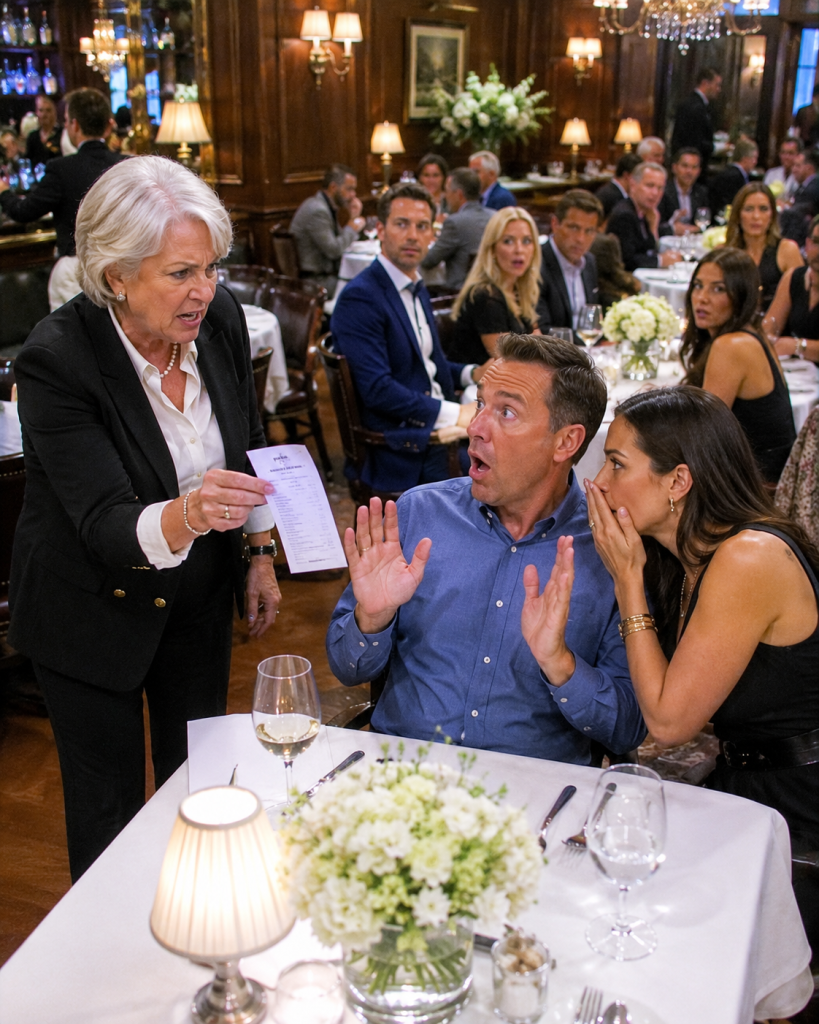
Lilia stood in the dining room berating a young server named Carmen over a salad.
“I want her fired.”
The surrounding tables went quiet.
I walked over.
“Carmen is one of our finest staff members.”
Lilia turned on me.
“Are you contradicting me?”
“I’m correcting the record.”
Her eyes narrowed.
She stared at my face longer this time.
Something shifted.
“Don’t I know you from somewhere?”
Across the table, David finally looked up.
His eyes locked on mine.
The color drained from his face.
His lips parted.
“Mom?”
The word barely left David’s mouth.
But I heard it.
Everyone in the dining room heard it.
For several seconds, nobody moved.
Lilia stared at me.
Then at David.
Then back at me.
Her face slowly lost its color.
“Mom?” she repeated.
I took a quiet breath.
“Yes, David.”
His chair scraped backward so violently that several people turned to look.
He stood.
His eyes moved over my navy blazer, the gold name badge pinned to my chest, and the small silver emblem beneath my name.
VICE PRESIDENT — GUEST SERVICES.
He swallowed.
“You…”
His voice broke.
“You work here?”
I almost smiled.
“No.”
David blinked.
“I own part of it.”
Silence.
Lilia’s mouth fell open.
Carmen stood frozen beside me, still holding the tray she had been carrying.
The dining room seemed to shrink around us.
David stared at the badge again.
“What did you just say?”
“I said I own part of Morrison Maritime.”
Lilia gave a short, nervous laugh.
“That’s impossible.”
I looked at her.
“Why?”
“Because…”
She stopped.
Her eyes traveled over me again.
For the first time in years, she was actually looking at me.
Not at the clothes I wore.
Not at the car I drove.
Not at the grocery bags I carried.
Not at the woman she had decided was old, dependent, and disposable.
She was looking at me.
And finally, she was seeing someone she had never bothered to know.
David shook his head.
“You’re lying.”
“I don’t need to.”
He looked around the room.
Then his gaze returned to me.
“You’re really a part owner?”
“Yes.”
“How?”
“That is a long story.”
Lilia stepped forward.
“You mean the money?”
I said nothing.
Her eyes widened.
“The fifty thousand?”
I nodded.
Her expression changed.
For the first time, I saw fear.
“You used the money we asked for?”
“No.”
I held her gaze.
“I used my money.”
David looked confused.
“What money?”
“The fifty thousand dollars you told me I owed you.”
His face tightened.
“I never said you owed me that.”
“You said you were going to take every penny I had saved.”
“I was angry.”
“You were very clear.”
Lilia interrupted.
“This is ridiculous. You can’t possibly be a partner in a company like this.”
James appeared at the entrance to the dining room.
He had been watching from a distance.
He walked toward us calmly.
“Actually, she can.”
David looked at him.
Then his face changed again.
“You’re…”
James extended his hand.
“James Morrison.”
David stared at the hand but didn’t take it.
“The captain.”
“Yes.”
Lilia looked between us.
“You know my mother-in-law?”
James smiled faintly.
“I’ve known Marlene for forty years.”
David’s eyebrows pulled together.
“Forty?”
James glanced at me.
“Longer than that, if we’re counting the years before we lost touch.”
Lilia looked stunned.
David looked like the floor had disappeared beneath him.
“You knew her before?”
James nodded.
“She was my first love.”
That sentence hit harder than I expected.
Not because of James.
Because of David.
My son had spent years acting as though my life had begun the day he needed something from me.
As though I had never been young.
Never had dreams.
Never been loved.
Never had a life before motherhood.
He had never asked.
He had never cared.
Now he was learning all of it in front of strangers.
Lilia recovered first.
She folded her arms.
“This doesn’t change anything.”
I looked at her.
“What exactly doesn’t it change?”
“You are still David’s mother.”
“Yes.”
“So we’re family.”
I almost laughed.
“Are we?”
Her jaw tightened.
“Of course we are.”
I shook my head.
“You stopped treating me like family long before I stopped paying your bills.”
David stepped forward.
“Mom, can we talk privately?”
I looked at him.
“We are talking.”
“Not here.”
“Why?”
He glanced around the dining room.
People were watching.
Carmen was watching.
The other servers were watching.
Passengers at nearby tables were pretending not to listen.
David lowered his voice.
“Please.”
For a moment, I remembered a little boy with scraped knees running into my kitchen.
Mom, look what I did.
Mom, can you help me?
Mom, don’t leave.
Mom, I love you.
I had spent thirty-five years loving that boy.
But that boy had grown into a man who watched his wife slap me and then asked me for money.
So I simply said,
“You should have thought about privacy before humiliating me in my own home.”
David flinched.
Lilia stepped closer.
“Let’s not make this dramatic.”
I stared at her.
“You hit me.”
Her lips parted.
“I was angry.”
“You hit me.”
“It was one slap.”
“One slap is still a choice.”
She looked away.
Carmen quietly set her tray down.
I turned toward her.
“Carmen.”
“Yes, ma’am?”
“You’re not fired.”
Carmen’s eyes widened.
“Thank you.”
Lilia scoffed.
“This is absurd.”
“No,” I said.
“This is accountability.”
I looked at the dining room.
Then at my son.
“You two are passengers on this ship. You will be treated exactly like every other passenger.”
David exhaled.
“Mom…”
“But there will be no special treatment.”
Lilia stared at me.
“You’re going to throw us off?”
“No.”
“Then what?”
“I am going to let you finish your cruise.”
She looked confused.
“Why?”
“Because you paid for it.”
David looked at me.
Then I added,
“And because I want you to experience what it feels like to receive something you didn’t earn.”
His face tightened.
I walked away.
Behind me, I heard Lilia whisper,
“This isn’t over.”
I stopped.
Then turned around.
“No.”
I smiled sadly.
“It isn’t.”
That evening, James found me on the upper deck.
The sun was disappearing behind the horizon.
The ocean looked endless.
I rested my hands on the railing.
“You okay?” he asked.
“I don’t know.”
He stood beside me.
“You handled it better than most people would.”
“I wanted to scream.”
“You didn’t.”
“I wanted to slap her back.”
“You didn’t.”
“I wanted David to feel what I felt.”
James looked at me.
“And did he?”
I thought about his face.
“Yes.”
For a moment, neither of us spoke.
Then James said,
“You don’t have to punish yourself for loving your son.”
I closed my eyes.
“I keep asking myself where I went wrong.”
“You didn’t.”
“I gave him everything.”
“You gave him everything you knew how to give.”
“And maybe that was the mistake.”
James shook his head.
“No. Loving someone isn’t the mistake.”
He paused.
“Believing love means tolerating cruelty is.”
I looked at him.
Those words stayed with me.
That night, I returned to my cabin.
For the first time in weeks, I opened the box of photographs I had carried out of David’s house.
There were pictures of David at five.
David at ten.
David on his first day of school.
David at eighteen.
David at his college graduation.
And one photograph I hadn’t looked at in years.
It was me.
Twenty-two years old.
Standing beside James.
Both of us laughing.
I remembered that woman.
She had wanted to travel.
She had wanted to open a little restaurant.
She had wanted children.
She had wanted a home filled with music.
Then life had changed.
James and I had separated.
David’s father had walked away.
And I had become a mother before I had ever learned how to become myself.
I closed my eyes.
For years, I had thought sacrifice was the same thing as love.
That night, I finally understood the difference.
Sacrifice was giving someone a chance.
Love was knowing when to stop giving them the knife.
The next morning, David knocked on my office door.
I looked up from a stack of reports.
“Come in.”
He entered alone.
He looked exhausted.
No expensive confidence.
No arrogant posture.
Just my son.
He sat down.
“Can we talk?”
“Yes.”
He stared at his hands.
“I didn’t know.”
“I know.”
“I didn’t know you were doing all this.”
“You never asked.”
He winced.
“I should have.”
“Yes.”
He looked up.
“Mom, I am sorry.”
I waited.
He continued.
“I was wrong.”
I said nothing.
“I shouldn’t have let Lilia hit you.”
“No.”
“I shouldn’t have said those things.”
“No.”
“I shouldn’t have asked for your savings.”
“No.”
His eyes filled with tears.
“I don’t know what happened to me.”
I looked at him for a long time.
“You stopped seeing me as your mother.”
He shook his head.
“No.”
“You did.”
“I didn’t mean to.”
“Intent doesn’t erase damage.”
He looked down.
“I thought you were okay.”
“I was.”
He frowned.
“Then why didn’t you tell me you were struggling?”
“Because I didn’t want to be a burden.”
He closed his eyes.
“You could never be a burden.”
I looked at him.
“You called me a burden.”
His face crumpled.
“I know.”
“And then you watched your wife hit me.”
“I know.”
“You asked for every penny I had.”
“I know.”
“You told me not to come to you when I needed family.”
He covered his face.
“I know.”
I let the silence stretch.
Finally, he whispered,
“Can you forgive me?”
That was the hardest question he had asked me.
Not because I didn’t want to.
Because forgiveness was not the same as trust.
“I can forgive you.”
He looked up hopefully.
“But that doesn’t mean things go back to the way they were.”
His hope faded.
“I understand.”
“No, David.”
I leaned forward.
“I don’t think you do.”
He listened.
“You don’t get to break someone and then demand that their forgiveness come with immediate access.”
His eyes lowered.
“You have to rebuild trust.”
“How?”
“By changing.”
He nodded slowly.
“And Lilia?”
I paused.
“That is your marriage.”
He looked away.
“I don’t know if I can stay with her.”
“That is something you have to decide.”
“She says you’re trying to destroy us.”
“I am not.”
“She says you embarrassed her.”
I almost laughed.
“She embarrassed herself.”
David rubbed his forehead.
“She doesn’t believe any of this.”
“She doesn’t have to.”
He looked at me.
“Mom…”
“Yes?”
“Are you happy?”
The question surprised me.
I looked toward the harbor.
Then I smiled.
“For the first time in a long time.”
He nodded.
And for the first time since I left his house, he didn’t ask me for money.
He simply stood.
“I’ll go.”
Before he reached the door, I said,
“David.”
He turned.
“You’re still my son.”
His eyes filled with tears.
“But you are not entitled to my life.”
He nodded.
“I understand.”
This time, I believed him.
Lilia did not take it nearly as well.
By that afternoon, she had already made three phone calls.
The first was to the cruise line’s corporate office.
The second was to her lawyer.
The third was to David.
I knew because my office received the reports.
She demanded that I be removed from the ship.
She claimed I had manipulated management.
She claimed I had deliberately humiliated her.
She claimed I was unstable.
And then she made her biggest mistake.
She claimed the $50,000 had actually been promised to her.
That claim triggered an internal review.
James came into my office holding a folder.
“You should see this.”
I opened it.
Inside were copies of messages.
Messages between David and Lilia.
I read them slowly.
My hands became cold.
There were dozens.
Some were months old.
Some were years old.
They had discussed my savings.
My house.
My car.
My retirement account.
They had calculated how much they thought they could get from me.
One message from Lilia said:
Once the cruise is paid for, we’ll deal with the rest later.
Another said:
She’ll complain, but she’ll give in.
Another:
David, you have to stop feeling guilty. She has no one else.
I stopped reading.
James watched me carefully.
“You don’t have to look at any more.”
“I need to.”
I continued.
Then I saw one sentence that made my stomach turn.
After she gives us the money, we can finally get the house into our name.
I stared at it.
“What house?”
James looked at me.
“Your old house?”
I nodded.
“The one I left?”
“Yes.”
He sat down.
“There’s more.”
He handed me another document.
A property transfer form.
My signature was on it.
But I had never signed it.
The document transferred partial ownership of my former home to David and Lilia.
My blood ran cold.
“This is forged.”
James nodded.
“Our legal department noticed it.”
I stared at the signature.
It looked like mine.
Almost perfect.
But not quite.
I knew every curve of my handwriting.
Every pressure point.
Every little flaw.
“This was the plan,” I whispered.
James said nothing.
“They weren’t just after the cruise.”
“No.”
“They wanted my house.”
“Yes.”
“And my savings.”
“Yes.”
I leaned back.
For the first time, anger replaced sadness.
Not because they wanted money.
Because they had planned it.
My humiliation wasn’t an accident.
My eviction wasn’t spontaneous.
They had been preparing.
I remembered David saying:
Consider it compensation.
He had already convinced himself that my money belonged to him.
James watched my expression.
“What do you want to do?”
I looked at the forged document.
Then I closed the folder.
“I want the truth.”
The investigation began quietly.
Morrison Maritime’s legal team contacted the bank.
The bank confirmed that no legitimate transfer had ever been authorized.
Then came the property records.
The forged document had been prepared weeks before I left the house.
The cruise reservation had been made months earlier.
The $50,000 demand wasn’t a sudden idea.
It was the final step.
They had expected me to pay.
When I refused, they had changed tactics.
They wanted me out.
They wanted access to my accounts.
They wanted the house.
And they believed I would be too ashamed, too tired, or too emotionally broken to fight back.
They were wrong.
Two days after I left my home, I had thought I had lost everything.
I hadn’t.
I had simply lost the illusion that my son loved me the way I loved him.
And strangely, that loss gave me freedom.
On the final night of the cruise, I asked David and Lilia to meet me in the conference room.
They arrived together.
Lilia looked furious.
David looked nervous.
James was there.
So was our attorney.
Lilia stopped when she saw them.
“What is this?”
I gestured toward the chairs.
“Sit.”
She refused.
“I don’t take orders from you.”
“You’re right.”
I looked at her calmly.
“You don’t.”
Then I placed the folder on the table.
“But you might want to sit anyway.”
David opened it.
His face changed.
Lilia saw the documents.
“What is that?”
David whispered,
“The property transfer.”
Her eyes widened.
“Where did you get that?”
I stared at her.
“That’s what I want to know.”
She looked at David.
David looked at her.
Neither spoke.
Our attorney opened another folder.
“These documents were submitted using a signature that appears to have been copied.”
Lilia’s face hardened.
“This is ridiculous.”
“The bank records suggest otherwise.”
“You can’t prove I did anything.”
“We haven’t accused you of anything yet.”
The attorney spoke calmly.
“We’re simply presenting the evidence.”
Lilia turned toward David.
“Tell them.”
David looked at her.
“Tell them what?”
“You know.”
He shook his head.
“No.”
Her face changed.
“You’re going to do this to me?”
David swallowed.
“I didn’t know about the forged signature.”
“You knew about the money.”
He closed his eyes.
“Yes.”
“You told me she would pay.”
“I was wrong.”
“You said she owed us.”
“I know.”
“You promised me the cruise.”
“I know.”
Lilia stared at him.
Then she turned toward me.
“This is because you hate me.”
“No.”
I shook my head.
“This is because you chose to hurt me.”
She laughed bitterly.
“You think you’re better than us now?”
“No.”
I stood.
“I think I’m finally done letting you decide what I’m worth.”
Lilia’s voice cracked.
“You have money now.”
“That isn’t the point.”
“You have everything!”
I looked at her.
“No.”
She frowned.
“I have peace.”
She went silent.
I continued.
“You wanted fifty thousand dollars.”
I pointed to the folder.
“You wanted my home.”
Then I looked at David.
“You wanted every penny I had.”
I took a breath.
“And you both believed I would have nothing left.”
I shook my head.
“You were wrong.”
The next morning, David and Lilia were removed from the passenger list for future bookings pending the legal investigation.
They were not thrown off the ship.
They were not publicly humiliated.
They were simply told that their relationship with Morrison Maritime was over.
For the first time, I understood something important.
Revenge didn’t have to be loud.
Sometimes it was a closed account.
A canceled contract.
A legal notice.
A locked door.
A boundary that could not be negotiated.
The consequences came quickly.
Their credit cards were already near their limits.
The cruise had been charged partly to cards they could barely afford.
The house transfer failed.
Their attempted claim on my savings collapsed.
And the forged property document triggered a police investigation.
I did not have to destroy them.
They had already built the trap themselves.
All I had to do was step aside and let the truth fall.
Three weeks later, I received a call from David.
I almost didn’t answer.
But I did.
“Hello?”
He was silent.
Then he said,
“Mom.”
“Yes?”
“We’re getting divorced.”
I closed my eyes.
“I’m sorry.”
He laughed bitterly.
“Are you?”
“Yes.”
“She blames you.”
“She can.”
“She says if you had just paid for the cruise, none of this would have happened.”
I shook my head.
“David, listen carefully.”
He was quiet.
“This did not happen because I refused to pay.”
“I know.”
“It happened because you both believed you were entitled to my money.”
“I know.”
“And because your wife hit me.”
“I know.”
“And because you let her.”
His voice became smaller.
“I know.”
I sat back.
“What are you going to do now?”
“I got a job.”
That surprised me.
“Good.”
“I’ll pay my own bills.”
“Good.”
“I sold the car.”
I nodded.
“Good.”
There was a long pause.
Then he asked,
“Can I see you?”
I thought about it.
“Yes.”
“Really?”
“Yes.”
“But not for money.”
“I know.”
“And not because you’re going to ask me to fix your life.”
“I know.”
“Then you can come.”
He began to cry.
“Thank you.”
I didn’t say anything.
Because this time, I didn’t need to rescue him.
I only needed to give him the opportunity to rescue himself.
David came to my office two weeks later.
He looked different.
Not dramatically.
Just quieter.
Older.
He carried no expensive watch.
No designer jacket.
No sense of entitlement.
He held a small paper bag.
“What is that?” I asked.
He handed it to me.
Inside was a framed photograph.
It was an old picture of me and him.
He was six.
I was twenty-nine.
We were sitting on the front steps of our old house.
I was laughing.
He was missing two front teeth.
I stared at it.
“I found it in the garage.”
I touched the glass.
“I thought you might want it.”
“Thank you.”
He sat across from me.
“I’ve been thinking.”
“That can be dangerous.”
He laughed softly.
It was the first time we had laughed together in months.
Then he became serious.
“I spent years thinking you owed me because you were my mother.”
I said nothing.
“I thought everything you had was supposed to become mine eventually.”
He swallowed.
“I was wrong.”
“Yes.”
“I don’t expect you to trust me.”
“Good.”
He smiled sadly.
“I deserved that.”
We sat in silence.
Then he asked,
“Do you still love me?”
The question broke something inside me.
I reached across the desk.
“Yes.”
He looked surprised.
“Even after everything?”
“Yes.”
“Why?”
“Because you’re my son.”
He looked down.
“But loving you doesn’t mean I will let you hurt me again.”
“I understand.”
“Do you?”
“Yes.”
He nodded.
“I finally do.”
I squeezed his hand.
“Then maybe someday we’ll be okay.”
He smiled.
“Someday.”
Months passed.
My life changed in ways I never expected.
I moved into a small apartment overlooking the harbor.
It wasn’t large.
It didn’t need to be.
I had a little balcony with two chairs.
A plant.
A table.
Every morning, I drank coffee while watching the ships leave.
James visited often.
Sometimes we talked about business.
Sometimes we talked about the past.
Sometimes we sat in silence.
One evening, he asked,
“Do you ever regret leaving?”
I looked at the ocean.
“No.”
“Not even losing your old home?”
“No.”
“Why?”
“Because I learned something.”
“What?”
I smiled.
“A home isn’t a place where someone lets you stay.”
James looked at me.
“A home is where you are wanted.”
He smiled.
“Then maybe you finally found one.”
I looked at him.
“Maybe I did.”
My career continued to grow.
The staff trusted me.
Guests trusted me.
James trusted me.
And for the first time in my life, I trusted myself.
I created a training program for older hospitality workers who had been overlooked because companies assumed they were too old to learn new systems.
I hired women who had spent years raising families.
Women who thought their careers were over.
Women who had been told they were too old.
I understood them.
Because I had been one of them.
I became the person I had needed when I was twenty-six.
Someone who said:
Your life isn’t over.
It’s beginning again.
A year after the cruise, I received a letter.
It was from Lilia.
I almost threw it away.
But I opened it.
There were only a few pages.
She apologized.
Not perfectly.
Not dramatically.
But honestly.
She admitted that she had believed money was the measure of success.
She admitted that she had treated me like an obstacle.
She admitted that she had convinced David that supporting me was weakness.
She did not ask for money.
She did not ask me to intervene in the legal case.
She did not ask me to take her back.
She simply wrote:
I thought you were weak because you were quiet.
I was wrong.
I thought your kindness meant you could be used.
I was wrong.
I thought taking from you would make my life better.
I was wrong.
I folded the letter.
I didn’t forgive her immediately.
But I didn’t hate her either.
Hate required energy.
I had better things to do with mine.
The legal case eventually ended.
The forged property documents were invalidated.
The financial claims were dismissed.
Lilia faced the consequences of her actions.
David cooperated with the investigation.
He lost a great deal.
His marriage.
His reputation.
His comfortable lifestyle.
But he gained something he had never understood before.
Responsibility.
He started over.
Not with my money.
Not with my connections.
Not with my rescue.
With his own hands.
And I was proud of him for that.
Not because he became rich.
Because he finally became accountable.
Two years after I walked out of my son’s house with two suitcases and a box of photographs, Morrison Maritime held its annual celebration.
James asked me to speak.
I stood before hundreds of employees.
I looked across the room at the faces of people who had become my second family.
Then I saw David standing near the back.
He had come alone.
No Lilia.
No expensive suit.
No entourage.
Just David.
My son.
The little boy was still there somewhere.
But now he was a man who understood what it meant to lose something.
I took the microphone.
“I want to tell you something about starting over.”
The room became quiet.
“Sometimes life doesn’t ask your permission before changing everything.”
I looked at David.
“Sometimes the people you love become the people who hurt you most.”
His eyes lowered.
“And sometimes, when they push you out, you think you’re losing your home.”
I paused.
“But you’re not.”
I smiled.
“Sometimes you’re finally being given the chance to find yourself.”
The room was silent.
I continued.
“For years, I believed my greatest achievement was raising my son.”
David looked up.
“I was wrong.”
A few people smiled.
“My greatest achievement was learning that I mattered too.”
The room erupted in applause.
I looked at James.
He was smiling.
Then I looked at David.
He was crying.
I didn’t feel victorious.
I felt peaceful.
There is a difference.
After the celebration, David waited outside.
“Mom?”
I turned.
“Yes?”
“That was beautiful.”
“Thank you.”
He hesitated.
“You really mean what you said?”
“Which part?”
“That you matter too.”
I smiled.
“Yes.”
He nodded.
“I wish I’d understood that sooner.”
“So do I.”
He laughed softly.
“Can I ask you something?”
“Yes.”
“Are you happy?”
I looked toward the harbor.
The lights of the ships reflected across the water.
James was standing several yards away, waiting for me.
“Yes.”
David smiled.
“Good.”
Then he hugged me.
It wasn’t like the hugs from childhood.
It was awkward.
Careful.
Almost uncertain.
But it was real.
When he stepped away, he said,
“I love you.”
I touched his shoulder.
“I love you too.”
He turned to leave.
Then stopped.
“Mom?”
“Yes?”
“I’ll never ask you for money again.”
I smiled.
“You’d better not.”
He laughed.
And this time, when he walked away, I didn’t feel abandoned.
I felt free.
A few weeks later, James and I stood on the observation deck as the Sea Star prepared to leave the harbor.
The ship’s horn sounded.
Deep.
Powerful.
The same sound that had once marked the beginning of a completely unexpected chapter of my life.
James stood beside me.
“You know,” he said, “I still remember the first time I saw you.”
“When?”
“At the harbor.”
“I looked terrible.”
“You looked exhausted.”
“That’s a polite way of saying terrible.”
He laughed.
“I thought you looked brave.”
I looked at him.
“I didn’t feel brave.”
“You drove to the harbor after sleeping in your car for three nights.”
“I had nowhere else to go.”
“Exactly.”
He smiled.
“You went somewhere anyway.”
I looked toward the horizon.
The sun was rising.
Golden light spread across the water.
I thought about the woman who had driven away from David’s house with nowhere to sleep.
She had believed her life was over.
She had believed she had failed as a mother.
She had believed being alone at sixty-two meant being forgotten.
She had been wrong.
I wasn’t forgotten.
I was simply finally remembering myself.
James took my hand.
I let him.
“You ever wonder what would have happened if Lilia hadn’t demanded that cruise?”
I laughed.
“Every day.”
“And?”
“I’d probably still be sitting in my son’s house, paying their bills.”
James nodded.
“Then maybe she did you a favor.”
I looked at him.
“Don’t tell her that.”
He laughed.
“I won’t.”
We watched the ship move into open water.
And I thought about that fifty thousand dollars.
The money they had believed would destroy me.
The money they had demanded.
The money they had assumed belonged to them.
It became the first investment I ever made in myself.
Not because it bought me a company.
Not because it made me wealthy.
But because it taught me something money never could.
My worth had never been measured by what I could give.
My worth was measured by who I was when I had nothing left to give.
And when my son and daughter-in-law took everything they thought they could take from me, they accidentally gave me the one thing I had been missing for decades.
A reason to choose myself.
Years later, people sometimes asked me how I became one of the owners of Morrison Maritime.
They wanted to hear about the business.
The partnership.
The cruise ships.
The investment.
The success.
But that wasn’t the real story.
The real story began in a living room.
With a $50,000 demand.
A slap.
A son who looked away.
And a sixty-two-year-old woman who walked out carrying two suitcases and a box of photographs.
People sometimes expect revenge to look like destruction.
Mine didn’t.
I didn’t ruin their lives.
I simply stopped financing them.
I stopped protecting them from consequences.
I stopped allowing their emergencies to become mine.
And once I stepped aside, they finally had to face the life they had built.
That was the price they paid.
Not because I demanded it.
Because actions always send a bill.
And eventually, someone has to pay.
One spring morning, I received another photograph from David.
He had started a small business.
Nothing glamorous.
Nothing impressive on paper.
But it was his.
He had worked for it.
He sent me a picture of himself standing outside a modest office with a coffee in one hand.
Underneath, he had written:
I finally understand what you meant when you said I needed to build my own life.
I smiled.
Then I wrote back:
I’m proud of you.
Not because you’re successful.
Because you did it yourself.
His reply came a few minutes later.
Love you, Mom.
I stared at those words.
Then I placed the phone down.
Outside my window, the harbor was glowing.
A cruise ship was leaving port.
People stood on balconies waving goodbye.
Some were beginning vacations.
Some were ending them.
And some, like me, were beginning an entirely different life.
I stood there for a long time.
Then I smiled.
I had spent thirty-five years believing motherhood meant giving everything away.
My time.
My money.
My youth.
My dreams.
My comfort.
My future.
But motherhood was never supposed to mean disappearing.
And family was never supposed to mean obedience.
Love was never supposed to require humiliation.
And kindness was never supposed to be an open invitation to exploitation.
I learned that at sixty-two.
Maybe later than I should have.
But exactly when I needed to.
I picked up my coffee.
Walked onto the balcony.
And watched the Sea Star disappear into the morning mist.
I had once walked out of my son’s house with no destination.
Now I had somewhere to go.
Not because someone had rescued me.
Not because someone had given me a second chance.
But because I had finally given myself one.
And that was worth far more than fifty thousand dollars.
It was worth my whole life.