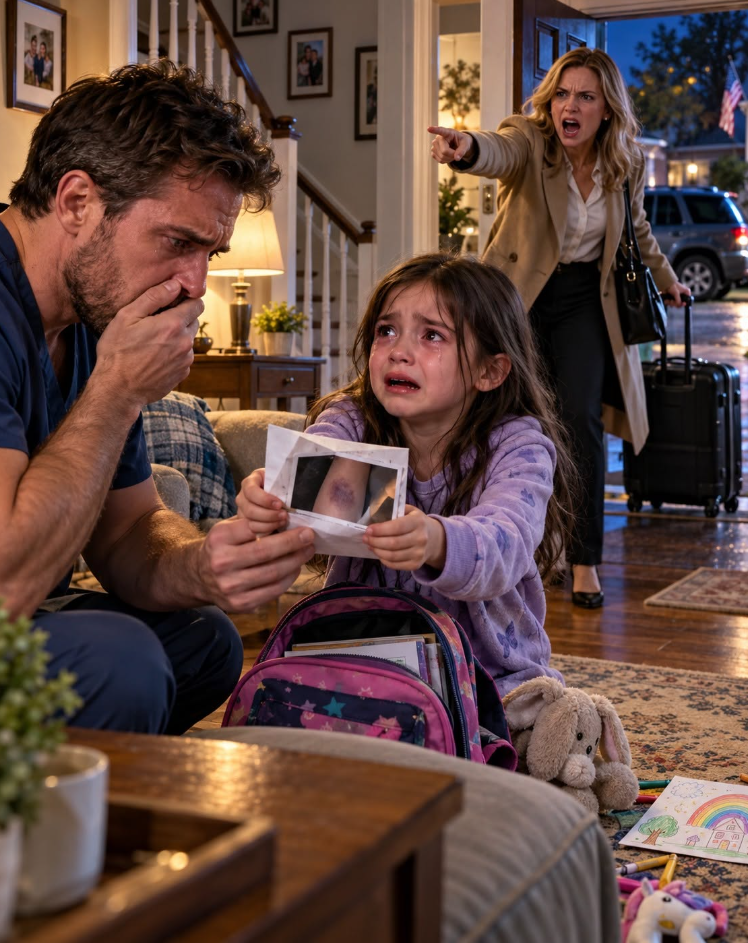
Inside the folded worksheet was a photograph.
Not a recent one.
The edges were bent, and a crease ran straight through the middle as though it had been folded and unfolded dozens of times.
I recognized Maris immediately.
She looked younger, maybe by eight years, standing outside the same house on Birch Street.
But it was the man beside her who made me stop breathing.
He was holding a newborn baby.
Lumi.
On the back, written in faded blue ink, were six words:
For Lumi, when she asks someday.
— Daniel
I looked at her.
“Who is Daniel?”
Lumi immediately started crying.
Not loudly.
That same terrible, silent crying I had been watching for weeks.
She reached back into the backpack.
“There’s more.”
She handed me a small envelope.
Inside were two more photographs, an old birthday card, and a folded piece of paper covered in handwriting.
I read only the first few lines before I had to sit down.
Daniel was Lumi’s biological father.
And according to the letter, he had not abandoned her.
That was the first lie.
Maris had told me that Lumi’s father disappeared before her first birthday and never contacted them again.
The letter told a different story.
Daniel wrote that he loved Lumi, that he had been trying to remain part of her life, and that if she was ever old enough to read the letter herself, he wanted her to know something very clearly:
His absence had never been his choice.
I lowered the paper.
“Where did you get this?”
Lumi stared at the floor.
“Grandma’s attic.”
Maris’s mother had died the previous year.
Lumi explained in fragmenTS.
Months earlier, while Maris was sorting through boxes after the funeral, Lumi found an old tin beneath a stack of blankeTS. Inside were photographs, letters, birthday cards, and envelopes addressed to her.
Maris caught her looking.
“She got really mad,” Lumi whispered.
My stomach tightened.
“What did she tell you?”
Lumi’s fingers disappeared inside her sleeves.
“She said Daniel was bad.”
“Did she tell you why?”
A nod.
“She said he didn’t want me.”
I looked at the letter in my hand.
“That doesn’t match what he wrote.”
“I know.”
Her voice cracked.
Then came the sentence that explained everything.
“Mom said you didn’t want me either.”
I went completely still.
Lumi finally looked at me.
“She said you married her, not me.”
I couldn’t speak.
“She said when you were nice to me, you were pretending.”
My chest felt hollow.
Lumi rubbed her cheek with her sleeve.
“She said eventually you’d get tired of me.
Like Daniel.”
Suddenly every silent tear made sense.
Every doorway.
Every frightened look.
Every time Lumi watched my hands.
She hadn’t been crying because she disliked me.
She had been waiting for me to become the man her mother had warned her I would become.
“Is that why you cry when we’re alone?”
Lumi nodded.
“Mom said not to bother you.”
My jaw tightened.
“What else did she say?”
Lumi hesitated.
Then she whispered, “She said if I made you mad, you’d leave.”
I closed my eyes.
There are moments in emergency medicine when emotion becomes a luxury you postpone because someone else needs you steady.
This was one of them.
I wanted to confront Maris immediately.
Instead, I looked at the seven-year-old sitting across from me.
She needed something more important than my anger.
She needed certainty.
So I moved from my chair to the floor, leaving several feet between us.
“Lumi, look at me.”
She did.
“You are not responsible for whether adults stay or leave.”
Her face crumpled.
“And you don’t have to earn kindness from me.”
A tear fell onto her sleeve.
“Really?”
“Really.”
“What if I’m annoying?”
“You’re seven.
That’s practically in the job description.”
For half a second, she looked shocked.
Then she laughed.
It was tiny.
But it was the first real laugh I had heard from her when we were alone.
I smiled.
Then I said something I would remember for the rest of my life.
“And if you’re scared of me, you can tell me.
If you’re angry with me, tell me.
If I make a mistake, tell me.
You don’t have to hide your feelings to keep me happy.”
Lumi stared at me.
“Are you mad at Mom?”
That question was harder.
“Yes,” I said carefully.
“But that’s an adult problem.
You don’t have to fix it.”
She looked at the photograph again.
“Is Daniel really my dad?”
“I don’t know everything yet.”
“Can we find out?”
I could have promised.
I didn’t.
Children who have been disappointed by adults don’t need bigger promises.
They need adults who keep small ones.
“I’ll help you find the truth.”
That night, after Lumi went to sleep, I photographed every document.
Every envelope.
Every postmark.
Every handwritten date.
Then I noticed something I had missed.
One envelope had never been opened.
It was dated only fourteen months earlier.
Daniel hadn’t disappeared seven years ago.
Someone had still been sending letters recently.
The next morning, I called an attorney.
Not because I wanted revenge.
Because Lumi’s documents involved custody, parental contact, and decisions far beyond anything I should handle based on emotion.
I also contacted Lumi’s school counselor.
I documented what Lumi had told me without coaching her or asking her to repeat it unnecessarily.
Then I waited.
Maris came home two days later.
At 8:17 p.m., I heard her suitcase wheels bump against the porch steps.
Lumi was upstairs.
I was sitting at the kitchen table.
The photograph was in front of me.
Maris walked inside, saw it, and stopped.
She didn’t ask what it was.
That told me enough.
“Where did you get that?”
Not hello.
Not how was Lumi.
Just that.
“Lumi showed me.”
Maris dropped her purse onto the counter.
“I told her not to touch those.”
“Why?”
“Because she’s a child.”
“So why did you tell her I didn’t want her?”
Silence.
The refrigerator hummed.
Maris slowly removed her coat.
“You’re misunderstanding this.”
“Then explain it.”
“She has attachment problems.”
“Answer the question.”
Her expression changed.
The warm, amused face I knew disappeared.
“You’ve known her six weeks as her stepfather, Gideon.
I’ve raised her for seven years.”
“And?”
“And you don’t understand what I’ve dealt with.”
I pushed Daniel’s letter toward her.
“Did he abandon Lumi?”
Maris looked at the paper but didn’t touch it.
“Essentially.”
“That’s not an answer.”
“He wasn’t reliable.”
“Then why are there recent letters?”
Her eyes flickered.
There it was.
Not surprise.
Calculation.
I knew that expression.
I had seen versions of it from frightened families in emergency rooms when somebody realized the facts were no longer under their control.
Maris sat across from me.
“He complicated things.”
“For whom?”
“For us.”
“Us?”
“My life, Gideon.”
That answer changed everything.
She began explaining.
Daniel and Maris had separated when Lumi was a baby.
Their relationship had been difficult, and there had been years of arguments about parenting, schedules, money, and contact.
I didn’t assume Daniel was perfect.
I still don’t.
But one fact became impossible to ignore.
Maris had deliberately allowed Lumi to believe her father had simply stopped caring.
And when I entered their lives, Maris had started building the same story around me.
Why?
Because a frightened child was easier to control than a secure one.
If Lumi believed people left whenever she disappointed them, she would work desperately to avoid disappointing Maris.
“She’s a child,” I said.
“I was protecting her.”
“No.
You were making her afraid.”
Maris stood.
“Don’t lecture me about my daughter.”
A tiny voice came from the hallway.
“I’m his daughter too.”
We both turned.
Lumi stood at the bottom of the stairs.
Maris’s face drained.
“Sweetheart, go upstairs.”
“No.”
It was barely audible.
But she said it.
No.
Maris stepped toward her.
Lumi stepped backward.
I didn’t move between them dramatically.
I didn’t shout.
I simply stood and said, “She doesn’t have to discuss this tonight.”
Maris stared at me.
“You’re choosing her over your wife?”
I couldn’t believe the question.
“There shouldn’t be sides between a mother and her seven-year-old daughter.”
“You have no idea what you’re doing.”
“Maybe not.
That’s why I called people who do.”
Her face changed again.
“What people?”
“The appropriate professionals.”
Maris stared at me for several seconds.
Then she grabbed her purse.
The front door slammed moments later.
Lumi jumped at the sound.
I looked at her.
“You didn’t cause that.”
She nodded, although I wasn’t sure she believed me yet.
So I kept proving it.
The following weeks were not cinematic.
They were paperwork.
AppointmenTS.
Conversations with professionals.
Background checks.
Records.
Family-court procedures.
Counseling.
And truth arriving slowly enough to hurt.
Daniel was located.
He lived three states away.
He had remarried and had a four-year-old son.
More importantly, he had kept copies.
Letters.
Emails.
Returned birthday packages.
Attempts to arrange contact.
Records showing that the story was considerably more complicated than the one Maris had given either of us.
When Daniel first spoke to Lumi through a supervised video call, I stayed outside the room.
That wasn’t my moment.
Twenty minutes later, the counselor opened the door.
Lumi came running out.
She wrapped both arms around my waist.
“He remembered Bunny.”
“What?”
“My stuffed rabbit.
The yellow one.
I lost it when I was little.”
She was crying.
But these tears were different.
“He remembered.”
I knelt beside her.
“That’s good.”
“Aren’t you sad?”
“Why would I be?”
“Because he’s my real dad.”
I understood immediately.
Somebody had taught this little girl that love was a chair with only one seat.
So I shook my head.
“Lumi, families aren’t musical chairs.”
She blinked.
“You don’t have to push somebody away to make room for somebody else.”
“But what do I call you?”
“Whatever feels right.”
Her eyes filled.
Then she whispered, “Can I still call you Daddy?”
That nearly broke me.
“If you want to.”
She threw her arms around my neck.
“I want to.”
The legal process took monThS.
Maris and I separated.
Eventually, we divorced.
I won’t pretend that was painless.
I had loved her.
Part of me kept searching for the woman I thought I married, hoping there was an explanation that could put everything back where it had been.
There wasn’t.
But something unexpected happened.
I didn’t disappear from Lumi’s life.
Because by then, the people involved understood that our bond mattered.
Daniel didn’t treat me like competition either.
The first time we met, we stood awkwardly outside a family counseling center.
He held out his hand.
“You’re Gideon?”
“Yes.”
He shook it.
Then he said, “Thank you for believing her.”
Not for finding him.
Not for exposing Maris.
For believing Lumi.
That mattered.
Over time, the adults built something imperfect but stable around her.
Daniel reentered Lumi’s life gradually and responsibly.
I remained involved under arrangements approved by the people responsible for her welfare.
Lumi continued counseling.
Maris was given her own opportunities to participate in counseling and rebuild trust under appropriate boundaries.
Nobody told Lumi she had to hate her mother.
That would only have replaced one kind of manipulation with another.
Instead, Lumi learned something much more powerful.
She was allowed to love people and still tell the truth about what hurt.
She was allowed to have boundaries.
She was allowed to ask questions.
Most importantly, she learned that adults’ choices were not her burden to carry.
Almost two years later, I was finishing another overnight shift when my phone buzzed.
A picture from Daniel.
Lumi was standing beside a science-fair volcano wearing safety goggles three sizes too large.
The caption said:
Your kid says nurses understand explosions.
Apparently you’re needed.
I laughed so loudly one of the residents looked over.
That afternoon, I drove straight from the hospital to her school.
Daniel was already there with his wife and Lumi’s little brother.
Lumi saw me from across the gym.
“Daddy!”
About six fathers turned around.
She rolled her eyes.
“Gideon Daddy!”
Daniel started laughing.
I walked over.
Her volcano looked structurally questionable.
“Is this safe?”
“No.”
“Excellent.”
She grinned.
And standing in that noisy elementary-school gym, I remembered the little girl who once cried whenever we were alone.
The child who had watched every doorway.
The child who believed love disappeared the moment she became inconvenient.
She wasn’t watching the exits anymore.
She was arguing with me about baking soda.
Before I left, Lumi slipped her hand into mine.
“Daddy?”
“Yeah?”
“Do you remember the first thing I showed you?”
I knew exactly what she meant.
“Yes.”
“I thought you’d leave after you saw it.”
I crouched so we were eye level.
“Why?”
“Because Mom said grown-ups leave when things get complicated.”
I looked at this brave little girl who had carried a folded photograph in her backpack because she didn’t know which adult was safe enough to see it.
“Sometimes they do,” I said.
“And sometimes leaving an unhealthy situation is the right choice.”
She considered that.
“But you didn’t leave me.”
“No.”
“Why?”
I squeezed her hand.
“Because you weren’t the complication.”
Her eyes softened.
“You were the reason to do things right.”
She hugged me.
And that’s when I finally understood something my years in the trauma unit had never taught me.
Saving someone doesn’t always look dramatic.
Sometimes there are no sirens.
No flashing lighTS.
No heroic moment anyone else gets to witness.
Sometimes saving someone means listening when their voice is barely above a whisper.
It means believing the thing they are terrified to tell you.
It means refusing to make a child responsible for an adult’s emotions.
And sometimes it means showing up so many ordinary Tuesdays in a row that eventually, a frightened little girl stops wondering when you’re going to disappear.
I once thought becoming Lumi’s stepfather happened when I signed a marriage certificate.
I was wrong.
It happened at a kitchen table beside a bowl of cold tomato soup, when a seven-year-old girl handed me a folded photograph and trusted me with the truth.
Maris had told her that people always leave.
Daniel and I couldn’t erase the years Lumi had spent believing that.
But together, in different roles, we could teach her something better.
People who truly love you don’t demand that you stay silent to keep their love.
They don’t make you afraid so you’ll stay close.
They listen.
They protect your right to tell the truth.
And when life becomes complicated, they keep showing up.
That night at the science fair, Lumi ran ahead of us toward the parking lot, laughing with her little brother.
Then she stopped beneath the streetlights and turned around.
“Come on, Dads!”
Daniel looked at me.
I looked at him.
Neither of us corrected her.
We just followed.
And for the first time since I had met Lumi, she wasn’t checking whether someone was leaving.
She already knew we were coming.