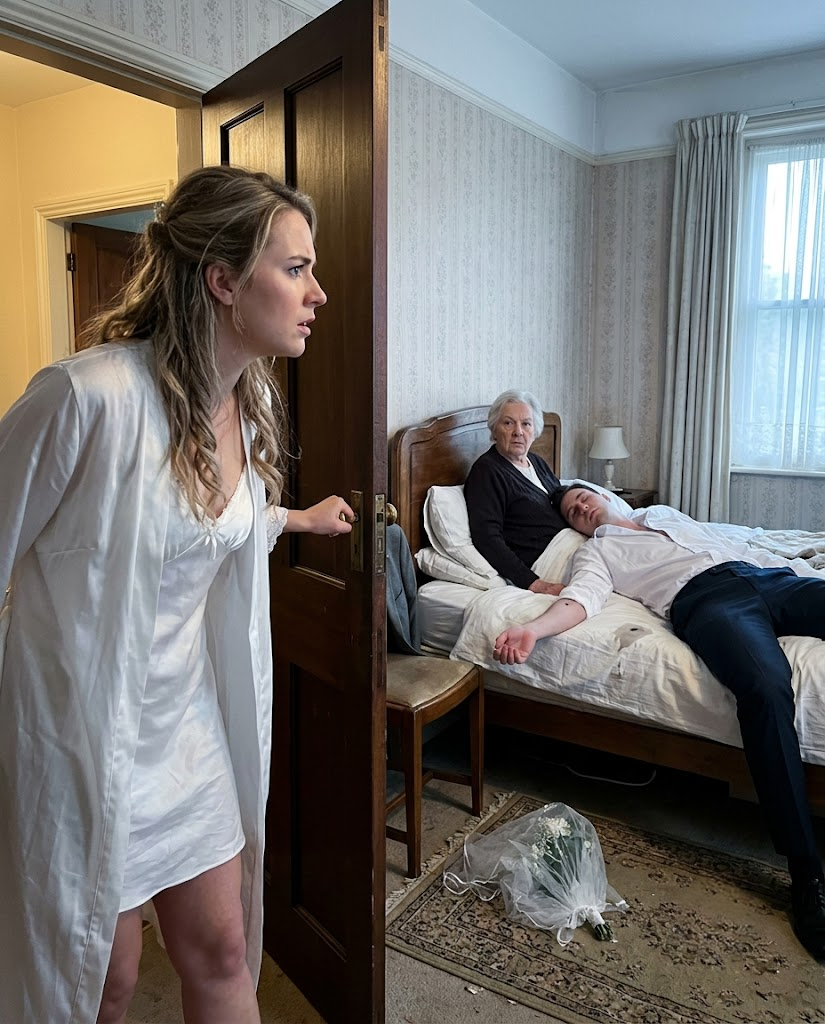
His fingers slipped beneath the mattress, and when his hand came back into view, a folded cloth pouch was clenched between them.
The responder nearest him immediately told him to stop moving and set it down.
My husband obeyed, but his eyes never left the pouch.
His grandmother did.
She looked at the responder, then at me, then toward the bedroom door as though she were calculating which person she could still control.
“That has nothing to do with this,” she said.
Nobody had accused her of anything yet.
That mattered.
The pouch was placed on a clean surface while the responders concentrated on getting my husband downstairs and into the ambulance.
I caught only a glimpse inside when the fabric unfolded slightly: sealed alcohol wipes, a small capped syringe, and a narrow piece of paper covered with handwriting.
His grandmother saw me looking.
“You don’t understand our family,” she said.
I stared at her.
“I understand my husband said no.”
For the first time since I had walked into that bedroom, she had no quick answer.
My husband was weak enough that the responders did not let him walk.
As they rolled him through the hallway, he reached for my hand.
“Come with me.”
“I am.”
His grandmother followed us to the front door.
One responder turned and told her there was not enough room for everyone.
“I’m his grandmother.”
My husband opened his eyes.
“Not her.”
The words were quiet.
They still stopped her.
I rode with him
During the drive, pieces of the previous night started returning to him in fragments.
He remembered going into his grandmother’s room because he had been raised to believe refusing the ritual would humiliate his mother and insult the older relatives who had gathered for the wedding.
He remembered being angry with himself for agreeing.
He remembered the drink.
She had brought it in a small glass and told him it would help him relax enough to sleep.
He said no.
She laughed.
He said no again.
Then she started talking about family duty.
According to him, she told him that every groom before him had managed one simple night without creating drama, and that if he truly intended to be a husband, he needed to prove he could put the family above his own discomfort.
He had taken one sip only because he wanted the argument to end.
The taste was wrong.
Bitter.
He set the glass down.
Then he started feeling heavy much faster than he expected.
At the hospital, while we waited for the staff to finish the first round of checks, he suddenly grabbed my hand harder.
“The sheet.”
“What about it?”
“I knocked the glass over.”
I leaned closer.
He shut his eyes, concentrating.
“That stain. I knocked it out of her hand when she tried to make me drink more.”
That explained the dark patch near his side.
It did not explain the puncture.
He knew that too.
He looked at the small mark on his arm and went pale again.
“I remember her getting mad.”
“What happened after that?”
“I don’t know.”
He swallowed.
Then another fragment returned.
“A pinch.”
He touched the area beside the puncture without pressing it.
“I thought she scratched me.”
He looked toward the hospital-room door as if he expected her to walk through it.
“She said I was making this harder than it needed to be.”
After that, he remembered nothing until my voice woke him the next morning.
The hospital staff did not speculate about what had been in the drink or the vial.
They documented his condition, the puncture, his account of what he remembered, and the fact that an unknown vial and the cloth pouch had been found in the room.
That restraint helped me more than I expected.
I did not need another person telling us what the story meant before the facts were clear.
I had already spent one night being told that something disturbing was harmless because his family had a name for it.
I was done accepting labels in place of answers.
A few hours later, my husband’s mother arrived.
She came alone.
She looked exhausted, still wearing the clothes she had put on that morning after hearing that her son had been taken to the hospital.
She hugged him first.
Then she looked at me.
“I’m sorry.”
I could not tell what she meant.
For the wedding night?
For her mother?
For believing the tradition?
Maybe all of it.
My husband asked her a question before I could.
“Did Dad do this too?”
Her face changed.
Not dramatically.
Just enough.
He noticed.
“So he did.”
She sat down.
She told us her husband had spent their wedding night in the same room with the family matriarch decades earlier, although the matriarch at that time had been someone else.
He had returned the following morning sick, groggy, and furious.
The family said he had drunk too much.
He insisted he had not.
Nobody believed him.
His wife had been young, overwhelmed, and terrified of starting her marriage by accusing the oldest woman in the family of lying.
So she had let the explanation stand.
My husband stared at his mother.
“Did he have a mark on his arm?”
She looked down.
“I don’t remember.”
“Think.”
She rubbed her palms together.
Then she nodded once.
“There was a bruise near his elbow. I thought it came from the reception.”
My husband turned his face away.
For several seconds, all I could hear was the low mechanical hum from the room around us and footsteps in the hallway.
His mother started crying.
Not loudly.
“I should have told you.”
“Yes,” he said.
She flinched.
He did not take it back.
That was the first moment I understood that whatever happened next would not be solved by exposing his grandmother alone.
Too many people had protected the tradition by refusing to look directly at what it required.
Some had been afraid.
Some had been embarrassed.
Some had decided surviving it was easier than challenging it.
A tradition is not harmless simply because enough frightened people learned how to repeat it.
Later that afternoon, someone involved in documenting what had been found at the house asked my husband about the handwritten paper inside the cloth pouch.
It contained dates and initials.
Wedding dates.
My husband recognized his parents’ anniversary immediately.
He recognized another belonging to an older relative.
Then he saw his own wedding date at the bottom.
Beside it was a single handwritten mark.
Nothing more.
No explanation.
No medical name.
No confession.
Just a list spanning years.
His mother covered her mouth.
“That’s not possible.”
My husband stared at her.
“You just told me Dad woke up the same way.”
She did not answer.
The grandmother called his phone before sunset.
He watched it ring.
Once.
Twice.
Three times.
Then he answered on speaker.
Her voice was controlled again.
She said everyone was overreacting.
She said the pouch had been in that room for years.
She said older people kept medical supplies for all kinds of innocent reasons.
My husband asked why his wedding date was written inside it.
Silence.
Then she changed direction.
“You’re letting your wife destroy this family over something she doesn’t understand.”
He looked at me.
I expected him to defend me.
Instead he said something better.
“No. I’m asking you.”
His grandmother tried to interrupt.
He kept going.
“Did you give me something after I told you no?”
She said he was confused.
“Did you use a needle on me?”
She said the hospital was filling his head with nonsense.
“Did you?”
Her voice hardened.
“You agreed to the tradition.”
My husband closed his eyes.
There it was.
Not an answer.
Worse.
A justification.
He asked why grooms had to be incapacitated at all.
His grandmother snapped that nobody had been incapacitated.
He reminded her that he had woken unable to explain hours of his own wedding night.
She told him he had always been dramatic.
Then she said something that made his mother stand up from the chair.
“You boys always fight it at first.”
My husband looked toward his mother.
She looked back at him.
Neither spoke.
His grandmother apparently realized what she had said because she immediately started talking about nerves, alcohol, and how men behaved after weddings.
But the sentence was already there.
You boys always fight it.
Not him.
Boys.
Plural.
My husband asked how many.
She refused to answer.
His mother stepped closer to the phone.
“Mom, what did you do to my husband?”
The grandmother’s tone changed instantly.
Now she sounded wounded.
Insulted.
Betrayed.
She said she had protected that family longer than any of them had been alive.
She said marriages changed people.
She said new spouses came in and pulled sons away from mothers, brothers away from brothers, grandchildren away from the people who raised them.
The wedding-night rule, she explained, reminded everyone where loyalty began.
My skin went cold.
This had never been about sleeping arrangements.
It had never been about some eccentric old custom.
The humiliation was the point.
The groom had to obey.
The bride had to accept being pushed aside.
And the family got to watch both of them learn, on the first night of the marriage, that their vows did not outrank the matriarch.
My husband spoke slowly.
“So when I refused the drink, you forced it.”
She denied forcing anything.
“When I tried to leave?”
“You were upset.”
“When I knocked the glass over?”
“You were acting irrationally.”
“When I said no?”
“You were embarrassing everyone.”
Same sentence.
Again.
My husband’s face became very still.
Then his grandmother made her biggest mistake.
She reminded him what he stood to lose.
Family money had been promised toward the life we were beginning together.
There were wedding gifts still controlled by relatives.
There were plans his grandmother had helped arrange.
There were people, she said, who would never forgive him if he turned a private matter into a public disgrace.
His mother whispered, “Don’t.”
The grandmother ignored her.
She told my husband he needed to decide whether one unpleasant night was worth destroying relationships that had lasted his entire life.
I watched him.
This was the same man who, less than twenty-four hours earlier, had asked me not to make a scene.
I loved him.
I was furious with him.
Both things were true.
He had known the ritual was wrong enough to hide how disturbing it would feel, yet he had still expected me to tolerate it because challenging his family seemed harder.
His grandmother had harmed him.
That did not erase the choice he had made before the harm happened.
He understood that.
Maybe that was why he did not ask me to forgive him.
He simply picked up the phone.
“If the money requires this, keep it.”
His grandmother started shouting.
“If being family requires my wife to accept this, then you don’t get to define family for me anymore.”
His hand shook.
His voice did not.
“And I’m giving a full statement.”
He ended the call.
His mother stared at the dark screen.
Then she sat down and cried harder.
My husband did not celebrate.
Neither did I.
There was no victory in discovering that a family had spent years teaching people to confuse obedience with love.
The practical consequences came slowly.
The vial, pouch, sheet, and other relevant items from the room were preserved for examination.
Hospital testing documented that my husband had been exposed to a sedating substance he had not knowingly agreed to take in the amount found in his system.
Later examination of the recovered items supported his account that the bedroom had contained materials consistent with what he remembered after refusing the drink.
No single object explained everything by itself.
Together, they made it much harder to dismiss the night as nerves or alcohol.
Other relatives were contacted.
Not everyone wanted to talk.
One initially insisted his own strange wedding morning had been nothing.
Then he learned about the dated list.
His answer changed.
Another remembered being told he had become sick after drinking with the matriarch even though he had never believed he drank enough to lose an entire stretch of time.
The pattern widened.
So did the shame.
My husband hated that part most.
He kept asking why nobody had warned him.
Eventually his mother gave him the only answer she had.
“Because admitting what happened to them meant admitting what we allowed to happen to the next person.”
That sentence stayed with me.
The grandmother continued denying that she intended to hurt anyone.
She said the substances had only been meant to calm people.
She said previous grooms had survived.
She said families sometimes needed rules outsiders would never understand.
She said my husband had betrayed her.
But intent did not put those hours back into his memory.
Tradition did not turn his refusal into consent.
And survival did not make the practice safe.
The case moved forward without the dramatic ending people always imagine these stories have.
There was paperwork.
Interviews.
Waiting.
Arguments between relatives.
Promises suddenly withdrawn.
Invitations quietly canceled.
My husband and I also had problems that no investigator could solve for us.
I moved into the spare room after he came home.
Not because I wanted to punish him.
Because I needed space to decide whether I could trust a man who had asked me to accept something he knew made me feel degraded.
He did not argue.
That mattered too.
He started telling me things he should have told me before the wedding.
How often his grandmother decided what counted as disrespect.
How family members learned to apologize before they understood what they had supposedly done wrong.
How every major decision came with some version of the same threat: don’t embarrass us.
He had spent years believing keeping the peace was kindness.
Our wedding night showed him the cost of that belief.
Weeks later, his grandmother faced criminal consequences connected to what had happened, while the broader family began confronting accounts from other men whose wedding nights suddenly looked different in hindsight.
Some relatives cut us off.
Some apologized.
A few tried to apologize and defend the tradition in the same sentence.
We stopped accepting those calls.
The promised family money disappeared.
We downsized plans we had made for our first year of marriage.
We returned things we could not comfortably afford to keep.
We ate takeout on the floor one night because a piece of furniture we had expected to buy with wedding money was no longer happening.
My husband looked around the nearly empty room and said, “I’m sorry this is what you married into.”
I shook my head.
“This isn’t what I married into.”
He looked confused.
I pointed between us.
“This is what we decide now.”
I still did not promise everything would be fine.
He did not ask me to.
Trust came back through smaller things.
He stopped volunteering my time to relatives.
He stopped answering demands disguised as emergencies.
When someone wanted something from both of us, he asked me before saying yes.
When his mother visited, she knocked instead of walking in.
Small things.
Necessary things.
Several months after the wedding, I opened a drawer and found the hotel key sleeve from the night we were supposed to begin married life together.
I had forgotten I kept it.
For a moment, I was back in that room alone, staring at the clock and wondering why I was the only person who seemed to understand how humiliating the situation was.
My husband found me holding it.
He did not touch me immediately.
He waited.
Then he asked, “Do you want me here?”
Such a simple question.
It should never have felt revolutionary.
I looked at the man who had once told me not to make a scene because he was afraid of disappointing his family.
Then I looked at the man standing in front of me now, waiting for an answer he was prepared to respect.
“Yes,” I said.
He came closer only after I said it.
The grandmother had built her tradition around the idea that marriage began with obedience.
Ours had almost been destroyed by it.
In the end, the moment that finally felt like the beginning of our marriage was much quieter.
He asked.
I chose.
And this time, nobody else was in the room.