At 10:17 Sunday morning, Margaret Bennett’s name appeared on my screen. I watched the call come in and chose not to answer.
I already knew why she was calling.
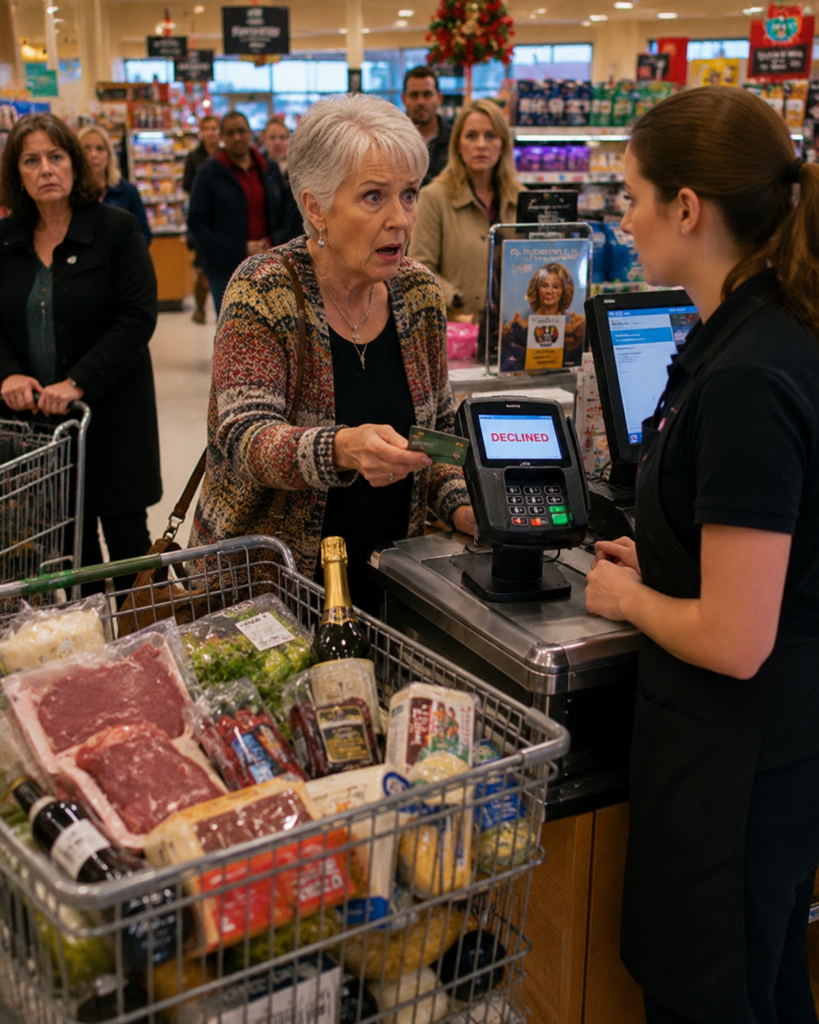
Two days earlier, my eleven-year-old daughter had told me she had gone without lunch for five straight school days. Less than forty-eight hours after that, my mother was standing beside a cart full of expensive groceries with a payment card that no longer worked.
Image
The difference between those two situations was impossible for me to ignore.
Sophie had been embarrassed to admit she was hungry.
Mom was furious because she couldn’t buy ribeye steaks.
My phone stopped ringing.
For maybe thirty seconds, nothing happened.
Then it started again.
I was in the kitchen making breakfast while Sophie sat at the table with her hair still messy from sleep, spreading peanut butter over toast. She glanced toward my phone but didn’t ask who was calling.
I turned the screen facedown.
That was the part I kept thinking about afterward.
Sophie had spent an entire week trying not to inconvenience anyone.
She had walked through her public middle school cafeteria on Monday expecting the money I had loaded into her account to be there. Instead, the transfer had been caught in a processing problem.
The balance showed negative.
So she stepped away.
On Tuesday, she did it again.
Wednesday too.
By Thursday, she had apparently figured out how to sit with her friends during lunch without making it obvious she wasn’t eating.
Friday afternoon, she came home so hungry that she stood at our kitchen counter eating cold leftover pasta directly from the container.
That was when I finally noticed.
“Didn’t you have lunch?” I asked.
She froze with the fork halfway to her mouth.
“My account was empty.”
“Since when?”
“Monday.”
I can still remember how quickly my anger turned inward.
Five days.
I was her father, and I had missed five days.
I asked what she had eaten instead.
She shrugged.
“Nothing.”
There are answers that sound louder because the person saying them refuses to dramatize them.
That was Sophie.
She wasn’t trying to make me feel guilty. She wasn’t angry. She wasn’t even asking me to fix what had already happened.
She was simply telling me the truth because I had finally asked the right question.
I handled the cafeteria problem immediately. But the technical error wasn’t the part that stayed with me that evening.
What bothered me was how easily a quiet kid could disappear inside a problem.
And then I made the mistake of calling my mother because I thought she would understand why I was upset.
Margaret lived about fifteen minutes from us in the same four-bedroom house where she and my father had raised our family.
After Dad died, her finances became difficult enough that selling the house started to look like a real possibility.
I didn’t want that for her.
So I stepped in.
The house was mine, but she continued living there. I paid the property taxes. I covered insurance, utilities, repairs, and maintenance.
And every month, I put $2,800 on a grocery card connected to my account.
It had started as practical help.
Over six years, it became routine.
Mom liked good food. Organic produce. Imported cheese. Premium cuts of meat. Bottles of wine that cost more than anything I normally bought for myself. She hosted elaborate Sunday dinners and liked shopping at a grocery store where a few bags could make an ordinary receipt feel like a car payment.
I had never complained about it.
Not once.
When she needed a refrigerator, I helped replace it.
When the landscaping company raised its prices, I listened to her frustration.
When she said certain cheaper foods bothered her stomach, I didn’t tell her she was being dramatic.
I paid the bill.
That Friday evening, I called her because I needed to say out loud what had happened to Sophie.
“My daughter went hungry at school for an entire week.”
Mom’s response came almost immediately.
“Well, she can take crackers.”
I thought I had heard her wrong.
“Crackers?”
“Children survive. You’re making this dramatic.”
That sentence changed something.
Not because it was the cruelest thing anyone had ever said.
It wasn’t.
What made it land was the standard behind it.
For six years, my mother’s comfort had mattered enough for me to rearrange my finances around it.
But when my daughter had gone without a basic meal for five days, Mom’s answer was survival.
Not concern.
Not, “Is Sophie okay?”
Not even, “How did that happen?”
Crackers.
Children survive.
I didn’t shout.
There wasn’t anything useful left to argue about.
“You’re right,” I told her. “People survive.”
Then I ended the call.
Later, after Sophie went to bed, I opened my banking app.
I found the card attached to Mom’s grocery spending.
Monthly allowance: $2,800.
I stared at that number longer than I expected to.
I wasn’t confused about whether I could afford it.
I was thinking about what the money had come to mean.
Help is supposed to solve a problem.
Somewhere over six years, our arrangement had stopped feeling temporary. Mom no longer talked about the grocery card like assistance from her son. She treated it like a normal piece of her monthly income.
Maybe that was partly my doing.
I had made it automatic.
I had made it easy.
I had removed every moment when either of us would have had to look directly at what I was providing.
But I couldn’t get past the fact that the person receiving $2,800 a month for groceries had just told me an eleven-year-old could manage on crackers.
So I canceled the card.
There was no dramatic speech afterward.
No warning text.
No threat.
I pressed the button and went upstairs.
Sunday morning, Mom went shopping as usual.
She filled her cart with salmon, imported olive oil, berries, wine, fresh flowers, and two ribeye steaks.
At the register, she tapped the card.
Declined.
She tried again.
Declined again.
This wasn’t the same kind of problem Sophie had experienced.
Sophie’s money had failed to appear because of a payment-processing issue.
Mom’s card failed because I had deliberately turned it off.
And now she was calling me.
The third call came while Sophie was pouring herself milk.
“Dad,” she said, glancing toward the buzzing phone, “are you going to get that?”
“Not yet.”
She accepted that answer without pushing.
That bothered me too.
She was so accustomed to staying out of adult problems that she rarely asked for explanations she thought might not belong to her.
I picked up the phone after the ringing stopped and opened the school payment account instead.
I checked Sophie’s balance twice.
Then I checked the confirmation that the correction had gone through.
Money was there.
Monday’s lunch was covered.
Tuesday’s too.
That mattered more to me at that moment than whatever was happening beside Mom’s abandoned grocery cart.
A voicemail notification appeared.
Then another.
I didn’t listen immediately.
I finished breakfast with my daughter.
We talked about ordinary things. A homework assignment. A friend who kept forgetting her locker combination. Whether Sophie wanted turkey or peanut butter in the backup lunch I had decided she would carry for a while, even with her cafeteria balance restored.
“Turkey,” she said.
“Cheese?”
“Yes.”
“Crackers?”
She looked at me strangely.
I almost laughed, but the word caught in my throat.
“No,” I said. “Forget crackers.”
She smiled a little and went back to her toast.
Only after she left the kitchen did I listen to Mom’s first voicemail.
Her voice was sharp.
She wanted to know why the card had been declined.
The second message was less confused and more irritated. She said there must be something wrong with the account and told me to call her because employees at the store were waiting.
That sentence nearly pulled me back into the role I had played for years.
Something had gone wrong.
Mom needed me.
Fix it.
I could have called the bank. I could have restored the card. I could have made the awkward moment at the register disappear before she finished putting the groceries back.
That was exactly why I didn’t.
Instead, I sent one text.
“The card is canceled. We can talk later today.”
Her reply arrived before I could set down the phone.
“Canceled? Why?”
I looked at the message.
For a moment, I wondered whether she genuinely didn’t connect it to our conversation Friday night.
Then I realized it didn’t matter.
I typed back, “You said people survive. I’m changing what I pay for.”
I didn’t mention Sophie again.
I didn’t need to use my daughter as leverage in a financial argument.
The problem wasn’t that Mom owed Sophie an apology in exchange for getting her grocery card restored.
The problem was that I had finally recognized a boundary I should have established much earlier.
Supporting someone does not mean financing every preference indefinitely.
And gratitude isn’t something you can buy by increasing the monthly limit.
Mom called again around lunchtime.
This time, I answered.
She started with the card.
Of course she did.
She told me she had been humiliated at checkout. She said I should have warned her. She reminded me that she depended on the grocery allowance and that changing it without notice was unfair.
I let her finish.
Then I said, “I’m not putting the $2,800 back.”
She went quiet for a moment.
“What am I supposed to do?”
There it was again.
The question underneath six years of automatic support.
I didn’t tell her to eat crackers.
I could have.
The comeback was sitting right there.
But turning her own sentence into a weapon would have made the conversation about winning.
I wasn’t trying to win.
I was trying to stop an arrangement that no longer made sense.
“You’ll need to plan a grocery budget you can manage,” I said. “We can go over essentials. But I’m not funding this the way I have been.”
She accused me of punishing her over one comment.
That forced me to put the real issue into words.
“No. The comment made me look at what I’ve been doing.”
She started to interrupt.
I kept going.
“I have covered the house, the utilities, the taxes, the insurance, repairs, maintenance, and $2,800 every month for groceries. I did that because I wanted you secure after Dad died. But it became normal enough that you stopped seeing how much support it was.”
She said that wasn’t true.
Maybe she believed that.
Maybe I had made the help so predictable that from her side it really did feel ordinary.
But ordinary to the receiver can still be enormous to the person providing it.
I told her the house expenses weren’t changing that day. She wasn’t being thrown out. The electricity wasn’t being shut off. I wasn’t trying to frighten her.
The grocery allowance was the thing I was ending.
That distinction mattered to me.
I wanted a boundary, not revenge.
Mom’s voice softened after that, but only slightly.
Then she said, “So this is because I said Sophie could take crackers?”
I looked through the kitchen doorway.
Sophie’s backpack was leaning against a chair where she had dropped it Friday afternoon.
A little keychain hung from the zipper.
An ordinary kid’s backpack.
An ordinary school week.
Five missed lunches that should never have happened.
“It’s because when I told you she hadn’t eaten lunch for five days, your first concern was whether I was being dramatic,” I said. “And that made me realize we don’t have the same definition of need anymore.”
Mom didn’t answer immediately.
When she finally did, she said she hadn’t meant Sophie should literally live on crackers.
I believed that was probably true.
But intent didn’t erase the attitude underneath it.
She had minimized something painful because it wasn’t happening to her.
And I had spent years making sure her own discomfort rarely reached that point.
We ended the call without resolving everything.
There was no sudden apology.
No perfect understanding.
Real family arguments rarely close that neatly.
But the card stayed canceled.
Monday morning, I packed Sophie a turkey-and-cheese sandwich even though her cafeteria account was working again.
I added an apple, a yogurt, and a granola bar.
Then I put twenty dollars in a small inside pocket of her backpack.
“Emergency lunch money,” I told her.
She looked embarrassed.
“Dad, it’s fixed now.”
“I know.”
“You don’t have to do all this.”
“I know that too.”
She zipped the pocket closed.
At the door, I stopped her.
“One more thing.”
She turned around.
“If something like that happens again, tell me the first day. Not Friday.”
She stared down at her sneakers.
“I didn’t want you to be mad.”
“I wouldn’t be mad at you.”
“I thought the school would fix it.”
“That still doesn’t mean you go hungry.”
She nodded.
Then she said something I wasn’t prepared for.
“I didn’t want my friends to know we had a money problem.”
My chest tightened.
“We don’t have a money problem.”
“I know. But the screen said negative.”
To an eleven-year-old, that was enough.
A red number on a cafeteria account had become a story she was afraid other people would tell about her.
That was when I understood how much of the week had been about shame rather than food.
I crouched beside her backpack and said, “A computer balance isn’t who you are. And asking for lunch isn’t something to be embarrassed about.”
She gave me the skeptical look kids give adults when we say something that sounds reasonable but doesn’t magically make middle school easier.
Then she left.
That afternoon, she came home and dropped her backpack by the same chair.
“How was lunch?” I asked.
“Fine.”
“Fine as in you ate?”
She rolled her eyes.
“Yes, Dad.”
“What did you have?”
“Pizza.”
“And?”
“Milk.”
“And?”
She laughed.
“I ate. I promise.”
That was all I needed.
Mom and I spoke again later that week.
The conversation was calmer.
She still thought canceling the card without warning had been harsh. I still thought six years of support should have made one inconvenient grocery trip survivable.
Neither of us changed our position completely.
But for the first time in a long time, we talked about actual numbers instead of treating my contribution like something that simply appeared every month.
I told her I would continue covering the household obligations I had already committed to while we reassessed everything else.
Groceries were now her responsibility.
If she needed help with necessities, she could ask specifically.
That was very different from handing over $2,800 and never looking at the cart.
A week earlier, I might have thought that distinction was petty.
After Sophie’s five missed lunches, I didn’t.
The biggest change wasn’t the money.
It was attention.
I started checking Sophie’s cafeteria account more carefully, but I also started checking Sophie more carefully.
Not interrogating her.
Not hovering over every school day.
Just noticing.
Was she coming home unusually hungry?
Was she quieter than normal?
Was there something she assumed she was supposed to handle alone because the adults around her were busy?
I had spent Friday night furious at the school payment problem.
By Sunday, I understood that a failed transaction had exposed two different blind spots.
One was mine.
I had missed what was happening to my daughter because she didn’t complain.
The other was the arrangement with my mother.
I had provided so much for so long that neither of us had stopped to ask where help ended and entitlement began.
Canceling the card didn’t solve every family issue.
It didn’t turn my mother into a different person.
It didn’t erase the week Sophie went hungry.
But it changed what happened next.
Sophie no longer had to sit through lunch pretending she wasn’t hungry because she was afraid of embarrassing someone.
Mom no longer had an automatic $2,800 grocery allowance she could treat as permanent.
And I stopped confusing financial support with an obligation to make every inconvenience disappear.
A few Sundays later, I opened the refrigerator while Sophie was looking for an afternoon snack.
She pulled out cheese, grapes, and a container of leftover pasta.
For a second, I was back at that Friday afternoon when I had found her eating cold noodles too quickly at the kitchen counter.
This time she wasn’t starving.
She was just hungry.
There’s a difference.
She put some pasta in a bowl and reached for the microwave.
Then she looked at me.
“What?”
“Nothing,” I said.
She narrowed her eyes because she knew I was watching her.
“Dad.”
“I’m just glad you ate lunch.”
She groaned.
“You’re never letting this go, are you?”
“Probably not.”
She shook her head and pressed the microwave button.
On the counter beside me was my phone.
No grocery-card alert.
No automatic $2,800 charge waiting for the next month.
Just an ordinary Sunday afternoon and my daughter making herself something to eat.
That felt like enough.