My daughter asked me to put a lock on the inside of her bedroom door.
She’s six, and she’s slept with that door open her whole life.
Then she told me why: “ONLY when Grandma stays over.”
My mother watches Harper three nights a week. I’m on doubles at the plant and Kayla picks up ER shifts, and without those three nights we don’t make the mortgage on this house.
Which is the same house I grew up in. I bought it off my mom four years ago, cheap, because she wanted something one-story.
“Travis, she’s six,” Kayla said. “Six-year-olds want locks and rocket ships.”
So I let it go.
Then I came home at six in the morning and the laundry room light was on, and Harper’s blanket was in there on the floor, folded in half like a bed.
My mother said she’d fallen asleep helping with towels.
A week later, driving to school, Harper was counting under her breath in the back seat. Not to ten. She got to a hundred and forty before I asked what she was doing.
“Quiet time,” she said. “I have to get to five hundred and then she opens it.”
I asked who opens what.
“The laundry room.”
I told myself my mother wouldn’t. She raised me. I turned out fine.
But that night I stood in front of that door with a screwdriver and a hall smoke detector chirping behind me that I still haven’t put batteries in.
There’s no handle on the inside. There’s a hook latch on the outside, painted over so many times it’s part of the wall now.
And the smell when I opened it made my stomach hurt the way it has since I was a kid, and I never once knew why.
Dryer sheets.
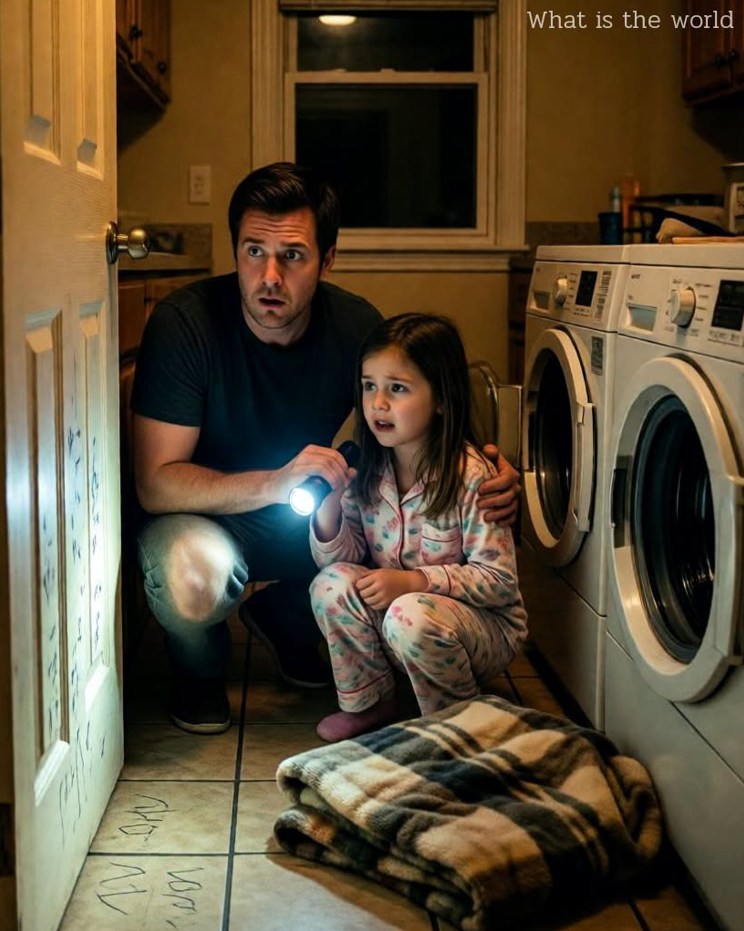
I got the flashlight from the junk drawer and got down on my knees.
Low on the inside of the frame, under the paint, somebody had scratched a row of lines with something sharp. NINE OF THEM. And under the lines, in a little kid’s letters: TRAVIS 1999.
I went still on that floor.
Harper was standing in the doorway in her pajamas. She said she’d made a line too, so I’d know how many.
Then she crouched down next to me and pointed lower, at a second name I hadn’t seen.
“Daddy, who’s Ronnie?”
What I Knew About Ronnie Before I Knew I Knew It
I sat on the laundry room floor for a long time.
Harper had her hand on my arm. She does that when she can’t read my face. She’s been doing it since she was three, this little steadying grip just above my elbow, and I don’t know where she learned it. Not from me.
Ronnie.
I hadn’t thought that name in maybe twenty years. Hadn’t let myself, is probably more honest.
Ronald Dean Pruitt. My mother’s second husband. He came into the house in 1996 when I was eight and he left in 2001 when I was thirteen. I used to tell people he just left. Moved on. I didn’t know where. That part was true. I didn’t know where because nobody told me and I didn’t ask because by the time he was gone I had learned very well how to not ask about things in that house.
Ronnie wasn’t violent. I want to be clear about that because that’s where people’s heads go. He didn’t hit. He had other ways.
He’d come home from the bar in a mood and whatever he decided was wrong with you, he’d tell you about it. At length. Calmly. In a voice that never rose above conversational. And if you cried or argued or said anything at all, you went in the laundry room until you could come out and be normal.
Sometimes normal took a while to find.
I was in there nine times. I know that now because I counted my own lines on the floor of that room thirty seconds ago with a flashlight while my daughter held my arm.
I don’t remember making the marks. I was eight, nine, ten. Kids do things and then the brain files it somewhere dark.
What I want to know, sitting there on the linoleum, is how many lines are scratched under Ronnie’s name.
The Second Set of Marks
I took the flashlight and moved it lower, below where Harper had pointed.
The name RONNIE was scratched in bigger letters than mine. Shakier. Like whoever made them was doing it fast, or in the dark.
Below the name, seven lines.
And below the lines, not a year. A different kind of mark. Three letters.
SRY.
Sorry.
I sat with that for a minute. Ronnie Pruitt scratched his own name into that door frame, put seven marks under it, and then wrote sorry in the dark.
I don’t know what that means. I have four or five theories and none of them make me feel better. Maybe he was locked in there too, before we lived there, by someone I never knew about. Maybe my mother put him in there once, some ugly night when things flipped around. Maybe he put himself in there. People do strange things when they’re drunk and guilty.
Maybe the sorry was for me.
I don’t know. I’ll probably never know. Ronnie Pruitt, wherever he ended up, is not someone I’m going to call.
Harper was still crouching next to me. She pointed at the lowest marks, the ones she’d made herself.
Three lines. Fresh scratches, pale wood showing through, no paint over them yet.
“I didn’t have anything sharp,” she said. “I used my fingernail.”
I put the flashlight down.
What My Mother Said
I called her the next morning. Eight-fifteen. She picks up on the second ring, always, because she’s been awake since five-thirty her whole life.
I didn’t ease into it. I told her I’d been in the laundry room. I told her what I found on the door frame. I told her Harper had three marks with her fingernail.
The line went quiet.
Not guilty quiet. More like tired quiet. The kind of quiet that’s been waiting twenty-five years to finally sit down.
“I didn’t think she’d mind,” my mother said. “I just needed her to settle.”
I asked how many times.
She said she didn’t keep track.
I asked how long. How long each time. She said not long, just until Harper stopped fussing, just until she could breathe for a minute because she was tired, Travis, she’s seventy-one and she’s doing this because we need her to, and Harper is fine, isn’t she, Harper is perfectly fine.
I didn’t say anything to that.
My mother said, “You turned out fine.”
And there it was.
I’ve heard that sentence my whole life. From her, from myself, from the part of my brain that didn’t want to look at the laundry room too hard. I turned out fine is the sentence that makes the laundry room okay. I turned out fine is the sentence that turns nine marks into nothing.
I said, “Mom. I’m going to need you to not watch Harper anymore.”
She hung up.
What Kayla Did
I sat at the kitchen table and waited for Kayla to come downstairs. She works nights, sleeps until ten. I had two hours.
I looked at the laundry room door from where I was sitting. From the kitchen it just looks like a door. White paint, brass knob on the outside. Normal.
I’d never noticed before that the knob is only on the outside.
Kayla came down at nine-forty in her scrubs because she had a shift at eleven. She looked at my face and stopped on the bottom stair.
“What happened.”
I told her. All of it. The blanket on the floor, the counting to five hundred, the marks on the door frame. Ronnie. My nine marks. Harper’s three.
She sat down across from me and didn’t say anything for a minute.
Then she said, “Travis. I need to ask Harper some questions.”
I said okay.
She said, “Not with you in the room.”
That landed somewhere uncomfortable. I said okay again.
Kayla went upstairs. I sat at the table. The dryer was running from a load I’d put in before bed, and the smell of the sheets was everywhere in the kitchen, and I got up and opened the back door and stood there in the cold until it was just cold air.
Kayla was up there for forty-five minutes.
When she came down she had Harper on her hip, which she hasn’t done since Harper was four because Harper’s too big now, but Harper had her face against Kayla’s neck and wasn’t complaining about being carried.
Kayla looked at me over Harper’s head.
“She’s okay,” she said. “She’s going to be okay. But we need to talk about what okay is going to take.”
What Harper Said to Me That Night
I put Harper to bed. Kayla went to her shift.
I sat on the edge of Harper’s mattress and she had her owl, the stuffed one with one eye that she’s had since she was born, and she was looking at the ceiling.
I asked if she wanted to talk.
She said, “Daddy, can we put a handle on the inside?”
I said yes. I said we’d do it this weekend, she could pick the color.
She said, “Pink. But not baby pink. Like a dark pink.”
I said okay.
She was quiet for a second. Then she said, “Grandma said the laundry room was just for thinking. She said it helps.”
I put my hand on the blanket over her feet.
She said, “Does it help?”
I told her no. I told her the laundry room is just a room and she never has to go in there again unless she wants to and she can always come get me, always, no matter what time, I don’t care if I’m sleeping or at work, she finds a way to get me.
She said, “What if you’re at the plant?”
I said there are phones.
She thought about that. Then she said, “Okay,” and pulled the owl up under her chin.
I sat there until she fell asleep. Took about ten minutes.
I went back to the laundry room and looked at the door frame again with the overhead light on. My nine marks, Ronnie’s seven, Harper’s three.
I got a utility knife from the junk drawer and I cut the hook latch out of the door frame. Paint and all. Left a raw square of wood.
I put the latch in the trash can outside.
Then I came back in and sat in the laundry room on the floor with the door open, and the dryer sheets smelled the way they always smell, and I stayed there until it was just a room.
It took a while.
I still haven’t put batteries in the smoke detector. That’s tomorrow.
If this hit you somewhere you weren’t expecting, pass it to someone who needs to read it.