The envelope looked ordinary.
White paper. Federal seal. My parents’ names typed in clean black ink across the front.
But the moment the senior agent held it out, my mother reacted as if it were burning. “I’m not accepting anything,” she snapped.
The agent did not blink.
“You don’t have to accept it for it to be served.”
My father’s mouth opened, then closed. For once, he had no speech prepared. No disappointed sigh. No lecture about family. No way to make the room bend around his version of reality.
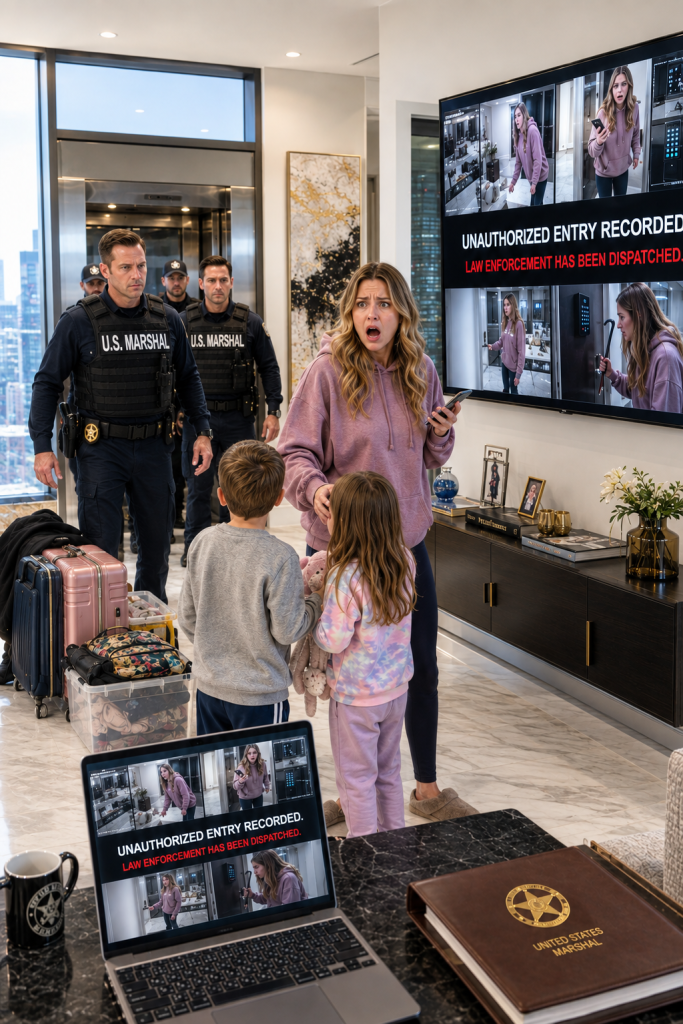
Paige stood beside the destroyed office door, still wearing the expression of someone waiting to wake from a nightmare. Her two children huddled behind her, clutching their backpacks, confused by words like federal and compromised and evidence.
I watched it all from the secure conference room twenty-eight floors above the city, my face reflected faintly in the dark glass wall in front of me. I was not in the penthouse. I had not been there since the first alert hit my phone and showed Paige standing in my private entryway, grinning like she had won something.
That had been her first mistake.
Thinking I needed to be present to defend what was mine.
The agent placed the envelope on the marble coffee table.
“My client has instructed us to proceed with all protective measures,” he said. “This includes removal from the premises, preservation of evidence, and immediate notification to every agency connected to the secured workspace.”
My mother gave a sharp laugh.
“Client? She’s your client now? She’s my daughter.”
The agent turned slightly toward the ceiling camera, as if speaking through it to me.
“Ms. Marissa Vale is the legal owner of this property, the protected leaseholder of the restricted workspace, and the complainant in this matter.”
Complainant.
That word finally cracked something in my mother’s face.
For years, she had treated me like a resource with inconvenient emotions. Paige was the fragile one, the struggling one, the one who always needed help. I was the dependable one. The successful one. The one who could afford it.
So when Paige’s marriage collapsed, my parents expected me to hand over my guest suite.
When Paige lost her rental, they expected me to “temporarily” move her into my penthouse.
When I refused, they called me selfish.
And when I changed the entry codes, they apparently decided to test whether a lock could love them more than I did.
My father picked up the envelope with stiff fingers.
“Open it,” my mother whispered.
“I know how envelopes work, Elaine.”
His voice was low and dangerous, but not directed at the agents. It was directed at the room itself, at the cameras, at me.
He tore the seal.
Inside were three documents.
The first was a formal notice barring them and Paige from all properties under my name.
The second was a civil complaint for attempted unlawful occupancy, property damage, and interference with federally protected materials.
The third was thinner. Only two pages.
My father stopped reading halfway down the first page.
My mother snatched it from him.
“What?” Paige demanded. “What is it?”
No one answered her.
My mother’s hands began to tremble.
Then she looked up at the nearest camera.
“Marissa,” she said, and there it was — not anger, not outrage, but fear. “Where did you get this?”
For the first time that afternoon, I leaned toward my microphone.
The penthouse speakers clicked softly.
“From Grandma’s attorney.”
Paige frowned.
“What does Grandma have to do with this?”
My father shut his eyes.
My mother whispered, “No.”
I let the silence stretch just long enough for all three of them to feel the shape of it.
“Four years ago,” I said, “Grandma left me a private letter with instructions to open it only if I ever believed my family was trying to take my home.”
Paige scoffed, but it came out thin.
“That’s insane.”
“Grandma knew all of you better than I did.”
My father finally spoke.
“That old woman was confused at the end.”
“No,” I said. “She was very clear.”
The agent nodded to one of the officers, who began photographing the documents in my father’s hands.
My mother clutched the paper tighter.
“Marissa, listen to me. Whatever you think this means, we can discuss it privately.”
“You had privacy,” I replied. “You used it to plan how to trap me in court.”
The room went still again.
On one of the television screens, paused footage showed my father’s mouth open mid-sentence, caught forever saying the words he never thought I would hear.
Once Paige gets mail delivered here, we’ll claim she’s established residency.
He looked smaller beneath the image of himself.
My father had always been a large man in my memory. Not physically, but in presence. He filled rooms with opinions. He decided when conversations were over. He measured love in obedience and called it respect.
Now he looked like a man standing underneath a falling ceiling, pretending it was only rain.
Paige stepped forward.
“Okay, fine,” she said quickly. “Maybe Dad said something stupid. But I didn’t know about any federal stuff. I thought this was just your office. I didn’t know breaking the door was a big deal.”
“You told your son to find a screwdriver,” I said.
Her face twisted.
“I was upset.”
“You told him there might be cash inside.”
“That was a joke.”
“You said you were going to sell my equipment.”
“I didn’t mean it!”
The senior agent looked at her without expression.
“Intent is something the court can consider.”
“The court?” Paige repeated, her voice rising. “Why does everyone keep saying court? She’s my sister!”
“No,” I said quietly. “I was your sister before you tried to steal my home.”
My mother flinched as if I had slapped her.
“Don’t speak to her like that.”
There it was.
Even now.
Even with police in the room and evidence on every screen, my mother’s first instinct was still to protect Paige from the consequences of Paige.
Something inside me, something old and tired and patient, finally went cold.
“I want them out,” I said.
The senior agent gave a short nod.
The officers moved gently but firmly. They told Paige she needed to gather essential belongings and leave the property. She argued. Then pleaded. Then cried. Her children began crying too, and for a moment my chest tightened.
Not because I regretted it.
Because they were children, and none of this was their fault.
I muted my microphone and looked away.
Beside me, my attorney, Daniel Cross, stood with his arms folded, watching the live feed.
“You’re doing the right thing,” he said.
“I know.”
But knowing did not make it painless.
On the screen, Paige wiped her face and shoved clothes into a designer duffel she had taken from my closet. An officer stopped her.
“That isn’t yours.”
She froze, then threw the bag onto the sofa.
“Fine! She can keep her precious bag.”
My mother helped gather the children’s things while glaring at every camera as if hatred could blur the footage. My father remained by the coffee table, still holding Grandma’s document.
That document was not just a warning.
It was a copy of a trust amendment.
For years, my parents had told me Grandma left “a few sentimental things” and nothing more. They said her estate had been simple. They said there was no money. They said the house had been sold to cover medical expenses.
They lied.
Grandma had left behind a trust for me.
A significant one.
And according to the amendment, my parents had been removed as successor trustees six months before her death because Grandma suspected them of pressuring her to change beneficiaries.
The attorney’s letter attached to it was worse.
It said that after Grandma died, my parents never disclosed the amendment. They transferred assets through an older trust document and represented themselves as valid trustees.
I had not known any of this until three weeks ago.
Three weeks ago, Grandma’s former attorney called me after receiving an anonymous package containing copies of bank statements, old emails, and a note written in shaky blue ink.
They lied to her too.
At first, I thought it was a mistake.
Then I saw the signatures.
Then I saw my father’s email to my mother.
Marissa doesn’t need it. Paige does.
I had spent three weeks feeling like the floor beneath my childhood had been quietly removed.
The penthouse incident had only given me the final piece.
Proof that they had not changed.
Proof that they would keep taking until there was nothing left to take.
My father looked up suddenly.
“Who sent you this?”
I unmuted.
“What?”
“The letter. The evidence. Who sent it?”
“I don’t know.”
He stared into the camera, his face pale but alert now.
“That’s not true.”
“It is.”
“Marissa,” he said, and his voice changed. It softened into the tone he used when he wanted obedience to feel like concern. “You don’t understand what you’ve opened.”
Daniel glanced at me.
I leaned closer.
“Are you threatening me?”
“No,” my father said. “I’m warning you.”
The senior agent stepped forward.
“Mr. Vale, I’d be careful.”
My father ignored him.
“That trust was complicated. Your grandmother was involved with people you don’t know. People who don’t like having old records dragged into daylight.”
My mother hissed, “Stop talking.”
But my father’s eyes stayed locked on the camera.
“She had secrets, Marissa. So did your grandfather. You think this is about money? You think this is about Paige sleeping in your guest room?”
He laughed once, bitterly.
“You have no idea what she left you.”
A chill moved through me.
Daniel’s posture changed.
“What does that mean?” I asked.
My mother grabbed my father’s arm.
“Enough.”
He shook her off.
“For once, she should hear it.”
Paige appeared in the hallway, clutching her daughter’s coat.
“Hear what?”
Nobody answered.
The agent repeated, “Mr. Vale.”
My father dropped the trust amendment back onto the coffee table.
Then he smiled.
It was not a pleasant smile.
It was the smile of a man who had lost control of the room but found a match in his pocket.
“You want to be independent?” he said to me. “Fine. Be independent. But when they come looking for what’s hidden in that building, don’t call us.”
The lights flickered.
Just once.
Every screen in the penthouse blinked black.
Then came back.
Daniel’s phone buzzed. So did mine. So did the agent’s.
A new security alert appeared.
ARCHIVE ACCESS REQUEST DETECTED.
Location: Vale Family Storage Facility.
Authorization used: MARISSA VALE.
I stared at it.
“That’s impossible,” I whispered.
Daniel was already typing.
“Your credentials?”
“No. I didn’t authorize anything.”
The senior agent snapped orders to his team. One of the federal techs opened a case kit and connected a device to the penthouse control panel.
My father’s smile faded.
For the first time, he looked genuinely surprised.
My mother noticed.
“What is that?” she asked.
The agent did not answer.
Another alert appeared.
BIOMETRIC OVERRIDE ACCEPTED.
My blood turned cold.
Accepted.
Not attempted. Accepted.
Daniel looked at me.
“Marissa, where are you?”
“Secure conference room.”
“Stay there.”
On screen, Paige stepped back.
“Wait. What’s happening?”
My father grabbed his coat.
“We’re leaving.”
The officer nearest him raised a hand.
“No one has been cleared to leave yet.”
My father exploded.
“You don’t understand! If someone accessed that storage unit, then this is already bigger than your paperwork.”
My mother was crying now, but silently. Tears slid down her face while she stared at the screen.
“Richard,” she whispered, “who has her biometric?”
My father did not answer.
That silence was the loudest confession of the day.
I stood.
Daniel moved in front of me.
“Marissa.”
“Who has my biometric?” I demanded.
My voice came through every speaker in the penthouse, sharp enough to stop everyone.
My father looked toward the camera.
For one second, I saw regret.
Not love.
Not guilt.
Regret that the wrong secret had surfaced at the wrong time.
Then a new video feed opened on the center television.
It showed a storage facility I recognized immediately. Low concrete ceiling. Blue metal doors. Fluorescent lights.
Unit 718.
My grandmother’s old unit.
The one my parents claimed had been emptied years ago.
The camera angle shook slightly as if the feed came from a body camera. Someone stood in front of the storage door, entering a code.
Then the person turned just enough for the camera to catch their reflection in the metal latch.
I stopped breathing.
It was me.
Not exactly me.
A woman with my height, my dark hair, my face, my posture.
She wore black gloves and a gray coat.
She lifted her hand to the scanner.
The lock flashed green.
Paige screamed.
My mother covered her mouth.
My father said one word.
“Impossible.”
The storage door rolled upward.
Inside was not furniture.
Not boxes.
Not old photographs.
Inside was a room.
A hidden, climate-controlled archive lined with shelves, safes, sealed cases, and a steel table in the center. On the table sat a black folder with my grandmother’s name embossed in silver.
The woman who looked like me walked straight to it.
She opened the folder.
The feed crackled.
A voice spoke, calm and female.
“Marissa should have stayed out of this.”
Then the screen went black.
For several seconds, nobody moved.
Even Daniel looked stunned.
I heard my own heartbeat, slow and heavy, as if it belonged to someone else.
The senior agent recovered first.
“Lock down all connected locations. Now.”
His team moved quickly, but my eyes remained fixed on the blank screen.
A woman with my face had just opened a door with my biometric signature.
A woman with my voice had spoken my name like a warning.
Behind me, Daniel said something into his phone, but I barely heard him.
Because suddenly, one memory rose from the deepest part of my mind.
I was seven years old, hiding under Grandma’s dining table during a thunderstorm. My parents were arguing in the kitchen. Grandma’s hand rested gently on my back.
“Listen to me, Marissa,” she had whispered. “One day, people may tell you that you are the only one. Don’t believe them.”
I had thought she meant I was not alone.
Now I wondered if she meant something else entirely.
On the penthouse screen, my father sank slowly onto the sofa.
My mother whispered, “She’s back.”
Paige turned to her.
“Who’s back?”
My mother stared at the dead screen, her face emptied of every lie she had carried for years.
Then she said the name that changed everything.
“Celeste.”
Daniel turned to me.
“Who is Celeste?”
I looked at my parents on the screen.
Neither of them would meet my eyes.
And somewhere across the city, a woman wearing my face had just stolen whatever my grandmother had spent her life hiding.
PART 3 — THE ENVELOPE THAT BURNED THE FAMILY TREE
My father did not take the envelope at first.
He stared at it as though the senior agent had extended a snake toward him instead of a sealed packet with his name printed across the front in black federal lettering.
My mother, however, had never been afraid of paper.
She stepped forward, chin high, one hand pressed to the pearls at her throat. Even through the speaker system, even from thousands of miles away in a silent London hotel room, I could hear her breathing—the tight, offended breaths of a woman who had spent her entire life mistaking control for love.
“Give it here,” she snapped.
The agent did not move.
“This envelope is addressed to both of you,” he said. “Before you open it, I need you to understand that everything you say and do in this residence is still being recorded.”
My father let out a bitter laugh.
“This is insane. This is our daughter’s home.”
“No,” the agent replied. “It is Deputy Marshal Keane’s private residence. And the room your daughter attempted to force open is a protected workspace containing federally secured materials.”
Paige flinched at the word “force.”
Her son, Tyler, stood frozen near the staircase, still holding the fireplace poker she had handed him. He was only ten, all elbows and wide eyes, with one suitcase beside his sneaker. His little sister, Emma, was curled on the couch in her pink coat, hugging a stuffed rabbit like she could disappear behind it.
I wanted to be angry at Paige. I was angry at Paige.
But looking at those children made something inside me ache.
They had not planned this. They had been packed into a car in the middle of the night and told they were moving into Aunt Marissa’s beautiful apartment because grown-ups had decided the truth was optional.
The agent noticed Tyler’s hand trembling.
“Buddy,” he said gently, “you can put that down.”
Tyler looked at Paige first.
That hurt worse than the door.
He waited for permission from the person who had handed him a tool and made him part of something he did not understand.
“Put it down,” Paige whispered.
The poker clattered against the marble floor.
My mother finally snatched the envelope from the agent. She tore it open with sharp, angry fingers, pulling out a stack of documents, a letter, and a flash drive sealed inside a clear evidence sleeve.
At the top of the first page, in bold letters, were the words:
NOTICE OF REVOCATION OF ACCESS AND FAMILY FINANCIAL BOUNDARY STATEMENT.
My mother’s face tightened.
“What kind of dramatic nonsense is this?”
My father leaned over her shoulder. Paige took one step closer, then stopped, as though the papers gave off heat.
I knew exactly what they were reading, because I had written the first letter myself.
Not as a deputy marshal.
As the daughter they had trained to feel guilty for having a locked door.
Mom. Dad.
If you are reading this inside my home, it means you crossed a line I clearly told you not to cross.
It means you chose to believe that family gives you ownership over my labor, my privacy, and my peace.
It means you used Paige’s children as shields.
It means I was right to prepare.
My mother stopped reading aloud.
But the screens in my penthouse did not.
At my instruction, the system opened the digital copy and began displaying it line by line across every television, every wall panel, every smart monitor in the apartment.
My father staggered back as my words filled the room.
For fifteen years, I have paid debts I did not create.
I have covered rent, medical bills, car repairs, legal fees, school supplies, emergency loans, “temporary” expenses, and family obligations that somehow never ended.
I did it because I loved you.
I stopped because loving you was destroying me.
Paige covered her mouth.
My mother whispered, “Turn that off.”
No one did.
The next page appeared.
A ledger.
Every transfer. Every check. Every so-called emergency. Every holiday where I was told not to bring gifts because “money would be more useful.” Every loan that became a donation the moment I asked about repayment.
My father’s voice came out low.
“You kept records?”
I sat in my hotel room with the London rain streaking the windows and whispered back, though they could not hear me yet.
“Yes, Dad. I learned from you.”
He had always told me that paperwork won wars.
He had never imagined I would be the one to build the archive.
The agent turned a page.
“This packet includes a formal no-entry notice, revocation of all prior access codes, documentation of attempted unlawful entry, evidence of property damage, and instructions from Deputy Marshal Keane regarding temporary care arrangements for the minors present.”
Paige’s head jerked up.
“What care arrangements?”
The agent’s expression softened, but only slightly.
“Your sister arranged a hotel suite nearby for the children tonight. Food, transportation, and a licensed child welfare liaison have already been contacted. You may accompany them if you agree to leave the residence peacefully and provide a statement.”
My mother gave a short, ugly laugh.
“Oh, now she wants to play hero.”
My voice cut through the apartment speakers.
“No, Mom.”
Everyone froze.
I had connected through the secure channel, my laptop open on the desk of a hotel room nearly three thousand miles away. My hair was still loose from sleep, my face pale in the blue glow of the screen, but my voice was steady.
“I want the kids warm, fed, and out of the middle of this.”
Paige turned toward the nearest camera.
“Marissa?”
“Hi, Paige.”
She looked smaller than she had two minutes earlier.
Not innocent. Not yet.
But smaller.
My father pointed at the camera. “You have no right to humiliate your family like this.”
“You broke into my home.”
“We are your family.”
“And you thought that made it easier.”
Silence rolled across the room.
My mother stepped forward, her eyes glittering. “You would really do this to your own sister? To your niece and nephew?”
“I did not bring Tyler and Emma there,” I said. “Paige did. You helped her. Dad helped her. You planned it for weeks.”
“That is not—”
The screens changed again.
This time the footage showed my mother at her kitchen table three nights earlier, captured from Paige’s own phone during a video call she had unknowingly backed up to a shared family cloud I had been invited to years before and never removed from.
My mother’s voice filled the apartment.
“Bring the children. She won’t dare make herself look cruel. Once you’re in, cry. Make it about stability.”
Paige shut her eyes.
My father said, “Enough.”
But the system played the next clip.
His voice.
“Do not leave once you’re inside. Possession matters. Keep mail there. Take pictures. Make her negotiate.”
The senior agent looked at him.
My father said nothing.
On screen, my mother smiled in the old video and added, “Marissa has had too much for too long. It is time she remembered where she came from.”
That sentence struck harder than I expected.
Because I did remember.
I remembered wearing thrift-store coats while my parents bought Paige new dresses because she “needed confidence.” I remembered being told I was strong, which in our house meant I could be ignored. I remembered bringing home scholarship letters and watching my mother ask if there was any cash award attached. I remembered my father smiling proudly at neighbors while whispering later that success was only respectable if it benefited the family.
I remembered all of it.
That was the problem.
Paige’s voice broke.
“Mom told me you said yes.”
I looked at her through the camera.
“No, she didn’t.”
Paige turned slowly toward our mother.
My mother’s expression did not change.
“She would have said yes eventually.”
It was such a perfect sentence that even my father closed his eyes.
There it was.
The family philosophy in six words.
Consent was just delay.
Boundaries were just obstacles.
My home had not been stolen tonight by mistake. It had been claimed according to the rules they had lived by for years.
One of the officers spoke quietly to Paige.
“Ma’am, you need to gather essential items for yourself and the children. The rest will be documented and removed later.”
“I’m not leaving,” my mother said.
The agent looked at her. “You are not a resident here.”
“I am her mother.”
“That is not a legal address.”
My father stepped between them. “We will call our attorney.”
The agent nodded. “You may.”
“He’ll straighten this out.”
“Before or after he explains the locksmith waiting in the lobby?”
My father’s face changed.
Just barely.
But I saw it.
So did the agent.
He tapped his earpiece. “Send him up.”
A minute later, the elevator opened again.
A nervous man in a brown jacket stepped out, carrying a locksmith bag and a clipboard. His eyes went from the officers to the agents to Paige’s suitcases, and the confidence drained out of him so fast he nearly dropped his tools.
“I was told this was a lockout,” he said.
My father did not look at him.
The agent held out a hand. “Invoice and work order.”
The locksmith handed them over immediately.
The work order listed my address.
The requested service: permanent lock replacement.
The client name: Richard Keane.
My father.
Not Paige.
Not a confused mother of two.
My father had planned to replace the locks on my home while I was overseas.
I leaned closer to my laptop camera.
“Dad.”
He would not look up.
“Ask him about Unit 14B,” I told the agent.
For the first time all night, my father looked truly afraid.
My mother turned toward him.
“Richard?”
The agent repeated calmly, “Unit 14B?”
My father swallowed.
The screens went black for one breath.
Then a new file opened.
KEANE FAMILY TIMELINE — PHASE TWO.
Paige whispered, “What is Unit 14B?”
My father said nothing.
And that was how I knew the night had only begun.
PART 4 — UNIT 14B AND THE LIES IN STORAGE
Unit 14B was a storage locker in a climate-controlled facility ten minutes from my parents’ house.
I knew about it because my father was careful, but not imaginative.
For years, every password he created was some variation of his high school football number, my mother’s initials, and the word “family.” He had used the same storage company since I was in college. Back then, he kept Christmas decorations there, boxes of old tax records, and my grandmother’s cedar chest, which my mother insisted smelled “too old” to keep in the house.
Three weeks before Paige broke into my penthouse, a notification had appeared in my email.
A storage facility receipt.
Forwarded accidentally.
My father had meant to send it to himself. Instead, autocomplete chose me.
The subject line read: 14B ACCESS CONFIRMED.
I might have ignored it if the amount had been normal.
It was not.
He had paid for after-hours access, document scanning services, and private shredding.
My father never paid extra unless he was hiding something.
So I did what I had learned to do on fugitive cases.
I followed the paper.
Not as a marshal. Not with government authority. I used public records, my own accounts, my own family documents, and one private attorney I trusted more than blood.
What I found did not surprise me.
That almost made it worse.
Inside Unit 14B, my father had been building a fake history.
Printed emails made to look like I had invited Paige to stay.
Unsent letters addressed to her at my penthouse.
Draft affidavits claiming she had “longstanding family permission.”
A copy of the old one-time service code.
Screenshots from real estate forums.
Notes from calls with an attorney who, judging from the messages, had not been told the whole truth.
And on top of it all, in a blue folder labeled MARISSA — LEVERAGE, he had placed copies of old checks I had written to him and Mom, with handwritten notes in the margins.
Proof she supports family.
Proof she accepts obligation.
Proof pattern of shared assets.
When my attorney sent me photographs of the folder, I stared at that phrase for a long time.
Shared assets.
Not daughter.
Not sister.
Not person.
Asset.
In the penthouse, my father finally found his voice.
“This is illegal,” he said. “You cannot search my storage unit.”
“I didn’t,” I replied through the speakers. “Your storage company contacted me after you listed my name and address as an authorized emergency contact. My attorney requested preservation of documents after your own emails suggested you were using my address in a false claim.”
His jaw tightened.
“You think you’re very smart.”
“No,” I said. “I think I was very tired.”
That landed differently.
Not dramatically. Not loudly.
But I saw Paige look at the floor.
The senior agent spoke to my father. “The contents of that unit are being reviewed by appropriate authorities now. Tonight’s attempted entry into a protected workspace makes the context relevant.”
My mother gripped the envelope so tightly the pages bent.
“Richard,” she said, “tell me you didn’t put my name on anything.”
My father looked at her.
There are marriages built on love, and there are marriages built on shared enemies. My parents had spent thirty-seven years turning outward whenever they needed someone to blame. Teachers. Bosses. Neighbors. Me.
For the first time, there was no one outside the circle.
Only them.
My father’s silence answered her.
She struck him with the papers. Not hard enough to hurt, but hard enough to reveal the crack.
“You said this would be simple,” she hissed.
Paige stared at them. “You both told me Marissa agreed.”
“You needed a place,” my mother snapped.
“So you lied?”
“I protected you.”
“You used me.”
“You would have been living in your car.”
“I was not living in my car!”
The lie burst out of Paige before she could stop it.
Everyone turned.
Even I sat back in my chair.
Paige pressed a hand over her mouth, then slowly lowered it.
“I wasn’t living in my car,” she said again, quieter. “I told Mom the landlord gave me thirty days. She said Marissa had room. She said Marissa had always been selfish but could be pushed. I said no at first.”
My mother scoffed.
Paige’s voice sharpened. “I said no.”
Tyler looked up.
It was the first time all night he had heard his mother sound like someone waking from a dream.
Paige went on, words tumbling faster now. “Then Dad said he talked to a lawyer. He said if Marissa really loved us, she wouldn’t fight. He said the worst that could happen was she’d yell and then calm down. Mom said to bring the kids because Marissa would never make a scene in front of them.”
My mother’s mouth flattened.
“You agreed.”
“I was desperate!”
“You were weak.”
Paige recoiled.
For a moment, I saw us as children again.
Me, twelve years old, holding a permission slip for a gifted summer program my parents refused to pay for.
Paige, seven years old, sobbing because she had spilled juice on Mom’s white rug.
Our mother had used different words then.
Careless. Dramatic. Ungrateful.
But the tone was identical.
The agent interrupted before the argument could spiral.
“Ms. Paige Keane, you have two choices right now. Leave peacefully with your children and cooperate, or be removed from the residence while arrangements are made for the minors.”
Paige looked at Tyler and Emma.
That was the moment I learned whether my sister was only selfish or something more complicated.
She bent, picked up Emma’s stuffed rabbit from the couch, and tucked it into her daughter’s arms.
“We’re leaving,” she whispered.
Emma began to cry.
“I know, baby,” Paige said, voice trembling. “I know. We’re going somewhere safe tonight.”
My mother lunged toward her.
“Paige, don’t you dare let Marissa scare you out of what you deserve.”
Paige turned on her.
“What do I deserve, Mom? Her house? Her bed? Her life?”
“You deserve help.”
“Then why didn’t you offer me your guest room?”
The silence after that was enormous.
My parents had a four-bedroom house.
A finished basement.
A sunroom my mother used for antique chairs no one was allowed to sit in.
They had never intended to take Paige in.
They intended to place her in my home like a flag in conquered land.
My father cleared his throat. “Your mother’s health—”
“Her health is fine,” Paige said. “She plays doubles tennis every Thursday.”
My mother’s eyes flashed.
I almost smiled.
Not because it was funny.
Because for once, Paige had noticed the furniture of our childhood—the excuses, the locked cabinets, the rooms reserved for appearances while the living daughters made themselves smaller.
The agents began escorting everyone toward the elevator. Paige carried Emma. Tyler pulled two suitcases and refused to look at the damaged office door.
As my parents passed the camera, my father finally looked directly at me.
“You think this ends with tonight?”
“No,” I said. “Tonight is just the part you can’t deny.”
My mother leaned close to the wall panel.
“You will regret making enemies of your own blood.”
I wanted to say something devastating.
Something sharp enough to cut through all the years she had made me apologize for succeeding.
Instead, I said the truest thing.
“I didn’t make enemies, Mom. I stopped pretending they were safe.”
The elevator doors opened.
For a second, my penthouse was full of people, noise, luggage, shame, and flashing red security notices.
Then the doors closed.
The apartment fell silent.
Across the ocean, dawn began to pale behind London’s rain.
I looked at the empty entryway on my screen.
My sister’s purse was still on the table.
One of Emma’s tiny gloves lay on the floor near the couch.
And the door to my protected office stood dented but closed.
The system generated its final alert of the night.
RESIDENCE SECURED.
I should have felt relief.
Instead, I felt something far more dangerous.
Clarity.
PART 5 — THE SISTER WHO FINALLY TOLD THE TRUTH
Paige called me at 6:43 a.m. London time from the hotel suite I had arranged.
I nearly did not answer.
Not because I wanted to punish her.
Because there are moments when hearing someone’s voice too soon can undo the strength it took to survive them.
The phone buzzed across my desk.
Paige Keane.
For years, that name had meant emergencies.
Can you send money?
Can you talk to Mom?
Can you cover this just once?
Can you please not make a big deal out of it?
I let it ring four times.
Then I answered.
For a moment, neither of us spoke.
In the background, I heard cartoons playing softly, the rustle of hotel sheets, and Emma asking if breakfast had pancakes.
Paige’s voice came small.
“They’re okay.”
I closed my eyes.
“Good.”
“Emma thinks we’re on vacation.”
“Let her.”
“Tyler knows we’re not.”
“He’s old enough to know when adults are lying.”
That hurt her. I heard it.
“I’m sorry,” she said.
I stared at the London skyline, the city washed silver by morning rain.
I had imagined those words before.
Not in a grand way. Not in a fantasy where everyone wept and changed overnight.
Just once, I wanted someone in my family to say they were sorry without adding a reason I was still somehow responsible.
Paige did not add one.
So I waited.
She inhaled unevenly.
“I thought you’d fold.”
There it was.
Ugly. Honest.
Better than pretty lies.
“Why?”
“Because you always did.”
I turned away from the window.
“I know.”
“I told myself that meant you didn’t mind.”
“No, Paige. You told yourself that because it helped you take things.”
She was quiet for so long I thought the call had dropped.
Then she said, “Mom said you had everything.”
“She said that a lot.”
“She said the penthouse was proof you abandoned us.”
“The penthouse was proof I worked.”
“I know.”
“No. You didn’t.”
She accepted that.
Another small silence.
Then she said, “Dad told me you used family money to buy it.”
I laughed once, without humor.
“What family money?”
“I know. I know that now.” Her voice shook. “He said there had been an inheritance from Grandma Hazel. He said you took your share early and never told me.”
My hand tightened around the phone.
Grandma Hazel.
The only adult in our family who had ever looked at me like I was not selfish for wanting a door that closed.
She had died when I was twenty-three. She left me a wooden recipe box, a watch that did not work, and a letter telling me to run toward the life my parents called “too much.”
There had been no money.
At least, none that reached me.
“What inheritance?” I asked.
Paige went silent.
Cold moved through me.
“Paige.”
“I don’t know,” she whispered. “Dad said Grandma left something for both of us. He said you got yours when you finished school. He said mine went toward family expenses because I had kids and needed more help.”
The rain tapped the glass like fingernails.
I sat down slowly.
“Did you ever see documents?”
“No.”
“Did he?”
“I don’t know.”
That was when the story shifted.
Until then, the night had been about my home.
Suddenly, it was about a dead grandmother, missing money, and another door my father had kept locked.
I pulled up my encrypted notes and opened a new file.
HAZEL KEANE ESTATE.
“Tell me everything he said.”
Paige let out a broken breath.
“Marissa, I called to apologize.”
“You can do both.”
So she did.
She told me how Dad had started mentioning Grandma Hazel’s “help” years ago, always vaguely, always when Paige asked why I had managed to graduate without drowning in debt. He implied I had received advantages. He implied I owed the family because I had already benefited from it.
Our mother repeated the story until it became family weather.
Marissa got out because Grandma helped her.
Marissa owes us because she got the head start.
Marissa’s place is not really hers alone.
I listened, and something old inside me, something I thought had scarred over, split open.
Because I had spent half my life feeling guilty for escaping with nothing but scholarships, night shifts, and stubbornness.
And all along, my parents may have been telling Paige I escaped with stolen gold.
“Was this why you hated me?” I asked.
Paige made a sound that was almost a sob.
“I didn’t hate you.”
“Paige.”
“I hated that you didn’t need us.”
I looked at my own reflection in the dark laptop screen.
“That was never true.”
She cried then.
Quietly at first. Then harder.
I let her.
I had no comfort ready. Not the kind she wanted.
But I stayed on the line.
When she could speak again, she said, “The agent asked if I’d give a statement.”
“And?”
“I said yes.”
“That matters.”
“It doesn’t fix it.”
“No.”
“What happens to Mom and Dad?”
“I don’t know.”
“Are you going to have them arrested?”
I leaned back, exhausted beyond sleep.
“That decision isn’t only mine anymore. Paige, you damaged a secured door connected to my work. Dad arranged a locksmith. They planned false documentation. There are recordings. There may be financial fraud. This is not a family argument.”
“I know.”
“Do you?”
“Yes.”
“Then say it.”
She took a breath.
“This was not a family argument.”
It sounded like a sentence from a language she had just begun learning.
I nodded, though she could not see me.
“Good.”
Later that day, my attorney confirmed what I feared.
Grandma Hazel’s estate had been small but real.
Not enough to buy a penthouse.
Not enough to change a life forever.
But enough to matter.
A savings bond portfolio. A modest investment account. Two insurance policies. Jewelry. The cedar chest.
And one handwritten instruction witnessed by her neighbor and pastor:
For my granddaughters, Marissa and Paige, equally. Let neither girl be made to beg for what is already hers.
The funds had never reached us.
My father, as executor, had filed paperwork claiming the assets were used to settle final expenses and family debts.
But the numbers did not match.
They did not even come close.
I stared at the scanned documents until my vision blurred.
Then I opened the photo of the blue folder from Unit 14B.
MARISSA — LEVERAGE.
Behind it, barely visible beneath a stack of altered address forms, was the corner of another label.
HAZEL.
I called the senior agent assigned to the residence incident and gave him my attorney’s number.
Then I called Paige again.
She answered on the first ring.
“Did you find something?”
“Yes.”
“What?”
I swallowed.
“A reason Dad was afraid of Unit 14B.”
She did not speak.
In the hotel background, Tyler laughed at something on television.
It was such a normal sound.
So painfully normal.
Paige whispered, “Marissa, what did they do?”
I looked at the rain, at the city, at the life I had built brick by brick while carrying guilt that had never belonged to me.
“I think,” I said, “they stole from both of us.”
PART 6 — THE HOUSE BUILT FROM LIES
I returned to Arlington four days later.
Not because the investigation required me.
Because my home did.
The penthouse smelled faintly of cleaning solution, cold coffee, and the sharp metallic scent of forced entry. The building manager met me downstairs with the solemn face of a man who had replayed security footage too many times and still could not believe people behaved that way in marble lobbies.
“Deputy Keane,” he said, “I am very sorry.”
“So am I.”
The elevator ride up felt longer than the flight from London.
When the doors opened, I stood for a moment without stepping out.
My entryway was spotless again. The suitcases were gone. The glove had been placed in a small evidence bag on the console. The office door remained closed, its reinforced surface dented near the keypad like a bruise.
I walked to it and pressed my palm against the metal.
My father had wanted this door opened.
Not because he cared what was behind it.
Because it was closed to him.
That had always been enough.
My phone buzzed.
A message from Paige.
Are you home?
I typed yes.
Three dots appeared.
Then vanished.
Then appeared again.
Finally:
I’m sorry about the door.
I looked at the dent.
For a strange second, I saw Tyler holding the poker, waiting for his mother’s permission to put it down.
I wrote back:
Do not make him carry your guilt.
Her reply came quickly.
I know.
That afternoon, my attorney arrived with two cardboard boxes and the expression of someone who had seen families become lawsuits and still hoped for better from humanity.
Her name was Elise Morgan. She wore navy suits, silver glasses, and never wasted a sentence.
“It’s worse than we thought,” she said.
I invited her in.
We sat at my dining table while pale winter sunlight fell across the city beyond the windows. She opened the first box.
“Your grandmother’s estate was not large, but there were assets. Your father reported liquidation for debts. Several debts appear unrelated to Hazel Keane. Some may not have existed.”
I listened without moving.
Elise continued.
“There are also forged acknowledgments. One bearing your name. One bearing Paige’s.”
“My signature?”
“A poor imitation.”
I almost laughed.
Of course it was poor.
My father had never paid close attention to me unless he needed something. He would not know the angle of my handwriting, the way my M curved, the way I crossed a double s.
“Can it be proven?”
“Yes.”
She opened the second folder.
“There is more. Years ago, a credit line was opened using your identifying information as a guarantor for a family business account.”
I stared at her.
“We never had a family business.”
“No. Your father used the phrase for a personal account. It was closed, but not before several late payments. That may explain some early credit issues you mentioned.”
I remembered being twenty-six, sitting in a bank office while a loan officer politely told me there were marks on my report I did not understand. I remembered calling my mother, panicked, and hearing her sigh.
“You probably forgot something, Marissa. You always take on too much.”
The room tilted.
Elise’s voice softened.
“Breathe.”
“I am.”
“Not well.”
I stood and walked to the window.
The Potomac cut through the city in a gray ribbon. Cars moved below like bright beads of intention. Everyone going somewhere. Everyone carrying something invisible.
For years, I had thought my family’s greatest theft was emotional.
The guilt. The pressure. The way they turned my independence into betrayal.
Now the paper trail showed a simpler kind of theft too.
Money.
Credit.
Inheritance.
Time.
My attorney waited until I turned back.
“What do you want to do?”
It was a dangerous question.
Because the answer that rose first was not noble.
I wanted them afraid.
I wanted my mother to feel the floor vanish beneath her certainty. I wanted my father to sit across from someone with a badge and realize charm was not evidence. I wanted every relative who had ever called me selfish to read the ledger and choke on it.
But underneath that, quieter and harder, was what I wanted most.
“I want it to stop,” I said.
Elise nodded.
“Then we proceed firmly. No private negotiations. No family meetings without counsel. No access. No payments. No exceptions.”
“No exceptions,” I repeated.
That evening, Paige came by the building lobby.
Not upstairs.
That had been my condition.
She stood near the concierge desk in jeans and a gray sweater, looking thinner than she had on camera. Tyler and Emma were not with her. She had left them with a neighbor from school, she said. A real one. Not our parents.
She handed me a small envelope.
“What’s this?”
“Money.”
I opened it.
Three hundred and forty dollars.
“It’s not enough,” she said quickly. “I know. It’s just the first. For the door. For everything. I’ll pay every month.”
I looked at the cash.
Once, Paige would have handed me a crisis and expected me to solve it.
Now she was handing me proof.
Small proof.
But proof.
“Keep it,” I said.
Her face fell.
“Marissa—”
“I’m not forgiving the debt. I’m telling you to deposit it and send it through Elise’s office so there’s a record.”
“Oh.”
“Paperwork protects both of us.”
She gave a weak smile. “You sound like Dad.”
The words struck both of us.
Paige winced. “I didn’t mean—”
“No,” I said. “It’s fine.”
But it wasn’t.
Because for a long time I had feared becoming my father simply because I liked locked doors, written agreements, and being believed.
That night, I understood the difference.
My father used records to trap people.
I used them to stop being trapped.
Paige leaned against the lobby wall.
“I gave my statement.”
“I heard.”
“I told them everything I remembered. About Mom. Dad. The lawyer. The storage unit. The inheritance story.”
“Thank you.”
She nodded.
Then she looked up at me with red-rimmed eyes.
“I need to ask you something, and I need you not to hate me more.”
“That’s a terrible opening.”
“I know.”
“Ask.”
She swallowed.
“Did Grandma Hazel love me too?”
The question emptied me.
Not because it was difficult.
Because it was easy.
“Yes,” I said.
Paige’s face broke.
“She was strict with me.”
“She was strict with everybody.”
“She used to tell me not to whine.”
“She told me to stop apologizing for taking up oxygen.”
Paige laughed through tears.
I smiled despite myself.
“She loved you,” I said. “She left things for both of us. Dad made sure we didn’t know.”
Paige covered her mouth.
For a second, she was not the sister who had smiled at my camera and said, We live here now.
She was seven years old again, standing in Grandma Hazel’s kitchen with flour on her nose.
“I don’t know who I am without their version of everything,” she whispered.
That sentence stayed with me long after she left.
A week later, the first hearing took place.
My parents arrived dressed like church.
My mother wore navy and pearls. My father wore the charcoal suit he reserved for funerals and bank managers. They did not look at me until the hallway outside the conference room filled with attorneys, officers, and the quiet machinery of consequence.
Then my mother smiled.
Not warmly.
Strategically.
“Marissa,” she said, “this has gone far enough.”
I looked at her.
For thirty-four years, that sentence had worked on me.
It had stopped arguments. Ended questions. Closed doors I had barely begun opening.
This time, I said, “No, it hasn’t.”
Her smile faltered.
My father stepped in. “We are willing to settle this privately.”
Elise, beside me, answered before I could.
“All communication goes through counsel.”
His eyes hardened.
“You always did need someone else to fight for you,” he said to me.
I felt the old reflex rise.
Explain. Defend. Prove.
Then Paige walked in.
Alone.
No children. No performance. No excuses.
She stood beside me.
Our mother stared as if Paige had entered the wrong room.
“Paige,” she said softly, “come here.”
Paige’s hands shook.
But she did not move.
“No.”
One word.
A small word.
A locked door.
My mother’s face changed in a way I had never seen before.
Not rage.
Fear.
Because Paige had been the daughter who stayed reachable. The one who answered. The one who believed being chosen meant being safe.
Now even she had stepped out of reach.
The hearing did not end everything.
Life rarely offers clean endings in official rooms.
There were pending charges. Civil claims. Restitution demands. A deeper review of my grandmother’s estate. My father’s attorney requested time. My mother cried at exactly the moment it might help her and stopped when no one moved toward her.
But something ended anyway.
Not legally.
Internally.
When my parents left, my father glanced back at us.
For one wild second, I expected thunder, a final curse, some dramatic declaration.
Instead, he looked tired.
Small.
Ordinary.
That was the real shock.
The monsters of childhood, when seen under fluorescent lights with counsel present, were just people who had benefited from never being challenged.
Paige exhaled beside me.
“What now?”
I looked through the courthouse windows at the bright, cold afternoon.
“Now we build something that isn’t made from lies.”
PART 7 — THE LAST TRICK MY MOTHER PLAYED
My mother did not accept defeat.
She reorganized it.
Two weeks after the hearing, she began calling relatives.
Aunts I had not seen in years. Cousins who liked my social media posts but had never asked what I did for a living. Old family friends who remembered me as “quiet” and Paige as “spirited,” which was adult code for one child being trained not to need anything and the other being allowed to set the curtains on fire emotionally.
The story my mother told was simple.
I had abandoned the family.
Paige had needed shelter.
I had used my government position to terrorize everyone.
My father was heartbroken.
The children were traumatized.
And I, apparently, had become “cold.”
That was the word that reached me most often.
Cold.
It arrived in texts wrapped in concern.
Your mom says you’ve gotten cold.
I know you have an important job, but don’t become cold.
Family can be messy, Marissa. Try not to be so cold.
I did not answer most of them.
Instead, Elise sent a brief statement to any relative who attempted to involve themselves:
This matter concerns unlawful entry, property damage, documented misrepresentations, and ongoing legal review. Deputy Keane will not discuss it socially.
That made people uncomfortable.
Good.
Vagueness had always been my mother’s weather system. She thrived in fog. Elise brought floodlights.
But my mother had one last trick.
She went to Paige.
Not directly at first.
She sent flowers to the hotel suite.
White lilies.
The kind she sent when she wanted to appear wounded.
The card read:
No matter what your sister makes you believe, you are still my daughter.
Paige sent me a photo.
Then she wrote:
I threw them out.
A minute later:
Okay, Tyler threw them out. He said they smelled like Grandma’s bathroom.
I laughed for the first time in days.
Then the phone rang.
Paige.
“Mom is downstairs,” she said.
I stood immediately. “At the hotel?”
“Yes.”
“Do not go down.”
“She says she has something of Grandma Hazel’s.”
I closed my eyes.
Of course.
My mother understood bait.
“What does she say it is?”
“A letter.”
The word slipped between my ribs.
Grandma Hazel had written letters.
To everyone.
On thick cream stationery, in blue ink, with the no-nonsense slant of a woman who believed affection and instruction belonged in the same envelope.
“Paige,” I said carefully, “call Elise.”
“She says she’ll leave if I don’t come down now.”
“Then let her leave.”
“What if it’s real?”
“Then she can give it to your attorney.”
Paige said nothing.
I knew that silence.
It was the sound of a child standing at the edge of an old pattern.
Mother calls.
Daughter comes.
Mother wounds.
Daughter apologizes for bleeding.
“Paige,” I said, softer, “you don’t have to earn the truth by walking into another trap.”
Her breath shook.
“Stay on the phone?”
“Yes.”
She called Elise from the hotel room phone while keeping me on her cell. Within twenty minutes, Elise had arranged for the hotel manager to accept the envelope from my mother in the lobby with cameras rolling.
My mother did not like that.
I heard her voice in the background through Paige’s phone.
“This is between family.”
The manager murmured something professional.
My mother sharpened.
“She is my daughter. I have a right to see her.”
Then Paige walked to the hotel room door, opened it two inches with the chain still on, and called down the hallway where my mother could hear.
“No, you don’t.”
There was a silence so clean it felt like snow.
Then my mother said, “Paige Elizabeth Keane, open this door.”
Paige’s voice trembled.
But it held.
“No.”
“I am your mother.”
“I know.”
“Then act like it.”
Paige looked at me through the phone screen, tears sliding down her face.
For a terrible second I thought she would break.
Instead, she said, “I am.”
Then she shut the door.
Later, Elise’s courier delivered the envelope to a secure office where it could be opened on video.
It was real.
A letter from Grandma Hazel to both of us.
My father had kept it.
My mother had used it as bait.
The letter began:
My girls,
If this reaches you late, blame the cowards, not yourselves.
I laughed and cried at the same time.
Only Grandma Hazel could comfort and insult from beyond the grave.
Elise scanned copies for both of us.
Paige and I read it together over video that evening.
My girls,
I have watched this family teach love like it is a debt ledger. I have watched your father count favors he did not earn and your mother mistake obedience for closeness.
Do not let them make you rivals.
Marissa, you will run first because you know you must.
Do not feel guilty for the door you close.
Paige, you will stay longer because you want to be chosen.
Do not confuse being needed with being loved.
I leave what I can equally. It is not much, but it is yours. More important, I leave you permission no one gave me when I was young:
You may belong to each other without belonging to the people who hurt you.
The letter ended there.
No flourish.
No sentimental blessing.
Just a key placed in our hands years too late.
Paige cried so hard she had to turn off her camera.
I sat alone at my dining table with the letter beside my laptop and let the grief come.
Not loud.
Not dramatic.
A grief for the years stolen by stories we had not chosen.
The next morning, my father’s attorney contacted Elise to discuss settlement.
The evidence from Unit 14B had changed the shape of his confidence. The estate documents were ugly. The forged acknowledgments uglier. The attempted lock change impossible to explain.
My parents agreed to restitution.
They agreed to no contact unless initiated through counsel.
They agreed to a formal written correction to key relatives.
My mother fought hardest against that last part.
“She values reputation,” Elise told me.
“I know.”
“Do you want the correction sent?”
I thought of every text calling me cold.
Every Thanksgiving where I had been expected to pay for flights, food, and silence.
“Yes,” I said.
The correction went out on a Friday morning.
By noon, my phone was full of apologies.
I ignored most of those too.
Not out of cruelty.
Out of peace.
Paige moved from the hotel into a modest short-term rental arranged through a local housing program and paid for partly with her own wages, partly through emergency assistance, and partly through a loan from me that existed on paper, with dates and signatures and no shame hidden inside it.
Tyler started seeing a counselor.
Emma drew a picture of my penthouse with a big red X over the office door and mailed it to me.
On the back she wrote:
Aunt Marissa, this door is not for poking.
I framed it.
Three months passed.
The dented office door was replaced.
My grandmother’s estate case moved forward.
My parents’ house, once the center of every family orbit, became just another address I did not visit.
Then, on a bright April afternoon, Paige came to my building again.
This time, I invited her upstairs.
She stepped out of the elevator slowly, as if the marble itself might accuse her.
I watched her look at the entry table where her purse had landed that night. The wall where the screens had displayed her humiliation. The hall where the office door now stood smooth and untouched.
“I don’t deserve to be here,” she said.
“No,” I replied.
She flinched.
“But I invited you.”
Her eyes filled.
We walked to the balcony. The city stretched below, alive and indifferent. For years, I had looked at that view as proof I had escaped.
Now it looked like something else.
A place I had outgrown.
Paige noticed the moving boxes stacked near the dining room.
“Are you renovating?”
“No.”
“Then what are those?”
I turned toward the windows, where my reflection stood beside hers.
“I’m selling the penthouse.”
She stared at me.
“What?”
“The closing is next month.”
“Because of me?”
“No,” I said. “Because of me.”
She did not understand.
That was okay.
The surprise was not ready yet.
PART 8 — THE DOOR THAT OPENED FOR GOOD
The penthouse sold on a Tuesday morning in May.
No drama.
No cinematic storm.
Just signatures, bank confirmations, keys sealed in an envelope, and a final walk-through where I stood in the empty living room and listened to the quiet.
Without furniture, the place looked less like a home and more like a stage after the actors had left.
The view was still spectacular. Arlington glittered beneath a blue sky. The river held sunlight in broken pieces. Somewhere below, a siren wailed and faded.
I walked once through every room.
The kitchen where I had made coffee before dawn.
The balcony where I had taken calls from witnesses, attorneys, friends, and once, Paige crying because Tyler had asked whether grandparents could be “in trouble like kids.”
The guest room where no guest from my family had ever slept because I had always known, deep down, that invitation would become occupation.
The hallway.
The office door.
I pressed my palm to it one last time.
For years, that door had protected my work.
But the penthouse had protected something else.
The frightened part of me that believed safety had to be high above everyone, behind glass, steel, cameras, codes.
I did not hate that part.
She had saved me.
But she was tired.
Downstairs, Paige waited by the curb with Tyler and Emma.
She had insisted on coming, though she said she did not know why.
Tyler had grown quieter since that night, but not smaller. There was a difference. His counselor said he was learning that adults could make mistakes without handing them to children to carry.
Emma wore a yellow backpack shaped like a duck and waved at the doorman as if she owned the city.
Paige looked up when I stepped outside.
“Well?” she asked.
“It’s done.”
Her eyes flicked toward the building. “Does it hurt?”
“Yes.”
“Do you regret it?”
“No.”
A black car pulled up.
Elise stepped out with a folder tucked under one arm and the satisfied expression of a woman about to reveal the last page of a contract everyone else had forgotten existed.
Paige noticed.
“What’s going on?”
I took the folder from Elise.
“Remember Grandma Hazel’s letter?”
Paige nodded.
“Remember what she wrote? That we may belong to each other without belonging to the people who hurt us?”
Paige’s expression went cautious.
“Yes.”
“I kept thinking about that.”
Emma tugged my sleeve.
“Are we in trouble?”
“No, bug,” I said.
She smiled. No one had called her that but me, and only recently.
I opened the folder.
“When the estate review began, Elise found enough documentation to recover part of what Dad took. Not all of it. Maybe not even most. But some. Between that, the sale of the penthouse, and money I had already set aside, I created a trust.”
Paige blinked.
“A trust?”
“Grandma Hazel’s name is on it.”
Elise handed Paige a copy.
THE HAZEL HOUSE TRUST.
Paige read the first page, confusion shifting slowly into disbelief.
“What is this?”
“It funds transitional housing grants for women and children leaving unstable family situations,” I said. “Not just strangers. Not just people with perfect stories. People who need help without being owned by whoever gives it.”
Paige looked up at me.
The city moved around us. Cars, footsteps, wind, ordinary life rushing past the moment where everything changed.
“You sold your penthouse for this?”
“I sold my penthouse because I didn’t want my safety to be a monument to fear anymore.”
Her mouth opened, but no words came out.
I continued before she could turn it into guilt.
“You are not in charge of the trust. Neither am I alone. Elise is one trustee. There is a board. Rules. Applications. Boundaries. Paperwork.”
Tyler gave a tiny smile at the word.
“Good paperwork?” he asked.
“The best kind,” I said. “The kind that keeps people honest.”
Paige looked back at the document.
Her hands shook.
“Marissa, I can’t accept—”
“You’re not being given the penthouse.”
A startled laugh escaped her.
“Okay.”
“You’re not being rescued from consequences.”
“I know.”
“And you’re not getting special treatment because you’re my sister.”
She swallowed.
“Okay.”
“But you are eligible to apply for one of the first housing grants when your current lease ends. You’ll need to keep working, keep making restitution payments, keep Tyler in counseling as long as his counselor recommends, and continue the financial classes Elise connected you with.”
Paige wiped her cheek.
“You made rules for helping me.”
“Yes.”
“Grandma would like that.”
“She would love that.”
Emma raised her hand like she was in school.
“Do we get pancakes?”
All three adults turned to her.
She shrugged. “You said a lot of serious words.”
Tyler laughed.
Paige laughed too, then covered her face, laughing and crying at once.
That was the first happy sound I had heard from my sister that did not cost someone else something.
Six months later, Paige moved into a two-bedroom townhouse supported by the Hazel House Trust.
Not free.
Not fancy.
Hers.
She cried when she signed the lease. Not because the place was beautiful, though to her it was. It had clean windows, a little patio, and a kitchen where Emma immediately claimed the bottom drawer for art supplies.
She cried because the key worked only for her.
No one had a secret copy.
Not me.
Not our parents.
No one.
On move-in day, Tyler stood in the doorway holding a box of books.
“Mom,” he asked, “do we live here now?”
The words passed through all of us.
Paige set down the lamp she was carrying.
Then she knelt in front of him.
“Yes,” she said. “Because we were invited by the lease, not because we took it.”
He considered that.
“That’s a weird answer.”
“It’s an honest one.”
He nodded and carried the books inside.
Our parents did not come.
By then, they had moved into a smaller house two counties away after selling the old one to satisfy part of the restitution agreement. My mother sent one letter through Elise near Thanksgiving.
It was four pages.
The first three were about her pain.
The last paragraph included the words, “I am sorry,” but surrounded them so carefully with explanations that they looked more like hostages than an apology.
I did not respond.
Paige did.
Not with anger.
Not with surrender.
She wrote:
I hope you get help. The kids and I are safe. Please contact my attorney for anything necessary. Do not come to the house.
Then she mailed it and took Emma to buy curtains.
That was growth, I learned.
Not becoming unbreakable.
Just choosing the next right door.
As for me, I did not buy another penthouse.
For a while, I rented a small brick house with creaky floors and a maple tree out front. It was not impressive. It did not have a panoramic view or elevator access or a wall of screens that could turn my private pain into public evidence.
It had a porch.
That felt impossible at first.
A porch meant being close to the ground. It meant neighbors could wave. It meant children on bikes could leave chalk drawings near the steps. It meant I was not floating above the world anymore, safe but separate.
The first night there, I barely slept.
The second night, I left the bedroom door open.
On the third, Paige and the kids came for dinner.
She brought lasagna, which she had burned at the edges, and a salad she admitted came from a bag. Tyler brought a board game. Emma brought a drawing of my new house with enormous purple flowers and a tiny square labeled “NO POKING DOOR.”
I taped it to the fridge.
After dinner, we sat on the porch while fireflies blinked over the lawn.
Paige was quiet for a long time.
Then she said, “I used to think you got the better life.”
I looked at her.
“Didn’t you?”
“Maybe.” She watched Emma chase a firefly with both hands cupped. “But I thought better meant untouched. Like you escaped and nothing hurt you after that.”
I leaned back in the porch chair.
“No. Better just meant mine.”
She nodded slowly.
“I want that.”
“You’re building it.”
“I’m scared I’ll mess it up.”
“You will.”
She laughed.
I smiled.
“Then you’ll fix what you can and tell the truth faster next time.”
Tyler looked up from the porch steps.
“Is that a family rule now?”
Paige looked at me.
I looked at her.
For once, the word family did not feel like a hook.
It felt like a table we might build differently.
“Yes,” Paige said. “That’s a family rule now.”
The sun sank behind the maple tree. Warm light spilled across the porch, across Paige’s tired face, across Tyler’s bent head, across Emma’s glowing jar of fireflies that I made her release before bedtime.
My phone buzzed once.
An unknown number.
For a second, old fear moved through me.
Then I turned the screen over without reading it.
Paige noticed.
“You okay?”
I listened to the evening.
Crickets. Children laughing down the street. The soft creak of the porch swing.
My house.
My door.
My choice.
“Yes,” I said. “I am.”
Emma ran up the steps and climbed into the chair beside me.
“Aunt Marissa?”
“Yeah, bug?”
She pointed at the house.
“Do we live here now?”
Paige went still.
Tyler looked up.
The question hung in the air, full of old echoes.
I smiled and brushed a curl from Emma’s forehead.
“No,” I said gently. “You visit here now. And then you go home to your own place.”
Emma thought about that.
Then she grinned.
“That’s better.”
She was right.
It was better.
Not because everything had been restored.
Some things were not meant to be restored. Some doors should stay closed. Some apologies arrive too late or too tangled to unlock anything.
It was better because no one had to steal a home to have one.
It was better because Paige had a key that belonged to her.
It was better because I had learned that protecting my peace did not mean living alone behind steel.
And it was better because, after all those years of being told family meant surrender, we had finally discovered the shocking, beautiful truth.
Family could also mean freedom.
The End