The first thing Madison noticed was not the contraction.
It was the quiet that came after it.
The kitchen seemed to pause around her, the rain tapping lightly against the porch screen, the refrigerator humming in the corner, the smell of lemon dish soap clinging to her hands.
She stood beside the sink, barefoot, thirty-eight weeks pregnant, with one hand curled around a glass of water and the other pressed against the tight curve of her stomach.
For most of the afternoon, she had told herself it was normal.
Every pregnant woman got uncomfortable near the end.
Every appointment came with warnings.
Every ache seemed larger when a due date was close enough to circle on the calendar.
But this was different.
This was sharp, low, and wrong in a way her body understood before her mind could name it.
Across the kitchen, Ethan was already dressed.
His charcoal suit looked too formal for their small house. His hair was combed back. His watch flashed whenever he lifted his phone.
He had spent the whole day moving around Madison like she was an obstacle between him and the one event that mattered.
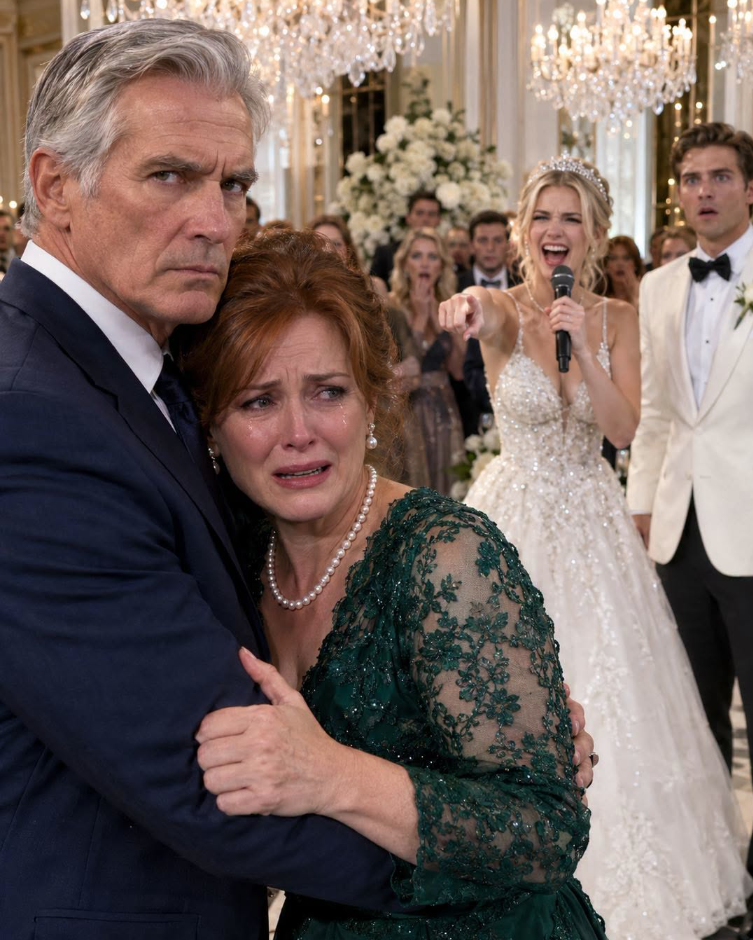
His mother, Patricia Walker, was turning sixty-five.
The dinner had been discussed for weeks.
Patricia had picked the restaurant, the cake, the seating, and the tone everyone else was supposed to carry into the room.
Ethan had treated it like a command performance.
Madison had tried to care.
She had even told him that morning to go for a little while if everything stayed calm.
That was before the pressure in her belly changed.
That was before her fingers went numb around the glass.
When the contraction tightened again, her grip failed.
The glass slipped.
It broke across the tile with a bright, ugly sound.
Ethan looked up from his phone, annoyed before he was afraid.
“Ethan,” Madison said.
Her voice sounded far away to her own ears.
“Something isn’t right.”
He stared at the shattered glass, then at her face, and for one moment she waited for him to become the man he had promised to be in every doctor’s office.
He did not.
He checked the time.
The movement was small, but Madison saw it.
Another contraction bent her forward, forcing one hand to the counter and the other around her stomach.
“Please,” she said. “I think the baby is coming.”
Ethan let out a breath that carried more irritation than fear.
“Madison, quit acting dramatic.”
The words landed colder than the tile under her feet.
They were not confused words.
They were not panicked words.
They were a decision.
Just days earlier, Madison’s blood pressure had worried her doctor enough that Ethan had been brought directly into the conversation.
It had been Tuesday at 10:20 a.m.
Madison remembered the time because the clock had hung above the framed safety poster in the exam room.
She remembered the doctor turning to Ethan, not Madison, as if making sure the warning reached the person who might have to drive.
“If she has severe pain, dizziness, bleeding, or anything unusual, you go straight to labor and delivery.”
Ethan had nodded.
He had squeezed Madison’s shoulder.
He had looked steady and responsible under fluorescent lights.
That was the part that hurt later.
Not just that he left.
That he knew.
In public, Ethan could perform concern perfectly.
At home, the same danger became something she was supposedly doing to him.
Madison forced herself to stand straighter.
“Your child needs you,” she said.
Ethan took his keys from the hook.
The sound of metal against metal seemed too loud.
“You always do this,” he said. “The second my family needs me, you turn everything into a crisis.”
Madison stared at him.
Her body was working through pain, fear, and disbelief all at once, but his sentence still found a clean place to cut.
“This is not about your mother,” she said.
He paused at the doorway.
For a second, she thought he might hear himself.
Instead, he gave a bitter little laugh.
“My mother only gets one sixty-fifth birthday. You’ve been pregnant for nine months. You can wait a couple hours.”
Then he left.
The front door slammed hard enough to rattle the ultrasound photo in the hallway.
The small frame tipped crooked and stayed there.
Madison stood in the kitchen, surrounded by broken glass, listening to his car pull away from the driveway.
For one breath, she wanted to scream after him.
She wanted Patricia’s perfect birthday table to hear the truth before the candles were lit.
She wanted someone to ask Ethan why his pregnant wife was on the kitchen floor while he cut cake for his mother.
But the next contraction took the anger out of her hands.
She sank carefully to her knees.
There were glass pieces everywhere.
She moved around them slowly, inch by inch, and reached for her phone.
The first call rang and died.
The second was rejected.
The third went unanswered.
By the fifth call, Madison understood he was looking at the screen and choosing not to pick up.
On the sixth, it went straight to voicemail.
The house felt too big around her.
Rain moved across the porch.
Somewhere in the hallway, the crooked ultrasound picture waited like a witness that could not speak.
At 7:41 p.m., Madison saw blood.
It was not a flood.
It was not the kind of thing that would look dramatic to someone determined to dismiss her.
But it was enough.
Enough to make the kitchen tilt.
Enough to bring back every word from the doctor.
Enough to turn Ethan’s insult into something dangerous.
Her hands shook so hard she almost missed the numbers, but she called 911.
When the dispatcher answered, Madison tried to make her voice steady.
It broke anyway.
“My husband left,” she cried. “I’m alone. I’m pregnant. Please hurry.”
Then she began dragging herself toward the entryway.
The front door was locked.
That detail became enormous in her mind.
If she could not reach it, the paramedics might lose seconds they did not have.
She used the wall, then the edge of the bench near the door, then one trembling hand against the floor.
The pain came in waves that did not feel like labor anymore.
They felt like warning bells inside her bones.
The ambulance arrived nine minutes later.
Red light swept across the ceiling.
A paramedic named Luis knelt beside her with gloved hands and a voice that stayed calm.
He did not ask whether she was being dramatic.
He did not look at the glass and sigh.
He put two fingers on her wrist and told her to keep her eyes open.
Another responder opened equipment bags near the door.
Someone asked how far along she was.
Someone else asked whether she had bleeding.
Madison tried to answer everything, but the words kept breaking apart.
She remembered Luis saying her blood pressure out loud.
She remembered the phrase fetal distress.
She remembered another voice saying possible abruption.
Then she was moving.
The stretcher wheels bumped over the threshold.
Rain touched her face as they carried her out.
The small American flag by the porch steps snapped in the wind while the ambulance doors opened behind her.
At the hospital, the world narrowed to white lights.
Shoes moved quickly around her.
A nurse cut away the dress Madison had been wearing all day.
Another nurse fastened a plastic wristband around her swollen wrist.
A fetal monitor was clipped across her belly.
Someone asked for her emergency contact.
Madison gave Ethan’s name.
She gave his number.
She still gave it because a part of her had not caught up to what he had done.
A husband was supposed to answer.
A father was supposed to come.
A man who had sat under a doctor’s warning at 10:20 a.m. was supposed to understand what it meant when the hospital called.
The nurse tried.
Nobody answered.
Another attempt was made.
Still nothing.
Madison watched the nurse’s face change, not into panic, but into that professional stillness people get when they realize the story is worse than the chart.
After that, everything accelerated.
The doctor came in.
The words emergency C-section moved through the room.
A consent form appeared.
Madison’s signature looked wrong, thin and uneven, like someone else had written her name for her.
She asked once whether the baby would be okay.
No one gave her the soft answer people give when the danger is small.
They gave her movement.
They gave her urgency.
They gave her hands on the stretcher rails and voices telling her to breathe.
In the operating room, Madison thought of Ethan at Patricia’s birthday table.
She pictured him leaning back in his chair, telling some version of the story where his wife was emotional and his mother was patient and everyone laughed because the hard part was not happening to them.
Then the anesthesia pulled the edges off the room.
When Madison woke, she was no longer in the life she had occupied that morning.
There was pain across her body.
There was a nurse checking her pressure.
There was a baby alive nearby, small and new and impossibly real.
There was also a silence where Ethan should have been.
The nurse told her the calls had been noted.
The emergency contact attempts were in the record.
The time of transport was in the record.
The condition on arrival was in the record.
Madison did not cry then.
She had cried in the ambulance.
She had cried in the bright hallway.
She had cried somewhere between fear and anesthesia.
But when she heard that the records showed what had happened, something inside her went quiet.
Not healed.
Not forgiving.
Quiet.
Two days passed in hospital light.
Madison learned how to hold the baby without pulling at her incision.
She learned that newborn sounds could be both tiny and terrifying.
She learned that nurses could be gentle without knowing your whole story.
She learned that Ethan had still not appeared.
He had not come during surgery.
He had not come while she recovered.
He had not come when the baby needed a name bracelet checked.
There were messages from him eventually, but they came late and thin, the kind that asked where she was without admitting where he had been.
Madison did not answer them right away.
She was too tired to perform pain for the person who had ignored it.
When she was discharged, the nurse placed the packet on the tray table and went over the instructions one by one.
Medication schedule.
Incision care.
Warning signs.
Follow-up appointment.
Then the nurse looked at the emergency contact section and paused.
She did not say what Madison already knew.
She simply made sure Madison had a safe way home.
By the time Madison returned to the house, the kitchen had been cleaned by someone from the small circle of people who had finally been called after Ethan failed to answer.
The broken glass was gone.
The floor looked normal.
That almost made it worse.
The house could be cleaned faster than a betrayal could.
Madison did not move the ultrasound photo.
She left it crooked.
She placed Ethan’s spare keys beneath it in the hallway.
Not thrown.
Not hidden.
Placed.
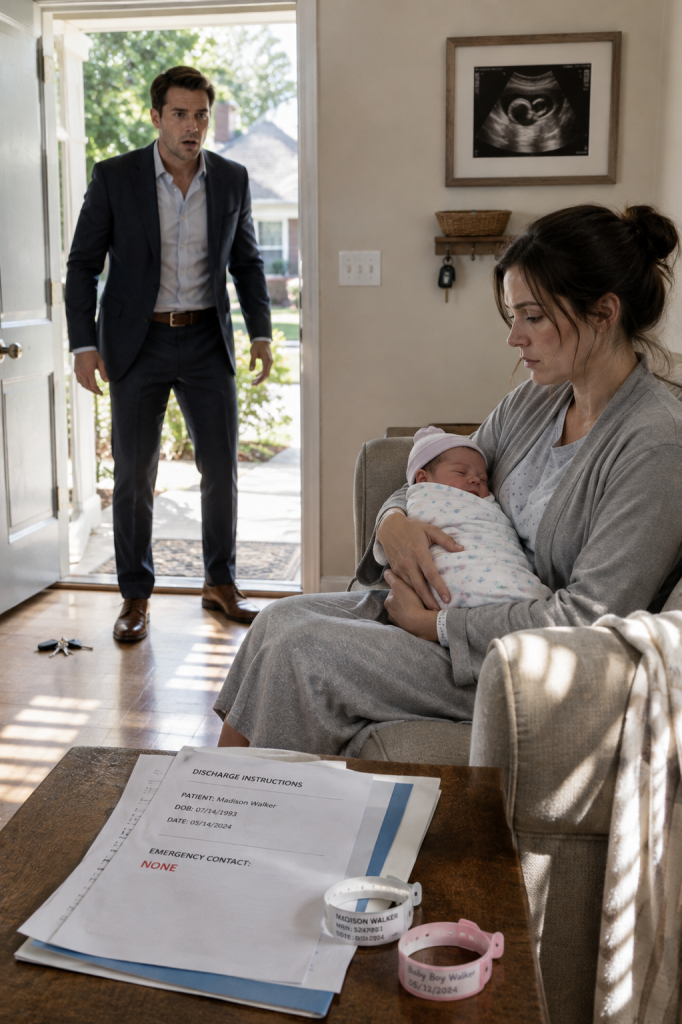
Then she carried the baby into the living room, lowered herself into the chair by the window, and set the hospital papers on the coffee table.
On top, she laid her plastic wristband.
Beside it, she placed the newborn ID band the nurse had taped to the discharge packet so it would not get misplaced.
She did not decorate the moment.
She did not write a speech.
The papers could speak clearly enough.
Two days after walking out, Ethan came home smiling.
The doorbell camera caught it.
His face was easy.
His shoulders were loose.
He looked like a man returning from a minor inconvenience, not a father who had missed an emergency surgery.
He opened the front door with the confidence of someone who believed the house still belonged to the version of him who had left it.
The hallway stopped him first.
It was too quiet.
The keys under the ultrasound photo caught his eye.
Then he saw the living room.
Madison sat by the window with the baby against her chest.
Morning light fell across her wristband.
The discharge packet waited on the coffee table.
Ethan’s smile vanished.
His own keys slipped from his hand and struck the hardwood.
The sound was sharp and final.
He looked at Madison, then at the baby, then at the top page of the packet.
Emergency Contact: Ethan Walker.
Attempted. No response.
His face drained of color.
For the first time since the kitchen, Madison saw fear in him that had nothing to do with being late to his mother’s dinner.
He whispered her name.
Madison did not answer the way she used to.
She turned the page.
Under the ambulance report, Luis’s name appeared near the bottom.
The time was there too.
7:41 p.m.
Patient reported spouse left residence despite late-term pregnancy and warning signs.
Ethan read it once.
Then again.
His mouth opened, but no explanation came out.
The kind of excuses that worked at family tables did not survive on hospital paper.
Madison kept one hand on the baby’s back and the other on the packet.
She did not raise her voice.
She did not need to.
The room held too much proof for shouting.
Ethan reached for the phone on the floor when Patricia’s name lit up the screen.
He stopped before touching it.
For once, his mother could wait.
That tiny delay told Madison more than any apology would have.
Not because it fixed anything.
Because it proved he had always known how to choose.
He had simply chosen her last.
The final page in the discharge packet listed the doctor’s warnings.
Severe pain.
Dizziness.
Bleeding.
Anything unusual.
Go straight to labor and delivery.
The same words Ethan had heard before the birthday dinner.
The same words he had ignored in their kitchen.
Madison slid that page forward.
Ethan covered his mouth.
His knees bent and he sank onto the edge of the couch, looking at the paper like it had accused him in a language he finally understood.
Madison watched him break down without mistaking it for repair.
A man can be terrified of consequences and still not understand the harm.
A man can cry after the proof appears and still have chosen cruelty before witnesses arrived.
That was the lesson Madison learned in the chair by the window.
The baby stirred against her.
She lowered her cheek to the soft blanket and breathed in that warm newborn scent that made the whole room feel both fragile and fierce.
Ethan tried to speak again.
Madison lifted one hand.
Not dramatically.
Just enough to stop him.
The first conversation would not be his performance.
It would not be Patricia’s version.
It would not begin with excuses about birthday dinners or family pressure or how he thought she was exaggerating.
It would begin with the record.
It would begin with the doctor’s warning.
It would begin with the unanswered calls.
It would begin with a baby who arrived while his father chose cake over an ambulance.
Ethan looked toward the hallway, where his spare keys sat under the crooked ultrasound photo.
For the first time, he seemed to understand why they were there.
Madison had not locked him out of a story.
He had walked out of it himself.
The hospital papers did not end the marriage in a single afternoon.
They did something colder and more permanent.
They removed the fog.
There would be appointments after that.
There would be hard conversations.
There would be family members who tried to soften what happened because softening cruel men is easier than holding them accountable.
Patricia would eventually hear enough to stop talking about the birthday dinner.
Ethan would eventually understand that being present after the danger passed was not the same as being there when it mattered.
But in that first morning light, Madison did not think that far ahead.
She thought about the kitchen floor.
She thought about the dispatcher’s voice.
She thought about Luis kneeling beside her when her own husband would not answer.
She thought about the nurse fastening the wristband around her wrist and asking for an emergency contact who never came.
Then she looked down at her baby and understood something simple.
The proof on the table was not only about Ethan.
It was about her too.
It proved she had begged for help and survived anyway.
It proved the pain had been real.
It proved the warning had been real.
It proved her silence was not forgiveness.
Ethan sat on the couch with his face in his hands while the phone went dark beside his keys.
Madison stayed in the chair, holding the baby, with the hospital wristband still on her wrist.
For the first time in two days, the house was quiet without feeling empty.
And the man who had told her she could wait finally learned what it felt like to be the one left standing outside a life that had moved on without him.