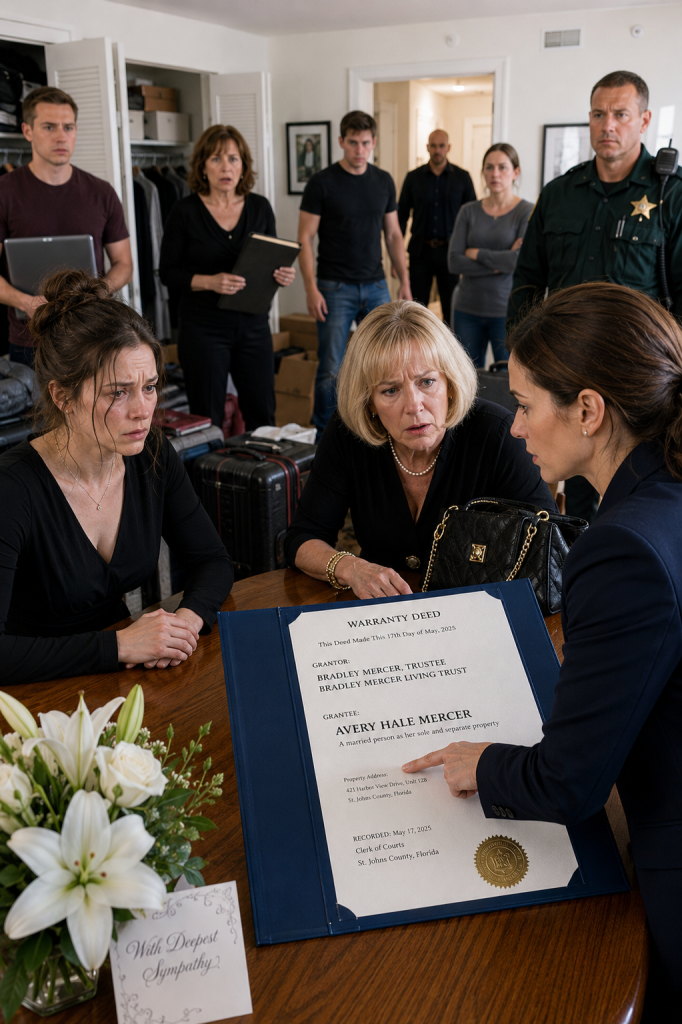
The deputy kept his finger on the recorded deed while the room fell silent around him.
Marjorie stared at the page as though the name might change if she refused to blink.
Behind her, eight relatives stood among half-packed suitcases, open drawers and piles of Bradley’s clothing.
Declan had already returned the laptop to the dining table, but his hands remained suspended above it, uncertain where to put themselves.
“This property passed directly to Avery Hale through a recorded survivorship deed,” the deputy said.
“It is not part of the probate estate.”
Marjorie lifted her chin.
“My son was sick.
He did not understand what he was signing.”
Lena Torres did not argue.
She simply opened the blue folder farther and arranged three documents beside the deed.
“Bradley signed in my office eleven days before his final hospitalization,” she said.
“His attending physician conducted a capacity examination that morning.
Two independent witnesses were present.
The deed was notarized, electronically recorded and accepted by St.
Johns County at 9:14 a.m.”
Fiona dropped the folder she had taken from Bradley’s desk.
The deputy looked toward the suitcases.
“No one removes anything else from this residence.”
Marjorie’s eyes moved from the deed to me.
“You planned this.”
I was still standing near the door in the dress I had worn to bury my husband.
My feet hurt.
My face felt stiff from hours of accepting condolences from people who had no idea how frightened Bradley had been during his final weeks.
“I followed his instructions,” I said.
“You isolated him.”
“I sat beside him while he was dying.”
“You kept his mother away.”
“Bradley kept you away.”
The words struck harder than I intended, but they were true.
For years, Bradley had tried to maintain a careful relationship with his family.
He paid Marjorie’s property taxes when she fell behind.
He covered Declan’s legal fees after a failed business venture.
He found work for Fiona’s son and quietly paid the deposit on an apartment for his younger cousin, Maeve.
He did those things without telling them where the money came from.
To his relatives, Bradley was a salaried project manager at Mercer Preservation Group, a regional company that restored historic hotels, courthouses and waterfront homes.
He drove a six-year-old car, wore inexpensive watches and avoided conversations about money.
They never knew that Mercer was his middle name.
They never knew that he had founded the company with his college mentor, Samuel Ortiz, or that he owned fifty-eight percent of it through a private holding company.
Bradley had hidden his success because the first time Marjorie learned he had received a large bonus, she arrived with three unpaid bills and a list of relatives who supposedly needed rescuing.
The requests did not stop after he helped.
They grew.
By the time he met me, he had learned to make himself appear smaller around his family.
I did not know the full truth at first either.
Bradley told me he managed restoration projects.
Our earliest dates were walks through old neighborhoods where he pointed out original windows, hand-cut stone and iron balconies.
He spoke about buildings as though they were living witnesses.
I learned he owned the company only after we became engaged.
He showed me the incorporation records and warned me that his family