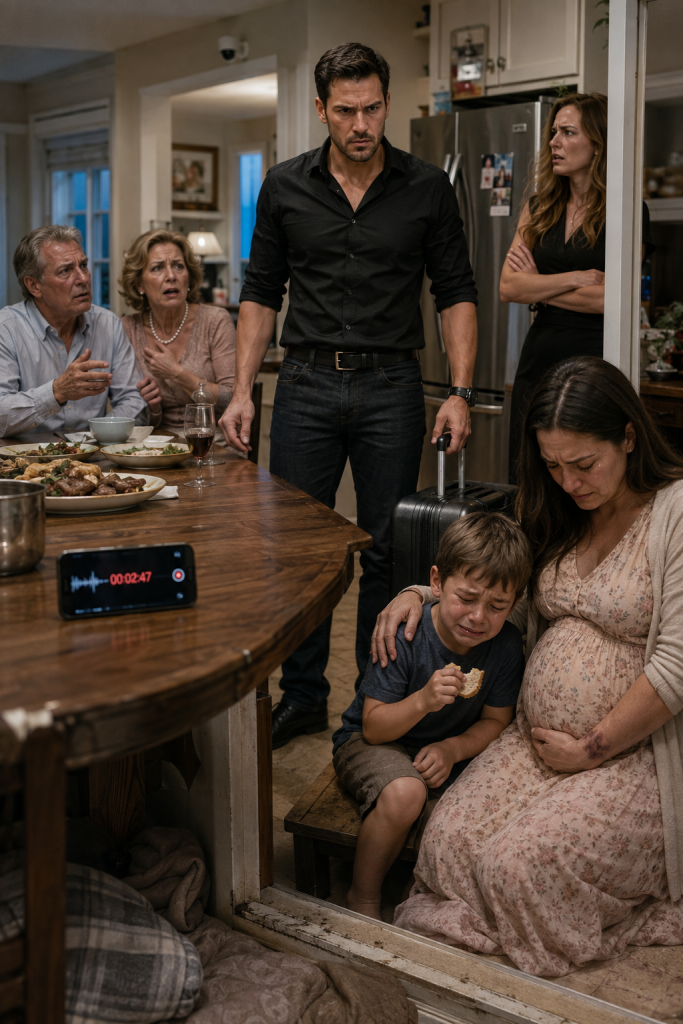
I left my phone recording on the kitchen counter.
Not because I wanted revenge.
Not because I planned to play their words for strangers or turn a private family failure into a public spectacle.
I left it there because, for the first time since walking through the front door, I understood that memory would not be enough. By morning, everyone in that room would begin rearranging the truth. My mother would soften her insults into concern. My father would call the entire evening a misunderstanding. Stephanie would insist she had been joking.
And Ashley, who had spent years trying to keep peace in a family that had never truly welcomed her, might begin wondering whether she had imagined the worst of it.
I looked at my wife.
“Take Samuel upstairs,” I said gently. “Use our bedroom. Lock the door if that helps you feel safe. I’ll be there in a few minutes.”
Samuel had moved close to her side. Ashley rested a hand on his shoulder, but she did not move.
“What are you going to do?” she asked.
“Nothing tonight.”
My sister gave a small, dismissive laugh.
“That would be a first.”
I turned toward her.
“I’m going to make sure my wife and son are comfortable. Then I’m going to ask all three of you to leave.”
My mother stared at me as though I had spoken in a language she did not understand.
“Leave?” she repeated. “At this hour?”
“There are hotels fifteen minutes away.”
“This is your father’s home too,” she said.
“No, it isn’t.”
The words came out quietly.
That seemed to unsettle them more than shouting would have.
My father pushed his chair back and stood. He had always been a large presence, even after age had rounded his shoulders and silvered his hair. When I was a boy, his silence had controlled rooms. A lifted eyebrow could end an argument. A disappointed sigh could follow me for days.
But that evening, looking at him across my own dining room, I saw something I had never allowed myself to see before.
He was uncertain.
“Devin,” he said, adopting the patient tone he used when he wanted me to feel unreasonable, “we can discuss this like adults.”
“We will. Tomorrow.”
“The documents need to be signed tomorrow.”
“They’ll be discussed tomorrow too.”
Stephanie stepped between us.
“You agreed to help Dad.”
“I agreed to review a restructuring plan.”
“You agreed to sign.”
“I said I would consider it after my attorney completed the final draft.”
Her expression changed for only a second, but I noticed.
“Your attorney?”
“Yes.”
“I thought Dad’s lawyer prepared it.”
“He prepared the version you saw.”
No one spoke.
Ashley’s fingers tightened on Samuel’s shoulder.
I picked up the stale bread from the floor and placed it on the counter. Then I crouched in front of my son.
“Hey, buddy.”
His eyes remained lowered.
“I brought you something.”
I opened my suitcase in the hallway and took out the soccer ball I had carried through two airports. It was bright blue, with silver lines across the panels. Samuel had chosen it from a picture weeks earlier.
His face did not light up the way I had imagined.
Instead, he looked toward the dining room, as if unsure whether he was allowed to accept it.
That hesitation hurt more than anything my family had said.
“This is yours,” I told him. “No one gets to decide whether you deserve it.”
He took the ball carefully.
“Can Mom come upstairs too?”
“Of course.”
“And you?”
“I’ll be right behind you.”
He nodded, though he did not look convinced.
Ashley leaned closer to me as she passed.
“Please don’t let this become worse,” she whispered.
“I won’t.”
There were a hundred things I wanted to ask her, but none of them belonged in that kitchen. Not while she was exhausted. Not while Samuel was listening. Not while my parents and sister watched us with expressions that shifted between irritation and concern for themselves.
I waited until Ashley and Samuel reached the second floor.
Then I faced my family.
“You have twenty minutes to gather your things.”
My mother’s face reddened.
“You would put your pregnant wife above the people who raised you?”
The question revealed more than she intended.
“I’m not ranking anyone,” I said. “I’m protecting the people who live here.”
“We were protecting you,” Stephanie replied.
“From what?”
She glanced toward my father.
It was brief, but it told me where the real conversation had been taking place.
My father buttoned his jacket.
“Your business has grown quickly,” he said. “Quick growth makes a man careless. We were trying to preserve what you built.”
“By transferring my voting shares?”
“By putting them in stable hands.”
“Whose hands?”
He did not answer.
My mother began collecting her purse and scarf from the back of a chair.
“You’ll regret speaking to us this way.”
“Maybe,” I said. “But regret is something I can live with. Ignoring what happened here isn’t.”
For the first time, Stephanie’s confidence seemed to weaken.
“Are you really choosing her version without hearing ours?”
“I heard your version before you knew I was standing in the hallway.”
Her eyes moved toward the phone on the counter.
She finally understood.
I picked it up and stopped the recording.
No one asked me to delete it.
That frightened me in a different way. It suggested they were already thinking beyond the evening—toward legal explanations, competing accounts, strategies.
My father walked toward the front door.
“Tomorrow,” he said, “you will learn that matters are more complicated than they appear.”
“I’m sure they are.”
He paused.
“Your wife has not told you everything.”
Ashley’s name in his mouth made my hands tighten, but I kept my voice steady.
“Neither have you.”
A car arrived to collect them twenty-seven minutes later.
I watched from the front window as my mother climbed into the back seat without looking at me. Stephanie stood on the sidewalk for several seconds, holding her overnight bag. She looked up at the house, then at me through the glass.
There was anger in her face, but there was something else too.
Fear.
My father touched her elbow, and she turned away.
When their car disappeared at the end of the street, the house became so quiet that I could hear the refrigerator humming in the kitchen.
For a few seconds, I stood alone in the hallway.
This was supposed to have been my safest place.
Ashley and I had chosen the house together six years earlier, when my company consisted of four employees, a borrowed office, and more hope than income. She had loved the curved staircase and the wide kitchen windows. I had loved the small room near the back garden because she had looked into it and said, “This could be your office until the company takes off.”
She had said until, not if.
The deed had been placed in her name later, after the company began attracting investors. It had not been a trick or a way to hide assets. It had been a promise.
No matter what happened to the business, Ashley and the children would have a home.
My family knew I had bought the house.
They did not know what I had done afterward.
Upstairs, I found Samuel asleep on top of our blankets, still holding the soccer ball against his chest.
Ashley sat beside him.
She had changed into one of my old university sweatshirts. It stretched over her belly, and her hair was pulled back loosely. In the softer light, she looked less frightened and more tired.
I sat at the edge of the bed.
For a while, neither of us spoke.
Then she said, “I should have called you.”
“Yes.”
The single word came out harder than I intended.
She looked down.
I rubbed both hands over my face.
“I’m sorry. That sounded like blame.”
“Maybe I deserve some.”
“No.”
“I kept things from you.”
“You were trying to get through something while I was away.”
“I was trying to keep you from losing your family.”
I looked toward Samuel.
“You and he are my family.”
“You know what I mean.”
I did.
My parents had not always been cruel. That was part of what made everything so difficult to understand.
My mother had worked nights at a hospital laundry when I was young. My father had taken extra construction jobs every winter. Stephanie had worn my old coats and never complained that the sleeves were too long. We had grown up counting grocery money at the kitchen table.
When my company succeeded, I had not felt as if I had escaped them.
I had felt as if all of us had escaped together.
I paid off my parents’ mortgage. I covered Stephanie’s tuition when she returned to school. I hired my father as an adviser after his contracting business began failing, even though his experience had little connection to cybersecurity.
At the time, helping them had felt like gratitude.
Somewhere along the way, gratitude had become obligation.
And obligation had become ownership.
“How long?” I asked.
Ashley looked toward the bedroom door.
“They came three days after you left.”
“They were supposed to visit for one weekend.”
“They said your father had a medical appointment in Columbus and that your mother wanted to help me prepare for the baby.”
“What happened?”
“The first few days were mostly uncomfortable. Your mother reorganized the kitchen. Stephanie criticized the nursery. Your father spent hours in your office.”
“He was in my office?”
“The door was locked, but he asked me for the key.”
“What did you say?”
“That you were the only one who used it.”
A faint, humorless smile crossed her face.
“He told me husbands shouldn’t keep locked rooms from their wives.”
“That sounds like him.”
“Then they began talking about the meeting with the notary. Your father said the power of attorney was only temporary because your travel schedule had become unpredictable. He said it would let him handle business emergencies when you were unavailable.”
“That’s what he told me too.”
“But Stephanie said something different.”
“What?”
“She said once the papers were signed, no one would have to tolerate me anymore.”
I lowered my voice.
“Did they threaten to remove you from the house?”
“Not directly. They kept saying this was a family property and that I should be grateful they allowed me to live here. I told them the house was ours. Your mother said I had misunderstood how marriage worked.”
“And the blankets downstairs?”
Ashley drew a slow breath.
“Your mother said the stairs were too dangerous for me at night. She moved my things into the small room beside the laundry area.”
“That room barely has a window.”
“I know.”
“Why didn’t you go to a hotel? Or call Mia?”
Mia was Ashley’s closest friend, an elementary-school counselor who lived less than ten minutes away.
“I tried to leave the next morning,” she said. “Then your father told me you were under enormous pressure because of the Minneapolis contract. He said if I caused a family crisis while you were negotiating, you might lose the deal.”
“That wasn’t true.”
“I know that now.”
“Ashley, you could never cost me a contract by asking for help.”
Her eyes filled, though her voice remained steady.
“I was afraid of being the reason you had to choose.”
I reached for her hand.
“You were already being forced to choose for both of us.”
She nodded.
“I kept thinking you’d be home Friday. I told myself I only had to make it until Friday.”
“And your wrist?”
She looked at the faint mark.
“I caught it on a shelf while moving a box in the utility room.”
I studied her face.
“That’s the truth?”
“Yes.”
Relief came with shame attached. I had been ready to believe the worst because enough damage had already been done.
“What box?”
“That’s what I need to show you.”
She eased herself off the bed.
I stood immediately.
“You should rest.”
“I’ve been waiting for you to come home so I could understand what I found.”
We left Samuel sleeping and walked downstairs.
The house looked different after my family’s departure. Their glasses remained on the dining table. A serving spoon rested across a bowl of broth. Stephanie’s perfume still lingered near the stairs.
Ashley led me past the kitchen to the small room beside the laundry area.
I had used it for storage. There were shelves along one wall, a utility sink, and a narrow foldout cot I had forgotten we owned.
Two blankets were arranged neatly on the cot.
Beside them sat Samuel’s small backpack, a stack of children’s books, and a night-light shaped like a moon.
Ashley had tried to turn the room into something gentle.
That made it harder to look at.
On the floor near the back wall stood a gray metal file box.
It was old, scratched at the corners, and secured by a simple latch.
“I found it behind the winter coats,” Ashley said. “I was moving them because your mother wanted the closet upstairs.”
“Was it ours?”
“I’d never seen it before.”
I crouched and opened the lid.
Inside were folders, envelopes, and several bound financial statements. Most were more than twenty years old.
The first folder carried my father’s name.
The second carried mine.
“What is this?” I asked.
“I only read enough to know it involved your family.”
I pulled out a document from a Columbus community bank. The paper was yellowed, but the typed words remained clear.
It was a loan agreement.
The borrower was Raymond Carter.
The collateral was listed as equipment from his old construction company.
At first, nothing seemed unusual. My father had taken many business loans.
Then I saw the guarantor’s name.
Evelyn Carter.
My father’s older sister.
Aunt Evelyn had disappeared from our lives when I was nine.
That was how the family described it: disappeared.
My parents said she had moved west after an argument about money. For years, I had pictured her driving toward California, relieved to leave Ohio behind. She sent no birthday cards. She made no phone calls. When I asked questions, my mother said Evelyn had always been selfish.
The document in my hand told a different story.
Evelyn had guaranteed a substantial loan for my father.
The next page was a notice of default.
The page after that transferred ownership of a small commercial property from Evelyn to the bank.
I remembered that property.
It had been a two-story brick building on Broad Street where Evelyn ran a bookkeeping service. When I was little, she let me sit at her desk and stamp old invoices. She kept peppermint candies in the top drawer.
“What happened to the building?” Ashley asked.
“I was told she sold it before moving away.”
“She didn’t.”
I looked deeper into the box.
There were letters.
Some were unopened.
All were addressed to my father.
The return address belonged to Evelyn.
The earliest had been sent twenty-two years ago. The latest was dated only four months earlier.
My hands went cold.
“She’s alive,” I said.
Ashley sat on the edge of the cot.
“It appears so.”
I opened the most recent envelope carefully.
The letter inside was handwritten.
Raymond,
I received another notice from the state regarding the old judgment. I am not asking Devin to pay your debt, and I will not contact him unless you force me to. But I will not sign away my remaining claim so you can use his company as security.
You told me this would be resolved after the family property sold. It never was.
I have waited long enough.
Evelyn
I read it twice.
Then a third time.
“What family property?” Ashley asked.
“I don’t know.”
Another folder contained tax records for a parcel of land outside Dayton. The listed owners were my father, Evelyn, and their younger brother, Thomas, who had died when I was in college.
The records showed the land had been sold twelve years earlier.
A handwritten accounting divided the proceeds into three shares.
Beside Evelyn’s name was a notation: applied to Raymond’s outstanding obligation.
Yet the recent letter suggested she had never agreed.
I sat on an overturned storage bin.
All evening, I had been trying to understand why my family wanted control of my company. Greed had seemed like the obvious answer.
Now I wondered whether desperation was closer to the truth.
That did not excuse anything.
But it changed the shape of the mystery.
“Did my father bring this box?” I asked.
“I think so. I heard him and Stephanie arguing in here yesterday. After they left, I noticed the coats had been moved.”
“What were they arguing about?”
“I couldn’t hear everything. Stephanie said, ‘You promised this would fix it.’ Your father told her to lower her voice.”
I looked through the financial statements again.
One belonged to a company called Carter Development Holdings.
I had never heard of it.
My father was listed as president.
Stephanie was listed as secretary.
The company owned two rental properties and had borrowed heavily against both. The most recent statement showed missed payments, legal fees, and a pending demand from a private lender.
The total debt was large enough to explain their urgency.
Not large enough to justify what they planned.
But large enough to ruin them.
“Stephanie is involved,” I said.
Ashley nodded.
“Maybe not in the way you think.”
I looked at her.
“Why would you say that?”
“Because I heard her crying in the bathroom two nights ago. She was on the phone with someone. She said she had only signed what your father gave her and didn’t understand she was personally responsible.”
That sounded like Stephanie.
She had always been impulsive, but not foolish. She trusted my father’s certainty because all of us had been trained to trust it.
Still, I remembered her voice in the dining room.
We’ll get rid of that woman and the boy.
Fear could explain why she wanted my signature.
It could not erase the choice she made to treat Ashley as an obstacle.
“I don’t know what to believe,” I said.
“You don’t have to decide tonight.”
I glanced at the old letters.
“Did they know you found this?”
“I don’t think so. Your mother called me upstairs before I could put the coats back. I closed the box and left it.”
“Why didn’t my father take it when he left?”
“He may have thought it was still hidden.”
Or he had been too distracted by my arrival.
I carried the box into my office and locked it inside the fireproof cabinet. Then I checked the security system.
Every interior camera was still active.
The recordings had been stored automatically on an encrypted server, just as I had configured them after the attempted burglary.
I did not watch everything.
I reviewed only enough to confirm dates and preserve copies.
My family had arrived eleven days earlier.
My father had tried the office door six times.
My mother had carried Ashley’s clothes downstairs.
Stephanie had stood in the hallway one afternoon, staring at the closed laundry-room door for nearly a minute. Then she had placed a plate of fresh food on the floor, knocked once, and walked away before Ashley opened it.
That small act confused me.
It did not match the woman I had heard in the dining room.
Perhaps guilt and cruelty could occupy the same person.
Perhaps they often did.
At midnight, I called Mia.
She arrived in pajamas beneath a long coat, carrying an overnight bag and a container of soup. She hugged Ashley without asking for explanations and checked on Samuel before sitting with us in the kitchen.
“You’re both coming home with me,” she said.
Ashley began to protest.
Mia raised one hand.
“My guest room is ready, Samuel likes my dog, and I have enough cereal to survive a minor national emergency.”
For the first time that evening, Ashley smiled.
I wanted them to remain with me, but wanting was not the same as understanding what they needed.
“Would you feel better at Mia’s?” I asked.
Ashley hesitated.
“For one night.”
The answer hurt, though it was reasonable.
“Then go.”
“You’re not angry?”
“I’m angry that you have to ask.”
Mia placed her hand over Ashley’s.
“Trust doesn’t come back because somebody says the right thing once,” she said. “It comes back when the next right thing happens, and then the next.”
I looked at her.
“Is that professional advice?”
“It’s what I tell second graders after someone breaks a crayon.”
Ashley laughed softly.
The sound loosened something in my chest.
Before they left, I woke Samuel enough to explain that he and his mother were having a sleepover at Mia’s house. He asked whether I was coming.
“Tomorrow morning,” I promised.
He held out the soccer ball.
“You keep it here so it doesn’t get lost.”
I took it.
“I’ll guard it.”
When the front door closed behind them, I returned to my office.
I did not sleep.
At seven the next morning, my attorney, Naomi Reed, arrived with coffee and the final version of the power of attorney.
Naomi had represented my company since its earliest years. She was calm, precise, and almost impossible to surprise.
Almost.
She read Evelyn’s letter twice before looking up.
“This changes the context,” she said.
“Does it change the meeting?”
“No. It makes the meeting more important.”
“What exactly is in the document you prepared?”
“The authority your father requested is not in it.”
I had instructed Naomi weeks earlier to draft a limited power of attorney after my father began insisting that my travel schedule created risk. The document allowed him to speak with one insurance provider regarding a specific claim involving storm damage at a small warehouse the company leased.
Nothing more.
It granted no control over shares, bank accounts, contracts, employees, or property.
It also expired after thirty days.
“And the attachment?” I asked.
Naomi opened a second folder.
“The acknowledgment you requested. Each attendee confirms they have disclosed any financial interest, debt, claim, or outside agreement that could affect their advice regarding your company.”
My father believed he was coming to receive authority.
Instead, he would be asked to disclose why he wanted it.
“Will this expose him publicly?”
“No. It creates a private record. What happens afterward depends on what he says and what evidence exists.”
“I don’t want to destroy my family.”
Naomi’s expression softened.
“Setting a boundary is not destruction.”
“What if they lose everything?”
“That question belongs after we know what ‘everything’ includes.”
At nine, Ashley called.
Her voice was steadier.
“Samuel wants pancakes.”
“That sounds urgent.”
“He says Mia’s dog should have one too.”
“Tell him dogs need legal counsel before entering pancake agreements.”
She paused.
“Are you still going to the notary?”
“Yes.”
“Do you want me there?”
I thought carefully.
“No. Not unless you want to be.”
“I don’t.”
“Then don’t come.”
Another pause.
“Thank you.”
It was a small moment, but I understood what Mia had meant.
The next right thing.
Then the next.
The meeting took place at eleven in a private conference room at Naomi’s office.
My parents arrived together.
Stephanie came separately.
She wore a gray sweater instead of the polished outfit she had worn the night before. Her eyes looked swollen, and she carried no designer handbag, only a paper folder clutched against her chest.
My father sat across from me.
My mother chose the chair beside him.
Stephanie sat at the far end of the table.
The notary introduced herself and explained that Naomi would review the documents before any signatures were collected.
My father interrupted.
“We have already reviewed them.”
“You reviewed a draft prepared by another attorney,” Naomi said. “Mr. Carter elected not to use that version.”
My father looked at me.
“You changed the agreement?”
“I clarified it.”
Naomi distributed copies.
The room became silent except for turning pages.
My mother stopped reading first.
“This is useless,” she said.
“It provides the authority Raymond said he needed,” I replied. “He can communicate with the insurer about the warehouse claim.”
“That isn’t what we discussed,” my father said.
“It’s what you told me.”
He closed the document.
“You’re embarrassing yourself by pretending not to understand business.”
Naomi slid the disclosure form toward him.
“Then perhaps this will help clarify the business purpose. Before Mr. Carter grants any authority, each participant must disclose related financial interests.”
My father did not touch the form.
Stephanie did.
She read the first paragraph, then looked at him.
“You said this was only about keeping Devin’s company in the family.”
My father’s jaw tightened.
“It is.”
“What about Carter Development Holdings?” I asked.
My mother turned sharply toward me.
Stephanie went still.
My father remained composed, but only just.
“Where did you hear that name?”
“I found the records.”
“You went through my private documents?”
“They were hidden in my house.”
For several seconds, no one spoke.
Then Stephanie pushed her chair back from the table.
“You brought the box there?”
My father’s silence answered her.
She looked at me.
“I didn’t know he brought it.”
“What did you know?”
Tears brightened her eyes, but she did not look away.
“I knew the company was in trouble. I knew Dad needed financing. He said your shares could be placed in a family trust temporarily, and the trust could guarantee a bridge loan.”
“A bridge to what?”
“The sale of the rental buildings.”
Naomi spoke carefully.
“Did you receive independent legal advice before signing the company guarantees?”
Stephanie shook her head.
“Dad said the attorney represented all of us.”
“He represented the company,” Naomi said. “That is not necessarily the same thing.”
My mother placed her hand on my father’s arm.
“Raymond was trying to protect what he built.”
“What did he build?” I asked. “A company I had never heard of? Debt Stephanie didn’t understand? A plan to use my shares without telling me the truth?”
My father looked suddenly older.
“I was going to repay everything.”
“With what?”
“The Broad Street redevelopment.”
The name pulled me back to Aunt Evelyn’s old office.
“What does Broad Street have to do with this?”
His eyes lowered.
“The bank sold Evelyn’s building after the default. Years later, I bought it through another company.”
My thoughts seemed to slow.
“You bought her building?”
“It was going to be restored. I thought if the redevelopment succeeded, I could repay her and return part of the property.”
“Did Evelyn know?”
“No.”
“Does she know now?”
My father did not answer.
Stephanie opened the paper folder she had brought and removed a recent letter.
“I received this three weeks ago,” she said.
The letter was from a law office in Oregon.
It stated that Evelyn Carter had assigned her remaining financial claim to a family trust.
The named trustee was not my father.
It was not Stephanie.
It was me.
I read the line twice.
“I didn’t know about this.”
“Neither did I,” Stephanie said. “Dad told me it was an old claim that would disappear if the power of attorney was signed.”
Naomi held out her hand for the letter.
After reading it, she asked, “Where is the trust document?”
“I don’t have it,” Stephanie replied. “The lawyer said it would be delivered directly to Devin if Evelyn approved the final terms.”
My father stood.
“This meeting is over.”
My mother rose with him.
But Stephanie remained seated.
“No,” she said.
Her voice was quiet, almost unsteady, yet it stopped both of them.
She looked at our father.
“You told me Aunt Evelyn abandoned us.”
“She abandoned her responsibilities.”
“You lost her building.”
“I made a business decision.”
“You used her property to cover your debt.”
“I was trying to keep our family afloat.”
Stephanie’s expression changed.
For years, she and I had defended our father with the same sentence.
He was trying to keep the family afloat.
We had never asked who he expected to drown so the rest of us could remain above water.
My mother looked toward me.
“You have no idea what those years were like. Your father was under pressure. Evelyn had money. We had children.”
“And that made it acceptable?” Stephanie asked.
Florence stared at her daughter as if the question itself were a betrayal.
My anger had carried me through the night, but sitting in that quiet room, I felt something more complicated.
My parents had made choices out of fear, pride, and desperation.
Then they had spent decades protecting those choices with new lies.
Stephanie had followed them because believing our father felt safer than examining him.
And I had played my own part.
I had solved every financial problem they brought me without asking how it began. I had mistaken rescuing them for loving them. Each time I paid a debt, I made it easier for the truth to remain hidden.
“I won’t sign anything today,” I said.
My father turned toward me.
“You’ll let the lender take everything?”
“I’ll review the debts. I’ll speak to Evelyn’s attorney. If there is a lawful way to keep anyone from losing a home, I’ll consider it.”
Relief flickered across my mother’s face.
I continued.
“But I will not transfer my shares. I will not guarantee the development company’s loans. And I will not discuss financial help until every record is disclosed.”
My father gave a bitter smile.
“So now we beg.”
“No. Now we tell the truth.”
Stephanie wiped her eyes.
“What about me?”
“You need your own lawyer.”
“I can’t afford one.”
“I’ll pay for an initial consultation directly. After that, you decide what to do.”
She nodded slowly.
It was not forgiveness.
It was not reconciliation.
It was one careful step away from the edge.
My mother picked up her purse.
“And Ashley?”
The way she said my wife’s name made the room colder.
“What about her?”
“Are we expected to apologize for one unpleasant evening when our family is facing ruin?”
“No,” I said. “You’re expected to understand that what happened was not one evening. It was the result of years of treating her as though she was temporary.”
Florence looked away.
I realized then that she was not ready to apologize. Any apology offered in that room would be another strategy.
“That conversation will happen only if Ashley agrees,” I said. “And only when she feels ready.”
My parents left without signing.
Stephanie stayed behind.
She sat with both hands around a paper cup of water.
“I said terrible things,” she whispered.
“Yes.”
“I thought she was keeping you from helping us.”
“She didn’t know what was happening.”
“I know.”
The room remained quiet.
“I left food outside the laundry room,” she said.
“I saw.”
Her face crumpled.
“That doesn’t make anything better.”
“No.”
“I don’t know why I’m telling you.”
“Because part of you wants credit for not being as cruel as you sounded.”
She flinched, but nodded.
“That’s probably true.”
I leaned back in my chair.
“You don’t need to convince me you’re a good person today. You need to decide what kind of person you’re going to be next.”
She stared into the water.
“Will Ashley ever forgive me?”
“That is not the first question.”
“What is?”
“Whether you can apologize without asking her to make you feel better.”
Stephanie was silent for a long time.
Then she said, “I need that lawyer’s number.”
Naomi gave it to her.
That afternoon, I went to Mia’s house.
Samuel opened the door wearing a plastic firefighter helmet. Mia’s golden retriever stood beside him with a dish towel tied around its neck like a cape.
“Dad,” Samuel announced, “we saved the kitchen.”
“Was it in danger?”
“Only pretend danger.”
“That’s the best kind.”
He took my hand and pulled me inside.
Ashley sat near the window with a cup of tea. Sunlight fell across her face. She still looked tired, but there was calm in her posture that had been missing the night before.
I told her everything.
I did not hide Stephanie’s involvement. I did not excuse my parents. I did not make promises about fixing the debts.
When I finished, Ashley asked, “What are you going to do about your aunt?”
“Call her attorney.”
“And your father?”
“I don’t know.”
“That’s honest.”
“I’m trying.”
She looked toward the living room, where Samuel was explaining imaginary fire safety to the dog.
“I’m not ready to go home today,” she said.
“Then we’ll stay here.”
“You don’t have to.”
“I know.”
Mia appeared in the doorway.
“For the record, the guest room has a two-night limit unless somebody unloads the dishwasher.”
“I accept those terms,” I said.
That evening, after Samuel fell asleep, I called the Oregon law office named in the letter.
The attorney, Laura Bennett, confirmed that she represented Evelyn Carter.
“I’m afraid I cannot discuss the trust in detail without my client’s authorization,” she said.
“Can you tell me whether my aunt is well?”
There was a pause.
“She is receiving medical care, but she is fully capable of making her own decisions.”
“Why did she name me as trustee?”
“That is a question she hoped to answer herself.”
“Can I speak to her?”
Another pause.
“She asked me to wait until you discovered the records on your own.”
I looked across Mia’s quiet kitchen at the old gray file box, which I had brought with me.
“She knew the box was in my house?”
“Yes.”
“How?”
“Because she was the person who sent it.”
My breath caught.
“My father brought it.”
“No, Mr. Carter. The delivery receipt was signed by your sister.”
Stephanie had known more than she admitted—or perhaps she had accepted a package without understanding what it contained.
“What is in the trust?” I asked.
“I can only tell you that it does not contain your father’s debt.”
“Then what does it contain?”
Laura’s voice softened.
“A record of an investment made twenty-one years ago.”
“In what?”
“In the first company you ever started.”
I stared at the darkness beyond the kitchen window.
“That’s impossible. I was sixteen.”
“You repaired computers from your aunt’s bookkeeping office during summer break.”
The memory returned with startling clarity: an old desk, a humming fan, handwritten invoices, peppermint candies.
“She gave me two hundred dollars to buy replacement parts,” I said.
“She considered it an investment.”
“In a teenager fixing computers?”
“She considered it an investment in you.”
Laura continued.
“Evelyn kept records of every payment, every loan, and every promise your family made. But the document she most wanted you to see was not financial.”
“What was it?”
“A letter.”
“From her?”
“No.”
I waited.
The attorney’s next words changed the question I had been asking since childhood.
“The letter was written by your mother—the week Evelyn supposedly left the family.”