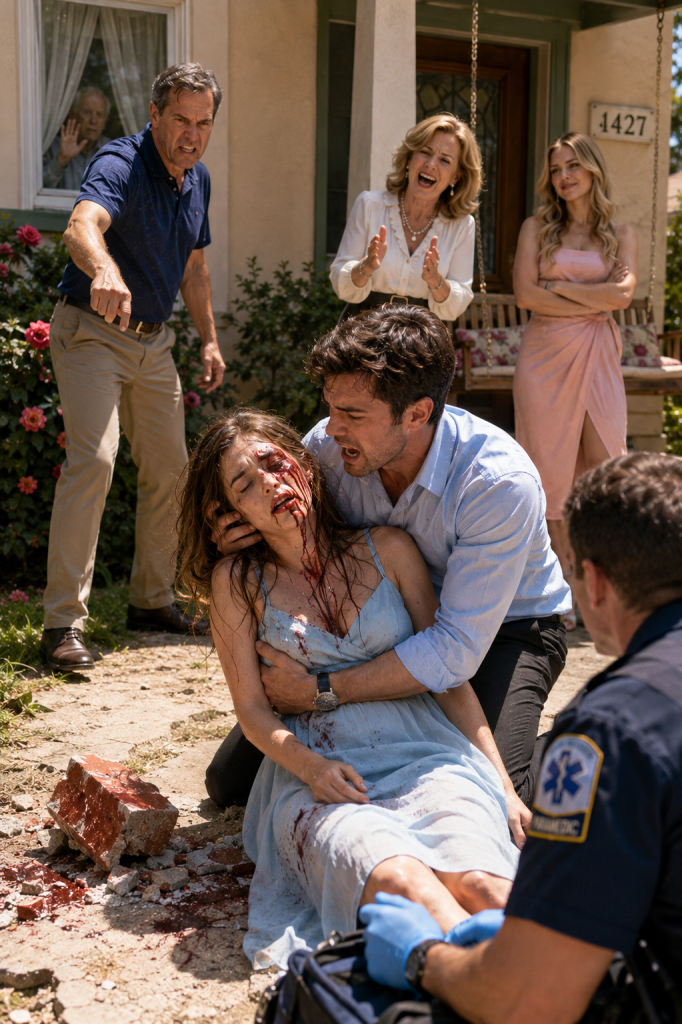
The brick struck me before I saw my father’s arm move.
One moment, I was standing on the broken sidewalk outside my parents’ house in the neighborhood where I had grown up in Santa Fe, New Mexico. I was wearing the pale blue dress I had bought especially for that evening because I planned to announce our wedding date over dinner.
The next moment, the world turned white.
The sound was not loud.
That somehow made it worse.
It was dry and wet at the same time, like something splitting open beneath the skin.
Warm blood ran over my left eyebrow, down my cheek, and across my lips.
My knees collapsed.
Ethan Parker, my fiancé, caught me before my face struck the concrete steps.
“Lena, look at me. Stay awake. Lena!”
I tried to open my left eye.
Nothing.
Only darkness.
Through my right eye, I saw my mother, Diane, standing beside the old wooden swing in the front yard.
She did not look frightened.
She did not rush toward me.
She did not call for help.
She was laughing.
My father, Charles Bennett, dropped the broken half of the brick onto the lawn.
“I warned you,” he said calmly, as though he had shut a cabinet door instead of crushing his daughter’s face.
Ethan stared at him in horror.
“What did you just do?”
No one answered.
Then my younger sister, Brooke, stepped through the front doorway.
She wore an expensive dress, her nails had been freshly done, and irritation tightened her face as though my blood had inconvenienced her evening.
“I told you she wouldn’t step aside,” she said, folding her arms.
My mother sighed.
“We tried being reasonable with her.”
Ethan carefully leaned me against one of the porch columns before standing.
“You people are insane.”
My father smiled and pointed toward Brooke.
“No. You’re simply engaged to the wrong daughter.”
The ringing inside my skull was unbearable, but those words struck harder than the brick.
“What are you talking about?” Ethan asked.
“Brooke should have been the one you chose,” my mother said. “Lena has always been selfish.”
Brooke stared down at me where I lay bleeding on the ground.
“And somehow, you still picked her.”
Ethan reached for his phone to call 911.
My father kicked it from his hand.
The screen shattered against the porch steps.
“No one is calling anyone.”
Ethan shoved him backward.
My father was already in his sixties, but he attacked like an animal trapped against a wall.
They crashed into the rose bushes.
My mother and Brooke did not scream.
They simply watched.
That was when something colder than the blood on my skin settled inside me.
This had not been a sudden explosion of rage.
It was not one reckless moment.
They had planned it.
Ever since Ethan sold his construction firm and became wealthy, my family had begun circling him.
First came the carefully arranged dinners.
Then the endless compliments.
Then Brooke started appearing “accidentally” at his gym, outside his office, at his favorite coffee shop, and even near our apartment.
Ethan rejected her every time.
He blocked her number and every social media account she created.
Brooke told my parents that I was controlling him.
“You’re going to marry Brooke,” my father growled as he struggled with Ethan, “or you’re no longer part of this family.”
“I love Lena.”
“You’ll move on,” Brooke said.
At that moment, an electrician’s pickup truck screeched to a stop at the curb.
The driver climbed out, saw my face, and immediately reached for his phone.
“I’m calling an ambulance!”
My father stepped toward him.
The electrician pointed directly at him.
“Take one more step and I’ll tell the dispatcher you’re attacking me too.”
My father stopped.
The sirens arrived only minutes later.
As the paramedics lifted me into the ambulance, I looked toward the living room window one last time.
An elderly man I had never seen stood behind the curtain.
One trembling hand rested against the glass as though he were trying to warn me.
Then the curtain fell shut.
And none of us understood what was about to be uncovered.
I woke to the unmistakable smell of a hospital.
Disinfectant.
Fresh sheets.
And the metallic scent a person recognizes without asking because she knows it belongs to her own blood.
I opened my right eye.
My left was hidden beneath thick bandages.
A woman in a white coat leaned over me.
“I’m Dr. Rebecca Morgan. You’re safe now, Lena.”
Safe.
The word felt almost foreign.
“Ethan…”
“He has not left since they brought you in.”
He appeared beside the bed with blood still staining his shirt, his knuckles scraped raw, and his eyes swollen from crying.
The moment he took my hand, he broke apart.
“I promised I wouldn’t leave you.”
I had never seen Ethan cry.
Not when his grandfather died.
Not when his first business collapsed.
But seeing me injured had shattered something inside him.
Dr. Morgan explained that the bones surrounding my left eye had fractured.
Surgeons had reconstructed part of the socket and closed a deep wound.
Then she said the sentence that cut straight through me.
“We believe your vision may return, but there is still too much swelling to know for certain.”
We believe.
Not we know.
An hour later, an investigator from the county district attorney’s office entered.
His name was Detective Marcus Hale.
He never raised his voice.
He did not pressure me.
He sat beside the bed and asked quietly,
“Did your father deliberately strike you with the brick?”
“Yes.”
“Had he threatened you before tonight?”
I closed my right eye.
Years of favoritism rushed back all at once.
Whenever Brooke wanted something that belonged to me, my parents expected me to surrender it.
Whenever she failed, I was expected to repair the damage.
When I won a scholarship, my father accused me of showing off.
When Brooke quit college, my mother said she was “taking time to discover herself.”
When I bought my first car, they demanded that I hand it over to Brooke because she supposedly needed something to rebuild her confidence.
“Yes,” I said. “Many times.”
I told him about Ethan.
About the sale of his company.
About the staged family dinners.
About Brooke’s messages.
The gifts Ethan returned unopened.
The letters he burned.
The countless demands that I move aside and let my sister have him.
Detective Hale closed his notebook.
“So the purpose of the attack was to force Mr. Parker to leave you and choose your sister.”
Ethan’s jaw tightened.
“They thought if they destroyed her face, I would stop loving her.”
Detective Hale remained silent for several seconds.
Anger showed in his eyes.
Then a nurse appeared at the doorway.
“There are three people asking to see you. Charles Bennett, Diane Bennett, and Brooke Bennett.”
Ethan stood immediately.
“They are not coming in.”
Before the nurse could answer, my father’s voice erupted from the hallway.
“Lena! You’ve humiliated this family long enough!”
My mother shouted,
“We came here to forgive you!”
Then Brooke added,
“You owe Dad an apology for provoking him!”
Detective Hale stepped into the hallway.
The door stayed partly open.
I heard his voice, calm and firm.
“You need to leave.”
“She’s my daughter,” my father replied.
“No. She is the victim.”
A long silence followed.
Then my father laughed.
“And you believe her?”
“I also have six witnesses, a recorded 911 call, and security footage from a neighboring property showing the final minutes.”
My mother stopped talking.
Then Brooke whispered something.
My father answered, apparently forgetting officers were standing around him.
“Erase it.”
Detective Hale replied,
“Thank you for saying that in front of three law enforcement officers.”
I heard the click of handcuffs.
My mother screamed.
Brooke began sobbing.
My father insisted that everything had been misunderstood.
As officers led them toward the elevator, an elderly voice echoed down the corridor.
“I have waited twenty-six years to watch someone finally stop Charles.”
I turned toward the doorway.
It was the same man I had seen through the living room window.
He carried a cane and an old leather briefcase.
He was not watching the police.
He was looking directly at me.
“I believe it is time you learned who I am.”
The hallway became so quiet that the fluorescent lights seemed deafening.
My father, still handcuffed, twisted around before the elevator doors closed.
“Stay away from her!”
The elderly man did not move.
He answered with quiet grief.
“I have already stayed away far too long.”
The elevator doors shut.
My family’s voices disappeared.
For the first time in my life, no one was yelling at me, blaming me, or demanding that I apologize for taking up space.
Detective Hale returned to the room.
“Do you know this gentleman?”
I slowly shook my head.
“No.”
The older man removed his cap.
His hair was white.
Arthritis had twisted his hands.
Tears filled his eyes.
“My name is Walter Lawson.”
The name meant nothing to me.
“I was your grandfather Henry’s closest friend.”
Something inside me went still.
My grandfather had died before I was born.
My family almost never spoke about him except to say he had been difficult, rigid, and stubborn.
“He called me his brother,” Walter said.
He opened the briefcase and removed an old photograph sealed inside clear plastic.
Two young men covered in sawdust stood laughing beside a cabin that was only half finished.
One was my grandfather, identical to the old portrait my mother kept hidden in a storage box.
The other was Walter.
“Your grandfather was not cruel,” Walter continued. “He was generous. Far too generous for the people who came after him.”
I swallowed.
“My parents never mentioned you.”
“They could not. Charles made certain I disappeared from all of your lives.”
Ethan remained beside the bed with one hand resting near mine.
Walter looked at him.
“Stay, son. You should hear this as well.”
He lowered himself into a chair with visible effort and opened the briefcase again.
“When your mother was pregnant with you, Henry built a maple crib by hand. He sanded every surface himself and carved little stars along both sides. He used to say his first granddaughter would bring light into that house.”
My eyes began burning.
“What happened to it?”
Walter lowered his gaze.
“Charles burned it.”
Ethan tightened his grip on my hand.
“Why?”
“Because he said no baby girl deserved that much work.”
The silence became unbearable.
“When you were born,” Walter continued, “Henry held you for almost an hour. He cried. He said, ‘This child will change the story of this family.’ But Charles wanted a son.”
Walter paused.
“When Brooke was born three years later, Charles decided she would become the child he displayed proudly.”
“But Brooke was a girl too,” I whispered.
“That was never the real issue. Charles believed she should have been born first. In his mind, you had taken the place meant for her.”
I struggled to breathe.
All my life, I had believed something inside me must be wrong.
That perhaps I really was difficult.
Cold.
Selfish.
Exactly as my parents had always claimed.
But I had done nothing.
My only offense had been being born first.
Walter removed a bundle of envelopes tied with a faded blue ribbon.
My name appeared on every one in elegant handwriting.
Lena Bennett.
“Your grandfather wrote these letters for you.”
“He asked me to deliver one every birthday,” Walter said, his voice breaking. “I could not do it. Charles threatened me. He said he would accuse me of stalking his family and destroy my life if I ever approached you.”
My fingers trembled as I touched the first envelope.
My grandfather had written to me for years.
He had loved me before I was old enough to understand rejection.
“I saved every letter,” Walter said. “I have carried them for twenty-six years.”
I began crying.
Ethan cried with me.
Detective Hale, standing near the door, lowered his eyes to give us privacy.
“There is more,” Walter said.
He removed a small brass key with an old leather tag.
“What does it open?”
“A safe-deposit box. Henry rented it six months before he died. He left instructions because he believed you would eventually need the truth.”
Before I could ask another question, Detective Hale stepped forward.
“I’m sorry to interrupt, but we have an update.”
His expression had changed.
He no longer looked merely angry.
He looked like a man who had uncovered something far larger than an assault.
“The district attorney’s office secured a warrant to search your parents’ house. We found files inside your father’s study.”
Ethan frowned.
“Files about what?”
“You.”
My stomach tightened.
Detective Hale opened his notebook.
“Photographs. Daily schedules. Addresses. News articles about the sale of your business. Copies of interviews. Notes tracking your movements.”
“They were watching us,” Ethan said.
“For several months,” the detective confirmed.
Then he paused.
“We also recovered handwritten notes.”
“What did they say?” I asked.
He inhaled slowly before reading.
“‘If Lena is removed as an option, Ethan will eventually notice Brooke.’”
He turned the page.
“Another says, ‘Beauty is important. If Lena’s face is damaged, he will finally understand which sister has greater value.’”
No one moved.
It had never been impulsive.
My father had not simply lost control during dinner.
My parents and sister had sat together and planned the attack.
They had discussed my face like an inconvenience that could be destroyed.
A nurse entered carrying a cordless telephone.
“Ms. Bennett, there is a call for you from the county detention center. It is not from your parents.”
Everyone exchanged confused looks.
My hand shook as I accepted the phone.
“Hello?”
At first, there was only quiet breathing and muffled crying.
“Lena,” a woman finally said, “you do not know me. My name is Sarah Bennett. I am your father’s younger sister.”
My entire body stiffened.
“I didn’t know he had a sister.”
“I know. Charles made certain of that. I have spent more than twenty years using my married name so he would never find me.”
Detective Hale sat down.
Walter closed his eyes as though a final piece had moved into place.
“When I heard Charles had been arrested,” Sarah continued, “I called because, for the first time in decades, I felt safe enough to speak.”
“What do you need to tell me?”
Silence stretched between us.
“That Walter only knows part of what happened.”
Walter raised his head.
“What part?”
“Charles was not always this vicious,” Sarah said. “He became obsessed after our father changed his will.”
Detective Hale straightened.
“Explain.”
“Our father discovered that Charles had been stealing from the family hardware business. He forgave him once. Then he caught him doing it again. That was when he rewrote everything.”
“What did he change?” I asked.
“He left Charles control of the business, but there were conditions. If Charles were ever convicted of a violent offense, or if he deliberately harmed an immediate family member, he would lose every protected asset.”
The room seemed colder.
“What assets?”
Sarah struggled to steady her voice.
“The original hardware store. Several commercial buildings surrounding it. A cabin by the lake. Investment portfolios. Mineral and land rights. A family trust. Today, the total value is slightly more than eleven million dollars.”
No one spoke.
“Our father knew Charles valued money above people,” she continued. “So he included one final clause.”
Her voice cracked.
“If Charles ever committed serious violence against one of his daughters, all protected assets would transfer to that daughter.”
The phone nearly slipped from my hand.
“To me?”
“Yes, Lena.”
For twenty-six years, my father had believed that controlling me was the only way to protect his wealth.
The moment he lifted that brick and struck my face, he destroyed the future he had spent decades trying to preserve.
I felt no happiness.
No triumph.
Only a sorrow so deep and ancient that it felt as though someone had finally turned on a light in a room where I had spent my whole life stumbling.
That same morning, Sarah sent certified copies of the documents to the district attorney’s office.
My grandfather’s key opened the safe-deposit box.
Inside were the original will, trust records, letters, deeds, and an old audio recording in which Henry Bennett calmly explained why he feared his son might one day harm his own child.
Two days later, Dr. Morgan entered carrying new test results.
“I have good news.”
Ethan jumped to his feet.
“Your optic nerve is intact,” she told me. “The swelling has decreased considerably. We expect your vision to return.”
I cried like a child.
Ethan embraced me carefully.
For the first time since the attack, my tears no longer felt like pain.
They felt like air returning to my lungs.
The weeks that followed passed slowly.
Statements.
Photographs.
Follow-up procedures.
Wound treatment.
Meetings with prosecutors and attorneys.
The electrician testified that my father had attempted to stop him from calling emergency services.
A neighbor across the street admitted she had seen the exact moment my father raised the brick.
Her security camera had recorded the final minutes.
The notes recovered from the study proved the attack had been planned.
At first, my parents and Brooke insisted that everything had been a private family dispute.
Then the evidence became impossible to deny, and their stories changed.
My father claimed Ethan had provoked him.
My mother insisted that I had always exaggerated.
Brooke said she had only wanted a chance to be happy.
But no one believed them anymore.
They entered plea agreements to avoid a prolonged trial.
The judge considered the planning, the brutality of my injuries, and their attempts to silence witnesses.
They received prison sentences, permanent protective orders, and responsibility for my medical costs.
Brooke, who had imagined herself taking both the man and the fortune, lost even the legal right to approach us.
One month after leaving the hospital, I asked Ethan not to take me home.
I wanted to visit the cemetery.
Walter waited beside my grandfather’s grave, holding a small object wrapped in canvas.
“Henry wanted this to survive,” he said.
Inside was a burned wooden board.
It was all that remained of the crib my father had destroyed.
Four words had been carved into the center by hand.
“For my first granddaughter.”
I ran my fingertips across the damaged wood.
For the first time in my life, I felt chosen.
Not merely tolerated.
Not compared.
Not unwanted.
Chosen.
We placed wildflowers beside my grandfather’s headstone.
“I finally received your letters,” I whispered.
Wind moved gently through the trees.
It almost sounded like an answer.
Months later, the scars faded, but they never vanished completely.
At first, I covered them with makeup.
Eventually, I stopped trying.
One afternoon, I stood in front of the mirror and traced the thin line beneath my left eye with one fingertip.
For years, I had believed beauty meant looking untouched.
I understood differently now.
That scar was proof I had survived people who wanted to erase me.
The civil case was resolved according to the trust.
Every protected asset transferred into my name.
I did not throw a celebration.
I did not purchase sports cars or designer clothes.
I sold several commercial properties and used the proceeds to establish a foundation that trains young Americans in skilled trades.
Carpentry.
Electrical work.
Metalworking.
Construction.
I kept the lake cabin.
I also restored the original hardware store and placed a bronze plaque near the entrance.
“Henry Bennett—an honest man and a beloved grandfather.”
Walter cried when he saw it.
So did Sarah.
I did not cry.
I smiled.
Sometimes justice does not make noise.
Sometimes it simply restores a good person’s name to the place where it belongs.
That evening, Ethan and I drove to the lake.
There were no reporters.
No speeches.
No dramatic announcement.
Only the two of us sitting on the dock as the sun disappeared behind the water.
He reached into his jacket.
“If you’re pulling out another ring,” I said, “your sense of timing is truly terrible.”
He laughed.
“It isn’t a ring.”
He handed me the first letter my grandfather had written.
“I think you’re ready to read this one.”
I opened the envelope carefully.
The paper had yellowed, but the handwriting remained strong.
The final lines read:
“If you ever feel unloved, remember this: people who do not know how to love you reveal something about themselves, never about your value. Build a life where kindness is inherited instead of cruelty.”
I folded the letter and looked across the lake.
For years, I believed my family determined my worth.
They never had.
They had only revealed their own emptiness.
Ethan took my hand.
“So, do you still want to marry me?”
I looked at the faint reflection of my scar shimmering in the water.
Then I looked at the man who had remained beside me even when my own family tried to convince him that I was worth less.
“I never questioned whether you would still love me,” I said.
“Then what were you questioning?”
For the first time, I smiled without fear.
“Whether you would still tell terrible jokes.”
Ethan laughed so hard he nearly dropped the ring box into the lake.
The sound traveled across the water.
Free.
Bright.
Full of hope.
And for the first time since the day my father tried to destroy my future, laughter did not hurt.
It sounded like my life beginning.