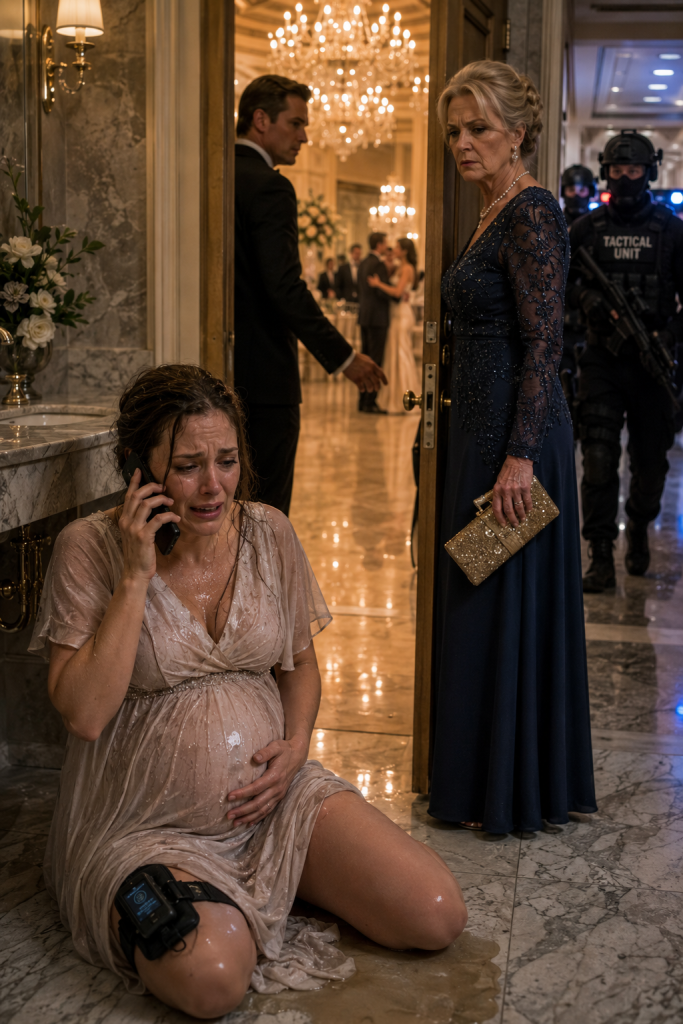
My water broke beneath imported crystal chandeliers while three hundred guests applauded my sister-in-law’s first dance.
For one strange second, I simply stood there, staring at the clear liquid spreading across the pale stone floor beneath my shoes.
The wedding band played on.
Guests lifted champagne glasses. Cameras flashed around Juliette Sterling and her new husband as they turned beneath a canopy of white roses. No one noticed the pregnant woman near the edge of the ballroom gripping a table for support.
Then the first contraction struck.
Pain tightened around my abdomen so suddenly that I nearly collapsed.
“Ethan,” I gasped, reaching for my husband. “Something’s wrong. Call an ambulance.”
Ethan Sterling looked at me, then quickly glanced toward the raised platform where his father was entertaining a group of investors.
His expression did not show concern.
It showed irritation.
“Can you walk?” he muttered. “The photographers are filming.”
“I’m thirty-four weeks pregnant,” I whispered. “My water just broke.”
Another contraction forced the air from my lungs.
Ethan caught my elbow, but not to comfort me. He turned his body so the cameras would not see my face.
Before he could answer, his mother appeared.
Vivian Sterling wore a silver evening gown and a diamond necklace worth more than the house where I had grown up. Her blond hair had been arranged perfectly, and even while she dug her nails into my arm, her smile remained fixed for the nearby guests.
“Not here,” she hissed.
“I need a doctor.”
“You need to stop causing a spectacle.”
“My baby is coming.”
Vivian’s eyes flicked toward the VIP tables.
At the center sat Marcus Vale, chief executive of Vale Meridian Capital. Beside him were two attorneys, a private banker, and Vivian’s husband, Harrison Sterling. Spread across the table were leather folders containing the contracts for a ten-million-dollar investment.
That money was supposed to save the Sterling family’s failing vineyard empire.
At least, that was what the guests had been told.
Vivian tightened her grip on me.
“Walk,” she ordered.
She dragged me through a service doorway while Ethan followed.
The music softened behind us as the door closed. We entered a narrow corridor used by catering staff. My shoes slipped against the polished floor, and I had to brace one hand against the wall.
“Please,” I said. “Call an ambulance now.”
Vivian pushed open the bridal bathroom.
It was a luxurious private suite with marble counters, velvet chairs, gold-framed mirrors, and no windows.
She shoved me inside.
I turned to Ethan.
He stood in the doorway, his face pale but unmoved.
“Ethan, please. This is your daughter.”
He looked away.
Vivian ripped my clutch from my hands.
“Investors are about to sign a ten-million-dollar deal that will save this family,” she sneered. “You will stay quiet until the contracts are signed.”
“You cannot lock a woman in labor inside a bathroom.”
“I can do whatever is necessary to protect my family.”
“I am your family.”
Vivian laughed softly.
“You were useful to Ethan. Do not confuse usefulness with belonging.”
The door slammed.
The deadbolt clicked from the outside.
“Ethan!” I cried.
His shadow remained beneath the door.
“Just fifteen minutes, Clara,” he said. “Do not make a scene.”
Then his footsteps faded.
I pressed both hands against my stomach.
The baby moved.
For the previous seven years, I had loved Ethan Sterling with a patience that often felt like work. I had defended him when friends warned me about his selfishness. I had forgiven the private jokes he made at my expense. I had accepted every apology he offered after allowing his mother to humiliate me.
He always promised he would stand up to her next time.
Next time never came.
Now I was on my knees in a locked bathroom, six weeks from my due date, while my husband chose a business contract over the safety of his wife and child.
Something inside me became very still.
The last piece of the woman who had believed Ethan could change disappeared.
Another contraction came.
I waited for it to pass, then reached beneath my maternity dress.
Taped securely to my thigh was a slim encrypted emergency phone.
Vivian had taken my clutch because she assumed my ordinary phone was inside it.
The clutch was a prop.
So was the heavy biometric briefcase I carried to work.
The Sterlings had spent years mistaking restraint for weakness. They mocked my simple clothes, my modest salary, and my unwillingness to discuss my job.
Vivian called me “the little accountant.”
Ethan laughed with them and apologized later.
None of them ever asked why a little accountant needed biometric security, encrypted communications, or federal clearance.
I pressed the single programmed number.
Special Agent Leah Morgan answered immediately.
“Clara?”
“I’m locked in the east bridal bathroom at the Sterling Estate,” I whispered. “My water broke. I’m thirty-four weeks pregnant. I need medical assistance.”
Her voice changed instantly.
“Who locked you in?”
“Vivian Sterling. Ethan helped her.”
“Are you bleeding?”
“I don’t think so.”
“How far apart are the contractions?”
“Maybe four minutes. I’m not sure.”
“Stay conscious. The medical unit is already staged nearby.”
I closed my eyes.
The operation had been scheduled to begin after the contracts were signed. Agents had surrounded the estate quietly, waiting for confirmation that Marcus Vale had transferred the first payment into the offshore account.
My emergency changed everything.
“Leah,” I whispered, “they’re signing now.”
“We know.”
“The evidence is in place.”
“We know that too.”
I looked at the locked door.
“The people who think they’ve already won are standing in the ballroom.”
Morgan’s voice became hard.
“Stay conscious, Clara. The tactical team is thirty seconds away. We’re coming for all of them.”
The line remained open.
At first, I heard only the distant music and the hum of the ventilation system.
Then came shouting.
A crash echoed through the corridor.
The bathroom door shook as someone struck it from the other side.
“Federal agents!” a voice thundered. “Move away from the door!”
I dragged myself toward the far wall.
The lock broke under the second impact.
The door flew open.
Two emergency medics rushed in first. Behind them stood agents in dark protective uniforms. Their weapons were pointed safely toward the floor as they secured the room.
Leah Morgan entered last.
She was forty-eight, calm under pressure, and one of the strongest people I had ever known. She had also been my commanding officer during my years in the Naval Reserve’s financial intelligence unit.
To the Sterling family, she was merely “Clara’s stern friend from Washington.”
She knelt beside me.
“Look at me,” she said. “Your baby comes first now.”
A medic checked my blood pressure while another prepared a stretcher.
From the corridor, Vivian’s voice rose above the confusion.
“This is private property! You cannot storm my daughter’s wedding!”
Leah did not even turn her head.
“We have federal warrants.”
“You have made a terrible mistake!”
“No,” Leah replied. “You made several.”
The medics lifted me carefully onto the stretcher.
As they carried me into the hallway, I saw what had happened to the perfect Sterling wedding.
Guests stood frozen against the walls.
The music had stopped.
White roses lay scattered across the floor where people had moved away from the tables. Agents guarded every exit. Several men in expensive suits had been separated from the crowd.
Harrison Sterling stood near the signing table with his hands raised.
Marcus Vale was seated, his face gray.
Juliette, still wearing her wedding gown, clung to her husband and sobbed.
Vivian struggled against an agent who had taken hold of her arm.
When she saw me, she pointed.
“She did this!” Vivian shouted. “That woman has been plotting against us!”
The room fell silent.
For the first time, many of the guests looked directly at me.
I was lying on a stretcher in a soaked maternity dress, my hair stuck to my face, and my hands shaking from pain.
Yet Vivian still looked at me as though I were the criminal.
Ethan pushed through the crowd.
“What have you done?” he demanded.
He did not ask whether I was safe.
He did not ask whether our daughter was alive.
He asked what I had done to his family’s deal.
I held his gaze.
“I told the truth.”
His expression changed.
For eighteen months, I had been helping a joint federal task force investigate Sterling Holdings. What began as a review of suspicious vineyard loans had uncovered a much larger operation involving fraudulent investments, shell corporations, bribed inspectors, stolen pension funds, and money moved through luxury property purchases.
The ten-million-dollar investment was not intended to save the vineyard.
It was intended to complete a laundering cycle.
The contracts on the table connected Marcus Vale’s offshore accounts to a network Harrison Sterling had spent years hiding.
The signing ceremony was the final evidence the task force needed.
My biometric briefcase contained copies of transaction records, secretly recorded meetings, access logs, and a list of every hidden partner.
At least, that was what the Sterlings believed.
Leah walked beside the stretcher.
An agent approached and whispered into her ear.
Her expression tightened.
“The briefcase is gone,” she told me.
I looked toward Ethan.
His eyes flicked toward the service exit.
It was a small movement, but I saw it.
So did Leah.
I caught Ethan’s sleeve as the stretcher passed.
“Where did you take it?”
He leaned close.
For the first time that night, he smiled.
“Somewhere your commander will never find.”
The medics tried to move me forward, but I kept hold of him.
“You left me locked in a room while our daughter was in danger.”
“You lied to me for eighteen months.”
“I protected innocent people from your family.”
“You destroyed everything.”
“No, Ethan. Your family destroyed itself.”
Leah signaled to two agents.
They seized Ethan before he could step away.
He shouted as they turned him toward the wall and searched him.
“You cannot arrest me for moving my wife’s property!”
“That property is evidence in a federal investigation,” Leah said.
“You do not have it.”
“We will.”
The medics wheeled me toward the exit.
Behind us, Ethan called my name.
This time, I did not look back.
The ambulance doors closed, shutting out the vineyard lights, the ruined wedding, and the family I had once tried so desperately to please.
A medic placed an oxygen mask over my face.
“Stay with us, Clara.”
“My baby?”
“Her heartbeat is strong.”
The siren began.
As the ambulance moved, I held my stomach and whispered to my daughter.
“I’m here. I won’t let them hurt you.”
At the hospital, doctors rushed me into an examination room. The contractions continued, but medication slowed them enough to give the baby more time. A neonatal team prepared for an early delivery.
Leah stayed outside until the doctor allowed her in.
By then, I was wearing a hospital gown and connected to several monitors.
She stood near the bed.
“We found the briefcase.”
“Where?”
“In the service kitchen freezer.”
Despite the pain, I almost laughed.
“Ethan thought the insulated walls would block the tracking signal.”
“He removed the tracker.”
“That was the decoy tracker.”
Leah smiled faintly.
“You trained him well.”
“No. He underestimated me well.”
The briefcase contained real evidence, but it was not the only copy. Every important document had already been encrypted and transferred to secure servers. Even if Ethan had burned the case, the investigation would have continued.
The Sterlings never understood that because they believed power meant possessing a single object.
Real power was preparation.
Leah pulled a chair closer.
“We arrested Harrison and Marcus Vale. Vivian is being questioned for obstruction, unlawful confinement, and evidence tampering. Ethan is claiming he moved the briefcase because he thought it contained your personal financial documents.”
“He knew.”
“We found his fingerprints on a hidden compartment.”
I turned toward her.
“What hidden compartment?”
“The one containing the offshore account codes.”
My chest tightened.
Those codes had never been shown to Ethan.
I had placed them in the compartment three days earlier after receiving information that someone inside the Sterling family had been accessing Harrison’s accounts.
I had suspected Juliette’s husband.
I had suspected Vivian.
I had even suspected Harrison’s chief financial officer.
I had not suspected Ethan.
“How long?” I asked.
“We are checking.”
Another contraction interrupted us.
The doctor entered and examined the monitors.
“Clara, the baby’s heart rate is beginning to dip during contractions.”
“What does that mean?”
“It means we need to deliver her soon.”
“Is she going to be all right?”
“We have an excellent neonatal team. But we should not wait.”
The room filled with nurses.
Leah squeezed my hand once, then stepped back.
“I’ll be here when you wake up.”
They prepared me for an emergency cesarean section.
As I was wheeled toward the operating room, I thought about all the small moments I had ignored.
Ethan asking casual questions about my work.
Ethan borrowing my keys.
Ethan standing too close when I opened the briefcase.
Ethan insisting we attend family dinners where Harrison discussed business after too much wine.
I had believed Ethan was weak.
I had believed he followed his mother because he lacked courage.
The truth was worse.
He had not merely tolerated his family’s crimes.
He had been learning from them.
The operating room lights were painfully bright.
A nurse told me to breathe.
The anesthesiologist spoke calmly while the surgical team prepared.
Then everything became a blur of voices and pressure.
I heard someone say the baby’s heart rate had dropped again.
I prayed silently.
Please let her live.
I no longer cared about the investigation, the Sterling fortune, or the years I had lost loving a man who had never deserved me.
I cared only about the child who had been trapped inside that bathroom with me.
Then I heard a cry.
It was small and sharp, but it filled the entire room.
My daughter was alive.
Tears ran into my hair.
“Is she all right?”
“She’s breathing,” the doctor said. “She’s very small, but she’s fighting.”
A nurse brought her close for only a moment.
Her face was red. Her eyes were closed. A tiny breathing mask covered her nose.
“She weighs four pounds, two ounces,” the nurse said.
I touched one finger to her cheek.
“Hello, Grace.”
Ethan and I had argued about names for months.
He wanted Victoria, after his grandmother.
I had secretly loved Grace.
In that moment, the decision became mine.
They took her to the neonatal intensive care unit.
I drifted into exhausted sleep.
When I woke, the room was dark except for a lamp beside the bed.
Leah sat in the chair near the window.
“How is Grace?” I asked.
“Stable. The doctor says she is doing better than expected.”
I closed my eyes in relief.
“Has Ethan asked about her?”
Leah hesitated.
That hesitation answered me.
“He asked whether the hospital could perform a paternity test,” she said.
Pain moved through me, but it had nothing to do with surgery.
“Why?”
“He claims you manipulated him into marriage as part of an investigation.”
“The investigation began five years after we married.”
“He knows that.”
“He knows Grace is his.”
“Yes.”
I stared at the ceiling.
Ethan was not asking because he doubted me.
He was creating a story in which he was the victim.
It was the Sterling way.
When confronted with their own cruelty, they rewrote the past until someone else carried the blame.
“What did you find about the account codes?” I asked.
Leah opened a folder.
“Ethan has been transferring money into a private account for more than two years.”
“How much?”
“Almost three million dollars.”
I looked at her.
“He was stealing from Harrison?”
“He was stealing from everyone. His father, the investors, the employees, and possibly you.”
“I kept separate accounts.”
“He accessed your retirement portfolio four months ago.”
My hands went cold.
“That account requires two-factor authentication.”
“He cloned your phone while you were sleeping.”
I remembered waking one night and finding Ethan standing beside the dresser.
He said he was looking for a charger.
I had believed him.
“How much did he take?”
“Nothing yet. He created a line of credit against it.”
“For what?”
“A residence in the Cayman Islands.”
The room seemed to tilt.
“He was planning to leave.”
“We think so.”
“With whom?”
Leah’s silence returned.
“Tell me.”
“Juliette’s wedding planner, Sabrina Cole.”
I laughed once, but it sounded broken.
Sabrina had spent six months arranging the vineyard wedding. She had attended family dinners, fittings, and private planning meetings.
She was thirty-one, polished, and always careful to compliment Vivian.
Two weeks earlier, she had placed a hand on my stomach and told me Ethan would be a wonderful father.
“How long?” I asked.
“Eleven months, according to recovered messages.”
I turned my face toward the window.
Outside, dawn was beginning to lighten the sky.
My husband had been preparing to steal my savings, abandon our child, and disappear with another woman.
Yet when my water broke, he still asked me to wait fifteen minutes so his family could secure ten million dollars.
He had not simply chosen money over us.
He had already decided we were disposable.
Leah allowed me to cry without offering empty comfort.
When I could finally speak, I said, “I want to see my daughter.”
A nurse brought me to the neonatal unit later that morning.
Grace lay inside an incubator with thin tubes attached to her body. She looked impossibly small beneath a knitted yellow cap.
I placed my hand through the opening.
Her fingers curled around mine.
“I’m sorry,” I whispered. “I’m sorry I stayed with him long enough for this to happen.”
A nurse standing nearby shook her head gently.
“You got her help. That is what matters.”
For three days, I remained in the hospital.
Grace grew stronger.
The Sterling empire began collapsing.
News crews surrounded the vineyard. Banks froze accounts. Investors filed lawsuits. Employees who had remained silent for years began speaking to investigators.
Harrison Sterling was charged with wire fraud, conspiracy, money laundering, and theft from employee pension funds.
Marcus Vale agreed to cooperate after agents confronted him with the signed contracts and recorded conversations.
Vivian was charged with obstruction and unlawful imprisonment. Her attempt to lock me in the bathroom had been captured by a service-hall security camera.
Ethan faced charges for evidence tampering, financial fraud, unauthorized access to protected accounts, and conspiracy.
The hidden briefcase compartment tied him directly to the offshore network.
Sabrina Cole was arrested at the airport with two suitcases, a false passport, and nearly two hundred thousand dollars in cash.
Juliette was not charged.
She had been protected from most of the family business and genuinely believed the investment was legal. Her wedding ended with agents questioning her husband, guests fleeing from cameras, and her parents being taken away.
On the fourth morning, she came to the hospital.
I almost refused to see her.
Then I remembered that she had never treated me with Vivian’s cruelty. Juliette had been self-centered and spoiled, but she had also been raised inside a family where appearances mattered more than truth.
She entered my room without makeup.
Her expensive wedding manicure was chipped. Her eyes were swollen.
“Is the baby alive?” she asked.
“Yes.”
She covered her mouth.
“I didn’t know what Mother did until the agents showed me the video.”
I said nothing.
Juliette sat in the chair beside the bed.
“I keep hearing her voice,” she whispered. “She told you to stay quiet. She knew you were in labor.”
“Yes.”
“And Ethan let her.”
“Yes.”
Tears filled her eyes.
“My entire wedding was paid for with stolen money.”
“The investigation will determine where the money came from.”
“Do not protect my feelings, Clara. I heard what Father did. They stole from the pension fund. Mr. Keller worked for us for forty years. His wife has cancer.”
I remembered Thomas Keller. He had been the vineyard’s maintenance supervisor before retiring.
Harrison had praised him at a company dinner, presented him with a gold watch, and then quietly moved part of the pension fund into a shell corporation.
“I’m sorry,” I said.
Juliette shook her head.
“You are sorry? My mother locked you in a bathroom.”
She looked toward the floor.
“I came because Ethan asked me to.”
My body tensed.
“What does he want?”
“He wants you to say he did not know about the business.”
“He did know.”
“He says if you help him, he will agree not to fight for custody.”
I stared at her.
“Custody?”
“He says the Sterling name gives him rights.”
For the first time since the wedding, anger replaced grief.
“Your brother left his premature daughter without medical care because he did not want to interrupt a business deal.”
“I know.”
“He has not visited her.”
“I know.”
“He tried to steal my retirement savings and flee with Sabrina.”
Juliette’s face crumpled.
“I know.”
“Then go back and tell him this: Grace is not another asset he can use in a negotiation.”
Juliette nodded.
Before leaving, she stopped at the door.
“I am going to cooperate with the investigators.”
“That is your choice.”
“I also told them about Grandfather’s storage room.”
I looked up.
“What storage room?”
“At the old bottling warehouse. Father and Mother used to go there after midnight. Ethan went with them twice last year.”
“Did you tell Agent Morgan?”
“Yes.”
“Good.”
The storage room changed the case.
Inside, agents found decades of paper ledgers, original contracts, blackmail files, and recordings Harrison had kept as protection against his partners.
The documents proved the scheme had begun long before Ethan and I married.
They also revealed something even more disturbing.
Harrison had financed Ethan’s relationship with me.
Seven years earlier, when Ethan and I met at a charity accounting conference, I believed the meeting had been accidental.
It was not.
Harrison had known that I held a mid-level position in the Department of Defense’s financial oversight office. At the time, my job was not connected to his companies, but he saw potential value in having someone with federal access inside the family.
Ethan had been encouraged to approach me.
The early dates I remembered so fondly had been planned.
The restaurant where we met again had been selected because Harrison knew I would attend a colleague’s retirement dinner there.
The sudden vineyard weekend where Ethan proposed had taken place two days after Harrison learned I was being considered for a higher security clearance.
I read the report in silence.
Leah sat across from me in a small hospital conference room.
“Was any of it real?” I asked.
“I cannot answer that.”
“He married me because his father told him to.”
“The evidence suggests Harrison encouraged the relationship. It does not tell us what Ethan felt.”
“He left me locked in a bathroom.”
Leah nodded.
“That tells me what he felt.”
The realization should have destroyed me.
Instead, it freed me.
For years, I had blamed myself for not being charming enough, wealthy enough, stylish enough, or agreeable enough to earn the Sterling family’s acceptance.
Now I understood that acceptance had never been available.
They had not brought me into the family because they loved me.
They brought me close because they wanted access.
When I became inconvenient, they treated me like a problem to be hidden.
Grace left the incubator after two weeks.
She still needed monitoring, but the doctors allowed me to hold her for longer periods.
The first time I held her against my chest, she opened her eyes.
They were dark blue.
Ethan’s eyes.
The resemblance hurt, but it did not frighten me.
She was not responsible for the man who had fathered her.
She was her own person.
“I will never make you earn love,” I promised. “You will never have to prove that you belong.”
A week later, Ethan requested a private meeting.
My attorney advised against it.
Leah advised against it.
I agreed anyway, but only under controlled conditions.
We met in a federal interview room. A glass wall separated us.
Ethan wore a county detention uniform. He looked thinner, but his confidence had not disappeared.
He picked up the telephone.
I picked up mine.
“You named her Grace,” he said.
“Yes.”
“You knew I wanted Victoria.”
“You lost the right to choose when you walked away.”
His jaw tightened.
“My attorney says you are filing for divorce.”
“The papers were submitted yesterday.”
“You cannot erase seven years.”
“I’m not erasing them. I’m ending them.”
“My father manipulated both of us.”
“Your father did not force you to lock me in a bathroom.”
“My mother locked the door.”
“You stood outside it.”
“I thought you would be safe for a few minutes.”
“I told you the baby was early.”
“There were doctors among the guests.”
“You did not call one.”
His eyes hardened.
“You were working against my family.”
“I was investigating crimes.”
“You wore a recording device in our home.”
“Only during business meetings after I discovered the pension theft.”
“You lied every day.”
“So did you.”
He leaned closer to the glass.
“Sabrina meant nothing.”
I almost smiled.
“That sentence is supposed to comfort me?”
“I was under pressure.”
“You planned to flee with her.”
“I needed an escape route.”
“From whom?”
“My father. The investigation. You.”
“There it is.”
“What?”
“The truth. You were escaping from me before I knew I needed to escape from you.”
Ethan lowered his voice.
“Help me, Clara. Tell them I did not understand the codes.”
“You created accounts using those codes.”
“I was protecting money from my father.”
“You pledged my retirement account as collateral.”
“I would have paid it back.”
“With stolen pension money?”
He stared at me.
I continued.
“You have not asked how Grace is.”
His expression softened too late.
“Is she healthy?”
“She is alive because strangers broke down a door you refused to open.”
“I panicked.”
“No. You calculated.”
His hand tightened around the receiver.
“If you testify against me, you will destroy our daughter’s future.”
“My testimony will protect her future.”
“She will grow up knowing her father is in prison.”
“She will grow up knowing her mother did not trade justice for appearances.”
“You think Morgan cares about you? The government used you.”
“No, Ethan. Your family used me. The government gave me a way to stop you.”
He looked suddenly tired.
“Did you ever love me?”
The question landed softly.
“Yes,” I said. “I loved the man I believed you could become.”
“And now?”
“Now I know who you chose to be.”
I placed the receiver back on the wall.
Ethan struck the glass with his palm.
“Clara!”
I walked away.
The divorce became a public spectacle despite my efforts to keep it private.
Sterling attorneys argued that my undercover work had violated Ethan’s marital rights. My attorneys produced evidence showing that I had obtained proper authorization only after discovering criminal activity.
Ethan demanded shared custody.
The hospital records, security footage, and his own recorded statement ended that effort.
In the hallway outside the bathroom, an agent’s microphone had captured Ethan telling Vivian, “Keep her in there until the transfer clears.”
He had not been confused.
He had not panicked.
He had made a decision.
The judge granted me temporary sole custody and ordered that Ethan have no contact with Grace until a full evaluation could be completed.
Vivian sent me a letter from detention.
It was six pages long.
She did not apologize.
She accused me of seducing Ethan, infiltrating the family, humiliating Juliette, and causing Harrison’s declining health.
Near the end, she wrote that I should remember Grace carried Sterling blood.
I gave the letter to my attorney.
Then I legally changed my daughter’s surname to mine.
Grace Bennett.
My mother cried when I told her.
My parents lived in a modest town two hours away. They had always been polite to Ethan, though my father never trusted him.
After Grace came home, they moved into my guest room for several weeks.
My mother woke for midnight feedings.
My father built a white crib beside my bed and checked every screw twice.
One evening, he found me sitting alone in the kitchen with Vivian’s letter.
“You do not have to read what cruel people write about you,” he said.
“I keep thinking I should have seen it earlier.”
He sat beside me.
“People who deceive for a living become good at it.”
“I defended him.”
“You loved your husband.”
“I put Grace in danger.”
“You got her out.”
“I stayed too long.”
“You left when the truth became impossible to ignore.”
I looked toward the living room, where my mother was humming softly to Grace.
“What will I tell her when she asks about him?”
“The truth,” my father said. “But not all at once. Children deserve honesty in portions their hearts can carry.”
The federal trial began nine months later.
By then, Grace was healthy, alert, and fascinated by ceiling fans.
I had returned to work in a different division. My role in the investigation had been disclosed, and for security reasons, I no longer handled Sterling-related evidence directly.
When I entered the courtroom to testify, Ethan watched me from the defense table.
Harrison sat beside his attorneys.
Vivian had chosen a separate trial after refusing a plea agreement.
Marcus Vale had already pleaded guilty and agreed to testify.
The courtroom was full.
Former Sterling employees occupied several rows.
Thomas Keller sat in the front beside his wife.
She wore a headscarf from chemotherapy.
When I took the oath, I looked at them instead of Ethan.
I explained how suspicious loan patterns led to the investigation.
I described the shell corporations, the pension transfers, the offshore accounts, and the ten-million-dollar deal.
The prosecutor showed photographs of the biometric briefcase.
He displayed the hidden compartment and the codes bearing Ethan’s fingerprints.
Then he played the service-hall recording.
Vivian’s voice filled the courtroom.
“You will stay quiet until the contracts are signed.”
My own voice followed.
“I am your family.”
Then Vivian’s answer.
“You were useful to Ethan. Do not confuse usefulness with belonging.”
Several jurors looked toward her empty seat.
Next came Ethan’s voice.
“Keep her in there until the transfer clears.”
He lowered his head.
His attorney tried to suggest that the phrase referred to protecting me from public embarrassment.
The prosecutor played the next sentence.
“If she starts screaming, turn up the music.”
A gasp moved through the courtroom.
I had never heard that line before.
The agents had entered moments later.
On cross-examination, Ethan’s attorney attacked my marriage.
“Mrs. Bennett, you secretly recorded members of your husband’s family.”
“I recorded suspected criminal activity under legal authorization.”
“You concealed your cooperation with federal agents.”
“Yes.”
“You carried an encrypted device beneath your clothing at a family wedding.”
“Yes.”
“Would you agree that your husband had reason to feel betrayed?”
I looked toward Ethan.
“He was free to feel betrayed. He was not free to endanger a woman in premature labor.”
The attorney paused.
“You want the jury to believe you were powerless in that bathroom, yet a tactical team arrived within seconds.”
“I was physically vulnerable. I was not unprepared.”
“Isn’t it true that you planned to destroy the Sterling family?”
“No.”
“What did you plan?”
“To preserve evidence and stop stolen money from disappearing.”
“Yet their company collapsed.”
“The company collapsed because it was built on fraud.”
The prosecutor rested after three weeks.
The jury deliberated for two days.
Harrison was convicted on nearly every count.
Ethan was convicted of conspiracy, financial fraud, evidence tampering, and unlawful access to protected accounts.
He was also convicted on a state charge connected to my confinement and the medical danger caused to Grace.
When the verdicts were read, Ethan looked at me.
I felt no triumph.
Only finality.
The judge later sentenced Harrison to decades in federal prison.
Ethan received a shorter but substantial sentence.
At his sentencing, he stood and apologized.
He said greed had corrupted him.
He said his father controlled him.
He said he had failed as a husband and father.
Then he turned toward me.
“I hope one day Clara tells my daughter that I loved her.”
The judge looked at him.
“You had an opportunity to demonstrate that love when her life was in danger.”
The courtroom became silent.
“You chose a financial transfer instead.”
Ethan sat down.
Vivian’s trial ended several months later.
The bathroom security footage was shown repeatedly.
She claimed she believed I was exaggerating the labor to sabotage Juliette’s wedding.
Medical experts testified that delaying treatment could have killed Grace or caused permanent harm.
Vivian was convicted of obstruction, unlawful imprisonment, and conspiracy.
Before sentencing, she attempted to address me.
I did not attend.
I was at home celebrating Grace’s first birthday.
We held the party in my parents’ backyard.
There were no imported chandeliers.
No investors.
No champagne tower.
My father hung paper stars from the trees. My mother baked a vanilla cake with uneven pink frosting.
Grace wore a yellow dress and spent most of the afternoon trying to remove one shoe.
Juliette came quietly.
She had divorced her husband after discovering he had accepted money from Harrison to hide records inside his company. She sold her jewelry and used the proceeds to help several former Sterling employees with legal fees.
She carried a small gift wrapped in brown paper.
“I didn’t know whether I should come,” she said.
“You cooperated with the investigation.”
“That does not make me innocent of everything.”
“No. But it means you stopped pretending.”
She knelt near Grace.
Inside the package was a wooden music box shaped like a vineyard cottage.
“I had the Sterling crest removed,” she said. “I thought she might like the song.”
Grace turned the handle and laughed when the music began.
Juliette wiped her eyes.
“I’m sorry,” she whispered.
This time, the apology was not about public embarrassment or damaged reputations.
It was for what had happened.
“I believe you,” I said.
The Sterling Estate was sold under court supervision.
Money recovered from the sale went first to employees, pension accounts, creditors, and defrauded investors.
The grand ballroom where Vivian had locked me away became part of a conference center owned by a workers’ cooperative.
Thomas Keller was elected to its board.
The bridal bathroom was renovated.
The gold mirrors were removed. The outside deadbolt was taken off the door.
I learned that detail from Juliette.
For a while, I thought I would never trust anyone again.
I checked every lock twice.
I woke from dreams of marble floors and distant music.
Whenever Grace cried at night, I rushed to her crib with my heart pounding.
Therapy helped.
So did time.
I began to understand that strength was not the absence of fear.
Strength was refusing to let fear choose the rest of my life.
Three years after the wedding, Leah Morgan retired.
At her farewell dinner, she handed me a small velvet box.
Inside was the encrypted emergency phone I had used in the bathroom.
It had been deactivated and cleared.
“I thought you might want it,” she said.
I held the slim device in my palm.
For years, it represented the secret life I could not discuss.
Now it represented the moment I stopped waiting for someone else to choose me.
“I don’t need it anymore,” I said.
“No,” Leah replied. “You don’t.”
I donated it to the training academy’s evidence museum with one condition.
The display would not identify Grace.
The plaque read:
Preparation is not fear. Asking for help is not weakness. Silence should never be mistaken for surrender.
Grace grew into a fearless child.
At four, she climbed everything.
At five, she asked why our family photographs did not include her father.
I followed my father’s advice and gave her the truth in a portion her heart could carry.
“Your father made choices that were not safe,” I explained. “A judge decided he had to live somewhere else for a long time.”
“Did he love me?”
I took a breath.
“He said he did. But love must also be shown by what people do.”
“Did you love him?”
“Yes.”
“Do you still?”
“No.”
She considered this carefully.
“Do you love me?”
“More than all the stars.”
She smiled.
“That’s a lot.”
“It is.”
When Grace turned seven, Ethan sent his first permitted letter.
He had completed therapy programs in prison and asked whether he could begin supervised communication.
I did not answer immediately.
I spoke with counselors, attorneys, and most importantly, Grace.
I did not read her the letter. I simply told her that her father wanted to write.
She thought about it for several days.
“Will he be mean to you?” she asked.
“He cannot reach me directly.”
“Will he lock us anywhere?”
“No.”
“Can I stop if I don’t like it?”
“Yes.”
She agreed to receive one letter through her therapist.
Ethan wrote about books, school, and the weather.
He did not blame me.
He did not mention the Sterling fortune.
He apologized for failing to protect her before she was born.
Grace listened as the therapist read it.
Then she asked for paper.
Her reply contained three sentences.
My name is Grace Bennett.
I like science and dogs.
You have to tell the truth to me.
It was more courage than Ethan deserved and exactly as much control as Grace needed.
I never told her she had to forgive him.
Forgiveness is not a debt children owe to adults who hurt them.
Years passed.
The scars from my surgery faded.
The emotional ones changed shape.
Some became warnings.
Others became proof that I had survived.
I eventually left federal service and founded a nonprofit that trained small businesses and employee groups to recognize financial fraud.
Thomas Keller became one of our first advisers.
Juliette managed community outreach.
Leah joined the board after discovering retirement bored her.
We called the organization Clear Ledger.
Our symbol was an open door.
At the dedication ceremony for our first regional office, I stood before a room filled with accountants, investigators, business owners, and families who had lost savings to fraud.
Grace sat in the front row beside my parents.
She was ten years old and wearing a yellow ribbon in her hair.
I told the audience that corruption depends on more than dishonest people.
It depends on silence.
It depends on employees who think they are too small to speak.
It depends on relatives who value reputation more than safety.
It depends on victims being made to believe that asking for help will destroy the family.
Then I looked at my daughter.
“Sometimes,” I said, “the family is not destroyed by the person who reveals the truth. It was already being destroyed by the people who demanded silence.”
After the ceremony, Grace ran to me.
“Mom, were you scared when you called Commander Morgan?”
“Yes.”
“But you called anyway.”
“Yes.”
She wrapped her arms around my waist.
“That means you were brave.”
For years, people described what happened at the Sterling wedding as the night I destroyed an empire.
They were wrong.
I did not destroy the Sterling empire.
Harrison destroyed it when he stole from people who trusted him.
Vivian destroyed it when she decided reputation mattered more than human life.
Ethan destroyed it when he chose money over his wife and unborn child.
I simply opened the door they had tried to keep locked.
The last time I visited the old vineyard, it was spring.
The workers’ cooperative had invited Clear Ledger to conduct a seminar.
The vines were green again.
Families walked through the gardens. Former employees owned shares in the business. A small memorial near the tasting room listed the names of workers whose pensions had been restored.
I stood outside the renovated bridal suite.
The door was open.
Sunlight filled the room where I had once knelt alone.
Grace stepped inside.
“Is this the bathroom?” she asked.
“Yes.”
“The one where Grandma Vivian locked you?”
I had never taught her to call Vivian that, but she had learned the relationship from old records.
“Yes.”
Grace examined the door.
“There’s no lock.”
“They removed it.”
She walked to the window that had been added during renovation.
Beyond the glass, workers moved among the vines.
“Did I cry when I was born?”
“Very loudly.”
“Were you happy?”
“Happier than I had ever been.”
She took my hand.
“Let’s go outside.”
We walked through the open door together.
The afternoon sun warmed my face.
There were no agents waiting in the hallway.
No contracts hidden beneath leather folders.
No husband asking me to remain quiet.
Only my daughter pulling me toward the vineyard, eager to show me a butterfly she had spotted among the flowers.
I followed her.
Behind us, the door remained open.
Ahead of us, the path was clear.