I did not open the bedroom door right away.
My hand hovered over the handle, every part of me begging for a reasonable explanation. Maybe someone had spilled wine. Maybe Vanessa was crying again. Maybe Luca had stepped away from the party because a business call had gone wrong.
Then I heard my sister laugh.
Soft.
Breathless.
Familiar.
The kind of laugh she used when she wanted someone to adore her.
I pushed the door open.
For one suspended second, the world refused to make sense.
The lamp beside our bed glowed warm against ivory sheets. Vanessa stood near the dresser in my robe, her dark hair tumbling over one shoulder. Luca was beside her, his white shirt unbuttoned at the collar, his expression frozen in a way I had never seen before.
Not guilty.
Not angry.
Dazed.
Like a man waking in a room he did not remember entering.
Vanessa saw me first.
Her face changed so quickly that, for years afterward, I wondered which expression had been real—the triumph that flashed across her eyes, or the tears that came immediately after.
“Sarah,” she whispered.
Luca turned.
The color drained from him.
I waited for him to speak.
To explain.
To cross the room.
To say my name with enough force to anchor me back inside my own life.
But silence spread between us, thick and final.
My marriage ended in that silence.
I backed away.
Luca took one step toward me. “Sarah, wait.”
Vanessa clutched the robe tighter and began to sob.
I did not wait.
I ran.
Down the hallway, past startled staff, past guests who smiled at me before noticing my face, past music that suddenly sounded too bright. Outside, cold air hit my skin. I had no coat, no purse, no plan.
Only the small emergency envelope my grandmother had once insisted every woman should keep hidden.
Cash.
A spare bank card in my maiden name.
An old key to a storage locker.
By morning, I was gone.
By the time I learned I was pregnant, I was two states away.
By the time I learned there were two heartbeats, I had already decided Luca would never know.
I told myself I was protecting them.
Some nights, when Ash slept with his fist curled under his cheek and Lena dreamed loudly beside him, I believed it.
Other nights, I wondered whether fear had simply dressed itself as wisdom.
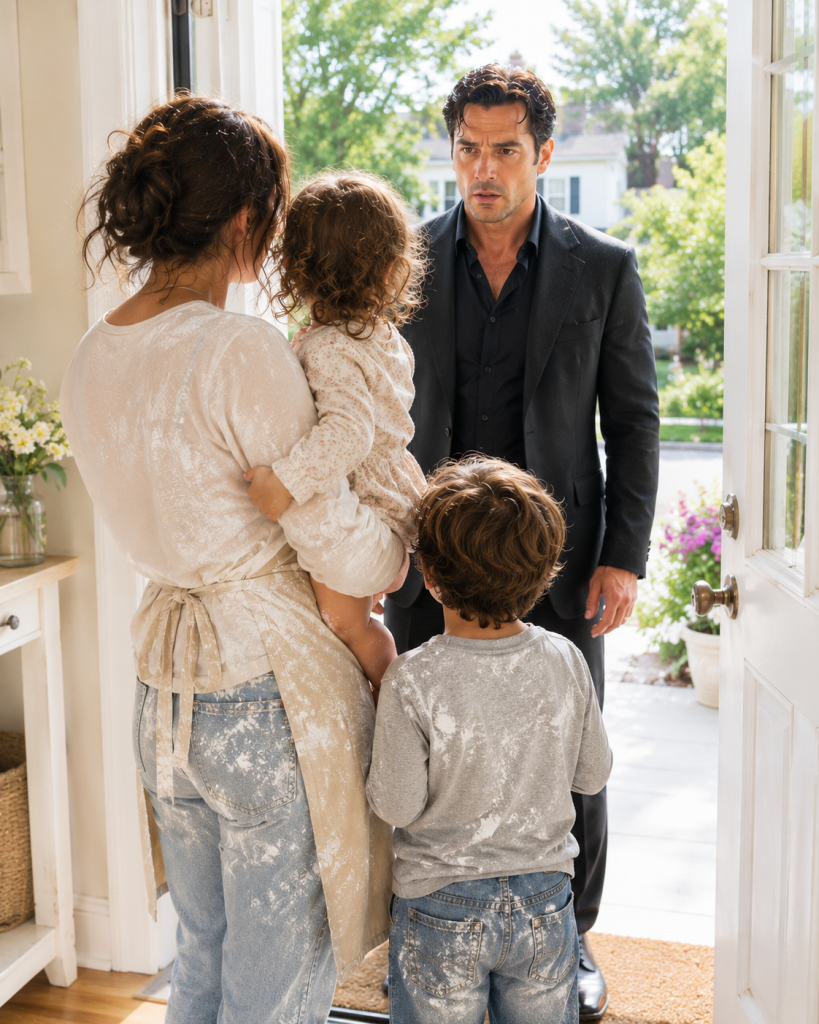
Now fear stood on the other side of my apartment door, wearing my husband’s face.
For the rest of that rainy morning, I moved like a woman walking through water.
I made the twins oatmeal with brown sugar. I wiped flour from Lena’s chin because she had decided breakfast needed decorating. I tied Ash’s shoelaces twice, though he had learned to do it himself months ago.
Through it all, I felt Luca outside.
Not physically. I knew he had stepped away from the porch. But his presence remained, pressing against the walls, slipping beneath the door, changing the air in the apartment I had built so carefully.
Mrs. Pike came up at noon.
She was seventy-two, round-faced, sharp-eyed, and kinder than she liked to admit. She had owned the bakery downstairs since before I was born and claimed she hired me because my cinnamon rolls were “almost acceptable.”
She took one look at me and shut the door behind her.
“Who was the man?”
I kept folding tiny shirts that were already folded.
“No one.”
“Try again.”
I sat on the edge of the sofa. Across the room, the twins were building a crooked tower from wooden blocks. Lena narrated the construction with great authority. Ash corrected the base without a word.
Mrs. Pike followed my gaze.
“Oh,” she said quietly.
That was the thing about people who had lived long enough. They did not need every detail to understand the shape of a disaster.
“He’s their father,” I said.
Mrs. Pike lowered herself into the chair opposite me.
“Does he know?”
“He does now.”
“And what kind of man is he?”
I almost laughed, but it would have sounded bitter.
“That depends who you ask.”
“I’m asking you.”
I looked down at my hands.
Once, Luca had remembered every small thing about me. That I hated yellow roses. That thunderstorms made me restless. That I read the last page of mystery novels first because uncertainty made me impatient. He had danced with me barefoot in our kitchen at midnight after a terrible charity dinner. He had learned to make tea the way my grandmother made it, with too much honey and a slice of orange.
He had also stood in our bedroom with my sister while my heart broke in half.
“I don’t know anymore,” I admitted.
Mrs. Pike was quiet for a long moment.
Then she said, “Not knowing is still an answer. Just not a comfortable one.”
By evening, the rain had stopped. The street below shone beneath the lamplight, clean and silver. I had almost convinced myself Luca had gone back to Chicago.
Then I found the envelope.
It had been slipped beneath the bakery’s back door.
My name was written on the front in Luca’s handwriting.
Sarah.
For a long time, I only stared.
Then, when the twins were asleep and the apartment was soft with their breathing, I opened it.
There was no demand inside.
No threat.
No legal language.
Only one photograph and a note.
The photograph showed Luca standing in a hospital hallway, younger by three years, pale and hollow-eyed. A bandage crossed his temple. His left wrist was wrapped. Beside him stood Dr. Elias Venn, the physician who had sometimes treated Luca privately after business trips.
I turned to the note.
I don’t expect forgiveness.
I am not asking for it.
But what you saw that night was not the truth.
I have proof, and I will give it to you whether you let me speak or not.
I never stopped looking.
Luca.
My fingers tightened around the paper.
Not the truth.
Three words could be mercy.
They could also be another trap.
I slept badly and woke before dawn to the bakery bell below, the smell of yeast rising through the floorboards. Work saved me that morning. Dough was honest. It needed pressure, warmth, time. It became exactly what you made of it.
At six-thirty, I went downstairs.
Luca was waiting across the street.
He stood beneath the awning of a closed hardware store, dressed in a dark suit that looked wrong against Gray Hollow’s chipped brick and sleepy windows. He did not approach when he saw me.
That, more than anything, unsettled me.
The Luca I knew had always moved toward what he wanted.
This man waited.
Mrs. Pike noticed him through the front window while arranging blueberry muffins.
“He looks like bad weather.”
“He usually is.”
“Does he frighten you?”
I considered lying.
“No,” I said at last. “But what he knows about me does.”
She nodded as if that made perfect sense.
By midmorning, the bakery was full. Tourists came for coffee. Local men argued gently about road repairs. Mrs. Halpern bought a birthday cake for her dog and dared anyone to comment.
I carried a tray of rolls to the counter and looked up.
Luca was inside.
The room quieted in the way small towns quiet when a stranger arrives too well dressed.
Lena, who had been drawing at the corner table, waved a purple crayon.
“Big sad man!”
Every head turned.
Luca’s face softened with such immediate tenderness that I had to look away.
Ash slid from his chair and came to stand beside me. He did not hide. He only watched Luca with those serious amber eyes.
Luca stopped several feet away.
“May I buy coffee?” he asked me.
It was absurdly formal.
Mrs. Pike answered before I could.
“Only if you pay like everyone else.”
A flicker of surprise crossed Luca’s face. Then, impossibly, he almost smiled.
“Yes, ma’am.”
He ordered black coffee and a plain roll. He left a five-dollar bill in the tip jar and took the smallest table by the window.
He stayed twenty minutes.
He did not speak to the children again.
He did not ask me for anything.
When he left, Lena climbed into his empty chair and inspected the roll crumbs.
“He didn’t eat much.”
“No.”
“Maybe he’s sick.”
Ash touched the table where Luca’s hand had rested.
Then he looked at me.
“Do we know him?” he asked.
His voice was small. Careful.
I knelt in front of him.
I had imagined this question for three years. I had answered it a thousand ways in the dark, each version better than the truth and less cruel than a lie.
“He knew me a long time ago,” I said.
Ash studied my face.
“Before us?”
“Yes.”
Lena leaned against my shoulder.
“Did he make you sad?”
I closed my eyes.
Children always find the door adults try to hide.
“Yes,” I said. “But that doesn’t mean you need to be afraid of him.”
Ash nodded, though I could tell he was filing the answer away in the private cabinet where he kept every important thing.
That night, another envelope appeared.
This time I opened it at once.
Inside was a copy of a medical report from the night of the party. Luca Moretti. Admitted at 2:17 a.m. Symptoms: confusion, impaired coordination, memory disturbance, elevated sedative markers.
I read it once.
Then again.
Then a third time because the words kept shifting beneath my eyes.
Sedative markers.
I remembered his face in the bedroom.
Not desire.
Not panic.
Dazed.
My breath came unevenly.
There was also a second note.
Ask Vanessa why she left Chicago six days after you did.
Ask her who paid her debts.
Ask her why Dr. Venn disappeared.
I pressed the paper against my chest.
Vanessa.
For years, I had tried not to think of her. Not because I forgave her, but because grief has limited room, and the twins had needed all of mine. I remembered her arriving at our home with two suitcases and red eyes, saying she had made mistakes, saying she had nowhere else to go.
I had let her in.
Because she was my sister.
Because I was lonely in that enormous house.
Because I believed broken people deserved shelter.
The next morning, I found Luca outside before sunrise.
He was standing near the alley, speaking quietly into his phone. When he saw me, he ended the call.
I wrapped my cardigan tighter around myself.
“You have five minutes.”
His eyes searched my face, but he kept his distance.
“I was drugged that night.”
The words landed between us without drama. Almost gently.
“By Vanessa?”
“I believe so.”
“You believe?”
His jaw tightened.
“I remember drinking champagne she brought me. I remember feeling strange. I remember trying to get upstairs because I thought something was wrong. After that, pieces. Her voice. Your robe. Then you in the doorway.”
My stomach turned.
“You never came after me.”
“I did.” His voice broke on the second word. “Sarah, I woke in the hospital. They told me you were gone. Vanessa said you had packed a bag before the party. She said you’d been unhappy for months. She said you left with someone.”
I stared at him.
“That’s ridiculous.”
“I know that now.”
“You knew it then.”
“I should have.”
The honesty disarmed me more than any excuse could have.
He looked older in the morning light. Not weak. Just worn down, like a man who had spent years losing arguments with memory.
“I searched,” he said. “Private investigators. Old friends. Hospitals. Shelters. Every place I could think of. Then accounts started closing before my people arrived. Leads disappeared. Someone was helping you stay hidden.”
“I was helping myself.”
“At first, yes.” He paused. “Later, someone else was making sure I looked in the wrong places.”
A chill moved through me.
“Who?”
“I don’t know yet.”
A car passed behind him, tires hissing against damp pavement.
I wanted to reject all of it. It would have been easier to keep the story I understood: betrayal, escape, survival. Pain has a strange comfort when it is familiar.
But the photograph.
The medical report.
The way he had looked that night.
The way Vanessa had cried too quickly.
“I was pregnant,” I said.
His face changed.
Not with surprise. He already knew that much from seeing the twins. But hearing it from me seemed to hollow him out.
“I didn’t know,” he whispered.
“I found out after I left.”
“Twins?”
I nodded.
His eyes shone, but he blinked it back.
“What are their names?”
I almost refused.
Then I thought of Lena calling him big sad man, of Ash touching the table where his hand had rested.
“Lena and Asher.”
“Asher,” he repeated softly. “Ash.”
“He chooses who gets to call him that.”
“I understand.”
The humility in his voice hurt.
I had expected Luca Moretti to arrive with lawyers, demands, expensive fury.
Instead, he stood in an alley behind a bakery asking permission to know the names of his children.
“I don’t trust you,” I said.
“You shouldn’t.”
That answer shook me.
He continued, “Not yet. Not because I say I was wronged. Not because I have papers. Trust is not something I get to reclaim by appearing at your door.”
I looked away.
The sunrise had begun staining the clouds peach and gold. Somewhere below, Mrs. Pike was turning on ovens. The world continued making bread while mine rearranged itself.
“What do you want?” I asked.
“To know them.” His voice was quiet. “Only in whatever way you decide is safe. I will not take them from you. I will not drag you back to Chicago. I will not force myself into their lives faster than they can understand.”
“And me?”
He looked at me then.
All the years between us stood in his eyes.
“I want the chance to tell you the whole truth,” he said. “After that, what you do with me is yours to decide.”
For three days, he stayed in Gray Hollow.
He rented a room at the Cedar Inn, the one with creaking floors and faded quilts. People noticed, of course. Gray Hollow noticed everything. By Friday, Mrs. Halpern had decided he was either a widower, a tax inspector, or a prince hiding from a scandal.
Luca came to the bakery each morning. He sat by the window. He bought coffee. He learned not to stare too long at the twins, though sometimes wonder escaped him.
Lena warmed first.
She had her father’s fearlessness and my inability to leave questions alone.
“Why do you wear black all the time?” she asked him on the fourth morning.
Luca looked at his suit.
“I suppose it became a habit.”
“Do you have other colors?”
“Yes.”
“Like purple?”
“No.”
“You should.”
“I will consider it.”
She studied him seriously.
“Mama says considering means maybe no.”
Luca’s mouth twitched.
“Your mama is usually right.”
Ash did not speak to him for longer.
Then, on Saturday afternoon, rain returned, trapping us all in the bakery after closing. Mrs. Pike had gone to visit her nephew. I was wiping tables while the twins played under the counter with a tin of buttons.
A clap of thunder shook the windows.
Lena squealed with delight.
Ash went still.
Luca noticed before I did.
He lowered himself to the floor several feet away.
“When I was little,” he said, not looking directly at Ash, “I used to count between lightning and thunder.”
Ash’s fingers paused over the buttons.
“Why?”
“So I knew how far away the storm was.”
Ash considered this.
“How?”
“When you see the light, count slowly until the thunder comes.”
Lightning flashed.
Luca began, “One. Two. Three.”
Ash joined at four.
Thunder rolled on seven.
“Far?” Ash asked.
“Far enough.”
Ash moved one button from one pile to another.
When the next flash came, he counted by himself.
I stood frozen with a damp cloth in my hand, watching my son accept one small tool from the father he did not yet know.
Something inside me loosened.
Not forgiveness.
Not trust.
Something more dangerous.
Hope.
That evening, after the twins fell asleep, Luca and I sat in the bakery kitchen. The ovens were off. The air smelled of sugar and cooling metal.
He placed a small recorder on the table.
“What is that?”
“A copy of a message Vanessa left for Dr. Venn two weeks after you disappeared.”
My heart thudded.
“Where did you get it?”
“From Venn’s former assistant. She contacted me last month.”
“Why now?”
“She said she was dying.” His face tightened. “She said she did not want to take certain secrets with her.”
He pressed play.
Static hissed.
Then Vanessa’s voice filled the kitchen.
“You promised it would only make him confused. You promised Sarah would see enough and run. That was the arrangement. I did everything you told me, and now Luca’s people are everywhere. If he finds her before the documents are finished, this all falls apart.”
My hands turned cold.
Another voice followed, lower and distorted by distance.
“You worry too much. Sarah believes what she saw. Luca believes she left him. Keep to the plan.”
The recording clicked off.
I could not move.
Documents.
Plan.
Not Vanessa alone.
“Who was the man?” I asked.
“I don’t know.” Luca’s frustration showed at last, controlled but fierce. “The assistant said Venn was afraid of him. She never heard his name.”
“Documents for what?”
Luca looked at me as if he hated the answer.
“Your inheritance.”
I stared.
“My what?”
“Your grandmother’s trust.”
“That trust was tiny. She left me enough for school and a few savings bonds.”
“No.” Luca reached into his coat and removed a folded copy of legal papers. “She left you controlling interest in land outside Aurora. Industrial land. Worth far more than anyone told you.”
“That’s impossible.”
“Your father managed the trust after she died.”
“My father said it was gone.”
“I know.”
The room seemed to tilt.
My father had died five years before my marriage ended. Stern, distant, respectable. A man who balanced every checkbook and answered every question with half a sentence. He had never liked Luca. He had liked Vanessa even less. But he had kept papers in locked drawers and secrets behind polished manners.
“Why would Vanessa care about land?”
“Because someone used her debts to get close to it. If you stayed married to me, your assets were protected under the agreements I insisted on. If you divorced me under scandal, isolated and overwhelmed, you might sign anything placed in front of you.”
I remembered the weeks after I ran.
Emails from unknown attorneys.
Calls from numbers I blocked.
A courier who found me in Ohio with papers he claimed were “routine estate corrections.”
I had burned them in a motel sink.
Luca watched the realization cross my face.
“You knew,” he said.
“I didn’t know. I only felt hunted.”
“You were.”
For the first time since he arrived, I believed him completely.
Not because every question had an answer, but because fear finally had the right shape.
I pressed my fingers to my temples.
“Vanessa ruined my marriage over land?”
“She helped ruin it,” he said. “But I don’t think she planned it.”
I looked at him.
“What do you mean?”
“She was scared in that recording. Vanessa could be selfish. She could be cruel. But this was organized. Patient. Someone knew your family, my schedule, our household, your grandmother’s estate, and your sister’s weaknesses.”
A name rose in my mind, impossible and unwanted.
No.
I pushed it away before it formed.
“What happened to Vanessa?” I asked.
Luca’s expression changed.
“I haven’t found her.”
“You said she left Chicago six days after I did.”
“She did. Then she vanished.”
The old anger I carried toward my sister shifted uneasily.
For three years, I had pictured her living comfortably somewhere, spending whatever reward she had earned, never thinking of me except as a problem solved.
But what if Vanessa had not been rewarded?
What if she had been removed from the board like every other piece?
Luca leaned forward.
“Sarah, there is something else.”
I hated that sentence.
“What?”
“Two months ago, someone accessed the old trust file again.”
“Who?”
“I don’t know. But after they did, someone searched for birth records in counties where you might have passed through.”
My blood went cold.
“The twins.”
He nodded once.
“That is why I came myself when my investigator found the bakery listing.”
“Bakery listing?”
“Gray Hollow’s Harvest Festival page. Mrs. Pike posted photos last year.”
I remembered the day. Lena with frosting on her nose. Ash holding a tray of apple tarts. Me laughing behind the counter, half-hidden but not hidden enough.
I had thought small towns were safe because no one important looked at them.
I had forgotten the internet made every window bigger.
The next week changed everything in small, almost ordinary ways.
Luca did not move in. He did not become a father overnight. He simply became present.
He learned Lena preferred strawberry jam but changed her mind if anyone agreed too quickly. He learned Ash liked machines and disliked being rushed. He learned both twins hated peas but would eat them if shaped into “tiny green planets.”
He walked them to the library with me. He stood at the edge of the playground while Lena demanded he watch her climb “the mountain,” which was only a ladder. He sat on a bench beside Ash and listened while Ash explained how rain gutters worked.
And I watched Luca learn a life he had missed.
Sometimes the grief of that nearly undid me.
One afternoon, Lena fell asleep against his arm in the reading corner. Luca did not move for forty minutes. His gaze remained fixed on the top of her head with such tenderness that I had to turn away.
He found me in the fiction aisle.
“I missed their first words,” he said.
“Yes.”
“First steps.”
“Yes.”
“Birthdays.”
“Yes.”
He swallowed hard.
“I don’t know where to put that.”
I ran my finger along the spine of a book.
“Neither do I.”
“I am angry,” he admitted. “Not at you. At the years. At myself. At every person who made this happen.”
“I’m angry too.”
“I know.”
“No, Luca. I’m angry that part of me wants to be relieved.”
He was silent.
I finally looked at him.
“I built my peace out of believing you broke me. Now you’re telling me someone else struck the match, but I still lived in the fire. I don’t know how to feel about that.”
His eyes softened.
“You don’t have to make it easier for me.”
That was the moment I understood he had changed.
The old Luca would have tried to fix my pain by force of will. This Luca sat beside it and let it breathe.
On the tenth day, a letter arrived with no return address.
It was waiting in our mailbox between a grocery flyer and Mrs. Pike’s flour invoice.
Inside was a single photograph.
Vanessa.
My sister stood outside a train station, thinner than I remembered, wearing a gray coat and looking over her shoulder as if she expected someone behind her. The photo was recent; a poster in the background advertised a summer concert dated only three weeks earlier.
On the back, someone had written:
She tried to come home.
Do not trust the man who found you.
My fingers went numb.
Luca read it twice, his face unreadable.
“Sarah,” he said carefully, “this could be meant to turn you against me.”
“Or warn me.”
“Yes.”
The honesty frightened me more than denial would have.
That night, I could not sleep. I sat by the window and watched the streetlights flicker over wet pavement. Below, Luca stood outside the bakery entrance, not guarding us exactly, not imposing, just unable to leave.
At midnight, Ash appeared beside me with his blanket trailing behind him.
“Is the big man my dad?”
The question was so quiet I almost missed it.
I pulled him into my lap.
“Yes.”
He leaned against me without surprise.
“Does Lena know?”
“Maybe in her own way.”
“Did he leave us?”
My throat tightened.
“No, sweetheart. He didn’t know where we were.”
Ash was quiet for a long time.
“Did you hide?”
I closed my eyes.
“Yes.”
“Because you were scared?”
“Yes.”
He nodded slowly.
Then he said, “He counts storms.”
I kissed his hair.
“I know.”
In the morning, everything felt different because the truth had entered the room and taken a seat at our table.
I told Lena too.
She listened while eating toast shaped like a star.
“So he is our dad?”
“Yes.”
“The big sad man?”
“Yes.”
She considered this, then climbed down from her chair, marched to Luca, and placed both hands on her hips.
“You should have said.”
Luca knelt so they were eye level.
“You’re right.”
“Mamas don’t like surprises.”
“I am learning that.”
“Do dads know stories?”
“Some.”
“Good. You can start with dragons.”
So he did.
Not well at first. His dragon had no name, no treasure, and a confusing career in architecture. Lena interrupted constantly. Ash eventually supplied blueprints for the castle. By the end, the dragon had become mayor of a mountain village and everyone was laughing.
Everyone except me, because I was trying not to cry.
For one beautiful, dangerous hour, we looked almost like a family.
Then Mrs. Pike came upstairs holding a yellow envelope.
“This was taped under the back counter,” she said. “I found it when I dropped a spoon.”
My name was on the front.
Not Sarah.
Sarita.
Only one person had ever called me that.
My grandmother.
My hands shook so violently that Luca took the envelope only after I nodded.
Inside was an old key, a bank receipt, and a folded letter written in blue ink.
My dearest Sarita,
If you are reading this, then someone has finally become desperate enough to look for what I hid.
I am sorry. I hoped your father would protect you better than he protected himself.
There are truths in our family that do not stay buried simply because good people stop asking questions.
The land is not the inheritance.
The land is the lock.
The key is what your father took from the Morettis before you were born.
Trust no signature. Trust no apology given too easily.
And if Luca comes to you with amber-eyed children between you, ask him what happened at Bellweather House the winter before your wedding.
I read the last line again.
Then I looked at Luca.
All the warmth left his face.
“Luca,” I whispered, “what is Bellweather House?”
PART 3
Luca did not answer right away.
That frightened me more than if he had denied knowing the name.
The letter trembled in my hands. Outside, rain tapped softly against the bakery windows, gentle and steady, as though the world had no idea it had just shifted beneath our feet. Mrs. Pike stood near the sink with her arms folded, her face solemn. The twins were in the living room, building a blanket fort with all the seriousness of architects defending a kingdom.
“Luca,” I said again, quieter this time. “What is Bellweather House?”
He lowered his eyes.
The man who had once commanded rooms full of powerful people now looked trapped by an old memory.
“It was a house outside Lake Forest,” he said. “An old estate my family used for meetings before I took over the company.”
“Meetings?”
“Private ones.”
I waited.
He looked toward the hallway, where Lena’s laugh floated faintly through the apartment.
“I went there the winter before our wedding,” he continued. “Your father asked me to come.”
“My father?”
The word felt strange in my mouth. My father had been gone for years, yet suddenly he was everywhere—in old papers, hidden trusts, my grandmother’s letter, Luca’s silence.
Luca nodded. “He said he had something important to discuss before I married you.”
“What did he want?”
Luca dragged a hand down his face.
“He wanted me to call off the wedding.”
For a moment, there was only the rain.
My father had never blessed my marriage warmly, but he had attended every dinner, every engagement event, every formal meeting with Luca’s family. He had shaken Luca’s hand with his polished politeness and offered careful, distant congratulations.
“He never told me that,” I said.
“No. He told me not to tell you.”
A small sound escaped me, not quite a laugh.
“So naturally you listened?”
“I was twenty-nine, proud, and convinced I could protect you from anything complicated.” His voice softened. “I thought silence was kindness.”
“You thought wrong.”
“I know.”
There was no defensiveness in him. That only made the hurt harder to hold. If he had argued, I could have braced against him. Instead, he stood there taking responsibility like a man who had spent three years learning the cost of secrets.
Mrs. Pike cleared her throat.
“I’ll take the children downstairs for cocoa,” she said.
I turned. “You don’t have to—”
“Yes, I do.” Her eyes moved from me to Luca. “Some conversations need walls around them.”
A minute later, Lena ran into the kitchen wearing a blanket like a royal cape.
“Are we having cocoa because Mama looks worried?”
Mrs. Pike placed a hand on her shoulder. “We’re having cocoa because cocoa is useful.”
Ash appeared behind his sister and looked directly at Luca.
“You’ll stay?”
Luca’s expression softened instantly. “I’ll stay right here unless your mother asks me to leave.”
Ash considered that, then nodded once.
When the door shut behind them, the apartment felt too quiet.
I placed my grandmother’s letter on the table between us.
“Tell me everything.”
Luca sat slowly. He did not reach for me. He did not soften the room with false comfort.
“I arrived at Bellweather House just before midnight,” he said. “Your father insisted it had to be private. I remember the road was icy. There were no staff, no cars except his. He was waiting in the library with a folder and a bottle of whiskey he never touched.”
That sounded like my father. He had believed objects were often more useful as props than comforts.
“What was in the folder?” I asked.
“Copies of old contracts. Land transfers. Photographs of men I didn’t recognize then.” Luca’s jaw tightened. “And one photograph of my father.”
I knew very little about Luca’s father. Carlo Moretti had died when Luca was twenty-three. Whenever his name came up, Luca became quiet in a way that told me not all grief was tender.
“My father accused him of stealing something?”
“No.” Luca looked at the letter. “He accused himself.”
I sat back.
“My father?”
“He said before you were born, he helped hide something that belonged to my family. He didn’t say what. He said he had done it because he owed your grandmother everything and because my father was becoming dangerous to everyone around him.”
The word dangerous slipped through the room like cold air.
“What did you say?”
“I told him I didn’t care about whatever had happened before we were born. I was marrying you, not your family history.”
My chest tightened. Once, that would have sounded romantic.
Now it sounded young.
“What did he say?”
“That history does not stay history just because children fall in love.”
I looked down at my grandmother’s handwriting. The land is the lock. The key is what your father took from the Morettis before you were born.
“My father wanted you to leave me because of this?”
“He wanted me to leave you because he believed my family would come looking for what he hid.” Luca paused. “He thought marrying me placed you too close to it.”
“And you didn’t tell me.”
“No.”
“Why?”
He looked at me then, eyes dark with regret.
“Because I thought he was trying to control you. Because I thought he disliked me and wanted to frighten me away. Because I was arrogant enough to believe love was stronger than any old secret.”
The truth landed heavily, but not cruelly.
For years I had imagined betrayal as a single blade. Now I saw something more complicated: a room full of people choosing silence for different reasons, each believing themselves justified, each leaving me with the consequences.
“What happened after that night?” I asked.
“Your father gave me a key.”
My pulse jumped.
“What key?”
“To Bellweather House.”
I looked at the small key from the yellow envelope on the table. Old brass. Simple. Worn at the teeth.
“Like this?”
Luca leaned forward. The moment he saw it clearly, his face changed.
“That’s it.”
The apartment seemed to shrink around us.
“You still had yours?”
“I gave it back.”
“To my father?”
“No.” His voice lowered. “To your grandmother.”
I stared at him.
“My grandmother was alive then?”
“Yes.”
“No.” I shook my head. “No, she died when I was sixteen.”
“That is what everyone believed.”
A rushing sound filled my ears. I gripped the edge of the table.
“My grandmother died. I went to her funeral.”
Luca’s face filled with quiet sorrow.
“I know.”
“You’re telling me my grandmother was alive before our wedding? That she met you?”
“Yes.”
The room tilted. I stood too quickly and bumped the chair back.
“No. That’s impossible. I saw the coffin. I held my mother’s hand. I watched them lower it into the ground.”
“I don’t know what happened when you were sixteen,” Luca said carefully. “I only know that the woman I met called herself Elena Rivas, and she knew things only your grandmother could have known.”
“My grandmother’s name was Elena.”
“I know.”
My breath came unevenly.
Old memories flashed like slides held to sunlight: my grandmother’s kitchen, the scent of orange peel and cinnamon, her hands guiding mine over pie dough, her voice calling me Sarita when no one else did. Her funeral had been gray and cold. My father had stood rigid beside the grave. My sister had cried because everyone else did.
And now a letter in her handwriting sat on my table.
Trust no signature. Trust no apology given too easily.
I pressed both hands to my mouth.
“She was alive,” I whispered.
“I think she was trying to protect you.”
“By letting me believe she was dead?”
Luca flinched.
The question had no good answer.
A soft knock came at the apartment door.
We both froze.
Then Mrs. Pike’s voice called, “It’s me. And two cocoa-covered citizens.”
I folded the letter quickly, though my hands still shook.
The twins tumbled in with chocolate mustaches and the warm, sleepy satisfaction of children who had been thoroughly spoiled. Lena climbed straight into my lap, forcing me back into my chair.
“You’re cold, Mama.”
“I’m okay.”
She placed both small hands on my cheeks.
“You say that when you are not okay.”
Across the room, Luca watched us with an expression I could not read. Ash walked to him and held out a wooden button.
“For the dragon mayor,” he said.
Luca took it as if Ash had offered him something priceless.
“Thank you.”
“It’s a shield.”
“Then I will keep it safe.”
Ash nodded.
Something in me softened at the sight. My children, who had known only my version of the world, were making space for another person. Not all at once. Not blindly. But carefully, instinctively, as children do when kindness is consistent.
Later, after they were asleep, Luca stood by the window.
“I should have told you before,” he said.
“Yes.”
“I should have told you about Bellweather House the moment I found you.”
“Yes.”
“I was afraid.”
I looked at him. “Of what?”
“That if I added another secret too soon, you would close the door forever.”
“I almost did anyway.”
“I know.”
A car passed below, headlights streaking across the ceiling.
“You don’t get to decide which truth I can survive,” I said.
He turned from the window.
“No. I don’t.”
The simplicity of his answer took the heat from my anger. I wanted him to fight me. I wanted to empty three years of pain into one argument and have it be enough. But healing, I was beginning to understand, was not an argument won. It was a series of rooms entered slowly.
“I need to go to Bellweather House,” I said.
Luca’s expression sharpened. “Sarah—”
“No.”
He stopped.
“You don’t get to protect me from this by keeping me away. Not again.”
For a long moment, he said nothing.
Then he nodded.
“We’ll go together.”
“No.” My voice steadied. “We’ll all go carefully. Not the children. Not yet. Mrs. Pike can keep them tomorrow afternoon. You and I will go, and you will tell me anything you remember before I have to ask.”
The corner of his mouth tightened, not with anger but with acceptance.
“All right.”
That night, sleep came in pieces.
I dreamed of my grandmother standing at the end of a hallway, one hand lifted, her face hidden by shadow. When I woke, dawn had barely touched the windows. The twins slept tangled together in their room, Lena’s foot on Ash’s blanket, Ash’s hand clutching the button tin.
I made pancakes because fear needed something ordinary to stand beside it.
Luca arrived at seven with coffee, wearing a navy sweater instead of a suit.
Lena noticed immediately.
“You found a color.”
“I did.”
“It is not purple.”
“I am taking small steps.”
She accepted this with a solemn nod.
Ash studied him over his juice.
“Are you going with Mama today?”
“Yes.”
“To the secret house?”
Luca looked at me.
I had not said those words in front of Ash. Somehow, he had collected them from the air.
“Yes,” I answered gently.
“Is it scary?”
“I don’t know yet.”
Ash frowned. “Then take a flashlight.”
Luca’s gaze softened. “That’s good advice.”
“And snacks,” Lena added. “Secret houses probably don’t have crackers.”
By noon, Mrs. Pike had installed the twins behind the bakery counter with coloring books, apple slices, and the authority to reject any customer who looked “too gloomy.” Lena took this responsibility seriously. Ash drew a detailed map of rainwater drainage systems around a castle.
Before we left, Mrs. Pike pulled me aside.
“You sure?”
“No.”
“Good. People who are sure around old secrets usually trip first.”
I almost smiled.
Then she pressed something into my palm. A small silver whistle.
“I used that during deliveries when I was younger. Loud enough to wake the dead. Or at least a nosy neighbor.”
“Mrs. Pike—”
“Humor me.”
I kissed her cheek.
Bellweather House sat two hours away, beyond the polished edges of Lake Forest, at the end of a road lined with bare trees and stone walls half-swallowed by ivy. It was smaller than I expected and sadder—a broad old house with dark windows, weathered shutters, and a roof that sagged slightly at one corner.
“This was a family meeting place?” I asked.
“Before my time,” Luca said. “By the time I knew it, the house was mostly empty.”
He parked near the front steps. Neither of us moved immediately.
The place seemed to be waiting.
Wind stirred dead leaves across the drive.
Luca looked at me. “Last chance to change your mind.”
I unbuckled my seat belt.
“I changed my mind three years ago and built a whole life from it. I’m not afraid of a house.”
That was not entirely true, but it got me out of the car.
The key from my grandmother’s envelope fit the lock.
The door opened with a long, tired creak.
Inside, the air smelled of dust, cedar, and old paper. Sheets covered furniture in the foyer. A cracked mirror reflected us in pale pieces: Luca broad-shouldered and tense, me clutching my coat closed as if cold could be kept out by stubbornness.
“Library,” he said.
I followed him down a hallway paneled in dark wood. Portraits hung along the walls, their faces stern and unfamiliar. One showed a young man with Luca’s eyes and a smile far too charming to trust.
“My father,” Luca said without warmth.
Carlo Moretti looked down at us as if amused.
The library doors were heavy. Luca pushed them open.
The room inside was exactly as I had imagined old secrets would look: towering shelves, a cold fireplace, green-shaded lamps, and a large desk beneath tall windows. Dust lay over everything except one shelf near the back.
I noticed it immediately.
“Someone has been here.”
Luca crossed the room and touched the clean line where dust had been disturbed.
“Recently.”
A thrill of unease moved through me.
On the desk sat a brass lamp, a cracked leather blotter, and nothing else. Luca stood beside the fireplace, looking toward the chairs.
“Your father sat there,” he said softly. “I sat opposite him. He looked older than I remembered. Tired.”
I walked to the shelves.
“What did my grandmother do when you gave her the key?”
“She told me I had made one wise decision too late.”
“That sounds like her.”
“She also told me love without truth becomes another kind of cage.”
I closed my eyes.
Yes. That sounded like her too.
My fingers moved over the books. Most were legal volumes, histories, old account ledgers. One title caught my eye because it was upside down: The Architecture of Bridges.
I pulled it.
Something clicked behind the shelf.
Luca turned sharply.
A narrow panel shifted open.
For several seconds neither of us spoke.
Behind the shelf was a small compartment, no bigger than a cupboard, containing a metal box and a stack of sealed envelopes tied with blue ribbon.
My grandmother’s ribbon.
I reached for the envelopes with shaking hands.
The first had my name on it.
Not Sarita.
Sarah.
I opened it carefully.
My dearest girl,
You are reading this because the truth has finally come near enough to touch you. I wish I could have placed it in your hands myself. I wish many things.
First, know this: you were loved. Not protected perfectly. Not always honestly. But loved.
Your father was not a simple man. Neither was Carlo Moretti. Both made choices that shaped your life before you had words to object.
But the object they fought over was never money. It was proof.
I looked up.
“Proof of what?”
Luca was very still.
I continued reading.
Years ago, Carlo Moretti used Bellweather House to store records of arrangements that could have destroyed families, businesses, and reputations across Chicago. Your father helped me remove those records when Carlo turned his attention toward our family. He did not steal treasure. He stole leverage.
The land outside Aurora became the hiding place because nobody looks beneath what they believe is already valuable.
The box is not safe here anymore.
Take it to the woman who taught you to make orange tea.
My throat closed.
“The woman who taught me to make orange tea was my grandmother.”
Luca stepped closer.
“Could she mean someone else?”
“No. No one else knew that.”
I reached for the metal box. It was locked, but the key from the envelope did not fit.
Luca examined the lock.
“This is newer.”
The second envelope was addressed to my father.
I hesitated, then opened it.
Inside was one page.
Daniel,
You taught our daughters to fear disappointment more than danger. That was your greatest mistake.
If Sarah ever stands in this room, let her choose differently than we did.
No more silence.
E.
I sat slowly in my father’s old chair.
For so long, I had thought of my family in clean lines: my grandmother warm, my father cold, Vanessa selfish, me foolish. Now every line blurred. People became whole and complicated, not because their choices hurt less, but because the story was larger than I had known.
Luca knelt beside the metal box.
“There’s a number etched underneath.”
He turned it carefully.
A sequence had been scratched into the metal.
2-14-16-19.
“Date?” he asked.
I stared at the numbers.
“No. Letters.”
B-N-P-S.
It meant nothing.
Then my breath caught.
“No,” I whispered. “Not letters. Positions.”
Luca looked at me.
“When my grandmother taught us recipes, she numbered the spice tins so Vanessa and I could help before we could read. Two was cinnamon. Fourteen was nutmeg. Sixteen was orange peel. Nineteen was star anise.”
“What does that mean?”
I thought of the final line.
Take it to the woman who taught you to make orange tea.
“Her kitchen.”
“But her house was sold after she died.”
“Yes,” I said slowly. “To a family friend.”
“Who?”
The answer came like a match struck in darkness.
“Mrs. Alvarez.”
Luca frowned. “Do you know where she is?”
I looked down at the box.
“She moved away when I was in college. I haven’t heard her name in years.”
The library seemed to listen with us.
Then, from somewhere above, floorboards creaked.
Luca rose instantly.
We both looked at the ceiling.
Another creak.
Slow.
Deliberate.
Someone was upstairs.
He moved toward the door, but I caught his sleeve.
“No,” I whispered.
His eyes met mine, and for once, he did not argue.
We took the metal box, the envelopes, and left the library without turning on another light. Every sound felt enormous: the brush of my coat, the soft shift of wood beneath our shoes, the wind pressing at the windows.
At the front door, I glanced back.
At the top of the staircase stood a figure in a gray coat.
For one impossible second, I thought it was a ghost.
Then she stepped into the light.
Vanessa.
My sister looked thinner than in the photograph, her face pale, her eyes wide with fear and relief and something that looked heartbreakingly like shame.
“Sarah,” she whispered.
My name cracked in her voice.
I could not move.
Three years of anger rose inside me, sharp and hot. Behind it came memories: Vanessa stealing my sweaters, Vanessa crying into my lap after our father scolded her, Vanessa singing off-key in our grandmother’s kitchen, Vanessa standing in my bedroom wearing my robe.
Luca stood beside me, silent but ready.
Vanessa gripped the railing.
“I know you hate me,” she said. “You should. But I didn’t know about the children. I swear I didn’t know.”
My throat worked.
“Why are you here?”
“Because I followed him.”
She looked at Luca.
His expression hardened. “You left the photograph.”
Vanessa nodded.
“I had to warn her.”
“About me?” he asked.
“About everyone.”
The wind pushed the front door wider behind us.
Vanessa descended one step.
“I was stupid,” she said, tears gathering but not falling. “Jealous. In debt. Angry that Sarah always seemed loved even when she didn’t feel it. Someone found that weakness and used it.”
“Who?” I asked.
She looked at me, and the fear in her face deepened.
“I don’t know his real name.”
“Then what did you call him?”
Her fingers tightened on the railing.
“He told me to call him Mr. Bell.”
Luca went still.
The name meant something to him.
I turned. “You know that name?”
“My father used to mention a Bell,” Luca said. “Only never like a person. More like a warning.”
Vanessa came down another step.
“He has people everywhere. In offices. Courts. Banks. He knew when Luca hired investigators. He knew where you almost went. He kept moving you away from the search.”
I swallowed.
“You helped him.”
“Yes.”
The honesty hurt.
Vanessa’s chin trembled.
“I told myself you were better off away from Luca. I told myself it was already broken. Then I realized they didn’t just want you hidden. They wanted you erased from your own life.”
“What changed?” I asked.
Vanessa reached into her coat and pulled out a small cloth pouch.
“Grandmother.”
My heart stopped.
“She found me first,” Vanessa said.
The foyer spun around me.
Luca’s hand hovered near my back but did not touch.
“She’s alive?” I whispered.
Vanessa’s eyes filled.
“I don’t know anymore. She was alive eighteen months ago.”
A sound left me, small and wounded.
“Where?”
“In a town called Maribel Crossing. She used another name. She was sick, but her mind was sharp. She told me if I had any love left for you, I would stop running from what I did and start running toward the truth.”
Vanessa held out the pouch.
“I was supposed to give you this if I found you before Bell did.”
I did not step forward.
Luca did.
Not to take it, but to stand halfway between us, giving me time.
Vanessa looked at him.
“I’m sorry,” she said.
His jaw tightened.
“You drugged me.”
“I know.”
“You let Sarah believe—”
“I know.” Her voice broke. “There is nothing I can say that makes it smaller.”
For a moment, Luca looked like the old anger might claim him. Then his gaze shifted toward me, and something in him settled.
“No,” he said quietly. “There isn’t.”
He did not forgive her.
He did not need to.
But he did not let the past decide the next breath.
I stepped forward and took the pouch.
Inside was a small brass locket.
My grandmother’s locket.
The one buried with her.
My knees nearly failed.
I opened it.
Inside was not a photograph, as I remembered. The old pictures had been removed. In their place was a folded piece of thin paper, so small I had to unfold it with a fingernail.
On it, in my grandmother’s handwriting, were three words:
Ask the twins.
A chill passed through me.
“The twins?” Luca said.
Vanessa looked confused. “What twins?”
I closed the locket slowly.
“My children.”
Her face changed completely.
For the first time since she appeared, Vanessa looked past me not as a conspirator, not as a guilty sister, but as someone realizing the world had continued without her.
“You have children?”
“A boy and a girl.”
Her hand went to her mouth.
“Oh, Sarah.”
I did not comfort her.
Not yet.
Maybe not for a long time.
But I no longer wanted hatred to be the only bridge between us.
A sound came from outside.
A car door closing.
Luca moved to the window beside the front door and looked out.
His expression shifted.
“Someone else is here.”
Vanessa turned white.
“No,” she whispered. “He followed me.”
“Who?” I asked, though I already knew.
Vanessa backed toward the stairs.
“Bell.”
Luca took my hand. This time, I let him.
We slipped through a side door into the fading afternoon, carrying the box, the envelopes, the locket, and more questions than we had answers. The trees thrashed overhead. Gravel crunched somewhere near the front drive.
Luca led us behind the house toward a narrow path through the woods.
Vanessa followed, breathing hard.
I looked back once.
A man stood near the front steps of Bellweather House, tall and still beneath a dark umbrella.
I could not see his face.
But he lifted one hand, not in threat.
In greeting.
As if he had expected me all along.
By the time we returned to Gray Hollow, evening had softened the sky to violet. Mrs. Pike met us at the bakery door with flour on her cheek and worry in her eyes.
“The children are fine,” she said before I could ask. “Fed, washed, and currently negotiating for one more story.”
I almost collapsed with relief.
Lena came running first, hair damp from her bath, pajamas covered in moons.
“Mama!”
She threw herself into my arms. Ash followed more quietly but held on longer.
Luca stood in the doorway, watching us with the metal box tucked under one arm and my grandmother’s locket in his hand.
Ash noticed it immediately.
“That’s the shiny thing,” he said.
I went still.
“What did you say?”
He pointed at the locket.
“The shiny thing from my dream.”
Lena gasped. “I dreamed it too! It was in the orange house.”
My heart began to pound.
“What orange house?”
Lena climbed onto a chair and swung her feet.
“The one with the lady who smells like tea.”
Ash nodded.
“She said we should tell Mama when the dragon finds the locked box.”
The bakery kitchen fell silent.
Mrs. Pike’s eyes widened.
Luca slowly placed the metal box on the table.
I knelt in front of my children.
“When did you dream this?”
Ash leaned against me, sleepy and serious.
“Lots of times.”
Lena nodded. “But last night the tea lady said hurry.”
I looked at Luca.
Then at Vanessa, who stood pale and silent near the door.
My grandmother’s message echoed in my mind.
Ask the twins.
Luca opened his hand.
The brass locket lay on his palm, warm from being held.
Inside the tiny folded paper, beneath the first three words, another line had appeared where I could have sworn there had been blank space before.
Not written in ink.
Pressed into the paper, visible only in the kitchen light.
They remember the room where Elena hid the key.
Ash touched the metal box.
Then he looked up at me with Luca’s amber eyes.
“Mama,” he whispered, “who is Elena?”