At 3:07 a.m., Grant Hayes finally noticed the silence.
Not the ordinary quiet of a penthouse after midnight, with the city humming behind glass and the air conditioner whispering through hidden vents. This silence was different. It had weight. It pressed against the walls, settled over the dining room, and made the expensive apartment feel strangely unfinished.
He ended the call.
For several seconds, he stood by the windows with his phone still in his hand, staring down at the glittering streets of Manhattan. Rain crossed the glass in restless lines. Taxi headlights moved below like small, determined stars.
Then he turned.
“Evelyn?”
No answer.
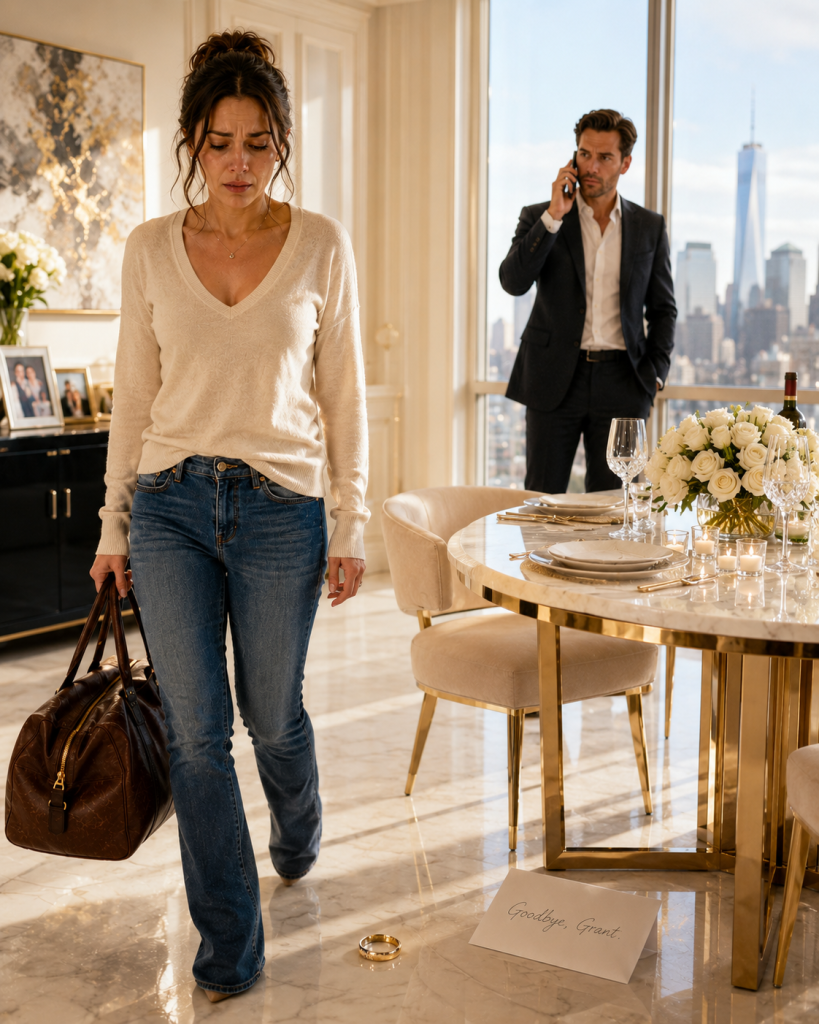
The candles had burned low, wax pooling around silver holders. The roses had begun to bow. The anniversary dinner sat untouched, beautiful and cold, like a display in a restaurant window after closing.
Grant looked toward the stairs.
“Evie?”
He had not called me that in months.
Maybe longer.
He crossed the dining room slowly, irritation arriving first because irritation was easier than fear.
Then his shoe struck something small.
A soft metallic sound touched the marble.
He looked down.
My wedding ring lay beside my chair.
Grant stared at it.
For a moment, he did not move. He simply stood over the diamond he had once chosen with such certainty, the ring he had slipped onto my finger in front of everyone we loved, the ring he assumed would always return to its place no matter how carelessly he treated the hand that wore it.
Then he bent down.
His fingers closed around it.
Cold.
That was what he would remember later. How cold it felt.
He searched the kitchen first. Then the library. Then the bedroom. My closet doors stood open. One drawer was half empty. The phone I had left behind rested on the dresser, dark and unreachable.
Beside it was the envelope.
Grant tore it open with hands that had negotiated hostile mergers without trembling.
My letter was short.
Grant,
You once told me I was the only thing you never wanted to lose.
Tonight, you laughed and said you could always marry again.
Maybe both were true when you said them. Maybe people change slowly enough that they do not hear themselves becoming strangers.
I have spent the last year grieving more than our child. I grieved the way you stopped looking for me while I was still standing beside you.
Do not call my friends. Do not send security. Do not turn this into a problem to manage.
I am safe.
I am leaving because if I stay one more night, I will begin believing I deserve to be unseen.
I do not.
Evelyn
At the bottom, beneath my name, I had written one final line.
Please let me become myself again.
Grant read it once.
Then again.
By the third time, the words no longer looked like ink. They looked like evidence.
He grabbed his coat and ran into the storm.
By then, I was already across the city, sitting in the back of a town car with my duffel bag on my lap and my mother’s necklace pressed between my fingers.
The driver glanced at me in the mirror.
“Rough night?”
I almost laughed.
“Something like that.”
“Where to, ma’am?”
I had almost said a hotel. Something anonymous. Something clean and quiet where no one would recognize me as Mrs. Grant Hayes. But the moment I stepped into the rain, I knew I could not spend my first night of freedom in another expensive room with another closed door.
“Brooklyn,” I said. “Carroll Gardens.”
The driver nodded.
I watched Manhattan blur behind us as we crossed the bridge. The city looked different from a distance. Less like a kingdom. More like a promise someone else had made.
My destination was a small brick building above an old stationery shop. The apartment belonged to Lena Moretti, my best friend from art school, the one person I had never been able to fool for long.
She opened the door wearing flannel pajamas, her curls piled on top of her head, one eye still half-asleep.
Then she saw my face.
“Oh, Evie.”
That was all.
No questions. No dramatic gasp. No speech about finally leaving or needing answers immediately. Lena simply stepped aside and pulled me inside.
Her apartment smelled like turpentine, coffee, and lavender laundry soap. Canvases leaned against every wall. A cat named Matisse glared at me from the sofa as if my heartbreak had interrupted his schedule.
Lena made tea I did not drink. She gave me towels. She took my wet coat. Then she sat beside me on the rug and waited.
I said the first true thing I could manage.
“He laughed.”
Her jaw tightened.
“At you?”
“No. That might have been better.” I stared at my hands. They looked strange without the ring. Younger, almost. “He laughed because someone joked I might leave. He said he could always marry again.”
Lena closed her eyes.
“I left the ring on the floor,” I whispered.
A tear slipped down my cheek, surprising me. I thought I had used all of them already.
Lena reached for my hand.
“Good.”
The word was not cruel. It was solid.
I leaned into her shoulder and finally let myself shake.
Morning came gray and slow. Rain still tapped the windows, but more gently now. I woke on Lena’s sofa beneath a quilt painted with sunlight from the lamp she had left burning.
For one suspended second, I did not remember.
Then I lifted my hand.
Bare.
My chest tightened, but I could breathe.
Lena was in the kitchen, speaking softly into her phone.
“She’s here,” she said. “No, I’m not telling you where. Because she asked for space, Grant, and for once you are going to respect a sentence that does not benefit you.”
I sat up.
Her eyes met mine. She did not look apologetic.
“He’s called twelve times,” she said after hanging up. “He also sent three messages to my gallery account, one to my old roommate, and one to my mother, who enjoyed declining him very much.”
Despite everything, I smiled.
Then the smile faded.
“What did he say?”
“That he needs to know you’re safe.”
“I told him I was safe.”
“Yes. Apparently he believed your handwriting less than my irritation.”
I looked toward the window. A delivery truck idled outside. A man in a yellow raincoat carried boxes into the stationery shop below. Ordinary life had the audacity to continue.
Lena set a mug in front of me.
“He also said he read the letter.”
My throat tightened.
“I shouldn’t care.”
“You care because you loved him.”
“Past tense?”
She sat across from me. “That’s your decision.”
The problem was that love had not vanished when I walked out. It had come with me, bruised and tired, hiding among my sweaters. I hated that. I wanted leaving to feel like cutting a ribbon, clean and ceremonial. Instead, it felt like walking away from a house that was burning while remembering every room before the fire.
After breakfast, Lena took me to her studio.
“You need to draw,” she said.
“I can’t.”
“Then ruin paper.”
She placed my old sketchbook on a wooden table beside a cup of charcoal pencils. Sunlight moved weakly through the high windows. The studio was messy, warm, alive. Paint stains covered the floor like accidental flowers.
I opened the sketchbook.
The first page was dated eight months earlier.
I had drawn a tiny pair of feet.
My breath caught.
Lena saw. “We can close it.”
“No.”
I touched the edge of the drawing.
That baby existed. Not long enough for the world to know. Not long enough for Grant to change meetings or learn lullabies. But long enough for me to imagine soft hair, midnight feedings, a nursery painted pale green, Grant kneeling beside a crib with wonder on his face.
I turned the page.
And drew a doorway.
Not a beautiful doorway. Not even a finished one. Just a dark rectangle with light beyond it.
At noon, someone knocked.
Lena frowned. “I swear if he hired someone—”
But when she opened the studio door, it was not Grant.
It was Julian Vale.
For several seconds, I forgot how to speak.
Julian stood in the hallway wearing a charcoal overcoat damp from the rain, his dark hair threaded with early silver. He held a cardboard tube under one arm and looked exactly like memory had no right to look after twelve years.
“Evelyn,” he said softly.
Lena’s eyebrows rose with open interest.
I stood too quickly, knocking a pencil to the floor.
“Julian?”
“I’m sorry to come without warning.”
“How did you know I was here?”
He glanced at Lena. “Your gallery assistant called me.”
Lena lifted both hands. “Before you look at me like that, he was already on your emergency list from art school. Apparently you never updated it.”
I had forgotten.
Julian Vale had been my mentor once. More than a mentor, if I was honest in the privacy of my own mind. He was the person who first convinced me my art mattered beyond pretty rooms and charity auctions. At twenty-six, I had nearly taken a fellowship in Florence with his recommendation in my bag.
Then I met Grant.
Then life became dinners, boards, foundations, and eventually a penthouse where my sketchbooks gathered dust.
Julian stepped inside but kept a careful distance.
“I heard you might need this.”
He handed me the cardboard tube.
Inside was a rolled canvas.
My hands trembled as I unfurled it across the table.
It was mine.
A painting I had made twelve years earlier, the last large piece before I slowly stopped calling myself an artist. A woman stood at the edge of a dark river, holding a lantern toward a city she was not sure would welcome her.
I had titled it Before Dawn.
“I thought this was lost,” I whispered.
“You left it in my studio before the Florence decision.” Julian’s voice was gentle. “I kept it safe.”
Lena looked between us. “Florence decision?”
I did not answer.
Julian did.
“She was awarded a fellowship. Fully funded. Six months in Italy. She didn’t go.”
Lena stared at me.
I felt exposed in a way that had nothing to do with Grant.
“I was getting married.”
“You were engaged,” Julian said. “There was time to go.”
The words were not judgmental. That made them worse.
I rolled the canvas halfway, then stopped. The woman’s painted face stared upward, determined and afraid.
“Why bring it now?”
“Because the foundation called me last week.”
“What foundation?”
“The Bellwether Arts Trust. They’re organizing a retrospective of fellows who never completed their residency. They want to include your early work. They also want to know whether you’d consider accepting the fellowship now.”
I laughed once. “That’s impossible.”
“Is it?”
“I’m thirty-eight.”
“Not deceased.”
Lena made a small approving sound.
I looked at Julian. “My life just fell apart.”
“Then perhaps it has room.”
The sentence stayed with me long after he left.
Grant found the car service by noon.
He did not find me.
Instead, he found the driver, who apparently told him only that I had gone to Brooklyn and tipped well. Grant called Lena again. She did not answer. He sent one message to my phone, forgetting I had left it behind, then another to my email.
Evelyn, I’m sorry. Please tell me where you are. I didn’t know you felt this alone.
I read the message on Lena’s laptop.
Anger moved through me, hot and clean.
He did not know because knowing would have required pausing long enough to ask.
Still, beneath the anger was sorrow.
Because once, Grant had asked. In the early years, he knew when I was quiet because of worry and when I was quiet because I was dreaming. He knew I liked burnt edges on toast. He knew I touched my necklace when I missed my mother. He knew I hated lilies because hospitals used them too often.
Where had that man gone?
Or had success simply given him permission to become someone already waiting inside him?
That evening, I walked alone through Carroll Gardens. Brownstones glowed warmly through rain-dark trees. Restaurants filled with voices and candlelight. A father carried a sleeping child across a crosswalk, pressing one hand protectively against the little girl’s back.
I stopped so suddenly someone behind me muttered and stepped around.
Grief arrived without warning.
Not dramatic. Not loud.
Just a hollow opening in the center of me.
I stood beneath a striped awning and cried for the baby I had lost, the marriage I had left, the artist I had abandoned, and the woman I had trained myself not to miss.
When I returned to Lena’s apartment, Grant was waiting across the street.
He looked drenched, exhausted, and very unlike the man who had laughed over whiskey the night before. His hair was wet. His tie was gone. He held my ring in his closed fist.
Lena stepped in front of me immediately.
Grant did not come closer.
“Evelyn,” he said.
His voice cracked.
I hated that it reached me.
“You shouldn’t be here,” I said.
“I know.”
“Then why are you?”
“Because I needed to say it where you could hear me.”
“You had years.”
“I know.”
Rain collected on his coat collar. He looked smaller in the amber streetlight. Not weak. Human. I had forgotten he could look that way.
“I read your letter,” he said. “I read it so many times I could hear your voice changing by the end.”
I folded my arms, more to hold myself together than to shut him out.
“I meant what I wrote.”
“I believe you.”
That surprised me.
He opened his hand.
The ring rested in his palm.
“I keep thinking about picking it up from the floor,” he said. “I was angry for maybe five seconds. Then I realized you put it there because I made you feel lower than the thing itself.”
I looked away.
He drew a shaky breath.
“I missed the appointment.”
I went still.
The appointment.
He had never named it before.
Eight months ago, when the bleeding started, I had called his assistant because Grant was in a private meeting. His assistant said he was unreachable. I went to the hospital alone.
He arrived the next morning with flowers and apologies and the devastated expression of a man who hated consequences but did not understand absence.
“You didn’t miss an appointment,” I said quietly. “You missed me.”
His face tightened.
“Yes.”
The word emerged stripped of defense.
Lena stood silently beside me, fierce as a guard dog in paint-splattered boots.
Grant looked at her. “I’m not asking her to come home tonight.”
“Good,” Lena said.
“I’m asking for one conversation tomorrow. Somewhere she chooses. No lawyers. No staff. No phone.”
I nearly smiled at that.
“You can survive without your phone?”
His mouth trembled. “I’d like to try.”
There was a time when I would have rushed toward the smallest opening in him and built hope inside it. Tonight, I let the silence stretch.
“Tomorrow,” I said. “Four o’clock. The public garden on Cranberry Street.”
He nodded once.
Then he placed the ring on the stone wall beside him.
“I’m not giving it back,” he said. “I’m returning it to you. What you do with it is yours.”
He walked away without waiting for praise.
I did not pick up the ring until his car disappeared.
It was still cold.
The next afternoon, I arrived at the garden ten minutes early.
Grant was already there.
No suit. No watch I recognized. No phone visible. He sat on a bench beneath bare branches, holding two paper cups of coffee.
“I didn’t know what you wanted anymore,” he said when I approached. “So I guessed.”
I took one.
Black, with cinnamon.
He remembered.
We sat with enough space between us for the past year.
“I spoke to Dr. Leland,” he said.
Our grief counselor. The one I had visited twice before Grant said therapy made him feel “managed.”
“She still has an opening next week.”
I looked at him carefully. “For you?”
“For me,” he said. “Whether or not you come.”
That mattered more than any apology he had ever offered.
He stared at the gravel path.
“I built a life where everything could be replaced if it became inconvenient. Employees. Apartments. Deals. Time. I didn’t realize I had started treating people the same way.”
“You realized.”
“Too late.”
“Maybe.”
He nodded as if he deserved nothing else.
For an hour, we spoke honestly in fragments.
I told him loneliness had become a room I lived in while he visited occasionally. He told me ambition had turned fear into fuel until he could no longer tell the difference between success and escape. I told him I was considering the Bellwether fellowship. His face changed when I said Florence, but he did not object.
“I should have told you to go,” he said.
“You should have asked whether I wanted to.”
“Yes.”
When we parted, he did not touch me. That restraint felt like respect.
For the next week, we existed in a strange in-between.
I stayed with Lena. Grant sent no flowers, no gifts, no dramatic declarations. Instead, he sent practical emails through Nina, my attorney, about temporary separation arrangements. He also began grief counseling. I knew because Dr. Leland’s office called me by mistake to confirm a billing detail.
I filled out the fellowship reconsideration form.
My hand shook when I typed my name.
Evelyn Carter.
Not Hayes.
Not yet again.
Just Carter.
Julian invited me to visit his studio to review old work for the retrospective. I hesitated, aware of how complicated my life already was, but Lena gave me one look and said, “Art is not an affair. Go.”
Julian’s studio was in Long Island City, bright and high-ceilinged, with rows of canvases and shelves of catalogues. He had saved more of my work than I remembered leaving behind.
Charcoal studies.
City sketches.
One unfinished portrait of Grant from our early days, his face turned toward the window, laughing.
I stared at it for a long time.
“You loved him,” Julian said.
“I did.”
“Do you still?”
I expected the question to offend me. It did not.
“Yes,” I said. “But I’m learning that love is not always an instruction.”
Julian smiled sadly. “No. Sometimes it is only information.”
As I sorted through portfolios, a folded letter slipped from between two canvases.
My name was written across the front.
Evelyn.
The handwriting was not Julian’s.
It was my mother’s.
My mother had died four years before I married Grant. Cancer took her quickly, leaving behind recipes, scarves that smelled faintly of rose soap, and a grief I had packed carefully away because wedding planning began soon after.
I touched the envelope with numb fingers.
“Where did this come from?”
Julian frowned. “I’ve never seen it.”
The paper had yellowed at the edges. The seal was already broken.
Inside was one page.
My darling Evie,
If Julian gives you this, it means you are standing near a door you are afraid to open. I know you. You will call fear practicality and sacrifice maturity. You will convince yourself that being chosen by someone powerful is safer than choosing yourself.
Grant may love you. I hope he does. But love that asks you to become smaller is not shelter.
Go to Florence if it is offered. Go anywhere your own soul becomes louder.
Do not confuse being adored with being known.
Mom
I sat down hard on a wooden stool.
Julian read my face, then the letter, and went pale.
“I didn’t know,” he said.
“It says if Julian gives you this.”
“I swear to you, Evelyn, I never had it.”
A chill moved through me.
“Then who did?”
He looked toward the envelope again.
“There’s something on the back.”
I turned it over.
In faint pencil, nearly erased, were two initials.
G.H.
Grant Hayes.
The room tilted.
Grant had found this letter years ago.
Grant had read my mother’s words.
And Grant had never told me.
That evening, I did not wait.
I called him from Lena’s phone.
He answered immediately.
“Evelyn?”
“My mother wrote me a letter.”
Silence.
A long one.
Then he whispered, “Where did you find it?”
The admission sat between us like a third person.
“In Julian’s studio.”
“I can explain.”
I closed my eyes.
“Did you hide it?”
“I didn’t mean to.”
“That is not an answer.”
His voice was rough. “Yes.”
The word cut deeper than his anniversary laugh because this was not carelessness. This was choice.
“Why?”
“You were leaving,” he said. “The fellowship. Florence. I was terrified you would go and discover a life that didn’t include me.”
“So you took my mother’s voice away from me.”
He made a sound like pain.
“I told myself I was protecting us.”
“No,” I said. “You were protecting yourself.”
The line went quiet.
Then Grant said, “There’s more.”
My hand tightened around the phone.
“What more?”
“I wasn’t the only one who knew about the letter.”
Behind me, Lena stopped moving.
“Who else?”
Grant exhaled shakily.
“Julian.”
I turned slowly toward the studio window, where Julian’s reflection stood behind me, pale and silent, holding another sealed envelope I had not seen before.
PART 3
The silence in the Long Island City studio didn’t feel like peace. It felt like a dropped glass, frozen a fraction of a second before the sharp fragments hit the floor.
Outside, the East River stretched like a sheet of bruised iron under a low, purple dusk. Inside, the heavy aroma of linseed oil and aged turpentine suddenly turned sickeningly sweet.
I didn’t lower the phone. I held the cold plastic to my ear, listening to Grant’s ragged breathing miles away, while staring directly into Julian’s reflection on the windowpane.
Julian didn’t flinch. He didn’t drop his gaze. He simply stood beside a stack of stretched canvases, holding that second sealed envelope with the calm, practiced posture of a man who had orchestrated the entire room.
“Evelyn?” Grant’s voice bled through the speaker, thin and stripped of the polished authority he had carried for a decade. “Evelyn, are you still there?”
“He’s standing behind me,” I whispered.
“Listen to me,” Grant pleaded, his words tumbling over one another with a desperate, frantic speed I had never heard from him—not during board takeovers, not during market crashes. “Twelve years ago, before we got married, Julian came to my office in Midtown. He brought that letter. Your mother had sent it to his gallery two weeks before she died, asking him to deliver it to you if you ever hesitated about your art—if you ever looked like you were walking away.”
My lungs refused to expand. “Julian brought it to you?”
“He traded it,” Grant said, the bitter truth scraping out of him. “He wanted seed funding for his first international gallery in London. Two million dollars. He told me your mother was trying to steer you away from me—that she saw me as a distraction from your talent. He said if I backed his gallery, he’d step aside, drop the Florence recommendation, and hand the letter over so it wouldn’t ‘complicate’ your choices.”
I looked at Julian.
The silver in his hair, the elegant charcoal overcoat, the quiet, soulful demeanor of the unappreciated artist who had preserved my early work like a sacred relic—it fell away in an instant. Beneath it sat an opportunist no different from the men Grant fought in boardrooms. Just better dressed. Warmer. Carrying charcoal instead of contracts.
“Is it true?” I asked softly, turning around to face Julian directly. I didn’t disconnect the call. I lowered the phone to my chest, letting the speaker carry my voice into the room.
Julian looked down at the second envelope in his hand. The subtle, melancholy warmth in his eyes hardened into something flat and pragmatic.
“You were never going to marry him if you went to Florence, Evelyn,” Julian said, his voice entirely devoid of remorse. “And you were never going to build a career if you stayed anchored to an ambitious boy who saw you as an accessory. I needed the gallery. You needed a reality check. I gave Grant what he wanted—a clear path to marry you—and I kept your artwork safe until you were mature enough to actually value it.”
“You took my mother’s last words,” I said. My voice wasn’t loud. It was hollow. “You sold them.”
“Your mother was a romantic who lived in a small town and thought art was a holy calling,” Julian replied coolly. “I knew the market. I knew what it took to survive. Look at you now—you’re thirty-eight, miserable, and sitting on a pile of unused talent because you chose a penthouse over a studio. I didn’t destroy your life, Evelyn. I deferred it.”
He stepped forward, extending the second envelope toward me.
“This is the rest of it,” Julian added quietly. “The second page of her letter. The part Grant never got to see because I kept it as insurance. Read it. Then accept the Bellwether fellowship. Florence is still waiting. I can get you there by next month.”
I stared at the envelope.
Twelve years ago, these two men had sat in an air-conditioned office overlooking Manhattan and carved up my future over two million dollars and a roll of canvas. One had bought my presence; the other had sold my trajectory. Both had convinced themselves they were doing it out of a superior understanding of what I needed.
My hand didn’t move toward the envelope.
“Evelyn!” Grant’s voice buzzed against my palm.
I lifted the phone back to my ear. “Grant.”
“I paid him,” Grant confessed, his breath hitching. “I took the letter. I locked it in my safe in the Tribeca apartment. I told myself I was saving you from a life of struggling as a painter. I told myself I could give you everything she promised you and more. But the truth… the truth was I was terrified. I knew if you went to Italy, you would grow into someone who didn’t need me. And I couldn’t bear the thought of not being the center of your world.”
The confession didn’t bring relief. It felt like watching a house you had lived in for years reveal that its foundation had been built on dry rot from day one.
“You both treated me like property,” I said into the quiet room. “A asset to buy. A career to manage. A canvas to paint your own ambition onto.”
I took a slow, deep breath. For the first time in eight months—since the cold hospital room, since the miscarried nursery dreams, since the cold anniversary dinner—the fog inside my head cleared entirely.
“Evelyn, please,” Grant begged. “Tell me where you are. Let me come get you.”
“No,” I said softly. “You stay where you are, Grant.”
I looked Julian dead in the eye. “And you… put that envelope on the table and get out of my sight.”
Julian’s eyes narrowed slightly. “Evelyn, don’t be naive. You need my backing for the Bellwether retrospective—”
“I don’t need your backing,” I interrupted, my voice dropping an octave, steady and sharp as glass. “I am the artist. Without my work, you have an empty room and a frame. Leave the letter.”
For three seconds, Julian didn’t move. Then, recognizing the absolute, immovable wall in my expression, he placed the yellowed envelope onto the wooden stool beside my charcoal pencils. He didn’t apologize. He adjusted his charcoal overcoat, picked up his leather briefcase, and walked out of the studio, his leather soles clicking down the hallway until the heavy fire door slammed shut.
I stood alone in the vast, echoing room.
I didn’t open the second page immediately. I sat down on the wooden stool, set my phone on the table next to the envelope, and looked at the speaker icon still glowing with Grant’s call.
“Are you still there?” I asked.
“I’m here,” Grant said. “I’m not hanging up.”
“Good,” I said, picking up the small pencil lying on the table. “Because for the first time in twelve years, Grant… you are going to sit quietly and listen to me.”
PART 4
The next three weeks did not look like a storm. They looked like accounting.
People assume that leaving a life is emotional—that it happens in tearful confrontations, slammed doors, and dramatic midnight drives. But true departure is quiet. It is the steady, meticulous unraveling of threads that took a decade to weave.
I stayed in Lena’s guest room. Every morning at six, I woke up to the smell of her dark roast coffee and the muted scrape of charcoal on textured paper. I drew until my thumbs were stained gray and my wrists ached. I drew the high, arched windows of the Tribeca penthouse. I drew the cold floor where my ring had rested. I drew the small, impossible outline of a child that would never breathe, and then I drew the woman standing at the edge of the river from my old canvas—only this time, she wasn’t holding a lantern for a city. She was holding it for herself.
Grant did not push.
He followed every boundary I set through Nina, my attorney. He did not show up at Lena’s apartment. He did not call during my work hours. When we needed to meet to sign the initial legal separation papers, he suggested the neutral conference room of a quiet law firm in Midtown—far from his firm, far from mine.
When I walked into the glass room on a rainy Tuesday afternoon, Grant was already sitting there.
He looked different. The razor-sharp, untouchable sheen of the corporate titan was missing. He wore a dark blue sweater, no tie, and his hands rested flat on the polished mahogany table. He had lost weight; the clean line of his jaw was sharper, shadowed by tired lines around his eyes.
Beside his elbow sat a dark wooden box.
“Evelyn,” he said, standing up immediately, then stopping himself from reaching out.
“Grant.”
I sat across from him. Nina sat to my left; his attorney, a sharp woman named Vance, sat to his right.
Vance opened a leather folder. “Mrs. Hayes, we’ve reviewed your terms regarding the temporary separation and division of marital assets. Mr. Hayes has instructed us not to contest any of your requests.”
I blinked, glancing at Grant. “None of them?”
“No,” Grant said directly, looking at me. “The house in the Hamptons, the investments from the early years, the gallery fund—everything is transferred to your name. You take what you want. I won’t haggle over numbers with you, Evie. I never should have treated our life like a transaction.”
“And the penthouse?” I asked quietly.
“I listed it for sale yesterday,” he replied. His voice was steady, but his throat moved as he swallowed. “I can’t live there. Every time I walk past the dining table, I see the candles burning down. Every time I walk down the hall, I expect to see you in the bedroom with your sketchbook. It’s not a home anymore. It’s just square footage.”
I looked down at the legal papers spread between us. A standard agreement. Generous, clean, devoid of bitterness.
“Thank you,” I said softly.
“I brought something else,” Grant said, reaching for the wooden box beside him. He slid it across the glossy table toward me.
I opened the brass latch.
Inside lay my mother’s letter—both pages, neatly aligned—along with a thick leather ledger bound in dark brown hide.
“What is this?” I touched the leather cover.
“It’s my calendar,” Grant said. His mouth twitched into a sad, fraction-of-a-second smile that vanished before it could take root. “Or rather… my real calendar. For the last five years.”
I opened the ledger.
It wasn’t filled with financial figures or corporate acquisitions. Page after page was filled with Grant’s handwriting, neat and precise, recording dates, times, and brief notes.
October 14, 2023: Evie stayed in bed until 10 AM. She looked at the rain for an hour without speaking. I asked if she wanted breakfast. She said no. I went to the office because I didn’t know how to fix her silence.
March 2, 2024: Hospital. Room 412. Doctor said the tissue was gone. Evie didn’t cry when I came in. She looked right through me. I bought yellow roses from the shop downstairs. She didn’t touch them. I scheduled three board meetings for the following day so I wouldn’t have to sit in the nursery.
June 11, 2025: Anniversary dinner at Le Bernardin. Evie wore the blue dress. She mentioned wanting to visit Florence again. I changed the subject to the Tokyo acquisition because every time she mentions art, I feel the space between us getting wider and I panic.
I stared at the pages, my vision blurring until the ink ran together into dark, jagged streams.
He had noticed.
Every quiet withdrawal, every silent tear in the shower, every moment I thought I had slipped beneath his notice—he had seen it all. He hadn’t been blind. He had been cowardice in an expensive suit, running away from the quiet tragedy of our life into the noise of billion-dollar deals because deals could be closed, while heartbreak couldn’t.
“I kept track,” Grant whispered, leaning across the table, his fingers lightly touching the edge of the wooden box. “Because I thought… I thought if I kept record of the distance, I could eventually figure out how to bridge it. But I never stopped running long enough to try.”
I closed the ledger slowly, resting my palm on its dark cover.
“Why didn’t you show me this six months ago?” I asked, my voice barely above a whisper.
“Because six months ago, I was still trying to win,” Grant said honestly. “I thought if I admitted I was terrified, I’d lose my leverage. I didn’t understand that love doesn’t have leverage, Evelyn. It only has presence. And I wasn’t present.”
The room was utterly quiet. Nina and Vance sat motionless, professional observers to the quiet death of a ten-year history.
I reached out, signed the bottom of the separation papers with my maiden name—Evelyn Carter—and pushed the blue folder back to Vance.
Then I took my mother’s letter and the dark ledger, placed them into my bag, and stood up.
Grant stood with me.
“Are you going to Italy?” he asked.
I looked at him—really looked at him. The boy who had spilled champagne on my sketchbook twelve years ago was gone. The cold CEO who had laughed over whiskey three weeks ago was gone too. Standing in front of me was simply Grant: a man carrying the full, unvarnished weight of his choices, standing in the middle of a room he could no longer buy his way out of.
“The fellowship starts in September,” I said softly. “I accepted yesterday.”
Grant’s chest heaved once, a quiet, shuddering breath. He nodded slowly, accepting the sentence.
“Florence,” he said, tasting the word. “It’s… it’s where you always belonged.”
“No,” I corrected gently, stepping toward the door. “It’s where I was supposed to start. I’m just twelve years late.”
PART 5
Florence, Italy — October 2026
The studio on Via Maggio smelled of olive oil, old brick, and wet plaster.
High overhead, daylight streamed through massive arched windows, illuminating long wooden tables covered in jars of pigment, horsehair brushes, and large, unprimed linen canvases. Outside, the Arno River flowed beneath the Ponte Vecchio, cold and steady, reflecting the pale gold of an autumn afternoon.
I stood in front of a six-foot canvas, wearing an apron stained with ultramarine and raw umber, a charcoal pencil balanced between my fingers.
The Bellwether retrospective had opened two weeks earlier at the Palazzo Ridolfi.
It had not been Julian’s show. After I cut ties with his gallery, the foundation had appointed a quiet, brilliant curator named Elena Rossi—a woman who cared nothing for high-society politics and everything for line, shadow, and truth. She had curated thirty of my early works alongside twelve new pieces I had completed during my first two months in Tuscany.
The centerpiece of the exhibition was not the painting of the woman by the river.
It was a portrait.
A large, detailed canvas depicting a man sitting at an empty dininvg table in a high-rise penthouse, his reflection trapped in the dark glass behind him, holding a small diamond ring in his palm while looking at an empty doorway.
I had titled it The Cost of Everything.
A knock sounded at the heavy wooden door of the studio.
I didn’t turn around immediately. “It’s open, Elena. The sketches for the second room are on the counter.”
“I’m not Elena.”
The pencil stopped in my hand.
I turned slowly.
Grant stood in the doorway.
He wore a dark wool coat, his hair slightly windswept from the Tuscan breeze. He held no flowers. He carried no luggage. He simply stood at the entrance of the studio, looking at the high ceilings, the messy paint jars, the sketches pinned to the brick walls, and finally, at me.
He looked older, but his eyes were clear. There was no cell phone in his hand. No earpiece tucked into his collar. He looked present—entirely, completely present in the room.
“Grant,” I said, stepping back from the easel.
“I came to see the exhibition,” he said softly, his voice echoing slightly in the vaulted space. “I spent three hours at the Palazzo today.”
I wiped my charcoal-stained hands on a rag. “What did you think?”
“I stood in front of The Cost of Everything for almost an hour,” he replied. He stepped further into the studio, his boots making a soft sound against the ancient stone floor. He stopped a respectful five feet away from me. “It’s brilliant, Evelyn. Cruel, but brilliant.”
“It wasn’t meant to be cruel,” I said quietly. “It was meant to be accurate.”
“It was,” he agreed without hesitation. “That was exactly who I was. A man who had everything and understood nothing.”
Silence settled between us—not the heavy, suffocating silence of the Tribeca penthouse, but a wide, spacious quiet that belonged to the city outside.
“How is New York?” I asked.
“Busy,” he said. “Different. I stepped down as managing partner at Hayes & Vance last month.”
I looked at him in surprise. “You left the firm?”
“I didn’t leave the business,” he clarified with a faint smile. “I restructured my life. I run a smaller venture fund now—mostly green infrastructure and historic preservation. Fewer acquisitions. Fewer trips to LA. More time.”
He looked around the studio, taking in the chaotic beauty of my work.
“Dr. Leland says I’ve made progress,” Grant added, looking back at me. “She says I’m finally learning how to stay in a room when things get uncomfortable.”
“And are you?”
“I’m trying,” he said simply.
He reached into his coat pocket. For a second, my heart dropped into my throat—a terrifying fear that he was going to pull out the ring, that he was going to offer the old marriage back to me like a solved puzzle.
Instead, he pulled out a small, worn paper card and placed it gently on the edge of my workbench.
It was a card for a local bookstore in the Oltrarno district, with a handwritten note on the back.
“I’m staying at a small hotel near San Miniato for the week,” Grant said, his voice dropping to a low, warm hum. “I’m not here to ask you to come home, Evie. I know that home doesn’t exist anymore. And I’m not here to ask you to be my wife again.”
I looked from the card back to his eyes. “Then why are you here, Grant?”
Grant looked at me—really looked at me—his gaze taking in the paint on my cheeks, the stray curls slipping from my clip, the quiet confidence that lived in my posture now.
“Because twelve years ago, I spilled champagne on your sketchbook and offered to buy you a new one,” he said softly. “And you told me I could start with an apology.”
He took a slow, deep breath.
“I’m here to apologize, Evelyn. Properly. Without a contract, without a bribe, and without an expiration date. And if… if you ever have a free afternoon, I’d like to take you to dinner. Not to talk about who we were. But to meet the woman you’ve become.”
He didn’t wait for an answer that would put pressure on the air. He turned slowly toward the wooden door, his coat sweeping behind him.
“Grant,” I called out.
He stopped at the threshold, turning his head back toward me.
“I’m painting until six,” I said, looking down at the canvas, then back up at him. “There’s a small trattoria behind Piazza Santo Spirito. They have terrible wine, but the bread is burnt at the edges just the way I like it.”
A true smile—unpracticed, unpolished, and completely warm—broke across Grant’s face. The kind of smile I hadn’t seen since a charity auction in Midtown Manhattan twelve years ago.
“I know the one,” he said gently. “I’ll be there at seven.”
He walked out into the Tuscan sunlight, leaving the heavy wooden door slightly open.
I turned back to my canvas. Outside, the rain had stopped, and the afternoon light crossed the Arno in long, brilliant streaks of gold. I picked up my brush, dipped it into the raw umber, and placed the first stroke onto the clean linen—not to fix the past, but to paint whatever came next.