Vanessa’s hand remained on my arm as if nothing in the world had changed.
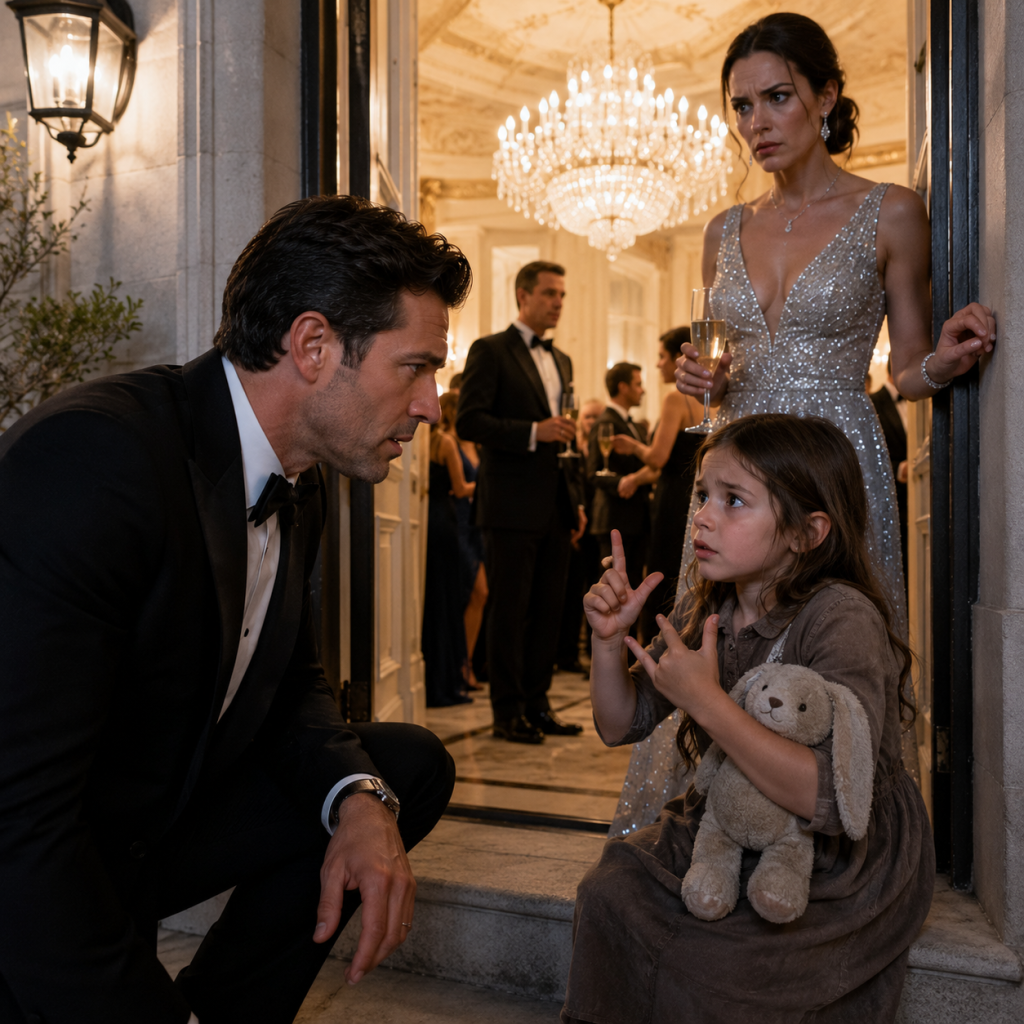
Her fingers were cool, perfectly manicured, light against the sleeve of my tuxedo. Behind her, the ballroom shimmered with candlelight and wealth. People laughed with mouths I could barely hear. Crystal glasses flashed beneath chandeliers. The quartet played on, though to me the violins had become a soft metallic whine, distant and warped.
Don’t eat tonight.
Lily’s small hands had moved quickly, urgently, then vanished as she fled through the service entrance.
I looked at Vanessa.
She smiled up at me with the practiced tenderness I had once mistaken for love.
“Darling,” she said, “you’re pale.”
Her voice arrived in pieces. The shape of her lips helped me fill in the rest.
“I’m fine,” I said.
“You’re not.” She touched my cheek. “You’ve been pushing yourself too hard again. Come back inside. I’ll have them bring you something warm.”
Something warm.
Tea.
Soup.
A plated dinner arranged by her hand, carried by my staff, approved by her schedule.
For four months, Vanessa had been the person closest to everything I consumed. Breakfast trays. Vitamins. Evening tea. The small white bowl of broth she insisted would help me sleep. When my hearing began to fail, I called her devotion. I called it care.
A child had called it medicine.
“I need air,” I said.
“We’re outside.”
“More of it.”
A faint line appeared between her brows, gone almost as soon as it came. Vanessa never allowed irritation to live long on her face. She had been raised among people who believed emotion was something to manage like stock portfolios and household staff.
“The governor is waiting to speak with you,” she said.
“He can wait.”
“He flew in for us.”
“For cameras,” I replied.
Her smile tightened. “This is important, Alexander.”
There it was.
My name, polished into warning.
Alexander Mercer did not step away from rooms full of powerful people. Alexander Mercer did not embarrass a fiancée in public. Alexander Mercer did not listen to barefoot children hiding behind curtains while a six-billion-dollar company, a political alliance, and an engagement announcement balanced on the edge of a champagne glass.
But my grandmother had once told me something with her hands when I was seven and crying because other children mocked the way she spoke.
People who cannot hear lies must learn to see truth.
Lily had looked terrified.
Vanessa looked perfect.
For the first time in months, perfection frightened me more.
“I’ll be back in five minutes,” I said.
Vanessa studied me. Then she leaned close enough that the cameras on the terrace would catch what looked like affection.
“Don’t make me chase you at our own engagement party,” she whispered.
I heard that clearly.
Not because my ears improved.
Because some tones do not need sound.
I kissed her cheek, gently enough for the audience behind the glass, coldly enough for myself.
“Five minutes.”
Then I walked away before she could stop me.
I did not go back to the ballroom.
Instead, I moved along the terrace toward the side corridor that led to the kitchen wing. My estate had been built in the 1920s by a steel magnate with a taste for limestone, lake views, and unnecessary hallways. Vanessa called it romantic. My chief of security called it a nightmare. Too many doors. Too many corners. Too many ways for a person to disappear without leaving the house.
That night, for the first time, I was grateful for all of them.
Near the service stairs, I found Nora.
She stood beside a pantry shelf, wiping her face with the back of one hand while trying to straighten her black uniform with the other. She was younger than I had expected from her voice, perhaps early thirties, with tired eyes and the wary posture of someone who had spent years apologizing before anyone asked.
When she saw me, she froze.
“Mr. Mercer.”
The words came blurred, but I read them on her lips.
“Where is Lily?” I asked.
Nora’s face drained of color.
“She didn’t mean to disturb you. She gets frightened in big places. I told her to stay upstairs, but she wakes up sometimes and—”
“Nora.”
She stopped.
“Where is she?”
Her throat moved. “In my room.”
“Take me to her.”
Fear sharpened her expression.
“Please don’t fire me.”
“I’m not going to fire you.”
“You don’t understand. Ms. Hale said—”
“I understand more than you think.”
She looked past my shoulder, toward the music and light spilling from the far end of the hall.
“She’s just a child,” Nora whispered.
“I know.”
Something in my voice must have reached her, because after a moment she nodded.
Nora led me up the back stairs, away from the party, to the third floor where guest suites became staff rooms. The air smelled faintly of laundry soap and old wood. The sound of the party faded into the walls until only the ringing in my ears remained.
At the end of the corridor, Nora opened a narrow door.
Lily sat on the bed beneath a quilt, knees tucked to her chest, the battered rabbit clutched against her mouth. Her eyes widened when she saw me.
She lifted one hand.
Sorry.
The sign was small. Careful.
I sat on the chair near the bed, slowly, so I would not frighten her. “You are not in trouble,” I signed.
Her gaze moved to her mother.
Nora stared at us, stunned.
“You sign?” she asked aloud.
“My grandmother was deaf,” I answered without looking away from Lily.
Lily’s fingers tightened around the rabbit.
“You told me not to eat,” I signed. “Why?”
Nora went still.
Lily looked at her mother again.
“It’s okay,” Nora said, but her voice trembled. “Tell him the truth, baby.”
Lily swallowed. Her tiny fingers moved.
Pretty lady puts drops in cup.
“What drops?” I signed.
She shook her head.
“Did you see the bottle?”
Lily nodded.
“Where?”
She pointed downward. Kitchen.
Nora pressed one hand against the doorframe.
“When?” I asked.
Lily looked down at her rabbit.
“Many times,” she signed.
My chest tightened with a cold, clean fear.
Not panic. Something worse. Understanding.
“Why didn’t you tell your mother?”
“I did,” Lily signed.
I turned to Nora.
Her eyes filled. “I thought she misunderstood.”
“Why?”
“Because Lily is four,” she said, shame breaking through her words. “Because Ms. Hale told me it was herbal extract for your sleep. Because I needed the job. Because people like me don’t accuse people like her unless we’re ready to lose everything.”
I could not blame her.
That made it hurt more.
Lily leaned forward, signing faster now.
Pretty lady said medicine makes loud man quiet.
The room seemed to tilt.
Nora made a small sound.
I forced my hands to remain steady. “Who is loud man?”
Lily pointed at me.
I almost laughed from the absurdity and horror of it.
Loud man.
That was how Vanessa saw me. Not fiancé. Not partner. Not man.
A problem to be softened.
A voice to be lowered.
“What else did she say?” I signed.
Lily’s face scrunched in concentration.
“Soon he signs papers,” she answered. “Then sleep.”
Nora whispered, “Oh God.”
I looked at her. “What papers?”
“I don’t know.”
But I did.
Vanessa had placed a revised prenuptial agreement on my desk two days earlier, wrapped in cream stationery and perfume.
Just a formality, darling. My father’s lawyers insist. You know how families are.
I had not signed it yet because the words swam whenever I tried to read for too long. My eyes tired easily now. My ears rang. My headaches returned every evening. Vanessa joked I was allergic to paperwork.
Maybe that had not been a joke.
I stood.
Nora caught my sleeve. “Please. Don’t confront her tonight.”
“I won’t.”
“You don’t know what she’s like when no one important is watching.”
I looked at Lily.
She had tucked her rabbit under her chin and was watching me with grave, enormous eyes.
“Tonight,” I signed to her, “you are safe.”
Lily stared at my hands.
Then she signed one word.
Promise?
I had made promises to investors, employees, reporters, committees, judges, doctors, and women who smiled for cameras beside me. Most had been dressed in legal language and escape clauses.
This one felt different.
I looked at the child and signed back slowly.
Promise.
There are moments in life when a man does not yet know what he has become, only what he can no longer be.
I could no longer be careless.
I returned to the party twenty minutes later.
The ballroom had shifted from formal celebration into the loosened elegance that arrives after expensive champagne does its work. Guests moved in glittering clusters. A senator laughed near the fireplace. My CFO, Marcus Vale, leaned too close to an investor’s wife. Vanessa stood beneath the chandelier speaking with her father.
Richard Hale had the pale, polished face of a man who had never entered a room without believing it should rearrange itself around him. He controlled banks, charities, political committees, and enough old Chicago money to make people forgive his lack of warmth. When Vanessa introduced us eighteen months earlier, he had looked at me not as a future son-in-law, but as an acquisition with pulse.
His eyes found me across the room.
Vanessa turned.
For one second, before she smiled, I saw calculation.
“There you are,” she said when I reached them. “I was beginning to worry.”
“Were you?”
She slipped her arm through mine. “Always.”
Richard studied my face.
“You look tired, Mercer.”
“I’m told it’s fashionable among CEOs.”
He did not smile.
A server approached with a plate of risotto, golden and fragrant.
“Mr. Mercer,” Vanessa said lightly, “you barely ate. Please.”
The plate hovered between us.
I felt Lily’s warning pass through my mind like a bell.
Don’t eat tonight.
I took the plate.
Vanessa relaxed almost invisibly.
Then I turned and handed it to Marcus Vale, who had approached at exactly the wrong moment.
“Marcus,” I said, “you’ve been praising the menu all night.”
He blinked. “I have?”
“Loudly.”
He accepted the plate because refusing me in front of donors would require courage he did not have. Vanessa’s fingers tightened around my arm.
“Alexander,” she murmured.
“Darling,” I replied, matching her tone.
Marcus took one bite and launched into a compliment about truffle balance that I could not hear and did not care to understand.
Vanessa’s hand slowly released my sleeve.
There it was.
Fear.
Tiny. Quick. Covered at once by a smile.
But real.
The rest of the evening became theater.
Vanessa offered me champagne; I placed the glass on a side table when she turned away.
She sent for tea; I told the server to leave it in my study.
She reminded me of the toast with her father; I insisted we postpone speeches because my hearing had “decided to make the evening mysterious.”
Guests laughed.
Vanessa did not.
At midnight, the final cars rolled down the drive beneath bare November trees. The ballroom stood wounded after celebration—half-empty glasses, wilted flowers, candle smoke hanging in the air. Staff moved quietly, cleaning evidence of happiness no one had fully felt.
Vanessa found me in the library.
I had not turned on all the lights. Only one green-shaded lamp glowed beside my chair. The darkness made it easier to watch people. They forgot where shadows ended.
“You embarrassed me tonight,” she said.
No soft voice now. No cameras. No audience.
I looked up from the unsigned prenup resting on my lap.
“I thought I was charming.”
“You refused every plate I sent you.”
“Was that embarrassing?”
Her jaw tightened. “You know what I mean.”
“I’m afraid I don’t hear as well as I used to.”
For the first time, that sentence felt like a weapon instead of a wound.
Vanessa crossed the room, silver gown whispering against the floor.
“You’re tired,” she said, regaining control of herself. “We both are. This illness has made you suspicious.”
“This illness?”
“Yes.”
“What do you think is wrong with me?”
Her expression softened too quickly. “Stress. Exhaustion. Maybe something neurological. We’ll find the right doctor.”
“We?”
“Of course.”
She sat on the arm of my chair and placed a hand near my collar, affectionate to anyone watching, possessive to anyone paying attention.
“You need me,” she said.
A month ago, those words would have warmed me.
Now they chilled me.
“Do I?”
Vanessa’s smile faded. “Don’t be difficult tonight.”
I closed the folder containing the prenup.
“I won’t sign this.”
Silence.
Even with the ringing in my ears, I felt it.
Her hand withdrew.
“Not tonight?” she asked carefully.
“Not ever.”
Something passed behind her eyes. Not rage. Not shock.
Recognition.
As if she had just discovered a locked door where she expected an open hallway.
“My father will be disappointed.”
“I imagine he has survived disappointment before.”
“You’re making a mistake.”
“Then it will be mine.”
She stood.
For several seconds, she looked at me as if searching for the version of Alexander Mercer she understood—the man who trusted schedules, contracts, perfect manners, strategic engagement, and beautiful women with access to his medicine cabinet.
That man was not entirely gone.
But a barefoot child had pulled him out of a fog and placed a promise in his hands.
Vanessa turned toward the door.
“Sleep well,” she said.
“I’ll try.”
She paused without looking back.
“You should drink the tea. It’s already upstairs.”
Then she left.
I did not drink the tea.
I sent it to Dr. Samuel Reed.
Sam had been my friend since college, long before Mercer Ridge Technologies became a name people said with envy or suspicion. He was a physician now, not one of my specialists, and perhaps that was why I trusted him. He had known me when my net worth could fit in a checking account and my greatest asset was stubbornness.
He arrived at the estate at two in the morning wearing jeans, a winter coat over a sweatshirt, and the expression of a man deeply annoyed to be frightened.
“You said urgent,” he signed as he entered my private study.
Sam was not deaf, but he had learned sign language in college to communicate with my grandmother, who adored him and once told me he had “honest eyebrows.” She had been right.
I signed back, “I need tests. Quietly.”
His face changed.
“What happened?”
I pointed to the sealed containers on the desk. Tea. Sauce from dinner. A glass of champagne. A portion of soup taken from the kitchen before disposal.
Sam looked from the containers to me.
“Alex.”
“Can you test them?”
“Yes. But you need to tell me why.”
I hesitated.
Then I told him everything.
Not with drama. Not with anger.
The symptoms. Vanessa’s care. Lily’s warning. The drops. The papers. The uneaten food.
By the end, Sam’s face had gone pale.
“You should leave this house tonight,” he said aloud.
I read his lips more than heard him.
“No.”
“Alex.”
“Nora and Lily are here.”
“Then bring them.”
“And Vanessa?”
“Let your security handle her.”
I laughed without humor.
“My security reports to men who admire Richard Hale’s money.”
Sam looked toward the door. “Then what’s the plan?”
“I need proof before sunrise.”
“This isn’t a board dispute.”
“No. It’s worse. It’s personal.”
Sam began gathering the containers into a medical case.
“I can run preliminary screens at my lab. Broader toxicology will take longer.”
“I don’t need every answer tonight.”
“You need enough to survive the next meal.”
That landed harder than I expected.
He examined my eyes, pulse, coordination, and hearing as best he could from the study. When he asked how long I had been sleeping twelve-hour stretches after Vanessa’s tea, the answer formed before I wanted to admit it.
“Since July.”
Sam signed one word.
Damn.
Then he softened.
“You were scared,” he said.
I looked away.
The fire in the study had burned low. Beyond the windows, the lake was invisible, but I could hear—or imagine I heard—the waves folding into darkness.
“I built my life on control,” I said. “When my own body stopped obeying me, I let the nearest person explain it.”
“That doesn’t make you foolish.”
“It makes me vulnerable.”
“Yes,” Sam said. “Those are not the same thing.”
Before he left, he looked back from the doorway.
“Who is the child?”
“Lily.”
“The one who warned you?”
“Yes.”
“Protect her,” he said. “Children don’t invent fear like that from nothing.”
After Sam left, I went upstairs to the staff corridor.
Nora opened the door before I knocked, as if she had been sitting awake on the other side.
“Is everything all right?” she whispered.
“No.”
Her face crumpled.
“But you and Lily are staying,” I added. “Safely. I’m moving you to the west guest suite until this is sorted out.”
“We can’t stay in a guest suite.”
“You can.”
“Mr. Mercer—”
“Alexander.”
She stared at me.
I had not intended to offer my first name. It simply appeared, easier than the distance I had been hiding behind.
“Alexander,” she repeated carefully.
Lily stirred on the small bed behind her.
I stepped inside only far enough for the child to see my hands.
“You were brave tonight,” I signed.
Lily blinked sleepily. “No trouble?”
“No trouble.”
“Pretty lady mad?”
I paused.
Children deserved truth, but not adult fear poured carelessly into their small hands.
“She may be upset,” I signed. “But grown-ups will handle it.”
Lily studied me with serious doubt.
Then she signed, “You eat tomorrow?”
I almost smiled.
“Only toast I make myself.”
She considered this acceptable and lay back down.
Nora watched her daughter with tears standing in her eyes.
“She stopped speaking after her father left,” Nora said quietly. “For almost a year. Signing was the only way she would talk to me.”
I looked at Lily, curled around her rabbit.
“My grandmother used to say silence is not emptiness.”
Nora wiped her cheek. “It’s where some children hide until it feels safe.”
I turned back to her.
“How long have you worked for Vanessa?”
“Six months. Mostly at her apartment. Then here during the wedding planning.”
“Did you ever see the bottle Lily mentioned?”
Nora folded her arms around herself.
“Once. In a small blue case. Vanessa told me it was prescribed by one of your doctors. I didn’t question it.”
“She counted on that.”
“Yes.”
There was no self-pity in Nora’s voice. Just shame, heavy and undeserved.
“You are not responsible for what she hid from you,” I said.
Nora looked at me as if kindness from me was harder to accept than anger.
“People with money always say that after poor people have already paid the price.”
I could not answer quickly.
Because she was right.
“I’ll try to say it before from now on,” I replied.
By dawn, my house had changed shape.
Nora and Lily were moved to the west suite. Two guards I trusted personally were placed outside, but out of sight, so Lily would not feel imprisoned. I ordered the kitchen sealed and all food preparation supervised by Sam’s nurse, who arrived looking half-asleep and entirely unimpressed by my wealth.
At seven, Vanessa came downstairs in silk and calm.
She found me in the breakfast room eating plain toast, prepared by my own suspicious hands under the judgmental supervision of Lily, who had insisted the edges were “too burned for rich people toast.”
Vanessa stopped in the doorway.
Nora stood near the sideboard.
Lily sat beside me with her rabbit on the table.
Sam stood by the window, pretending to read a message.
Vanessa took in the room slowly.
“What is this?” she asked.
“Breakfast.”
Her gaze settled on the toast.
“You cooked?”
“Badly.”
Lily nodded. “Very badly.”
Vanessa’s smile appeared, bright and brittle. “How sweet.”
No one answered.
She looked at Nora. “Why aren’t you in the service wing?”
“Because I moved her,” I said.
Vanessa turned to me. “You moved my staff?”
“She works in my house.”
“She works for me.”
“Not anymore.”
The words landed cleanly.
Nora’s shoulders loosened by an inch.
Vanessa laughed once. “Alexander, you are confused.”
“I am clearer than I’ve been in months.”
Her eyes flickered.
Sam noticed. Nora noticed. Even Lily, who did not understand all the words, watched Vanessa’s face like a small, solemn judge.
Vanessa stepped closer.
“May we speak privately?”
“No.”
“You’re humiliating me.”
“I’m asking you to answer a question.”
Her chin lifted. “In front of the help?”
Lily frowned. She turned to me and signed, “Pretty lady means mean thing.”
“I know,” I signed back.
Vanessa’s eyes narrowed. “What did she say?”
“Enough.”
For the first time, her composure cracked visibly.
Sam set down his phone.
“Ms. Hale,” he said, “Mr. Mercer’s food and beverages are being reviewed for medical concerns.”
Her face went still.
“By whose authority?”
“Mine,” I said.
“You’re making yourself look unstable.”
“Then I hope everyone enjoys the show.”
She leaned toward me, lowering her voice. “You are ill. You are frightened. And people around you are clearly taking advantage of your condition.”
“Which people?”
Her eyes moved to Nora.
Then Lily.
Something cold unfolded inside me.
“No,” I said quietly.
Vanessa looked back at me.
“Choose your next words carefully.”
She smiled, but it no longer reached any part of her.
“Careful has never been your strength, darling.”
The room held.
Then Richard Hale entered without knocking.
That was the true answer.
Vanessa had not come downstairs alone because she had never intended to face anything alone. Her father stepped in wearing a dark overcoat, his face grave with theatrical concern.
“Alexander,” he said. “We need to talk.”
Sam’s posture shifted.
I set my toast down.
Richard glanced at him. “This is a family matter.”
“I’m not family,” Sam said. “That’s why I’m useful.”
Richard ignored him and turned to me.
“Vanessa called me. She’s worried about your mental state. Frankly, after what I’m seeing, so am I.”
“There it is,” I said.
His expression did not change. “There what is?”
“The word you planned to use if affection stopped working.”
Richard sighed. “This kind of paranoia is common when men accustomed to authority experience physical decline.”
Sam’s eyebrows rose.
Lily leaned toward Nora and whispered, “He talks like a boring villain.”
Nora pressed her lips together.
Richard looked toward the child. “Why is she here?”
“Because she belongs to her mother,” I said. “And her mother belongs to herself.”
Nora’s eyes filled again.
Vanessa stepped beside her father. They looked like a portrait of old money and perfect innocence.
For four months, I had stood beside Vanessa in photographs, believing her calm was strength. Now I saw it for what it was: rehearsal.
Sam’s phone buzzed.
He read the message.
Then he looked at me.
“We have preliminary results.”
Vanessa’s hand tightened around her father’s sleeve.
Richard saw it.
I saw him see it.
“Go on,” I said.
Sam’s voice stayed calm. “Several samples contain substances inconsistent with normal food preparation or prescribed treatment. I won’t discuss specifics here, but they may explain dizziness, sedation, auditory symptoms, and cognitive fog.”
The room went silent.
Vanessa’s face emptied.
Richard recovered first.
“That is an outrageous accusation.”
“It is a preliminary medical finding,” Sam said. “Not an accusation.”
“From a private doctor with no chain of custody.”
Sam smiled faintly. “That is why the formal samples are already being sent through proper channels.”
Vanessa looked at me.
There were tears in her eyes now.
Once, those tears would have undone me.
“Alexander,” she whispered. “You can’t believe I would hurt you.”
I looked at her for a long time.
And I realized something strange.
The anger I expected did not come roaring through me. It arrived quietly, like a door closing.
“I don’t know what you would do,” I said. “That is the problem.”
Her tears stopped as if someone had turned off a light.
Richard placed a hand on her back.
“We’re leaving,” he said.
“No,” I replied. “Vanessa may leave. You may leave. But the engagement is over.”
Vanessa inhaled sharply.
Richard’s face hardened.
“You should think very carefully before you make permanent decisions in a compromised medical state.”
“I have.”
“This will affect your company.”
“I’m sure.”
“Your board.”
“Yes.”
“Your reputation.”
I almost smiled. “That one has survived worse.”
Richard stepped closer. “You do not want the Hale family as an enemy.”
The sentence should have sounded dangerous.
Instead, after Lily’s warning, Nora’s fear, and Sam’s steady hands, it sounded small.
A powerful man reaching for the oldest tool he had.
Fear.
“I don’t want enemies at all,” I said. “But I’m finished mistaking threats for relationships.”
For the first time since I had met him, Richard Hale had no elegant reply.
He turned and left.
Vanessa followed, but at the doorway she stopped.
Her eyes moved to Lily.
A child who had seen too much.
Then to Nora.
A woman she had underestimated.
Then to me.
“You have no idea what you just ruined,” Vanessa said.
Her voice was not loud.
It did not need to be.
When she was gone, the breakfast room remained frozen.
Lily climbed off her chair and walked to me. She placed one small hand on my sleeve.
“Toast safe?” she signed.
I looked at the burned piece on my plate.
“For now,” I signed.
She nodded seriously, then picked it up and took a bite herself.
Nora gasped. “Lily!”
The child chewed, made a face, and signed, “Bad safe toast.”
And somehow, with the engagement broken, my body shaking, and my future tilting beneath me, I laughed.
The following days did not bring peace.
They brought clarity, which is often less comfortable.
Vanessa left the estate but not my life. Her attorney sent a statement expressing concern for my wellbeing. Richard Hale contacted two board members before lunch. By evening, rumors began moving through investor circles that I had suffered a breakdown during my engagement party and was being influenced by “temporary domestic staff.”
That phrase reached me through Marcus Vale, my CFO, who called with a voice too smooth to be innocent.
“Alex, we all support you,” he said.
“No one starts a sentence like that unless support has conditions.”
He paused. “The board is concerned.”
“The board can schedule concern through my assistant.”
“There are questions about your health.”
“There should be. I’ve been unwell.”
“And your judgment.”
“There shouldn’t be.”
Another pause.
“Richard Hale is requesting an emergency review of the pending partnership.”
“Good. Cancel it.”
“Cancel?”
“You heard me.”
“I’m not sure I did.”
“Then read my lips when I say it in person tomorrow.”
I ended the call.
Mia, who had been placing Lily’s drawings on the refrigerator, looked over.
“You enjoy making rich men nervous.”
“I used to enjoy making everyone nervous.”
“And now?”
I looked at the refrigerator.
Lily had drawn three new pictures. One of Nora holding an umbrella. One of Sam with “honest eyebrows.” One of me sitting at the breakfast table with toast flames rising beside my plate.
“Now I’m trying to be more selective.”
Mia smiled despite herself.
She had stayed.
Not because I asked her to. Not exactly. I had offered to pay for a hotel, transportation, private security, even a different job arranged through Sam’s hospital network. Nora refused all of it at first, then accepted the guest suite only after Lily cried at the idea of leaving before “loud man gets his ears back.”
Her words, not mine.
The medical picture was still uncertain. Sam believed some of my symptoms might improve now that the substances were stopped. Others might take time. Some damage might remain. He said all of this carefully, with compassion and no false promises.
Oddly, uncertainty frightened me less now that it had a shape.
Mia helped me build new routines.
Plain meals prepared under supervision. Medication logged twice. Walks through the west garden even when I complained. Hearing exercises with Sam. Rest periods that felt humiliating until Lily renamed them “boss naps,” which made them only slightly less humiliating.
On the fourth afternoon, I found Nora in the music room.
She was not touching anything. She stood near the piano, looking at the framed photograph of my grandmother that sat on a side table. My grandmother, Beatrice Mercer, was smiling with one hand raised mid-sign.
“She looks like Lily,” Nora said.
I stopped in the doorway.
“How?”
“Not her face. Her eyes. Like she is listening with more than ears.”
I walked in slowly. My strength was better in the mornings, worse by evening. I hated the walker less now, though not enough to admit Mia had been right.
“My grandmother taught me to sign because she said the world becomes kinder when people make an effort to be understood.”
Nora smiled faintly. “Lily would have liked her.”
“She would have adored Lily.”
The music room held us quietly.
Then Nora said, “I should have believed her sooner.”
“Children say many things.”
“Not Lily. Not about people.” She folded her arms tightly. “She used to tell me her father’s mood before he opened the door. Happy hands. Angry shoes. Quiet face. She was always right.”
I looked at her. “Where is he now?”
“Gone.”
“Lily said that.”
Nora glanced toward the piano. “He left after I stopped making excuses for him. He sends birthday cards late and child support never. The world does not always punish ordinary selfishness. Sometimes it just lets it move on.”
Her voice was calm, but her hands trembled.
“I’m sorry,” I said.
She looked at me.
“People keep saying that lately.”
“Does it help?”
“Sometimes.” A sad smile touched her mouth. “When they mean it.”
“I do.”
“I know.”
That simple trust felt undeserved.
Before I could answer, Lily ran in holding a stack of paper.
“Mr. Loud!”
Nora turned. “Lily.”
“What? He is loud, even when he can’t hear.”
I crouched, carefully.
Lily shoved the papers toward me. They were drawings from the engagement party. The ballroom. The chandelier. Vanessa’s silver dress. A small blue case on a kitchen counter.
My breath slowed.
“Lily,” I signed. “Did you draw this from memory?”
She nodded.
“Where was the blue case?”
She pointed to the drawing, then signed, “Pretty lady’s bag. Then kitchen drawer. Then cup.”
Nora covered her mouth.
I looked closer.
In the corner of the drawing, behind the counter, Lily had drawn another figure.
Not Vanessa.
A man.
Tall. Dark suit. Bent slightly toward the blue case.
“Who is this?” I asked.
Lily’s face changed.
She looked at her mother.
“Baby?” Nora said softly.
Lily signed one word.
Doctor.
Sam arrived within the hour.
He studied the drawing in my study while Lily sat on Nora’s lap, swinging her feet. Mia—Nora, I reminded myself, though Lily’s mother still felt like the center of the house now—watched him with fierce protectiveness.
“It could be any man in a suit,” Sam said.
Lily frowned.
“Not any,” she signed. “Doctor.”
“How did you know he was a doctor?” I asked.
Lily pointed to her ears.
“He said ears,” she signed. “He said loud man ears almost done.”
Sam’s expression darkened.
Of my three specialists, only one had discussed hearing most often.
Dr. Paul Kessler.
He had been recommended by Vanessa.
He had dismissed my questions as anxiety.
He had told me to trust Vanessa’s notes because “partners often notice patterns patients miss.”
I felt foolish all over again.
Sam shook his head. “Alex, do not do that.”
“Do what?”
“Blame yourself for trusting a doctor.”
I looked at Lily’s drawing.
Trust had become a room full of broken glass. Every step required care.
“Can we prove it?” I asked.
“Maybe. We start with records. Prescriptions. Appointment notes. Lab orders. Who had access. Who benefited.”
“Vanessa.”
“Maybe,” Sam said. “But the child saw Kessler near the case. And Richard Hale moved too quickly this morning. This may not be just a fiancée trying to control a prenup.”
No.
It was beginning to look larger.
Contracts. Board pressure. Medical doubts. A partnership with Hale capital that would have shifted control of Mercer Ridge if I were declared impaired after marriage.
I thought of Vanessa squeezing my hand in waiting rooms.
I thought of Kessler telling me not to worry.
I thought of Lily hiding behind a curtain, saving my life with trembling fingers no one else bothered to understand.
That night, after Lily fell asleep and Nora finally allowed herself to rest, I went alone to my grandmother’s old room.
It had been converted into a private sitting room after she died, but I had kept her books, her shawls, and the little carved box where she stored letters. When I opened it, the faint scent of lavender rose from the past.
Inside was a photograph I had not seen in years.
My grandmother standing beside me at age eight, both of us signing to each other in the garden.
On the back, she had written:
Listen hardest when the world goes quiet.
I sat there until the sky turned black over the lake.
For months, I had believed my fading hearing was taking me away from life.
Now I wondered whether silence had returned me to the parts of myself I had abandoned.
The next morning, I called an emergency board meeting.
Not by video.
In person.
By noon, twelve people sat in the glass conference room at Mercer Ridge headquarters, looking concerned in tailored suits. Marcus Vale sat to my right. Sam sat to my left as my medical advocate. My legal counsel occupied the far end. Nora and Lily were not there; I would not turn a child into evidence before people who saw morality as a liability.
But Lily’s drawing was in a folder beside me.
So were Sam’s preliminary findings.
Richard Hale arrived without invitation.
I let him enter.
Vanessa came with him in a navy suit, her hair pulled back, her face pale but composed. She looked like a woman attending a negotiation, not facing the collapse of an engagement.
That told me enough.
Marcus began with careful words about stability, investor confidence, health, continuity.
I let him talk.
The room became a blur of mouths and polished concern. My hearing faltered under the fluorescent lights, turning sentences into waves. For one frightening moment, panic rose in me. What if they were right? What if I could not hold the room anymore?
Then Sam touched the table twice.
A signal we had agreed on.
Slow down. Look. Breathe.
I did.
Across the table, Vanessa watched me. She had seen the panic. She expected it to break me.
Instead, I opened my folder.
“My engagement to Vanessa Hale is over,” I said.
The room stirred.
Richard leaned back.
I continued. “The proposed Hale partnership is suspended pending independent review. Any effort to question my competency will be met with medical documentation, legal response, and full disclosure of why such concerns arose.”
Vanessa’s lips parted.
Marcus paled.
One board member said, “Alex, surely we don’t need—”
“We do,” I said.
My voice was not loud.
It carried anyway.
“For months, I allowed fear over my health to isolate me. I relied on the wrong people. That is my responsibility. But make no mistake. Illness is not absence. Hearing loss is not incompetence. And concern is not a crown you can place on your own head.”
Silence settled.
Real silence this time.
Mine.
Theirs.
Chosen.
Richard stood. “This is reckless.”
“No,” I said. “Reckless was letting people convince me that love meant surrendering judgment.”
Vanessa looked at me then, and for the first time I saw something like grief beneath her composure.
Not remorse, perhaps.
But loss.
“I did care about you,” she said quietly.
I looked at her for a long moment.
“Maybe you did,” I said. “But care that requires control becomes something else.”
Her eyes shone.
Richard placed a hand on her shoulder. She stepped away from it.
The gesture was small.
Everyone saw.
That was the first crack in the Hale wall.
After the meeting, Sam drove me home because he said my color was “terrible but improving,” which I told him was the least inspiring medical update I had ever received.
When we reached the estate, Lily ran down the front steps waving both hands.
Nora followed, calling for her to slow down.
Lily stopped in front of me and signed, “You came back.”
The simplicity of it nearly undid me.
“Yes,” I signed. “I came back.”
She examined my face.
“Ears better?”
“A little.”
“Toast better?”
“Not yet.”
She sighed as if I had disappointed her deeply.
Nora stood beside us, the wind lifting strands of hair around her face.
“How did it go?” she asked.
“I think I kept my company.”
“And yourself?”
I looked at the house behind her. Limestone walls. High windows. A beautiful place filled with rooms that had almost killed me by being too quiet.
“I’m working on that.”
Her smile was small but real.
That evening, we ate dinner in the kitchen instead of the dining room. Sam stayed. My head of security sat at the counter. Nora made soup because she said dramatic weeks required simple food. Lily drew rabbits on napkins. For the first time in years, my house did not feel designed to impress anyone.
After dinner, Lily climbed onto the chair beside me with her stuffed rabbit.
She tapped my sleeve.
“I remembered more,” she signed.
The room changed instantly.
Nora sat beside her. “About the party?”
Lily nodded.
“What did you remember, baby?”
Lily placed the rabbit on the table and arranged its limp ears carefully, as though the toy needed to hear too.
“Pretty lady cried,” she signed.
“When?” I asked.
“In music room. Before party.”
Vanessa had been in my music room?
I had not entered it that night before Lily’s drawing. I had assumed no one had.
“What was she crying about?” Nora asked.
Lily’s face tightened with concentration.
“She said, ‘I don’t want to do it anymore.’”
Sam and I exchanged a look.
“Who was she talking to?” I signed.
Lily looked toward the hallway.
“Doctor.”
Kessler.
“She said,” Lily continued slowly, “‘He trusts me.’ Doctor said, ‘Then finish it.’”
The kitchen went still.
Nora pulled Lily closer.
I felt anger rise, but it did not blind me this time. It sharpened the edges of the room.
Vanessa had not been alone.
And maybe, for one brief moment, she had wanted out.
Before anyone could speak, the front doorbell rang.
No one moved.
My security chief checked his phone, frowned, and said, “There’s a woman at the gate asking for Nora.”
Nora went pale.
“For me?”
“She says her name is Evelyn Kessler.”
Sam stood. “Kessler?”
The security chief nodded. “She says she’s Dr. Paul Kessler’s wife.”
Nora looked at me.
I nodded.
“Bring her in.”
Five minutes later, a woman in her fifties entered the kitchen wearing a raincoat over pajamas, her hair pinned badly, her face drawn with exhaustion. She held a manila envelope against her chest.
Her eyes moved from me to Sam to Nora, then landed on Lily.
“I’m sorry,” she said. “I didn’t know where else to go.”
“Mrs. Kessler,” Sam said carefully, “where is your husband?”
She shook her head.
“Gone.”
The word struck the room like a dropped glass.
“What do you mean gone?” I asked.
“He left this afternoon. Packed one suitcase. Took his passport.” Her hands tightened around the envelope. “But before he left, he told me if anyone came asking questions about Alexander Mercer, I should burn everything in his study.”
She placed the envelope on the table.
“I didn’t burn it.”
Nora held Lily close.
I opened the envelope.
Inside were photocopied medical notes, payment records, and a photograph of Kessler standing beside Richard Hale outside a private clinic.
At the bottom was a sealed letter addressed to Vanessa.
The handwriting on the envelope was not Kessler’s.
It was Richard Hale’s.
I unfolded the letter.
Only one sentence was written inside.
If Mercer survives the wedding, you lose more than the money.
I looked up slowly.
Evelyn Kessler’s eyes filled.
“That isn’t the worst part,” she said.
She reached into her coat pocket and placed a small silver recorder on the table.
“My husband kept this hidden behind his books. I listened before I came here.”
Her voice broke.
“Mr. Mercer, Vanessa wasn’t the first person they tested this on.”
The kitchen fell silent.
Then the recorder clicked on by itself, and Richard Hale’s voice filled the room.
“Eleanor Mercer asked too many questions before she died.”