My sister pressed a $20 bill into my hand and told me I could serve drinks at her wedding.
I said nothing.
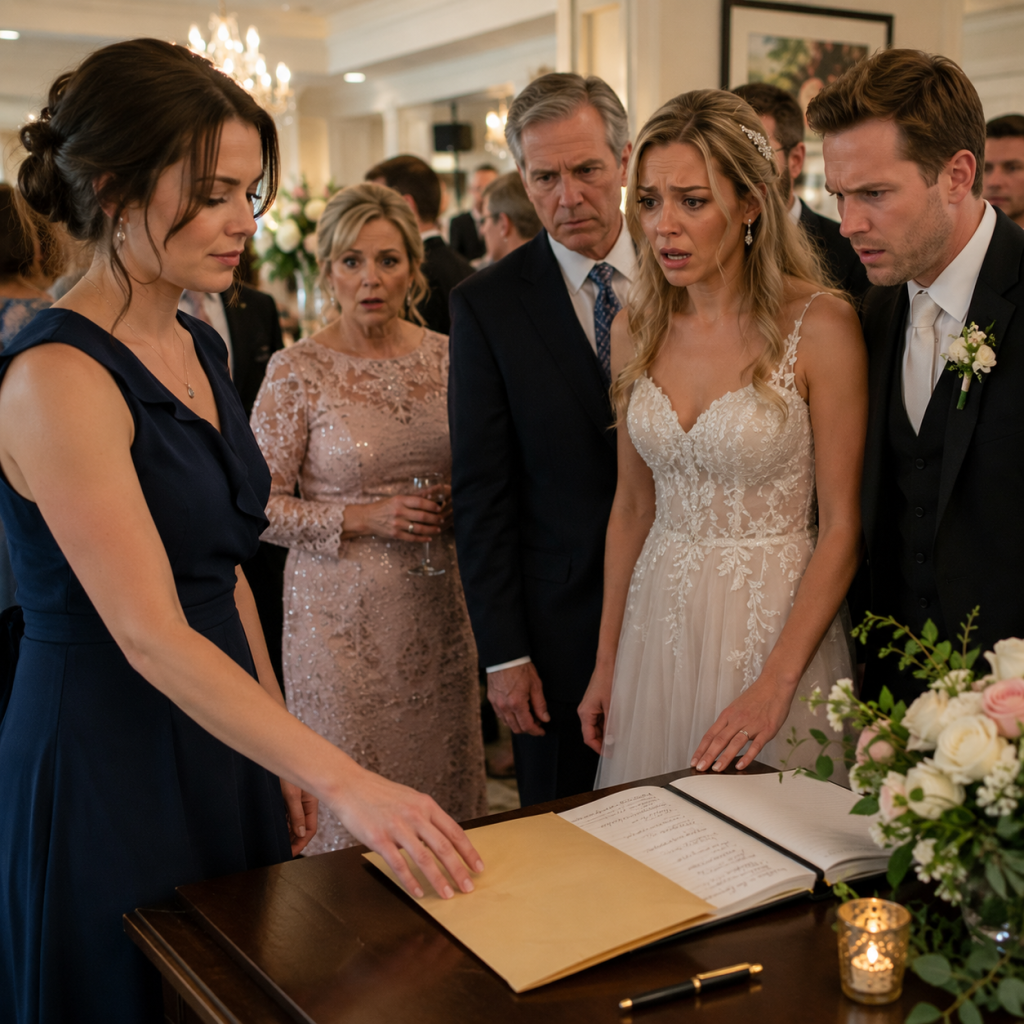
Hours later, I placed a manila envelope beside her guest book—and the second she recognized the signatures inside, the smile she had worn all day quietly disappeared.
I had been back in North Carolina for less than twenty-four hours after five years away.
My parents’ house sat at the end of a curved suburban street outside Raleigh, behind trimmed boxwoods and two white columns that had been added after my sister announced her engagement. The front porch had been repainted. New lanterns flanked the door. Even the old brass house numbers had been replaced with black modern ones.
From the driveway, it looked like a home prepared for a magazine photograph.
Inside, it still felt like a place where everyone had been assigned a role years ago.
My younger sister, Jenna, was the one people noticed.
I was the one they called when something needed to be fixed.
That morning, the living room was filled with garment bags, flower boxes, curling irons, coffee cups, and women moving from room to room with phones in their hands. A playlist drifted from a speaker on the kitchen island. Someone had placed white roses in every available vase.
Jenna stood beneath a ring light wearing a satin robe with BRIDE stitched across the back in gold thread.
She was laughing at something her maid of honor had said when she saw me near the front door.
Her expression paused.
Only for a moment.
Then the smile returned, brighter and more deliberate.
“Oh,” she said. “You actually came.”
Three women turned toward me. One of them lowered a makeup brush.
Mom appeared from the dining room carrying a clipboard.
She looked at my plain navy sweater, dark pants, and the boots I had worn through two airports and a four-hour delay in Charlotte.
“You could’ve changed before coming over,” she said quietly. “The photographer is already here.”
“My suitcase is still in the car.”
“Well, don’t leave it there all day.”
She turned away before I could answer.
That was how my mother had always spoken to me—not exactly unkindly, but as if I were one more detail she needed to arrange before guests arrived.
Jenna crossed the room and slipped an arm around my shoulders.
“This is my sister, Claire,” she told the phone mounted beneath the ring light. “She lives in Minnesota now. We hardly ever see her.”
A few comments floated up the screen.
Someone asked what I did for work.
Jenna read it and laughed.
“She handles contracts or spreadsheets or something. Very exciting.”
“I manage commercial property agreements,” I said.
Jenna waved one hand toward the phone.
“See? Spreadsheets.”
The women around her smiled.
Not cruelly.
That almost made it worse.
Their smiles suggested they were participating in something harmless, a family joke everyone understood except the person standing in the middle of it.
Mom checked the time on her clipboard.
“Jenna, hair in ten minutes. Claire, can you bring those boxes into the dining room?”
I picked up two boxes of wedding programs and carried them through the house.
When I returned, Jenna’s fiancé, Luke, had arrived with coffee for the wedding party. He was tall, soft-spoken, and usually careful around my family. We had met only three times, but he had always seemed decent.
“Claire,” he said. “Good to see you.”
“You too.”
“How was the flight?”
“Long.”
Before I could say anything else, Jenna handed him a cup and kissed his cheek.
“She survived,” she said. “Claire always survives.”
Luke glanced at her, then at me, as if he had heard something beneath the sentence but wasn’t sure what it was.
Dad entered from the hallway wearing slacks and an undershirt, still fastening one cuff.
“There she is,” he said when he noticed me. “The traveler returns.”
He hugged me with one arm.
It lasted less than a second.
“You look tired.”
“I am.”
“You should’ve come earlier in the week.”
“I couldn’t leave work earlier.”
Jenna made a small sound.
“There’s always a reason.”
Dad looked at me with the familiar expression that meant let it go.
I had spent half my childhood learning to recognize that look from across crowded rooms.
Whenever Jenna made a comment, I was expected to understand that she was emotional, excited, tired, young, under pressure, or simply being Jenna.
Whenever I answered, I was expected to be older.
Calmer.
More understanding.
By thirty-five, I had become very good at being understanding from several states away.
Jenna opened a silver clutch lying on the kitchen island and pulled out a folded $20 bill.
“Actually,” she said, “since you’re already dressed comfortably, maybe you could help the reception staff for a little while.”
I thought she was joking.
Then she pressed the bill against my sweater.
“We had someone cancel,” she continued. “Just drinks and water until dinner starts. You’d be helping me.”
The bill slipped between us and landed near the toe of my boot.
The playlist kept playing.
Someone near the window pretended to look for a charger.
Dad reached for a coffee cup he had already moved twice.
Mom adjusted a vase of roses even though it was centered perfectly on the island.
I bent down and picked up the money.
For one brief second, I remembered my grandmother doing the same thing in that kitchen fifteen years earlier, collecting a receipt that had fallen from her purse. She had been the only person in the family who never confused silence with agreement.
I placed the bill back in Jenna’s hand.
“Keep it,” I said. “You may need it.”
Her fingers closed around the money.
“You don’t have to make this awkward.”
“I’m not.”
Her eyes narrowed slightly.
Then she remembered the phone.
She turned back toward the ring light and laughed.
“Older sisters,” she said to the people watching. “Always dramatic.”
No one corrected her.
I went outside and retrieved my suitcase.
My old bedroom was at the end of the upstairs hall. The walls had been painted light gray, and the shelves that once held my books now displayed framed photographs of Jenna’s engagement.
A black-and-white dress hung from the closet door.
Pinned to it was a square piece of cream stationery.
HELP WITH GUESTS.
STAY OUT OF THE FORMAL PHOTOS UNTIL YOU’VE CHANGED.
The handwriting belonged to Mom.
I sat on the edge of the bed and read the note twice.
Then I folded it along the existing crease and slipped it into the inner pocket of my suitcase.
My phone vibrated.
The message was from Allison Grant, an attorney in Minneapolis who had worked with my company for nearly six years.
The lender released the complete application file. Certified copies are being delivered to the venue by four. The account remains paused pending review.
I stared at the words until the screen dimmed.
Downstairs, laughter rose through the floorboards.
I could hear Mom directing people toward the back patio. I could hear Jenna asking whether the flowers looked expensive enough in photographs.
No one knew about the letter that had arrived at my apartment three weeks earlier.
It had come in an ordinary white envelope from a financial servicing company I had never heard of.
At first, I assumed it was advertising.
Then I saw my grandmother’s address.
The letter welcomed me as a guarantor on a new line of credit secured against a property outside Chapel Hill.
The property was a cedar-sided cottage near Jordan Lake that had belonged to my grandmother, Ruth Morgan, for thirty-eight years.
When she passed, she left the cottage to a small family holding company. I owned fifty-five percent. My parents shared twenty-five percent. Jenna owned the remaining twenty.
Grandma had arranged it that way deliberately.
“You’ll take care of the structure,” she told me during one of our last afternoons together. “Your father will take care of the stories. Your sister will take care of the parties. Somebody has to make sure the roof stays on.”
I had laughed at the time.
After she died, I understood.
For five years, I had paid most of the property taxes. I arranged repairs after storms. I replaced the water heater and hired someone to reinforce the back deck. My parents used the cottage several weekends each summer. Jenna held birthday dinners there and once hosted a promotional photo shoot for her small home-decor business.
No one thanked me.
I never asked them to.
The cottage mattered because it was the last place where I had felt known without having to explain myself.
The servicing letter said a $186,000 line of credit had been approved against it.
The application carried my name.
The signature did not belong to me.
It resembled mine in the way a carefully copied drawing resembles the original from across a room. The first letter was close. The final stroke curved in the wrong direction.
The middle initial was also incorrect.
Claire E. Morgan.
My middle name was Anne.
When I called Dad, he told me it was probably a clerical error.
When I asked why our family property had been used for a loan, he became quiet.
Then he said, “We were going to discuss it after the wedding.”
That sentence told me more than an explanation would have.
“What was the money for?”
“Family expenses.”
“What expenses?”
“Claire, this is not a good time.”
“Whose signature is on the application?”
He exhaled slowly.
“No one is taking anything from you.”
“That’s not what I asked.”
“You always assume the worst when it comes to your sister.”
Then he ended the call.
I contacted the lender the same afternoon.
Because my name appeared as a guarantor and majority owner, they provided the application after I submitted identification and a formal dispute. The documents were not complicated.
That was the problem.
I understood every page.
The line had been opened eight months earlier.
Nearly $140,000 had already been withdrawn.
Some of it had gone toward deposits for Jenna’s wedding. Another portion had covered overdue payments connected to her home-decor studio. Twenty-five thousand dollars had been transferred toward a down payment on the townhouse where she and Luke planned to live after the wedding.
My parents had told Luke’s family the money came from the sale of an investment account.
It had not.
It came from a cottage they did not have the authority to borrow against without me.
My signature appeared on six pages.
All six were false.
I had not returned to North Carolina planning to confront anyone in front of wedding guests. Allison had advised me to wait until the lender completed its preliminary review.
“Do not make accusations,” she said. “Bring copies. Ask questions. Let them answer.”
That was what I intended to do.
Then Jenna handed me twenty dollars and asked me to serve drinks at a wedding financed partly through my name.
Something inside me became very still.
Not angry.
Still.
I changed into the black-and-white dress because refusing would have given my family a simpler story to tell.
Claire arrived with an attitude.
Claire made the morning difficult.
Claire could not put her feelings aside for one day.
I had heard versions of that story my entire life.
So I zipped the dress, tied my hair back, and went downstairs.
Mom looked relieved when she saw me.
“Thank you,” she said. “This is much better.”
Jenna glanced over from the makeup chair.
“I knew you could cooperate.”
I almost smiled.
For the next three hours, I did exactly what they asked.
I carried boxes to cars.
I checked place cards against the seating chart.
I found Dad’s missing cuff link beneath a bathroom hand towel.
I drove behind Mom to Hawthorne Mill, a renovated brick venue twenty minutes outside Raleigh, because the trunk of her SUV was filled with centerpieces and she was worried something would shift.
The mill stood beside a narrow river, surrounded by bare sycamore trees and winter grass. White fabric hung from the ceiling beams. Long farmhouse tables filled the reception hall. Through tall windows, late-afternoon light stretched across the polished concrete floor.
It was beautiful.
Jenna had always known how to make things look beautiful.
That was her gift.
It was also the reason people rarely looked beneath the surface.
At the entrance, a wooden table held the guest book, silver pens, and a framed engagement photograph of Jenna and Luke standing beneath flowering trees. Behind them, someone had arranged eucalyptus branches around a sign that read:
WELCOME TO OUR BEGINNING.
I stood looking at the words longer than I meant to.
“Claire.”
Mom’s voice came from behind me.
She handed me a tray of water glasses.
“The catering manager said these should go near the back row.”
I took the tray.
“Where’s the staff member who canceled?”
Mom’s gaze shifted.
“What?”
“Jenna said someone canceled. That’s why you needed me.”
“Oh. That.”
She smoothed the front of her dress.
“They worked it out. But since you’re already dressed, it’s helpful to have another pair of hands.”
Of course.
There had never been a missing staff member.
Jenna simply wanted me in a uniform.
I carried the water to the back row.
Guests began arriving shortly after three-thirty.
Aunts I had not seen in years touched my arm and told me I looked thin. Family friends asked whether Minneapolis was near Chicago. One man called me Caroline twice, even after I corrected him.
Jenna moved through the lobby in a fitted robe while the photographer followed her.
Whenever she saw me carrying something, her shoulders relaxed.
She believed the morning had settled into the shape she wanted.
Near four o’clock, Luke’s mother, Teresa, approached me by the coat room.
She was a composed woman in her early sixties, with short silver hair and a way of listening that made careless people nervous.
“You’re Claire,” she said.
“I am.”
“I’ve heard a lot about you.”
“I’m never sure whether that’s good.”
One corner of her mouth lifted.
“Luke says you work with commercial contracts.”
“I do.”
“That sounds more interesting than spreadsheets.”
I looked across the lobby.
Jenna was posing beside the guest book.
“Some days.”
Teresa followed my gaze.
“You came a long way for this.”
“She’s my sister.”
“That wasn’t what I meant.”
Before I could answer, my phone vibrated.
The courier is at the front entrance.
I excused myself.
A young man in a brown jacket stood just outside the glass doors holding a rigid manila envelope. He checked my identification, asked me to sign a delivery screen, and handed it over.
The envelope was heavier than ordinary paper.
Inside were certified copies of the credit application, the recorded security agreement, the ownership documents for the cottage, the lender’s temporary hold notice, and a letter from Allison outlining the discrepancies.
There was also a copy of an email included in the lender’s file.
The message had been sent by Jenna to Dad two days before the application was submitted.
Claire won’t be here to sign. Use the page from the insurance renewal. It’s close enough, and we’ll replace it once she agrees.
Dad’s reply was one sentence.
Your mother says do it. We cannot lose these deposits.
I read the exchange once more.
Then I closed the envelope.
Through the glass doors, I could see my family moving around the lobby.
Dad was greeting guests.
Mom was adjusting the guest-book display.
Jenna stood beside the framed photograph, smiling at two women from her studio.
They looked comfortable.
Certain.
Protected by the assumption that I would do what I had always done—solve the problem privately, absorb the discomfort, and preserve the family’s appearance.
I carried the envelope inside.
Dad noticed it first.
His eyes went from the delivery label to my face.
The color beneath his cheeks changed.
“Claire,” he said.
He crossed the lobby quickly.
“What is that?”
“Documents.”
“From whom?”
“You know.”
His jaw tightened.
“This is neither the place nor the time.”
“I called you three weeks ago.”
“We said we would handle it.”
“You said it was a clerical error.”
He glanced toward the arriving guests.
“Lower your voice.”
My voice had not changed.
Mom joined us.
“What’s going on?”
Her eyes settled on the envelope.
For half a second, she stopped breathing.
Then she reached for my arm.
“Claire, put that in your car.”
“I’m keeping it with me.”
“Your sister is about to get married.”
“I’m aware.”
“She has been under enormous pressure.”
“So have I.”
Mom looked at Dad, waiting for him to restore order.
That was their rhythm.
She framed the problem emotionally. He issued the decision. I was expected to accept it.
Dad moved closer.
“After the reception, the three of us will sit down.”
“The four of us.”
He frowned.
“Jenna is involved.”
“This is not something she needs to deal with today.”
“Her name is on the transfers.”
A chair scraped near the entrance.
Teresa had been signing the guest book. She did not turn around, but her pen had stopped moving.
Dad noticed.
His voice became softer.
“Not here.”
I looked at the welcome sign, the framed photograph, the rows of white chairs visible through the open doors.
Then I placed the envelope beside the guest book.
The sound it made against the wooden table was small.
Still, several people looked over.
Jenna saw us from across the lobby.
She excused herself from her friends and walked toward the table.
“What’s happening?”
“Nothing,” Mom said quickly.
Jenna’s eyes moved to the envelope.
“What is that?”
“Paperwork,” I said.
“Today?”
“It couldn’t wait.”
She gave me a warning look.
“Put it upstairs.”
I rested two fingers on the flap.
“Maybe Dad should read the first page.”
Jenna turned toward him.
Dad’s gaze remained on the floor.
“You knew about this?” she asked Mom.
Mom tightened both hands around her clutch.
“Jenna, we’re handling it.”
My sister’s expression changed.
Not into fear.
Not yet.
Into irritation.
She had spent the entire day surrounded by people anticipating her needs. In her mind, any interruption was an act of disrespect.
She leaned closer to me.
“Don’t do this.”
“I didn’t.”
“You know what I mean.”
I had heard those same words from Mom that morning.
Perhaps they had always meant the same thing.
Do not make us face what we have done while anyone else can see it.
Luke entered the lobby from the side hallway wearing a dark suit and no tie. His best man followed several steps behind him.
He smiled when he saw Jenna.
Then he noticed the cluster around the guest-book table.
“What’s wrong?”
“Nothing,” Jenna said.
At the same time, I said, “We need to discuss the cottage.”
Luke looked between us.
“What cottage?”
Dad rubbed one hand over his mouth.
Jenna’s shoulders lifted.
“Claire is upset over a family property issue. It has nothing to do with us.”
“That’s not what the paper says.”
She looked at me sharply.
I opened the envelope and removed the first document.
At the bottom of the page were two signatures.
One belonged to Dad.
The other was supposed to be mine.
I turned the page toward Jenna.
Her eyes moved directly to the signature line.
The confident expression she had worn all day slipped away before she could recover it.
Her hand started toward the paper, then stopped.
Behind her, the photographer slowly lowered his camera.
Luke stepped closer.
“What am I looking at?”
“A credit agreement secured against my grandmother’s cottage.”
His brow tightened.
“What does that have to do with Jenna?”
I removed the transaction summary and placed it beneath the first page.
Luke read the list of transfers.
The venue deposit.
The catering balance.
The studio account.
The townhouse down payment.
He looked at Jenna.
“You told me your parents gave us that money.”
“They did.”
“No,” I said. “They withdrew it from a line opened against the cottage.”
Jenna’s voice sharpened.
“It belongs to the family.”
“I own fifty-five percent.”
“On paper.”
“Yes,” I said. “That’s usually where ownership is recorded.”
Teresa turned away from the guest book.
She walked to Luke’s side and read the top page without touching it.
Mom moved between the table and the arriving guests.
“Everyone should go inside,” she said with a strained smile. “We’re just clearing up a misunderstanding.”
No one moved immediately.
A cousin near the coat room became very interested in her phone.
The best man took one step backward.
Dad picked up the first document.
“Claire, you have made your point.”
“I haven’t said what the point is.”
“You want everyone to know you own more of the cottage. Fine. They know.”
“That isn’t the issue.”
I tapped the signature.
“I didn’t sign this.”
Luke looked at Dad.
The room seemed to narrow around the table.
Jenna folded her arms.
“You would’ve signed eventually.”
“That’s not the same thing.”
“You always said you wanted to help the family.”
“I paid the taxes. I paid for repairs. I never agreed to borrow against it.”
“It was temporary.”
“The line has been open for eight months.”
“We were going to repay it after the studio improved.”
Luke stared at her.
“You knew?”
Jenna looked away.
That was the moment the balance shifted.
Until then, she had still believed the problem was my timing.
She had not understood that the pages changed how Luke saw her.
“I knew we were using the cottage,” she said. “I didn’t know every technical detail.”
I removed the email exchange.
“Then read this.”
Her eyes found her own name at the top.
Claire won’t be here to sign.
The color left her face.
She reached for the page.
I did not pull it away.
There was no need.
Luke read over her shoulder.
His mouth tightened at the words use the page from the insurance renewal.
He read Dad’s reply next.
Then he looked at my parents.
“Did all three of you know?”
Mom’s eyes filled, but her voice remained controlled.
“We were trying to keep everything together.”
“By using her signature?”
“We knew Claire would understand once the pressure was over.”
I almost laughed.
Not because anything was funny.
Because my mother still believed understanding was an obligation that belonged only to me.
“Mom,” I said, “you never asked.”
“You had already moved away.”
“For work.”
“You barely came home.”
“I called every Sunday for the first year.”
Mom looked down.
Dad placed the papers on the table.
“You stopped calling.”
“Because every conversation became a list of what Jenna needed.”
Jenna shook her head.
“This is not about childhood.”
“No. It’s about a credit agreement signed eight months ago.”
Luke placed both palms on the edge of the table.
“How much is outstanding?”
“Just under one hundred forty thousand dollars,” I said.
His eyes closed briefly.
“And the townhouse?”
“The down payment is included in the lender’s review.”
Jenna stared at me.
“What review?”
I took out the formal notice.
“The account has been paused.”
Dad’s head came up.
“You contacted the lender?”
“My name is on the account.”
“You had no right to freeze family funds before talking to us.”
Teresa spoke for the first time.
“She had every right.”
Her voice was not loud.
It did not need to be.
Dad turned toward her.
“This is a private family matter.”
Teresa looked at the guest book, the photographer, the arriving guests, and the welcome sign.
“It stopped being private when her name was placed on documents without her permission.”
Luke stepped away from the table.
Jenna followed him with her eyes.
“Luke, this is being made to sound worse than it is.”
He looked at her.
“What part sounds incorrect?”
She opened her mouth.
Nothing came out.
The music inside the ceremony room continued playing. Through the doorway, guests shifted in their seats. Someone from the venue approached, noticed our faces, and quietly turned away.
Mom took Jenna’s hand.
“We can fix this after today.”
Luke stared at their joined hands.
“Is that why you pushed the wedding forward?”
Jenna blinked.
“What?”
“You wanted to be married before the townhouse review.”
“No.”
He waited.
Her gaze moved toward Dad.
That was answer enough.
Luke took a slow breath.
“I’m not signing the marriage license today.”
Jenna’s fingers went slack in Mom’s hand.
“You can’t be serious.”
“I am.”
“We have a hundred and twenty people sitting in there.”
“I know.”
“The flowers are here. The food is here. My dress is upstairs.”
“I know.”
Her voice became smaller.
“You’re embarrassing me.”
Luke’s expression changed then.
Not with anger.
With something quieter and more painful.
“I’m asking whether I know the person I was about to marry.”
Jenna looked around as if someone else might correct him.
No one did.
Dad straightened his shoulders.
“This is an emotional reaction. Everyone needs to calm down.”
Luke faced him.
“Did you sign Claire’s name?”
Dad glanced at the paper.
“I authorized the application on behalf of the family company.”
“That wasn’t the question.”
Dad said nothing.
A silver pen rolled off the guest-book table and landed softly on the floor.
No one bent to pick it up.
Jenna turned on me.
“You came here to stop my wedding.”
“I came because you invited me.”
“You brought those papers.”
“They carry my name.”
“You could have waited one day.”
“I waited three weeks for one of you to tell the truth.”
Her eyes filled.
For a moment, she looked like the little girl who used to stand outside my bedroom after breaking something, waiting for me to decide how much of the blame I would take.
“Why do you always have to be right?” she asked.
“I don’t.”
“Then let this go.”
“I can’t.”
“You mean you won’t.”
I looked at the black-and-white dress she had chosen for me.
At the tray of untouched water glasses near the back wall.
At the folded $20 bill still visible inside her open clutch.
“No,” I said. “I won’t.”
Mom pressed a hand to her forehead.
“Claire, please. Your grandmother would not want the family divided over a building.”
“The cottage isn’t dividing us.”
I placed the forged signature in front of her.
“This is.”
The venue coordinator approached Luke and quietly asked whether the ceremony should be delayed.
Luke looked at Jenna.
She held his gaze for several seconds.
Then she looked away.
“Please give us the room,” he said.
The coordinator nodded.
Within minutes, the ceremony space began to empty. Guests moved toward the patio and reception hall, speaking in low voices. No announcement was made. None was needed.
People understand when a wedding has stopped moving forward.
They simply do not know where to look.
The immediate family remained in the lobby.
Luke’s best man closed the doors.
Teresa picked up the fallen silver pen and placed it beside the guest book.
Dad sat in a chair near the coat room.
It was the first time all day I had seen him look his age.
“What happens now?” he asked.
“The lender completes its review,” I said. “The line can be removed from the cottage if the outstanding balance is repaid or transferred to assets belonging to the people who authorized it.”
Dad looked at me.
“We don’t have that kind of cash.”
“You have the house.”
Mom’s face changed.
“This house?”
“The house you own without my name on it.”
“We’ve lived there twenty-seven years.”
“And Grandma lived in the cottage for thirty-eight.”
Mom looked toward the window.
I continued before she could answer.
“Jenna’s studio equipment can be sold. The townhouse purchase can be canceled. The remaining wedding balances can be handled through a repayment agreement.”
Jenna stared at me.
“You’ve planned all of this.”
“I asked an attorney what options existed.”
“You planned to take everything.”
“No. I planned to protect what belongs to me.”
Dad leaned forward.
“And if we refuse?”
“Then the lender and title company decide what happens.”
The words settled differently than a threat would have.
I was not holding power over them.
I had simply stopped shielding them from the consequences of their own decisions.
Luke removed the folded marriage license from the inside pocket of his jacket.
He placed it on the guest-book table beside the manila envelope.
Jenna stared at it.
“Are you leaving?”
“I’m going to stay with my brother tonight.”
“Luke.”
“I need time.”
She reached for him, but he stepped back gently.
“I asked you twice whether the townhouse money came with conditions.”
“My parents told me it was handled.”
“You knew the cottage was involved.”
She said nothing.
He looked toward the black-and-white dress I was wearing.
“And you asked her to serve drinks?”
Jenna’s face tightened.
“That has nothing to do with this.”
Luke glanced at the $20 bill inside her clutch.
“I think it does.”
He walked out with his mother.
The door closed quietly behind them.
Jenna remained beside the guest book, staring at the unsigned license.
The framed engagement photograph still showed her and Luke smiling beneath spring blossoms.
For the first time, the image looked less like a promise and more like evidence of how carefully a moment could be arranged.
Dad asked the venue coordinator to send the guests home.
Dinner had already been prepared, so the food was donated through a local community kitchen that worked with the venue. The cake remained untouched on its table. White flowers lined an aisle no one walked down.
I changed out of the black-and-white dress before leaving.
I folded it and placed it on the bed in the bridal suite.
The note from Mom remained in my suitcase.
I kept the $20 bill.
Jenna had dropped it near the guest-book table without noticing.
For the next six weeks, everything moved through letters, scheduled calls, and conference rooms.
My parents hired an attorney.
So did Jenna.
The lender confirmed that my authorization had not been valid. The line against the cottage was removed after my parents agreed to refinance their suburban home and apply the proceeds toward the outstanding balance.
Jenna withdrew from the townhouse purchase.
She closed her studio’s retail space and moved the remaining inventory into a rented storage unit.
Luke postponed the relationship indefinitely.
He did not make a public statement. Neither did his family. That silence seemed harder for Jenna than criticism would have been. There was nothing she could argue with and no audience she could persuade.
My parents blamed me for several weeks.
Dad sent long emails about loyalty, sacrifice, and the cost of raising two daughters.
Mom left voicemails that began with concern and ended with a request that I reconsider some part of the settlement.
I answered only through Allison.
Then, one Sunday evening in March, Jenna called.
I almost let it go to voicemail.
Instead, I answered.
Neither of us spoke for several seconds.
“I found the note,” she said finally.
“What note?”
“The one Mom pinned to the dress.”
I leaned against my kitchen counter in Minneapolis.
Outside the window, late snow had begun collecting along the fire escape.
“I didn’t know she wrote that.”
“You saw the dress.”
“I thought you agreed to help.”
“I agreed because I wanted to see how far all of you would go.”
Jenna exhaled.
“I didn’t think of it that way.”
“I know.”
She was quiet again.
“I thought you would fix it,” she said.
“The loan?”
“Everything.”
Her voice sounded different without a room full of people around her.
“I kept telling myself the studio would improve. Then I’d repay the account before you noticed. Dad said the cottage value was rising anyway. Mom said you didn’t care about the place because you never came back.”
“I paid every tax bill.”
“I know that now.”
“You could have asked me.”
“You would have said no.”
“Yes.”
She gave a small, unsteady laugh.
“At least you’re honest.”
“I always was.”
“I just didn’t like the answer.”
That was the closest she came to apologizing during that first call.
It was not enough to repair anything.
But it was the first conversation we had ever had in which she did not ask me to protect her from the meaning of her own choices.
“I’m not ready to pretend we’re okay,” I said.
“I know.”
“I don’t know whether we will be.”
“I know that too.”
We ended the call without making plans.
Three months later, I returned to North Carolina to inspect the cottage.
The winter storms had loosened several shingles. One porch step needed replacing. Pine needles covered the driveway, and the lake was bright beneath the morning sun.
I unlocked the front door with Grandma’s brass key.
The house smelled faintly of cedar, dust, and the lavender sachets she used to tuck into drawers.
Her blue coffee mug still sat on the open shelf beside the sink.
I carried my suitcase to the small bedroom facing the water.
Then I opened every curtain.
That afternoon, a contractor came to measure the roof. A local attorney updated the holding-company agreement so no future borrowing could occur without in-person authorization from every owner. I changed the locks and sent my parents two new keys with written conditions for using the property.
They did not thank me.
They did not argue either.
Near sunset, I sat on the porch steps with the manila envelope beside me.
Most of the papers inside were no longer needed. The lender had corrected the records. My credit file was clear. The cottage was protected.
I removed the copied signature page one last time.
Someone had studied my handwriting carefully.
They had copied the shape of my name without understanding how I formed it.
The false signature looked convincing until you placed it beside the real one.
Then the difference was obvious.
Mine moved forward.
The copied one hesitated.
I tore neither page.
I placed them back inside the envelope and stored it in Grandma’s old desk, not because I wanted to hold on to what happened, but because forgetting and forgiving were not the same thing.
Before leaving the room, I found the folded $20 bill in my wallet.
I set it beneath Grandma’s blue mug.
Then I stepped outside and locked the door behind me.
The brass key felt warm in my palm.
For most of my life, my family had mistaken my quiet for permission.
Standing on that porch, I finally understood that I did not need to become louder to prove them wrong.
I only needed to stop handing the key back.