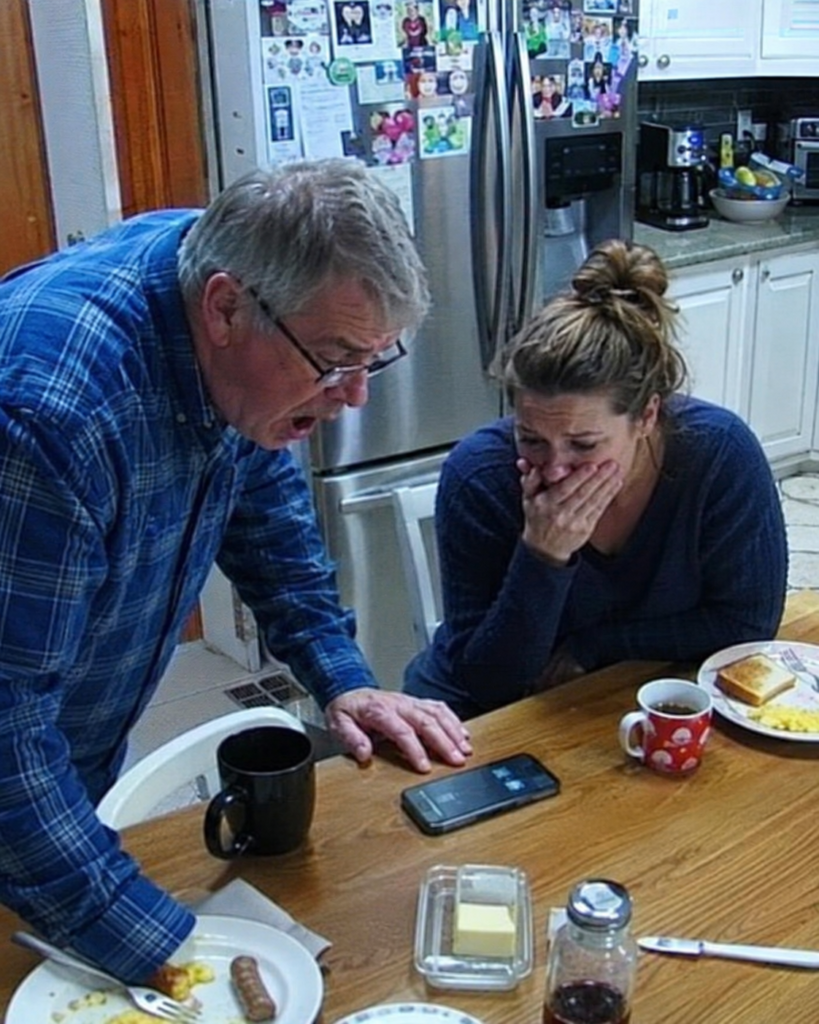
“Dominic.”
“What?”
Bea stared at him as if he had spoken in another language.
Dominic stood near the kitchen island, one hand resting lightly against the marble, his sleeves rolled to his forearms. In the afternoon light, the bruise across his knuckles looked darker than it had at breakfast. He seemed too large for the quiet room, too controlled, too watchful.
“My name,” he said. “Use it.”
Bea’s fingers tightened around the mixing bowl. “That wouldn’t be appropriate.”
“There’s that word again.”
“It’s a useful word.”
A faint curve touched his mouth, not quite a smile but close enough to unsettle her. “Not in this house.”
“In your house, Mr. Russo, it is the only word that keeps people employed.”
His expression shifted. Not anger. Interest.
For a moment, Bea wished she had swallowed the sentence before it escaped. She was not the kind of woman who challenged men like Dominic Russo. She was the kind of woman who understood the shape of a room, the safest corner, the fastest way to disappear. Yet lately he had been looking at her as if disappearing was the one thing he would no longer allow her to do.
“That’s what you think?” he asked.
“That’s what I know.”
The saucepan on the stove gave a soft hiss as milk threatened to rise. Bea turned quickly, grateful for the distraction. She lowered the flame and stirred, aware of him behind her even though he made no sound.
“Leo asked for muffins,” she said.
“I know.”
“You came to check on them?”
“I came to check on you.”
The spoon paused in her hand.
Outside, the gardens glittered with leftover rain. Beyond the window, two guards crossed the stone path near the hedges, their black coats sharp against the pale afternoon.
Bea forced herself to keep stirring. “I don’t need checking on.”
“I didn’t say you did.”
“Then why?”
Dominic was quiet long enough that she turned to look at him.
His gaze had lowered to her cardigan again, not in the way men had looked at her before. Not measuring. Not judging. Not taking. He looked as if he were trying to read the armor she wore and the wounds beneath it.
“Because you flinch when Mrs. Bell speaks,” he said.
Bea’s breath caught.
“Because you eat standing up in the laundry room even when there are empty chairs. Because my son trusts you more than he trusts anyone in this house, and because last night—”
He stopped.
Bea’s pulse jumped. “Last night?”
Dominic’s face closed.
“Nothing.”
But she knew from the sudden stillness in him that it was not nothing.
The kitchen seemed warmer than before. Bea set the spoon down and reached for the flour, trying to steady herself. “Whatever you think you saw, I apologize.”
His brows drew together. “For what?”
“For being careless.”
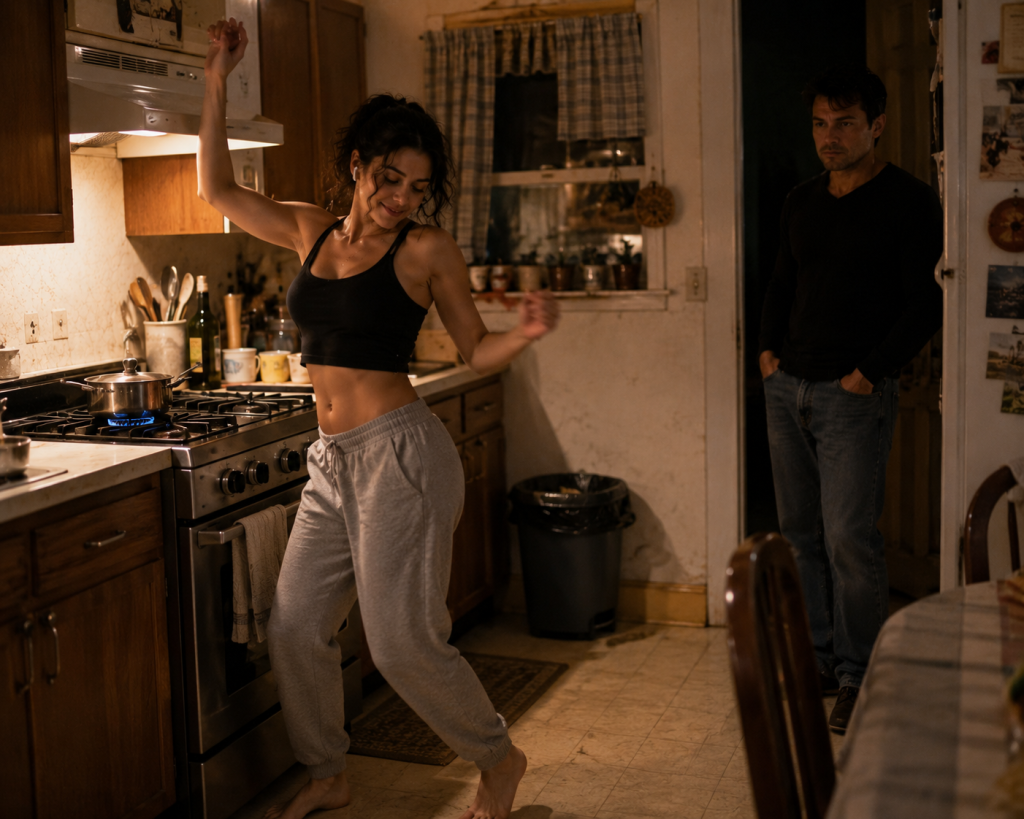
“You were dancing.”
The bowl slipped slightly in her hands. Dominic moved at once, catching it before it hit the counter. His fingers brushed hers. The contact was brief, but it traveled up Bea’s arm like a secret.
She pulled back.
“You saw me.”
“I did.”
Her face burned. “That was private.”
“I know.”
“Then you shouldn’t have watched.”
“No,” he said quietly. “I shouldn’t have.”
The apology was so unexpected that it disarmed her more than any command could have.
Dominic stepped back, giving her space. “I left before you noticed.”
“That doesn’t make it better.”
“No. It doesn’t.”
Bea stared at him, unsure what to do with a powerful man who admitted fault without being forced. She was more familiar with excuses. With laughter. With blame turned back on her until she felt foolish for having a boundary at all.
“I wasn’t laughing at you,” he said.
“I didn’t ask.”
“You were thinking it.”
She looked away.
Dominic’s voice lowered. “You looked happy.”
That hurt in a place she had not expected.
Happy.
The word felt almost embarrassing. A luxury item tucked away in a locked cabinet. She had not meant for anyone to see that version of her—the woman who forgot her duties for three minutes, who moved without apology, who believed no one was watching.
“I was tired,” she said.
“That wasn’t tired.”
“Then I was foolish.”
“You were free.”
The kitchen fell silent.
Bea could not answer. She reached for the butter and began cutting it into squares with more concentration than the task required.
Dominic watched her for another moment, then said, “I won’t mention it again.”
“Thank you.”
“But I need you to understand something.”
Her knife stopped.
“You don’t have to hide here.”
A small, humorless laugh escaped her before she could stop it. “With respect, you don’t know what you’re saying.”
“Then tell me.”
“No.”
“Beatrice—”
“No,” she repeated, softer this time but firmer. “You don’t get to look at me for one night and decide you know me.”
He absorbed that without anger, and somehow that made her feel even more exposed.
“You’re right,” he said.
Bea glanced up.
Dominic’s expression was unreadable, but his voice had changed. There was no command in it now. Only restraint.
“You’re right,” he repeated. “I don’t know you.”
Leo’s voice rang from the hallway before either of them could speak again.
“Bea! I found the blue boat!”
The boy burst into the kitchen carrying a small wooden sailboat missing half its paint. His cheeks were flushed from running, his dark hair falling over his forehead in the same unruly wave as his father’s.
Bea’s face softened immediately. “You found it under the stairs?”
“In the closet with the old umbrellas. Can we take it to the pond?”
“If your father says yes.”
Leo turned wide, hopeful eyes toward Dominic.
Dominic looked from his son to Bea, and for a heartbeat something unspoken passed across his face. A man feared by half the city stood there, defeated by a child holding a toy boat and a woman who still refused to call him by his name.
“If Bea has time,” Dominic said.
“I have time,” Bea answered before she remembered herself. “I mean, after the muffins go in.”
Leo cheered.
Dominic did not smile, but his eyes warmed.
That evening, the rain stopped.
The estate smelled of wet grass and roses when Bea walked Leo down to the koi pond. Dominic followed at a distance, close enough to watch but far enough not to intrude. The boy knelt at the water’s edge, carefully placing the blue boat on the surface. Bea crouched beside him, one hand hovering at his back in case he leaned too far.
“Mommy said boats know where they’re going,” Leo said suddenly.
Bea stilled.
Dominic stopped walking.
Leo pushed the boat with one finger. “Even when the water is messy.”
Bea looked back at Dominic, but his face had turned hard in the way people’s faces did when pain found them in public.
“She sounds like she was very wise,” Bea said gently.
Leo nodded. “She sang the boat song.”
“What boat song?”
He hummed a few notes.
Dominic turned away.
Bea heard the silence in him more than she heard the music. She returned her attention to Leo, humming softly with him until he giggled because she got the tune wrong. The boat drifted in circles, trapped by a fallen leaf.
“Sometimes,” Bea said, reaching for a stick to free it, “a boat needs a little help.”
Leo watched carefully. “But it still goes by itself after?”
“Yes, sweetheart. After.”
Dominic stood beneath the dripping branches and wondered how long it had been since anyone had spoken to his son about grief without making it sound like a room everyone should avoid.
Later, when Leo had fallen asleep with the blue boat on his nightstand, Dominic found Bea in the library returning picture books to the lower shelves.
“He talked about her today,” he said from the doorway.
Bea looked over her shoulder. “I’m sorry if I upset him.”
“You didn’t.”
She rose slowly, smoothing her dress. “He misses her.”
Dominic’s jaw tightened. “I know.”
“Children can tell when adults are afraid of a name.”
His gaze sharpened.
Bea wished, again, that she had said less. Something about him pulled honesty from her at the worst times.
“I only mean,” she added carefully, “maybe he needs to know he’s allowed to remember her out loud.”
Dominic stepped into the room. The lamplight touched the tired lines at the corners of his eyes.
“Her name was Sofia.”
Bea nodded. “Sofia.”
The sound of it seemed to enter the room like a ghost given permission to return.
Dominic looked at the shelves, at the small stack of books Leo loved, at the stuffed rabbit Bea had tucked into the reading chair earlier that week.
“She used to sing to him in the conservatory,” he said. “That ridiculous song about the little boat that wanted the moon.”
“It’s not ridiculous if he remembers it.”
His eyes returned to hers.
“No,” he said after a moment. “I suppose not.”
That should have been the end of the conversation. Bea should have excused herself, gone downstairs, finished folding towels, and hidden the strange ache in her chest. Instead, she remained still as Dominic crossed to the window.
The gardens beyond the glass were dark, the pond barely visible under the moonlight.
“She died on a road like this,” he said.
Bea’s heart tightened. “I’m sorry.”
“Everyone says that.”
“Because they don’t know what else to say.”
“What would you say?”
She looked at his reflection in the glass.
“I’d say grief doesn’t leave just because people stop asking about it.”
Dominic closed his eyes briefly.
For the first time, he looked less like a king in a criminal court and more like a man who had spent two years standing in the ruins of a life he never learned how to mourn.
When he spoke again, his voice was rough. “Leo cried for you last night.”
Bea frowned. “Last night?”
“He woke from a nightmare. Mrs. Bell went to him first. He screamed until she left. Then he asked for you.”
“No one told me.”
“I know.”
The change in his tone made Bea’s stomach sink.
Dominic turned from the window. “That won’t happen again.”
“Please don’t punish anyone because of me.”
“I’m not punishing anyone.”
“Mr. Russo—”
“Dominic.”
She pressed her lips together.
His voice softened by a fraction. “You can say it once without signing away your soul.”
Despite herself, Bea almost smiled. Almost.
“Dominic,” she said.
His name sounded different in her mouth. Less like a warning. More like a door opening.
The effect on him was visible only for a second, a stillness that passed through his body before he controlled it.
“Thank you,” he said.
The next few days changed the rhythm of the house.
Not loudly. Not enough for visitors to notice. But inside the Russo estate, where even silence had a hierarchy, everyone felt the shift.
Bea was given a place at breakfast when Leo asked for her. Dominic corrected Mrs. Bell when she assigned Bea extra work after dinner. A driver appeared whenever Bea needed to take Leo to the library or the park. No one explained it. No one dared ask.
Mrs. Bell watched from polished doorways with a thin mouth and colder eyes.
“You should be careful,” she told Bea one morning in the laundry room.
Bea was folding Leo’s pajamas, each pair warm from the dryer. “Careful with what?”
“With forgetting what you are.”
The words landed quietly. That was Mrs. Bell’s specialty. She never shouted. She never left bruises. She simply slid small sharp things between a person’s ribs and walked away before anyone saw the blood.
Bea kept folding. “I haven’t forgotten.”
“Haven’t you?” Mrs. Bell moved closer, lowering her voice. “Men like Mr. Russo notice things the way children notice toys in windows. One day they want them. The next day they don’t.”
Bea’s hands stilled.
Mrs. Bell smiled. “I’m telling you this for your own good.”
“No,” Bea said softly. “You’re not.”
The older woman’s eyes flashed.
For the first time since Bea had entered the house six months ago, she did not look down.
“I know what kindness sounds like,” Bea continued. “That wasn’t it.”
Mrs. Bell stared at her as if a chair had stood up and spoken.
Before she could reply, Leo appeared at the doorway in dinosaur pajamas and socks that did not match.
“Bea, Daddy says pancakes.”
Bea’s face warmed with relief. “Does he?”
“He says yours are better.”
Mrs. Bell’s jaw tightened.
Bea picked up the folded pajamas. “Then we shouldn’t keep him waiting.”
As Leo slipped his small hand into hers, Bea felt Mrs. Bell’s gaze following them all the way down the corridor.
Breakfast smelled of butter and maple syrup. Dominic was already at the table, reading something on his phone with a frown. He looked up when Bea entered, and the frown eased.
Leo climbed into his chair. “Bea told Mrs. Bell she knows kindness.”
Bea nearly dropped the plate.
Dominic looked at her. “Did she?”
“It was nothing.”
“It didn’t sound like nothing.”
“It was private.”
“Most important things are.”
Leo poured too much syrup over his pancakes. Bea reached for a napkin, but Dominic beat her to it. Their hands nearly touched over the table. Leo watched them both with solemn interest.
“Are you friends now?” he asked.
Bea choked softly. Dominic leaned back, amusement ghosting across his face.
“Bea is very careful about choosing friends,” he said.
Leo considered this. “You should be careful too, Daddy.”
Dominic’s brows lifted. “Should I?”
“Yes. Bea says careful people don’t fall in ponds.”
Bea hid her smile behind her coffee cup.
Dominic looked at her over Leo’s head. “Wise advice.”
By the weekend, the house felt almost alive.
Leo’s laughter echoed more often. Dominic began appearing in ordinary rooms at ordinary hours, as if relearning the shape of his home. He watched his son build block towers in the sitting room. He answered questions at dinner instead of disappearing into his study. Once, Bea found him standing in the doorway of the nursery, listening while she read Leo a story about a bear who lost his way in the woods.
When the story ended, Leo yawned and reached for Dominic.
“Stay,” the boy whispered.
Dominic crossed the room slowly, as if afraid the request might vanish if he moved too quickly. He sat on the edge of the bed. Leo curled against his side with the natural trust of a child who had been waiting a long time to be asked back into his father’s arms.
Bea slipped toward the door.
“Don’t go,” Leo mumbled.
She stopped.
Dominic looked at her.
The room was soft with lamplight, painted in blues and creams. A wooden moon hung above the bed. On the shelf stood a framed photograph of Sofia Russo, smiling in a white summer dress, Leo as a baby in her arms.
Bea sat quietly in the chair near the window and opened another book.
She read until Leo’s breathing deepened and Dominic’s hand rested still against his son’s back.
When she closed the book, Dominic did not move.
“He used to fall asleep like this every night,” he said.
“Before?”
“Yes.”
Bea looked at the photograph. “He still remembers how.”
Dominic’s throat worked. “I didn’t know how to be in this room after she died.”
“No one knows how to be anywhere after that kind of loss.”
“You do.”
The words startled her.
She met his eyes.
Dominic watched her with that dangerous stillness again. “You speak like someone who understands grief.”
Bea stood carefully, setting the book aside. “Everyone understands grief eventually.”
“That wasn’t what I said.”
“No,” she whispered. “It wasn’t.”
She left before he could ask more.
But Dominic Russo had built his life on noticing what people tried to hide.
The next morning, a folder appeared on his desk.
Not because he had ordered anyone to investigate Bea. He told himself that at first. He had asked only for routine employment records, nothing more. It was a lie, and he knew it.
Her file was thin.
Beatrice Anne Gallagher. Twenty-six years old. Born in Queens. Mother deceased. Father deceased. No criminal record. No debts listed. Previous employment: two short-term housekeeping positions, one bakery assistant job, one hospital cafeteria job. Emergency contact: none.
None.
Dominic stared at the word longer than he wanted to.
There were gaps in the file. Months unaccounted for. A reference that had gone unanswered. A former employer who had spoken too carefully when contacted.
He closed the folder.
Then opened it again.
At the bottom was the staffing agency that had placed her in his house: Lark House Domestic Services.
Dominic frowned.
He knew every major staffing service used by families like his. Lark House was respectable, discreet, expensive.
But he had not hired Bea.
Mrs. Bell had.
That detail sat uneasily in his mind.
By noon, he found Bea in the sunroom helping Leo paint. The boy had covered half the paper in blue water and yellow stars. Bea’s hands were stained green. A streak of paint touched her cheek.
Dominic stopped in the doorway.
Leo looked up. “Daddy! I’m making the boat find the moon.”
“I see that.”
“Bea says stars are maps.”
Dominic’s eyes moved to Bea.
She wiped her hands on a cloth. “Metaphorically.”
“Of course.”
Leo held up the painting. Three figures stood inside a crooked blue boat: one small, one tall, one with dark curly hair. Above them, a bright star hovered near the moon.
Dominic’s chest tightened. “Who’s in the boat?”
“That’s me,” Leo said proudly. “That’s you. That’s Bea.”
Bea went very still.
Dominic looked at her, but she was staring at the painting as if it had broken something open inside her.
“And Mommy is the star,” Leo added. “She can still see.”
No one spoke.
Then Bea blinked quickly and smiled with visible effort. “It’s beautiful, sweetheart.”
“I’m giving it to Daddy.”
Dominic took the painting carefully, though the corner smeared blue onto his thumb.
“Thank you,” he said.
Leo beamed.
That night, Dominic hung the painting in his study.
He did it himself. No staff. No instructions. Just a nail, a hammer, and the quiet picture of a family his son had drawn before anyone else dared name it.
Bea saw it there two days later when she brought in fresh coffee.
She stopped at the threshold.
Dominic looked up from his desk. Papers lay in front of him, but he had not been reading them.
“Leo asked where I put it,” he said.
“It belongs somewhere he can see it.”
“I see it.”
She swallowed.
The room smelled of leather, smoke, and rain. The painting looked small on the wall between dark shelves and framed certificates, but it changed the room. It softened the hard edges.
Bea set the coffee on his desk. “Will that be all?”
“No.”
Her fingers tightened around the tray.
Dominic noticed. His voice changed. “Sit down, Beatrice.”
“I have work.”
“Your work can wait.”
“That’s what people say when they’re not the ones who will be blamed for waiting.”
Dominic’s expression hardened, not at her, but because of what her words revealed.
“Sit,” he said again, quieter. “Please.”
The please did what the order could not.
Bea sat on the edge of the leather chair opposite his desk.
Dominic opened a drawer and took out her employment file.
Her face drained of color.
“I didn’t dig through your life,” he said.
“You’re holding my file.”
“I checked what I should have checked before someone was brought into my home.”
“Someone like me?”
“Someone near my son.”
That landed differently. Bea looked down.
Dominic closed the folder without opening it. “Mrs. Bell hired you through Lark House.”
“Yes.”
“Why?”
“Because I applied.”
“That’s not an answer.”
“It’s the only one I have.”
“Beatrice.”
She looked up sharply. “Don’t say my name like that.”
“Like what?”
“Like you already know I’m lying.”
His silence answered.
Bea stood. “I should go.”
Dominic rose too, but remained behind the desk. He seemed to understand that coming closer would make her run.
“There are gaps,” he said.
“In the file?”
“In your story.”
“Maybe my story is none of your business.”
“It became my business when my son started crying your name in his sleep.”
Her eyes flashed. “That is not fair.”
“No,” he said. “It isn’t.”
The anger between them thinned into something more fragile.
Dominic exhaled slowly. “I’m not trying to trap you.”
“Men always say that from rooms with doors they control.”
For the first time, Dominic looked genuinely struck.
Bea regretted it immediately, but she did not apologize.
He stepped away from the desk and walked to the study door. He opened it wide.
“There,” he said.
She stared.
“You can leave whenever you want.”
Her throat tightened.
Dominic returned to his place by the window, deliberately leaving the open doorway between them. “I need to know if there is something in your past that could put Leo at risk.”
“No.”
“Are you sure?”
“Yes.”
“Could it put you at risk?”
That question was softer. Worse.
Bea looked at the open door. Freedom, offered without theater.
“My father owed money,” she said at last.
Dominic’s body stilled.
“Not to you,” she added quickly. “Not to your family. Small men. Loud men. Men who made everyone around them feel smaller so they could feel important.” Her hands twisted together. “When he died, they came looking for whatever they thought he left behind. There was nothing. There had never been anything.”
Dominic’s eyes did not leave her.
“I moved. Worked where I could. Lark House gave me a placement here. Good pay. A room. Walls.” She gave a small, tired smile. “Very high walls.”
“Did Mrs. Bell know this?”
“She knew enough.”
Dominic’s face darkened.
“Don’t,” Bea said immediately.
“Don’t what?”
“Become a storm because someone handed you a cloud.”
His mouth tightened, but the image seemed to reach him.
Bea looked at Leo’s painting. “Your son feels safe with me because I know what it’s like to be afraid in a house full of adults. That’s all.”
“No,” Dominic said. “That isn’t all.”
She met his eyes.
He looked at her for a long time, and when he spoke again, the words came quietly.
“It should have been.”
Bea did not know what to do with that.
For the next week, Dominic tried something that did not come naturally to him.
He did not push.
He did not demand answers, did not corner her in dim hallways, did not punish Mrs. Bell in some grand visible way that would only make Bea feel responsible. Instead, he changed the house through small decisions no one could argue with.
Leo’s schedule was adjusted so Bea was officially included as his afternoon companion, with increased pay added quietly to her account. Mrs. Bell was informed that all disciplinary matters regarding Bea would go through Dominic personally. Staff meals were moved from the laundry room to the bright breakfast nook beside the garden doors.
When Bea discovered the changes, she found Dominic in the conservatory, where he was attempting to keep Leo from overwatering a fern.
“You changed my position,” she said.
Dominic looked up. “Yes.”
“You changed my pay.”
“Yes.”
“You didn’t ask me.”
Leo poured water onto Dominic’s shoe.
Dominic glanced down, then back at Bea. “Leo, the fern is not my foot.”
“Sorry, Daddy.”
Bea tried not to laugh.
Dominic took the watering can away gently. “Go choose one more plant. One.”
Leo ran to the other side of the conservatory.
Bea folded her arms. “You didn’t ask me.”
“No,” Dominic said. “I should have.”
The simple admission made it difficult to maintain her anger.
“I’m not charity,” she said.
“I know.”
“I won’t be kept.”
His expression sharpened. “No one is keeping you.”
“Then why does it feel like the walls moved without me?”
Dominic was silent for a beat. “Because I’m used to fixing things by moving walls.”
“And people?”
His eyes met hers. “Sometimes.”
“At least you’re honest.”
“Not always.”
The words slipped out with enough weight that Bea heard the hidden door behind them.
“What aren’t you honest about?” she asked.
Dominic looked across the conservatory toward Leo, who was whispering seriously to a rubber plant.
“My work. My grief. The kind of father I’ve been.” He paused. “You.”
Bea’s heart beat harder. “Me?”
“I tell myself I’m only watching because of Leo.”
“And are you?”
“No.”
The air changed.
Rain tapped against the glass roof overhead, soft at first, then stronger. Bea felt every inch of space between them, every leaf-scented breath, every unspoken warning.
Dominic did not move closer.
“I won’t make your life difficult because I don’t know what to do with wanting you,” he said.
Bea’s eyes widened.
He said it plainly, without charm, without a smile, as if the truth had cost him something and he intended to pay in full.
“I won’t ask you for anything you can’t freely give,” he continued. “I won’t confuse gratitude with affection, fear with respect, or employment with obligation.”
The words were so careful they hurt.
“Who taught you to say things like that?” she whispered.
“No one. I’m learning late.”
Across the room, Leo called, “Can plants hear secrets?”
Bea looked away first, grateful and shaken. “Some can.”
Dominic’s gaze remained on her. “Then this room is in trouble.”
Despite everything, she smiled.
And Dominic Russo, who had faced down enemies without blinking, looked briefly defenseless before that smile.
The almost-peace lasted until Thursday.
Bea found the first envelope tucked beneath her pillow.
At first she thought it was a mistake—some folded receipt, some note Leo had drawn and hidden for her to find. But the paper was thick, cream-colored, sealed without a name.
Inside was a photograph.
Bea at the koi pond with Leo.
The image had been taken from a distance, through trees or hedges. Leo was laughing. Bea was leaning close, one hand outstretched over the water.
On the back, written in neat black ink, were five words.
You don’t belong with them.
Bea sat on the edge of her narrow bed, the room tilting around her.
Her first instinct was to pack.
That old instinct. That familiar map. Leave before the walls turn against you. Leave before kindness becomes debt. Leave before a child’s hand in yours becomes the thing someone can use to hurt you.
She placed the photograph face down.
Then Leo knocked.
“Bea? I had the bad dream again.”
Everything inside her rearranged around his small voice.
She opened the door.
Leo stood in the hall clutching his rabbit, eyes wet, curls tangled. “I couldn’t find Daddy.”
Bea knelt. “Come here.”
He wrapped his arms around her neck.
She held him, staring over his shoulder at the empty hallway.
For the first time since arriving at the Russo estate, the high walls did not feel high enough.
She did not tell Dominic that night.
She wanted to. She almost did when she brought Leo to his room and found Dominic waiting there, still in his suit, relief flickering across his face as his son ran into his arms. She almost pulled the photograph from her cardigan pocket and placed it in his hand.
But fear is rarely logical. It has its own language.
What if he thought she had brought trouble into his house?
What if he sent her away to protect Leo?
What if Mrs. Bell was right, and this strange, fragile warmth was only something she had borrowed?
So Bea said nothing.
The second envelope arrived the next afternoon.
This one was tucked into Leo’s storybook.
Inside was another photograph: Bea entering the library alone. On the back:
Ask what happened before she came here.
Her stomach dropped.
She went straight to Mrs. Bell.
The housekeeper was in the linen closet, counting guest towels as if the world depended on it.
Bea closed the door behind her.
Mrs. Bell looked up. “That is not appropriate.”
Bea held up the envelope. “Did you do this?”
The older woman’s face changed too quickly. Not guilt, exactly. Recognition.
“What is that?”
“You tell me.”
Mrs. Bell set down the towel. “Lower your voice.”
“No.”
“Beatrice—”
“No.” Bea’s hands trembled, but she held her ground. “You know something.”
Mrs. Bell’s lips pressed together.
“Tell me.”
For once, the housekeeper looked uncertain. Older. Frightened in a way Bea had never seen.
“You should leave this house,” Mrs. Bell said.
The words were not cruel.
That made them worse.
“Why?”
“Because some doors were closed for a reason.”
“What doors?”
Mrs. Bell’s eyes moved toward the hallway, as though she expected someone to be listening.
Before she could answer, Dominic’s voice came from behind the door.
“Open it.”
Mrs. Bell went pale.
Bea stepped back.
The door opened, and Dominic stood there, his face controlled but his eyes cold enough to freeze the air. He looked at Bea first, then at the envelope in her hand.
“What is that?”
Bea couldn’t hide it now.
He took the envelope, read the message, and went very still.
Not angry.
Worse.
Silent.
“Who gave you this?” he asked.
“I found it in Leo’s book.”
His gaze snapped to Mrs. Bell.
“I didn’t place it there,” she said quickly.
“But you know what it means.”
Mrs. Bell’s mouth trembled once. “I know what secrets do to houses.”
Dominic stepped closer. “Speak plainly.”
“No,” Bea interrupted.
Both of them looked at her.
Her voice shook, but she forced it steady. “Not like this. Not with everyone afraid of you. I want the truth, but I want it without someone being crushed to make it come out.”
Dominic’s eyes flickered with something unreadable.
Mrs. Bell stared at Bea as if she had never seen her before.
For a long moment, no one moved.
Then Dominic turned to Mrs. Bell. “You’ll remain in your room until I decide how to handle this.”
Bea stiffened.
Dominic looked at her before she could protest. “Not punishment. Protection. If she knows something, she may be in danger too.”
Mrs. Bell laughed once, bitterly. “Now you understand danger?”
Dominic’s face hardened. “Careful.”
“No,” Mrs. Bell said, and there was a sudden, exhausted bravery in her voice. “I have been careful for two years. I have swallowed enough ghosts.”
The hallway fell silent.
Then she looked at Bea.
“She brought you here.”
Bea frowned. “Who?”
Mrs. Bell’s eyes filled with tears she refused to let fall.
“Sofia.”
The name passed through the corridor like a draft beneath a locked door.
Dominic did not move.
Bea felt the floor vanish beneath her. “That’s impossible. She died two years ago. I only came six months ago.”
Mrs. Bell shook her head. “Not directly. But she made arrangements. Lark House. The placement list. Your name was in a file she left with instructions.”
Dominic’s voice was barely audible. “What file?”
Mrs. Bell looked at him then, and something like grief twisted her features.
“The one she told me to hide if anything ever happened to her.”
Dominic stared at the housekeeper. “You had something of my wife’s for two years and never told me?”
“She was afraid.”
“Of me?”
Mrs. Bell did not answer.
That silence was worse than any accusation.
Bea stepped back, pressing a hand to the wall.
Sofia Russo had known her name.
A dead woman had somehow reached across two years and placed Bea inside this house.
Dominic looked at Bea, and for the first time since she had met him, he seemed utterly lost.
Mrs. Bell drew a small brass key from the chain at her waist. Her fingers shook as she held it out.
“The file is in the east wing,” she whispered. “In Sofia’s music room.”
Dominic took the key.
No one spoke as they walked.
The east wing had been closed since Bea arrived. She had dusted outside its doors but never entered. The staff avoided it with the quiet discipline of people trained not to disturb the dead.
Dominic unlocked the music room himself.
The door opened with a soft sigh.
Inside, everything remained as Sofia had left it. A white piano near the window. Sheet music stacked neatly on a bench. Dried flowers in a vase. Dust lay over the room like preserved snowfall.
Leo’s boat song seemed to linger in the air.
Mrs. Bell went to the piano and knelt with effort. Beneath it, hidden behind a loose panel, was a narrow metal box.
Dominic opened it.
Inside were letters, photographs, and a leather-bound notebook tied with blue ribbon.
On top lay an envelope.
Bea’s name was written across it in elegant handwriting.
Beatrice Gallagher.
Her hands shook so badly Dominic had to lift the envelope first. He did not open it. He handed it to her.
“This is yours.”
Bea stared at the handwriting.
A woman she had never met had written her name before dying.
Slowly, she broke the seal.
Inside was a single page.
The first line made her stop breathing.
If you are reading this, Beatrice, then my son found you.
Bea’s vision blurred.
Dominic moved beside her. “What does it say?”
She could not answer.
The page trembled in her hands as she read the next line.
And if Dominic is with you, then he must finally learn what happened the night I died.
Bea looked up.
Dominic’s face had gone white.
From somewhere deep inside the metal box, a small object shifted and fell against the side with a soft metallic click.
It was not a letter.
It was a child’s silver bracelet.
And engraved on the inside, worn but still readable, was Bea’s full name.
Beatrice Anne Gallagher.