My name is Tessa Langley, and the night my husband locked me out in a freezing Virginia downpour while I was in active labor was the night he sealed his own destruction.
For months, I had played the part of the exhausted, agreeable wife. I ironed his shirts, balanced our shared checking account, and listened to his endless complaints about his middle-management corporate job. My husband, Grant Holloway, believed I was a mid-level administrative officer shuffling routine logistics paperwork at Fort Belvoir. He had no idea that I was a highly decorated Army Colonel with two combat deployments, nor did he know that my late grandfather, Everett Langley, had recently left me a private trust worth twenty million dollars.
My attorneys had been explicit: keep the trust entirely confidential until the federal probate review was complete. Any leak could invite legal challenges. So, I maintained my silence. But silence in my marriage had already become a daily survival tactic.
The truth finally arrived shortly after ten o’clock on a Thursday. A sudden, violent wave of pressure seized my abdomen. I gripped the kitchen island, gasping as the contraction radiated through my spine, threatening to buckle my knees.
Grant sat at the dining table, bathed in the blue light of his laptop. He wore a crisp, tailored shirt I had never seen before.
He didn’t even flinch. He just kept typing, his jaw set in a hard line. “Not tonight, Tessa.”
“I cannot choose the night,” I whispered, panic rising as another, sharper contraction hit. My vision swam with dark spots.
“You need to leave,” he said, his voice completely devoid of emotion.
I stared at him, my mind unable to process the sheer cruelty. “I am carrying your child.”
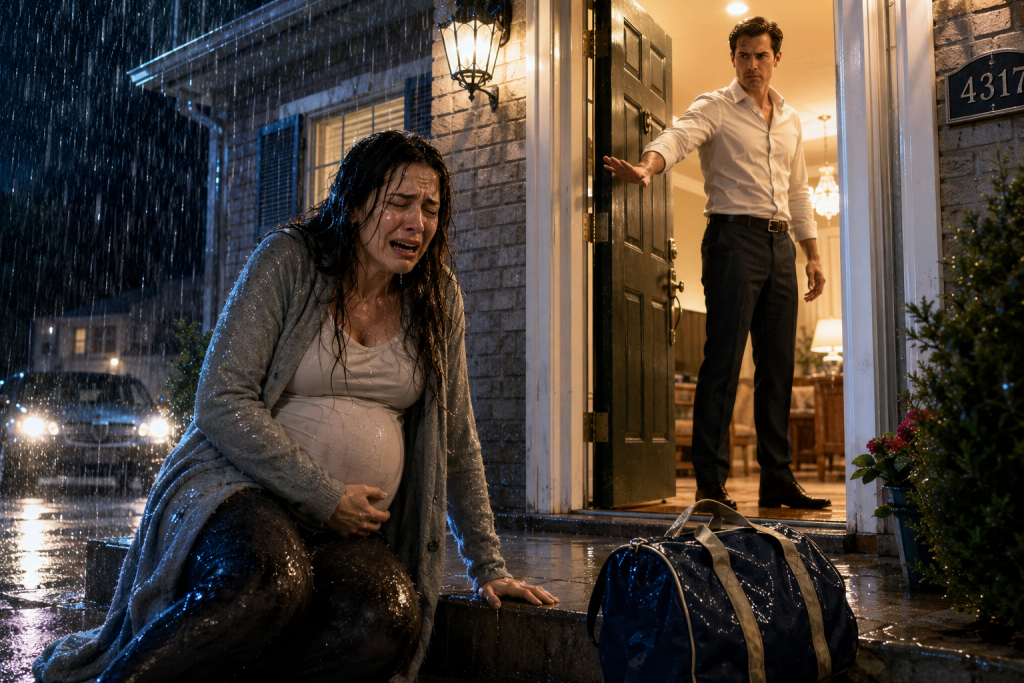
He stepped forward, grabbed my upper arm with bruising force, shoved me onto the porch, and threw the bag at my feet. Before I could even find my balance on the slick concrete, the heavy oak door slammed shut. The deadbolt clicked with a sickening finality.
The rain was freezing, soaking through my maternity clothes in seconds. Trembling uncontrollably, clutching my massive belly, I dragged myself to the front window. What I saw shattered whatever illusion of love I had left. Grant was not pacing. He was not panicked about what he had just done. He was standing by the kitchen counter, casually pouring a glass of red wine. He picked up his phone, dialed a number, and a warm, genuine smile spread across his face—a smile I hadn’t seen in years.
A sharp, tearing agony ripped through my stomach. The preeclampsia was accelerating. I could feel my heart racing, a high-pitched ringing filling my ears.
I managed to pull out my phone with frozen, numb fingers and dialed my neighbor, Mrs. Alvarez, a retired nurse. She arrived in under three minutes, her tires screeching in the wet driveway. As she loaded my soaked, shivering body into her car, my consciousness began to slip. The last thing I saw was the warm yellow light of my own living room, and the silhouette of the man who had just tried to kill me and our daughter.
I woke to the rhythmic beep of hospital machinery and the sterile, sharp smell of iodine. A warm, tiny weight rested on my chest. I blinked against the harsh fluorescent lights to see my daughter, Evelyn Rose, sleeping peacefully. She was perfect. I had survived an emergency C-section. We both had.
But my relief was brutally short-lived.
Less than twelve hours after surgery, the door to my private military hospital room swung open. Grant walked in, dressed in a tailored charcoal suit, looking as though he had just stepped out of a celebratory lunch. Beside him stood a woman I recognized instantly, though she was out of uniform and wearing a designer cream dress.
Major Paige Donnelly. She was my executive officer.
Paige stood unnervingly close to my husband, a massive, glittering diamond ring prominent on her left hand. But it wasn’t the fake ring that made my blood run cold. It was the thick legal clipboard in her hand.
“You look terrible, Tessa,” Grant said smoothly, stepping into the room with an air of absolute ownership.
I pulled Evelyn closer to my chest, my surgical incision burning. “Get out of my room.”
Paige stepped forward, her voice dripping with artificial, cloying sympathy. “Colonel, we aren’t here to argue. We’re here to transfer you. Given your… erratic mental state, the complications of your birth, and your refusal to communicate, Grant has enacted the Medical Power of Attorney.”
My heart hammered against my ribs. The insurance paperwork. Weeks ago, when I was exhausted and sick, Grant had rushed me through a stack of documents for Evelyn’s future coverage. He had buried a broad Medical Power of Attorney inside it.
“The private ambulance is waiting downstairs,” Grant said, checking his Rolex. “We’re moving you to a civilian psychiatric facility. It’s better for everyone if you are out of the military’s jurisdiction while we finalize our divorce and custody arrangements.”
They were trying to isolate me. To pull me out of the safety of the federal military hospital and trap me in a civilian facility where Grant called all the shots, effectively stripping me of my command and my child.
Before I could reach for the emergency call button, the heavy door opened again. The air in the room instantly dropped ten degrees. General Roland Keene stepped inside, his uniform immaculate, three silver stars gleaming on his chest. Four armed Military Police officers filed in behind him, blocking the exit.
Grant puffed up his chest, irritated by the interruption. “Excuse me, who are you? This is a private family medical matter—”
“Shut your mouth, Mr. Holloway, before I have you detained as a threat to a senior officer,” General Keene barked, his voice rattling the windows. He turned his icy gaze to Paige. “Major Donnelly. I see you’ve made yourself comfortable in civilian attire while on active duty hours.”
Paige swallowed hard, her arrogant posture crumbling instantly. “General, I am acting under legal civilian authority as Mr. Holloway’s representative—”
“You are acting under the delusion that Army Cyber Command is blind,” Keene interrupted. He looked at me, giving a sharp nod. “Colonel Langley, I am pleased to inform you that your promotion to head the Strategic Operations Command is officially secure. I am less pleased to inform you that your executive officer has committed treason.”
Grant stepped back, his face draining of all color. “Treason?”
“Cyber Command caught the anomalies at 0300 hours,” Keene said, stepping closer to Paige, who was now visibly shaking. “You didn’t just illegally access Colonel Langley’s restricted medical files to feed information to her husband, Major. You attempted to alter classified strategic deployment orders to frame her for gross negligence, hoping a court-martial would clear your path to her position.”
Paige opened her mouth, a desperate, breathless sound escaping her throat.
“Strip her,” Keene ordered the MPs.
Right there in the recovery room, the officers stepped forward, roughly pulling Paige’s arms behind her back. The handcuffs clicked shut with a harsh, metallic finality. As they dragged her out, crying and begging Grant to do something, my husband stood paralyzed, realizing his bulletproof plan was unraveling in real-time.
“Get him out of my sight,” I whispered to the General, exhausted but triumphant.
The MPs grabbed Grant by the arms, hauling him toward the door. Just as he crossed the threshold, my civilian attorney, Mara Ellison, pushed past him into the room. She was breathless, her usually perfect hair slightly disheveled, clutching a thick red folder.
“Tessa,” Mara said, ignoring the chaos that had just left the room. Her voice was shaking in a way I had never heard before. “Grant and his mother didn’t just try to lock you away. They’ve taken the house. And if we don’t stop them right now, by tomorrow morning, you will owe the federal government six million dollars.”
The room fell into a suffocating silence as General Keene dismissed the remaining staff, leaving only me, Evelyn, and Mara. The triumph of Paige’s arrest evaporated, replaced by a cold, creeping dread.
Mara opened the red folder, spreading documents across the rolling hospital table. “While you were fighting for your life in surgery, a massive wire transfer was initiated. Your mother-in-law, Judith Holloway, used a counterfeit power of attorney—completely different from the medical one—to leverage your home. She took out a secondary mortgage at a staggering interest rate and immediately funneled the cash into a newly formed Delaware shell company.”
I felt the blood drain from my face, clutching the bedsheets. “How is that even possible? My physical signature and a notary are required for the deed.”
“She forged it,” Mara said grimly, adjusting her glasses. “Brilliantly. They knew they couldn’t touch the twenty-million-dollar trust yet because it’s legally insulated until the final probate review next week. So, they decided to saddle you with catastrophic debt before the divorce proceedings started. When the trust finally clears, the creditors would instantly seize your assets to pay off the fraudulent loans. They planned to drain you dry, leave you bankrupt, and let you face federal fraud charges for defaulting on a military-subsidized loan.”
I looked down at Evelyn. My beautiful, innocent daughter. Grant hadn’t just abandoned us; he and his mother had actively, meticulously plotted to ruin our lives.
“Can we stop the transfer?” I asked, my voice terrifyingly calm. The soldier in me was taking over, locking away the pain to focus on the mission.
“I froze the accounts an hour ago,” Mara said. “But Judith is incredibly aggressive. She’s already filed a motion with the bank claiming you authorized the transfer before going into labor to hide assets from Grant. It’s a mess, Tessa. If they convince a judge to unfreeze it before the trust finalizes, the money is gone.”
A soft, hesitant knock interrupted us. The door opened slowly, revealing an elderly man leaning heavily on a polished wooden cane. He wore a tailored navy coat, his silver hair neatly combed. I didn’t recognize him, but Mara immediately stood up, her posture rigid.
“Who are you?” General Keene asked, his hand instinctively moving toward his belt.
The old man ignored the general and looked directly at me. His eyes were sad, carrying the weight of decades of unspoken history. “She has Everett’s chin,” he murmured softly.
“You knew my grandfather?” I asked, my voice tight.
“I did,” the man said, stepping fully into the room. “My name is Calvin Rhodes. Everett, Charles Holloway, and I were business partners forty years ago.”
He walked to the edge of my bed and reached into his coat pocket. He pulled out a worn, leather-bound journal, its edges frayed from years of handling. He set it gently on the mattress beside my hand.
“Your grandfather knew this day might come, Tessa,” Calvin said, his voice grave. “Grant’s mother, Judith, has spent her entire life cultivating a venomous lie. She convinced Grant that Everett stole their family’s fortune. She raised him for one purpose: to infiltrate your life and take back what she believed was theirs.”
I stared at the journal. “What is this?”
Calvin’s grip on his cane tightened. “It’s the blueprint of your husband’s betrayal. Open it, Tessa. You need to see that your marriage wasn’t a tragedy of circumstance. It was a perfectly executed project.”
With trembling fingers that felt as though they belonged to someone else, I opened the old, leather-bound journal. The binding cracked in the quiet of the hospital room, releasing a faint scent of cedar, old paper, and dust—the unmistakable smell of my grandfather’s study. The pages were densely packed with Everett Langley’s meticulous, looping handwriting. Interspersed between the handwritten notes were neatly folded printouts of emails, confidential private investigator reports, and dense financial logs spanning nearly a decade.
Calvin Rhodes leaned heavily on his cane, his voice steady but heavily laced with a sorrow that only decades of carrying a dark secret could produce. “Forty years ago, Grant’s father, Charles Holloway, tried to embezzle millions from our tech company. He was desperate to fund a catastrophic gambling addiction that he had kept hidden from everyone, including his wife. Everett caught him and reported him to federal authorities to save the company from complete ruin. The company collapsed anyway, and Charles lost everything. He eventually drank himself to death in a cheap motel. Judith, his widow, blamed your grandfather entirely. When Everett later amassed his own massive fortune through defense contracts, Judith’s bitter grief festered into sheer, unadulterated obsession.”
I turned the fragile page. Pasted there was a glossy photograph of Grant and me from the night we first met at a military charity gala in D.C. He had “accidentally” spilled coffee on my silk dress, profusely apologizing with that charming, crooked smile that had instantly disarmed me.
Next to the photo, my grandfather had written a date in stark red ink: October 14th.
“Look closely at the dates, Tessa,” Calvin urged gently, tapping the page with a gnarl-knuckled finger.
I flipped to the next marked section. A folded copy of the receipt from the expensive rooftop restaurant where Grant had proposed to me under a canopy of stars.
May 3rd.
I looked up, my throat suddenly so tight that the air simply stopped moving into my lungs. A cold dread coiled in my gut, heavy and venomous. “What do these dates mean, Calvin?”
“October 14th was the exact day Charles Holloway was indicted for federal wire fraud,” Calvin said softly. “May 3rd was the day the maid found his body.”
A physical wave of nausea washed over me, so violent the sterile hospital room began to spin. I dropped the journal onto the bedsheets as if the leather had suddenly caught fire. It wasn’t just a betrayal of infidelity or standard greed. It was a psychotic, meticulously planned revenge narrative. Every tender moment, every anniversary, every manufactured “coincidence” in our relationship had been scripted by Judith and dutifully executed by Grant as a sick act of familial vengeance. He had never loved me. He was nothing but a sleeper agent planted in my life, playing the role of a loving partner until he could destroy me from the inside out.
“Everett suspected Grant’s true motives shortly after you married him,” Calvin continued, his eyes locked on mine. “That is precisely why he structured the twenty-million-dollar trust the way he did. It isn’t just an inheritance, Tessa. It’s a bear trap. Any unauthorized attempt to leverage your assets, forge your signature, or bypass the probate review by a member of the Holloway family automatically triggers a federal fraud alert. It is coded to instantly forward all of this evidence—the fake shell companies, the IP addresses, the forged signatures—directly to the cyber crimes division of the FBI.”
Mara Ellison, my attorney, widened her eyes behind her silver-rimmed glasses. She looked down at the banking documents scattered on my tray table. “The Delaware shell company… Judith used Grant’s home IP address to set it up. They used his military spouse credentials to bypass the initial banking security checks.”
“Exactly,” Calvin said, a grim, satisfied smile touching his weathered lips. “They think they’ve outsmarted a dying old man and a vulnerable pregnant woman. They have no idea they just walked into a federal vault and locked the heavy steel door from the inside.”
The agonizing pain of the betrayal was still there, a hollow ache in my chest, but the icy resolve of a combat commander rapidly surged up to replace it. They had locked me in the freezing rain to die. They had tried to steal my newborn child’s future.
I looked at General Keene, who was already pulling out his encrypted government phone, and then at Mara.
“They think they’ve won,” I said, my voice dropping to a dangerous whisper that commanded the entire room. “Let them.”
“What are your orders, Colonel?” General Keene asked, a lethal, eager glint in his eye.
“Unfreeze the accounts, Mara,” I commanded, sitting up straighter despite the burning in my surgical incision. “Call the bank right now. Tell them I verbally approve the transaction. Let Judith complete the wire transfer. Let her fully commit the federal felony.”
Mara hesitated for only a fraction of a second before nodding. As she dialed the bank, I turned back to the three-star general.
“And General?” I said, my heart pounding a steady, militaristic drumbeat against my ribs. “I need you to make a direct call to the FBI Director. Tell him the Holloway family just triggered the Langley protocol.”
Three days later, I was formally discharged from the medical center. The violent storm that had nearly killed me had finally passed, leaving the Virginia air crisp, freezing, and blindingly clear. My neighbor, Mrs. Alvarez, drove me and little Evelyn back to my neighborhood—back to the very home Judith and Grant thought they had successfully stolen from under me.
The drive was quiet, filled only with the soft, rhythmic breathing of my daughter in the backseat. I stared out the window, my palms slick with a strange mixture of anticipation and lingering exhaustion. As we turned the corner and pulled into the long, tree-lined driveway, there were no moving trucks waiting to evict me.
Instead, the manicured lawn was completely dominated by four black SUVs.
Flashing red and blue lights painted the front of my brick house in chaotic, strobing colors. Grant and Judith were standing on the front porch, surrounded by a dozen men and women in dark windbreakers bearing the stark yellow letters of the FBI and the Army CID. The scene was absolute bedlam. The static of police radios hissed through the cold morning air.
Grant looked completely disheveled, his usual polished arrogance obliterated, replaced by raw, trembling panic as a federal agent aggressively patted him down against the porch railing. Judith was feral. She was screaming, waving a sheaf of useless bank papers wildly in the air, her perfectly styled hair falling in desperate clumps around her face.
“This is my son’s property! She signed it over to us!” Judith shrieked as a female federal agent calmly grabbed her wrists and slammed them into heavy steel handcuffs. “Tessa authorized the loan! She’s mentally unstable! Let go of me!”
I stepped out of Mrs. Alvarez’s car, carrying Evelyn tightly in her thermal carrier against my chest. The wet gravel crunched loudly under my heavy boots as I walked up my own driveway, my spine perfectly straight.
Grant saw me and violently lunged forward, but an agent shoved him hard against the brick facade of the house, pinning his shoulder. “Tessa!” he begged, his voice cracking, thick streams of tears running down his pale face. “Tessa, please! Tell them it’s a massive mistake! Tell them about the trust! Mom just got confused with the paperwork! Please, they’re going to lock us away!”
Mara stepped out from the passenger side of our car, adjusting her glasses and holding up an illuminated tablet. “The trust is exactly why they are here, Mr. Holloway. The bait was taken. The wire fraud, the forged deed, the cyber-espionage facilitated by Major Donnelly, and the conspiracy to embezzle military assets… it’s all perfectly documented. You left a digital footprint a mile wide.”
Judith stopped fighting the agents for a brief second to glare at me. Her face twisted into a grotesque mask of pure, unadulterated hatred. “You arrogant bitch. You stole everything from us! Your grandfather ruined my husband, and now you’re ruining my son!”
I walked slowly up the front steps, signaling the agents to hold for a moment. I stopped just inches from the woman who had orchestrated my ruin for forty years, and the weak man who had carried out her bidding. I looked at her, then at Grant, who was weeping openly, finally realizing the absolute, crushing magnitude of his failure.
“I didn’t steal a single thing, Judith,” I said softly, my voice steady, cold, and utterly final. “You handed me the match, and I just stood back to watch you burn your own house down.”
I turned my back on them without another word and walked through the front door of my home. The heavy oak door shut firmly behind me, leaving the screaming, the pathetic pleading, and the sirens out in the cold where they belonged.
In the long months that followed, the Holloways faced the full, crushing weight of the federal justice system. Paige Donnelly was swiftly court-martialed, stripped of her rank, and sentenced to fifteen years in federal prison for espionage and strategic sabotage. Grant and Judith pleaded guilty to multiple counts of grand-scale wire fraud, forgery, and conspiracy. Their lifelong, venomous dream of reclaiming a stolen fortune dissolved into the stark reality of concrete cells and matching jumpsuits.
I took my rightful command of the Strategic Operations Command. I raised my daughter in a home filled with light, truth, and the unwavering support of a real family—people like Mrs. Alvarez, Mara, and Calvin.
I had lost a husband who viewed me merely as a pawn in a generational war, but I had gained absolute sovereignty over my own life. I learned that true power isn’t about avoiding betrayal; it’s about having the quiet, ruthless strength to build an empire from the wreckage they leave behind.