The flatline was not a sound.
It was a wall.
A high, merciless line drawn between the world I had known and whatever waited on the other side.
For years, I had heard that alarm in emergency rooms, trauma bays, operating suites. I had moved toward it with steady hands and a clear head, because panic helped no one. I had taught younger doctors to listen past the noise, to find the rhythm of action beneath chaos.
Check airway.
Start compressions.
Call for blood.
Find the cause.
Do not freeze.
But now the sound belonged to me.
Somewhere beyond the bright blur of surgical lights, people shouted my name.
“Amelia?”
“Dr. Grant?”
“Pressure’s dropping!”
“Get Dr. Patel in here now!”
I wanted to answer them.
I wanted to say, I’m here.
I wanted to tell them the baby had cried, that I had heard him, that one tiny sound was enough to pull me back from any edge.
But my body would not obey.
The room tilted, then stretched, as if I were sinking underwater. Faces became pale moons above me. The lights shivered. The smell of antiseptic faded, replaced by something distant and strangely clean.
And through it all, one voice finally broke.
“No. No, no, no. Amelia!”
Cameron.
At last, he sounded afraid.
The irony would have hurt if I still had enough strength for pain.
A hand touched my cheek. His hand. Trembling now. Not commanding. Not cold. Trembling.
“Amelia, stay with me. Look at me.”
For seven years, I had looked at him.
Across late-night takeout boxes on our kitchen island.
Across hospital cafeterias when both of us were too exhausted to speak.
Across the little nursery we had painted soft sage green because we didn’t want to know the baby’s gender until birth.
I had looked at him and seen home.
But now, as my vision narrowed to a thin silver circle, I could not find him inside the man leaning over me.
Only fear.
Only regret arriving too late.
Then another voice cut through the room.
“Move aside, Dr. Bennett.”
It was not loud, but everyone heard it.
Dr. Nathan Patel, Chief of Obstetrics, entered like a blade through silk. I knew him well enough to recognize the controlled fury in his posture. He was not a man who wasted words in emergencies.
Cameron lifted his head. “I’m handling it.”
“You are removed from this case.”
The room went still for half a second.
Even dying, I felt the shock ripple through the staff.
Cameron’s face went white. “She’s my wife.”
“And she is my patient now.”
Nathan stepped to the foot of the bed, already snapping on gloves. “Massive postpartum hemorrhage protocol. Two large-bore lines. Prepare for surgical intervention. Page anesthesia. And someone take that baby to NICU observation immediately.”
At the word baby, something inside me fought.
My son.
I tried to turn my head.
A nurse appeared beside me, a young woman with kind brown eyes. Her name tag swam in and out of focus.
Mara.
“He’s alive,” she whispered, as if she knew the only thing keeping me tethered. “He’s breathing, Dr. Grant. He’s a fighter.”
A fighter.
Good.
That was good.
The darkness folded closer.
Cameron was still beside me. I felt his fingers slip into my hand, careful around the cut across my palm.
“Amelia,” he whispered. “I’m sorry. Please. I’m sorry.”
Sorry.
The word floated above me, weightless and useless.
Then I heard Sophie.
She was near the door, crying softly.
“I didn’t know this would happen,” she said. “I didn’t mean for any of this—”
Her voice broke off as Nathan turned sharply toward her.
“Out.”
“But Dr. Bennett—”
“Out of my delivery room.”
No one moved to defend her.
Not even Cameron.
That was the last thing I saw before the world went black.
When I opened my eyes again, the ceiling was different.
Lower. Dimmer. Quiet.
No surgical lights. No shouting. No shrieking monitors.
Just a soft rhythmic beeping and a pale strip of morning sun on a white wall.
For several seconds, I did not know where I was.
Then everything returned.
Not all at once. Not mercifully.
It came in pieces.
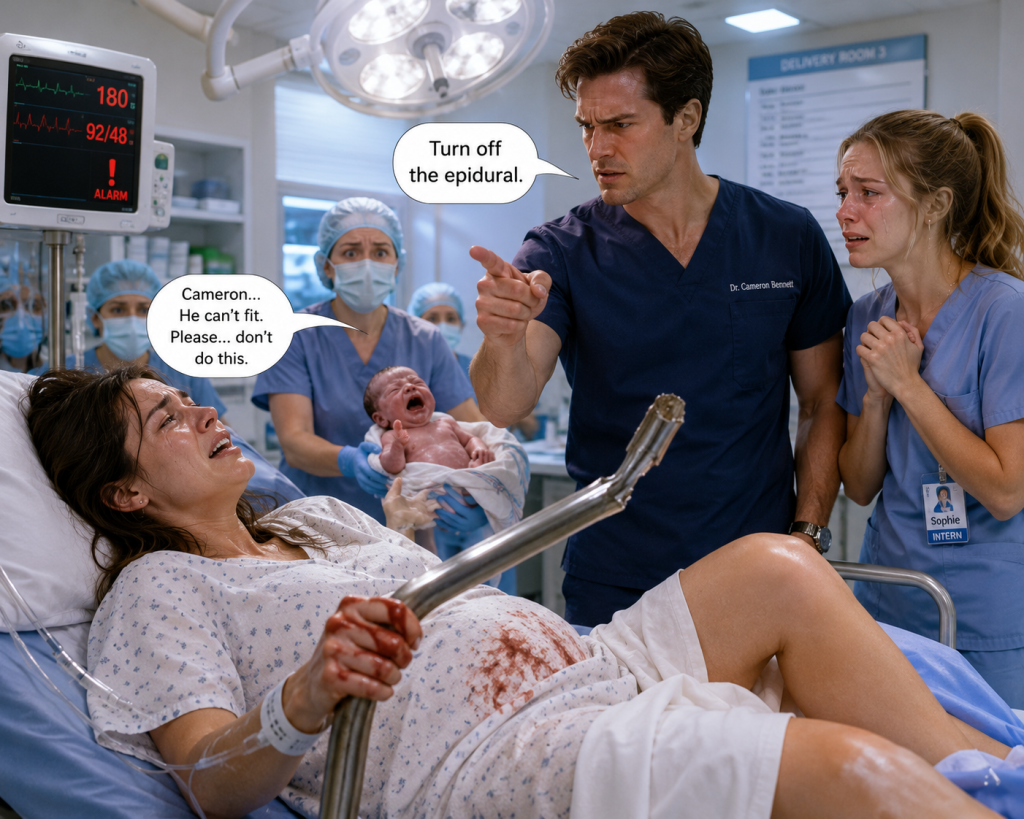
Turn off the epidural.
Hold her still.
If you put that much effort into pushing…
The baby’s cry.
The flatline.
Cameron’s voice breaking after he had broken me.
I inhaled sharply, and pain tugged low in my abdomen, deep and heavy. My throat felt raw. My arms were bruised. My body seemed to belong to someone else, someone who had survived a war she had never agreed to fight.
“Amelia?”
I turned my head.
My mother sat in the chair beside my bed.
Eleanor Grant was not a woman who cried easily. She had raised me alone after my father died, worked double shifts as a pediatric nurse, and taught me that composure was not the absence of feeling but the discipline to keep breathing through it.
Now her eyes were swollen red.
Her hair, usually pinned with military precision, had slipped loose around her face.
“Mom,” I whispered.
She rose so quickly the chair scraped the floor. Her hands hovered over me before settling gently on my shoulder, as if she was afraid I might vanish.
“Oh, sweetheart.”
That was all she said before her voice failed.
I had not cried in the delivery room after the betrayal became clear.
I had not cried when the pain became unbearable.
But when my mother bent over me, pressing her cheek to my hair, I began to shake.
Not loudly.
Not dramatically.
Just a silent, helpless trembling that seemed to come from somewhere deeper than the body.
She held me with the careful strength of someone who had once held me through fevers, heartbreaks, residency rejections, and my father’s funeral.
“Where’s my baby?” I asked.
“He’s in the neonatal unit for observation,” she said quickly. “He’s stable. Big, beautiful boy. Ten pounds, four ounces. The nurses say he has your lungs.”
My breath caught. “Can I see him?”
“As soon as Dr. Patel clears it.”
“Is he hurt?”
“No. They’re watching his blood sugar and breathing, but he’s doing well.”
Doing well.
The words settled over me like a blanket, thin but warm enough to keep me alive.
A tear slid into my hairline.
“Did Cameron see him?”
My mother’s face changed.
It was subtle, but I saw it. Her mouth tightened. Her eyes cooled.
“He tried.”
I closed my eyes.
“Tried?”
“Dr. Patel restricted access until you regained consciousness and until the hospital administration reviews what happened.”
A strange silence opened between us.
The hospital administration.
Reviews what happened.
The words should have comforted me. Instead, they made the truth feel solid.
This was not a nightmare.
This was an incident.
A case.
A file.
A sequence of decisions that would be documented, scrutinized, defended, denied.
“Where is Cameron now?” I asked.
“Outside this unit. Or somewhere near it.” My mother’s voice hardened. “He has been asking every ten minutes to see you.”
“And Sophie?”
My mother looked toward the window.
“Gone.”
I felt my pulse quicken. “Gone where?”
“No one seems to know.”
That should not have surprised me.
And yet it did.
Sophie Vale had floated into our lives six months earlier with wide eyes, soft apologies, and a talent for appearing fragile at exactly the right moment. She was Cameron’s intern, though everyone knew he treated her less like a student and more like a personal project.
At first, I had ignored the unease in my stomach.
Cameron had always been generous with younger doctors. He liked teaching. He liked being admired. That was not a crime.
But then came the late-night messages.
The private research meetings.
The way Sophie said his name as if it belonged in her mouth.
The way Cameron grew irritated whenever I mentioned it.
You’re imagining things, Amelia.
You’re exhausted.
You’re pregnant and emotional.
I had believed him because I wanted to believe my marriage was stronger than my instincts.
That had been my first mistake.
The door opened softly.
Nathan Patel stepped in, wearing a clean white coat and the exhausted expression of a man who had not slept.
Relief crossed his face when he saw me awake.
“Amelia,” he said gently. “You scared the life out of half this hospital.”
“Only half?” I whispered.
His mouth twitched. “The other half is pretending they weren’t scared.”
My mother stepped back, wiping her eyes.
Nathan came to the bedside and checked my pupils, my pulse, the monitor, my incision. His movements were careful but not hesitant. I recognized the difference.
“How bad?” I asked.
He paused.
That pause told me enough.
“Bad,” he said.
I appreciated the honesty.
“You hemorrhaged after delivery. Uterine rupture. We had to take you back surgically. You received transfusions. You coded briefly before we stabilized you.”
My mother pressed a hand over her mouth.
I stared at Nathan.
Briefly.
In medicine, briefly could mean seconds.
In life, briefly meant a door had opened.
And I had almost walked through it.
“Will I recover?”
“Yes,” Nathan said. “Physically, with time. There may be complications we monitor for, but you are stable. You are lucky.”
I looked at him.
He corrected himself quietly.
“No. Not lucky. You endured far more than you should have.”
That sentence did what sympathy could not.
It gave shape to what had happened.
I swallowed through the ache in my throat.
“Did Cameron’s choices cause it?”
Nathan’s face became unreadable.
“I’m not going to discuss formal conclusions before the review.”
“Nathan.”
For the first time, my voice sounded like mine.
Not strong. Not steady.
But mine.
He exhaled.
“You know the clinical picture. Suspected macrosomia. Signs of maternal distress. A clear request from the patient for surgical delivery. Objections from nursing staff. A medication decision that should never have been made under those circumstances.”
My mother looked at him sharply. “Medication decision?”
I closed my eyes.
“He turned off my epidural.”
Nathan’s jaw tightened.
My mother’s face drained of color.
For a moment, she said nothing.
Then she whispered, “He did what?”
I could not answer.
The room seemed too small for the truth.
Nathan placed a folder on the bedside table. “Hospital risk management will speak with you once you are ready. Not today, unless you insist. Your only job today is to heal and meet your son.”
“My son,” I repeated.
That one word softened something inside me.
Nathan’s expression gentled. “He’s doing well. We can arrange a supervised visit shortly.”
My mother squeezed my shoulder.
A knock sounded before anyone could respond.
The door cracked open, and a nurse leaned in.
“Dr. Patel, Dr. Bennett is outside again. He says he won’t leave until he speaks with Dr. Grant.”
My body reacted before my mind did.
The monitor beeped faster.
My mother noticed immediately. “Absolutely not.”
Nathan looked at me, not my mother. “Amelia?”
Every part of me wanted to say no.
No, I never want to see him again.
No, keep him away from me.
No, let him stand outside forever with the door closed between us the way his heart was closed when I needed him.
But beneath the anger, beneath the pain, there was something else.
A question.
Not whether he loved me.
That answer no longer mattered the way it once had.
The question was why.
Why had he believed Sophie so completely?
Why had he looked at me in labor and seen an enemy?
Why had he been willing to risk me?
“I’ll see him,” I said.
My mother turned. “Amelia.”
“Five minutes. With you and Nathan here.”
Nathan nodded once. “I’ll allow it under those conditions.”
My mother looked like she wanted to argue, but she knew me too well. Instead, she moved closer to the bed like a guard.
When Cameron entered, I barely recognized him.
He had always been polished. Even after twenty-four-hour shifts, he looked composed in that infuriatingly effortless way some surgeons did. Tall, precise, handsome in the clean-cut manner that made hospital donors trust him on sight.
Now he looked ruined.
His hair was disheveled. His eyes were bloodshot. His white coat was gone. Without it, he seemed smaller.
For a second, he stopped at the sight of me.
The bruises.
The tubes.
The bandage around my hand.
The woman he had told to stop making a spectacle.
His face crumpled.
“Amelia.”
I said nothing.
He took one step forward.
My mother’s voice cut through the room. “That’s close enough.”
Cameron stopped.
His gaze flickered to her, then back to me.
“I don’t know how to begin.”
“Try the truth,” I said.
He flinched.
Good.
Not because I wanted to hurt him.
Because truth should hurt when it arrives late.
“I was wrong,” he said. “I was horribly wrong.”
“That’s not the truth. That’s the conclusion.”
His throat moved.
Nathan remained near the door, silent and watchful.
Cameron looked down at his hands. I noticed they were shaking.
“Sophie told me you threatened her.”
The words entered the room slowly.
My mother made a sound of disbelief.
I stared at him. “When?”
“Two weeks ago. She said you confronted her in the physicians’ lounge. She said you accused her of trying to ruin our marriage.”
“I did accuse her of crossing boundaries,” I said. “Because she was. I did not threaten her.”
“I know that now.”
“Convenient.”
His eyes closed briefly. “She had bruises on her wrist.”
I remembered then.
A flash of memory.
Sophie reaching for my phone when it buzzed on the counter. Me catching her wrist, not hard, just enough to stop her.
“What are you doing?” I had asked.
She had smiled.
“Just checking if Cameron needed anything.”
My phone.
My husband.
As if both belonged to her.
“I held her wrist for half a second,” I said. “She was trying to read my messages.”
“She said you grabbed her.”
“And you believed her.”
He did not defend himself.
That almost made it worse.
“She said you were becoming unstable,” he continued quietly. “That the pregnancy was affecting you. That you were paranoid. At first, I dismissed it.”
“Did you?”
His face tightened.
“I thought I did. But then she showed me messages.”
My heart shifted.
“What messages?”
“Screenshots. From your number.”
“I never messaged her.”
“I know that now.”
The room chilled.
Nathan stepped closer. “What did the messages say?”
Cameron’s mouth opened, then closed. Shame moved across his face.
“They were cruel. Accusatory. Threatening to end her career if she didn’t stay away from me.”
My mother gripped the bed rail.
I stared at him, unable to speak for a moment.
Someone had used my number.
Or made it look that way.
Cameron continued, voice unsteady. “This morning, before the delivery, Sophie told me you knocked over her medication tray on purpose. She said you’d been trying to sabotage her. She said you wanted everyone to think she was incompetent.”
“She dug her nails into my arm.”
“I know.”
“How?”
He looked at the bandage on the inside of my arm where the marks had been cleaned and photographed.
“Mara reported it. She saw enough to question it. After you coded, she checked the security angle from the medication station. It doesn’t show everything, but it shows Sophie leaning over you before the tray fell.”
Nathan’s brows lifted slightly. “Mara found that?”
“Yes.”
Something inside me warmed toward the young nurse who had whispered that my son was a fighter.
Cameron took another breath.
“I went looking for Sophie after Dr. Patel removed me. I wanted answers. She was gone. Her locker was empty. Her badge left on the floor.”
“Dramatic,” my mother muttered.
Cameron looked at her with deserved humility.
“Then I found this.”
He reached into his pocket.
Nathan moved instantly. “Hands where I can see them.”
Cameron froze, then slowly withdrew a folded envelope.
“I gave it to security first,” he said. “They cleared it for me to show you. It’s already been photographed.”
Nathan took the envelope before it reached my bed. He opened it, read the single page inside, and his expression darkened.
“What is it?” I asked.
Nathan hesitated.
“Read it,” I said.
He handed it to my mother.
She unfolded the page.
Her voice was tight as she read.
“Dear Cameron, by the time you understand, she will have taken everything from me. You always said Amelia was stronger than everyone else. I wanted to prove she wasn’t. I wanted you to see what it felt like when the perfect Dr. Grant finally needed mercy. Maybe now you’ll understand who truly stood beside you.”
My mother stopped.
Silence pressed against the windows.
Cameron looked ill.
“That’s not an apology,” I said.
“No,” Nathan replied. “It’s a confession with vanity.”
I turned toward Cameron.
“And you brought this to me because what? You want me to feel sorry for you?”
“No.” His voice broke. “No, Amelia. I don’t deserve that.”
“What do you deserve?”
He looked at me then.
Really looked.
For once, he seemed to understand that there was no correct answer that could save him.
“I don’t know,” he whispered.
I watched him stand there, the man I had loved, the father of my child, the physician who had failed at both roles when it mattered most.
A part of me wanted to ask if he loved Sophie.
Another part knew that question was too small.
Betrayal did not begin with an affair.
Sometimes it began with attention.
With ego.
With the pleasure of being needed by someone who never challenged you.
With the slow resentment of a wife who saw through your brilliance to the flaws beneath it.
“Did you care for her?” I asked.
His face twisted.
“I cared about how she made me feel.”
The honesty was unexpected.
And it landed heavier than denial would have.
“At the hospital,” he continued, “everyone looks to you. You walk into a crisis and people calm down. You never need rescuing. Sophie made me feel… necessary. Admired. I let that matter more than it should have.”
My mother’s voice was cold. “So you punished my daughter for being competent.”
Cameron had no answer.
Outside the room, someone pushed a cart down the hallway. Its wheels squeaked faintly, an ordinary sound in the middle of an extraordinary ruin.
I thought of all the evenings Cameron came home late and I told myself surgery ran long.
All the times he seemed distant and I blamed stress.
All the little dismissals I swallowed because marriage, I believed, was made of forgiveness for small wounds.
But small wounds, ignored long enough, became infection.
“I need you to leave,” I said.
Cameron stepped forward instinctively. “Amelia—”
The monitor quickened again.
Nathan’s voice sharpened. “Dr. Bennett.”
Cameron stopped.
Tears filled his eyes.
“I haven’t seen our son.”
Our son.
The phrase pierced me.
Not because he had no right to it.
Because rights were not the same as trust.
“His name is Noah,” I said.
Cameron’s face changed.
We had chosen the name together months ago, lying in bed during a thunderstorm, his palm spread over my stomach while the baby kicked at every roll of thunder.
Noah Bennett Grant.
That had been the plan.
But plans belonged to the people we had been before.
“Noah,” he repeated softly.
“You can request supervised visitation when Dr. Patel and the neonatal team approve it.”
His eyes widened as if the formality wounded him.
I did not apologize.
He had made me a patient before he remembered I was his wife.
Now I would speak like one.
Cameron nodded slowly. “I understand.”
I wasn’t sure he did.
But he left.
The door closed behind him with a soft click.
For a long moment, no one spoke.
Then my mother sat beside me and took my uninjured hand.
“You were very brave,” she said.
I looked at the ceiling.
“I wasn’t brave. I was trapped.”
“Sometimes surviving being trapped is bravery.”
I turned my head toward the window. The morning sun had climbed higher, laying a golden rectangle across the floor.
“I want to see Noah.”
Nathan nodded. “I’ll arrange it.”
Twenty minutes later, they wheeled me through corridors I knew too well.
It was strange to be moved through my own hospital as a patient.
People looked away too quickly.
Whispers stopped when I passed.
In the elevator reflection, I caught a glimpse of myself and nearly turned away too.
Pale face.
Hollow eyes.
Hair tangled around my shoulders.
A hospital bracelet on my wrist where my watch usually sat.
I had spent years thinking strength looked like control.
Now it looked like breathing in and out while everything familiar collapsed.
The neonatal unit smelled different from the delivery room. Warmer. Softer. Milk, clean cotton, plastic tubing, and hope.
Mara met us at the entrance.
She was younger than I had realized, perhaps twenty-five. Her eyes were tired, but when she saw me, relief brightened her face.
“Dr. Grant.”
“Mara,” I said. My voice was still weak. “Thank you.”
Her composure wavered.
“I should have done more.”
“You did enough to save me.”
She shook her head quickly. “Dr. Patel saved you.”
“You spoke up.”
Her eyes filled.
In hospitals, speaking up could cost more than outsiders understood. Reputation. Evaluations. Future assignments. The quiet hostility of powerful people who disliked being questioned.
Mara had risked all of that.
For me.
For Noah.
She pressed her lips together and nodded.
“He’s right over here.”
They rolled me beside a clear bassinet.
And there he was.
My son.
Noah.
He was wrapped in a white blanket with a blue stripe, his round face turned slightly to one side, one fist tucked near his cheek as if he had entered the world ready to argue.
His hair was dark and soft, a surprising amount of it. His cheeks were full. His mouth made tiny searching movements in his sleep.
A sensor wrapped around his foot glowed red.
He was the most beautiful person I had ever seen.
Every crack inside me shifted around him.
Not healed.
Not erased.
But rearranged.
“Oh,” I whispered.
My mother began crying again behind me.
Mara carefully lifted Noah and placed him against my chest, guiding my arms around him.
He was warm.
Solid.
Real.
The weight of him stunned me.
For months, I had imagined this moment. I had imagined Cameron beside me, one arm around my shoulders, both of us laughing through tears.
Instead, my mother stood at my back, Nathan near the doorway, and a young nurse who had shown more courage than my husband placed my child in my arms.
It was not the picture I had wanted.
But it was mine.
Noah stirred, then opened his eyes.
Newborn eyes never focused the way stories claimed.
But for one impossible second, it felt as if he looked straight at me.
“Hi,” I whispered, my tears falling onto his blanket. “I’m your mom.”
His tiny mouth opened.
Not a cry.
Just a small sound, soft and startled.
I laughed.
It hurt.
I laughed anyway.
My mother touched his hair with one finger. “He looks like you.”
“He looks furious.”
“That’s also like you.”
I smiled through tears.
For the first time since the delivery room, the air entered my lungs without scraping.
I stayed with Noah for nearly an hour, though Nathan warned me twice not to overdo it. When fatigue finally dragged at my bones, Mara returned him to the bassinet.
Before I left, I touched his small hand.
His fingers curled around mine.
A promise formed in me then, quiet and immovable.
Whatever happened next, Noah would never grow up believing love meant surrendering your voice to someone else’s certainty.
By afternoon, the hospital had changed around me.
Or perhaps I had changed enough to notice.
Risk management came.
So did legal counsel.
So did a representative from the medical board, though she was careful to say the process was preliminary.
Everyone spoke gently.
Everyone documented meticulously.
The story became a timeline.
Time epidural discontinued.
Time patient requested C-section.
Time nursing objection recorded.
Time fetal delivery.
Time maternal collapse.
Clinical facts marched across paper, organized and sterile.
But between each line lived the part no chart could capture.
The look in Cameron’s eyes when he chose Sophie’s tears over my expertise.
The sound of steel snapping beneath my hand.
The helplessness of being restrained by people who looked ashamed while obeying orders.
When they asked if I wanted to make a formal complaint, my mother straightened as though preparing for battle.
I surprised her by saying, “Not today.”
The hospital attorney blinked. “Dr. Grant, we can begin the process whenever you’re ready.”
“I know. Not today.”
After they left, my mother stared at me.
“Amelia.”
“I’m not protecting him.”
“Then what are you doing?”
I looked down at my bandaged hand.
“I’m protecting myself from making decisions while I’m still bleeding from them.”
Her expression softened.
She sat beside me. “That sounds like something your father would have said.”
The mention of him brought an old ache.
My father, Thomas Grant, had died when I was twelve. A cardiologist with gentle hands and a laugh that filled rooms. He had taught me how to listen to heartbeats with his stethoscope, then told me that every rhythm was someone’s story trying to continue.
After he died, my mother rarely spoke about the day itself.
A sudden cardiac event, she had always said.
Fast. Unexpected. Nothing anyone could have done.
It was the phrase families used when the truth was too final for details.
I had accepted it because grief did not leave room for investigation.
Now, holding my own life by the fragile thread of recovery, I thought of him more than I had in years.
“What would Dad think of this?” I asked.
My mother looked toward the window.
“He would be devastated.”
“And after that?”
A faint, sad smile touched her mouth.
“After that, he would become extremely inconvenient to everyone responsible.”
I smiled too.
Then the door opened again.
This time, it was not Cameron.
A hospital security officer stood outside with Nathan.
Nathan looked serious.
“Amelia, we found Sophie.”
My pulse jumped.
“Where?”
“In the east parking garage. She never left campus.”
My mother rose. “What was she doing?”
Nathan exchanged a glance with the officer.
“She was sitting in her car. She appeared disoriented.”
“Disoriented?” I repeated.
“She’s claiming she doesn’t remember leaving the delivery room.”
I almost laughed.
It came out as a breath.
“How convenient.”
“There’s more,” Nathan said.
Of course there was.
There was always more once the first lie cracked.
The security officer stepped forward. “We reviewed badge access. Ms. Vale entered a restricted records room three nights ago using Dr. Bennett’s credentials.”
My mother looked sharply toward Nathan.
“Cameron gave her his badge?”
Nathan’s expression was grim. “That is one possibility.”
“What did she access?” I asked.
The officer opened a folder. “Your medical records. Your prenatal scans. Internal notes from Dr. Bennett’s account. And one archived file from twenty-two years ago.”
The room went still.
My mother’s hand tightened on the back of the chair.
I noticed.
Nathan noticed too.
“What file?” I asked.
The officer looked down.
“A mortality review. Patient name: Dr. Thomas Grant.”
For a moment, the room vanished.
My father’s name did not belong here.
Not in this hospital room.
Not in the same conversation as Sophie Vale.
My mother whispered, “That’s impossible.”
I turned to her.
“Mom?”
Her face had gone gray.
Nathan stepped closer. “Eleanor, do you know why that file would be restricted?”
She did not answer.
The security officer continued carefully. “There was also a print request sent from that terminal. We recovered several pages from the printer queue before they were deleted.”
“What pages?” I asked.
He hesitated.
My mother suddenly said, “Amelia, you don’t need this today.”
But her voice was too urgent.
Too afraid.
I looked at the officer.
“Show me.”
Nathan’s expression tightened. “Amelia—”
“Show me.”
The officer placed three pages on the rolling table beside my bed.
Most of the text was redacted or distorted from the recovered file, but one paragraph near the bottom was clear enough to read.
My eyes moved over the words once.
Then again.
I could not make sense of them at first because my mind refused to connect them.
Internal inquiry raised concerns regarding medication administration prior to Dr. Grant’s collapse.
Medication administration.
Prior to collapse.
Not sudden.
Not nothing anyone could have done.
My mother’s breath shook.
“Mom,” I whispered, “what is this?”
She covered her mouth, tears spilling down her face.
For the first time in my life, Eleanor Grant looked afraid of me.
Or afraid of what I was about to learn.
Before she could answer, a commotion rose in the hallway.
Voices.
Footsteps.
Then Cameron appeared in the doorway, pale and wild-eyed, holding a sealed evidence bag in one hand while a security officer tried to stop him.
“I know why Sophie targeted you,” he said.
Nathan stepped in front of him. “You need to leave.”
Cameron’s eyes were fixed on me.
“Amelia, Sophie Vale isn’t her real name.”
My heart began to pound.
My mother gripped the chair as if the floor had shifted beneath her.
Cameron lifted the evidence bag.
Inside was an old photograph.
A little girl with pale hair stood beside a woman I had never seen before.
On the back, written in faded blue ink, were five words.
For Thomas. Until you tell them.
Cameron’s voice dropped to a whisper.
“Sophie is your father’s daughter.”
The monitor beside my bed quickened.
My mother closed her eyes.
And in the silence that followed, I understood the most terrifying part.
She already knew.