Part 1: The Stranger at the Gate
The security camera alerted me at 2:17 in the morning.
At my age, I understood the difference between real rest and simply closing your eyes while waiting for the next problem to arrive. Men like me never truly sleep deeply. We listen for unusual sounds, unfamiliar engines, and silence where something should be heard.
The monitor beside my bed glowed blue.
North gate. Unknown vehicle. Lights off.
My name is Callan Mercer, and I run Red Mesa Training Group on a remote stretch of desert in southern New Mexico. Officially, we train executives and security teams in crisis response, defensive driving, evacuation procedures, and protective operations.
But the real lesson I teach is judgment.
“Anyone can panic when they have power in their hands,” I always tell my students. “The difficult part is staying human when anger tells you to become something else.”
That night, I forgot my own advice for a few seconds.
The vehicle sat fifty yards outside the fence line, angled strangely in the gravel. Kentucky plates. Cracked windshield. One broken taillight.
No call.
No explanation.
No attempt to leave.
Everything about it felt wrong.
I dressed quickly, grabbed my jacket, and left through the side entrance without waking the guard. The desert air smelled of dust and dry brush. The moon cut sharp shadows across the mountains.
I approached the sedan carefully.
A person who owns a training facility does not casually walk toward a suspicious vehicle in the middle of the night.
The driver’s door opened before I reached it.
Someone fell out.
Not stepped.
Fell.
A young woman hit the gravel on one knee, catching herself with both hands. The sound she made was quiet, but the pain behind it was impossible to miss.
At first, I only saw tangled dark hair.
Then she lifted her face toward the moonlight.
“Dad.”
Everything inside me stopped.
“Juniper?”
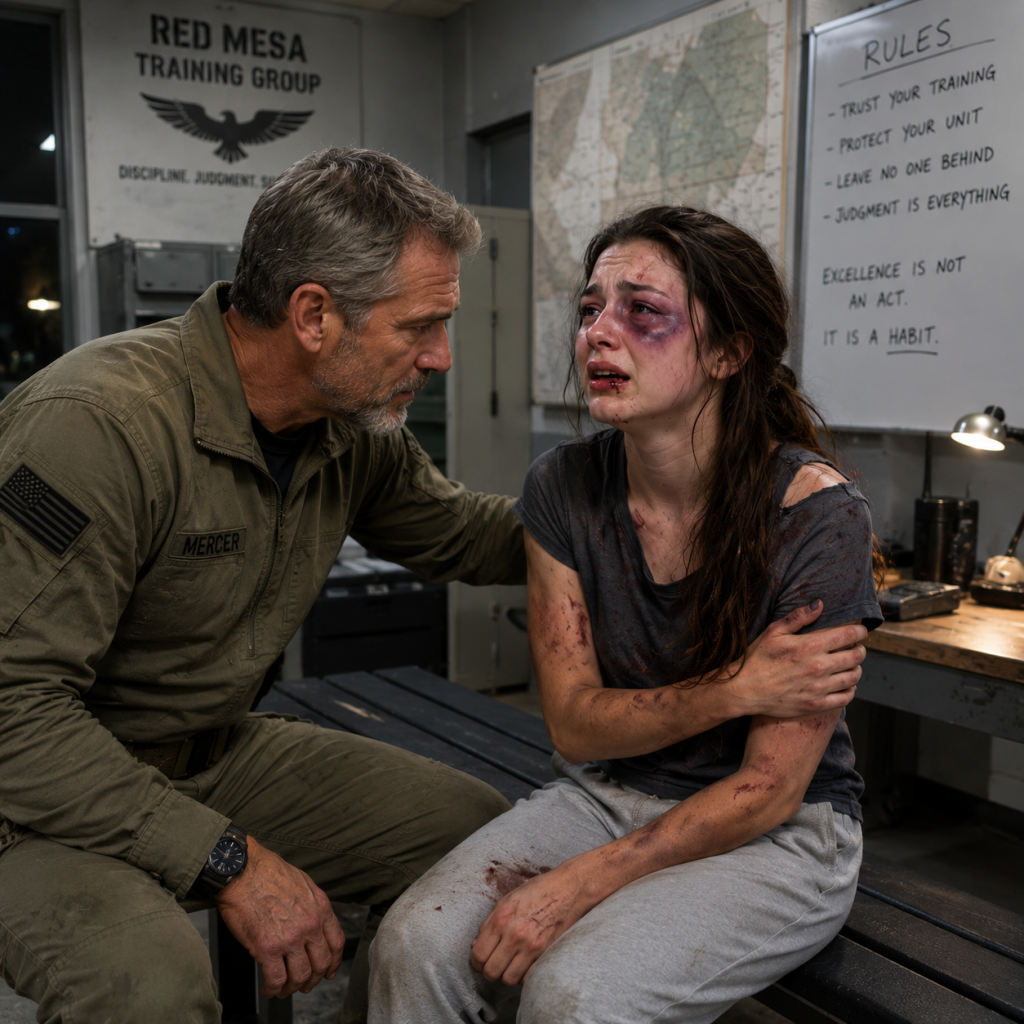
My daughter tried to stand, but she was barely holding herself together. One arm pressed tightly against her ribs. One eye was swollen. Her lip was split. Dark bruises covered both arms in the unmistakable shape of someone else’s hands.
She was seventeen years old.
And she had driven nearly fourteen hundred miles to find me.
I reached her just before she collapsed.
“Please,” she whispered. “Don’t call Mom.”
I had heard fear in many voices throughout my life.
But I had never heard it like that.
So I didn’t call her mother.
I lifted Juniper into my arms like she was still the little girl who used to run barefoot by the lake, like I had not spent years losing pieces of her childhood through custody battles, distance, and a woman who knew exactly how to make me powerless.
I carried her into the gatehouse.
The bright lights made everything clearer.
The darkness had allowed me to hope it wasn’t as bad as it looked.
The light removed that illusion.
Possible broken ribs.
Bruising along her jaw.
A mark on her wrist.
Scratches around her neck.
A swollen cheek.
I placed her carefully on the bench and forced myself to breathe.
Then I asked the only question that mattered.
“Who did this?”
Juniper looked at me with her one clear eye.
And whatever she was about to say would change everything.
Part 2: The Name Behind the Fear
Juniper looked at me with the one eye she could still open.
For a brief moment, I didn’t see the injured teenager in front of me.
I saw the little girl who once stood in my kitchen holding a broken snow globe, trying desperately not to cry because she thought I would be angry.
Then she reached into her coat and pulled out a cheap prepaid phone wrapped inside a plastic grocery bag.
“There were eleven of them,” she whispered. “They recorded everything.”
The room suddenly felt smaller.
There was only the phone in her hand, the fear in her eyes, and the faint buzzing of the fluorescent lights above us.
“Who?” I asked.
Juniper swallowed.
“The Harrows.”
The name hit me instantly.
I knew that family.
The Harrows were connected to Juniper’s mother’s new life—not through blood, but through marriage, loyalty, silence, and fear. They lived in eastern Kentucky, in a place where everyone knew their trucks, their businesses, their church connections, their hunting land, and the favors they could call in.
Her mother, Mireya, married Vance Harrow when Juniper was ten.
Vance always appeared respectable. Perfect clothes. Perfect manners. A smile that lasted just long enough to hide what was underneath.
His father, Orson Harrow, was the kind of man who controlled a room without needing a title. Everyone listened when he spoke.
I had met Orson twice.
Both times, something inside me warned me to be careful.
“Family handles its own,” he once told me during a casual dinner.
At the time, I should have taken Juniper and walked away.
I didn’t.
I followed the custody agreement.
That was my first mistake.
I took the phone from Juniper and placed it face down on the counter.
She stared at it nervously.
“You’re not going to watch it?”
“Not tonight.”
“But you need to know what they did.”
“I know enough to keep you safe,” I said. “The rest comes later, when it can actually help us.”
She looked confused.
She had driven across multiple states expecting anger. She expected me to explode.
But anger would have been easy.
Anger would have made me reckless.
My daughter did not need revenge.
She needed someone thinking clearly.
I called Ellis, our medic, and asked him to come to the gatehouse with emergency supplies.
Then I held Juniper’s freezing hand.
“You made it here,” I told her. “That means they don’t get control over your life anymore.”
Outside, the abandoned sedan slowly cooled in the darkness.
Inside, my daughter finally leaned against my shoulder.
But she did not cry.
Not until Ellis arrived and gently asked her name.
The moment she answered, everything she had been holding inside finally broke.
And the sound of her pain changed the direction of my entire life.
Part 3: The Truth Begins to Surface
By sunrise, the desert was covered in pale gold light.
Juniper slept inside the infirmary, her ribs wrapped, my jacket folded beneath her head like a pillow. I sat outside her door on a metal chair, elbows resting on my knees, holding a cup of coffee that had gone cold hours ago.
Around me, Red Mesa slowly came alive.
Vehicles started.
Voices echoed near the barracks.
Equipment shifted inside the storage buildings.
But I stayed still.
My entire focus was on the room behind that door.
At 6:40, Ellis stepped outside with his hands in his pockets.
“She needs a hospital,” he said.
“How bad?”
“Bad enough that I’m telling you she needs one. Not bad enough that I have to drag you there myself.”
“Police report?”
Ellis glanced toward the infirmary.
“Eventually. But not local authorities. Not anyone connected to where she came from. Not until she feels safe enough to speak.”
I nodded.
Ellis had worked beside me for six years. He understood when silence was better than advice.
“Did she say anything else?”
“Only pieces.”
“Tell me.”
He hesitated.
I looked up.
That was enough.
“There was a barn,” Ellis said quietly. “Cameras everywhere. A group of relatives and several other men. She said it started after she discovered something she wasn’t supposed to find.”
He paused.
“Her stepfather was there. Watching from the doorway.”
The coffee cup crushed slightly in my hand before I realized I was squeezing it.
Hot liquid spilled across my fingers.
I felt the burn.
I registered it.
Then I carefully placed the cup down.
Ellis watched me closely.
Not with fear.
With concern.
“Callan.”
“I’m here.”
“No,” he said. “I mean really here. Stay in control.”
A small smile almost reached my face.
That was why I trusted Ellis.
Not because he lacked fear.
Fearless people were dangerous.
Ellis was valuable because he could stand beside a father whose daughter had arrived broken and still say what needed to be said.
“I’ll stay useful,” I told him.
He nodded.
“Good.”
Near noon, Juniper woke.
I was sitting beside her bed pretending to read a maintenance report. I had not turned a page in nearly an hour.
Her eye opened slowly.
For a few seconds, confusion crossed her face. She looked around at the white walls, the small window, the medical equipment, and the desert outside.
Then she saw me.
And she remembered.
Her expression changed.
“Mom called?”
“No.”
“Don’t let her know I’m here.”
“I won’t.”
“She’ll make me go back.”
I leaned closer.
“No one is taking you anywhere you don’t choose to go.”
For the first time since she arrived, some of the fear in her face began to fade.
Part 4: Following the Money
The first thing we uncovered was money.
It almost always starts there.
Families like the Harrows wrapped their power in words like loyalty, tradition, faith, and family. But behind those words, there was always something practical hiding underneath—payments, favors, contracts, property deals, or money moving through places where nobody thought to look.
I divided my team into groups.
Sloane and Rafael handled public records. They searched county contracts, property transfers, tax records, business registrations, nonprofit filings, and government agreements. They worked for hours with laptops, notebooks, and endless cups of energy drinks.
Corruption looked mysterious from the outside.
But once placed into a spreadsheet, it became a pattern.
Meanwhile, Ivo and Mei analyzed financial connections.
I made one rule clear.
“No breaking into systems. No illegal access. If we have to force our way in, we’re already collecting evidence the wrong way.”
They used only information that could legally be obtained—public archives, business records, old reports, online registrations, court documents, and careless social media posts.
The Harrows were careful with their crimes.
But they were careless with their ego.
And pride always leaves traces.
By lunchtime, we found the public image they had built.
Harrow Ridge Youth Recovery.
A wilderness program for troubled teenagers.
It had county funding, church donations, and state reimbursements. The website showed smiling teenagers hiking through forests. The testimonials talked about discipline, responsibility, and family values.
I read those words again.
Family values.
They felt almost insulting.
By the afternoon, Sloane found the first weakness.
One teenager featured in their success stories had also appeared on a missing-person discussion forum under another name. He was not officially missing anymore, but his family had spent years trying to locate him after he left the program.
Then Rafael uncovered two civil complaints that had disappeared after witnesses suddenly withdrew.
Mei discovered connections between three companies tied to recording equipment, payment services, and a private membership website.
The website avoided obvious language.
Instead, it used phrases designed to make cruelty sound respectable.
“Exclusive discipline events.”
“Real consequence experiences.”
“No actors.”
I stood behind Mei’s chair, reading the pages silently.
“Preserve everything,” I said.
She looked up.
“Screenshots. Dates. Source records. Verification details. Everything. Assume someone will challenge every piece of evidence.”
She nodded and continued working.
That was how real investigations were built.
Not with anger.
With patience.
Later that evening, Rowan entered my office carrying a printed article.
“Another name,” he said.
The article was about Deacon Pryce, a Kentucky State Police investigator who had once spoken publicly about organized fraud and problems connected to youth programs in the county.
Three years earlier, he had tried to investigate.
Then the issue disappeared.
“Someone tried before,” Rowan said.
“Maybe he can try again.”
“Or maybe he was pressured.”
“Then we find out without giving him enough information to hurt us.”
That night, I sat beside Juniper while she slowly ate soup in the mess hall.
She looked different after cleaning up. Her hair was braided away from her face. The swelling around her eye had started fading, but the injuries still reminded me how young she was.
“Are you doing something?” she asked.
“Yes.”
Her spoon stopped.
“Are you going after them?”
“No.”
“Are your people going there?”
“No one is going to the Harrows.”
She studied me carefully.
Children who grow up between two homes learn how to hear what people avoid saying.
“Then what are you doing?”
“Making sure the right people learn the truth. In a way they can’t ignore.”
Her expression tightened.
“They’ll get away with it.”
“No.”
“You don’t know that.”
“I know what I do best.”
Her eye filled with tears.
“Dad, they control everyone there.”
I leaned closer.
“Then we don’t fight them in their town.”
She looked confused.
“When bad people control a small room,” I explained, “you don’t argue inside that room. You remove the walls.”
Juniper looked down.
“Cressa is still there.”
“I know.”
“She helped me.”
“I know.”
“They’ll know.”
That was the fear I had been waiting for.
“We’re finding a way to get her out before everything comes down.”
Juniper looked at me.
“Can you do it?”
“I can try.”
“That’s not enough.”
The words sounded exactly like something I would say.
I nodded.
“No. It isn’t.”
At 11:00 that night, the first package reached Deacon Pryce through a secure legal channel.
There were no accusations.
No emotional speeches.
No angry father demanding revenge.
Only documents.
Archived pages.
Financial records.
Contract information.
And one question on the cover:
How many children disappeared after being sent to Harrow Ridge Youth Recovery?
Before midnight, the same information reached federal investigators.
A smaller version went to three journalists known for protecting victims instead of chasing headlines.
By morning, the first cracks appeared in the Harrow empire.
Then Juniper’s phone received a message from a borrowed number.
It was from Cressa Harrow.
“They know someone helped you.”
Part 5: The Hardest Decision
The hardest thing I did during those days was nothing.
Not because we were inactive.
Red Mesa became a quiet operation center. Printers ran nonstop. Whiteboards filled with timelines and connections. Students worked through documents in shifts, sleeping briefly between reviews. Rowan checked every file before it was sent, making sure we protected victims and followed legal procedures. Ellis kept Juniper away from the evidence screens, which was difficult because she had inherited both my stubbornness and my distrust of being kept in the dark.
But personally, I stayed still.
I did not drive east.
I did not confront Vance Harrow.
I did not send anyone to threaten him.
I did not give my anger a chance to ruin everything we were building.
I repeated the same rule until everyone knew it by heart.
“We are not becoming the story,” I told them. “We are building the story so carefully that the people responsible cannot escape it.”
Then Cressa stopped responding.
Juniper called the borrowed number again and again. Every attempt went straight to voicemail.
By noon, she was sitting upright in the infirmary bed, determination replacing fear.
“I’m going back.”
“No.”
“You can’t just decide that.”
“I can,” I said. “Because you’re injured, terrified, and making a choice based on fear.”
Her expression hardened.
“You weren’t there.”
The words hit exactly where she intended.
Ellis quietly looked away.
I pulled my chair closer.
“You’re right,” I admitted.
Juniper looked surprised.
“I wasn’t there. I should have trusted my instincts sooner. I should have fought harder when your mother started limiting my time with you. I should have questioned every excuse instead of accepting silence.”
Her anger softened slightly.
“But I’m here now,” I continued. “And I’m not sending you back into their hands because you feel responsible for saving everyone.”
She looked down.
“Cressa saved me.”
“Then we save her the right way.”
“How?”
“We find someone near her who isn’t controlled by the Harrows.”
Juniper gave a bitter laugh.
“Good luck.”
But luck arrived at 2:15 that afternoon.
Her name was Hollis Wren.
Sloane found her through old public records, archived posts, and a comment attached to a missing youth discussion. Hollis was a retired school nurse who had briefly worked with Harrow Ridge Youth Recovery before resigning.
Her old resignation notes mentioned concerns about supervision and medical reporting.
That was enough to make us look closer.
Rowan called her directly.
“Mrs. Wren, my name is Rowan Vale. I’m contacting you because we believe a young woman connected to the Harrow family may be in danger. We are not asking you to break any laws. We only need to know if there is a safe reporting path outside Cottle County.”
Silence followed.
Then a quiet voice answered.
“Which girl?”
Rowan looked at me.
“Cressa Harrow.”
The silence changed.
“Is Juniper alive?”
I closed my eyes.
“Yes,” Rowan said.
A shaky breath came through the phone.
“Thank God.”
That was when we learned the truth.
After Juniper escaped, Cressa had gone to Hollis for help. She did not tell her everything. She was too afraid. She only showed fear.
Hollis had told her to leave and come back if she needed help.
Cressa never returned.
“Do you believe she’s in immediate danger?” Rowan asked.
Hollis answered without hesitation.
“I believe every girl in that family is in danger once she stops being useful.”
The room went silent.
Hollis gave us the name of a state child protection supervisor she trusted—someone outside the Harrow family’s influence. Rowan sent everything through official channels with an urgent witness-safety request.
By sunset, Deacon Pryce finally called.
Not me.
Rowan.
That was intentional.
“Your evidence package is either the biggest mistake I’ve ever seen,” Pryce said, “or it’s the missing piece from a case I couldn’t finish.”
“It’s real,” Rowan replied.
“Who is the victim?”
“Protected minor. Details will come through legal channels.”
“Is she safe?”
“Yes.”
“Is another witness at risk?”
“Yes.”
Pryce exhaled slowly.
“Listen carefully. Do not send me anything obtained illegally. Do not contact suspects. Do not encourage anyone to disappear. Do not turn this into a personal mission.”
Rowan glanced at me when Pryce said that last part.
I almost smiled.
“But,” Pryce continued, “if you have clean financial records, public documents, contract trails, witness names, and evidence connected to minors in that program, I want it immediately.”
“You’ll have it within the hour.”
After that call, the entire atmosphere changed.
Not with celebration.
With focus.
Everyone moved faster, but smarter.
They organized files. Verified sources. Removed anything that could expose Juniper. Created separate evidence packets for different agencies.
No emotion.
No shortcuts.
Just a case strong enough to survive.
Two mornings later, the first official action happened.
Harrow Ridge Youth Recovery was suspended pending investigation.
By afternoon, state vehicles appeared outside the county services office.
That evening, a local reporter posted a simple question online:
“Why did Cottle County continue sending teenagers to a private wilderness program despite repeated complaints?”
It was a small question.
But it started something much bigger.
That night, Juniper sat outside the infirmary wrapped in a blanket, watching the old three-legged dog chase insects beneath the lights.
“Do they know it was me?” she asked.
“Not because of us.”
“But they know someone helped.”
“Maybe.”
She pulled the blanket tighter.
“I’m scared.”
“I know.”
She looked at me.
“Are you scared?”
I looked across the compound at the people working to expose the truth.
“Yes.”
That surprised her.
“What are you scared of?”
I looked down.
“That I’ll enjoy this.”
She studied me quietly.
Then she reached for my hand.
For the first time since she arrived, my daughter touched me without fear.
Part 6: The Harrows’ First Mistake
The Harrows made their first major mistake on a Thursday morning.
Rusk Harrow went on local radio.
A careful man would have stayed silent once investigators started examining contracts and finances. But Rusk had spent his entire life confusing fear with respect. He believed speaking louder meant having control.
By 8:20, everyone at Red Mesa was listening.
The host gave him an easy opportunity to defend himself. He talked about family values, helping troubled youth, outsiders attacking their traditions, and government interference.
Rusk accepted the invitation.
“People don’t understand us,” he said. “Around here, family handles its own.”
Mei immediately looked up from her laptop.
“That phrase again.”
Rowan nodded.
“Save that clip.”
Rusk continued.
He called former participants liars. He accused investigators of having political motives. He claimed Harrow Ridge had simply given troubled teenagers the discipline they needed.
Then he made the mistake that changed everything.
He admitted they had “disciplined” young people inside a county-funded program.
Sloane paused the recording.
“Did he just confess to unauthorized treatment of minors?”
“Yes,” Rowan replied.
The audio was preserved and sent to investigators, prosecutors, and journalists.
By that evening, one journalist published the first story.
Not about Juniper.
Not yet.
The first article focused on money.
That was the smarter attack.
People can argue about emotions. They can dismiss a teenager’s story as family conflict or misunderstanding.
But financial records are harder to ignore.
The article showed county payments, program funding, old complaints, withdrawn lawsuits, contract problems, and campaign donations connected to Harrow businesses.
No dramatic accusations.
No unnecessary details.
Just facts.
And facts were dangerous.
The next morning, state officials announced a formal investigation.
Cottle County suddenly acted shocked, as if nobody had noticed the cracks forming for years.
Then the second mistake happened.
Part 7: The Video That Exposed Them
Reese Harrow posted a video online.
I watched it from my office while Rowan stood behind me and Juniper rested down the hall.
Reese sat inside a truck, sunglasses pushed into her hair, looking angry and almost excited to have an audience.
“People believe anything,” she said. “They attack my family because we refuse to bow down. Some people can’t handle discipline. Some people need to learn when to stay quiet.”
She never mentioned Juniper.
She didn’t need to.
Everyone knew exactly who she meant.
The video did more damage than all our research combined.
Because Reese forgot one important thing about cameras.
They record everything.
Before the day ended, the internet had started pulling apart every word she said. Former Harrow Ridge participants began commenting from anonymous accounts.
Then they stopped hiding.
Parents spoke.
Relatives spoke.
Former students shared stories.
One person described a brother who returned from the program completely changed. Another recognized the black-painted barn wall from memories they had tried to forget.
Every comment became a lead.
Every lead became a witness.
Every witness became evidence.
By Saturday morning, Deacon Pryce had enough information to move forward.
The first warrants targeted the Harrow towing business.
Then county offices.
Then Harrow Ridge Youth Recovery.
Then the barn.
There were no dramatic speeches.
No movie-style confrontation.
Just investigators arriving, collecting records, removing equipment, and carrying out boxes of evidence.
A news helicopter captured footage of the barn investigation.
When the black-painted wall appeared on screen, I stopped breathing.
That was the place where my daughter had learned what the Harrows were capable of.
Investigators removed it piece by piece.
I expected satisfaction.
Instead, I felt grief.
Deep, angry grief.
Part 8: The Fall of the Family
At 4:10 that afternoon, Vance Harrow was arrested outside his home.
The same man who had once stood confidently in his doorway now stood in handcuffs.
His smile was gone.
His family watched from behind the windows.
Mireya covered her mouth.
Orson sat in the shadows of the living room, silent and still.
Juniper asked to watch the arrest footage.
I hesitated.
Then she said quietly:
“I need to see him not be in control.”
So we watched.
Vance looked smaller than I expected.
Juniper did not cry.
She stared at the screen and whispered:
“He saw me.”
I muted the video.
“What?”
“In the barn. I kept looking at him. I thought if he looked at me long enough, he would remember I was a person.”
Her fingers touched the bandage around her ribs.
“He looked away.”
On the screen, Vance was placed into the vehicle.
Juniper leaned back.
“Good.”
Not happiness.
Not revenge.
Just relief.
The same day, authorities found Cressa Harrow.
She was located at a relative’s trailer outside the county. She was not locked away, but she was being controlled and watched.
That was how the Harrows operated.
They made captivity look like family.
Cressa had bruises on her arms and carried Juniper’s old hoodie in her backpack.
When Rowan told Juniper she was safe, she was standing by the window pretending she had not been waiting for that call.
“She’s out,” Rowan said.
Juniper covered her mouth.
“Alive?”
“Alive.”
“Did she tell them?”
“She’s talking.”
Her legs gave out, and she sat on the bed.
For the first time since arriving at Red Mesa, Juniper cried like a child.
Not from fear.
From relief.
Someone had made it out.
By Sunday, several Harrow associates had been arrested or named in warrants. Others disappeared before authorities arrived. Some tried to deny everything online, only to expose themselves through careless mistakes.
The system they built was no longer protecting them.
It was becoming evidence against them.
But one person remained untouched.
Orson Harrow.
Juniper noticed.
“Why haven’t they arrested him?”
I looked at the frozen image of Orson sitting silently behind the others.
“Because men like him rarely hold the weapon themselves.”
She frowned.
“Then he wins.”
I shook my head.
“No.”
I looked at the man who had spent years controlling everyone around him.
“It means he knows he’s next.”
Part 7: The Conversation With Mireya
Nine days later, Mireya called.
I knew it was her before I checked the screen.
Some calls carry a certain feeling before you even answer them.
Juniper was outside with Ellis’s wife, slowly walking around the infirmary yard beneath the morning sun. She wore sunglasses to cover the fading bruising and an oversized Red Mesa hoodie. The three-legged dog followed beside her like a tiny security guard.
I let the phone ring twice before answering.
I said nothing.
Mireya spoke first.
“Callan, where is she?”
I looked across the desert beyond the fence.
“Safe.”
“You had no right to keep her from me.”
The words almost broke my calm because they sounded exactly like the person who had failed her.
“No right?” I repeated.
“She’s my daughter.”
“She was your daughter when she came to you hurt.”
A pause.
“You don’t understand what it’s like here.”
“No,” I said. “I understand exactly what it’s like there. That’s the problem.”
“They would have calmed down.”
I closed my eyes.
There it was.
Not denial.
An excuse.
A woman who had spent years surviving by pretending the danger around her was normal.
“Listen to yourself,” I said.
“You think you’re better than me because you ran away to the desert and play soldier?”
“I think our daughter drove fourteen hundred miles injured because she felt safer reaching me than staying there.”
The silence that followed was heavy.
“You destroyed my life,” she whispered.
“No,” I replied. “I exposed the life you chose.”
“You don’t know what Orson can do.”
I looked around the compound. The investigators. The evidence. The people working to expose the truth.
“Neither does Orson anymore.”
For the first time, her voice softened.
“Is she asking for me?”
That was the first honest thing she had said.
It hurt.
“No.”
Mireya started crying.
Years earlier, those tears would have changed my response. I would have comforted her. I would have confused regret with accountability.
Not anymore.
“Callan, please. I made mistakes.”
“Yes.”
“I was scared.”
“Yes.”
“I thought keeping peace would protect her.”
“But it didn’t.”
Silence.
Then she whispered:
“What do I do?”
I thought about Juniper as a child. The missed visits. The excuses. The moments when I should have pushed harder.
“You tell the truth,” I said. “To investigators. To your daughter if she ever wants to hear it. But not a version where everyone else is responsible. The truth about the choices you made.”
“Will you let me talk to her?”
“No.”
“You can’t decide forever.”
“She can. And right now, she doesn’t want contact.”
Another quiet sob.
“Do not call asking for access,” I said. “If Juniper wants a relationship with you, that decision belongs to her.”
“You hate me.”
“No.”
The answer surprised her.
“I don’t have room to hate you. I’m too busy loving her.”
I ended the call.
My hand shook afterward.
I let it.
Then I returned to the yard.
Juniper sat on the bench, one hand resting carefully against her ribs.
“Was that Mom?”
“Yes.”
“What did she say?”
“She asked for you.”
Juniper looked down at the dog resting against her leg.
“What did you tell her?”
“I told her you decide.”
Her expression softened.
“I don’t want to talk to her.”
“Then you don’t.”
“Even if she cries?”
“Especially not just because she cries.”
For the first time in days, Juniper looked like she believed she had control over her own life again.
Part 8: Finding Her Voice
A week later, we returned to Kentucky.
Not secretly.
Not recklessly.
Not alone.
Juniper traveled with a victim advocate, an attorney, and an investigator from Deacon Pryce’s task force.
She gave her statement in a state office far from Cottle County.
I waited outside because that was what she asked for.
And that was difficult.
But being a father was not always about standing in front of your child.
Sometimes it meant respecting the door they needed to close so they could finally speak for themselves.
When Juniper walked out, she looked exhausted.
But stronger.
“They believed me,” she said.
“Good.”
“No,” she whispered. “Dad, they really believed me.”
I hugged her carefully.
“I believed you too.”
She looked at me.
“You’re my dad.”
As if that somehow made my belief less important.
It didn’t.
Over the next month, the investigation expanded.
Not because of revenge.
Because once one person finally spoke, others found the courage to do the same.
Harrow Ridge Youth Recovery became a statewide scandal.
Officials resigned.
Sheriff Alden Meeks, who had ignored complaints and protected connections, was suspended and later charged.
Reese Harrow’s online videos became evidence against her. Not Juniper’s footage—that remained protected because she was a minor—but the videos Reese proudly created herself.
She had recorded enough.
Enough arrogance.
Enough threats.
Enough proof.
She tried to present herself as the victim.
Nobody believed her.
Rusk Harrow’s lawyers blamed everything they could.
Culture.
Family.
Politics.
Teenagers.
Outsiders.
Eventually, there was nothing left to blame.
Vance tried cooperating late.
Men like him often do.
They stay silent while damage happens, then search for morality once consequences arrive.
Juniper never asked about him again.
Orson was different.
He lasted longer.
Men like Orson rarely leave obvious fingerprints. His name appeared less often. His voice was rarely recorded. He built a system where other people carried out the harm while he remained untouched.
But systems always leave evidence.
Witnesses placed him in meetings.
Financial records connected him to hidden companies.
Former employees described cash payments and private instructions.
A program director finally explained the phrase everyone feared:
“Giving the weather.”
It meant Orson approved something without ever directly ordering it.
I remembered meeting him years earlier, smiling with a paper plate in his hand while every instinct told me something was wrong.
Some men do not need to raise their voices.
They become the reason everyone else lowers theirs.
On a gray Tuesday morning, Orson Harrow was finally indicted.
The news showed him entering court with a cane, a dark suit, and the same pride he had always carried.
Reporters shouted questions.
He ignored them.
Until one asked:
“Mr. Harrow, did your family handle its own?”
He stopped.
For a second, he looked like the same man ruling from his mountain.
Then his lawyer touched his arm and guided him forward.
Juniper watched the clip once.
Only once.
Then she closed the laptop.
“He looks smaller than I remember,” she said.
I nodded.
“They usually do when the room gets bigger.”
Part 8: Learning to Heal
Juniper came to live with me in New Mexico because she chose to, not because a court finally admitted what I had known all along.
That difference mattered.
At first, she stayed in the small room across from my office at Red Mesa. For the first few nights, she slept with the lights on. For weeks, sudden noises made her jump. She kept her shoes beside the bed, pointed toward the door, always ready to leave.
Healing was not some dramatic transformation.
It was slow.
It looked like unfinished meals, unexpected silence during conversations, anger appearing out of nowhere because the real pain was too large to explain. It looked like Ellis teaching her how to care for her injuries, Rowan bringing her old mystery novels, and Sloane sending her a ridiculous pink safety keychain that Juniper proudly attached to her backpack.
It looked like Bishop, the three-legged dog, deciding she belonged to him.
School continued online at first. Therapy happened twice a week. Court meetings became part of our routine.
Some days Juniper wanted updates.
Other days she warned me that if I mentioned Kentucky, she would throw my coffee into the desert.
I learned something important during that time.
Commanding was easy.
Listening was harder.
So every day, I asked one question:
“Do you want information or distraction?”
Sometimes she wanted answers.
Sometimes she wanted pancakes.
We became very good at pancakes.
Part 9: The Letters She Wasn’t Ready to Read
Mireya started sending letters three weeks after Orson’s indictment.
The first one arrived at Red Mesa with Juniper’s name written carefully across the envelope.
Juniper held it for a long time before handing it to me.
“Put it somewhere.”
“Do you want me to read it?”
“No.”
“Do you want to throw it away?”
She almost smiled.
“Not yet.”
I placed it in my safe.
More letters came.
Seven in total.
Juniper never opened any of them that year.
One night she said, “Maybe I’ll read them someday.”
“Okay.”
“But I don’t want someday to become everyone pressuring me.”
“It won’t.”
“Promise?”
“Yes.”
She looked directly at me.
“I’m not forgiving her just because she feels guilty now.”
I studied my daughter sitting at the kitchen table, slowly rebuilding herself.
“You don’t owe forgiveness to someone just because consequences finally reached them.”
She nodded.
“Good.”
Part 10: Justice Takes Time
The trials moved slowly.
Real justice rarely looks dramatic. It is paperwork, hearings, evidence reviews, and long waits.
Some Harrow family members accepted deals.
Others blamed each other.
The youth program was permanently shut down. County officials resigned. The sheriff who had protected Orson’s influence eventually faced charges himself.
Cressa testified first in private, then publicly after turning eighteen.
Juniper watched from a separate room with me beside her.
Cressa’s voice shook at the beginning.
Then it became stronger.
She told the truth about the barn. About the people who knew. About the silence that allowed everything to continue.
She explained why she helped Juniper escape.
“Because I thought if she reached her father, at least one adult would finally protect her.”
Juniper cried when she heard that.
So did I.
Afterward, the two girls met privately.
When they came out, they were holding hands.
Not as victims.
As survivors.
Two people who had decided the world did not get the final word.
Part 11: Orson Harrow’s Final Judgment
Nearly two years after Juniper arrived at my gate, Orson Harrow finally faced sentencing.
By then, Juniper was nineteen, attending community college, and working part-time at Red Mesa. She organized supply orders with the same determination she had always carried.
We watched the hearing through a secure video connection.
Orson looked exactly as he always had.
Controlled.
Proud.
Untouchable.
Until he wasn’t.
When Juniper stood to speak, her hands trembled.
Her voice did not.
“You called it family,” she said. “But you used that word to force people into silence. You made fear sound like loyalty.”
The courtroom stayed quiet.
“My real family was far away, and I still had to drive to them because the people around me chose comfort over protecting me.”
She looked directly ahead.
“I used to think that meant I was unwanted. Now I know it means I survived.”
Mireya sat in the back row.
Juniper never looked at her.
“I don’t forgive you,” Juniper said. “But I’m not carrying hatred for you either. Hate would keep me connected to you. I’m leaving the truth here, and I’m going home.”
That was my daughter.
Not perfectly healed.
Not pretending nothing happened.
Just alive.
After court, reporters waited outside.
Juniper ignored them.
Cressa walked beside her.
I walked on the other side.
Then Mireya called her name.
Juniper stopped.
Mireya looked older. Not innocent.
Just changed by consequences.
“I’m sorry,” she whispered.
Three words.
Too late.
But not meaningless.
Juniper looked at her for a long moment.
“I believe you’re sorry.”
Hope appeared briefly on Mireya’s face.
Then Juniper finished.
“But I don’t want you in my life.”
Mireya nodded slowly.
Juniper turned away.
And we kept walking.
Part 12: Choosing What Remains
Months later, Daniel asked if I ever regretted not taking revenge.
I knew what he meant.
The part of me that wanted to drive back to Kentucky and destroy everyone who hurt my daughter.
“Sometimes,” I admitted.
He looked surprised.
“But regret isn’t always wisdom,” I continued. “Sometimes it’s just anger wishing it had been given the chance to act.”
He thought about that.
“You built a case instead.”
“We all did.”
Juniper escaped.
Cressa helped.
Hollis spoke.
Pryce acted.
The team gathered evidence.
Rowan kept everything legal.
And Juniper told the truth.
That was how the Harrows fell.
Not through rage.
Through patience.
Years later, Red Mesa was still running.
I changed my first lesson.
I used to teach observation, discipline, and strategy.
Now I begin with one idea:
“Trust your instincts. They are not proof, but they are warnings. Do not let fear, pressure, or other people’s opinions convince you to ignore what you already know.”
I tell my students about a girl who drove fourteen hundred miles because every adult around her had confused silence with safety.
I don’t tell them every painful detail.
I tell them the lesson.
Bad people survive in closed rooms.
Open the walls.
Mireya still sends letters every Christmas.
Juniper keeps them unopened in a box.
Maybe she will read them someday.
Maybe she won’t.
That choice belongs to her.
Cressa lives in Arizona now and speaks with Juniper every week.
Hollis received a state award and hated every photograph taken of her.
Pryce retired knowing he had finished one battle honestly.
The Harrow name still exists in old records and courthouse files.
But the ridge no longer belongs to them.
That is the weakness of people who build power through fear.
They seem permanent until someone opens a door.
People sometimes ask what I said to Mireya after everything ended.
They expect anger.
They expect revenge.
The truth was much simpler.
When she called and said she had lost everything, I remembered my daughter at the gatehouse, terrified and alone.
So I told her:
“You chose the people who taught you that family meant silence.”
A pause.
“I chose the girl who survived it.”
Then I ended the call.
Outside, the desert was bright.
Bishop chased dust across the yard.
Juniper stood near the fence arguing with a delivery driver about missing supplies, completely unafraid.
She looked strong.
She looked free.
She looked like no one’s victim.
And for the first time in years, the cold feeling at the back of my neck finally disappeared.
THE END.