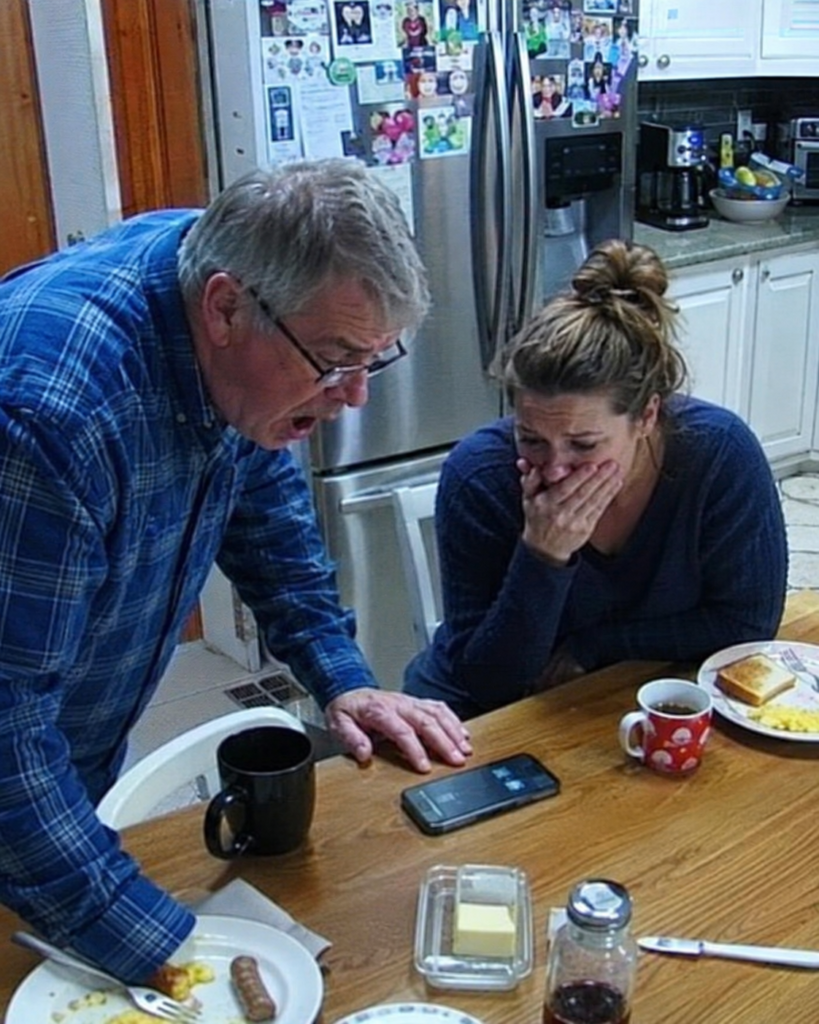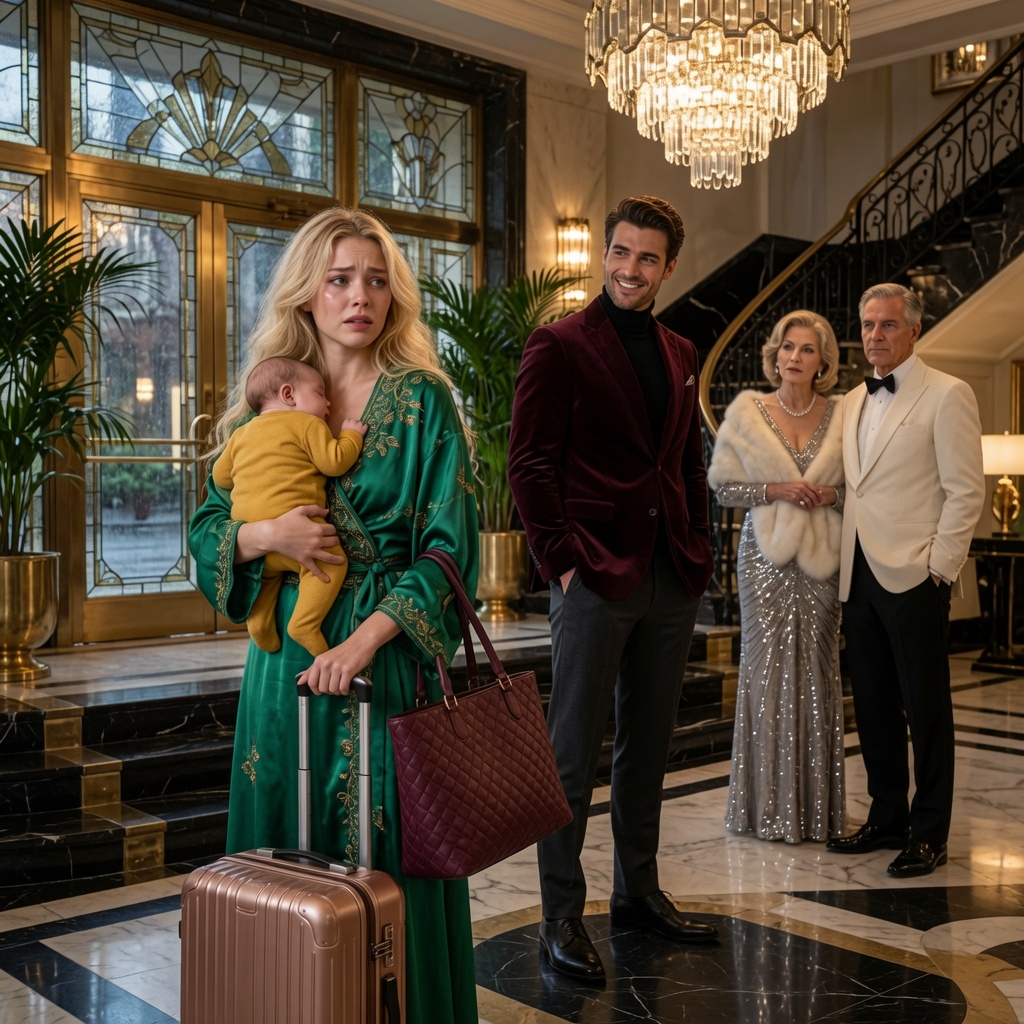
Ruth Alden’s kitchen smelled like chamomile, lemon polish, and old wood warmed by the Arizona sun. It was a small room compared to the Hayes mansion’s marble-and-glass kitchen, but sitting there with my son asleep in a borrowed bassinet near the window, I felt more protected than I had in three years.
Ruth placed a mug of tea in front of me, then reached into a drawer and pulled out a yellow legal pad.
“Before you call anyone,” she said, “write down everything that happened this morning. Exact time. Exact words. Every detail.”
My hand trembled around the pen.
“Now?”
“Especially now,” she said. “Before shock starts cleaning up the edges.”
So I wrote.
4:30 a.m. Trevor came home in yesterday’s suit.
Divorce.
Did not ask about Caleb.
Watched me pack.
Asked where I thought I was going.
Smiled when I left.
By the time I finished, the sun had lifted over the rooftops, spilling pale gold across Ruth’s table. Caleb stirred, making that tiny newborn sound between a sigh and a whimper, and I stood automatically.
Ruth watched me lift him.
“You have a lawyer?” she asked.
“I know one,” I said. “Or I knew her. From my old job.”
“Call her.”
My phone had been silent since I left the mansion. No calls from Trevor. No message asking if Caleb was safe. Nothing from his mother, Evelyn, who usually texted me before six to ask if the guest towels had been steamed or whether the breakfast fruit had been sliced thin enough.
For a moment, staring at that blank screen hurt worse than the word divorce.
Then my phone buzzed.
Trevor.
Not a call.
A message.
Bring the baby back by noon. You’re emotional. Don’t make this ugly.
I almost laughed. Not because it was funny, but because I could hear his voice so clearly. Calm. Annoyed. Certain the world would rearrange itself around his convenience.
Ruth leaned forward. “Don’t respond.”
“I know.”
“No,” she said firmly. “I mean it. Men like him don’t send messages to communicate. They send them to build a story.”
I looked down at Caleb’s soft cheek pressed against my shoulder.
“Then I’ll build mine better.”
At eight-thirty, I called Marisol Vega.
She answered on the second ring, her voice sharp and alert. “Naomi?”
Hearing my name from someone who knew me before I became Mrs. Trevor Hayes nearly broke me.
“I need a divorce attorney,” I said. “And possibly a forensic accountant.”
There was a brief silence.
Then Marisol said, “Where are you?”
I told her.
“I’ll be there in forty minutes.”
She arrived in thirty-two.
Marisol looked almost exactly as I remembered: sleek black hair, dark suit, eyes that missed nothing. She stepped into Ruth’s house carrying a leather bag and the kind of stillness that made chaos feel embarrassed.
She didn’t waste time on pity. She asked questions. Clean, precise ones.
“When did you leave?”
“About five.”
“Did he threaten you?”
“No.”
“Did he ask about the baby?”
“No.”
“Do you have access to marital accounts?”
“Not anymore.”
Her pen paused.
“Not anymore?”
I told her about the passwords. The vanished statements. The sudden change in Trevor’s tone three months earlier, when he realized I had noticed numbers that did not belong where they were. I told her about Hayes Development Group, the family real estate company that funded their mansion, their vacations, their charity galas, and Evelyn’s endless speeches about legacy.
Then I opened the encrypted folder on my laptop.
Marisol’s expression did not change at first. She clicked through the photographs I had taken: wire transfer confirmations glimpsed beside Trevor’s dinner plate; invoices billed to properties that did not exist; charity funds routed through vendors connected to Hayes-owned shell companies; screenshots of account balances that did not match court disclosures from an older lawsuit I had found online.
Then she stopped.
Very slowly, she sat back.
“Naomi,” she said. “Why didn’t you bring this to someone sooner?”
I glanced at Caleb.
“Because I was pregnant. Because I was afraid. Because every time I thought I was ready, Trevor would apologize just enough to make me doubt myself.”
Ruth made a small sound, not quite a sigh.
Marisol clicked another file.
The room changed.
I knew it before she spoke. I saw it in the way her jaw tightened and her shoulders became still.
“What is this?” she asked.
“A ledger I found in a locked cabinet in Edward’s home office,” I said. “Trevor’s father. I only had ten minutes before Evelyn came back from lunch. I photographed what I could.”
Marisol enlarged the image.
Rows of names. Dates. Payments. Initials.
Some entries were ordinary enough to appear harmless unless you knew how to read patterns. Others were worse. Payments to inspectors before permits were approved. Retainers to consultants who never existed. Large donations to a children’s foundation that circled back into Hayes-controlled accounts within forty-eight hours.
And one recurring name that appeared often enough to make Marisol whisper, “Oh, my God.”
I leaned forward. “What?”
She tapped the screen.
“Judge Callahan.”
My stomach tightened.
“I don’t know who that is.”
“You might soon,” she said. “He hears a lot of high-asset divorce and custody cases in this county.”
The tea in my stomach turned cold.
At noon, Trevor filed for emergency temporary custody.
At one, a courier arrived at Ruth’s door with papers claiming I had abducted Caleb from his “primary residence,” was emotionally unstable, had no income, no permanent home, and posed a risk of fleeing the state.
By two, Evelyn Hayes had already begun calling people.
I knew because my phone started lighting up with messages from women I had entertained at her parties.
Thinking of you. Evelyn says you’re struggling.
Please bring the baby home before this becomes worse.
Trevor is devastated. Don’t punish him.
The last message came from a number I did not recognize.
You married above yourself. Leave quietly.
I stared at that one for a long time.
Then I took a screenshot and added it to the file.
Marisol worked from Ruth’s dining room until evening. She filed responses, made calls, and spoke in a low, controlled voice that reminded me of a surgeon preparing an operating room.
By dusk, she had arranged an emergency hearing for the following morning.
“You need to be ready,” she told me. “They’re going to paint you as unstable. They’ll say postpartum hormones. They’ll say you’re overwhelmed. They’ll say you stole the baby.”
“I’m his mother.”
“And Trevor is a Hayes,” she said. “That means they believe the room belongs to them before they enter it.”
Ruth set a plate of soup in front of me. “Then she’ll enter first.”
I barely slept that night. Caleb woke every two hours, rooting against my chest, and each time I fed him in the dark, I thought of the nursery at the mansion. The hand-painted clouds. The imported crib Evelyn chose without asking me. The silver rattle engraved with CALEB EDWARD HAYES, as if even his middle name had been another deed transferred into their possession.
At three a.m., my phone buzzed again.
This time it was Trevor.
You’re making a mistake.
A second later:
My father wants to fix this quietly. You can still walk away with dignity.
Then:
But if you go after my family, I will make sure Caleb grows up knowing you destroyed everything.
I stared at the messages until the words blurred.
Then I forwarded them to Marisol.
Her reply came almost instantly.
Good. Keep letting him talk.
The courthouse smelled like floor wax and old paper. I arrived in the same navy dress I had worn to Caleb’s baptism because most of my clothes were still in Trevor’s closet. Ruth held the baby while I signed documents with Marisol.
At 9:15, the Hayes family arrived.
Trevor walked in first, clean-shaven, wearing a charcoal suit and the wounded expression of a man who had practiced being misunderstood in the mirror.
His mother came behind him in cream silk, pearls at her throat, her silver hair swept into a flawless twist. Evelyn Hayes did not look at me. She looked at Caleb.
Not with love.
With ownership.
Edward Hayes entered last. Tall, composed, expensive in a way that did not need labels. He nodded to a few attorneys, shook one man’s hand, and smiled as if the courthouse were a private club.
Then his eyes landed on me.
For the first time since I had known him, Edward looked uncertain.
Not afraid.
Just aware.
That was enough.
In the courtroom, Trevor’s attorney stood and told the judge a beautiful story.
He said I had been fragile since giving birth. He said Trevor had been concerned for weeks. He said I had grown paranoid about family finances, accusing people without basis. He said I had fled before dawn with a newborn and no plan.
When Trevor took the stand, he lowered his voice just enough.
“I love my son,” he said. “I’m worried about Naomi. I want her to get help. But Caleb needs stability.”
He did not look at me when he said it.
I wondered whether he was ashamed.
Then I saw his mother’s faint smile.
No. He was performing.
Marisol rose.
She did not attack him. She did something worse.
She asked simple questions.
“Mr. Hayes, what time did you arrive home yesterday morning?”
Trevor adjusted his cuff. “Around four-thirty.”
“From work?”
“Yes.”
“What kind of work were you doing at four-thirty in the morning?”
A flicker.
“Meetings. Calls with overseas investors.”
“Did you ask to hold your son when you came home?”
He hesitated.
“No. It was tense.”
“Did you ask whether your son had eaten?”
“No.”
“Did you tell your wife you wanted a divorce while she was holding your two-month-old baby?”
His attorney stood. “Objection.”
The judge allowed it.
Trevor’s face hardened. “Yes.”
“Did you arrange alternative housing for your wife and infant son before asking for that divorce?”
“No.”
“Did you send this message at 12:06 p.m.?”
She handed a copy to the clerk.
Trevor’s mouth tightened.
Bring the baby back by noon. You’re emotional. Don’t make this ugly.
Marisol turned toward the judge. “Your Honor, we have several messages like this. We also have evidence that Mrs. Hayes’ access to marital funds was restricted before Mr. Hayes requested a divorce.”
Trevor’s attorney stood again, objecting faster now.
Then Marisol opened the folder.
Not the whole thing.
Just enough.
Bank access logs. Screenshots. Dates. A timeline showing how Trevor removed me from accounts two weeks before asking for a divorce. Proof that my name had been quietly taken off household credit lines. Emails from Evelyn instructing staff not to allow me use of “family vehicles without permission.”
Each page was a small match.
Together they made smoke.
The judge leaned forward.
Marisol’s voice remained even. “Mrs. Hayes did not flee without a plan. She left after her husband ended the marriage at dawn, after months of financial restriction, while caring for an infant. She is staying with a longtime family friend. The baby is safe. What is not safe is returning him to a household where the mother’s access to resources was deliberately cut off.”
For the first time, Trevor looked at me.
Not hurt now.
Angry.
The judge denied Trevor’s emergency custody request.
Temporary physical custody remained with me. Trevor received supervised visitation twice a week until a fuller hearing could be held. He was ordered not to remove Caleb from my care, not to interfere with my finances, and not to contact me except through attorneys or a parenting app.
Evelyn’s face did not move when the ruling came down.
That frightened me more than if she had shouted.
Outside the courtroom, Trevor caught up to me near the elevators.
He stayed far enough away to avoid violating the order, but close enough for me to hear him.
“You have no idea what you just did.”
I shifted Caleb higher against my shoulder.
“No,” I said. “You don’t.”
His eyes sharpened.
For one second, I saw the boy beneath the Hayes polish. Spoiled. Cornered. Dangerous because he had never been taught to lose.
Then Edward’s hand landed on his shoulder.
“Not here,” his father said quietly.
But Edward was looking at me.
That evening, Marisol called with news.
“The judge signed the temporary support order,” she said. “Trevor has to restore access to marital funds and cover housing expenses.”
I sat on Ruth’s porch with Caleb asleep in my lap. The sky was purple over Scottsdale, and the air smelled like dust and orange blossoms.
“That was fast,” I said.
“That was the easy part.”
“What’s the hard part?”
Marisol paused.
“The financial disclosures. Once we request them formally, they’ll know what you have.”
I watched a moth batter itself against Ruth’s porch light.
“They already suspect.”
“Suspecting is different from seeing the knife.”
The next week moved like a storm trapped inside glass. Quiet on the outside. Violent within.
Trevor sent polite messages through the parenting app, each one clearly written for a future judge.
I hope you and Caleb are well.
Please let me know if he needs anything.
Looking forward to seeing my son.
At supervised visits, he wore soft sweaters and brought wooden toys. The supervisor wrote that he was “attentive” and “appropriate.” Caleb mostly slept through them.
Evelyn did not attend. That worried me.
Women like Evelyn did not withdraw. They repositioned.
On Friday, Ruth and I returned from the pediatrician to find a black SUV parked across the street. The windows were tinted. The engine was running.
Ruth noticed it at the same time I did.
“Inside,” she said.
My pulse quickened. “You think it’s them?”
“I think rich people rarely do their own watching.”
I carried Caleb in, locked the door, and called Marisol.
She did not sound surprised.
“Document it,” she said. “Photo, time, plate if visible. Don’t confront anyone.”
Ruth stood by the front curtain, phone in hand.
“Plate’s covered,” she said.
The SUV stayed for forty-three minutes.
The next morning, an article appeared online.
LOCAL REAL ESTATE HEIR SEEKS CUSTODY AMID CONCERN FOR INFANT SON
There were no names in the headline, but the details made it obvious. The article described a “prominent Scottsdale family,” a “troubled young mother,” and a “bitter domestic dispute.” It quoted an anonymous family friend who said Trevor had been “heartbroken” and “deeply worried.”
By noon, Evelyn’s social circle had shared it everywhere.
My hands shook as I read the comments.
Some people called me unstable. Some called me a gold digger. Some said a good mother would never run away.
Ruth took the phone gently from me.
“Stop feeding yourself poison.”
“They’re making me look insane.”
“No,” Ruth said. “They’re making themselves comfortable. There’s a difference.”
That afternoon, Marisol filed for a protective order limiting public statements involving the custody matter. Then she did something I had not expected.
She sent a preservation letter to Hayes Development Group.
Not just Trevor.
The company.
Edward Hayes.
Evelyn Hayes.
Their accountants.
Their attorneys.
Their foundation.
Every entity named in the files.
The letter demanded they preserve all communications, financial records, transaction histories, electronic devices, cloud backups, charity ledgers, vendor contracts, and internal audits.
“Once they receive it,” Marisol said, “destroying anything becomes a much bigger problem.”
“And if they already destroyed things?”
“Then we find the smoke marks.”
The response came faster than expected.
Not from Trevor.
From Edward.
He requested a meeting.
“No,” Marisol said immediately when I told her.
“He asked through his attorney.”
“Still no.”
“He says it concerns Caleb.”
Marisol went quiet.
Then she said, “Forward me everything.”
The proposed meeting was to take place at her office with attorneys present. That alone told me Edward was taking no chances.
Two days later, I sat across from my father-in-law in a glass-walled conference room high above downtown Phoenix. Marisol sat beside me. Edward’s attorney sat beside him. A recorder rested on the table between us.
Edward looked older than he had in court.
Not weak. Never weak.
But the skin beneath his eyes had loosened, and his hands, folded on the table, were not quite still.
“Naomi,” he said, “this has gone too far.”
I said nothing.
He turned slightly toward Marisol. “My family is prepared to offer a generous settlement.”
Marisol uncapped her pen. “Define generous.”
“Five million dollars. A house purchased in Naomi’s name. Full medical coverage for the child. Joint custody, with Trevor having unsupervised visitation after a transition period.”
My breath stopped.
Five million dollars.
For three years, Evelyn had made me feel indebted for grocery money.
Now Edward was offering me five million dollars to stop looking.
Marisol’s voice was dry. “And in exchange?”
Edward’s eyes returned to mine.
“Confidentiality. Mutual non-disparagement. Immediate withdrawal of all financial allegations unrelated to the divorce.”
“There are financial allegations related to the divorce,” Marisol said.
Edward ignored her.
“Naomi, you have a son to think about.”
I felt Caleb’s weight in my arms though he wasn’t there. Ruth had him at home.
“I am thinking about him.”
Edward leaned forward.
“Then think carefully. The Hayes name can protect him. Or your choices can bury him beneath scandal before he knows how to walk.”
There it was. Not a threat dressed as concern.
Concern dressed as a threat.
For the first time, I smiled.
Edward noticed. His expression cooled.
“What?” he asked.
“You all keep making the same mistake.”
“And what mistake is that?”
“You think I want your name.”
His jaw flexed.
“I don’t,” I said. “I want my son free of it.”
The settlement offer expired at five o’clock.
At five-oh-three, Marisol received an anonymous email.
No subject line.
No message.
Only an attachment.
A video file.
She called me immediately and told me not to open anything on my own devices. I drove to her office after leaving Caleb with Ruth. By the time I arrived, Marisol’s forensic consultant had already isolated the file on a secure machine.
The video showed Edward’s home office.
The angle was high, probably from a security camera. The timestamp was from four months earlier, when I was heavily pregnant and still pretending not to notice anything.
Edward stood near his desk. Trevor paced in front of him.
Their voices were clear.
“She’s looking at accounts,” Trevor said.
Edward poured a drink. “Then stop leaving papers around.”
“She was an accountant, Dad. She knows what she’s seeing.”
“Does she know enough to prove it?”
Trevor dragged a hand through his hair. “I don’t know.”
Evelyn entered the frame then, wearing a pale robe, her face bare of makeup and somehow more severe.
“I told you not to marry clever,” she said.
Trevor turned on her. “This is not helpful.”
Evelyn ignored him. “Move her into dependence. Cut off access slowly. Make her emotional. Pregnant women are easy to discredit.”
My skin went cold.
On the screen, Edward said nothing.
Evelyn continued, calm as glass. “After the baby comes, wait. Let exhaustion do most of the work. Then file first.”
Trevor stopped pacing.
“And Caleb?”
Evelyn’s voice softened.
Not with love.
With calculation.
“Caleb is Hayes blood. He stays.”
The video ended.
No one spoke in Marisol’s office.
I stared at the frozen screen, at Evelyn’s pale face caught mid-sentence.
Pregnant women are easy to discredit.
Marisol’s consultant finally cleared his throat. “There’s metadata. Original file, not edited.”
Marisol looked at me. “Do you know who could’ve sent this?”
I shook my head.
But I was lying.
Not completely. I did not know.
I suspected.
When I returned to Ruth’s house, the porch light was off. That was strange. Ruth always left it on for me.
I found her in the kitchen, sitting at the table with Caleb asleep beside her in the bassinet. In front of her was an old cardboard box tied with twine.
She looked up as I entered.
“You saw the video,” she said.
I stopped in the doorway.
My heart began to pound.
“How do you know that?”
Ruth touched the twine with one finger.
“Because I sent it.”
The room seemed to tilt.
“You?”
She untied the box slowly, like someone opening a grave.
“I worked for Edward Hayes before you were born,” she said. “Not as a neighbor. Not as a friend. As his bookkeeper.”
I could not move.
Ruth lifted the lid.
Inside were ledgers. Photographs. Old checks. Handwritten notes. Newspaper clippings yellowed at the edges. A stack of VHS tapes. A flash drive taped to an envelope.
“I kept quiet for thirty years,” she said. “Then you came to my door with that baby.”
My throat tightened. “Ruth, what is all this?”
She looked at Caleb.
Then back at me.
“The beginning,” she said. “But not of Trevor’s downfall.”
She reached into the box and removed a sealed envelope. My name was written across the front in ink that had faded brown with age.
Naomi.
I stared at it.
“That’s impossible,” I whispered. “You didn’t know me then.”
Ruth’s eyes filled with something I had never seen in them before.
Fear.
“No,” she said softly. “But your mother did.”
…If you want to know what happened next, please type “YES” and like for more.