Alexander did not move for several seconds.
The note trembled in his hand, though everything else about him remained still—the polished shoes planted on the carpet, the expensive suit tailored to perfection, the face of a man who had probably negotiated with kings and destroyed rivals without raising his voice.
But now, with one piece of paper between his fingers, he looked like someone had reached into his chest and broken something old.
“Protect her from our father,” I read aloud, though the words felt wrong in my mouth. Too dramatic. Too impossible. Too much like the beginning of someone else’s nightmare.
Alexander folded the note carefully, almost reverently, and placed it back inside the briefcase.
“Who was she?” I asked.
His eyes lifted to mine.
“My sister,” he said. “Isabella.”
The name hit the air like a match striking in darkness.
I didn’t know why my heart reacted to it. I had never heard that name in my life. At least, not that I could remember. But something inside me shifted, as if a locked room in my mind had heard a familiar key turn.
“Isabella,” I repeated.
Alexander’s jaw tightened. “She was twenty-three when she vanished. Brilliant. Reckless. Kind in a way our family never understood.” He looked at the photograph again. “She was engaged to a man our father hated. Then one morning, she was gone.”
“Gone how?”
“Her apartment was empty. Her phone disconnected. Her bank accounts untouched. No ransom. No goodbye.” His voice lowered. “My father said she chose to leave.”
“And you believed him?”
A shadow crossed his face.
“I was seventeen.”
That answer told me enough.
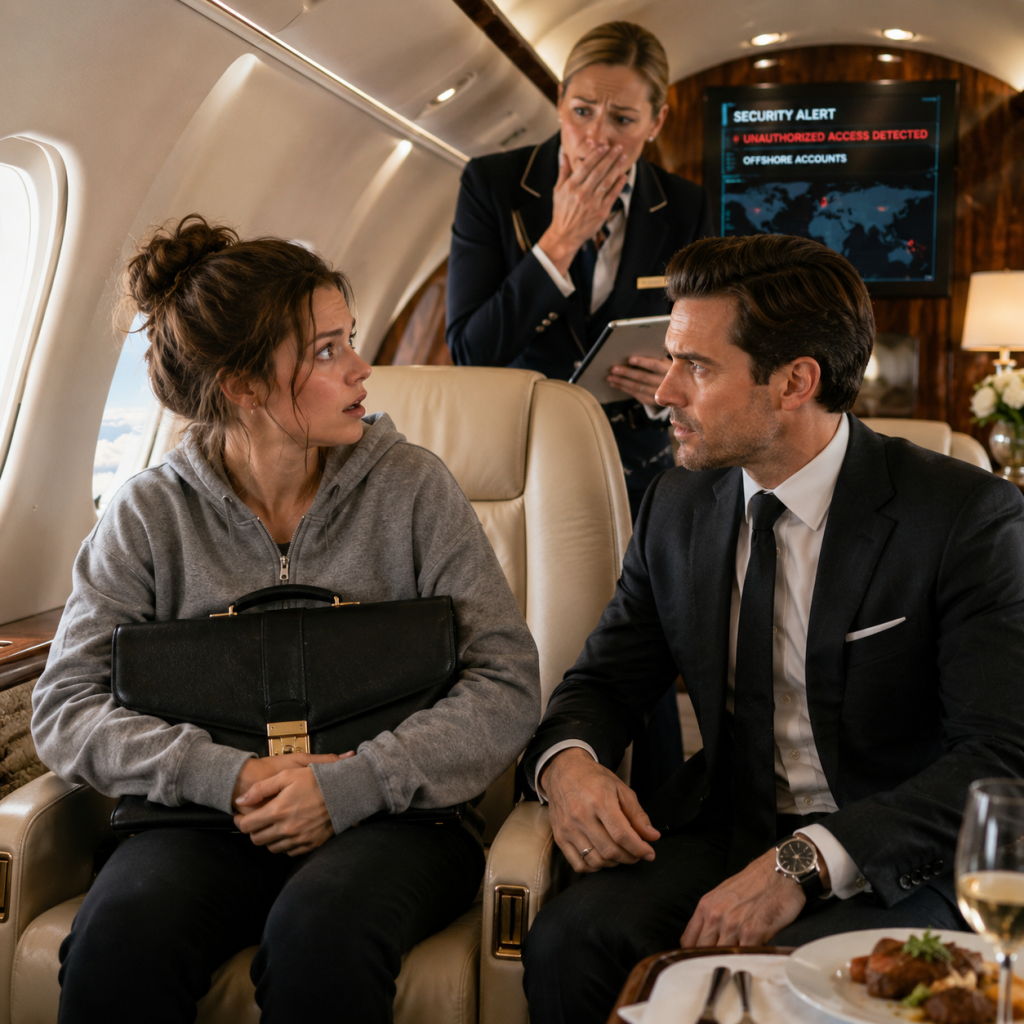
Outside the jet window, clouds rolled beneath us like pale waves, hiding the earth completely. The world felt far away, and suddenly I understood the danger of being trapped in the sky with a billionaire who might know more about my life than I did.
“What does this have to do with me?” I asked.
Alexander didn’t answer quickly.
Instead, he reached into the briefcase again and removed the photograph. He held it beside my face, and the flight attendant gasped before she could stop herself.
I didn’t need a mirror.
I could see it in Alexander’s eyes.
I looked like her.
Not a little. Not in the vague way strangers sometimes say people resemble each other.
I looked like the younger echo of the woman in the photograph.
Same eyes. Same birthmark. Same delicate slope of the nose. Same expression around the mouth, as if we were both always one second away from saying something we shouldn’t.
My fingers grew cold.
“My mother died when I was a baby,” I said automatically.
“Who told you that?”
“My foster records.”
Alexander’s face changed again, and this time I recognized the emotion.
Anger.
Not at me.
At something far away and long buried.
“Emma,” he said carefully, “what was your mother’s name in those records?”
I swallowed.
“Mara Collins.”
He closed his eyes for a moment.
“That was not my sister’s name.”
The cabin seemed to narrow.
I thought of the social workers who passed me from one temporary house to another. The plastic bags filled with my clothes. The school forms with blank spaces where family history should have been. The way every adult in charge of my life had spoken softly whenever I asked about where I came from.
“I don’t understand,” I whispered.
“I don’t either,” Alexander said. “Not yet.”
His words should have comforted me.
They didn’t.
Because the more I looked at him, the more I saw a resemblance there too. Not as obvious as the woman in the photograph, but it existed in the line of his cheekbones and the color of his eyes. He was a stranger who suddenly looked like family, and that frightened me more than when I had believed him dangerous.
The flight attendant took a hesitant step forward.
“Mr. Blackwood,” she said quietly, “should I contact security on arrival?”
Alexander’s gaze snapped to her. “No.”
She lowered her eyes.
“No one knows about this,” he continued. “Not the pilots. Not the staff. Not my office.”
“But sir—”
“No one.”
His voice was calm, but the warning inside it was clear enough to silence the entire cabin.
I looked from him to the briefcase. “Why would someone put that in my hands?”
“That is the question.”
“And why now?”
Alexander’s fingers rested on the edge of the table between us. “Because my father is dying.”
The words landed heavily.
I stared at him. “Your father?”
“Victor Blackwood.”
Even I knew that name.
Everyone did.
Victor Blackwood was not just rich. He was the kind of rich people spoke about with lowered voices. Old money. Oil. Banks. Hotels. Private islands. Political friendships that never appeared in photographs. His face appeared in magazines beside headlines about philanthropy, power, and legacy.
He was the man whose name was printed on hospital wings, university libraries, and museums where people like me could only afford to stand outside and take pictures.
“That’s your father?” I asked.
Alexander gave a humorless smile. “Unfortunately.”
My throat tightened.
Protect her from our father.
The sentence no longer felt dramatic.
It felt like a warning written by someone who had run out of time.
“When is he dying?” I asked.
Alexander looked toward the window. “Soon. According to his doctors. Though men like my father have a talent for surviving long after decency gives up on them.”
There was bitterness in his voice, but beneath it something more complicated—fear, perhaps, or loyalty worn thin from years of being stretched.
“Does he know about me?”
“I don’t know.”
“But if he does…”
Alexander looked back at me.
“If he does,” he said, “then you are in danger.”
I laughed once, sharp and breathless. “That’s insane. I’m nobody.”
“No,” he said softly. “That may be exactly why you survived.”
Before I could answer, the jet dipped slightly. The seatbelt sign chimed. The flight attendant announced our descent into New York, but her voice sounded far away, as though coming through water.
New York.
I had boarded the plane thinking I was heading to an interview for a job I probably wouldn’t get. A last chance. A desperate attempt to build a life that did not smell like unpaid rent and old disappointment.
Now I was sitting across from a man who might be my uncle, holding a note from a dead or missing woman who might be my mother, while the name of one of the most powerful men in America hung over us like a blade.
Alexander closed the briefcase and locked it.
“When we land,” he said, “you stay close to me.”
“I don’t even know you.”
“No,” he said. “But whoever arranged for you to receive this briefcase knew both of us well enough to force this meeting.”
“Force?”
His eyes sharpened. “You said you thought the briefcase was yours.”
I nodded.
“Where was your bag?”
“Beside me at the gate.”
“And when you picked this up?”
“I was tired. There was a delay. I looked down and it was there.”
“Meaning someone switched them.”
The thought made my skin crawl.
Someone had stood close enough to touch my things. Someone had watched me sleep. Someone had chosen me.
“Who?” I whispered.
Alexander didn’t answer.
The plane landed twenty minutes later.
The moment the wheels touched the runway, my old life ended without ceremony.
No thunder. No announcement. Just a soft jolt, a rush of engines, and the sickening realization that there was no going back to being Emma Collins, broke waitress, anonymous orphan, invisible girl.
By the time the jet door opened, two black cars waited on the tarmac.
Alexander stepped out first. He offered me his hand, and for a second I hesitated.
His hand remained steady.
I took it.
The air was cold, sharp with fuel and winter. Men in dark coats stood near the vehicles, their faces blank in the practiced way of private security. One of them reached for my suitcase.
Alexander stopped him.
“I’ll carry hers.”
The guard froze, surprised.
Alexander took my worn suitcase himself, the ridiculous old thing with one cracked wheel and a faded sticker from a city I had never visited. Seeing it in his hand, beside his perfect suit and private jet, made my eyes burn unexpectedly.
Maybe because no one had carried anything for me in years.
Maybe because kindness felt more dangerous now than cruelty.
He led me to the second car.
“Where are we going?” I asked.
“My house.”
“No.”
He paused.
“I’m not going to some stranger’s house because of a creepy note and a photograph.”
“You cannot go to your hotel.”
“I didn’t tell you I had a hotel.”
His silence answered me.
I stepped back. “You checked?”
“Before the flight took off. I check everyone near me.”
“That’s not comforting.”
“It was not meant to be.”
The wind pulled at my hair. I hugged my coat tighter around myself.
“I need space to think,” I said.
“You need protection.”
“I need answers.”
“So do I.”
We stared at each other on the tarmac, both too stubborn to move.
Then his phone rang.
He glanced at the screen, and the color drained from his face.
“What?” I asked.
He answered.
For three seconds, he said nothing.
Then a voice came through faintly on the other end. I couldn’t make out the words, only the tone—old, thin, amused.
Alexander’s expression hardened into stone.
“How did you get this number?” he asked.
The voice continued.
Alexander looked at me.
Every instinct in my body screamed.
He ended the call without saying goodbye.
“Get in the car,” he said.
“What happened?”
“Now, Emma.”
This time, I did not argue.
Inside, the car smelled of leather and cedar. The doors locked softly, sealing us away from the world. Alexander sat beside me, the briefcase between us like a sleeping animal.
“Who was that?” I asked.
He stared ahead.
“My father.”
My heart slammed once.
“What did he say?”
Alexander’s hand curled into a fist.
“He said, ‘Bring my granddaughter home.’”
The city blurred past the tinted windows in silver and black streaks.
Granddaughter.
The word filled the car until there was no room for air.
I wanted to reject it. Laugh at it. Tear it apart with logic. But the photograph was still in the briefcase, and the note existed, and Victor Blackwood had known about me within minutes of the plane landing.
Maybe before.
“Stop the car,” I said.
Alexander did not look at me. “No.”
“Stop the car!”
“You are panicking.”
“Of course I’m panicking! A dying billionaire just called me his granddaughter!”
The driver’s eyes flicked briefly to the mirror.
Alexander noticed. “Eyes on the road.”
The driver obeyed.
I turned toward Alexander. “Did you know before today?”
“No.”
“Swear it.”
His eyes met mine.
“I swear on Isabella’s memory.”
The answer was immediate. Quiet. Final.
I believed him, and hated that I did.
We crossed a bridge into Manhattan, where towers rose like glass knives beneath the gray sky. I had dreamed of New York once, back when dreaming still felt like something that belonged to me. I thought I would arrive with a suitcase and ambition, maybe cry in a tiny apartment, maybe become someone new.
Instead, I arrived in a locked car beside a man with my mother’s eyes.
Alexander’s house was not a house.
It was a limestone mansion hidden behind iron gates on a quiet street where even the trees looked expensive. Security cameras watched from corners. A guard stepped out before the car fully stopped. Another opened my door.
I almost refused to leave the car, but then I saw the wrought-iron gate closing behind us, trapping me inside wealth so old and polished it felt like a museum for secrets.
Alexander led me through a marble foyer into a sitting room warmed by a fire. Everything looked untouched. Beautiful, but not lived in. The kind of room where silence had been arranged by an interior designer.
“Sit,” he said.
“I’m not a dog.”
His mouth twitched faintly. “Please sit.”
I sat.
He handed the briefcase to a guard. “Lock this in my private study. No one opens it.”
The guard nodded and left.
I watched him disappear. “I don’t like that being away from me.”
“You didn’t like it near you either.”
“That was before I found out it may be the only proof I exist.”
Alexander’s expression softened slightly. “You exist with or without proof.”
I looked away.
That was exactly the kind of thing people said when they had never needed documents to be believed.
A woman entered carrying a silver tray with tea, coffee, and food arranged in small perfect portions. I realized I hadn’t eaten since the airport. My stomach hurt with hunger, but I refused to touch anything.
Alexander noticed.
“It isn’t poisoned.”
“That’s what someone would say if it were poisoned.”
This time, he almost smiled.
The woman left. The doors closed.
Finally, we were alone.
Alexander removed his jacket and stood by the fire. For the first time, I saw how tired he looked beneath the expensive surface.
“My father built an empire on control,” he said. “People think money was his gift. It wasn’t. His gift was knowing what everyone wanted, feared, regretted, and owed. He collected secrets the way other men collected art.”
“And Isabella?”
“She was the one thing he couldn’t control.”
I leaned forward despite myself.
“She fell in love with Daniel Reyes,” Alexander continued. “A journalist. Poor, stubborn, fearless. He was investigating Blackwood Holdings.”
“My father?”
Alexander nodded. “And Victor hated him for it. Not because Daniel was wrong, but because he was close to proving it.”
“Proving what?”
Alexander’s eyes darkened. “That my father’s fortune was built on more than business.”
A chill slid over me.
“What happened to Daniel?”
“He died.”
The room went quiet.
“How?”
“Car accident, according to the report.”
“But you don’t believe that.”
“No.”
I thought of the note again.
Protect her from our father.
“Was Isabella pregnant?” I asked.
Alexander looked at me for a long moment.
“We never knew.”
My breath caught.
“After Daniel died,” he said, “Isabella came home one last time. I heard her fighting with our father in his study. She said he would never find the child. I thought she meant…” He stopped, voice roughening. “I thought she was threatening to disappear and start over. I didn’t understand.”
I wrapped my arms around myself.
A child.
Me.
Hidden. Renamed. Passed through systems. Buried under paperwork.
“What if she’s alive?” I asked.
Alexander’s face did not move, but something in his eyes did.
“I have asked myself that question every day for twenty-six years.”
Before I could respond, the sitting room doors opened.
A tall woman in a cream suit walked in without knocking. Her silver-blonde hair was pulled back tightly, her posture elegant, her eyes sharp enough to cut thread.
She stopped when she saw me.
For one second, her expression cracked.
Then it vanished.
“Alexander,” she said. “You should have told me we had a guest.”
His voice cooled. “Vivienne.”
She looked me over with a smile that contained no warmth. “And who might this be?”
I stood before Alexander could answer.
“Emma Collins.”
“Collins,” she repeated, tasting the lie in my name. “How ordinary.”
Alexander stepped forward. “Why are you here?”
Vivienne removed her gloves slowly. “Your father asked for you.”
“He can call.”
“He did. You hung up.”
“And yet the world continued.”
Her smile sharpened. “Barely.”
Then her gaze returned to me.
It lingered on my face.
The birthmark.
The eyes.
The ghost.
Vivienne’s hand tightened around her gloves.
“Well,” she said softly. “That is unfortunate.”
My pulse jumped.
“You know who I am.”
She looked amused. “My dear, in this family, knowing is rarely the same as saying.”
Alexander’s voice dropped. “Careful.”
Vivienne ignored him. “Victor wants both of you at the estate tonight.”
“No.”
“He is dying.”
“You’ve said that for years.”
“This time he means it.”
“Death is not one of his business appointments, Vivienne. He doesn’t get to demand attendance.”
Her eyes flashed. “He changed the will.”
The room went still.
Alexander’s face revealed nothing. “When?”
“This morning.”
Before the briefcase. Before the flight landed. Before I knew any of this.
My mouth went dry.
Vivienne looked at me as though I had tracked mud onto a priceless rug.
“The revised documents include a beneficiary previously unknown to the family,” she said. “A young woman named Emma.”
The silence after my name was so complete I could hear the fire crackle.
Alexander’s eyes narrowed. “How much?”
Vivienne smiled.
“Everything.”
For a moment, I thought I had misheard.
Then Alexander went very still.
Everything.
The mansion. The banks. The hotels. The foundations. The blood-soaked invisible machinery of an empire.
“No,” I said.
Both of them looked at me.
“No,” I repeated, louder. “I don’t want anything.”
Vivienne laughed softly. “How charming. She thinks wanting matters.”
Alexander turned to her. “Leave.”
“Gladly. But understand this—by sunrise, every cousin, board member, lawyer, investor, and parasite attached to the Blackwood name will know she exists.” Vivienne stepped closer to me, her perfume cold and expensive. “Run, hide, cry, refuse. It won’t matter. The moment Victor named you, you became the most valuable and most hated girl in this city.”
I couldn’t breathe.
Vivienne moved toward the door, then paused.
“Oh,” she added, glancing back at Alexander. “Your father also said to tell her something.”
My fingers curled into my sleeves.
“He said, ‘Ask Emma why her mother never came back.’”
The door closed behind her.
The sentence stayed.
Ask Emma.
Not ask Alexander.
Not ask the records.
Ask me.
As if I knew.
As if somewhere inside me, buried beneath years of forgetting, there was an answer.
Alexander crossed the room and opened a cabinet. He poured a drink, then seemed to remember I was there and set it down untouched.
“We are not going to the estate,” he said.
“Yes, we are.”
He turned. “No.”
I surprised even myself by meeting his stare.
“Your father knows who I am. Your stepmother, aunt, whatever she is, knows who I am. Someone planted that briefcase so I’d meet you. Someone changed a will and made me a target. And now Victor says my mother didn’t come back, like there’s a reason.” My voice shook, but I did not stop. “I have spent my entire life being the last person to learn the truth about myself. I’m done.”
Alexander studied me.
For the first time, he looked less like a billionaire and more like a man standing in front of a storm, measuring whether he could survive it.
“Vivienne is my father’s third wife,” he said finally. “And she never delivers messages unless they benefit her.”
“Then let’s find out why this one did.”
His jaw flexed.
“It may be a trap.”
I almost laughed.
“Alexander, I think my whole life was a trap.”
We left within the hour.
This time, the convoy had three cars.
I sat beside Alexander in the middle one while the city gave way to quieter roads, then iron fences, then stretches of land too wide and empty to belong to anyone who was not absurdly powerful.
The Blackwood estate appeared at dusk.
It rose behind black gates at the end of a road lined with skeletal winter trees. The mansion was enormous, old, and severe, its windows glowing amber like watchful eyes. It did not look like a home. It looked like a place where families went to become legends, then ghosts.
My hands were cold.
Alexander noticed but did not comment.
At the entrance, servants opened the doors before we reached them. Inside, the air smelled of wax, roses, and something medicinal hidden beneath expensive candles.
Portraits lined the walls.
Men with hard eyes.
Women with pearls and secrets.
Children posed like heirs before they were old enough to understand inheritance was another word for war.
And then I saw her.
A portrait halfway down the hall.
Isabella Blackwood.
Younger than in the photograph. Maybe nineteen. Wearing a green dress, dark hair falling over one shoulder, eyes bright with something no painter had managed to tame.
I stopped.
The world narrowed.
For one impossible second, I heard a lullaby.
Soft. Hummed. Familiar.
My knees nearly buckled.
Alexander caught my elbow. “Emma?”
“I know that song,” I whispered.
“What song?”
But it was gone.
A memory like a candle blown out.
Before I could chase it, a door opened at the end of the hall.
Vivienne emerged.
Behind her stood a doctor, two lawyers, and a man I recognized from business magazines as Alexander’s cousin, Julian Blackwood. His smile vanished when he saw me.
“So it’s true,” Julian said.
Alexander placed himself slightly in front of me.
Julian’s gaze flicked to him. “Relax. I’m not going to bite our little miracle.”
“Speak to her like that again,” Alexander said, “and you’ll lose teeth.”
Julian’s smile returned, thinner this time.
Vivienne clapped once, softly. “How touching. A family reunion.”
“Where is Victor?” Alexander asked.
“In the west room.”
“Alone?”
Vivienne’s eyes moved to me. “He requested the girl first.”
“No.”
“Yes,” she said. “Those were his terms.”
“I don’t care about his terms.”
But I stepped around Alexander.
“I’ll go.”
His head snapped toward me. “Emma.”
I looked up at him. “He’s dying, right?”
No one answered.
“Then he has less time to lie.”
Alexander did not like it. I could see that clearly. But he also knew I was right, or at least too determined to stop without making a scene in front of the vultures.
Vivienne led me down a corridor where the carpet swallowed every footstep.
At the last door, she paused.
“Do not believe everything he says,” she murmured.
I looked at her. “Because he lies?”
Her smile was strange.
“Because sometimes the truth is worse.”
Then she opened the door.
The room beyond was dim, lit by lamps shaded in dark red. Heavy curtains covered the windows. Machines hummed quietly beside a large bed, where an old man lay propped against pillows.
Victor Blackwood was smaller than I expected.
Not weak.
Never weak.
Even dying, he seemed to occupy the room like a throne. His white hair was combed back. His skin was pale and thin, but his eyes were alive—gray, clear, and terribly amused.
He looked at me.
And smiled.
“Isabella,” he whispered.
My heart stopped.
Then his smile changed.
“No,” he said. “Not Isabella. Her daughter.”
I stood near the door, refusing to move closer.
“My name is Emma.”
“So they told you.”
“So everyone told me.”
He gave a faint chuckle that turned into a cough. The doctor moved forward, but Victor lifted one finger, and the man froze.
Power, I realized, did not need strength.
Sometimes it only needed habit.
Victor’s eyes returned to me. “You have her defiance.”
“I have nothing from you.”
“That remains to be seen.”
I forced myself to breathe.
“Where is my mother?”
Victor studied me for a long moment.
Then he said, “Alive.”
The room tilted.
Behind me, I heard Vivienne inhale sharply.
Alive.
One word, and the floor vanished beneath twenty-six years of grief I had been handed before I was old enough to question it.
“You’re lying,” I said.
“I often do,” Victor replied. “Not about this.”
My voice came out smaller. “Where is she?”
He smiled again, and this time there was something almost tender in it, which somehow made him more terrifying.
“Waiting.”
“For what?”
“For you.”
I took a step forward despite myself. “Where?”
Victor’s gaze moved past me to Vivienne.
“Leave us.”
Vivienne stiffened. “Victor—”
“Leave.”
For the first time since I had met her, Vivienne looked afraid.
She obeyed.
The door closed.
Now it was only Victor and me, with the machines humming between us like mechanical insects.
He lifted a trembling hand toward the bedside table. “Open the drawer.”
I didn’t move.
He smiled. “Still alive enough to kill you, child, but too tired to get my own drawer. Choose which fact matters more.”
Slowly, I opened it.
Inside was a small brass key, a faded hospital bracelet, and a folded photograph.
I picked up the photograph.
A young woman lay in a hospital bed, exhausted and smiling through tears.
Isabella.
In her arms was a newborn baby wrapped in a white blanket.
On the back, in blue ink, someone had written:
Emma. Born during the storm. Hide her well.
My vision blurred.
I did not cry. Not then. Something in me went too quiet for tears.
Victor watched me like a man watching a safe unlock.
“She begged me,” he said. “Not for herself. For you.”
“What did you do to her?”
“I saved her life.”
“You expect me to believe that?”
“No,” he said. “I expect you to misunderstand it until it is too late.”
The machines continued their steady rhythm.
I gripped the photograph. “Why did she write protect me from you?”
Victor closed his eyes briefly.
“Because she thought I was the monster.”
“And weren’t you?”
When he opened his eyes again, the amusement had faded.
“Yes,” he said simply. “But not the only one.”
A knock sounded at the door.
Victor’s face changed.
Fear.
Real fear.
It flashed across his eyes so quickly I might have missed it if I had not been staring straight at him.
The door opened before he could speak.
Alexander stepped in.
His expression was controlled, but his gaze immediately went to the photograph in my hand.
“What did he give you?” he asked.
I turned toward him, still shaking.
“My mother is alive.”
Alexander froze.
Victor laughed softly from the bed.
“Careful, son,” he whispered. “This is the part where everyone chooses which lie they love most.”
Alexander moved closer. “Where is Isabella?”
Victor looked at him with something almost like pity.
“You still think this began with her disappearance.”
The lights flickered.
Once.
Twice.
Then the machines beside Victor’s bed let out a sharp, broken alarm.
Alexander turned toward the hallway. “Doctor!”
No one came.
The lights went out completely.
For three seconds, the room drowned in darkness.
Then emergency lights glowed red along the floor.
The bed was empty.
I stared.
Victor Blackwood, dying patriarch of an empire, had vanished.
In his place, on the pillow, lay the pink hair ribbon from the briefcase.
And beside it, a fresh note written in the same handwriting as my mother’s.
Alexander picked it up first.
His face went white.
“What does it say?” I asked.
He looked at me, and for the first time since I met him, Alexander Blackwood looked truly afraid.
I took the note from his hand.
There were only six words.
Emma is not Isabella’s only child.
…If you want to know what happened next, please type “YES” and like for more.