The ink on our divorce papers had barely dried when I saw my husband smile for another woman. Not a guilty smile. Not an embarrassed one. A victorious one.
Trevor Cross stood on the courthouse steps in Minneapolis as if the end of our marriage were a ribbon-cutting ceremony. Rain silvered the shoulders of his charcoal suit. Camera flashes burst white against the bruised afternoon sky. Beside him, Sienna Mercer leaned into his arm with practiced softness, her red lips tilted toward the reporters like she had rehearsed every angle in a mirror.
I stood three yards away holding a cardboard folder that contained six years of love, labor, forgiveness, and signatures.
My wedding ring was still on my finger.
Trevor’s was already gone.
Sienna glanced at my hand and smiled. “Some women are only part of the warm-up, honey.”
The reporters heard it. Some laughed under their breath. One camera swung toward me, hungry for tears.
I gave them none.
Trevor adjusted his cuffs, the gold initials I had given him on our fourth anniversary catching the light. “Audrey, don’t make this dramatic,” he said. “You were good to me. But Sienna is the life I’m choosing now.”
For a second, I could still see him at twenty-eight, eating instant noodles over the sink in our first apartment because we could not afford a dining table. I could see him sleeping on folded blueprints, whispering that one day Cross Meridian would have a tower with his name on it. I could see myself beside him, pregnant with dreams before I was pregnant with children, drafting contracts at two in the morning while he pitched investors by day.
Then the vision burned away.
I slipped the diamond band from my finger. My skin underneath was pale, a thin ghost-circle left behind. I placed the ring on top of the folder and handed both to his attorney.
“I hope you truly understand what you just gave away,” I said.
Trevor laughed.
That laugh followed me longer than the rain, longer than the cameras, longer than the marriage itself.
What he did not know was that I left the courthouse and drove straight to a doctor’s office, where a woman with kind eyes pressed cold gel across my stomach and turned the monitor toward me.
Two heartbeats filled the room.
Fast. Wild. Alive.
I covered my mouth with both hands.
“Twins,” the doctor said softly.
And for the first time that day, I cried.
Not because Trevor had left me.
Because he had left them.
For nine months, I disappeared. I rented a small white house near Lake Harriet where the windows rattled in winter and the kitchen smelled of old pine. I changed my number. I stopped reading articles about Trevor and Sienna. I ignored magazine covers showing her hand on his chest, her mouth near his ear, her body draped in silk beside headlines about beauty, power, reinvention.
Let him believe I was broken.
Let him believe I had crawled into silence because he had won.
I grew two sons inside that silence.
Henry arrived first, angry at the world, fists clenched, dark hair plastered to his head. Miles came seven minutes later, quiet and watchful, blinking up at me with blue eyes so painfully like Trevor’s that my chest cracked open.
I named them without asking anyone.
I held them against my skin and made them one promise.
“You will never beg for love from someone who chose applause over you.”
But promises made in hospital rooms are tested in boardrooms.
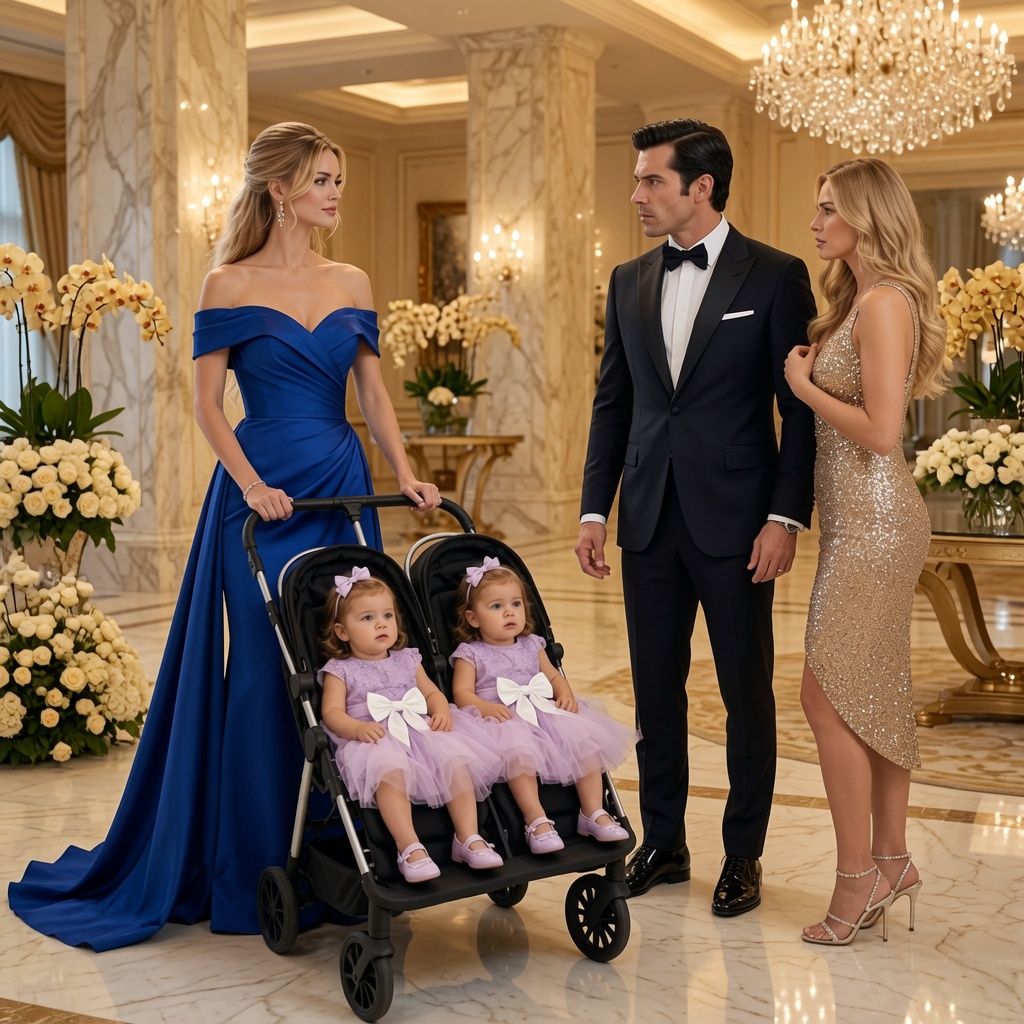
When the twins were nine months old, I dressed them in navy sweaters, packed bottles into a diaper bag, and pushed their double stroller through the revolving doors of Cross Meridian Tower.
The lobby was exactly as I remembered: black marble floors, brass elevator doors, a waterfall wall whispering behind imported orchids. Above the reception desk, Trevor’s company logo gleamed like a crown.
The receptionist looked up.
Then froze.
Behind me came my attorney, Marisol Vale, calm in a cream coat, carrying a leather case.
Behind her came three board members Trevor thought still belonged to him.
Up on the mezzanine, the private elevator opened.
Trevor stepped out with Sienna on his arm.
His smile vanished.
Then he saw the babies.
His face went white.
“Audrey,” he whispered.
The lobby went still enough to hear Miles hiccup in his sleep.
I placed one sealed envelope on the security desk.
“Inside,” I said, “are paternity results, trust documents, and the original ownership agreement Trevor signed before Cross Meridian became an empire.”
Sienna’s fingers tightened around his sleeve. “Trevor?”
He did not answer her.
He could not stop staring at Henry.
At the same stubborn chin.
At the same Cross family eyes.
I looked at the man who had traded me for a headline and said, “You wanted your future, Trevor. Now meet the heirs you abandoned.”
The first thing Trevor lost was his voice.
The second was the room.
Everyone watched him now, not as the brilliant founder, not as the billionaire visionary, not as the man who had turned ambition into glass and steel.
They watched him as a father who had not known his own sons existed because he had never cared enough to ask.
“Audrey,” he said again, softer this time. “We should talk privately.”
“We tried private,” I said. “Private was where you lied.”
Sienna let go of his arm as if he had become contagious. “What is she talking about?”
Marisol stepped forward. “Mr. Cross, you are being formally notified that Henry and Miles Cross are beneficiaries under the amended Meridian Founders Trust. Mrs. Cross—”
“Ex,” Trevor snapped.
Marisol did not blink. “Ms. Hale retained thirty-eight percent founder equity through the original ownership agreement. Your divorce settlement did not supersede that agreement because you failed to disclose it.”
The words moved through the lobby like a match dropped in gasoline.
Trevor looked at me then, truly looked, perhaps for the first time in years. “You wouldn’t.”
I almost smiled.
Not because I was cruel.
Because he still thought this was revenge.
He still thought I had come for his money.
He had no idea I had come for the truth.
“I already did,” I said.
The board members moved past me toward the conference elevators. One of them, old Richard Bell with his silver cane and tired eyes, paused beside the stroller. He looked down at Henry and Miles, and grief crossed his face so quickly most people would have missed it.
I did not.
“Mrs. Hale,” he murmured. “They look just like him.”
“No,” I said quietly. “They look like themselves.”
Trevor followed us upstairs because men like Trevor always follow the thing they think they can still control.
In the boardroom, Lake Street stretched below the windows, washed clean by rain. I had chosen those windows years ago, back when the company occupied half a floor and Trevor insisted investors respected height. I remembered eating sandwiches on the carpet while contractors installed the glass. I remembered Trevor lifting me into his arms and spinning me until we were both laughing.
Now he stood at the head of the table, pale with fury.
Sienna sat beside him, phone in hand, probably texting her publicist.
The twins slept in the corner beneath a soft blanket.
Marisol opened the file.
“The original agreement states that Audrey Hale contributed the seed capital, legal framework, client acquisition strategy, and intellectual property architecture for Cross Meridian Group. In return, she retained non-dilutable founder equity and approval rights over transfer of controlling interest.”
“That document was symbolic,” Trevor said.
I looked at him. “You cashed checks from that symbol.”
His jaw tightened.
Marisol continued. “Additionally, under Section Twelve, any direct descendant of either founder becomes eligible for succession trust protection if one founder attempts unilateral control restructuring.”
Sienna’s head lifted. “Succession?”
Trevor slammed his palm on the table. Henry startled and began to cry.
Every head turned.
I walked to the stroller and lifted him gently. His little body curled into mine, warm and furious. Miles woke too, blinking in confusion. For a moment, the empire disappeared. There was only milk breath, soft hair, tiny fingers gripping my blouse.
Trevor stared at them with something almost like wonder.
Almost.
Then he ruined it.
“How do I know they’re mine?”
The room died.
Even Sienna looked at him as if he had become smaller.
I reached into the envelope and slid the paternity report across the polished table. It stopped in front of him.
“Because science has more integrity than you do.”
His eyes flickered over the page.
Probability of paternity: 99.9999%.
Trevor sat down.
Hard.
Sienna stood. “You knew there was a chance?”
“No,” he said quickly. Too quickly. “Audrey never told me.”
I laughed once, quietly. It surprised everyone, including me.
“I had an appointment the day of the divorce. You knew that. I asked you to come with me.”
His brows drew together.
“You said,” I continued, “that you had a strategy meeting.”
Sienna’s face changed.
Because she knew.
The strategy meeting had been her.
Trevor looked away.
And in that small cowardly turn of his head, six years of unanswered questions finally found their answer.
He had not drifted away.
He had chosen, step by step, lie by lie, hand by hand.
Richard Bell leaned forward. “Trevor, we need to discuss temporary suspension of executive authority pending legal review.”
Trevor’s face hardened. “You cannot suspend me from my own company.”
I met his eyes.
“It was never only yours.”
That was when the door opened.
A young assistant stepped in, trembling. “Mr. Cross? There are reporters downstairs. A lot of them.”
Sienna’s phone began ringing.
Then Trevor’s.
Then Richard’s.
Then Marisol’s.
The story had broken.
Not from me.
Not from my attorney.
From someone inside the building.
A photograph appeared across every screen within minutes: Trevor in the lobby, white-faced, staring at two babies in a stroller under the Cross Meridian logo.
The caption read: BILLIONAIRE CEO CONFRONTED BY EX-WIFE AND SECRET TWINS.
Sienna turned on him with a whisper sharp enough to cut glass. “You promised me there were no complications.”
Trevor looked at her. “I didn’t know.”
But his eyes slid toward me.
And I knew he was lying again.
Marisol saw it too.
She closed the folder with one finger. “Audrey,” she said softly, “there is something else.”
I turned.
She hesitated, the first crack in her professional calm all morning.
“When we subpoenaed the archived medical communications from the fertility clinic, my team found a transfer confirmation.”
The air thinned.
Trevor stood very slowly. “Marisol.”
My pulse began to beat in my throat.
“What transfer?” I asked.
Marisol’s face was pale now. “Trevor signed authorization forms two years ago to move two embryos from the joint marital account into protected storage.”
I could not understand the sentence.
Not at first.
It moved through me too slowly, like cold water rising around my knees.
Two years ago.
Before the divorce.
Before Sienna.
Before the courthouse.
Trevor had authorized storage?
I turned to him. “What is she talking about?”
His silence was not empty.
It was full of buried things.
Sienna looked between us. “Embryos?”
I remembered the fertility treatments. The needles. The bruises on my stomach. The nights Trevor held my hair back when hormones made me sick. The devastating call after our failed cycle. The doctor saying there were no viable embryos left.
No viable embryos.
That was what Trevor had told me.
I had believed him because he had held me while I sobbed.
I had believed him because a wife should be able to believe the man who kisses her forehead in the dark.
My voice barely worked. “You told me they were gone.”
Trevor closed his eyes.
And there it was.
The real betrayal.
Not Sienna.
Not the divorce.
Not the cameras.
This.
“You told me our embryos didn’t survive,” I whispered.
Richard Bell lowered his head.
Marisol looked stricken. “Audrey, the twins were conceived naturally, yes. But those embryos still exist.”
The room tilted.
Henry whimpered against my shoulder.
Miles reached for my necklace.
Trevor spoke at last, and his voice sounded stripped raw. “I couldn’t let you destroy them.”
I stared at him.
“Destroy them?” I repeated.
His face twisted. “You said after the failed cycle that you couldn’t go through it again.”
“I said I couldn’t survive another loss alone.”
“You were angry.”
“I was grieving.”
“You wanted to stop.”
“I wanted my husband to hold me!”
My voice cracked so sharply Miles began to cry.
I pressed my cheek to his hair and tasted salt.
Trevor stepped toward us. “Audrey, I thought I was protecting our future.”
“No,” I said. “You were controlling it.”
He flinched.
Good.
Let him.
For years, Trevor had called control vision. He called secrecy strategy. He called cruelty efficiency. He could turn any sin into a business term if the lighting was flattering enough.
But there was no flattering this.
Sienna backed away from the table. “You kept embryos from your wife?”
He rounded on her. “Stay out of this.”
She stared at him, and for the first time, the model mask slipped. Beneath it was a woman realizing she had mistaken access for intimacy.
“You told me she was cold,” Sienna said. “You told me she never wanted children.”
I looked at her.
Her face was frightened now.
Young, almost.
“He told me you refused to give him a family,” she whispered.
A bitter tenderness moved through me. Not forgiveness. Not yet. But recognition.
Trevor had not just abandoned me for Sienna.
He had written a version of me cruel enough to justify it.
He had needed me to become the villain so he could walk away feeling like a hero.
Outside the boardroom, voices rose. Reporters. Security. Staff pretending not to listen.
Inside, everything was ruined and finally honest.
Richard Bell cleared his throat. “Trevor, this changes governance. If Audrey pursues fraud claims—”
“She won’t,” Trevor said.
He looked at me with the confidence of a man who still believed love could be used like collateral.
“Audrey won’t destroy what we built.”
I kissed Henry’s temple.
Then I placed him back in the stroller beside his brother and walked to the table.
“You’re right,” I said.
His shoulders eased.
“I won’t destroy it.”
A flicker of hope crossed his face.
I leaned forward.
“I’m going to take it back.”
The vote happened before sunset.
Trevor screamed once. Not loudly. Not theatrically. Just one sharp sound when Richard Bell cast the deciding vote to remove him as acting CEO pending investigation.
Sienna left through the service elevator with her sunglasses on, but not before every gossip site in America reported that she had deleted all photographs of Trevor from her public account.
By six o’clock, Cross Meridian Tower belonged to a different silence.
A cleaner one.
Marisol walked me to the lobby. The twins were awake now, chewing on soft toys, unaware that their existence had cracked a billion-dollar empire down the middle.
“You did well,” Marisol said.
“No,” I replied. “I survived.”
She nodded, as if that was the truer victory.
At the revolving doors, Trevor was waiting.
No cameras now. No Sienna. No board.
Just a man in an expensive suit standing beneath a logo that suddenly looked too heavy for him.
“Audrey,” he said.
I should have kept walking.
I did not.
He looked older than he had that morning. The sharpness had drained from him. Without power, Trevor Cross looked almost ordinary.
“I want to see them,” he said.
I tightened my grip on the stroller. “You saw them.”
“I mean… properly.”
“You mean now that the paternity report is public?”
Pain flashed across his face. “That isn’t fair.”
I laughed softly. “Fair died on the courthouse steps.”
He looked down at Henry and Miles. Henry stared back with solemn suspicion. Miles waved one damp fist.
Trevor’s mouth trembled.
For one dangerous second, I remembered the man I had loved.
Then he said, “We can fix this.”
And the memory shattered.
“No, Trevor,” I said. “Some things don’t get fixed. They get named.”
His eyes reddened. “I made mistakes.”
“You made choices.”
“I was scared.”
“So was I.”
“I thought you’d hate me.”
“I do,” I said. Then my voice softened against my will. “And I don’t. That’s the cruel part.”
He swallowed.
I took one step closer, close enough to smell his cologne, the same cedar and smoke scent that once meant home.
“You don’t get to come back because consequences found you,” I said. “You don’t get to call fatherhood a right after treating it like a rumor. You want to know them? Then you start with court. Therapy. Truth. And you never, ever use them to clean your image.”
Trevor nodded too quickly. “Anything.”
“No,” I said. “Not anything. Exactly what they need. Not what you want.”
For the first time, he had no answer.
I pushed the stroller toward the doors.
Behind me, Trevor said, “Audrey.”
I stopped.
His voice broke.
“Did you ever love me?”
The question was so cruel in its smallness that I almost turned around.
Almost.
Instead, I looked down at my sons.
“At my worst,” I said, “I loved you better than you loved me at your best.”
Then I walked out into the cold evening.
For months, the world tried to turn my pain into entertainment.
They called me the secret founder. The betrayed ex-wife. The mother of the billionaire twins. They called Trevor disgraced, humbled, embattled. They called Sienna a homewrecker, then a victim, then old news.
But inside the little white house near Lake Harriet, the headlines mattered less than teething fevers, bottle warmers, court filings, and the soft thud of two boys learning to crawl across the living room rug.
Trevor did what I demanded.
Therapy. Supervised visits. Legal admissions. Full disclosure.
He arrived every Thursday with no cameras and no assistant. At first, Henry cried whenever Trevor held him. Miles only watched.
Trevor learned to warm bottles. Badly.
He learned Henry hated peas.
He learned Miles laughed only when someone sneezed.
He learned babies did not care about net worth.
One snowy evening, I found him sitting on my kitchen floor in his shirtsleeves while Henry slept against his chest and Miles tugged at his tie.
Trevor looked up at me.
“I missed everything,” he whispered.
I wanted to punish him with silence.
Instead, I said, “Yes.”
He closed his eyes.
That was all.
A year passed.
Then another.
Cross Meridian stabilized under my leadership, though I never moved into Trevor’s old office. I used the smaller one down the hall with morning light and a photograph of Henry and Miles taped crookedly to my monitor.
Trevor rebuilt himself slowly, not publicly, not perfectly. Sometimes he failed. Sometimes he pushed too hard. Sometimes he looked at me like he wanted to ask for something neither of us could survive giving.
But he kept showing up.
And children are dangerous that way.
They do not remember betrayal the way adults do.
They remember who kneels to tie their shoes.
Who claps when they stack blocks.
Who stays when they spill juice.
By the time Henry and Miles turned four, they called him Daddy without looking at me for permission.
The first time it happened, Trevor cried in the hallway where he thought no one could see.
I saw.
I said nothing.
On their fifth birthday, we held a small party in the backyard. Blue paper lanterns swung from the trees. Henry wore a cardboard crown. Miles refused shoes. Trevor grilled hot dogs under strict supervision because he still burned everything.
For one afternoon, life looked almost kind.
After cake, Trevor found me near the fence.
“I need to tell you something,” he said.
My body knew before my mind did.
“What?”
He handed me an envelope.
Not a legal one.
A medical one.
“The embryos,” he said. “I signed full transfer rights to you. They’re yours. Only yours.”
I stared at the envelope.
My hands shook.
“I should have done it years ago,” he said. “I’m sorry.”
The words were too small for the damage, but they were true.
I looked across the yard. Henry and Miles were chasing bubbles through sunlight, their laughter rising like bells.
When I turned back, Trevor’s face had changed.
There was no strategy in it.
No performance.
Just grief.
“I loved you,” he said. “Badly. Selfishly. But I did.”
My throat tightened.
“I know.”
That hurt more than denying it would have.
He nodded, accepting the mercy and the wound together.
Then he said, “There’s something else in the envelope.”
I opened it.
Inside was a photograph from years earlier.
Me asleep in a hospital chair after our failed fertility procedure, Trevor’s coat over my knees, his hand resting near mine but not touching.
On the back, in his handwriting, were six words:
I was afraid to lose them.
I looked up.
Trevor’s eyes were wet.
“I was afraid to lose you too,” he said. “So I did the one thing that guaranteed it.”
For a moment, the yard blurred. The lanterns, the children, the man I had loved and lost and partly recovered in a form I did not know how to name.
Then Henry shouted, “Mommy! Daddy! Watch!”
He ran toward us holding a bubble wand like a sword.
Miles followed, barefoot and laughing.
A bubble rose between Trevor and me, trembling with the whole sky inside it.
It floated for one perfect second.
Then burst.
Years later, people would ask whether Trevor Cross got what he deserved.
I never knew how to answer.
He lost the company. He lost Sienna. He lost the version of himself that photographers loved. But he gained two sons who made him smaller and better, which is sometimes the harsher sentence.
As for me, I gained everything I had been told was gone.
A name no man could erase.
A company I had built.
Two boys with storm-blue eyes.
And the truth.
But the final twist did not come from Trevor.
It came on a rainy Thursday, almost six years after the courthouse, when Henry and Miles were asleep upstairs and I opened the last sealed clinic file Marisol had found in storage.
I expected invoices.
Consent forms.
Proof of Trevor’s betrayal in another sterile stack of paper.
Instead, I found a letter addressed to me.
Not from Trevor.
From Dr. Elaine Voss, our fertility specialist.
My hands went cold as I read.
Audrey, if you are seeing this, then the truth has finally surfaced. Trevor did not ask me to lie about the embryos. I did. Your final cycle produced two viable embryos, but the genetic screen revealed a rare marker connected to the Cross family line. Trevor was not informed until after I placed them in protected storage. He believed he was saving them from your grief. But I was saving you from something else.
I stopped breathing.
The room seemed to lean in.
The next page was a genetic report.
The marker was not Trevor’s.
It was mine.
A dormant condition, almost impossible to detect, triggered only under specific inheritance patterns.
Henry and Miles, conceived naturally, had not inherited it.
But the embryos had.
Both.
I sank into the chair as rain tapped the window.
Trevor had lied.
But not first.
Not alone.
The life I thought he stole from me had been altered before he ever touched the papers.
I looked toward the stairs, where my sons slept safely under dinosaur blankets.
Happy, whole, breathing.
For years, I had believed Trevor’s betrayal had cost me everything.
But in the cruelest, most impossible way, his fear had delayed a choice that would have broken me in a different room, under softer lights, with a doctor calling it mercy.
The next morning, I drove to the lake before sunrise.
Trevor met me there because I asked him to.
He arrived in an old coat, hair messy, face unguarded.
I handed him the file.
He read it slowly.
When he finished, he sat beside me on the bench and cried without covering his face.
“I didn’t know,” he said.
“I know.”
“I still lied.”
“I know.”
“I still hurt you.”
“Yes.”
The lake was gray and endless before us.
After a long time, he whispered, “What do we do with this?”
I thought of the courthouse. The cameras. The laugh. The babies in the lobby. The empire falling. The boys learning to walk. The bubble bursting in sunlight.
I thought of all the ways love can fail and still leave something living behind.
“We stop trying to make pain simple,” I said.
Trevor nodded.
The sun rose slowly, turning the water gold.
And for once, neither of us reached for the past.
We only sat there, two ruined people made quiet by the same miracle, while somewhere behind us, in a small white house near Lake Harriet, two little boys slept through the dawn that had cost everything and saved them.