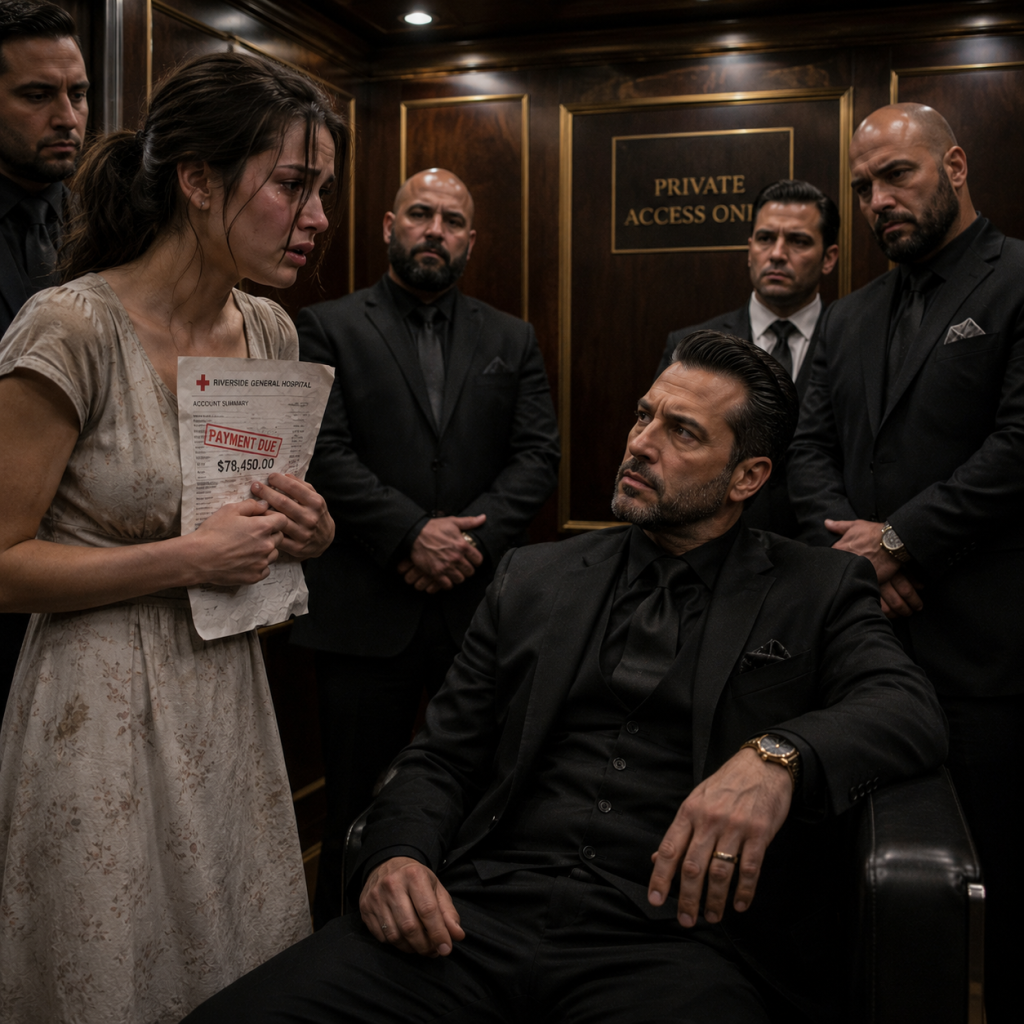
He was older than me by perhaps fifteen years, maybe more, with dark hair brushed neatly back and a face that seemed carved for patience rather than mercy. There was no flashy watch, no diamond ring, no display of wealth beyond the perfect cut of his suit and the way the others arranged themselves around him as if gravity had chosen him first.
His eyes were not unkind.
That almost made it worse.
I tried to speak, but my throat tightened. All I managed was a broken breath.
The elevator began to rise.
A soft chime sounded as we passed the next floor.
“I’m sorry,” I said, because apology was the only language panic had left me. “I didn’t know this was private. I just—I need to get out. I’ll leave at the next floor. I won’t cause trouble.”
One of the men glanced at the man in the center, waiting.
The man did not take his eyes off me.
“You are already in trouble,” he said. “The question is whether you brought it with you, or whether it followed.”
I swallowed.
Outside the elevator, somewhere below us, people were still laughing. Maybe not all of them. Maybe I had imagined it. But the sound had chased me through the corridor as clearly as footsteps—the bright, delighted laughter of people relieved that someone else had become the evening’s entertainment.
My father’s voice echoed louder than all of it.
I’m sorry. I don’t know this young woman.
“My mother,” I whispered.
The man’s gaze shifted to the paper in my hand.
“May I?”
I hesitated.
Every instinct said not to give anything to a stranger, especially a stranger whose guards reached under their jackets when frightened girls burst into elevators. But the nurse’s voice was still ticking inside my head like a clock.
Forty minutes.
I handed him the paper.
He took it carefully, smoothing the torn fold with his thumb. His eyes moved across the hospital letterhead, the account number, the deposit amount, the red line at the bottom that might as well have been a sentence.
“What is her name?” he asked.
“Lena Hart.”
He looked up.
For the first time, something changed in his face. It was small, gone almost before it arrived, but I saw it: a flicker of recognition. Not surprise exactly. Something older. Something remembered.
“What is your name?” he asked.
“Clara.”
“Clara Hart?”
I nodded.
The men around him exchanged a glance. The elevator felt suddenly too small.
He folded the bill once, not creasing it, then held it out to the man on his right.
“Pay it,” he said.
The man took the paper and immediately removed a phone from his jacket.
I stared at him.
“No,” I said, too quickly. “No, I can’t— That’s not why I— I didn’t ask you for money.”
The man in the center watched me as though the protest interested him.
“You asked someone,” he said.
Heat rose to my face.
“My father,” I said.
The words tasted like rust.
A soft sound came from one of the guards, not quite a laugh, not quite disbelief. The man in the center silenced him with a glance.
“And he refused?” he asked.
I looked away.
The elevator numbers glowed above the door. Twenty-seven. Twenty-eight. Twenty-nine.
“He said he didn’t know me.”
The words came out flat. I wished they had come with anger. Anger would have been useful. Anger could stand up straight. But all I had was the humiliation sitting heavy in my chest and the image of my father turning me into a stranger because there were investors watching.
The man’s jaw tightened.
“Arthur Hartwell,” he said, not as a question.
I looked back at him.
“You know him?”
“I know many men who build monuments to themselves.” His voice remained calm. “Some of them forget what they buried underneath.”
The phone call beside him ended.
“Done,” the guard said. “Hospital confirmed receipt. Operating room held.”
For a moment, the elevator disappeared.
All the marble, mirrors, suits, danger—gone.
The only thing left was air rushing into my lungs.
I pressed a hand to my mouth. My knees weakened so sharply that I gripped the brass rail behind me.
“Are you sure?” I asked. “Please, are you sure?”
The guard’s expression softened just enough to make him human. “The nurse said they’re taking her in now.”
My eyes filled before I could stop them. I turned away, ashamed of the relief that broke out of me so violently. I had spent years being careful with tears, saving them for locked bathrooms and late-night bus rides, because my mother cried so rarely that I thought courage meant never allowing yourself to be seen falling apart.
But now she would have a chance.
Because a stranger in a private elevator had said pay it.
“Thank you,” I whispered. “I’ll pay you back. I don’t know how long it’ll take, but I will. I can work. I can sign something.”
The elevator reached the top floor with a gentle bell.
The doors opened into a quiet hallway lit by amber lamps. Beyond it was a private lounge with velvet chairs, dark wood shelves, and tall windows overlooking the city. Rain streaked the glass. The hotel ballroom music was gone up here, replaced by the soft hum of the sky.
The man stepped out first.
Then he turned.
“You should sit down,” he said.
“I should go to the hospital.”
“You should breathe before you fall.”
“I’m fine.”
“You are not.”
His certainty should have irritated me. Instead, it made the room tilt a little.
I stepped out because the alternative was arguing with a man whose guards still watched every corner as if the shadows had appointments.
He led me into the lounge.
No one touched me. No one blocked the door. One guard moved quietly to the far side of the room. Another murmured into a phone. The man who had made the payment placed the hospital bill on a table as carefully as if it were evidence.
The man in the center gestured to a chair near the window.
I sat because my legs had decided for me.
A woman in a charcoal suit appeared from a side door, carrying a glass of water and a folded white napkin. She looked at me once, took in everything, and set the glass beside me without a question.
“Thank you,” I said.
She nodded and stepped back.
I drank too fast and nearly coughed. My hands shook around the glass.
The man stood across from me, not sitting, not looming. Just waiting.
“I don’t know your name,” I said.
Something faint moved at the corner of his mouth.
“No,” he said. “You don’t.”
The woman in the charcoal suit gave him a look.
He exhaled, as if remembering ordinary manners.
“Matteo Vale.”
The name struck the room differently than other names. Even I, who knew little about the polished circles of this city, had heard it. Vale Holdings owned restaurants, shipping warehouses, private security firms, old apartment blocks no one could buy, and half the waterfront rumors. My mother used to turn off the television whenever his name appeared in news reports, always before I could understand why.
Matteo Vale.
People called him a businessman when they were being careful.
Other things when they weren’t.
I set the water down.
“I should leave,” I said.
“That would be unwise while Hartwell’s security is looking for you.”
My stomach clenched.
“They won’t care about me now.”
“You embarrassed him.”
“He embarrassed me.”
“Yes,” Matteo said. “But men like Arthur do not measure damage honestly.”
The way he said my father’s first name made it clear this was not casual knowledge.
I looked toward the elevator.
“I just needed him to help my mother,” I said. “I didn’t go there to cause a scene.”
“I believe you.”
Two words.
Simple.
Unadorned.
No one had said them to me in that ballroom. No one had stepped forward, no one had asked whether I was all right, no one had looked at Arthur Hartwell and wondered why a crying young woman would call him Dad unless some part of it were true.
Matteo believed me.
The relief of that was dangerous.
“How do you know my mother?” I asked.
His eyes lowered for half a second.
The pause was too long.
“I knew her years ago,” he said.
“When?”
“Before you were born.”
The answer opened a door in my mind, and behind it were all the years my mother had never explained.
My mother, who worked double shifts at the clinic until her feet swelled.
My mother, who kept one locked metal box under her bed and told me it was full of old tax records.
My mother, who never dated, never spoke badly of Arthur Hartwell, never spoke well of him either.
“What does that mean?” I asked.
Matteo finally sat in the chair opposite mine. The movement was controlled, but his expression had grown distant.
“It means your mother was once very brave for someone who had no reason to be.”
“That doesn’t answer anything.”
“No,” he said. “It doesn’t.”
The woman in the charcoal suit stepped forward. “Mr. Vale, the hospital line is ready.”
He looked at me. “Would you like to speak to them?”
I nearly knocked the glass over reaching for the phone.
The nurse’s voice came through after one ring. “Miss Hart?”
“Yes. Is she— Did they—”
“She’s being prepped now,” the nurse said gently. “The surgeon is with her. The deposit cleared. You should come as soon as you can, but please drive safely.”
My breath trembled.
“Can you tell her I’m coming?”
“She’s already under mild sedation, but I’ll let the team know.”
“Please tell her I’m sorry.”
The nurse softened. “You did enough tonight. Get here when you can.”
When the call ended, I held the phone a moment longer, like it was the only thread connecting me to the world I understood.
Matteo’s assistant took it from my hand with quiet care.
“I have to go,” I said.
“My driver will take you.”
“I can take a taxi.”
“Can you pay for one?”
I opened my mouth.
Closed it.
He did not look pleased to be right.
“That was not meant to shame you,” he said.
“It still did.”
For the first time, his composure cracked into something like regret.
“I apologize.”
The apology surprised me enough that I forgot to be embarrassed.
Men like my father apologized only when the apology cost someone else more. This man, with guards and whispered power wrapped around him like a second suit, said it simply and waited as if I had the right to accept or reject it.
I nodded once.
“Thank you.”
The assistant handed me a plain black coat. “It’s raining.”
“I can’t take this too.”
“You can return it,” she said.
I almost smiled at the practical kindness.
Matteo rose as I did. “Clara.”
My hand paused on the coat.
“When your mother wakes,” he said, “do not tell her Arthur refused you in public.”
I stared at him.
“Why?”
“Because she will blame herself.”
The answer struck exactly where it hurt.
Mom would. She would look at the hospital ceiling, pale and stitched and exhausted, and somehow decide my humiliation belonged on her conscience. She would apologize for being sick, for needing money, for having once loved the wrong man.
I hated that Matteo knew that.
I hated more that he was right.
“I don’t lie to my mother,” I said.
“Then choose the gentlest truth.”
His voice was soft, almost weary.
I studied him. “You talk like someone who has practiced that.”
His eyes met mine.
“Yes,” he said. “I have.”
Before I could ask anything else, the elevator doors opened again.
Not from the private lift we had arrived in, but from another at the far side of the lounge.
A man hurried out, breathless beneath his polished hotel-manager smile. Behind him came two security guards wearing the Halcyon crest. One of them was the guard who had grabbed my arm downstairs.
He stopped when he saw me.
Then he saw Matteo Vale.
Whatever speech he had prepared died immediately.
“Mr. Vale,” the manager said, bowing his head a fraction too low. “I apologize for the intrusion. We were informed that an unauthorized guest entered this floor.”
Matteo did not answer right away.
The quiet stretched until the manager’s smile began to suffer.
“She is my guest,” Matteo said.
The guard who had grabbed me looked at the carpet.
The manager’s eyes flicked toward me, then away. “Of course. Our mistake.”
“It was.”
The manager swallowed.
“We’ll leave you at once.”
“Not yet.”
The room became still.
Matteo turned to me. “Is this the man who touched your arm?”
My mouth went dry.
The guard looked up quickly, panic flashing across his face. He was not cruel-looking now. He looked young, maybe only a few years older than me, with nervous eyes and a stiff collar. Downstairs, he had seemed like a wall. Up here, he looked like an employee who had followed an order and suddenly understood the order had led him somewhere dangerous.
I thought of my father’s voice. The watching crowd. The hand on my arm.
Then I thought of my mother teaching me that humiliation could make a person careless if they let it.
“He did,” I said. “But he didn’t hurt me.”
Matteo watched me for a moment.
The manager jumped in. “Mr. Hartwell instructed our team to remove her from the ballroom. We had no knowledge she was connected to—”
“Connected to whom?” Matteo asked.
The manager stopped.
“To anyone,” he finished weakly.
Matteo looked at the guard. “Did she resist?”
The guard’s throat bobbed. “No, sir. She asked to speak to Mr. Hartwell. He said he didn’t know her. We escorted her out. She pulled away and ran. I followed into the corridor, but she reached your elevator.”
The words were factual. Somehow hearing them that way made it worse.
Matteo nodded once.
“You may go,” he told the guard.
The guard blinked. “Sir?”
“You followed your employer’s instruction. Poorly considered, but not invented. Go.”
Relief washed over the young man’s face. “Thank you, sir.”
The manager began to retreat with him.
“You stay,” Matteo said.
The manager froze.
I took a step forward. “Please don’t make this into something.”
Matteo turned his head slightly.
“I’m not.”
The manager looked as though he disagreed.
Matteo’s voice remained even. “A woman entered your hotel in distress and asked for help. Your staff treated her as an inconvenience because the man embarrassing her was wealthy. That is a failure of training.”
The manager nodded rapidly. “Absolutely. We’ll review procedures.”
“No. You will change them.”
The manager’s mouth opened, then closed.
Matteo glanced at his assistant. “Mara, have our office send a written recommendation to Halcyon ownership. Guests in medical distress are not to be removed without an offer to contact emergency services or verify assistance.”
“Yes, Mr. Vale,” Mara said.
I stared at him.
It was not revenge. It was worse for the manager, maybe, because it was reasonable. Professional. Impossible to argue with.
The manager bowed his head again. “I understand.”
“Good,” Matteo said. “You may leave.”
When the elevator closed behind them, my shoulders finally dropped.
“You didn’t have to do that,” I said.
“Yes,” he replied. “I did.”
“Why?”
He looked toward the rain-streaked windows.
“Because once, someone should have done the same for your mother.”
The room shifted around those words.
I felt it—the sudden weight of a history I had not been told, sitting between us like a sealed envelope.
“Mr. Vale,” Mara said softly, “the car is ready.”
He nodded.
I pulled the borrowed coat around me. It was too large, warm from the room, and smelled faintly of cedar.
At the elevator, I turned back.
“Why did my mother never mention you?”
Matteo’s expression did not change, but his eyes did.
“Because she wanted you to have a life untouched by men like us.”
“Us?”
He did not answer.
The elevator opened.
This time, he did not come with me. Mara did.
The ride down was quiet.
Mara stood beside me with her hands folded in front of her, elegant and unreadable.
“Is he dangerous?” I asked before I could stop myself.
She did not look surprised.
“Yes,” she said.
My chest tightened.
Then she added, “But not to everyone.”
“That isn’t comforting.”
“It isn’t meant to be.”
The elevator descended.
“Why did he help me?”
Mara looked at the glowing numbers. “Mr. Vale pays old debts.”
“My mother loaned him money?”
The question came out absurdly hopeful. Something simple. Something ordinary. Something that could be added up and paid back.
Mara’s face softened.
“No, Miss Hart,” she said. “Not money.”
The doors opened onto a private garage where a black sedan waited.
Rain hammered the concrete outside. The driver held the door for me. I climbed in, and Mara sat beside me, leaving just enough space to be polite.
As the car pulled away from the Halcyon, I caught a glimpse of the hotel’s golden entrance. Cameras flashed for arriving guests. Women laughed beneath umbrellas. Somewhere inside, my father was probably still smiling beneath his banner, explaining my interruption as a misunderstanding.
A misunderstanding.
That was what people called pain when they wanted it to leave no fingerprints.
My phone buzzed.
For one wild second, I thought it might be the hospital.
It was a text from an unknown number.
You should not have come tonight.
No name.
No punctuation beyond the period.
I stared at it until the words blurred.
Mara noticed. “Is everything all right?”
I turned the phone toward her.
She read the message once.
Her expression changed so subtly that anyone else might have missed it. I did not.
“Do you recognize the number?” she asked.
“No.”
“May I?”
I handed her the phone.
She copied the number into her own device, then returned mine.
“Do not respond,” she said.
“Is it from my father?”
“Possibly.”
“But you don’t think so.”
“I don’t know yet.”
The car moved through wet streets, city lights smeared gold and red across the windows. My hands rested uselessly in my lap. Now that the immediate emergency had loosened its grip, exhaustion pressed in from all sides.
“What old debt?” I asked.
Mara looked at me.
“My mother and Matteo. What happened?”
“That is not my story to tell.”
“Everyone keeps saying things like that. But it is my life they’re talking about.”
She was silent for several blocks.
Then she said, “Your mother once worked for Arthur Hartwell.”
I turned sharply. “No, she didn’t.”
“She did.”
“She told me they met at a charity auction.”
“That may also be true.”
The car passed under a bridge, shadows sliding across Mara’s face.
“What did she do for him?”
“She handled records for one of his early development companies.”
“My mother was a nurse.”
“Later,” Mara said. “Before that, she was very good with numbers.”
I thought of Mom at the kitchen table, balancing bills down to the cent, finding extra money where none existed, catching mistakes in insurance statements after twelve-hour shifts. I had always thought necessity taught her precision.
Maybe precision had once been her profession.
“Why did she stop?”
Mara’s silence answered before she did.
“Because she found something.”
The hospital appeared ahead, its windows bright against the rain.
My heart began to pound again.
“What did she find?”
Mara looked toward the entrance, where nurses moved beneath the awning and an ambulance idled with soft blue lights.
“You should ask her when she is strong enough.”
“That sounds like a warning.”
“It is advice.”
The car stopped.
I stepped out before the driver could open my door, clutching the coat around me. Mara followed with an umbrella and walked me to the entrance.
At the sliding doors, she handed me a small card.
“My number,” she said. “Call if you need a ride home, or if anyone from Hartwell approaches you.”
I looked down at the card. No title. Just Mara Venn and a phone number pressed into thick cream paper.
“Why would he approach me?”
Mara’s eyes moved past me, scanning the lobby with practiced calm.
“Because tonight you became inconvenient.”
The doors slid open, releasing the sterile warmth of the hospital.
“Mara,” I said.
She paused.
“Is my mother in danger?”
For the first time, she looked like she wanted to lie.
“I hope not,” she said.
Then she turned and walked back into the rain.
The next two hours stretched into a corridor of fluorescent light and vending machine coffee.
I signed forms. I sat. I stood. I called the apartment and listened to our answering machine click on, as if some part of me expected my mother to pick up from home and tell me this had all been a mistake. I watched families pass with flowers and overnight bags. I watched doctors move quickly, their faces composed in ways that made every expression difficult to read.
At some point, a nurse brought me a blanket.
At some point after that, I realized I was still wearing Matteo Vale’s coat.
I checked my phone every few minutes.
No update from the unknown number.
No call from my father.
That hurt, though I hated myself for letting it.
Near midnight, the surgeon came out.
I stood so quickly the blanket fell from my shoulders.
“Miss Hart?”
“Yes.”
“The operation went well,” he said.
The world stopped.
Then, gently, it started again.
“She’s stable,” he continued. “We’ll monitor her closely through the night, but she came through the procedure as well as we could have hoped.”
I pressed both hands over my mouth.
The surgeon smiled with tired kindness. “You can see her for a few minutes once they move her to recovery.”
“Thank you,” I said, but the words were too small.
When they finally let me in, my mother looked smaller than I had ever seen her.
Tubes and monitors surrounded her. Her hair, usually twisted into a practical bun, lay loose against the pillow. Her face was pale, but there was color in her lips, and the steady beep of the monitor felt like a promise repeating itself.
I sat beside her and took her hand.
“Hi, Mom,” I whispered. “You scared me.”
Her fingers were cool.
I held them between mine and bowed my head.
“I’m sorry,” I said, even though the nurse had told me not to. “I know you’ll tell me not to be, but I am. I went to him. I know I promised I wouldn’t. I didn’t know what else to do.”
Her eyelids fluttered but did not open.
I wiped my cheeks with the back of my wrist.
“He said he didn’t know me,” I whispered.
The monitor kept its steady rhythm.
“And then someone helped. Someone named Matteo Vale.”
My mother’s fingers moved.
Barely.
So lightly I almost missed it.
I leaned closer.
“Mom?”
Her eyes opened a sliver. Clouded with medication. Unfocused. But open.
For a second, I thought she saw me.
Then her lips parted.
“No,” she breathed.
I froze.
“Mom, it’s okay. The surgery went well.”
Her fingers tightened around mine with sudden strength.
“No… Vale.”
My heart thudded.
“You know him?”
Her eyes shifted, trying to focus. Fear moved through them—not the fear of pain or confusion, but recognition.
“Don’t…” she whispered.
The nurse stepped in. “She needs rest now.”
“Wait,” I said. “Mom, what are you trying to tell me?”
My mother’s grip weakened.
“Box,” she breathed. “Blue box.”
“What blue box?”
But her eyes had already closed.
The nurse checked the monitor and gave me a reassuring look. “Sedation can make patients say things that don’t come together clearly. She’s stable. Let her sleep.”
I nodded because my body knew how, but my mind was racing.
Blue box.
Not the metal box under her bed. That one was gray.
Unless there was another.
I kissed my mother’s hand before they made me leave.
In the hallway, I called Mara.
She answered on the second ring.
“How is she?” she asked.
“Stable.”
A pause. “I’m glad.”
“She woke up for a second.”
“What did she say?”
I leaned against the wall.
“She said, ‘No Vale.’ Then she said something about a blue box.”
Silence.
Not confusion.
Not surprise.
Silence like a door being locked.
“Mara?”
“Where are you now?” she asked.
“At the hospital.”
“Stay there.”
“I need to go home.”
“No.”
The sharpness in her voice startled me.
“Why not?”
“Because if Lena mentioned the box, then someone else may already be looking for it.”
My skin went cold.
“What is in it?”
“I don’t know.”
“You do.”
“I know what people think is in it,” Mara said. “That is not the same.”
I looked down the hospital corridor, suddenly aware of every stranger sitting in every chair.
“My mother told me not to trust Vale.”
“She said ‘No Vale’ while sedated. That may not mean what you think.”
“It sounded clear to me.”
“I understand.”
“No, you don’t. Everyone around me knows something about my mother except me.”
Mara exhaled softly. “You’re right.”
The admission disarmed me more than another evasion would have.
“I’m going home,” I said.
“Clara—”
“I need the box.”
“You need to be careful.”
“I have spent my whole life being careful. Tonight careful almost cost my mother her surgery.”
I ended the call before she could answer.
It was reckless. I knew that before I did it.
But there is a kind of helplessness that becomes unbearable once the emergency passes. Sitting still in a hospital corridor while strangers held pieces of my mother’s past felt impossible. If there was a blue box, if there was anything at home that explained why Matteo Vale looked at my mother’s name like a memory and why my mother woke from surgery afraid of him, I needed to see it with my own eyes.
I took a taxi with the last cash in my purse.
The driver talked about the rain, the traffic, a baseball game that had gone badly for his team. I answered when required and watched the city change from glittering towers to shuttered storefronts to the narrow streets of our neighborhood.
Our apartment building leaned between a laundromat and a bakery that opened before sunrise. The front door stuck in wet weather. The hallway smelled of old wood, lemon cleaner, and someone’s late dinner.
Home.
Ordinary.
Safe.
Except the light under our apartment door was on.
I stopped halfway down the hall.
I had turned it off before leaving.
For a few seconds, I heard only the rain tapping against the stairwell window and the distant hiss of pipes in the walls.
Then came a sound from inside.
A drawer sliding shut.
I backed away slowly.
My heel struck a loose floorboard.
The sound was tiny.
Inside, everything went still.
My pulse hammered so loudly I thought whoever was inside must hear it.
I turned and hurried down the hall, not running, because running made noise. At the stairwell, I slipped through the door and pulled it softly closed behind me.
My phone shook in my hand as I called Mara.
This time she answered immediately.
“There’s someone in my apartment,” I whispered.
“Are you inside?”
“No.”
“Good. Leave the building.”
“I can’t. They might have the box.”
“Clara, leave the building.”
The stairwell door above me creaked.
I looked up.
A shadow crossed the frosted glass pane.
I moved down the stairs as quietly as I could, one hand gripping the rail. Second floor. First floor. Lobby.
Behind me, a door opened.
Footsteps entered the stairwell.
I pushed through the front door into the rain.
A pair of headlights flashed across the street.
For one terrifying second, I thought it was whoever had broken into our apartment.
Then the black sedan door opened, and Mara stepped out beneath an umbrella.
She crossed the sidewalk quickly. “Get in.”
I did not argue this time.
The moment I was inside, the car pulled away from the curb.
I twisted in my seat to look back.
A man stood at the entrance of my building, half-hidden by rain and shadow. He was not one of Matteo’s guards. He wore a gray coat and held something under his arm.
Something small.
Something blue.
My breath caught.
“He has it,” I said. “He has the box.”
Mara spoke sharply to the driver. “Do not follow too closely.”
The sedan slowed, letting a delivery truck pass between us and the curb.
The man in the gray coat stepped into a waiting car two buildings down.
It was not black or polished or expensive.
It was a plain silver sedan with a dent near the back wheel.
The kind of car no one remembers.
It pulled away.
Our driver followed at a distance.
“Who is he?” I asked.
Mara’s face was unreadable again, but her hand had tightened around her phone.
“I don’t know yet.”
“Is he with my father?”
“Possibly.”
“With Matteo?”
She looked at me.
“No.”
“You said that very quickly.”
“Because it matters.”
The cars moved through the wet city. My apartment disappeared behind us. So did the hospital, the Halcyon, the life I had understood that morning when my biggest fear was a bill I could not pay.
Now there was a box my mother had whispered about after surgery, a man breaking into our home, and Matteo Vale somewhere at the center of a history that everyone seemed afraid to name.
My phone buzzed again.
Unknown number.
This time, it was not a text.
It was a photo.
My hand went numb.
The image showed a younger version of my mother standing on a pier at night, hair loose in the wind, one hand resting protectively over her stomach.
Beside her stood Arthur Hartwell, younger too, handsome and smiling for the camera.
And on her other side stood Matteo Vale.
His hand was also on my mother’s shoulder.
On the back of the photograph, someone had written four words in blue ink:
Clara must never know.
Before I could speak, another message appeared beneath it.
Ask your mother who your father really is.
END OF PART 2 – LIKE, SHARE AND COMMENT “”THE ENTIRE STORY”” IF YOU WANT TO READ THE FULL STORY