Lucas’s words seemed to drain every sound from the hospital corridor.
“She stopped eating so Owen and I could have lunch.”
For a moment, I could only stare at him.
The emergency department moved around us in a blur of white coats, squeaking shoes, ringing telephones, and curtains being pulled across metal rails. Yet all I could hear was my son’s uneven breathing.
“What do you mean?” I asked.
Lucas lowered his eyes. “Sometimes there wasn’t enough.”
“Enough food?”
He nodded.
Owen stood beside him, still clutching the small blue backpack he carried everywhere. His cheeks were wet, and a damp curl clung to his forehead.
“Claire said she wasn’t hungry,” he whispered. “But her stomach made noises.”
I crouched in front of them.
“Where did this happen?”
“At home,” Lucas said. “At the little table in the sunroom.”
My confusion sharpened into something colder. The pantry in our house was always full. Groceries were delivered twice a week. There were refrigerators in the main kitchen and the staff kitchen, both stocked with more food than three people could reasonably eat.
“There is always enough food in the house,” I said, more defensively than I intended.
Lucas flinched.
I immediately regretted my tone.
“I’m not angry with you,” I said, softening my voice. “I’m trying to understand.”
He looked at Owen before answering.
“Mrs. Dale said we weren’t allowed in the big kitchen anymore.”
Mrs. Dale was Ruth.
“Why?”
“Because we made a mess.”
Owen shook his head quickly. “We only spilled flour one time.”
“Claire was teaching us pancakes,” Lucas added. “Then Mrs. Dale got mad. She said Claire had to bring our lunches from the staff room.”
I stood slowly.
The fluorescent lights above us suddenly felt too bright.
“What did Claire give you?”
“Her sandwiches,” Owen said. “And apples. She cut them like little boats.”
“And what did she eat?”
Neither boy answered.
That silence told me enough.
I turned away before they could see the anger on my face.
It would have been easy to blame Ruth for everything. In that moment, I wanted to. But the truth was larger and more humiliating.
This had happened in my home.
My sons had been eating another person’s lunch while I sat in restaurants discussing acquisitions over meals that cost more than Claire probably earned in a day.
And I had noticed nothing.
A nurse appeared through the emergency doors and called my name.
“Mr. Whitmore?”
I went to her at once.
“Is she awake?”
“Not yet, but she’s stable.”
The word stable loosened something in my chest, though not enough.
“What happened?”
“The physician will speak with you shortly. We believe she was severely dehydrated, with low blood sugar and low blood pressure. There are also signs of anemia. The medication she took may have worsened the drop in blood pressure.”
“She didn’t know what she was taking.”
The nurse’s expression remained professional, but her eyes hardened slightly.
“That is why people should never share prescription medication.”
“I understand.”
It was a strange thing to say when clearly I had understood almost nothing until that evening.
“Can I see her?”
“Only briefly. We’re still running tests.”
The boys tried to follow me, but the nurse stopped them.
“Let your dad go first,” she said gently.
Lucas caught my hand.
“Tell her we’re here.”
“I will.”
“And tell her tomorrow is pancake day,” Owen added.
His small voice cracked on the final word.
I squeezed both their hands before stepping through the doors.
Claire lay beneath a thin hospital blanket, an IV line taped to the back of her hand. Without the gray housekeeper’s uniform and careful posture, she looked younger than twenty-eight. Her face was colorless except for the faint shadows beneath her eyes.
I pulled a chair beside the bed.
For the first time since she had entered my home, I really looked at her.
Her fingernails were short and unpolished. There was a faint burn mark near her wrist, probably from the kitchen. A loose strand of brown hair rested across her cheek.
Three weeks.
She had lived under my roof for three weeks, caring for my children, and I had spoken to her perhaps six times.
Good morning.
The study needs dusting.
The boys’ shoes are in the hall.
I’ll be home late.
I had treated her presence like the soft hum of the heating system—useful, reliable, and barely worth noticing unless something went wrong.
“Claire,” I said quietly.
She didn’t move.
“The boys are here. They’re waiting outside.”
Her eyelids fluttered but remained closed.
“Lucas said you gave them your lunch.”
I leaned forward, resting my elbows on my knees.
“You shouldn’t have had to do that.”
The words sounded inadequate. Almost insulting.
Nothing about the situation should have been possible.
A physician entered and introduced herself as Dr. Mehta. She glanced at the monitors before facing me.
“Ms. Bennett is responding to fluids and glucose. Her blood tests show significant iron-deficiency anemia. That likely developed over time.”
“Is it serious?”
“It can be, but it’s treatable. Her collapse was probably caused by several factors at once—poor nutrition, dehydration, exhaustion, and the blood pressure medication.”
“Will she recover?”
“I expect so. We would like to keep her overnight for observation.”
I looked at Claire again.
“Why would someone her age have anemia that severe?”
“There are many possible causes. Diet, a medical condition, blood loss. We’ll need to speak with her once she’s awake.”
Dr. Mehta hesitated.
“Are you a relative?”
“No. She works for me.”
Something in my answer felt wrong, as though it reduced Claire to the smallest possible part of the truth.
“She cares for my sons,” I added.
The doctor nodded. “Does she have anyone we can contact?”
“I don’t know.”
The shame returned, sharper than before.
“I’ll find out.”
When I left the room, Lucas and Owen were sitting beneath a television mounted on the wall. Neither was watching it.
A security guard had brought them paper cups of water. Lucas held his without drinking. Owen had fallen against his brother’s shoulder, exhausted by crying.
I sat between them.
“She’s going to be all right.”
Owen lifted his head. “Promise?”
I had avoided promises since Evelyn died.
When someone you love disappears despite every promise made by doctors, prayers, and frightened relatives, the word itself begins to feel dangerous.
But both boys were staring at me.
“I promise we’ll make sure she gets everything she needs,” I said.
Lucas studied my face.
“That’s not the same promise.”
“No,” I admitted. “It isn’t.”
He looked down at his shoes.
I put an arm around each of them.
For once, neither pulled away.
After several minutes, I called Ruth again.
This time, I asked her to come to the hospital.
She arrived forty minutes later wearing a dark wool coat over her uniform. Ruth Dale had managed my household for nearly seven years. She had been there before the twins were born, through Evelyn’s illness, through the funeral, through the long months when I stopped eating dinner at home because the empty chair across from me made breathing difficult.
She had been dependable when everything else felt uncertain.
That history was the only reason I asked her to sit before I spoke.
We were in a quiet corner of the waiting room. The boys slept together on a padded bench, covered by my suit jacket.
“Tell me exactly what happened,” I said.
Ruth folded her hands in her lap.
“Claire had been looking pale. I asked if she was sick. She said no.”
“She fainted twice.”
“Yes.”
“And you gave her your medication.”
“I thought it might help. I didn’t understand that her blood pressure was already low.”
“You should have called a doctor.”
“She begged me not to.”
“Why?”
Ruth’s eyes shifted toward the emergency doors.
“She was afraid you would dismiss her.”
The answer struck me as absurd.
Then I remembered how often I had dismissed employees for mistakes that inconvenienced me.
A driver who arrived twelve minutes late.
An assistant who booked the wrong restaurant.
A gardener who damaged an imported rosebush Evelyn had planted.
I had always considered myself fair because I paid generous severance.
Perhaps Claire had heard the stories.
“Why wasn’t she eating?” I asked.
“I don’t know.”
“My sons do.”
Ruth pressed her lips together.
I told her what Lucas had said.
Her face changed.
“I never told her not to feed the boys.”
“You told them they couldn’t use the main kitchen.”
“I told Claire she shouldn’t turn the kitchen into a playroom. They were throwing flour.”
“They are five.”
“And there was food in the staff kitchen.”
“Was there?”
“Of course.”
“When did you last check?”
Ruth hesitated.
I waited.
“Monday.”
It was Thursday.
“And since Monday?”
“I assumed the delivery had been unpacked.”
“By whom?”
“Claire.”
“She collapsed while leaving work. She was barely eating. Did it occur to anyone that she might not have money to replace the groceries she was giving my children?”
Ruth looked genuinely shaken now.
“I didn’t know she was giving them her meals.”
“That sentence seems to describe everyone in this family. We didn’t know.”
My voice had risen. Lucas stirred on the bench.
I lowered it.
Ruth glanced toward him.
“You’re right,” she said. “I failed to pay attention.”
Her admission took some of the heat from my anger.
I had expected excuses. Defensiveness. Perhaps because those were the things I had been telling myself since I arrived.
“I failed too,” I said.
Ruth looked at me.
I hated the surprise in her expression.
“How much do you know about Claire?” I asked.
“She came through the agency.”
“That’s not what I asked.”
Ruth considered this.
“She lives in Queens. She takes two trains and a bus to reach the house. Her mother died several years ago. She has a younger brother, but I don’t think they speak often.”
“Why not?”
“She never said.”
“Anything else?”
Ruth looked down at her hands.
“She’s been sleeping in the laundry room during her breaks.”
My anger returned, but this time it had nowhere simple to go.
“Why?”
“She said the journey home was too long between shifts.”
“Between shifts?”
“She’s been working evenings at a diner.”
I stared at her.
“She works here from seven in the morning until five, then goes to a diner?”
“Not every night. Three or four times a week.”
“How is that possible?”
“It isn’t,” Ruth said quietly. “Not for long.”
I stood and walked toward the darkened window at the end of the corridor.
Beyond the glass, Manhattan glowed against the night, every office tower filled with people making decisions that seemed urgent because enough money was attached to them.
That morning, I had spent forty minutes arguing over the wording of a liability clause.
I had not spent forty seconds asking Claire whether she was well.
Behind me, Ruth said, “There is something else.”
I turned.
“She asked questions about Mrs. Whitmore.”
A tightness formed beneath my ribs.
“What kind of questions?”
“What she was like. What songs she sang to the boys. Which room had been hers.”
“And you answered?”
“Some of them.”
“Why?”
“Because Claire already seemed to know the answers.”
The corridor tilted slightly, though I knew I had not moved.
“What does that mean?”
“She knew about the window seat in the east bedroom. She knew Mrs. Whitmore kept lavender oil beside her bed. She knew the boys had matching silver stars in their nursery.”
The silver stars had been a private gift from Evelyn’s mother. They had never appeared in photographs. After Evelyn died, I packed them away in a cedar box in the attic because I could not bear to see them hanging above empty cribs.
“How could Claire know that?”
“I asked her,” Ruth said.
“And?”
“She claimed she had seen them in an old picture.”
“There are no pictures of them.”
“I know.”
The emergency doors opened before I could ask anything else.
A nurse approached us.
“Mr. Whitmore, Ms. Bennett is awake.”
I looked toward the boys.
“Can they see her?”
“For a few minutes.”
Lucas was awake before I reached the bench. Perhaps he had not truly been sleeping at all.
When I told them Claire had opened her eyes, they both ran ahead of me. The nurse caught them gently before they entered the treatment room.
“No jumping on the bed,” she warned.
They nodded with exaggerated seriousness.
Claire looked fragile against the white pillows, but there was color in her cheeks now. The moment she saw the boys, her expression softened.
“There you are,” she murmured.
Owen burst into tears.
He hurried to her side and wrapped both hands around her fingers.
“You missed dinner.”
“I’m sorry.”
“And you fell down.”
“I’m sorry about that too.”
Lucas stood at the foot of the bed, trying to remain composed.
“Dad said you’re going to be okay.”
Claire’s gaze moved to me.
For the first time, I saw fear in her eyes.
Not fear of the hospital.
Fear of me.
“I’m sorry, Mr. Whitmore,” she said. “I know I left before finishing the upstairs rooms.”
I could not speak for a moment.
“You nearly died on my front path,” I said. “I’m not concerned about the upstairs rooms.”
Her fingers tightened around Owen’s.
“I didn’t nearly die.”
“The doctor disagrees.”
“She said I’ll be fine.”
“She said you need treatment and rest.”
Claire looked toward the IV bag.
“I can come back on Monday.”
“No.”
Her face went still.
The boys looked at me in horror.
Lucas stepped between us. “You can’t fire her.”
“I’m not firing her.”
Claire’s guarded expression did not change.
“You are not coming back on Monday because you will be resting,” I said. “You will be paid as usual.”
“That isn’t necessary.”
“It is.”
“I don’t accept money I haven’t earned.”
“You earned it by giving my sons your lunch while I failed to notice there was a problem.”
Her eyes flickered toward the boys.
“Lucas misunderstood.”
“I didn’t,” Lucas said.
Claire sighed.
“Your kitchen is full of food,” I continued. “Why were you feeding them from your own meals?”
She looked embarrassed.
“The grocery order for the staff kitchen was delayed.”
“That doesn’t explain why you didn’t take food from the main kitchen.”
“I was told not to.”
Ruth stepped closer. “Claire, I never meant—”
“You said Mr. Whitmore didn’t like staff taking food from the family kitchen.”
I looked at Ruth.
She appeared stricken.
“That rule was for catered events,” she said. “Years ago. It wasn’t meant for the children’s meals.”
Claire gave a small, exhausted shrug.
“The boys were hungry. It didn’t seem complicated.”
“It became complicated when you stopped eating,” I said.
“I had dinner at the diner.”
“On the nights you worked there.”
Her eyes snapped to Ruth.
The betrayal in her expression was immediate.
“I told you that in confidence.”
“And I should have spoken sooner,” Ruth said. “I’m sorry.”
Claire turned her face toward the window.
The boys watched the adults with anxious eyes.
I knew this was not the place for interrogation, though every new answer seemed to reveal another question.
“Why are you working two jobs?” I asked.
She remained silent.
“Is someone depending on you?”
“No.”
“Are you in debt?”
“That’s personal.”
“You collapsed while caring for my children. It stopped being entirely personal.”
Her gaze met mine.
There was no fear in it now.
Only anger.
“You’re right,” she said. “I work for you. That does not mean you own every part of my life.”
The words landed cleanly because they were true.
I took a step back.
“No,” I said. “It doesn’t.”
Claire seemed surprised.
I lowered my voice.
“But I need to know whether you are safe to be around my sons. And I need to know why you know a song their mother wrote.”
The color disappeared from her face again.
Lucas looked between us.
“You said Mommy taught it to you,” he told Claire.
She closed her eyes briefly.
“I said I learned it from someone who loved you.”
“That means Mommy,” Owen said.
Claire swallowed.
A monitor beside the bed quickened its rhythm.
The nurse glanced through the open doorway.
I raised a hand.
“We can discuss this later.”
Claire opened her eyes.
“No. You’ve already waited too long.”
She looked at the boys.
“Could Ruth take them for hot chocolate?”
“I don’t want hot chocolate,” Lucas said.
Claire gave him a faint smile.
“Even with marshmallows?”
He hesitated.
“Two marshmallows?”
“Three.”
Lucas looked at me, suspicious of the arrangement.
I nodded.
“Go with Ruth. Stay inside the hospital.”
When they had gone, Claire stared at the blanket over her legs.
I closed the door halfway and returned to the chair.
“How did you know Evelyn?”
She took a slow breath.
“I met her at St. Catherine’s.”
The name struck me immediately.
St. Catherine’s had been the hospice where Evelyn spent the final eleven days of her life.
“You worked there?”
“No. My mother was a patient.”
I searched my memory, but those days existed in fragments—plastic cups of coffee, dim hallways, whispers outside closed doors, the endless sound of machines.
“I don’t remember you.”
“You wouldn’t. I wasn’t there often during the day. I worked mornings and visited my mother at night.”
“When?”
“The same week your wife was there.”
The room seemed to contract around us.
“You met Evelyn at night?”
Claire nodded.
“My mother’s room was two doors down. She couldn’t sleep. Neither could I. Sometimes I walked the hallway.”
Her voice became softer.
“Your wife sat by the window at the end of the corridor. She said her room felt too crowded with people trying not to cry.”
That sounded like Evelyn.
Even near the end, she hated being watched with pity. She had once ordered me out of her room because I was breathing “like a tragic accordion.”
“What did she say to you?”
“Not much at first. We talked about the vending machine. She said the coffee tasted like burnt rainwater.”
Despite myself, I almost smiled.
“She was right.”
“The second night, she asked why I was there. I told her about my mother. She told me about the boys.”
Claire’s eyes shone, though her voice remained steady.
“She showed me pictures. She had dozens on her phone. Lucas sleeping with one fist in the air. Owen covered in mashed banana. Both of them wearing paper crowns.”
I remembered those photographs.
I had taken some of them.
“She spoke about them as if they were the whole world,” Claire said.
“They were.”
Her gaze lifted to mine.
“Were they?”
The question was not cruel. That made it harder to hear.
“I loved my sons.”
“I didn’t say you didn’t.”
“What are you saying?”
“That grief can make people disappear without leaving.”
I stood abruptly.
The chair legs scraped against the floor.
“You know nothing about my grief.”
“No,” she said. “But I know what it looks like when children wait at a window for someone who keeps coming home after they’re asleep.”
I wanted to tell her she had no right.
I wanted to remind her that I had built everything Evelyn and I once dreamed of. That I worked so Lucas and Owen would never fear losing their home, their education, their future.
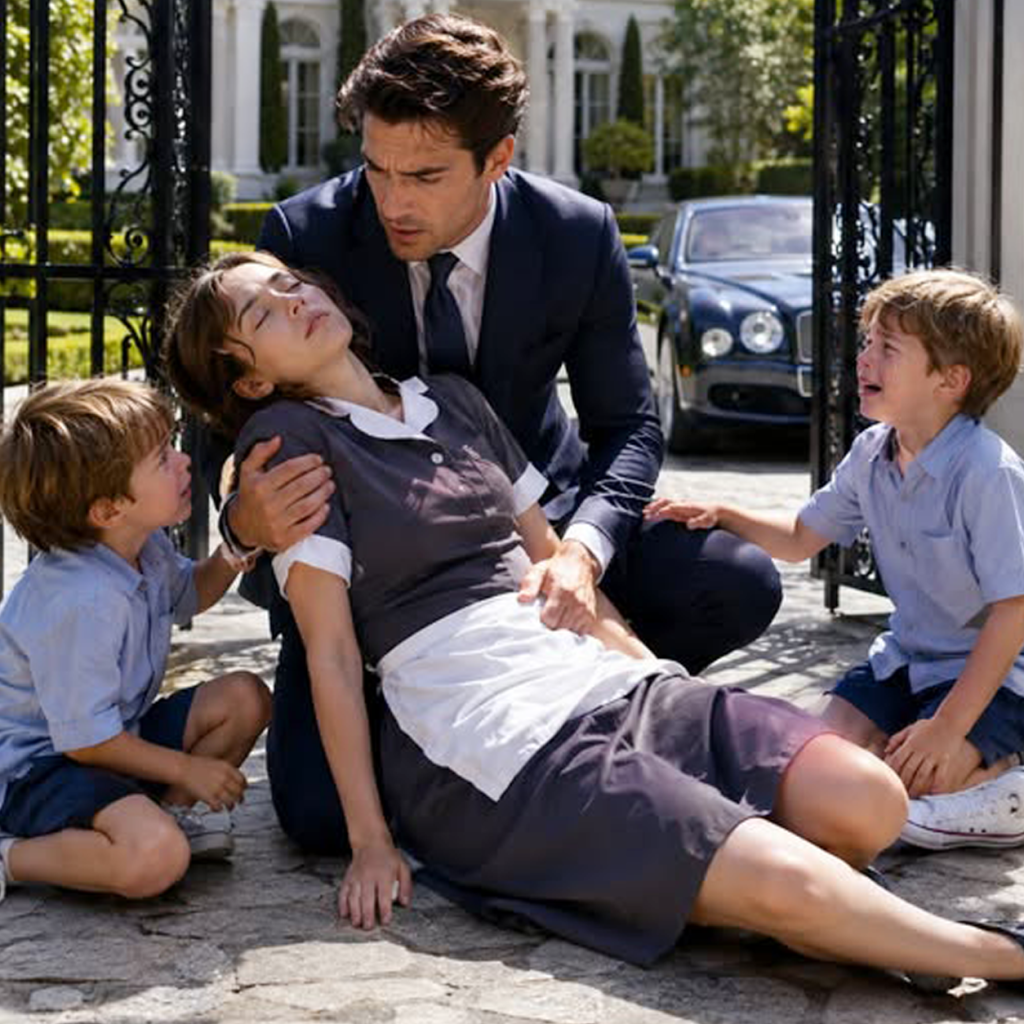
But I had seen them kneeling beside Claire at the gate.
I had heard Owen call her Aunt Claire.
And I knew exactly how many nights I had come home after they were asleep.
“Why did you apply to work at my house?” I asked.
Claire looked away.
“I needed a job.”
“That is not the whole answer.”
“No.”
“Did Evelyn ask you to find us?”
“Not exactly.”
“What does that mean?”
She reached toward the bedside table, where the nurse had placed her belongings in a clear plastic bag.
“My bag,” she said. “There’s a small pocket inside.”
I handed it to her.
Her fingers trembled as she unfastened the zipper. She removed a tarnished silver key, a folded transit map, several receipts, and a photograph worn soft at the edges.
She held the photograph out to me.
It showed two women sitting beside a hospice window.
Claire was younger, her hair pulled into a loose braid. Beside her sat Evelyn.
My wife.
She was thinner than I remembered, wrapped in the blue cardigan she loved. A blanket covered her knees, but her smile was unmistakable—warm, mischievous, alive.
My breath stopped.
I lowered myself into the chair.
“I’ve never seen this.”
“A nurse took it.”
“Why didn’t Evelyn tell me about you?”
“She knew you were barely sleeping. She didn’t want to give you another person to worry about.”
That also sounded like Evelyn.
I traced the edge of the photograph without touching her face.
“Did she teach you the star song?”
“Yes.”
“Why?”
“My mother was afraid at night. Evelyn heard her crying. She came into the room and sang it.”
I closed my eyes.
The melody returned to me so clearly that for a moment I could almost hear Evelyn’s voice in the hospital room.
Stars above and stars below,
Keep the ones we love aglow.
I had written the first two lines as a joke during a blackout years earlier. Evelyn had added the rest, turning it into a lullaby for our unborn sons.
“She made me promise to remember it,” Claire said.
“Why?”
“She said songs survive people.”
I opened my eyes.
“Is that why you came?”
“Partly.”
“What is the other part?”
Claire gathered the photograph back into her hand.
“My mother died four days after your wife.”
“I’m sorry.”
“For a while, I couldn’t go near hospitals. I couldn’t listen to music. I left New York and stayed with my brother in Ohio.”
“What brought you back?”
“A letter.”
Something in the way she said it made me sit straighter.
“What letter?”
“One Evelyn left with a hospice nurse.”
“For you?”
Claire nodded.
“When did you receive it?”
“Six months ago.”
“That doesn’t make sense. Evelyn died almost five years ago.”
“The nurse retired. She had kept a box of personal belongings from patients whose families never collected them. When she moved, she tried to find the people named on the envelopes.”
“And Evelyn wrote to you?”
“Yes.”
“What did she say?”
Claire’s fingers closed around the photograph.
“She asked me to check on the boys when they turned five.”
I stared at her.
“Why would she ask a stranger to do that?”
“She didn’t consider me a stranger.”
“You knew her for a week.”
“Sometimes a week is enough when both people know time is running out.”
The answer unsettled me because I understood it.
In the final days of Evelyn’s life, entire relationships formed in a single glance. Nurses knew the shape of our fear better than lifelong friends. Other families recognized our silence because it matched their own.
“Why didn’t you contact me directly?” I asked.
“I tried.”
“When?”
“Twice. Your assistant returned the first call and said you didn’t respond to personal requests from unknown individuals. The second time, no one called back.”
I remembered neither message.
There had been several assistants since Evelyn’s death. Layers of people stood between me and anything they believed might disturb my schedule.
“So you applied through the agency.”
“Yes.”
“Under false pretenses.”
“I have housekeeping experience. I didn’t lie about my qualifications.”
“You concealed your connection to my wife.”
“I was afraid you wouldn’t let me near the boys.”
“You were right.”
Claire looked down.
“Which is exactly why I didn’t tell you.”
I could not argue with that.
“What did you expect to find?”
Her expression changed.
Until then, she had seemed exhausted, defensive, and sad. Now uncertainty entered her face.
“I didn’t know.”
“You came into my home because of a five-year-old letter. You must have expected something.”
“She wanted me to make sure the boys still knew the song.”
“That was all?”
“No.”
The monitor continued its soft, steady rhythm.
“What else?”
Claire glanced toward the half-open door.
“She asked me to look for something.”
A chill moved through me.
“What?”
“She didn’t explain clearly.”
“Try.”
Claire hesitated.
“She wrote that before the boys’ fifth birthday, you would receive a box from her attorney.”
“I didn’t.”
“Are you certain?”
“Yes.”
Evelyn’s estate had been settled years earlier. I would have remembered anything arriving from her.
“Maybe it was delayed,” Claire said.
“Or maybe the letter wasn’t real.”
Her face tightened.
“You think I invented it?”
“I think my wife was heavily medicated and dying. I think people remember conversations differently. I think letters can be misunderstood.”
“It wasn’t misunderstood.”
“Then show it to me.”
Claire became very still.
“The letter,” I said. “Show me.”
“I don’t have it here.”
“Where is it?”
“In my apartment.”
“Then I’ll send someone to retrieve it.”
“No.”
“Why not?”
“Because I don’t know you well enough to let one of your employees search my home.”
The irony nearly made me laugh.
“You entered my home under a hidden identity.”
“I entered as Claire Bennett. That is my name.”
“You know what I mean.”
“Yes,” she said. “And I also know that having money has taught you to expect locked doors to open when you reach them.”
Her words angered me again, but beneath the anger was a reluctant awareness that she was right.
I had already begun solving the problem as I solved business disputes—send a car, send an employee, obtain the document, control the variables.
Claire was not a variable.
She was a person lying in a hospital bed because no one in my home had taken the time to ask whether she had eaten.
“When you’re discharged,” I said, choosing each word carefully, “you can bring me the letter yourself.”
“I will.”
“And the box Evelyn mentioned—what was inside?”
“I don’t know.”
“What did she ask you to look for?”
Claire’s gaze returned to the photograph.
“She called it the second star.”
I felt a faint prickling along my arms.
“The boys had two silver stars hanging in their nursery,” I said.
“I know.”
“How?”
“Evelyn drew them in the letter.”
The cedar box in the attic flashed through my mind.
I had packed both stars away myself.
At least, I thought I had.
I stood.
“Stay here.”
Claire frowned. “Where are you going?”
“Home.”
“The boys—”
“They’re coming with me.”
“You should let them sleep.”
“I need to check something.”
“Nathan.”
It was the first time she had used my name.
I stopped at the door.
Claire’s face was pale again, but her eyes were intent.
“Evelyn wrote one more thing.”
I waited.
“She said the box would only make sense after you found the missing star.”
“What missing star?”
“I don’t know.”
“I put both of them in the attic.”
“Then perhaps one of them isn’t the star she meant.”
Before I could answer, the boys returned carrying hot chocolate in paper cups. Each had three marshmallows floating on the surface.
Owen hurried to Claire.
“We saved you one.”
He held up a fourth cup.
Claire smiled, but her eyes remained on me.
I wanted to drive home that instant. I wanted to climb the attic stairs, open the cedar box, and prove that both silver stars were exactly where I had left them.
Instead, I stayed until the nurse said visiting hours were over.
The boys hugged Claire carefully. Lucas made her promise not to leave the hospital without telling him. Owen placed his untouched marshmallows in a napkin and left them beside her bed “for breakfast.”
In the elevator, Lucas leaned against me.
“Are you still mad at her?”
“I’m not mad.”
“You look mad.”
“I’m confused.”
“Is that why grown-ups get quiet?”
“Sometimes.”
He considered this.
“Claire gets quiet when she’s scared.”
I looked down at him.
“What is she scared of?”
Lucas shrugged.
“The attic.”
The elevator doors opened.
I did not move.
“What did you say?”
“The attic,” he repeated. “She went up there yesterday.”
My pulse began to quicken.
“Why?”
“She said she was looking for Christmas blankets.”
“It’s July.”
Lucas nodded solemnly. “That’s why it was weird.”
The drive home felt longer than the journey to the hospital.
Both boys fell asleep in the back seat. Ruth followed in her own car, keeping a careful distance behind us.
When we reached the mansion, the front gate was still open. A faint stain darkened the stone where Claire had fallen.
I carried Owen upstairs while Ruth took Lucas. We placed them in their beds without changing their clothes.
Then I went to the attic.
Ruth followed me to the narrow staircase.
“Sir, perhaps this can wait until morning.”
“No.”
The attic door creaked open.
Dust moved through the beam of my phone’s flashlight. The air smelled of cedar, old paper, and the lavender sachets Evelyn used to tuck into linen drawers.
I had not entered the room in more than two years.
Boxes stood in careful rows, each labeled in my handwriting.
EVELYN—BOOKS.
NURSERY.
PHOTOGRAPHS.
The cedar box rested beneath a folded white crib canopy.
My hands shook as I lifted it onto an old table.
The brass clasp opened with a soft click.
Inside were the boys’ hospital bracelets, two knitted caps, Evelyn’s handwritten nursery plans, and several small velvet pouches.
I found the first silver star in the pouch marked LUCAS.
The second pouch, marked OWEN, was empty.
I searched the box again.
Then the surrounding cartons.
Nothing.
Behind me, Ruth whispered, “Perhaps it was misplaced.”
“No.”
I remembered wrapping both stars in tissue paper. I remembered placing them side by side before closing the lid.
I picked up Lucas’s star.
It was smaller than my palm, with five rounded points and a tiny hook at the top.
Something had been scratched into the back.
I held it closer to the light.
Not scratched.
Engraved.
A date.
The twins’ fifth birthday.
And beneath it, three words I had never seen before.
ASK ABOUT DANIEL.
“Who is Daniel?” Ruth asked.
I could not answer.
A sound came from the staircase.
We both turned.
Lucas stood in the attic doorway, barefoot and drowsy, clutching his blue backpack.
“What are you doing up?” I asked.
He looked at the silver star in my hand.
“Claire said you’d find that.”
My throat tightened.
“When did she say that?”
“Yesterday.”
Ruth and I exchanged a glance.
Lucas opened his backpack and pulled out a flat, cream-colored envelope.
“She told me to give you this only if she got sick.”
He crossed the attic and placed it in my hand.
My name was written across the front in a familiar sloping script.
Nathan.
I had seen that handwriting on birthday cards, grocery lists, love notes, and the last letter Evelyn left beside my pillow.
For several seconds, I could not breathe.
Then I turned the envelope over.
The seal had already been broken.
Inside was a single sheet of paper and a small brass key.
I unfolded the page.
The message was brief.
Nathan,
If Claire has given you this, then the second star is missing, just as I feared.
Do not blame her.
Do not call my attorney.
And before you trust anyone in this house, ask Ruth what happened to Daniel.
I read the final line twice.
Then I slowly lifted my eyes.
Ruth had gone completely pale.
END OF PART 2 – LIKE, SHARE AND COMMENT “THE ENTIRE STORY” IF YOU WANT TO READ THE FULL STORY