My mom and twin sister kicked me out at 19.
I lived in a tent and struggled for years.
Now I have my own house.
They showed up uninvited with my sister’s family, demanding to move in.
I smiled and called security:
“Release the dogs…
Escort our guests out.”
Grant’s face filled the security camera, one hand gripping the bars.
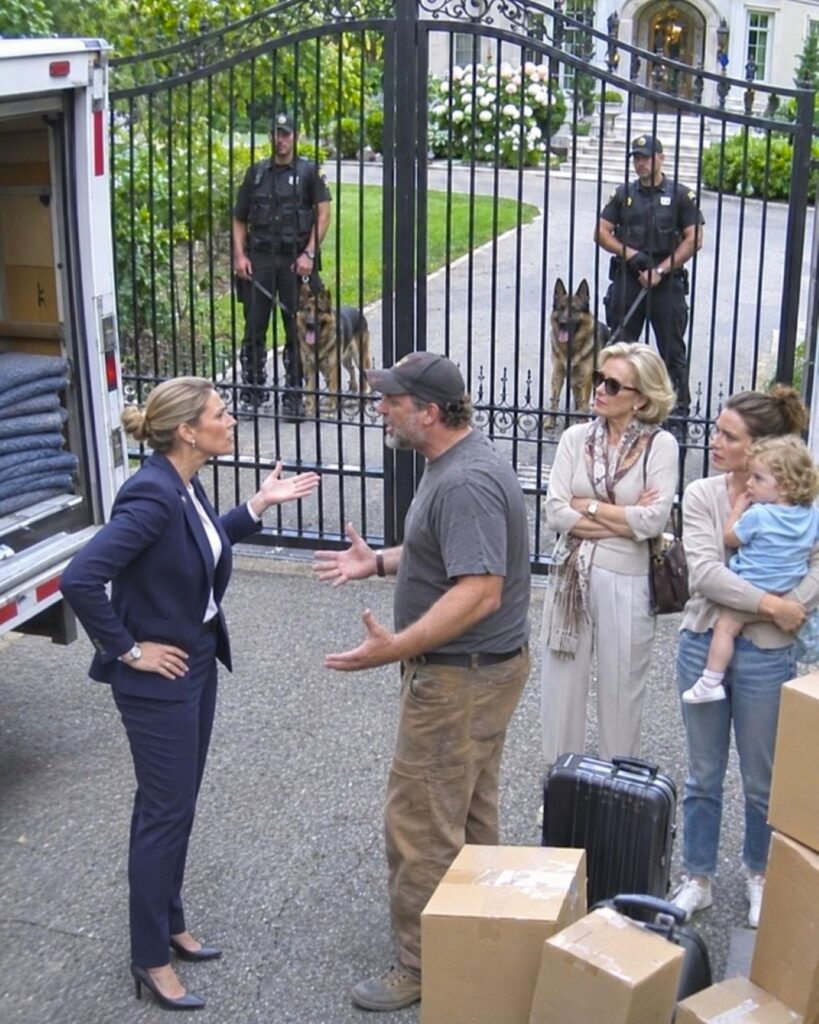
Behind him, a rented moving truck blocked half my driveway.
My mother stood beside it in sunglasses, while my twin sister held a child against her hip.
Boxes were stacked on the pavement.
They had not come to visit.
They had come to move in.
My mother pressed the intercom.
“We drove three hours. The kids are exhausted. Stop embarrassing us and open up.”
I stayed inside my office, watching them on the screens.
“My answer is no.”
My sister, Mallerie, stepped closer.
“The downstairs suite is perfect for us. Grant can use the workshop. You have more space than you need.”
Grant glanced through the gate at my company vans.
“Nice setup,” he said. “Business must be good.”
Twelve years earlier, they had watched me leave home at nineteen with two trash bags and nowhere to sleep.
My mother had given my bedroom to Mallerie and Grant because Mallerie was pregnant.
When I asked for the couch, Grant said he needed it for his back.
When I asked about the basement, Mallerie said the air was bad for baby supplies.
Then Mom looked at me as if she had rehearsed the words.
“You are nineteen, Paige. At some point, you have to stop being my responsibility.”
For weeks, I slept on friends’ floors.
When those options disappeared, I bought a tent and hid it behind storage sheds at a roadside flea market.
I washed in gas station bathrooms before work.
I kept my best shirt sealed in plastic so it would not smell like wet grass.
One afternoon, Mom saw me collecting grocery carts.
Our eyes met through her windshield.
She drove away.
Now she stood outside the home I had earned and said,
“You know what it feels like to have nowhere comfortable to sleep. You should be the last person denying family shelter.”
I leaned toward the intercom.
“You remember that?”
Her mouth tightened.
“Of course. It was difficult for everyone.”
For everyone.
Not just the girl sleeping with her shoes beside her head in case she had to run.
Mallerie raised her voice.
“Do not rewrite history. Mom worried herself sick. You refused help.”
“What help?”
Grant laughed.
“This is why nobody calls you. You turn everything into a trial.”
Then my mother’s polished expression disappeared.
“You are single. You have no husband and no children. You have a house, a yard, and buildings sitting half empty while your sister’s family struggles. I did not raise you to be selfish.”
She had raised me to be quiet, useful, and available.
But she had not raised the woman standing behind that locked gate.
“You are not moving in,” I said.
“You are not staying here. You are not using my workshop. Move the truck before I have it towed.”
The youngest child began crying.
Mallerie glared into the camera.
“Look what you are doing to them.”
“No. You brought children to a locked gate with boxes and a moving truck. You did this.”
Grant stepped close enough to fog the camera cover.
“Open it.”
I called Rachel Monroe, my operations manager.
“I need the front entrance handled. Bring the security team.”
Five minutes later, Rachel walked down the drive with two handlers and two trained patrol dogs at heel.
The dogs stood silent and alert.
I walked onto the porch.
“Move the truck. Leave the entrance. Do not return without written permission.”
Mallerie looked at the dogs, then at me.
For the first time, she seemed unsure whether tears would work.
Mom whispered,
“This is cruel.”
“No, Mom. This is a boundary with witnesses.”
Grant shouted insults while the cameras recorded.
Rachel warned him that the truck was blocking private access.
He finally moved it.
As they drove away, Mallerie mouthed something through the window.
You will regret this.
For three days, my phone filled with messages about family, forgiveness, innocent children, and how heartless I had become.
I sent one reply.
“You arrived uninvited with a moving truck and attempted to move into my home without consent. The answer is no.”
Mom returned alone the next morning.
She cried into the intercom and said Mallerie was overwhelmed.
Then she used my grandmother.
“Elaine would be ashamed of you.”
The words struck exactly where she intended.
But I remembered Grandma Elaine telling me that cracks reveal where pressure has been ignored.
“Grandma would ask why you need my house after throwing me out of yours.”
Mom slapped the intercom and left.
That afternoon, I drove forty miles to inspect storm damage at a historic rowhouse in Lancaster.
I was standing beneath exposed lath and wet insulation when Rachel called.
“Paige, open the camera app. Side delivery gate. Now.”
The live feed appeared.
Grant’s truck was backed against the secondary entrance.
Mallerie held a cardboard box.
Mom watched the road.
Grant had cut the rubber chain cover and was forcing a pry bar against the latch.
Then Mallerie pointed toward the opening and handed her oldest child a small suitcase.
The child took one uncertain step toward the damaged gate.
My breath slowed.
“Call the police,” I said. “Active trespass. Forced entry. Property damage. Children being brought into a commercial workyard.”
“Already calling.”
Rachel’s voice exploded through the outdoor speaker.
“Step away from the gate. You do not have permission to enter. This area is recorded. Police are coming.”
Grant shouted that she was only an employee and had no right to interfere with family business.
Rachel did not raise her voice.
“This is not family business. This is private property.”
The patrol handlers brought the dogs forward on leashes, stopping inside the fence line.
Grant backed away from the latch but shouted louder.
Mallerie started crying toward the camera.
Mom repeated,
“Paige approved this. Paige changes her mind.”
Then the police cruisers turned into the gravel drive.
Mallerie rushed toward the first officer, clutching her youngest child and claiming I had invited them.
Grant dropped the pry bar beside the damaged latch.
Rachel opened the security archive containing the first confrontation, the intercom recordings, and the live footage.
One officer looked at the broken gate.
Then he looked into the camera and asked:
“Ms. Whitaker, did you ever give these people permission to enter your property?”
“No,” I said.
The word came easily.
Almost frighteningly easily.
“No permission. Not verbally. Not in writing. Not once.”
The officer nodded.
“Understood.”
Grant immediately started shouting.
“She’s lying.”
Rachel turned toward the body camera.
“She has recordings.”
“I don’t care.”
Grant pointed at the security camera.
“She told Mallerie they could stay.”
Mallerie’s face changed.
Only slightly.
But I saw it.
So did Rachel.
My mother looked down.
The officer noticed.
“Ma’am,” he said to Mallerie, “when did she say that?”
Mallerie shifted the child higher.
“Yesterday.”
I answered immediately.
“I never spoke to her yesterday.”
“You texted me.”
“I sent one message.”
Rachel pulled it up.
The officer read it.
His expression remained neutral.
Then he read it again.
“You arrived uninvited,” he quoted. “The answer is no.”
Grant stepped forward.
“That doesn’t matter.”
The officer raised one hand.
“Stay where you are.”
Grant stopped.
Barely.
Another officer walked toward the latch.
He photographed the cut covering.
Then the bent plate.
Then the pry bar.
Then the truck.
Then the suitcase beside the opening.
The oldest child stood very still.
He looked about ten.
Maybe eleven.
I had met him only a handful of times.
His name was Caleb.
He stared at the ground.
That hurt worse than Mallerie’s accusations.
Because children always knew when adults were lying.
They simply lacked the authority to escape.
“Caleb,” Mallerie whispered, “come here.”
He did not move.
The officer crouched nearby.
“You’re not in trouble.”
Caleb nodded once.
His little shoulders remained rigid.
Mallerie grabbed his arm.
“Come stand with me.”
“Ma’am.”
The officer’s voice sharpened.
“Please don’t pull him.”
She released him.
My mother suddenly spoke.
“This is unnecessary.”
Nobody answered.
“We are family.”
Still nobody answered.
Mom stepped closer to the officer.
“My daughter owns everything.”
The sentence nearly made me laugh.
Not from humor.
From disbelief.
A week earlier, ownership had apparently made my house communal.
Now ownership mattered because police had arrived.
Mom continued.
“She told us she would help.”
“I said no.”
My voice carried through the speaker.
Mom looked directly at the camera.
I had seen that expression before.
It belonged to my childhood.
The expression said,
Be quiet.
Make this easier.
Do not embarrass me.
For thirty-one years, some part of me had obeyed it.
That part was tired.
“I said no,” I repeated.
“Twice at the gate. Again by text. Again when Mom returned. They were warned not to come back.”
Rachel lifted a printed document.
“And this was posted after the first incident.”
The officer accepted it.
It was our formal no-trespass notice.
Rachel had insisted we prepare one.
At the time, I had thought she was being cautious.
Now I wanted to hug her.
Grant saw the paper.
His face reddened.
“What is that?”
Rachel answered.
“Documentation.”
“You think paperwork makes you important?”
“No,” Rachel said. “It makes things documented.”
One handler coughed.
I knew that cough.
He was hiding laughter.
Grant heard it too.
He turned toward him.
The nearest patrol dog rose slightly.
Not lunging.
Not growling.
Simply attentive.
Grant stepped back.
The officer pointed toward the truck.
“Sir, remain there.”
“This is ridiculous.”
“Remain there.”
Something changed then.
The entire performance collapsed.
Not loudly.
Quietly.
Like rotten flooring finally accepting gravity.
Mallerie stopped crying.
Mom removed her sunglasses.
Grant looked around for someone weaker.
There was nobody.
Rachel had witnesses.
The officers had cameras.
I had recordings.
The children had seen everything.
And the gate was still broken.
Grant could not bully evidence.
He tried anyway.
“She owes us.”
The officer looked at him.
“Money?”
Grant hesitated.
“No.”
“Property?”
“No.”
“A contract?”
“No.”
“Then what does she owe?”
Grant’s mouth opened.
Nothing came out.
My mother answered instead.
“Family loyalty.”
The officer exhaled.
“That is not a property right.”
Silence followed.
Beautiful silence.
I could hear wind across my microphone.
Dry leaves scraped along the delivery lane.
Somewhere near my workshop, a compressor clicked off.
Ordinary sounds.
Normal sounds.
Sounds from a life they did not own.
The officer asked Mallerie for identification.
Then Grant.
Then Mom.
Rachel remained inside the gate.
The handlers stayed back.
Nobody released the dogs.
Nobody needed to.
The truth had teeth enough.
I left Lancaster immediately.
Rachel told me not to rush.
The police already had everything needed.
Still, I drove home.
Not because I feared they would get inside.
Because I needed to stand there myself.
I needed nineteen-year-old Paige to see something.
She needed to see that nobody was driving away this time.
Nobody was leaving her behind a grocery cart.
Nobody was deciding whether she deserved shelter.
I was deciding.
And I chose myself.
By the time I reached the property, Grant was sitting on the truck bumper.
An officer stood nearby.
Mallerie sat inside Mom’s sedan.
The children were buckled into the back.
Mom stood apart.
Rachel met me near the workshop.
“You okay?”
“No.”
I looked toward the broken gate.
“But I will be.”
Rachel nodded.
“That sounds more accurate.”
I smiled faintly.
“You’re annoyingly practical.”
“It’s in my contract.”
That made me laugh.
Just once.
It surprised me.
The first officer approached.
He introduced himself as Officer Hale.
Then he explained what happened.
Grant admitted cutting the chain cover.
He claimed he believed he had consent.
The recordings contradicted him.
The pry marks were being documented.
The no-trespass notice had been acknowledged through earlier contact.
Mallerie maintained that I had invited them.
Until Hale asked to see her message.
There was no message.
Instead, there was something else.
A text from Grant.
Hale could not show me everything.
But Mallerie had apparently opened it while searching.
Rachel had heard the exchange.
“What did it say?” I asked.
Rachel’s jaw tightened.
“Grant told her to start unloading quickly.”
I waited.
Rachel continued.
“He said once their stuff was inside, you wouldn’t throw the kids out.”
My stomach turned cold.
Not from surprise.
From recognition.
They had counted on my conscience.
They had weaponized their own children.
Again.
Just differently.
I closed my eyes.
The flea market returned.
Wet canvas.
Cold socks.
A flashlight with dying batteries.
The sound of trucks passing beyond the tree line.
I remembered imagining my mother arriving.
I imagined headlights stopping.
Her opening the door.
Her saying,
Come home.
I had imagined it so many nights that eventually the fantasy felt embarrassing.
Now she had come.
Twelve years late.
Not to rescue me.
To occupy my house.
“Paige?”
Rachel touched my elbow.
I opened my eyes.
“I’m here.”
Officer Hale approached again.
“Ms. Whitaker, would you like to make a statement?”
“Yes.”
My voice steadied.
“Yes, I would.”
We sat inside my office.
The same office where I had watched the first confrontation.
I described everything.
The eviction at nineteen.
The recent arrival.
The moving truck.
The warning.
Mom’s return.
The second forced entry.
I kept facts separate from feelings.
Rachel had taught me that.
Facts were easier to defend.
Feelings mattered.
But facts built walls.
When I finished, Hale closed his notebook.
“I need to ask one more thing.”
“Okay.”
“Did anyone make direct threats?”
I thought about Mallerie’s silent words.
You will regret this.
I described them.
Then Grant’s behavior.
His demands.
His proximity to the camera.
Hale noted everything.
“We’ll include that.”
“What happens now?”
He explained the immediate process.
There would be reports.
Possible charges.
Property damage documentation.
Trespass issues.
Potential court restrictions.
He recommended speaking with counsel.
I already had one.
Business ownership teaches certain lessons quickly.
Never build without permits.
Never hire without paperwork.
Never assume goodwill replaces documentation.
And apparently, never underestimate relatives with a moving truck.
When we stepped outside, Mom was waiting.
Hale moved between us automatically.
She looked smaller.
Not kinder.
Just smaller.
“Paige,” she said.
I said nothing.
“Please.”
Hale glanced at me.
“You don’t have to speak with her.”
“I know.”
Those words mattered.
I know.
I had choices now.
“Two minutes,” I said. “Officer stays.”
Mom flinched.
“Is that necessary?”
“Yes.”
We stood ten feet apart.
The late afternoon sun made every shadow sharp.
Mom folded her hands.
“I did not know Grant would damage anything.”
I believed that.
It changed nothing.
“You watched the road.”
Her eyes shifted.
“I was nervous.”
“Why?”
No answer.
“If you thought you had permission, why watch the road?”
“Paige—”
“Why?”
Her chin trembled.
“For the police.”
There it was.
The smallest confession.
Quiet.
Unavoidable.
“You knew.”
“I knew you might overreact.”
I laughed once.
Mom looked offended.
“Overreact?”
I gestured toward the gate.
“He used a pry bar.”
“I told him not to.”
“But you stayed.”
“Mallerie had nowhere else.”
“So you decided my no meant yes.”
Mom’s face hardened.
“You don’t understand.”
“I understand perfectly.”
“No, you don’t. You have never raised children.”
The old weapon.
Always polished.
Always ready.
Marriage.
Children.
Sacrifice.
As if suffering required witnesses to become legitimate.
“You’re right,” I said.
“I never raised children.”
Mom seemed relieved.
Then I continued.
“But I remember being yours.”
Her face emptied.
Officer Hale looked away.
Not because he was uncomfortable.
Because he understood some moments belonged to the people inside them.
I stepped closer.
Still beyond reach.
“I remember asking for one night on your couch.”
Mom’s lips parted.
“I remember Grant saying his back hurt.”
“Paige.”
“I remember asking for the basement.”
“That was years ago.”
“I remember you watching me work.”
She swallowed.
“I didn’t know you were homeless then.”
“Our eyes met.”
“You never told me.”
“I had two trash bags.”
She looked down.
“I thought you were staying somewhere.”
“Where?”
Silence.
“With friends.”
“For how long?”
She had no answer.
“Did you ever call?”
“I thought you were angry.”
“I was homeless.”
“You were stubborn.”
Officer Hale glanced up.
Mom realized what she had said.
Too late.
I felt something inside me settle.
Not break.
Settle.
Like a beam finally seated properly.
For years, I had carried a private question.
Maybe I was difficult.
Maybe I remembered wrong.
Maybe they offered more.
Maybe I rejected something.
Maybe Mom truly believed I had another option.
But there, with an officer and cameras recording, she gave me the final missing piece.
She knew enough.
She simply believed my hardship was an acceptable consequence.
Because forcing me to disappear made Mallerie’s life easier.
“Thank you,” I said.
Mom blinked.
“For what?”
“For finally not pretending.”
I turned away.
She called my name.
I kept walking.
“Paige!”
I stopped.
Not facing her.
“If you contact me,” I said, “do it through my attorney.”
“You cannot mean that.”
“I do.”
“What about your sister?”
“Attorney.”
“The children?”
My chest tightened.
“Do not use them.”
“They love you.”
“They barely know me.”
“They could.”
That almost worked.
Almost.
I turned.
“They still can, if their parents stop using them as keys to doors.”
Mallerie heard that.
The car window was partly open.
Her eyes met mine.
For one second, something crossed her face.
Shame.
Real shame.
Then Grant shouted from the truck.
“Can we go now?”
The moment vanished.
Hale told them they were free to leave under specific instructions.
Grant would receive further information.
They were not to return.
They drove away.
This time, no one mouthed threats.
No one waved.
I watched until the truck disappeared.
Then I walked to the damaged gate.
The latch hung crooked.
Metal had been gouged around the plate.
A stupid amount of damage for such a small opening.
Rachel stood beside me.
“We’ll replace it tomorrow.”
“No.”
She looked at me.
“Monday?”
“I mean replace everything.”
I touched the bent steel.
“Stronger posts. New access controls. Camera on both angles. Vehicle barrier here.”
Rachel nodded.
“I’ll call Mason.”
“And Rachel?”
“Yeah?”
“Thank you.”
She shrugged.
“You pay me.”
“No.”
I looked at her.
“You knew what this was.”
Her expression softened.
“I knew enough.”
“How?”
Rachel leaned against the fence.
“My dad used to show up at workplaces.”
I waited.
“He would apologize, cry, promise he changed.”
She looked toward the road.
“Then he’d ask for money.”
“I’m sorry.”
“It was twenty years ago.”
“That doesn’t mean it didn’t happen.”
Rachel looked at me.
Then she smiled sadly.
“Exactly.”
We stood there without speaking.
Sometimes friendship is not comfort.
Sometimes it is recognition without intrusion.
That evening, I did something I had avoided for twelve years.
I drove to the flea market.
The place had changed.
New signs.
New fencing.
Half the old sheds were gone.
The gravel lot had been paved.
A discount furniture warehouse occupied the east end.
But behind it, near a row of old sycamores, stood one familiar building.
The maintenance shed.
My tent had been behind that shed.
I parked nearby.
For several minutes, I stayed inside.
Then I got out.
The September air smelled different than memory.
Drier.
Cleaner.
Memory adds weather.
Every bad night becomes colder.
Every shadow deeper.
Every silence louder.
Still, when I rounded the shed, my body remembered.
My shoulders tightened.
My hands went cold.
There.
That patch of earth.
I knew it.
Even without the old weeds.
Even without the dented dumpster.
Even without my faded blue tent.
I knew.
I stood where nineteen-year-old Paige had once slept.
She had owned almost nothing.
One sleeping bag.
Three shirts.
Two pairs of jeans.
A flashlight.
A cracked phone.
A grocery store badge.
Twenty-seven dollars.
And a notebook.
I had written construction terms in that notebook.
Joist.
Flashing.
Load path.
Ledger.
Sheathing.
Because one morning, while stocking hardware, a contractor named Luis Moreno heard me explain the difference between two concrete anchors to a customer.
He asked where I learned.
I told him I read the labels.
He laughed.
Then offered me a cleanup shift.
That cleanup shift became demolition work.
Then material runs.
Then framing assistance.
Then night classes.
Then estimating.
Then licensing.
Then my first renovation.
Then my company.
Nobody handed me a house.
But people handed me small chances.
That mattered.
A chance is not rescue.
It is a door.
You still have to walk through.
I touched the shed wall.
The metal felt cool.
“You made it,” I whispered.
The words felt foolish.
Then they didn’t.
“You made it.”
My eyes burned.
I let them.
Nobody was watching.
Nobody needed me to look composed.
I cried for the girl who kept shoes beside her head.
For the girl who learned which station had the cleanest bathroom.
For the girl who worked doubles so exhaustion could replace fear.
For the girl who stopped calling Mom because unanswered ringing hurt more than silence.
And then, slowly, I cried for myself now.
Because surviving something does not mean you finished feeling it.
I stayed until dusk.
When I returned home, Rachel had left a thermos on my porch.
A sticky note was attached.
Soup.
Eat.
Bossy handwriting.
I smiled.
Then I went inside.
The house felt enormous.
For the first time, I understood why that had bothered me.
Mom was wrong about one thing.
Empty rooms were not waste.
Space could be peaceful.
Space could be chosen.
Space could belong to nobody until I decided otherwise.
I heated the soup.
Then my phone buzzed.
Attorney.
I almost ignored it.
Instead, I answered.
My attorney, Nadia Chen, did not waste words.
“Paige, we have a problem.”
I sat down.
“What kind?”
“Your sister filed something today.”
My stomach dropped.
“What?”
“Not a lawsuit. Not yet.”
Nadia paused.
“She submitted mail showing your address.”
I stopped breathing.
“What mail?”
“School enrollment paperwork. Insurance correspondence. Two account statements.”
“That is impossible.”
“I know.”
“No one lives here.”
“I know.”
“How old?”
“The earliest item is six weeks old.”
I stood.
My chair scraped backward.
“Six weeks?”
“Yes.”
“They planned this.”
“That is my concern.”
I walked toward my office.
“Send everything.”
“Already did.”
The documents appeared in my inbox.
I opened the first image.
Mallerie’s name.
My address.
The second.
Grant’s name.
My address.
The third made me sit.
A change-of-address confirmation.
Submitted online.
Temporary forwarding requested.
My home address listed as theirs.
They had been building a paper trail.
Before the moving truck.
Before the gate.
Before Mom cried about shelter.
This was never spontaneous.
Nadia continued.
“We need to respond carefully.”
“Can they claim residence?”
“Paper does not create permission.”
Her voice remained calm.
“But we document immediately. We notify relevant parties. We preserve everything. And nobody enters.”
I stared at the screen.
“There’s more, isn’t there?”
“Yes.”
Of course there was.
“One form lists your mother as a supporting witness.”
I closed my eyes.
“What does she claim?”
“That you verbally agreed to provide temporary housing.”
“When?”
“Last month.”
I laughed.
It sounded awful.
“I hadn’t spoken to Mom last month.”
“That helps.”
“I have phone records.”
“That helps more.”
A memory surfaced.
Mom’s first visit.
Mallerie saying the downstairs suite was perfect.
Not asking.
Declaring.
Grant noticing the workshop.
The moving truck.
The confidence.
They had expected resistance.
They had also expected to defeat it.
“Nadia.”
“Yes?”
“Do everything necessary.”
“I will.”
“No warnings from me.”
“Good.”
“No personal calls.”
“Better.”
“And Nadia?”
“Yes?”
“I want the whole timeline.”
“You’ll have it.”
I barely slept.
The next morning, Rachel arrived early.
So did Mason, our security contractor.
By noon, the damaged entrance had been rebuilt.
By evening, Nadia had sent formal notices disputing residency claims.
The school district received documentation.
The postal issue was flagged.
Insurance records were corrected.
Every false use of my address was preserved.
Then came the first revelation.
The children were not enrolled at my address yet.
Mallerie had only started the process.
The paperwork had been rejected pending proof.
That mattered.
But another discovery mattered more.
Grant had given my property address to a lender.
Not as collateral.
He could not legally pledge property he did not own.
But he had listed the workshop as his business location.
His failed construction company had been receiving notices under my address.
One envelope had apparently been intercepted before reaching me.
Nadia found that particularly interesting.
So did police.
The situation widened.
Not dramatically.
Procedurally.
Which frightened Grant more.
A shouting match he understood.
Documents were different.
Documents did not tire.
Documents did not feel guilty.
Documents did not care who Mom favored.
Within a week, Grant hired counsel.
Within two, his messages stopped.
Mom’s did not.
She sent emails to Nadia.
Long ones.
She described me as emotionally wounded.
As unforgiving.
As confused about childhood events.
She said she feared I had become “obsessed with punishment.”
Nadia forwarded only what mattered.
One sentence mattered.
Mom admitted they discussed “establishing the family” at my property before asking me.
Before asking.
I read it three times.
Then I printed it.
Not for court.
For myself.
Some people will give truth only while trying to justify themselves.
Mom thought planning beforehand proved desperation.
Instead, it proved intent.
The charges against Grant proceeded.
Not the fantasy of television justice.
No dramatic handcuffs.
No packed courtroom.
No thunderous confession.
Real consequences were slower.
Less satisfying.
More durable.
His attorney negotiated.
He faced charges related to property damage and unlawful entry.
Restitution became part of the case.
The false-address issues triggered separate reviews.
Mallerie was not charged for standing beside a broken gate.
But her statements were documented.
So was Mom’s.
Nadia filed for civil protections.
The court hearing was scheduled three weeks later.
I dreaded it.
Not because I feared losing.
Because court meant seeing them again.
For several nights, I dreamed I was nineteen.
I would wake inside my bedroom, hear Mallerie laughing in the hall, then open the door and find the flea market outside.
Rachel finally said what I refused to admit.
“You need somebody who isn’t your lawyer.”
“I have friends.”
“That is not what I said.”
“I’m fine.”
She stared at me.
“You inspected the same invoice for forty minutes.”
“It was complicated.”
“It was paint.”
I frowned.
Rachel crossed her arms.
“You built an entire company around fixing structures before they collapse.”
I knew where this was going.
“Don’t.”
“And yet when the structure is your nervous system—”
“Rachel.”
“I’m done.”
She walked away.
Then turned.
“Therapist.”
“I heard you.”
“Excellent.”
I hated when she was right.
Two days later, I sat in Dr. Lena Brooks’s office.
I expected questions about my mother.
Instead, she asked about my house.
“What room feels safest?”
“My office.”
“Why?”
“Cameras.”
She waited.
I heard it too.
Not bedroom.
Not kitchen.
Not living room.
Office.
Cameras.
Locks.
Screens.
Evidence.
Safety had become surveillance.
That realization stayed with me.
“What room feels least safe?”
I almost said none.
Then I pictured the downstairs suite.
The room Mallerie had claimed before ever entering.
“The guest suite.”
“Why?”
I looked toward the window.
“Because she named it.”
Dr. Brooks nodded.
“Then reclaim it.”
“How?”
“That is yours to decide.”
I returned home and stood in the suite.
It was lovely.
Separate entrance.
Small sitting room.
Bathroom.
Bedroom.
French doors to the garden.
I had designed it for Grandma Elaine.
She died before the renovation finished.
That was why I rarely entered.
Not because it was empty.
Because it contained an unfinished future.
Mallerie had seen pictures online.
She had mistaken my grief for available space.
I walked through every room.
Then I called Rachel.
“I’m changing the suite.”
“To what?”
“I don’t know yet.”
“That seems unlike you.”
“It’s new.”
She laughed.
“Good.”
The court hearing arrived on Tuesday.
Rain fell all morning.
Nadia met me outside the courthouse.
“You do not have to engage them.”
“I know.”
“Good.”
“I keep practicing that.”
Mom arrived first.
She wore navy blue.
The same color she wore to Grandma’s funeral.
Mallerie followed.
Alone.
Grant came separately with his attorney.
That surprised me.
Then I noticed Mallerie’s hand.
No wedding ring.
She saw me notice.
Her fingers curled inward.
Nobody spoke.
Inside, the proceeding was restrained.
Evidence was reviewed.
Dates.
Messages.
Warnings.
Property records.
Video references.
The court did not care who had hurt whose feelings twelve years ago.
That disappointed one part of me.
Then relieved another.
I did not need the legal system to validate childhood pain.
I needed it to protect present boundaries.
It did.
Restrictions were entered.
No unauthorized entry.
No interference with my property.
No direct harassment.
Communication regarding the ongoing matters went through counsel.
Simple.
Clear.
Enforceable.
When we exited, Grant disappeared quickly.
Mallerie stayed.
Mom caught her arm.
“Come on.”
Mallerie pulled away.
“I need a minute.”
Mom looked at me.
Then Nadia.
Then the courthouse deputy.
She released Mallerie.
Nadia asked me quietly,
“Do you want to leave?”
I almost said yes.
Then Mallerie spoke.
“Grant left.”
I looked at her.
“What?”
“He moved out three nights ago.”
Mom interrupted.
“Not here.”
Mallerie turned on her.
“Yes. Here.”
Mom’s face tightened.
“This is private.”
“So was Paige’s house.”
The words landed hard.
Mallerie looked as shocked as everyone else.
Perhaps most of all herself.
Mom whispered,
“Do not start.”
Mallerie laughed bitterly.
“That’s what you always say.”
I stayed silent.
She looked at me.
“I’m not asking to come home with you.”
“Good.”
Her face crumpled slightly.
I regretted the sharpness.
Not the answer.
Just the blade.
She nodded.
“I deserved that.”
Mom stepped forward.
“Mallerie, we are leaving.”
“No.”
“Mallerie.”
“No, Mom.”
The courthouse doors opened behind us.
People passed.
Umbrellas snapped open.
Cars hissed through wet streets.
Our family stood motionless in the middle.
Mallerie wiped her face.
“Grant’s business failed eight months ago.”
I knew part of that already.
She continued.
“He hid how bad.”
Mom said,
“This is unnecessary.”
Mallerie ignored her.
“He borrowed money.”
“How much?” I asked.
“More than I knew.”
“From Mom?”
Mallerie looked at her.
Mom looked away.
“How much?” I asked again.
Mom whispered,
“Everything.”
Rain tapped the courthouse awning.
I felt no triumph.
Only exhaustion.
“Define everything.”
Mom’s voice was barely audible.
“I sold the house.”
There it was.
The missing reason.
The house where I grew up.
The house I had been expelled from.
Gone.
“When?”
“Four months ago.”
“And the money?”
Mallerie answered.
“Grant used most of it.”
Mom snapped,
“He invested it.”
“He lost it.”
“You agreed.”
“I believed him.”
“So did I.”
They stared at each other.
Two people arguing over ruins they had built together.
I suddenly understood the moving truck.
The urgency.
The entitlement.
My house had not merely looked convenient.
It was their final plan.
“What about the children?” I asked.
Mallerie’s face changed.
“We’re staying at an extended-stay motel.”
My heart tightened.
I hated that.
I hated that she knew I would hate it.
She noticed.
“I’m not asking.”
“Then why tell me?”
“Because I want to say the truth.”
Mom scoffed.
“This is humiliating.”
Mallerie turned.
“You know what was humiliating?”
Mom froze.
“Watching Grant pry open Paige’s gate.”
“Mallerie.”
“Watching Caleb carry that suitcase.”
Mom’s mouth closed.
“I told him Aunt Paige wanted us.”
My stomach twisted.
Mallerie looked at me.
“I lied to my son.”
Tears spilled down her face.
“I told him you said yes.”
I said nothing.
“Because Grant said if the kids went first, you wouldn’t stop us.”
“I know.”
Her face went white.
“How?”
“The police found his message.”
She covered her mouth.
For a moment, she looked twenty years younger.
My twin.
The girl who once shared my birthday cake.
The girl who stole my sweaters.
The girl who slept beside me during thunderstorms.
Before Grant.
Before pregnancy.
Before Mom decided one daughter’s needs required sacrificing the other.
“I’m sorry.”
The words were almost soundless.
Mom stiffened.
“Mallerie.”
She turned sharply.
“No.”
That single word carried decades.
“No more.”
Mom stared.
“You think this is my fault?”
“Some of it.”
Mom recoiled.
“I gave you everything.”
“Yes.”
Mallerie’s voice cracked.
“You did.”
Then she looked at me.
“And that was part of the problem.”
I felt something shift beneath us.
Not reconciliation.
Truth.
Mom’s face hardened instantly.
“I will not stand here while both my daughters attack me.”
I almost answered.
Mallerie did first.
“Paige isn’t attacking you.”
Mom stared.
“She hasn’t said anything.”
Another silence.
Different this time.
Mom looked at me.
Perhaps expecting rescue.
Perhaps expecting anger.
I gave neither.
“I’m leaving,” I said.
Mallerie nodded.
“Okay.”
I took two steps.
Then stopped.
“The children have food?”
Her eyes filled again.
“Yes.”
“School?”
“Still enrolled where we were.”
“Transportation?”
“I drive them.”
“Safe room?”
She hesitated.
“Yes.”
That hesitation told me enough.
I pulled Nadia aside.
Quietly.
“Can I help the children without giving residency rights?”
Nadia studied me.
“Yes. But structure it.”
“I don’t want them at my house.”
“You don’t need to.”
“I don’t want cash going through Grant.”
“Then don’t.”
Mallerie waited several yards away.
Mom had gone to the car.
I returned.
“I will pay the motel directly for fourteen days.”
Mallerie’s mouth opened.
I raised one hand.
“Listen first.”
She closed it.
“Fourteen days.”
She nodded.
“For the children.”
“Yes.”
“Not Grant.”
“No.”
“You give Nadia the booking information.”
“Okay.”
“This does not change the order.”
“I understand.”
“You do not come to my property.”
“I understand.”
“You do not use my address.”
“I won’t.”
“And Mallerie?”
“Yes?”
“If anyone calls this forgiveness, I stop helping.”
She swallowed.
“Okay.”
“This is not forgiveness.”
“I know.”
“It is not reconciliation.”
“I know.”
“It is two weeks of beds for three children.”
She started crying.
Quietly now.
No performance.
No camera.
No audience she could manipulate.
“Thank you.”
I nodded.
Then left.
For fourteen days, I heard nothing.
Nadia handled payment.
Mallerie found a small rental outside York.
I learned this only because Nadia confirmed the motel assistance ended.
No extension requested.
No surprise visit.
No guilt message.
That mattered.
Three weeks later, an envelope arrived at Nadia’s office.
From Mallerie.
Inside was a handwritten letter.
Nadia asked whether I wanted it.
I said no.
Then called back ten minutes later.
“Yes.”
I read it that evening.
Mallerie did not ask for anything.
That was the first important thing.
She described the year before my eviction.
Mom had always compared us.
But pregnancy changed the comparison.
Mallerie became fragile.
Important.
Needing protection.
I became capable.
Independent.
Expected to adjust.
Mallerie admitted she liked it.
That was the second important thing.
She liked being chosen.
She liked watching Mom rearrange the entire house around her pregnancy.
She liked that Grant’s opinions suddenly mattered.
She knew I was losing space.
She told herself I did not care.
When I asked for the couch, she had heard me.
When I asked for the basement, she had known I was desperate.
She wrote:
I knew enough.
Three words.
I read them until the page blurred.
I knew enough.
Not everything.
Enough.
Then came the hardest paragraph.
The afternoon Mom saw me collecting carts, Mallerie was in the passenger seat.
I had never seen her.
The windshield glare had hidden her.
But she saw me.
She saw my grocery store vest.
My cracked shoes.
The backpack holding everything I carried to work.
She asked Mom whether they should stop.
Mom said,
“She needs to learn.”
Mallerie did not argue.
I lowered the letter.
The room disappeared.
Not because the revelation surprised me.
Because it completed a memory I had lived alone.
There had been two people behind that windshield.
Two people who knew enough.
I wanted to tear the letter.
Instead, I kept reading.
Mallerie wrote that she had spent years telling herself I chose distance.
That I was jealous.
That I resented her children.
That I was too proud to accept help.
Every story protected her from one fact.
She benefited from my abandonment.
And when her life collapsed, she tried to benefit again.
The letter ended simply.
I am not asking you to forgive me.
I am trying to become someone who could deserve to ask someday.
I folded it.
Then unfolded it.
I did not reply.
Not that night.
Not that week.
But I kept it.
Mom sent no letter.
She sent accusations through relatives instead.
Cousin Brenda called.
Then Aunt Sheryl.
Then a second cousin I had not heard from since Grandma’s funeral.
They all began similarly.
“Your mother is devastated.”
I answered each with one sentence.
“If she wants to take responsibility, she knows how.”
Some argued.
Some retreated.
One surprised me.
Aunt Sheryl became silent.
Then said,
“I wondered when this would happen.”
“What?”
“When somebody finally told your mother no.”
I sat down.
“You knew?”
“I knew she favored Mallerie.”
“That isn’t what I asked.”
Sheryl sighed.
“I knew you left.”
“Did you know I was homeless?”
“No.”
I believed her.
Mostly.
“Would it have mattered?”
“Yes.”
She answered too fast.
Then corrected herself.
“It should have.”
That honesty hurt less than certainty.
“I should have checked on you.”
“Yes.”
“I didn’t.”
“No.”
“I’m sorry.”
I closed my eyes.
“Thank you.”
She started crying.
I did not comfort her.
That was new too.
An apology does not create an obligation to soothe the apologizer.
Sheryl eventually said,
“There is something you should have.”
“What?”
“Your grandmother’s trunk.”
I frowned.
“What trunk?”
“Elaine’s cedar trunk.”
“I thought Mom had it.”
“She does.”
“Then I don’t understand.”
“Your grandmother left instructions.”
My pulse changed.
“What instructions?”
“That trunk was supposed to go to you.”
I stood.
“Why didn’t it?”
Sheryl was quiet.
“Your mother said Elaine changed her mind.”
“Did she?”
“I never saw anything saying that.”
A week later, Nadia sent a formal request.
Mom ignored it.
Then Sheryl provided a copy of Grandma’s inventory.
There it was.
Cedar storage trunk.
Contents intact.
To Paige Whitaker.
No ambiguity.
No sentimental dispute.
Mom responded through her attorney.
She claimed the trunk had been stored for safekeeping.
For twelve years.
Without telling me.
Eventually, arrangements were made.
I did not meet Mom.
A delivery service brought the trunk to my office.
Rachel stayed late.
“You want privacy?”
I stared at the old brass latch.
“No.”
She pulled up a chair.
The trunk smelled like cedar, dust, and Grandma’s house.
Inside were quilts.
Photo albums.
Recipe cards.
An old jewelry box.
A tin of buttons.
Two porcelain birds.
Grandma loved useless little birds.
I laughed when I saw them.
Then cried.
Rachel handed me tissues.
“Those birds ugly?”
“Extremely.”
“Thought so.”
Beneath the quilts was an envelope.
My name was written across the front.
Paige.
Grandma’s handwriting.
My fingers shook.
The envelope had never been opened.
I knew because Grandma sealed letters with ridiculous wax stamps.
This one showed a tiny oak tree.
Intact.
I broke it.
Inside were four handwritten pages.
I read slowly.
Grandma had written the letter months before she died.
She knew something was wrong.
Not everything.
Enough.
Apparently, during my first year away from home, I visited her only twice.
I had lied.
I told her I shared an apartment.
I said work was going well.
I never mentioned the tent.
Grandma had believed some of it.
Not all.
She wrote that I seemed too tired.
Too thin.
Too careful.
She had asked Mom whether I needed help.
Mom told her I was independent and wanted distance.
My hands shook harder.
Rachel said nothing.
Then I reached the final page.
Grandma wrote:
Paige,
being capable does not mean you need less love.
That sentence broke something open.
I bent forward.
The letter trembled between my hands.
Rachel moved to kneel beside me.
Not touching.
Just present.
I kept reading.
Grandma wrote that families often assign roles.
One becomes the fragile one.
One becomes the responsible one.
One gets rescued.
One becomes the rescuer.
Then everyone pretends those roles are personality.
They are not.
They are habits.
And habits can become cruelty when nobody questions them.
My grandmother had seen us.
Not completely.
But enough.
Near the end, she wrote:
If they ever make you believe your strength means you need nothing, do not believe them.
A roof is not love.
Money is not love.
Sacrifice without choice is not love.
And family without respect is merely proximity.
I stopped reading.
Rachel whispered,
“She was good.”
“She was.”
There was one final paragraph.
Someday, you may have more than you need.
People will tell you that means they are entitled to what you built.
Generosity is beautiful.
But generosity without consent becomes extraction.
Give where your heart can remain open.
Say no where giving would destroy it.
Then do not apologize for knowing the difference.
I pressed the letter against my chest.
Twelve years.
Mom had possessed that trunk for twelve years.
Had she read the envelope?
No.
The seal proved she had not.
Perhaps that was worse.
She did not need to know what Grandma wrote.
She only needed to know it was mine.
And still, she kept it.
Rachel finally asked,
“What are you thinking?”
I looked toward the hallway.
“The guest suite.”
“What about it?”
“I know what I’m doing.”
Within two months, the downstairs suite was no longer a guest suite.
We renovated the detached carriage building instead.
It had once stored equipment.
Then old cabinetry.
Then nothing important.
Now it became something new.
Two small bedrooms.
A shared kitchen.
A bathroom.
Laundry.
Secure lockers.
A separate entrance.
Good lighting.
No cameras inside.
Only exterior safety systems.
I funded it privately.
Then partnered with a local nonprofit that helped young adults facing sudden housing loss.
Not long-term housing.
Not dependency.
A bridge.
Thirty days.
Sometimes sixty.
Case management.
Job support.
Transportation assistance.
No lectures about gratitude.
No forced family reconciliation.
No requirement to explain why home had stopped being safe.
Rachel watched the first bed being assembled.
“You naming it?”
“No.”
“You should.”
“I hate naming buildings.”
“You named the warehouse.”
“That was practical.”
“You called it Warehouse Two.”
“Exactly.”
She laughed.
A week later, the nonprofit director asked the same thing.
I resisted.
Then I remembered the wax oak tree.
We called it Elaine House.
Not because Grandma had rescued me.
She had not known I needed rescue.
But because her words arrived when I was finally able to hear them.
The first resident was nineteen.
Of course she was.
Her name was Tessa.
I never asked for her story.
That was the program’s rule.
Residents could share.
Staff could listen.
Nobody demanded pain as proof of deserving shelter.
One evening, I saw Tessa sitting on the porch with work boots beside her.
Something inside me stopped.
Shoes.
Beside her.
Ready.
I walked over.
“Everything okay?”
She nodded.
“Yeah.”
I looked at the boots.
She noticed.
“I keep them there because they’re muddy.”
I laughed softly.
“Good reason.”
She smiled.
“You’re Paige, right?”
“Unfortunately.”
“Rachel says you say that.”
“Rachel talks too much.”
Tessa grinned.
Then grew serious.
“Thank you for this place.”
I looked toward the windows.
Warm light filled the kitchen.
Someone was making pasta.
Music played softly.
The front door was unlocked from the inside and secured from outside access.
Nobody needed permission to use the couch.
Nobody had to earn the basement.
Nobody slept behind a shed.
“Use the time,” I said.
“That’s thanks enough.”
She nodded.
Then asked,
“Did you ever need something like this?”
I could have lied.
Instead, I said,
“Yes.”
She waited.
I gave her nothing more.
She respected that.
Healing sometimes looks like that.
Not telling everything.
Not hiding everything.
Choosing.
Months passed.
Grant’s case resolved.
He accepted responsibility for the property damage.
Restitution was ordered.
Additional matters related to his business continued separately.
He and Mallerie separated.
Later, she filed for divorce.
I learned this from Nadia, not gossip.
Mallerie kept the restrictions.
Never came uninvited.
Never used my address again.
She found work at a dental office.
Then evening bookkeeping.
The children remained in school.
Mom moved into a small apartment.
She blamed Grant publicly.
She blamed Mallerie privately.
She blamed me whenever someone listened.
Eventually, fewer people did.
Not because I campaigned against her.
I said almost nothing.
But truth has an advantage.
It requires less maintenance.
Mom’s story kept changing.
Mine had cameras.
Mine had dates.
Mine had documents.
Mine had silence where exaggeration might have gone.
Six months after the gate incident, I received another letter from Mallerie.
This one was shorter.
Caleb wants to apologize.
I will not bring him anywhere.
I will not give him your number.
If you are willing, Nadia can arrange a supervised video call.
If not, I will tell him the adults are handling things.
I read the message twice.
Then called Dr. Brooks.
“Am I helping him or myself?”
“Possibly both.”
“That sounds vague.”
“It is.”
“What if Mallerie is using him?”
“What evidence do you have that she is?”
I hated that question.
“None.”
“What evidence do you have that she isn’t?”
“Six months of respecting boundaries.”
Dr. Brooks nodded.
“Then decide from current evidence, not old fear.”
I agreed to ten minutes.
Caleb appeared on Nadia’s screen the following Friday.
He had grown.
Children do that while adults are busy fighting.
He wore a green sweatshirt.
His hair needed cutting.
Mallerie sat far behind him.
Visible.
Silent.
Nadia joined from her office.
Caleb looked into the camera.
“Hi, Aunt Paige.”
“Hi, Caleb.”
He swallowed.
“I’m sorry I walked toward your gate.”
My heart broke.
“Caleb.”
He looked down.
“You do not owe me that apology.”
“But I—”
“No.”
I softened my voice.
“You were a child doing what adults told you.”
“I knew something was wrong.”
“That was not your job to fix.”
He looked up.
“But I had the suitcase.”
“I know.”
“I thought you wanted us there.”
“I know.”
His mouth trembled.
“Mom told me.”
Mallerie closed her eyes.
“I know.”
Caleb whispered,
“Are you mad at her?”
I thought carefully.
“Yes.”
Mallerie looked up.
I continued.
“But that belongs between adults.”
Caleb nodded.
“You don’t have to carry it.”
He started crying.
So did I.
Not dramatically.
Quiet tears.
The kind that come when someone finally puts down a weight they never should have carried.
“Okay,” he whispered.
“Okay.”
Before the call ended, he asked something I did not expect.
“Can I see your dogs someday?”
I laughed.
Even Nadia smiled.
“They’re working dogs.”
“I know.”
“That means rules.”
“I like rules.”
Mallerie made a small sound.
Half laugh.
Half sob.
I looked at her.
For the first time in months, we shared the same memory.
As children, Mallerie hated rules.
I loved them.
She would climb the fence.
I would check whether climbing was allowed.
“Maybe someday,” I told Caleb.
Not yes.
Not no.
Maybe.
And for once, maybe was not manipulation.
It was possibility.
A year passed.
Elaine House helped twenty-three people.
Some stayed two weeks.
Some two months.
One returned to family after mediation.
Several did not.
Nobody was pressured.
Tessa became an apprentice electrician.
She left with a toolbox and a ridiculous plant someone gave her.
The plant barely survived.
Tessa did.
That mattered more.
Rachel became general manager.
She protested.
I ignored her.
“You’re already doing it.”
“I enjoy complaining.”
“You can complain with a raise.”
She considered.
“Acceptable.”
We expanded the business.
Not recklessly.
Steadily.
Historic restoration became our specialty.
I liked old buildings.
They taught the right lesson.
Damage does not always require demolition.
Sometimes you remove rot.
Sometimes you reinforce.
Sometimes you preserve scars because they tell the building’s truth.
And sometimes the safest choice is replacement.
Not everything deserves restoration.
That lesson applied elsewhere too.
Mom remained outside my life.
For almost eighteen months.
Then, one November morning, Nadia called.
“Your mother sent something.”
“What?”
“An apology.”
I waited.
“Actual apology?”
“I am not grading apologies.”
“Nadia.”
“It contains no request for money, housing, access, or contact.”
That got my attention.
“Send it.”
The email was six paragraphs.
No accusations.
No mention of grandchildren as leverage.
No Grandma.
No health crisis.
No emergency.
Mom wrote that she had spent months insisting Grant caused everything.
Then therapy forced her to examine why she had supported him.
She wrote that she favored Mallerie because Mallerie’s neediness made her feel necessary.
My independence made her insecure.
So she punished it.
Not consciously at first.
Then deliberately.
She admitted seeing me at the grocery store.
She admitted Mallerie was in the car.
She admitted she drove away because stopping would mean acknowledging what she had done.
I had to stop reading there.
I walked outside.
Cold air burned my lungs.
The vineyard—
No.
There was no vineyard.
That belonged to somebody else’s story.
My world was steel fencing, maple trees, work vans, fresh gravel, and the distant sound of nail guns.
My world was mine.
I went back inside.
Mom’s final paragraph was simple.
I do not expect forgiveness.
I do not expect contact.
I am sorry that when you needed a mother, I chose the version of family that required you to disappear.
I cannot repair that.
I can only stop pretending it did not happen.
I closed the email.
Then I cried.
Not because everything was healed.
Because she had finally named the wound without asking me to bandage her.
I did not respond for three weeks.
When I did, my message contained four sentences.
I read your apology.
I believe you understand more than before.
I am not ready for a relationship.
I hope you continue doing the work.
She replied once.
I will.
Then she did something extraordinary.
Nothing.
No second message.
No guilt.
No holiday pressure.
No surprise visit.
Nothing.
For six more months, she respected the boundary.
That mattered too.
Mallerie and I moved differently.
Slower.
Not sisters again.
Not yet.
First, we became two adults learning whether trust could exist without history demanding shortcuts.
We met for coffee in public.
Thirty minutes.
Then forty-five.
Then an hour.
The first time, we discussed nothing important.
Weather.
School schedules.
Her job.
My projects.
It felt absurd.
Then I realized ordinary conversation was something we had never really possessed.
Our childhood had been competition.
Our adulthood had been distance.
Maybe boring was progress.
On our fourth meeting, Mallerie brought a photograph.
We were nine.
Matching swimsuits.
Missing front teeth.
Grandma Elaine stood behind us holding towels.
“You remember that day?” Mallerie asked.
“Yes.”
“You pushed me into the lake.”
“You deserved it.”
She laughed.
“I probably did.”
Then she grew quiet.
“I miss her.”
“So do I.”
“Mom told me about the trunk.”
I waited.
“I didn’t know.”
“I believe you.”
She looked surprised.
That mattered.
“She should have given it to you.”
“Yes.”
“I’m sorry.”
“You didn’t do that.”
“No.”
She traced the photograph’s edge.
“But I benefited from a lot I didn’t personally do.”
I looked at her.
“You don’t have to confess every time we meet.”
“I don’t know how else to prove I understand.”
“You prove it by behaving differently.”
She considered that.
“Okay.”
“And Mall?”
Her eyes widened.
I had not called her that since high school.
“Yeah?”
“You don’t owe me a lifetime of humiliation.”
Tears filled her eyes.
“I owe you something.”
“Accountability.”
She nodded.
“Not self-destruction.”
She looked down.
“I’m learning the difference.”
“So am I.”
That was probably the closest we came to forgiveness that year.
Not a declaration.
Not a hug.
A shared lesson.
The children reentered my life carefully.
Caleb first.
Then his sister Nora.
Then little Sophie.
Always planned.
Always invited.
Never overnight at first.
They visited Elaine House during an open-house fundraiser.
Caleb met the patrol dogs.
He obeyed every instruction.
Rachel teased him.
“You really do like rules.”
He nodded proudly.
“Told you.”
Mallerie stood near the gate.
The repaired gate.
Stronger now.
Cleaner.
No pry marks.
For several minutes, she stared at it.
Then she turned to me.
“I’m sorry.”
“I know.”
“I hate that they saw that.”
“I know.”
“I can’t erase it.”
“No.”
She looked toward Caleb.
“But you can give them something different now.”
Her eyes met mine.
“I’m trying.”
“I can see that.”
That sentence made her cry.
I let her.
Then Nora dragged us both toward the dogs.
Life is inconsiderate about dramatic moments.
Children need snacks.
Dogs need handlers.
Phones ring.
Concrete deliveries arrive.
Healing happens between appointments.
Two years after the break-in, Mom asked through Nadia whether I would consider one supervised meeting.
Not at home.
Not on a holiday.
No children.
No Mallerie.
Just us.
I almost refused.
Then I realized my first instinct was no longer fear.
It was evaluation.
That difference mattered.
I agreed.
We met at Dr. Brooks’s office.
Mom looked older.
Of course she did.
So did I.
Time had passed for both of us.
She sat across from me.
No sunglasses.
No polished performance.
No tears when I entered.
That helped.
“Hello, Paige.”
“Hi, Mom.”
The word felt strange.
Not wrong.
Just unused.
Dr. Brooks explained the boundaries.
Mom listened.
Then she said,
“I want to tell you something once.”
I waited.
“You were right.”
My chest tightened.
“About what?”
“The grocery store.”
I said nothing.
“I saw you.”
Her hands trembled.
“I knew you were struggling.”
She took a shaky breath.
“I told myself you needed to learn independence.”
I almost laughed.
She saw it.
“I know.”
Her voice cracked.
“That sounds monstrous now.”
“It sounded monstrous then.”
She nodded.
“Yes.”
No defense.
That was new.
“I drove away because I was ashamed.”
“Of me?”
“Of myself.”
I had wondered about that moment for fourteen years.
Her answer did not heal it.
But it put the responsibility in the correct place.
“You could have stopped.”
“Yes.”
“You could have called.”
“Yes.”
“You could have given me one night.”
“Yes.”
“Why didn’t you?”
She cried then.
Not loudly.
“I wanted to be right more than I wanted to be your mother.”
The room became very still.
Dr. Brooks did not move.
Neither did I.
Mom continued.
“And when you succeeded, I changed the story.”
“How?”
“I told people you left proudly.”
Her voice was breaking.
“I said you wanted independence.”
I stared at her.
“I said you refused help.”
My throat tightened.
“I know.”
“I said it so many times that I started believing parts of it.”
She wiped her face.
“Then when Mallerie needed somewhere, I convinced myself your success was proof I had done the right thing.”
I felt sick.
“That is incredible.”
“I know.”
“No. It is cruel.”
“Yes.”
Again, no defense.
“Did you ever think about what could have happened to me?”
Her face collapsed.
“Yes.”
“When?”
“After the gate.”
I looked away.
Not after I left.
Not after the grocery store.
Not during those years.
After the gate.
When consequences returned to her.
Mom understood my silence.
“I know that answer is terrible.”
“It is.”
“I cannot make it better.”
“No.”
“I can only tell you the truth now.”
I studied her.
Then asked the question I had carried longest.
“Did you love me?”
Mom closed her eyes.
“Yes.”
“That wasn’t enough.”
“No.”
Her answer came without hesitation.
And somehow, that was the answer I needed.
Love was not enough.
Not without action.
Not without respect.
Not without protection.
People can love you and still fail you.
People can love you and still harm you.
Understanding that did not excuse them.
It freed me from believing their harm meant I was unlovable.
I exhaled.
A breath I had held for fourteen years.
“I believe you loved me.”
Mom cried harder.
I continued.
“I also believe you abandoned me.”
She nodded.
“Yes.”
“Both are true.”
“Yes.”
“I don’t know what happens next.”
“I understand.”
“No promises.”
“Okay.”
“No access to my house.”
“Okay.”
“No showing up.”
“Okay.”
“If I say no—”
“It means no.”
I looked at her.
She met my eyes.
“It means no,” she repeated.
Something loosened.
Not vanished.
Loosened.
When the session ended, Mom stood.
She did not reach for me.
That mattered.
She waited.
I made the choice.
I hugged her.
Briefly.
Her body shook.
Mine did too.
Then I stepped back.
The hug was not forgiveness.
It was not restoration.
It was not a contract.
It was one moment freely chosen.
That made it different from everything she had demanded before.
The next year was quieter.
Mom and I spoke occasionally.
Ten-minute calls.
Then longer.
We met for lunch twice.
She never asked to visit my house.
I eventually invited her to Elaine House.
Not my home.
The other building.
The one created from what happened.
She stood inside the small kitchen and touched the countertop.
“This is beautiful.”
“It works.”
She smiled faintly.
“You always say that.”
“What?”
“That things work.”
“I’m a contractor.”
“No.”
She looked at me.
“You were always trying to make things work.”
The old version of Mom might have meant that as praise.
This one looked ashamed.
“I should not have made that your job.”
I nodded.
“No.”
A resident walked through carrying laundry.
Mom stepped aside.
She looked toward the bedrooms.
“How many people have stayed here?”
“Forty-one.”
Her eyes widened.
“Forty-one?”
“So far.”
She looked at the plaque near the entrance.
ELAINE HOUSE.
Her fingers touched Grandma’s name.
“She would have loved this.”
“I think so.”
Then Mom whispered,
“She would have been ashamed of me.”
There it was.
The sentence she once used against me.
I could have returned it.
I could have said,
Yes.
I could have made it hurt.
Instead, I remembered Grandma’s letter.
Give where your heart can remain open.
Say no where giving would destroy it.
I chose something else.
“Grandma would have wanted you to do better.”
Mom looked at me.
“That’s different.”
“Yes.”
She nodded slowly.
“Yes, it is.”
Three years after the gate incident, Mallerie invited me to Caleb’s birthday.
Not at her house.
At a bowling alley.
Neutral ground had become our family tradition.
I attended.
Mom was there.
So was Sheryl.
Grant was not.
He had scheduled visitation separately.
His relationship with the children was complicated.
That belonged to them.
I stopped making his consequences my emotional occupation.
That freedom was enormous.
Caleb turned fourteen.
He beat everyone at bowling.
Then pretended not to care.
Sophie dropped cake on Rachel’s shoe.
Rachel stared at the frosting.
Sophie looked terrified.
Rachel said,
“This is a serious workplace violation.”
Sophie burst into giggles.
So did everyone else.
I stood beside the table, watching Mom help Nora with a napkin.
Watching Mallerie argue with Caleb about candles.
Watching Rachel scrape frosting from her shoe.
No one was performing reconciliation.
No perfect family had emerged.
We were simply people in a room behaving better than before.
That counted.
Later, Mallerie approached me near the arcade.
“I need to tell you something.”
My stomach still reacted to that phrase.
She noticed.
“Nothing bad.”
“People always say that before bad things.”
She smiled.
“I got promoted.”
I blinked.
“What?”
“Office manager.”
I smiled.
“Mall, that’s great.”
Her eyes brightened.
“Yeah?”
“Yeah.”
“I signed a lease too.”
“New place?”
“Three bedrooms.”
“That’s good.”
“Small.”
“Small is fine.”
“It’s ours.”
The way she said ours made me understand.
No borrowed money.
No Mom.
No Grant.
No sister.
Hers.
“I’m proud of you.”
She went still.
I had never said that to her as an adult.
Maybe not since childhood.
“Thank you.”
Then she whispered,
“I’m proud of you too.”
I laughed.
“You’re several years late.”
“I know.”
She smiled.
“But I am.”
We hugged.
Not carefully.
Not briefly.
Really hugged.
When we separated, both of us were crying.
Caleb walked by holding pizza.
He saw us.
“Oh no.”
We laughed.
“What?” Mallerie asked.
“You’re doing the twin thing.”
“What twin thing?”
“The creepy crying together.”
“We’re not crying together.”
He pointed.
“You literally are.”
I wiped my face.
“Go eat pizza.”
“Yes, Aunt Paige.”
He walked away shaking his head.
Mallerie looked at me.
“The twin thing?”
“Apparently.”
We laughed again.
That night, I drove home alone.
Alone did not feel lonely.
There is a difference.
The front gate opened automatically.
No moving truck.
No boxes.
No shouting.
The security lights glowed softly.
I parked beside the workshop.
One patrol dog, retired now, slept inside Rachel’s truck.
She had adopted him after his service ended.
His name was Atlas.
Rachel was inside Elaine House helping with a broken dishwasher.
Of course she was.
I walked over.
“You are the general manager.”
She looked up from under the sink.
“And?”
“We employ plumbers.”
“I was curious.”
“You’re stealing my personality.”
“Terrifying, isn’t it?”
Atlas lifted his head.
Then went back to sleep.
One resident sat at the kitchen table filling out community college forms.
Another cooked eggs.
It was nearly ten at night.
Nobody whispered as if existence needed permission.
Nobody hid their belongings.
Nobody kept shoes beside their head for escape.
I stood in the doorway.
Rachel crawled from beneath the sink.
“Fixed.”
“You are impossible.”
“You’re welcome.”
She washed her hands.
Then noticed my expression.
“What?”
“Nothing.”
“That’s a lie.”
I looked around.
“This works.”
Rachel smiled.
“Contractor.”
“Exactly.”
We stepped outside.
The night was cool.
Maple leaves moved overhead.
Beyond the buildings, lights glowed inside my house.
My house.
Those words no longer sounded defensive.
They sounded peaceful.
I remembered the first gate confrontation.
My mother demanding entry.
Mallerie claiming rooms.
Grant measuring my success with his eyes.
I remembered the dogs.
The police.
The pry bar.
The broken latch.
For years, I had imagined justice as somebody finally understanding my pain.
Mom apologizing.
Mallerie confessing.
Grant facing consequences.
Those things mattered.
But they were not the deepest justice.
The deepest justice was this.
I no longer needed anyone to agree that my boundaries were legitimate.
I knew.
I no longer needed Mom to explain why she drove away.
She had.
But even before she did, I had learned the truth.
Her choice was about her.
My survival was about me.
Mallerie’s entitlement had been hers.
Her accountability was hers too.
Grant’s consequences belonged to Grant.
The children’s healing belonged to them.
And my house—
my life—
belonged to me.
Rachel glanced over.
“You doing the dramatic staring thing?”
“I do not dramatically stare.”
“You absolutely do.”
“I’m reflecting.”
“Dramatically.”
I smiled.
“Go home, Rachel.”
“You first.”
“I live here.”
“Show-off.”
She whistled for Atlas.
He lumbered from the truck.
At the walkway, she stopped.
“Paige?”
“Yeah?”
“You know what tomorrow is?”
I thought.
Then realized.
The anniversary.
Four years since the gate.
“I know.”
“You okay?”
I looked toward the entrance.
The steel posts stood straight.
The latch had not failed since replacement.
A small scar remained on one original section.
I had chosen not to replace it.
Most people never noticed.
I did.
“I’m good.”
Rachel studied me.
Then nodded.
“Night.”
“Night.”
She drove away.
I walked toward the house.
Halfway there, my phone buzzed.
A message from Mallerie.
Caleb says you still owe him a rematch.
Attached was a photograph.
Caleb holding a bowling trophy above his head.
Mom appeared in the background, making a face.
I smiled.
Then another message arrived.
Mom.
Thank you for coming today.
No question.
No demand.
No guilt.
Just gratitude.
I replied with a heart.
Nothing more.
Nothing needed.
I entered the house.
The downstairs suite still existed.
I had reclaimed it years earlier.
One room became a library.
The other became a workshop for my own projects.
Grandma’s cedar trunk stood beneath the window.
The porcelain birds sat above it.
Still ugly.
Still perfect.
Her letter was framed inside the cabinet.
Not the whole thing.
Just one line.
Give where your heart can remain open.
I touched the frame.
Then turned off the light.
Upstairs, I opened my bedroom window.
Night air moved through the curtains.
I could hear crickets near the fence.
A truck passed on the county road.
Years ago, that sound would have kept me awake.
Headlights through canvas.
Footsteps near gravel.
Every engine a possible threat.
Now it faded into distance.
I climbed into bed.
My shoes were in the closet.
Not beside my head.
I noticed that sometimes.
Not every night anymore.
That was progress too.
Before sleeping, I thought about nineteen-year-old Paige.
For years, I imagined going back to rescue her.
I imagined finding the tent, unzipping the flap, and telling her everything would work out.
The company.
The house.
Elaine House.
Rachel.
The children.
Mallerie.
Even Mom.
I imagined telling her she would become strong enough to survive all of it.
But now I would say something different.
I would tell her she was already enough before surviving anything.
She did not need homelessness to become worthy.
She did not need betrayal to become strong.
She did not need success to prove they were wrong.
They were wrong when she had nothing.
They were wrong when she slept on wet ground.
They were wrong before the company.
Before the house.
Before security gates.
Before anyone called her successful.
Her worth had never been the prize at the end.
It had been hers from the beginning.
That realization was quieter than revenge.
Quieter than justice.
Quieter than forgiveness.
But it brought something none of those things could guarantee.
Peace.
The next morning, sunlight crossed my bedroom floor.
I woke without an alarm.
For several minutes, I simply listened.
No pounding at the gate.
No phone ringing.
No emergency.
Then downstairs, the doorbell sounded.
Once.
My body tensed.
Old reflex.
Then relaxed.
I checked the screen.
Mallerie stood outside.
Alone.
No moving truck.
No boxes.
No children used as leverage.
She held two coffee cups.
And she waited.
She did not touch the handle.
She did not knock again.
She did not assume entry.
She simply waited for my answer.
I smiled.
Then pressed the intercom.
“You’re early.”
She lifted one coffee.
“Peace offering.”
“For what?”
“Caleb’s rematch.”
“He sent you?”
“He threatened me.”
I laughed.
Then looked at the gate control.
Four years earlier, the same button had felt like a weapon.
Open.
Closed.
Safe.
Unsafe.
Mine.
The meaning was different now.
A boundary was not a permanent wall.
A boundary was a door whose handle belonged to me.
I pressed the release.
The gate opened.
Slowly.
Mallerie waited until it stopped.
Then she walked in.
No demand.
No entitlement.
No assumption.
Just an invitation accepted properly.
I met her on the porch.
She handed me the coffee.
“Still black?”
“Still terrible with cream.”
“Some things never change.”
“Thank God for that.”
She smiled.
Behind her, the gate closed.
Not trapping anyone.
Not keeping everyone out.
Simply protecting the choice of who entered.
We sat on the porch as sunlight reached the yard.
Mallerie talked about the children.
I told her about a restoration project.
She complained about office software.
I complained about subcontractors.
Nothing dramatic happened.
And that, after everything, felt miraculous.
Inside the workshop, tools waited.
At Elaine House, someone started breakfast.
On Rachel’s desk, tomorrow’s schedule was probably already overorganized.
Mom would call on Sunday.
Caleb would demand his bowling rematch.
Life would continue.
Not perfectly.
Freely.
I looked toward the front gate.
Once, my family stood outside it demanding what belonged to me.
They believed my success was an empty room they could occupy.
They believed my kindness was an unlocked door.
They believed my history would make me surrender.
They were wrong.
My past did not teach me to give everyone shelter.
It taught me what shelter means.
Safety.
Consent.
Dignity.
Choice.
And love, when it is real, does not demand that you surrender those things to prove it.
Mallerie nudged my shoulder.
“Where’d you go?”
I looked at my sister.
Then my house.
Then the morning.
“Nowhere.”
She raised an eyebrow.
“You were doing the staring thing.”
I groaned.
“Rachel taught you that?”
“She says it’s dramatic.”
“I hate both of you.”
Mallerie laughed.
“No, you don’t.”
Once, that sentence would have felt like someone telling me what I felt.
This time, it was different.
Because she smiled while saying it.
Because she would accept whatever answer came.
Because neither of us needed to pretend anymore.
I took a sip of coffee.
“No,” I said.
“I don’t.”
The gate remained closed.
The porch remained warm.
The house remained mine.
And for the first time in my life, family felt like something I could choose without losing myself.
That was enough.
More than enough.
It was home.