Part 1:
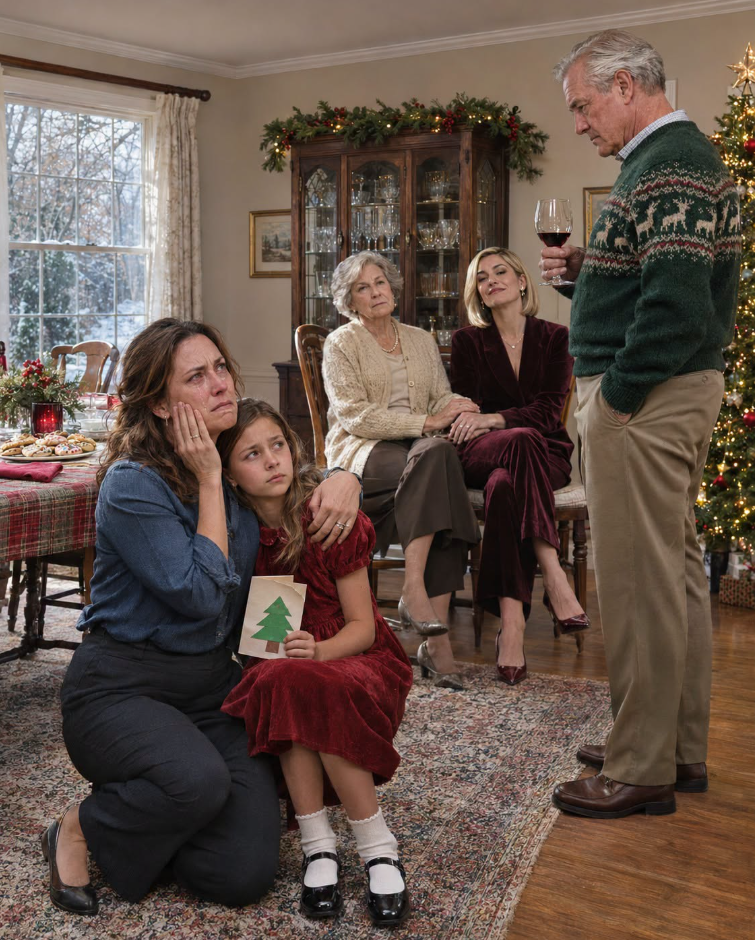
The fifth slap was the one that made me stop crying. Not because it hurt more than the others, but because my 10-year-old daughter was standing behind me screaming, “Grandpa, please stop hurting my mommy!”
And my father didn’t even look ashamed. He simply adjusted his Christmas sweater, picked up his wine glass, and said, “Maybe now she’ll learn some respect.”
But what my family didn’t know was that I had been paying for almost everything they owned—their house, their cars, my parents’ insurance, even my younger sister’s expensive lifestyle. And before that Christmas dinner was over, I was about to take every single dollar back.
Let me explain. My name is Natalie Brooks. I’m 36, divorced, and raising my daughter Sophie on my own. For the past 6 years, I’d been the financial backbone of my family.
My father, Richard, had retired early after his construction business failed. My mother, Elaine, claimed she couldn’t work because of her health. And my younger sister, Madison, was the family’s golden child.
Madison had expensive clothes, a luxury SUV, and a beautiful house she constantly showed off on social media. But there was one little detail she never mentioned.
I paid her mortgage.
I also covered my parents’ mortgage, their electricity, internet, car insurance, and several monthly bills. Why? Because when my daughter was born, my parents helped me through a difficult divorce. They let me stay in their home for 3 months. I never forgot that kindness.
So when Dad’s business collapsed, I promised to help them until they got back on their feet. That was 6 years ago. And somehow, temporary help had become a permanent obligation.
Every month, nearly $7,000 disappeared from my account. I never complained until Christmas Eve.
Part 2:
That evening, I arrived at my parents’ house with homemade cookies and presents for everyone. Sophie was excited. She had spent weeks making a handmade Christmas card for her grandfather.
But the moment we entered the dining room, Madison looked at my daughter’s simple red dress and laughed. “Seriously, Natalie, couldn’t you afford something nicer for her?”
I smiled politely. “She picked it herself. She loves it.”
Madison rolled her eyes. “Well, I guess that’s what happens when your mother spends all her money supporting everyone else.”
I looked at her. “That’s an interesting comment coming from someone whose mortgage I pay.”
The entire table went quiet, and that was when everything exploded.
Madison’s face turned bright red. “Don’t embarrass me in front of everyone,” she snapped.
I couldn’t believe what I was hearing. “Embarrass you? I’m the one paying your bills.”
My father slammed his fork against the table. “Enough, Natalie. Your sister has a successful career. She deserves nice things.”
I stared at him. “She hasn’t worked a full-time job in 2 years, Dad.”
Madison immediately started crying. “See? She’s always jealous of me.”
My mother reached for her hand. “Don’t listen to your sister, sweetheart.”
Then Dad pointed at Sophie. “Even your daughter needs to learn some manners. She should be grateful she’s invited to this family dinner.”
Sophie lowered her eyes. She was holding the Christmas card she’d made for him.
I felt something break inside me. “Don’t speak to my daughter like that.”
Dad stood up. “What did you just say?”
“I said she’s a child. You don’t get to humiliate her.”
He walked around the table. “You ungrateful little parasite. Your sister is successful. You’re nothing.”
Before I could react, his hand struck my face. Once. Twice. I stumbled backward. Then he slapped me again and again, five times.
My mother screamed, but she didn’t move to stop him. Madison covered her mouth, not because she was horrified. She was smiling.
I tasted blood and felt my cheek burning. Then Dad leaned toward me and spat on the floor. “You’re trash. Your sister is successful. You’re just a parasite.”
For several seconds, nobody spoke. I looked at my daughter. She was crying. “Mommy, let’s go home.”
I wanted to hug her, but first I needed to do something. I calmly took out my phone.
Dad laughed. “Who are you calling? The police? Go ahead.”
I opened my banking app and called the bank’s customer service. “Hello. I need to stop every recurring payment and automatic transfer connected to my account, effective immediately.”
My father’s smile disappeared. I continued. “That includes the mortgage payments, vehicle payments, insurance premiums, and all household utilities.”
Dad stepped closer. “Natalie, what are you doing?”
I looked directly into his eyes. “Something I should have done 6 years ago.”
Then I added one more thing. “Also, I want to cancel the authorized access my family has to my accounts.”
Madison suddenly stopped crying because she knew exactly what that meant. Her lifestyle was about to change. But the biggest surprise was still waiting.
I took Sophie home that night. I didn’t argue. I didn’t scream. I didn’t send angry messages. I simply left.
On Christmas morning, my phone had 47 missed calls. 47.
Dad’s first voicemail was furious. “You have until noon to turn those payments back on. This is your family.”
The second was from Madison. “You’re seriously going to ruin my life because of one stupid argument?”
Then came Mom. “Your father didn’t mean it. You know how emotional he gets. Please don’t punish all of us.”
Not one person asked if my daughter was okay. Not one person asked whether I needed medical attention. Instead, they were worried about money.
I spent the next few days documenting everything. I contacted my bank, reviewed my recurring payments, and made sure all my personal accounts were secure. I also consulted an attorney about the money I’d been contributing toward my parents’ house.
You see, when my parents refinanced their mortgage 3 years earlier, Dad had begged me to help. He couldn’t qualify for the terms he wanted, so I had contributed a substantial amount toward the down payment.
In return, we signed a written agreement acknowledging my contribution and the repayment terms. Dad had conveniently forgotten that document, but I hadn’t.
Then, on December 27th, Madison sent me a photograph. It was a picture of my parents sitting in their living room. Her caption read, “Hope you’re happy you destroyed Christmas.”
I stared at it for a moment. Then I noticed something in the background—a brand-new television, a luxury recliner, and several expensive gifts under the tree. They had spent thousands of dollars while expecting me to cover their basic expenses.
That same afternoon, Dad called again. This time, his voice was strangely calm. “Listen, Natalie, we need to talk. Your mother is very upset. Madison’s mortgage is due next week. You can’t just abandon your responsibilities.”
I took a deep breath. “Those aren’t my responsibilities, Dad.”
He laughed. “After everything we’ve done for you?”
I almost laughed myself. “Tell me one thing. Did you ever intend to pay me back?”
Silence.
Then he said something I’ll never forget. “You’re my daughter. Family doesn’t keep score.”
I looked at the signed agreement on my desk. “No, Dad. Family doesn’t slap family five times at Christmas dinner either.”
I ended the call.
Two days later, I received an email from my attorney. My parents had responded to the repayment notice, and their response revealed something I never expected.
My parents weren’t just refusing to repay my contribution. They were claiming the money had been a gift, but there was a problem. The agreement was signed by both my father and mother. It clearly stated that my contribution was a loan, not a gift.
Even better, I had bank statements showing every transfer. My attorney explained that I had a strong basis to pursue repayment under the agreement.
But then something even more shocking happened. Madison called me. She wasn’t crying this time. She was furious.
“Do you know what you’ve done? The bank contacted me about my mortgage.”
I replied calmly. “That’s between you and your bank.”
“But you promised Dad you’d help us.”
“I helped you for 6 years, Madison. I paid your mortgage while you spent money on designer bags and vacations.”
She went silent. Then she whispered, “Dad said you were doing it because you wanted to.”
That sentence hurt more than I expected. Because she was right. I had wanted to help. I just never imagined my kindness would become something they believed they were entitled to.
A few weeks later, my parents were forced to sell their expensive second car and downsize their lifestyle. Madison moved into a smaller apartment after failing to manage her mortgage payments.
My legal claim moved forward, and eventually my parents agreed to a repayment settlement rather than continue fighting the documented agreement. I didn’t celebrate their financial problems. I simply stopped solving them.
As for the Christmas incident, I filed a police report and provided photographs of my injuries and the messages sent afterward. Dad tried calling me several times. Mom sent long messages about forgiveness, but I established one condition.
They would never be alone with Sophie again unless they acknowledged what happened and took responsibility.
Months passed. One afternoon, Sophie came home from school carrying a small envelope. Inside was a Christmas card she’d never given her grandfather.
She had written, “Dear Grandpa, I hope you learn to be nice. I still remember when you were kind to me.”
I hugged her tightly. “Do you want to send it?”
She shook her head. “No, Mommy. I think I’ll keep it.”
And I realized something. For years, I’d confused financial support with love. I’d believed that if I kept giving, eventually my family would appreciate me.
But real love doesn’t require you to sacrifice your dignity. And family doesn’t give anyone permission to hurt your child.
That Christmas, my father thought five slaps would teach me my place. Instead, he taught me exactly where my boundaries belonged.
I didn’t destroy my family. I simply stopped paying for a family that had forgotten how to treat me like one.