Part 1:
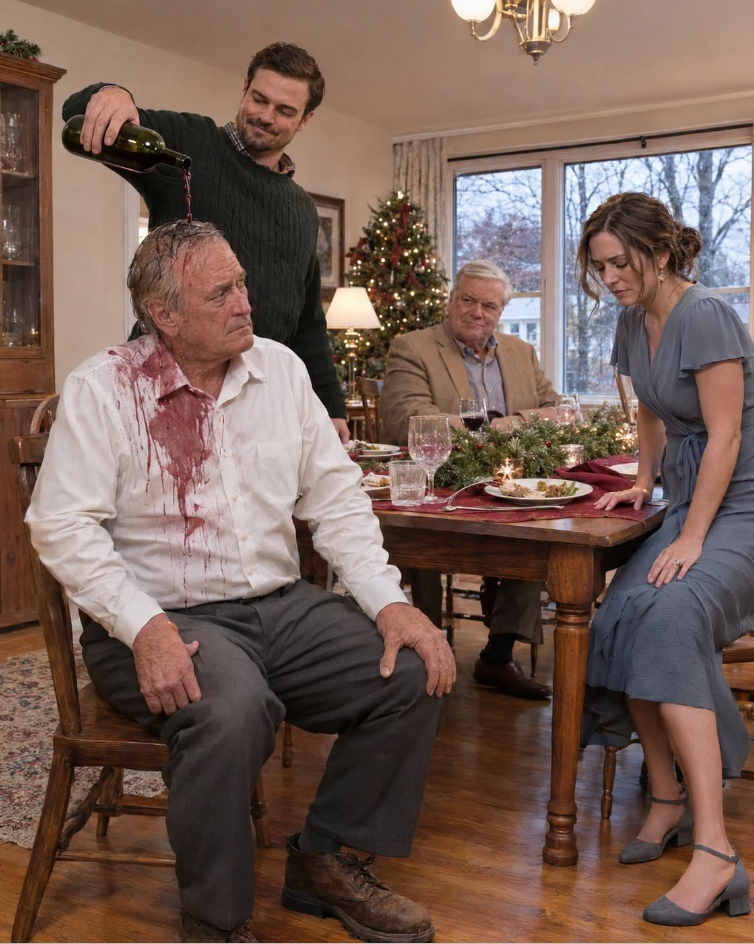
At Christmas dinner at my daughter’s house, my son-in-law poured a whole bottle of red wine over my head, smiled, and said, “Oops. My hand slipped.”
Then his father grabbed me by the collar and said, “What are you going to do about it, old man?”
My daughter said, cold as a window in January, “They’re just joking.”
I told the man holding my shirt, “Let go of me.”
He smirked and punched me in the face. 3 seconds later, he was screaming on her kitchen floor.
Thank you for being here on Father’s Revenge Stories, friend. Tell me in the comments where you’re watching from tonight, your state and your town.
And one note before I go on. This story includes some fictional details added for entertainment and for the lesson in it. Any resemblance to real names or places is coincidence, but what I’m going to tell you is worth hearing.
My name is Carl Hart. I’m 63 years old, a widowerower, and I own Evans Supply, a plumbing and electrical wholesale house outside Dayton, Ohio. I bought it at 31 and paid off the last dollar of the note at 52. The building, the trucks, and the inventory are worth a little over $3 million, and I don’t owe a scent on any of it.
You’d never guess it to look at me. I drive a 2009 Silverado with a cracked dash and wear a Carheart jacket my wife Joyce patched at the elbow before she died.
People who see me at the lumberyard figure I’m a retired pipe fitter living on Social Security. I let them figure.
In my business, you learn early that paper tells the truth and appearances lie.
Type “LOVE” in the comments, and I’ll post the rest of the story.
Part 2:
Joyce passed four years ago in March. Since then, it’s been me, the shop, and a framed photograph of her laughing on my desk next to the receivables ledger.
I have one daughter, Amanda. She’s 34, a pediatric nurse, the kind of person who stays an hour past her shift because a scared kid asked her to. She married Grant Meyers 8 years ago.
Grant runs Ellis Realy, a small outfit that finds tenants and handles repairs for rental owners. He’s got a good handshake, a least Audi, and a talent for making a man feel like he’s the only person in the room. I wanted to like him for Amanda’s sake. I worked at it.
They have a daughter, Ellie. She was nine that fall. She has her grandmother’s laugh and her own stubborn little chin. And when I pull into their driveway, she comes off the porch like she’s been fired from a cannon.
“Grandpa, watch this.”
Then she does a cartwheel in the leaves, and I clap like she won the state fair. Half of why I did what I did for that family was so that kid would never watch money turn her home into a battlefield.
Every month for 6 years, I sent Amanda and Grant $1,500. No contract, no court order, nothing in writing. A father’s gift meant to ease the weight while Grant got his business off the ground.
Amanda would call after every transfer and say, “Dad, you spoil us.” I’d hear her smiling through the phone, and my chest would loosen the way it only does for her.
What I didn’t see for a long time was that Grant had stopped looking at that money as a gift. He’d started looking at it as a down payment.
The first crack came in October. Grant stood in my warehouse with his hands in the pockets of a coat that cost more than my truck and said, “Carl, a business nikes should be working harder for the family. It’s just sitting here.”
I told him, “A paid-off business never sits. It stands guard.”
He laughed like I’d told a joke he didn’t understand.
Two weeks later, my longtime foreman, Leonard Young, caught me by the loan dock. Leonard is 66. He’s been with me for 22 years and can tell you which pallet is short by the sound of the forklift. He had his cap in his hands, which is how I knew it was bad.
“Carl, your son-in-law was in the office Tuesday while you were at the bank,” he said. “Sat down with Kathy and asked to see the accounts payable aging. Said you’d asked him to take a look at the books. Kathy didn’t like it. She didn’t show him anything, but she wanted me to tell you.”
Kathy has kept my books for 19 years. I’d told Grant nothing. I’d asked him for nothing. I stood on that dock with the cold coming up through my boots and felt something settle in my chest that no furnace could have warmed.
That night, Amanda called, all sunshine. They were having the family over for Christmas dinner. She said Grant’s father would be there. Ellie was making place cards, and I was sitting next to her.
“It’ll be a real family night, Dad,” she said.
I believed her. I’ve turned those words over in my head more times than I can count since.
I should tell you about Bruce Meyers now, because you’re going to be seeing a lot of him. Bruce is 66, a retired insurance man who carries himself like the head of a family other families should envy. Silver hair, good teeth, a voice made for selling annuities to widows. For 40 years he sold fear for a living, and he was very good at it.
The first sign of what he was came at Thanksgiving, four weeks before the wine. Amanda hosted. Grant carved the turkey with a flourish, and halfway through the meal, he looked at the car heart hanging on the back of my chair and grinned.
“Carl, be honest. Is that the same coat from last winter and the winter before?” He turned to Bruce like he was sharing a family treasure. “The man owns a company worth millions and dresses like the Goodwill owes him money. It’s embarrassing.”
My face went hot to the ears. I set my fork down because my fingers had started to tremble, and a man my age learns to put things down before his hands give him away.
Bruce leaned into the light. “The boy’s right,” he said, savoring it. “I’ve known rich men and poor men. A poor man can’t help looking poor. A rich man who chooses to live like one? That’s not humility. That’s a man who forgot what money is for.”
I looked at my daughter and waited for her to defend her own father at her own table. She laughed a thin, nervous laugh and patted the air with her hand.
“Grant, don’t tease him so hard. Dad likes his old things.” Then she turned that stretched smile on me. “Right, Dad? Tell them you don’t mind.”
I minded so much my chest felt wrapped in wire. But the words I wanted would have frightened Ellie, so I swallowed them.
“That coat has kept me warm for 15 winters,” I said. “That’s all a coat owes anybody.”
“I like Grandpa’s coat,” Ellie said loud, the way children speak when they think the can’t hear the plain truth. “It smells like sawdust and peppermints.”
She glared at her father with that chin stuck out. Grant’s jaw tightened in a way I’d never seen it tighten on his own child.
“Ellie, eat your turkey. Grown-ups are talking.”
That night, driving home, my phone lit up with the family group chat. Grant had snapped a photo of my coat on the chair and captioned it, “The richest man in Dayton, folks. Somebody start a collection.”
Three laughing faces. And under it, one more message, typed letter by letter the way a nine-year-old types when she’s supposed to be in bed.
“That is my grandpa’s coat, and he is the nicest man in the world, and you are being mean.”
I pulled over on the shoulder of Route 48 and cried. Not pretty tears. The ugly kind that rack a man’s shoulders, because my little girl had done in one sentence what her mother wouldn’t do in an entire evening.
The first week of December, Grant came to my house with a folder and the smile of a man delivering good news. He squared it on my kitchen table like a card player laying down a winning hand. A partnership agreement. Meyers and Hart, he called it.
He’d come in as a co-owner of Evans Supply, handle growth strategy, and in exchange, he’d take on a loan of $400,000 to expand, with me signing as personal guarantor. All it needed was my name on the last page.
I started on page one with a pencil, the way my father taught me. Grant watched me read like a salesman watching a customer hold a watch. On page three, I stopped.
“Grant, this clause says a majority vote of the partners can sell the company’s assets. With you at 49% and a proxy clause on page six, that’s you.”
“That’s boilerplate.”
“And the guarantee? If your loan goes bad, the bank comes after me. My house, my accounts, my building. It doesn’t ask you. It asks the guarantor.”
His smile slid off like a plate off a table. “I knew it,” he said. “I told Amanda. You’ve never trusted me. The minute I asked to be treated like a partner instead of a handout, out comes the pencil.”
“If your company needs work, I’ll hire your company like any other,” I said. “One year, my approvals, my right to end it. You earn every dollar in daylight. But I won’t sign a paper that gives away the keys and calls it trust.”
Something cold and organized moved behind his eyes and replace the hurt. I’ve negotiated with men who wanted my money for 30 years. I know the second a negotiation stops being one.
“Fine,” he said, soft and even. “We’ll do it your way.” He tucked the folder under his arm. “For now.”
Two days later, Amanda called, crying before she said hello. Exactly the way her husband had promised she would.
“Dad, how could you? He worked so hard on that proposal, and you treated him like a con man in your own kitchen.”
I asked her one question. “Honey, have you read the agreement?”
A long pause. “Grant handles the paperwork. He explained it.”
My daughter, who reads every line of Ellie’s school forms twice, had gone to war over a contract she’d never laid eyes on. I told her gently what was in it. She didn’t want to hear it.
“He said you’d say that,” she whispered. “He said you’ve been alone too long, and it makes you suspicious.” Then she said, “Mom would be so sad to see this.”
I gripped the edge of the table until my knuckles achd. Joyce’s photograph was on the sideboard, her laughing with her hair down.
“Your mother spent 20 years beside me in that building,” I said. “She’d tell you to read before you sign. She’d tell you that first.”
“So you love that company more than your own family?” Amanda said, and the tears had burned off into something bright and brittle. “That’s what Grant said you’d prove.”
She hung up. I sat there with a warm phone in my hand, staring at the second chair across the table where Joyce used to do the crossword.
I wasn’t angry. Anger would have been a relief. What I felt was older and heavier. The road to me no longer ran through my own front door. It ran through my daughter, and another man was standing on it, collecting tolls in the currency of her tears.
Then I did something I’d never done in 62 years of being underestimated. I took a spiral notebook from the junk drawer and wrote down the date, the time, and every word of that call. Next to it, I wrote two more lines.
Folder, December 3. Leonard, October 29.
It was a start.
The next week, I hired a lawyer. Her name is Rachel Young, 48 years old, no relation to Leonard, with reading glasses on a chain and the patience of a woman who has watched families come apart over smaller things than a business.
I laid out everything. She listened with her fingers steepled. And when I finished, she said, “Mr. Hart, you’re about to get a lesson in how people try to take what they can’t ask for. Here’s your homework. Write everything down. Sign nothing from that family. Don’t accuse your daughter of anything in any room I might one day have to defend. And let me do the talking when it gets loud.”
“When?” I said.
“Mr. Hart,” she said, “that man went to your bookkeeper first. It’s already loud. He just hasn’t raised his voice yet.”
She had me change the locks, the account passwords, and the signature cards at my bank. She sent a short, polite letter to Evans Supplies Bank and vendors. “No one but Carl Hart is authorized to discuss the company’s finances.”
Grant didn’t know any of that yet. What he knew was that the folder had come back refused and that the old man was getting quiet. That should have scared me more than it did.
Bruce called me on the night of December 19th, close to 11. His voice came down the line warm as a hand on a shoulder.
“Carl, did I wake you? I’ve been feeling bad about the way things got left. A man thinks about family at night.”
“It’s late, Bruce.”
“That’s the thing. A signature is an odd possession, Carl. It’s only worth what people believe about the man who signed it. A few concerns here. A worried daughter at the right dinner tables. And one day a bank wonders if the old fellow was entirely himself when he signed anything.”
Ice settled in a glass on his end. “Questions are so hard to retire once they’re asked.”
My heart was hammering so hard I could hear it in the receiver. I made my voice come out level as a carpenter’s line.
“Bruce, you called my house at 11 at night to describe my sanity to me as weather. I’m hanging up now, and I’m going to remember this call exactly.”
“Remember it,” he said gently. “A man who remembers everything should have no trouble remembering how alone he is.”
I wrote it in the notebook word for word. Then I called Rachel at home.
“Good,” she said. “Keep him talking next time. And Carl, from now on, record your calls. Ohio is a one-party consent state. You can legally record any conversation you’re part of.”
So the next time Bruce called, I was ready. That was the 22nd. He phoned in the afternoon, all friendly, and I let him run.
“Christmas is for being practical, Carl,” he said. “Bring the folder to the dinner. Let’s finish our business like grandfathers instead of businessmen. Think about which grandfather you want to be in that child’s memory.”
I said I’d think about it. I hung up, saved the recording, and sent it to Rachel.
Amanda called Christmas Eve morning. Her voice was made of held breath.
“Dad, you’re still coming tomorrow, right? 5:00. And Dad, Grant says if you just bring the folder, they can settle it at the table in 5 minutes, and then nobody has to think about business again. Just bring it for me so Christmas can be Christmas.”
I looked across my kitchen at the white shirt hanging on the closet door. Joyce bought it for me the Christmas before she died. Good collar, pearl buttons. She teased me for calling it my courthouse shirt, my marrying and burying shirt. I’d pressed it that morning.
“Sweetheart, listen to your father,” I said. “I’m coming to Christmas dinner. I’m bringing a gift for Ellie, and I’m bringing myself. That’s the whole inventory. Christmas isn’t an office, and I’m not a delivery service. If the men want 5 minutes of business, they can have it on a weekday with my lawyer at the table. And honey, stop carrying messages. It’s bending you in the middle.”
She cried a little. From relief or dread, I couldn’t tell.
“Okay, Dad. Wear the white shirt. You look nice in the white shirt.”
Even in the middle of being used as a bridge, my daughter had remembered which shirt her mother gave me.
The next afternoon, I tied a red ribbon around Ellie’s present. A music box I’d built in my garage all fall out of maple and walnut, with a little carved bird on the lid. The mechanism played the lullaby Joyce used to hum while she shelled peas.
I wound it once at my kitchen table and listened to it play for the empty chairs. Then I put on the white shirt, buttoned my good coat, and drove across town at dusk with the music box on the seat beside me and nothing in my pockets a man could sign with.
If you’re still with me on Father’s Revenge Stories, stay close. In a moment, I’ll open my daughter’s front door on Christmas night and show you what my son-in-law poured, what his father swung, and what my own daughter called it.
Before I do, comment the word “shirt” below so I know you’re still at this table with me. And a reminder that parts of what follows are fictionalized for the sake of the lesson. If that’s not for you, you can click away now.
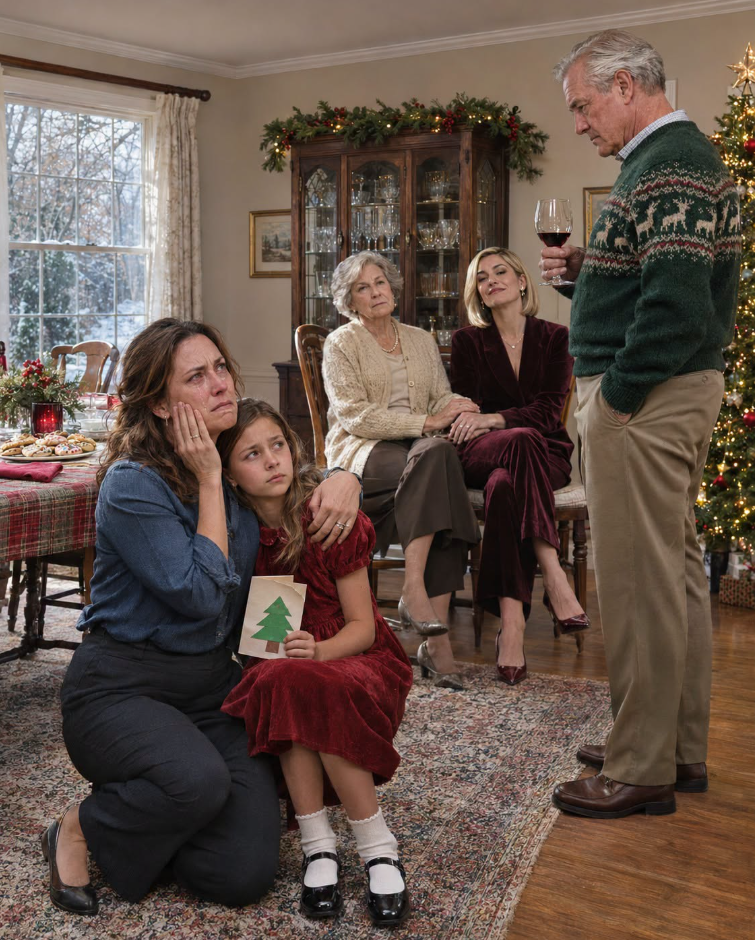
Ellie opened the door before I knocked, in a red dress with a white collar. She took the box from my hands with both of hers, careful as a girl carrying a full bowl of soup.
“You made it,” she said. “Grandpa, you made the bird on top.”
She turned the key once right there in the hall, heard the first notes of her grandmother’s lullabi, and looked up at me with her whole heart in her face.
“After dinner,” Amanda said, setting it on the high bookshelf. “Desert first, and then you can play with it all night, just us.”
Ellie agreed with the seriousness of a bank officer.
Dinner was a performance with a roast at the center. Grant played host a half inch too large. Bruce held court, announcing how glad the family was that I’d come, like a man locking a door from the inside. Amanda moved with bright, breakable cheer, laughing a breath too fast at things that weren’t jokes.
Under the table, Ellie kicked my ankle every time Bruce used his announcement voice on my name. A secret Morse code I kicked back. It was the happiest transaction of the evening.
After the plates were cleared, the babysitter, a kind girl named Briana, took Ellie upstairs for a movie and headphones, exactly as arranged. Ellie went with one backward look at the music box and one at me. I nodded at her.
I’ve turned that nod over many nights since, my granddaughter leaving the room, out of earshot of her own Christmas, believing the grown-ups downstairs were about to be happy.
Then the table changed temperature.
Grant put both forearms on the tablecloth like a man opening a meeting. “So, Carl, the folder. Tell me you brought it, and this whole family can exhale.”
“I brought a gift for my granddaughter,” I said. “That’s the whole of my luggage.”
Bruce made a sound in his chest like a gate swinging. “There it is,” he said to the table. “He’d rather watch his family twist than sign one piece of paper.”
“Dad, please,” Amanda said, her brightness cracking along the edge. “It would take 5 minutes. Then it’s just Christmas.”
“It was just Christmas,” I said, “until it needed my signature to stay that way.”
Grant stood up smiling and took a fresh bottle of red from the sideboard. “Then let’s drink to stubbornness,” he announced, and came around behind my chair with the bottle held high.
I heard the cork already out. I had half a second to think the sound was wrong. Then the wine came down on me.
Not a splash, not a glass tipped by accident. A whole bottle poured at a host’s easy pace over my head, down my face, into my ears, into the collar of my white shirt, and over Joyce’s pearl buttons while my son-in-law stood over me laughing.
“Oops,” he sang. “My hand slipped.”
I set my glass down on the tablecloth. I stood up out of the wine and the wreckage of that shirt, and I took one step toward Grant with my hands open at my sides, ready to say a sentence I’d composed for exactly this doorway. I never got to say it.
Bruce came up out of his chair faster than a man of 66 should move. He took the front of my soaked shirt in his fist and twisted it up against my throat.
“Old man!” he shouted, close enough that I felt the spit. “What do you think you’re going to do about it?”
And my daughter, my own daughter, with her father’s wine running off the end of the table onto her kitchen floor, said in a voice as cold as a window in January, “They’re just joking.”
I looked straight into Bruce’s eyes over his fist. “Let go of me.”
He smirked. I will see that smirk when I’m 91. Corner of the mouth, contempt like a signature.
He drew back his free hand and punched me square on the cheekbone. My head snapped sideways. The room rang like a struck bell, and he came on behind it, lunging with both hands for my collar.
Here is everything I did that night, and I’ll list it like inventory, because inventory is my trade. I spent four years in the army, in the military police, a long time ago, and some things the body doesn’t forget.
I turned out of the line of his weight. I caught his reaching arm at the wrist and let his own momentum carry it past me, no harder than a man holds a gate against a wind, and I stepped back out of his grip with both hands up and empty.
Bruce Meyers, committed to a lunge that no longer had a man standing in front of it, went down alone. All 200 lb of him, straight into the tile. I heard the sound his shoulder made, like a branch deciding. I heard his wrist go under him wrong.
3 seconds. Count them with me. 1, 2, 3.
And the man who had punched me was screaming on my daughter’s kitchen floor, cradling his arm, howling that it was broken, that I’d done it. I stood over him with wine dripping off my chin and did not touch him again.
Grant didn’t go to his father. He stepped back, took out his phone, and filmed Bruce writhing on the tile, swinging the camera slowly across me, soaked and bleeding from the cheek, like a man documenting a fire he intended to sell.
Amanda dropped to her knees beside Bruce, cradling his head. Then she looked up at me, white-faced, mascara running, and her voice broke over the screaming like a plate over a rail.
“What did you do, Dad? You ruined Christmas.”
“Do you really think this was a joke?” I said.
Her mouth opened. Bruce’s howling rose between us, and she turned back down to him, and the moment closed like a door I hadn’t shut.
I walked to the bookshelf, took down Ellie’s music box, and set it in the middle of the wrecked table, among the plates and the red stain spreading across the cloth, where my granddaughter would find it in the morning and know her grandfather had kept his promise.
Then I walked out of my daughter’s house into the cold with wine drying on Joyce’s white shirt and my cheeks swelling shut, and drove home through the empty streets tasting blood and merllo. The whole way, my hands on the wheel did not shake at all.
At 12:40 that night, the video hit the family group chat. 22 seconds. It began with me already standing, wine dark and dripping, my hands raised, and Bruce already falling. It ended on Bruce screaming on the tile with my daughter kneeling over him.
Across the whole thing, Grant had laid a caption. “This is what he did to my father on Christmas night. Pray for my dad. Share this.”
No bottle, no fist in my collar, no punch. The truth had been in that room for exactly as long as it took to film, and my son-in-law had cut the room down to the size of his story and thrown the rest away.
The messages came inside a minute. A cousin of Joyce’s in Columbus. “Carl, how could you? He’s an old man.”
A fellow from church. “Saw the video. Ashamed for you.”
My daughter wrote nothing at all, and her silence arrived in that chat like furniture being moved in a house where someone has died.
I called Rachel at 1:00 in the morning, and she answered on the second ring, wide awake.
“I’ve seen it. Do not reply. Not a word. Screenshot everything with timestamps. A man who edits his own evidence has just handed us his fingerprints.”
Morning came. I drove to an urgent care out by the interstate, and a doctor with a gray braid and reading glasses low on her nose turned my chin in her fingers and asked how it happened.
“Another man’s fist,” I said. “Christmas night in my daughter’s kitchen. I didn’t hit him back. He fell on his own momentum. And there’s a video in this town saying otherwise.”
She photographed the cheek from two angles, closed the cut with three small strips, and wrote in her chart, “Contusion, left cheekbone, struck by fist. Patient states he did not strike the other party.”
“Your face has given its statement, Mr. Hart,” she said. “I don’t know your son-in-law. The chart doesn’t care.”
Bruce’s injuries were real, and Rachel never let me forget it. A dislocated shoulder, a cracked wrist that would need a plate and screws.
“We never say he wasn’t hurt,” she told me. “We say how.”
Then the letters came. A lawyer in Cincinnati wrote on Bruce’s behalf. Unprovoked assault, medical bills mounting, a civil suit being prepared unless the matter can be resolved between the families in a manner Mr. Hart will find reasonable.
And in the same week, a second envelope from Ellis Realy. The assault claim would vanish. My name would be cleared if I signed the partnership and the loan guarantee by January 15th.
“Read them in order,” Rachel said. “You’re watching us shakeddown dress itself for dinner. The assault was never the point. The assault was the envelope.”
On the 2nd of January, my daughter called, her voice ironed flat.
“Dad. Grant says until the lawyer sorts this out, Ellie shouldn’t be around you. She’s seen the video. She’s having bad dreams. He says if you sign, all of this stops. The claim, the video, everything. And Ellie gets her Sundays back the same week.”
I kept my voice level by an act of will I wouldn’t have credited.
“Amanda, I’m not choosing a company over my granddaughter. I’m refusing to buy her back with a signature, because a grandfather who can be bought back can be sold again cheaper next time. You tell your husband the child is not a clause.”
Then my voice, which had held through the wine and the fist in the video, broke on that telephone, and I cried with my daughter listening, and she cried too. Two people weeping at each other through a phone neither of us could put down.
Every Sunday after that, I set the table for two and wrote Ellie a letter on Joyce’s cream stationary. Nothing about the war, just the snow, the dog next door, the way the music box tune had gotten stuck in my head. I filed each one in a folder marked “For Ellie when she’s ready.”
What turned it was a thing I had no way of knowing.
In February, a woman named Hannah Rogers, who kept the books for Ellis Realy, called Rachel’s office. Grant had asked her to backdate an email and a signature page so that a loan application for $400,000 would show my guarantee as signed in October.
I had signed nothing.
Hannah refused, and Grant suspended her by 4:00 that afternoon. She went home, called a lawyer from her church, and preserved every file she’d touched.
The signature page, it turned out, was real ink on a real page. Grant had lifted my signature off an account authorization form Amanda scanned for him that December, a form she’d carried to my table in a plastic sleeve back in November, believing it was for Ellie’s education fund.
When her friend Julie, an accountant, looked at the destination box on the form one night over wine, she found the receiving account belonged to Ellis Realy. Amanda read the thread of her husband’s texts three times at Julie’s kitchen table. The last one, from December 8th, was four words long.
“Got it. This works.”
She slept on Julie’s couch. The next morning, she hired her own lawyer and gave her one instruction, as Rachel later relayed it.
“Tell my father the kitchen has a camera. It’s had one for years. It watches the whole room, and my husband never once asked what it keeps.”
Rachel called me on a Thursday in March. “Your daughter’s council has delivered the Christmas recording from the home security system. Come in tomorrow. We’ll watch what he edited.”
There is no audio on that film. I watched it in Rachel’s office, in a chair that felt too small for me, with my hands pressed flat on my knees.
There was Grant standing behind my chair with the bottle already raised. There was no slip, no stumble, just a man watering a plant he hated, tipping it slow with both hands.
Then Bruce out of his chair, his fist at my collar before his body had finished standing. Then the punch, then me, stepping back with my palms out and empty, while Bruce’s whole weight went past me and down. Nobody’s hands on him anywhere in the frame.
And at the very end, a small wooden box set gently in the middle of a ruined table.
I cried into my hands like a boy because the worst night of my family’s life was on that screen, and the truest thing in it was my own empty hands.
What came next took weeks of paper. A forensic examiner confirmed the signature on the loan guarantee was a scanned image, not ink laid down by a moving hand, with the same broken gap in the lower loop of my C where my pen has always skipped. Hannah’s records matched.
The bank’s fraud department got the file in April, and a detective named Jason Rogers, no relation to Hannah, sat across from me and asked if I wanted to press charges. I said I wanted the record to say what happened. He said that was the same thing.
They came to my showroom together on a Tuesday morning in May, Grant and his father, without calling first. Leonard saw them through the office glass and walked to the counter and stood beside me without a word, the way he’d stood beside me when a supplier once tried to short a delivery.
Grant wore a suit that hung looser than it used to. Bruce had his arm in a sling, a steel plate and six screws under the bandage, and his silver hair had lost some of its shine. Three contractors were waiting at the far end of the counter for their copper fittings. Nobody was looking at their paperwork.
Grant put both hands flat on my counter and spoke like a man reading a statement he’d rehearsed in the parking lot.
“Carl. Dad. We can end this today. One year of management, signed clean. My lenders will look at me again if your name is next to mine. Dad will withdraw the claim, and we’ll tell the whole family the video was cut wrong. All you have to do is sign.”
Bruce stood half a step behind him and said nothing. For 40 years he’d talked his way into widows’ kitchens, and now he was letting his son do it for him.
“On Christmas night,” I said slowly, so Grant would remember it, “you poured a bottle of wine over a man’s head and called it an accident. Now you want that man to save your company.”
“Carl, come on,” Bruce said at last, with a trace of the old warmth. “It’s a family matter. Nobody wants cops or paper in this. Grant tells me you agreed to the guarantee in October. You gave your word. All we’re doing is making it official.”
The showroom went very quiet.
“I never agreed to anything in October, Bruce,” I said. “Grant told you I did?”
Bruce turned his head. “He said you’d signed and then you got cold feet because of your age. He said the bank had your signatures on file and the rest was a formality. He said you were slipping.”
“Dad,” Grant said, very low. “Not here.”
The bell over the front door rang. Detective Jason Rogers came in out of the sunlight with two uniformed deputies behind him and a document in his hand. He didn’t hurry. He nodded to me, and then he looked at Grant.
“Grant Meyers, I have a warrant for your arrest. Two counts of forgery and one count of attempted theft by deception.”
He turned to the older man. “Bruce Meyers, this is a summon. The county prosecutor has charged you with assault based on the kitchen video and the urgent care chart. A deputy tried your house this morning. Your neighbor said you’d be here.”
Grant went the color of a wet sidewalk. “That’s a mistake. My father-in-law is confused. Ask my wife. Ask anyone. Dad, tell them.”
Bruce looked at the paper in his own good hand and then at his son. I [clears throat] watched a man who sold fear for a living do the arithmetic of his own fear.
“For us,” he said. “You told me the signature was real. You told me the old man was too proud to admit he’d signed.” His voice cracked upward. “I called that man at 11 at night. I put my hands on him in front of that child’s mother for a signature you told me was good.”
“Dad, shut up.”
“Don’t you tell me to shut up.” Bruce’s lip shook. “Officer, I wanted understood that I knew nothing about any forged page. Whatever he did with that paper, he did it without me. I’ve got the texts. He said it was settled. He said Carl was scenile.”
He actually stepped away from his son one full step, as if the ground between them had cracked open. “You made me look like a fool, Grant. At my age, in front of everyone.”
Grant stared at his father. Whatever he’d been about to say died in his mouth. A deputy turned him toward the counter, and the cuffs clicked in the quiet. The same plain sound a pallet jack makes when it locks.
The contractors didn’t pretend to read their invoices anymore. A kid from the loading dock stood in the doorway with a box of fittings against his chest. Grant looked back at me over his shoulder.
“Carl. Dad. Please call Amanda. Tell her I’m sorry.”
“She knows how to reach me, Grant,” I said. “She doesn’t need you to carry her messages anymore.”
Leonard held the door for them on the way out. Leonard holds doors like a man returning a library book to a library he doesn’t respect.
Bruce lingered at the counter with his summons, a retired insurance man in a sling who suddenly looked to every one of his 66 years.
“Carl,” he began, “what I said on the phone about being alone—”
“I wrote it down.” And I said, “I remember every word. Go home, Bruce.”
He went. His lawyer in Cincinnati withdrew the civil claim that afternoon.
In July, Bruce pled to a reduced assault charge, paid a fine, and took a year of probation. The men who used to take his calls stopped taking them. A man who sold trust for 40 years found out what it’s worth when you can’t deliver it. He never spoke to his son again that I heard, and he sent me one letter, which I filed without answering.
Grant took a plea in October. Two years of probation, restitution to the bank for its investigators’ costs, and a felony that ended his real estate license. Ellis Realy closed the same month. The sign came down off the strip mall window while I was driving past with a load of copper fittings, and I’ll admit I slowed down to watch.
Amanda filed in June. She kept the house for a while and moved Ellie into a smaller one nearer her work when the mortgage got ahead of her.
She never told me she was sorry that spring. She tried twice on the phone, and each time the words came out as logistics. I told her we’d go at the speed of the slowest person at the table, and that was me.
This past Christmas Eve, a year after the wine, a white envelope came to my house in my daughter’s handwriting. Inside was a sheet of construction paper folded twice. In green crayon, there was a house with its door open and three figures holding hands in front of it, two tall and one small.
Underneath, in the careful capital letters of a 10-year-old who presses too hard, “Grandpa, can Christmas be at your house this year?”
I read it six times in my own doorway. Then I called Rachel and asked how a father answers that correctly.
“You say yes, Mr. Hart,” she said. “There’s no exhibit attached to yes.”
They came on Christmas Day at dusk. Amanda parked at the curb like a guest, which undid me more than the knock. Ellie was out of the car before it stopped, in her red coat, carrying something against her chest.
It was the music box. She set it on my kitchen table with great ceremony.
“It lived at our house all year,” she said. “Mama said it should hear your kitchen.”
I made Joyce’s chicken and dumplings from the card in her handwriting. We ate at the table where I’d sat alone so many nights that past year, facing two empty chairs. This time they weren’t empty.
Ellie asked for seconds and then for the story of the bird on the lid, and Amanda ate like a woman who’d been carrying something heavy and had set it down outside the door.
Afterward, she carried plates to my sink the way she did at 15 and said over the running water, without turning around, “I called it a joke, Dad. I’ve heard myself say it every night since. And you never once used me against him. You had a stack of paper thicker than my arm, and you never made me the price of anything.”
“We start,” I said, drying my hands. “That’s all anyone does who means to finish.”
She turned, and we held each other. And this time, nothing in the room was being taken.
Near 10, Ellie, sleepy and offended by coats, looked around my kitchen at the small tree and the three plates in the rack.
“Grandpa, are you sad it’s only us?”
I knelt, knees complaining, and took her warm hands. “No, my love. This year, Grandpa’s only having Christmas with the people who really want him here.”
She thought about it with the gravity of a judge, nodded once, and hugged me around the neck with her whole considerable strength.
Then there were tail lights in the December dark, my daughter driving carefully the way she does when her girl is asleep in the back. I stood in the doorway until the cold came through my shirt.
Then I put the music box on the shelf where it belongs, wrote one line in the notebook, “Company came,” closed it, and left the porch light on and the front door unlocked the way a man does when everyone he’s waiting for has finally come home.