PART 1 — The Cry Beneath the Music
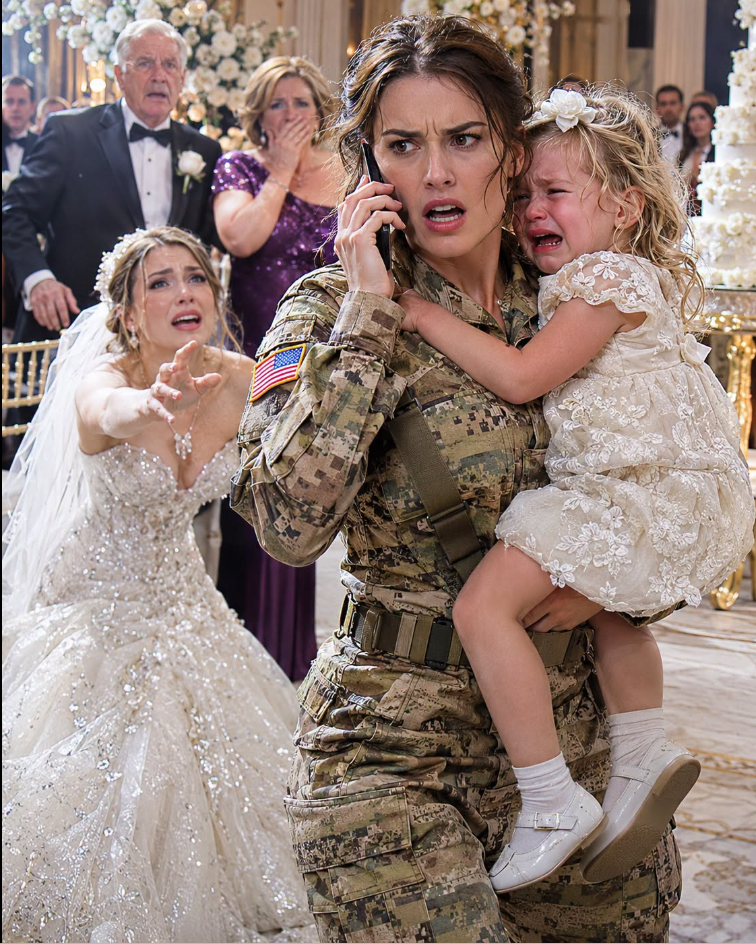
My daughter’s crying did not sound like the tired protest of a toddler who had missed her afternoon nap. It was a piercing, ragged scream that sliced through the reception band’s bass line and seemed to lodge beneath my ribs. I had completed two tours in logistics and field support with the U.S. Army before retiring as a Captain, spending ten years assessing emergencies, protecting supply routes, and imposing order where a mistaken judgment could endanger an entire squad. A decade in uniform teaches you to recognize distress before anyone explains it. Surprise drives a voice upward; real injury pulls a sound from somewhere much deeper. My fifteen-month-old daughter, Maisie, was making that deeper sound. Whatever my family wanted me to believe, this was not ordinary fussiness.
I gave neither of them an answer. During an emergency, the first task is to examine the casualty, not absorb the nervous explanations of everyone standing nearby. I took Maisie away from the ballroom entrance, beyond the noise of two hundred formally dressed guests drinking mint juleps and waiting for the bridal party’s arrival. In the quieter alcove beside the coatroom, I lowered myself onto an upholstered settee and brushed her damp curls away from her face. Her body shook so hard that each breath broke into uneven little catches. Whenever my forearm touched her lower legs, she threw her back into an arch and cried harder. I carefully raised the skirt of her ivory lace dress. Her right leg looked normal. Around her left knee, however, the skin was stretched over a glossy swelling that extended down the upper shin. Purple discoloration was already spreading underneath it. The lightest touch of two fingers against the tibia brought a scream that seemed to shake the ballroom doors.
“She’s fine!” Lena snapped. Her attention flickered toward the ballroom, where Camille, the wedding coordinator, held up one finger to signal the approaching entrance. “Dad said she bumped her knee! Toddlers bump their knees twenty times a day! If you leave right now—if you walk out that door and pull Caleb away from the head table—don’t bother coming back into this family. I mean it, Audrey. For once in your life, do not make yourself the center of the room.” I studied my sister beyond the diamond earrings and the veil that had cost more than my first car. For years, my family had welcomed my competence when it saved them effort, then resented it whenever it made their failures impossible to ignore. I stood, drawing Maisie securely against my chest. One arm supported her back while I kept the injured leg free of pressure. With my other hand, I reached into my blazer and took out my phone.
The summer heat struck my face when I stepped onto the gravel drive. Through the glass above the entrance, I could still see my parents standing several feet apart, both staring downward, while Lena adjusted her veil with shaking fingers. Their positions, their silence, and the explanations they had offered did not fit together. I had spent roughly thirty minutes on the lawn posing for wedding photographs, trusting them to care for Maisie. Something had happened during that interval, and instead of telling me, my family had closed ranks around it. I could recognize the shape of withheld information even without knowing its contents. What I did not yet understand was how precisely that silence could be measured. There was an opening in their account of the afternoon, and it was exactly twenty-seven minutes long.
The ambulance siren cut through western Henrico County’s quiet streets beneath the trees. Henderson, the young paramedic whose name was stitched in black on his uniform, had secured Maisie’s leg in an inflatable pediatric splint. Exhaustion had finally made her head heavy against my collarbone, but every jolt in the road drew another small whimper from her. Each one scraped through me. “Captain,” Henderson said, holding his pen over the report. “What was the mechanism of injury? Did she fall from a height? Was there direct blunt-force impact?” Admitting what I did not know left a bitter taste. “I don’t know,” I said. “My parents were supervising her while my husband and I were in the wedding party photographs. They stated she bumped her knee on a runner.” His gaze moved to the swelling beneath the transparent splint and then returned to me. “And the time of initial onset?” he asked. “How long was the patient exhibiting acute distress before you placed the call?” I could not account for those minutes. “I can’t verify the timeline,” I whispered. “I was handed the child at approximately 1614 hours. That is all I know.”
At St. Mary’s pediatric emergency department, we were taken into Trauma Room Four. Dr. Leah Foster had gray at her temples, faded blue constellations across her scrub top, and the economical movements of someone accustomed to urgent decisions. Her gentle examination almost undid me. She checked Maisie’s hip, thigh, and ankle before requesting immediate X-rays of both legs. Caleb arrived ten minutes later without his tuxedo jacket, his sleeves rolled to his elbows. Instead of demanding answers I did not have, he took my hand and held it until feeling returned to my fingers. We had met while I was stationed at Fort Gregg-Adams. He knew my motionless silence meant I was searching through every available fact for the point where things had failed. “She’s going to be okay, Aud,” he murmured, resting his forehead against my temple. “The bone will heal. Children are resilient.” I kept my voice beneath the hiss of the wall suction. “It isn’t just the bone, Caleb,” I said. “Look at the timing. My father didn’t slip on a carpet. If a child takes a fall hard enough to crack a tibia, she doesn’t stop crying after thirty seconds. Someone kept her away from me while she was in agony.”
Forty minutes later, Dr. Foster returned and displayed the digital images on the wall monitor. “It’s what we call a toddler’s fracture,” she explained, indicating a thin diagonal mark along the upper portion of Maisie’s left tibia with her pen. “A non-displaced spiral oblique fracture. The good news is that the periosteum is intact, the alignment is preserved, and she won’t require surgical intervention or internal fixation. We’ll apply a long-leg fiberglass cast, monitor for twenty-four hours to ensure there’s no neurovascular compromise, and she should make a full recovery in six to eight weeks.” Caleb released a shaking breath and closed his eyes, his shoulders dropping against the wall. I kept looking at the narrow line on the image. There was relief in knowing she would heal, but the explanation of her injury still had to exist somewhere outside this room. A swollen leg had become a visible fracture, and the account about a harmless bump had become even harder to reconcile with what lay in front of us.
“Dr. Foster, what kind of mechanical force produces that specific spiral fracture pattern in a fifteen-month-old?” I asked. For an instant, something shifted behind her professional composure. “It’s a rotational torsional injury, Captain Bennett. It almost never happens from a simple trip on a level surface. It occurs when the foot is fixed or caught against an obstruction while the body’s momentum continues to twist with significant downward mass. For example, catching a foot in a crib rail while falling—or having an adult stumble down an incline while holding the child, where the adult’s body traps the limb against a riser.” A riser. The word stayed with me. My parents had described a knee striking a runner, something small and ordinary that required no interruption. The doctor was describing a trapped foot, a twisting body, and the weight of an adult. Those were not two versions of the same minor mishap.
My phone vibrated inside the clutch I had placed on the stainless steel counter. My mother had sent a message: Audrey, please tell me she’s fine. Your father is beside himself. Lena is trying to hold the reception together, but everyone is whispering. Was an ambulance really necessary? I did not respond. Instead, I opened a blank note and titled it INCIDENT LOG: JUNE 13. I recorded Dr. Foster’s description of how the fracture occurred, keeping the clinical wording intact. In the Army, an unrecorded event could become an argument with no firm ground beneath it. When accounts conflicted, a log written at the time mattered. My daughter was being treated, and I was grateful for that. But the unanswered questions had not diminished with her diagnosis. They had become more specific, and I intended to preserve every answer as it emerged.
We were discharged at 22:30. Pediatric pain medication had left Maisie deeply asleep, her left leg wrapped in bright pink fiberglass from above the knee down to her tiny toes. Caleb carried her to our SUV with such care that she might have been made of delicate glass. I settled into the passenger seat, looking at my phone in the dashboard’s light. The wedding was behind us, but its unfinished conversations had followed us out of the estate and into the hospital. My daughter’s cast was real. So was the interval before anyone put her back into my arms. No explanation offered over the course of that evening had accounted for both.
At 23:14, Lena called. I let the phone ring until it stopped. Three seconds later, she tried again, then called a third time. A message followed: Audrey, you need to call me right now. Gavin is asking questions and Camille from the venue is reviewing the event log for insurance. Please just tell Gavin and Camille that mom told you Maisie bumped her leg before the first dance. That’s all you have to say. Call me. I read it until the display went dark. My mother had not approached me before the first dance with a clear account of an injury. She had placed a screaming child in my arms at 16:14 and spoken about overstimulation. Lena had then threatened to expel me from the family if I sought help instead of following her schedule.
“Caleb,” I said, my voice flat and cold. “Look at this.” He pulled onto the shoulder of River Road, stopped the SUV, and read the message under the amber interior light. “Why does she need Camille to believe you knew?” he asked quietly. That was the question. Lena was not asking how her niece was feeling, what the doctors had found, or whether we needed anything. She wanted a particular statement repeated to her husband and the venue coordinator. She wanted the sequence of events described in a way that placed knowledge with me before the ambulance arrived. The wording was narrow, deliberate, and nothing like an apology. Before I could answer Caleb, the phone vibrated again.
This notification came from a local number I did not recognize. Mrs. Bennett, this is Tori Mason. I was the assistant working the bridal suite today. I’m so sorry. I should never have left her in that stairwell. I stared at the last word. A stairwell. Not a runner in the foyer, not an ordinary toddler’s stumble, and not the harmless bump my parents had insisted on describing. Somewhere inside Oakridge Manor, beyond the lawn where I had been smiling for photographs, my daughter had been hurt on stairs. Someone who had been there was finally reaching out—and she was apologizing for leaving Maisie behind.
PART 2 — The Minutes They Kept from Me
Morning arrived over our suburban Richmond house beneath a gray, humid sky. Maisie slept in her crib with the pink cast supported on a rolled flannel blanket, exactly as the orthopedic resident had shown us. Every half hour, I entered her room and checked the circulation in her exposed toes. Color returned in under two seconds, the swelling remained controlled, and her condition was stable. Those small, repeatable checks gave me facts I could trust. The immediate danger inside our home had been addressed. Outside it, however, the people who had withheld the truth were already trying to shape what happened next. Caring for my daughter and finding out what they had done were no longer separate concerns. The first required me to understand the second.
At 08:30, I sat at the kitchen island with black coffee, a yellow legal pad, and my laptop. Caleb faced me across the counter, dark circles beneath his eyes, while I drew a straight line down the page. One column was headed DOCUMENTED EVIDENCE; the other, FAMILY TESTIMONY. I needed a visible separation between what could be established and what my relatives wanted accepted. “Tori Mason sent that message at twelve minutes past midnight,” Caleb said, placing sliced melon between us. “She hasn’t replied to your text this morning?” I looked at the page. “She’s terrified,” I replied. “She’s twenty-six, working an hourly event gig for Oakridge Manor, and she finds herself adjacent to a potential personal injury claim. She thinks she’s going to be made the scapegoat.” Her apology had not sounded like someone preparing an excuse. It had sounded like someone afraid of what telling the truth might cost.
My phone rang with Oakridge Manor Events – Operations on the screen. I put the call on speaker. “Captain Bennett.” Camille Dubois answered without any of the bright urgency she had carried during the wedding. Her voice now belonged to someone trying to establish an accurate account for a business facing liability. “Audrey, good morning. It’s Camille Dubois.” She continued, “First and foremost, how is your little girl? We’ve all been sick with worry since the squad left.” I gave her the diagnosis without softening it. “She has an undisplaced spiral fracture of the tibia, Camille. She’s casted and resting. Thank you for asking.” After a pause, I added, “I understand from my sister’s messages last night that you are currently finalizing the venue’s internal incident report.” There was no reason to circle around the subject. If an official record existed, I wanted to know what it contained.
Camille released a slow breath. “Yes. Because municipal paramedics were dispatched to the private property, our commercial liability carrier requires an immediate, contemporaneous timeline of the event. I cannot release the full insurance binder to you without a formal records request, but as the legal guardian of the minor involved, I can provide you with the dispatch sequence and the logged entries.” I lifted my pen. “I’m listening.” She began reading from her screen. “The initial incident in the south service wing was logged by our facility monitor at 15:47,” she said. “Our staff noted an adult male guest carrying a toddler in the service stairwell between the second-floor staging rooms and the ground level. At 15:49, our assistant, Tori Mason, reported child distress in the corridor. At 15:52, I personally arrived at the service landing and observed your parents and your sister, Lena, attending to the child.”
I wrote the times heavily enough to leave their impression in the paper: 15:47 for the incident, 15:52 for Camille’s arrival. There were already several adults in the picture, and a member of staff had reported my child’s distress within two minutes. “Camille,” I said evenly, “What is the logged time for when Maisie was returned to my physical custody?” She consulted the record. “According to the lawn coordinator who was pacing the photography combinations,” she replied, “your mother brought the child out through the French doors at 16:14.” Twenty-seven minutes. The number sent a cold current down my arms. For nearly half an hour, my fifteen-month-old had been inside with a broken shin while I stood about forty yards away in the June sunlight, smiling toward a Canon EOS 5D Mark IV. I had not been unreachable. I had been close enough for someone to walk outside and get me.
“Camille,” I said quietly. “In your incident summary, does it state why no one came to the lawn to inform me of the accident between 15:47 and 16:14?” The silence that followed seemed to fill the kitchen. Somewhere on her end of the call, a pen clicked. “Audrey… the note entered at 15:53 by our shift supervisor reads: ‘Parent reportedly informed per family; event flow to proceed.’ ” I looked at the two columns on my pad. There it was: a written assertion that I had known while the portraits continued. “Per family,” I repeated. “Who specifically told you that I had been informed?” The question was no longer whether information had failed to reach me. Someone had told the venue that it already had. That distinction changed everything about the twenty-seven minutes.
“Your sister,” Camille whispered, and the protective formality in her voice gave way. “When I heard the little girl screaming, I told Lena, ‘We need to halt the portraits and bring Audrey inside right now.’ And Lena looked me dead in the eye and said, ‘Audrey already knows. Dad called her on the headset. She wants us to finish the formal combinations so we don’t blow the reception schedule.’ ” My fingers tightened against the edge of the island until the knuckles whitened. Lena had not simply waited for someone else to act. When a person with the authority to interrupt the photographs had tried to reach me, my sister had supplied a reason to stop her. She had made the delay appear to be my decision. “Thank you, Camille,” I said. “Preserve that log. Do not alter a single syllable.”
When I ended the call, Caleb was watching me with his jaw clenched hard enough to make the muscles jump. “She lied,” he said, his voice lower now. “She didn’t just ask them to wait. She actively blocked venue management from reaching you by claiming you had authorized the delay.” I tapped my pen against the page. “She established an information blackout,” I said. “In tactical terms, she severed the casualty’s communication line with command to prevent an operational abort. She wanted her grand entrance, and Maisie’s leg was an inconvenient variable.” The record did not depend on my interpretation of Lena’s expression or on a frightened recollection of her tone. The venue had logged the incident, the distress, Camille’s presence, and the claim that I already knew. My sister’s message from the previous night now had a clear purpose: she needed me to make that claim true after the fact.
Before Caleb could answer, Tori finally sent another message: Mrs. Bennett, please call me. I’m at the coffee shop on Patterson. I’ll tell you everything, but please don’t let them take my event certification. The shop occupied a brick strip mall behind the university and smelled of old coffee grounds and toasted bagels. Tori had chosen the booth farthest from the entrance. She sat wrapped around a paper cup of green tea, her dark hair pulled tightly back, an oversized denim jacket hanging from her narrow shoulders. Her fear was visible before either of us spoke. When Caleb and I sat across from her, she recoiled slightly and looked straight at my hands. Whatever account my family was circulating, she clearly expected it might turn her into the person held responsible.
“I didn’t hurt her, Mrs. Bennett,” Tori blurted before I could introduce my husband. “I swear to God on my grandmother’s grave, I never touched that baby’s leg. I wasn’t even in the stairwell when he slipped!” I leaned forward and kept my voice controlled. “Tori, take a breath,” I said. “I am not here to prosecute you. I know you didn’t cause this injury. The physician has already verified the mechanics of the trauma. An adult fell while carrying her. I know that adult was my father.” Relief passed across her face, and her shoulders dropped. “Your mother told the venue director that I was the one responsible for escorting them down from the bridal suite. She tried to make it sound like I was supposed to be carrying the diaper bag and guiding your father.” I placed my open notebook on the table. “Tell me what you saw from the beginning,” I said. “Start at 15:40.”
Tori swallowed before she began. “Okay. At about quarter to four, your mother came into the bridal prep room. She said Maisie was getting fussy and needed her diaper changed before the grand entrance. She asked me to run up to the third-floor mezzanine to retrieve the personalized floral diaper bag that had been left near the vanity. I ran up the main stairs. It took me maybe five minutes to find it because the caterers had moved some boxes.” As she spoke, her thumbnail kept following the paper cup’s rim. Her account put her somewhere other than beside my father when he started down the service stairs. It also explained why she had returned toward that corridor at just the moment the venue’s records placed the accident there. I listened without interrupting, letting her establish the sequence in her own words.
“When I came back down toward the service wing—it’s the corridor behind the commercial kitchen that leads to the service stairwell—I heard this terrible, muffled thumping sound, like something heavy sliding down the steps, followed immediately by this awful, high-pitched scream. I dropped the bag and ran through the fire doors.” I asked, “What was the scene on the landing?” Her voice fell. “Your father was sitting flat on the concrete landing, halfway between the first and second floors,” she said. “His back was slammed hard against the cinderblock wall. His tuxedo trousers were scuffed at the knee, and his dress shoe—the right one—was wedged between the metal baluster and the concrete tread. He was holding Maisie against his chest with both arms, wrapping himself around her like a shield. But her little legs were dangling out, and her left foot had caught the edge of the industrial steel riser on the way down.”
The physician’s explanation settled into a terrible, exact picture. A fixed foot. A turning body. Downward weight. My father’s two-hundred-pound frame had twisted toward the wall while he protected Maisie against his chest, but her foot had been trapped against the stair’s steel edge. Her tibia had taken the rotation. Nothing in that sequence resembled a small knock against a carpet. “He was crying,” Tori continued. “Your father was sobbing, saying, ‘Oh God, Maryanne, I caught my heel. The leather sole slipped on the brass nose. I didn’t drop her! I kept my arms around her!’ And your mother was kneeling beside him, trying to pry Maisie out of his grip. The baby was screaming so hard she was turning blue around the lips.” Across from me, Caleb asked in a low, dangerous voice, “And then?”
“And then Lena came through the fire doors,” Tori said. “She was holding her dress up so the hem wouldn’t drag on the dusty concrete. She took one look at them and said, ‘What did you do? What did you just do?’ Your mother said, ‘Douglas slipped on the stairs. We need Audrey. Someone go get Audrey right now.’ ” Tori lifted her gaze to mine. Her eyes were wide with the memory. “Camille appeared right behind Lena. Camille had her radio in her hand and said, ‘I’m halting the lawn photos. I’ll bring the mother inside.’ And that’s when your sister stepped directly in front of the door, blocked Camille with her arm, and said: ‘No. You do not touch that door. Audrey is finishing the generational portraits. If she comes in here, the entire wedding party will dissolve. Give her five minutes. Maisie is just startled.’ ”
“And my father?” I asked, keeping each word steady. “What did he say?” Tori’s answer was barely above a whisper. “He didn’t say anything. He just sat there on the concrete, rocking the baby, repeating, ‘She didn’t hit the floor. She never hit the floor.’ Like if he said it enough times, the fall wouldn’t count. Camille looked uncomfortable, but Lena told her, ‘Audrey knows. Dad signaled her. Let the plan be the plan.’ Then Lena looked at me and said, ‘Tori, take the diaper bag, go back to the bridal suite, and stay there until the introductions are complete. We have this under control.’ ” I kept the notebook open in front of me. My father had known how she fell. My mother had initially asked for me. Camille had tried to bring me inside. And Lena had stood between all of them and the door.
Tori reached across the table and brushed my jacket sleeve with her fingers. “I should have pushed past her, Mrs. Bennett. I knew that baby was hurt. But I’m twenty-six, I make fifteen dollars an hour, and your sister looked like she would have had me fired on the spot if I breathed. I went back upstairs. I sat in the bridal suite listening to that little girl scream through the floorboards for twenty minutes.” Her fear did not make what happened acceptable, but it explained why the message had come after midnight and why she was sitting here expecting blame. She had been sent away by someone who spoke as though every person in the building belonged to her schedule. Then my mother had suggested that the assistant should have prevented the fall. Tori had finally decided that being afraid of them was not enough reason to stay silent.
I shut the notebook, and the elastic snapped against its cover in the quiet booth. “You did the right thing today, Tori,” I said as I stood. “You gave me the ground truth. Write down everything you just told me in an email, timestamp it, and send it to my address. If Oakridge Manor or my family attempts to implicate you in this incident, you refer them directly to me.” The venue’s records had given me times. Tori had supplied what happened between them. Their accounts did not merely overlap; together they exposed the point at which an accident had become a deliberate withholding of information. My daughter’s injury had begun with a fall. Her continued suffering outside my sight had depended on decisions made afterward.
Outside, the parking lot shimmered in the humid glare. Caleb caught my arm. “Audrey, what’s the next move?” There was still one person whose account I needed to hear directly. My father had carried Maisie down those stairs. He had sat on the landing while Lena spoke for him, and he had later stood in the foyer telling me she had only bumped her knee. I took out my phone. “Call my father,” I said. “Tell him I am sitting at the diner near his house in twenty minutes. Alone.” I knew how the bone had broken now. What I needed him to explain was why he had helped keep the truth from me.
PART 3 — The Lie He Had Not Deleted
The diner looked as though it had remained unchanged since the late seventies. Its cracked booths were upholstered in a dull split-pea green, and the air carried the stubborn combination of burned bacon grease and industrial glass cleaner. My father was waiting in a corner when I arrived. His shoulders curved forward, and both hands gripped a mug of cooling coffee so tightly that patches of white and yellow showed across his knuckles. He resembled a uniform with the person inside it emptied out. At the wedding, he had tried to make himself inconspicuous beside my mother. Here, without the reception around him or Lena’s timetable to follow, there was nothing between us but the table and what he had done.
He flinched when I sat down and could not meet my eyes. “Audrey,” he croaked, his voice thick with restrained tears. “How… how is the little one? Is she in a lot of pain?” I placed my phone face down between us. “She has an undisplaced spiral fracture of the tibia, Dad,” I said. “The bone twisted until it cracked. She’ll be in a full-leg cast until August.” I did not dress the diagnosis in gentler words. He had heard the word bump, had used it himself, and had allowed that small word to stand in place of a serious injury. Whatever relief he hoped to find in this conversation could not begin with another softened account. Maisie would recover, but her recovery did not change what had happened on the stairs or what followed it.
A tear spilled over his lower eyelid and ran through the stubble along his cheek. “I slipped, Aud. The soles of those Italian shoes… they were slick as grease on the brass stair nosing. I caught my toe on the eighth step. I didn’t let her go. I swear to Almighty God, I held her against my ribs the whole way down. I took the brunt of the wall with my shoulder.” His explanation came with the desperation Tori had described: the insistence that he had held on, that Maisie had not fallen free of his arms. I could hear how much he needed that distinction to mean she should not have been badly hurt. But keeping her against his chest had not kept her foot from catching. Both things could be true, however much he wanted one to cancel out the other.
“I know you didn’t drop her, Dad,” I said softly. He raised his head, hope appearing briefly in his faded blue eyes. “You do?” I answered without leaving room for him to mistake knowledge for absolution. “I talked to Tori Mason. I reviewed the physics of the fracture with the orthopedic surgeon. If you had dropped her, she would have suffered a skull contusion or a clavicle break. You shielded her torso. Your mistake was taking the service stairs with a toddler in your arms because you were trying to shave ninety seconds off Lena’s timeline.” The fall itself did not require a villainous intention to be dangerous. Haste, unsuitable footing, and a child in his arms had been enough. I understood that much. What I would not do was let the accident serve as an explanation for everything that happened after it.
“Lena kept tapping that damn ivory card,” he whispered, covering his face. “Every five minutes, she was telling us we were behind schedule. The photographers were losing the light. The caterers were holding the prime rib. I just… I wanted to get the diaper bag down without causing a delay.” It was the same pressure that had filled the house and lawn all afternoon: every movement assigned, every interruption treated as a threat to the whole event. My father had hurried because he wanted to keep that machinery moving. Now he spoke about the card as though it explained the weight of the decisions he had placed beneath it. I let him finish. I had not come to argue that he intended to break his granddaughter’s leg. I had come because the choices he made once she was screaming could not be blamed on a slippery shoe.
“The fall was an accident, Dad,” I said, allowing the firmness back into my voice. “An accident born of carelessness and haste, but an accident nonetheless. What happened between 15:47 and 16:14 was not an accident. That was a choice.” His whole body stiffened. Slowly, he lowered his hands, revealing the guilt he had been trying to hide behind them. The numbers needed no embellishment. They marked the beginning of the incident and the moment Maisie was returned to me. Between them were Tori’s report, Camille’s arrival, my mother asking someone to get me, and Lena stopping the interruption. There had been opportunities to change direction. More than one adult had known that I was outside. None of them had needed permission from a wedding schedule to bring me my injured daughter.
I leaned toward him. “Why didn’t you carry her out onto that lawn?” I asked. “Why did you sit on that concrete landing for twenty-seven minutes while my child was screaming with a fractured leg?” He struggled to get the answer out. “Lena said… Lena told us that if you saw her like that, you’d call the paramedics immediately,” he stammered. “She said you’d turn the whole afternoon into an Audrey emergency. She said Maisie was just bruised—that toddlers cry when they get scared. She said, ‘Give it five minutes. Let us finish the pictures. If she’s still crying when the photos are done, Maryanne can bring her out.’ And then five minutes turned into ten, and ten turned into twenty… and I was so ashamed, Audrey. I was so goddamn ashamed that I had fallen. I wanted Maisie to stop crying so I could convince myself I hadn’t broken her.”
There it was, spoken without my having to infer it from the log. He had waited for her distress to subside because silence would have made him feel less responsible. Meanwhile, the person most able to decide what her child needed had been kept outside. “You traded my daughter’s medical treatment for your own comfort,” I said, letting the words fall separately between us. “You sat there letting her suffer because you were terrified of looking clumsy in front of your younger daughter.” His chest moved with silent sobs. “I know,” he wept. “I know. Maryanne said we should go get you, but Lena kept saying, ‘Not yet. Not yet. Two more shots.’ ” Two more photographs. Another small extension. Another reason to continue a delay that should never have begun. My child’s pain had remained in the stairwell while the portraits went on outside.
“And when Camille Dubois came into that stairwell and offered to halt the wedding party?” I asked. “Did you hear what Lena told her?” My father looked toward the grease-marked window and the parking lot beyond it. “I heard.” I would not let his answer remain that vague. “Tell me what she said, Dad. Say it out loud.” He spoke so quietly that I had to listen carefully. “She told Camille that you already knew,” he whispered. “She said you told us to keep Maisie inside until the photos were done.” I held his gaze. “And you stayed silent.” The admission broke out of him. “I didn’t want to make a scene,” he choked. “God forgive me, Audrey. I just didn’t want to make a scene.” He had been willing to let his granddaughter keep screaming, but not willing to contradict his daughter in front of the coordinator.
I lifted my phone, opened Lena’s message from 23:14, and turned the screen toward him. Please just tell Gavin and Camille that mom told you she bumped her leg before the first dance. He stared at it with his mouth partly open. The words did not ask him to remember a difficult moment differently. They showed what Lena wanted me to say now, after the hospital visit, after the cast, after the emergency had become impossible to dismiss. Her request placed the burden on me to validate an account I knew was false. My father had already confessed that he heard her tell Camille I had authorized the delay. Now he was looking at the attempt to carry that lie beyond the stairwell and make me participate in preserving it. He could not explain this message as something said in the confusion of the fall.
“She isn’t just protecting herself from a bad memory, Dad,” I said. “She is building a counter-narrative. She is currently telling Gavin’s family, the bridesmaids, and our relatives that I was informed of the injury, that I chose to remain on the lawn to finish my portraits, and that my 911 call was an unhinged, dramatic overreaction designed to sabotage her reception.” The difference mattered. One story concerned frightened people making indefensible decisions while a child cried. The other transformed the mother who had been kept uninformed into someone who knowingly left her child in pain and then disrupted a wedding for attention. Lena’s message was not merely defensive. It asked me to support the very claim that excused her conduct and shifted the failure onto me.
“No,” my father gasped, shaking his head. “No, she wouldn’t do that. Maryanne wouldn’t let her.” I had expected him to reach for my mother as the boundary Lena would not be allowed to cross. But Maryanne had already contacted Caleb, and her words did not leave room for that hope. “Maryanne is already doing it,” I said. I opened the voicemail she had left my husband forty minutes earlier. Until then, he had been speaking about the stairwell as a place where everyone had failed to act. Now he needed to hear how that failure was being described outside it. My mother had not used her call to correct the record. She had used it to ask my husband to correct me.
I pressed play, and her sweet, pleading Southern voice filled the space over the table. “Caleb, darling, please talk some sense into Audrey. We all know how rigid she gets when her military training kicks in. It was a simple miscommunication. Everyone thought someone else had told her. To blow this up and threaten Lena’s marriage over a bruised shin is simply unchristian. Please, let’s just put this behind us before Gavin’s family begins to think we are unstable.” A bruised shin. Even after the diagnosis, she had chosen a description small enough to make my response seem excessive. The deliberate claim that I already knew had become a simple misunderstanding. The concern at the end of the message was still what Gavin’s family might think. My father heard all of it without interrupting.
He sat motionless beneath the fluorescent lighting, every tired line in his face exposed. I did not need to add commentary to my mother’s voice. It had supplied its own answer to his insistence that she would not allow Lena to blame me. Their explanations were no longer confined to the day of the wedding. They were continuing into the morning afterward, carrying the same pressure to protect appearances and the same refusal to name Maisie’s injury accurately. The accident could not be undone. Neither could the minutes in which my daughter had cried without me. But what they said about those minutes now was still a choice, and my father had reached another moment in which silence would help the lie continue.
“There’s something else,” he said suddenly, barely louder than a breath. My finger stopped above the screen. “What else, Dad?” Fresh tears gathered in his eyes. “The wedding logistics chat,” he whispered. “The private WhatsApp group Lena set up for the inner circle. She posted something in there after you left in the ambulance. I… I read it yesterday morning, Audrey. I should have sent it to you immediately, but your mother begged me to delete the app.” I kept looking at him. There was another record, separate from the venue’s incident report and separate from the messages Lena had sent directly to me. My father had seen it. My mother knew enough about it to want the application gone. Whatever it contained, he had carried that knowledge into this booth along with his account of the fall.
“Did you delete it?” I asked. He reached into his cardigan with a shaking hand and brought out an old smartphone with a cracked screen. “No,” he said. “I didn’t delete it. Because for the first time in thirty years, I realized that if I let her tell this lie, I am not just a clumsy old man who dropped his granddaughter. I am a monster.” The phone was still in his hand. Beyond the messages I had already read, beyond the times in the venue’s log and the account Tori had finally given me, something Lena had written remained preserved in that private group. My mother had wanted it erased. My father had brought it with him. And he had not yet shown me what it said.