PART 2
I found out later what happened next.
Our neighbor, Mr. Kaspar, opened his door to find a ten-year-old girl standing in the snow in her socks, screaming.
He’s sixty-seven. A retired paramedic.
When Calla said “stroke” and “FAST,” he didn’t ask a single question. He grabbed his phone, dialed 911, and ran across the yard to our house in his slippers.
Hamilton met him at the back door.
“Kaspar, it’s nothing. She’s just tired. Go home.”
Mr. Kaspar pushed right past him.
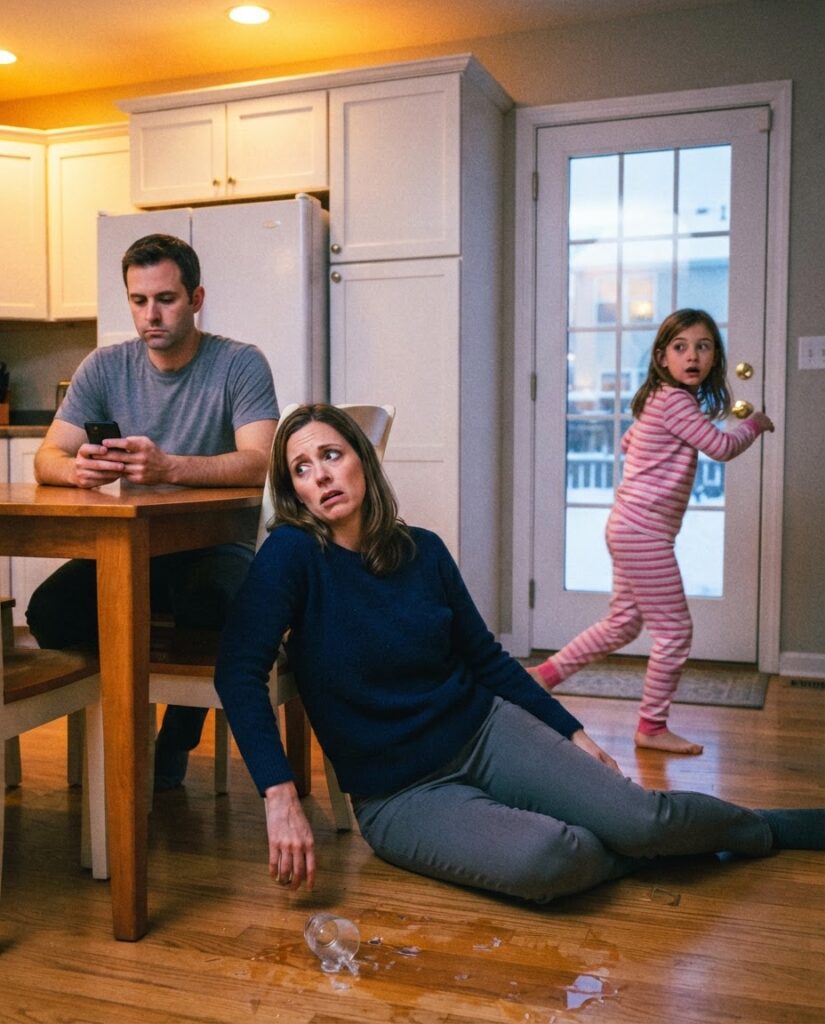
He found me on the kitchen floor. He knelt down and looked at my face. He lifted my left arm and let it go. It fell like a rock.
“Bronwyn, can you smile for me?”
Only half my mouth moved.
He looked up at my husband.
“This is a stroke,” he said. “A big one. Why didn’t you call 911?”
Hamilton didn’t answer.
The ambulance arrived seven minutes later. The paramedics checked my blood sugar, my blood pressure, my face. One of them got on the radio.
“Stroke alert. Female, thirty-eight. Onset 7:42 p.m. We’re coming in hot.”
At the hospital, a neurologist named Dr. Ingram met us at the doors. They rushed me into a scanner. The pictures showed a blood clot blocking an artery in my brain.
They gave me a clot-busting medicine through my IV. Then they took me to a special room and pulled the clot out with a tiny wire through an artery in my leg.
I woke up the next morning.
My left hand moved. Slowly. But it moved.
I said, “Calla.”
Clearly.
Dr. Ingram sat on the edge of my bed.
“Bronwyn, you’re very lucky,” he said. “We got to you in time. Fifty-one minutes from the start of your stroke to the medicine. Another hour or two, and you could have lost the use of your left side for good. Or worse.”
He paused.
“Your daughter recognized every sign. Most adults don’t. She saved your life.”
Calla was sitting in the chair next to my bed, holding my left hand. She’d fallen asleep.
Her socks were still wet.
The hospital social worker came that afternoon. Mr. Kaspar had told the paramedics everything. How my husband laughed. How he took my phone. How he blocked the door.
A police officer came too.
Hamilton was charged with interfering with an emergency call. The officer said taking away someone’s phone while they’re having a medical emergency is a crime.
When Hamilton came to the hospital, he tried to apologize.
“I didn’t know, Bronwyn. I really thought you were just tired.”
“Calla knew,” I said. My words were still a little slow. But they were mine. “She’s ten. She told you what it was. She said ‘FAST.’ You told her to calm down.”
He didn’t have anything to say.
I filed for divorce in March.
My recovery took six months. Physical therapy three times a week. Learning to tie my shoes again. Learning to write my name. Some days I cried from frustration.
Calla came to every session. She cheered for me like I was running a marathon.
In May, her school held an assembly. The principal called Calla up on stage. The fire department gave her a “Junior Lifesaver” award.
She gave a little speech.
“If someone’s face droops, if their arm is weak, or if they talk funny, don’t wait,” she said into the microphone. “Even if a grown-up tells you to. Call 911. That’s what FAST means.”
The whole gym stood up and clapped.
I was in the front row.
I clapped with both hands.
THE END.