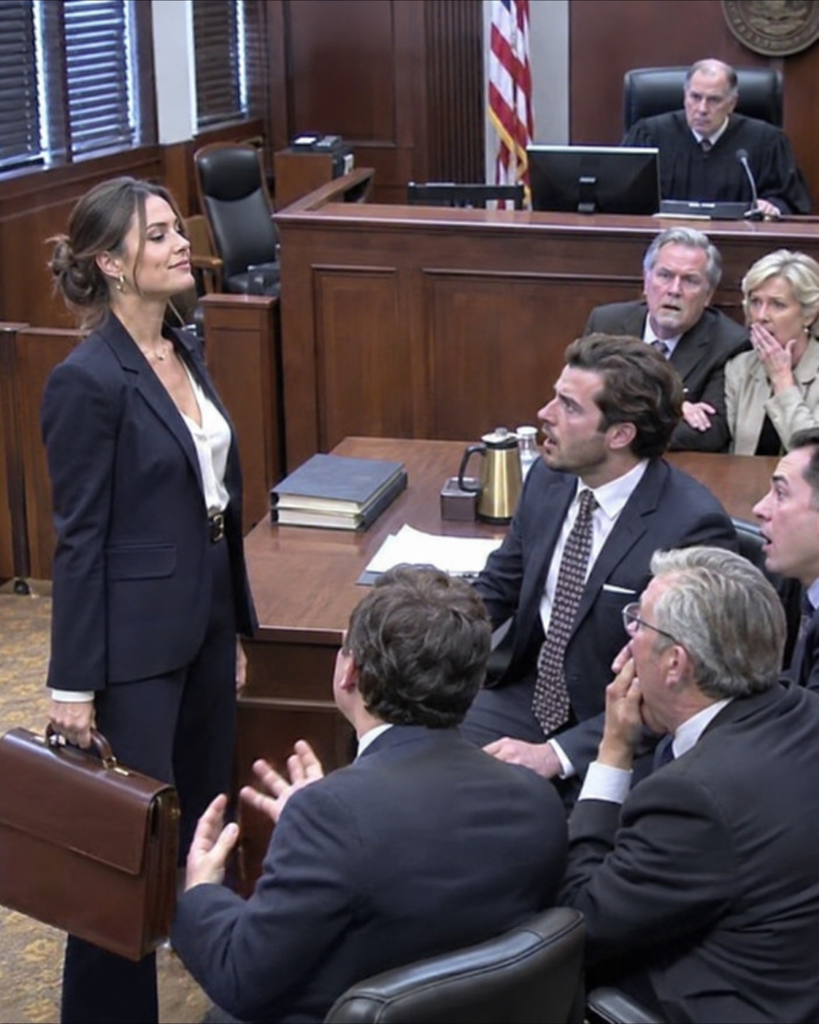
“My father-in-law burst out laughing when I entered the courtroom without a lawyer, mocking me for being too poor to hire one.
What he didn’t know was that I had spent years serving as a military attorney.
He sat there watching as I faced the judge and tore apart his son’s entire case with one sentence that brought the courtroom to absolute silence.
The first person to ridicule me was my mother-in-law.
Vivian Hale raised her elegant hand to cover her mouth, but I could still hear the soft chuckle that slipped out.
Her diamond bracelet glittered beneath the courtroom lights as she leaned closer to her husband and murmured something that made him smile.
They believed I was defenseless.
They believed the woman sitting by herself at the table, with nothing but a leather briefcase and a glass of water, was someone they could easily destroy.
Across the aisle, Preston sat confidently beside three high-priced attorneys.
Their table was crowded with heavy folders, sleek tablets, and meticulously prepared legal arguments.
My table was nearly bare.
Judge Rebecca Morrison peered at me over the rim of her glasses.
“Mrs. Hale, you are aware that you have the right to an attorney?”
“Yes, Your Honor.”
“And you’ve decided to represent yourself?”
“Yes.”
Several people seated in the gallery traded amused looks.
Preston’s chief attorney, Martin Voss, rose to his feet and straightened his expensive suit jacket.
“Your Honor, we have concerns that moving forward without legal counsel could cause avoidable complications. This is a rather simple matter.”
Simple.
That word nearly brought a smile to my face.
Because it was the same word Preston’s family had used while trying to wipe away seven years of my life.
Three weeks before that morning, Preston had set divorce documents beside my breakfast plate as casually as someone leaving a receipt on a restaurant table.
Not an apology.
Not an explanation.
Only a pile of paperwork that reduced our entire marriage to legal terminology and financial figures.
“I contributed nothing?” I asked once I’d finished reading the documents.
His face remained almost expressionless.
“You took care of the house, Amelia.”
“I took care of everything.”
He turned his eyes away.
For years, they had confused my quietness with weakness.
All they saw was the obedient wife who arranged dinner parties, coordinated family gatherings, and remained at Preston’s side as he established his reputation.
They had never discovered the truth about who I used to be.
They had no idea that before I became Amelia Hale, I had been Captain Amelia Carter, a military attorney who had fought cases under enormous pressure, examined every detail, and understood that confidence could influence a verdict before the first witness even took the stand.
I had concealed that side of my life because all I wanted was a peaceful marriage.
But now, I stood inside a courtroom facing the very people who were convinced their victory was already guaranteed.
Martin Voss approached the judge with the self-assurance of a man who expected an effortless win.
Then the judge shifted her attention toward me.
“Mrs. Hale, you may proceed.”
I unlocked my briefcase, took out one folder, and rose to my feet.
The entire courtroom fell silent.
Because the woman they had assumed was completely unprepared had finally introduced herself.
“My name is Amelia Carter Hale, Your Honor, and I move to strike my husband’s financial affidavit because the signature attributed to me on its supporting agreement was forged.”
Preston’s smile vanished.
For one extraordinary second, nobody moved.
Then Martin Voss stood so abruptly that his chair scraped against the floor.
“Your Honor, that is a serious accusation.”
“It is,” I replied. “Which is why I brought evidence.”
I placed the folder on the document stand and opened it to the first page.
“Exhibit A is the agreement Mr. Hale claims I signed, waiving any interest in marital assets.
Exhibit B is a certified record of my attendance at a military legal conference in Virginia on the date that agreement was supposedly executed in this state.”
Judge Morrison leaned forward.
“Were you physically present in Virginia?”
“Yes, Your Honor. For the entire day.”
“And the document claims you signed it here?”
“At two forty-three that afternoon.”
I turned another page.
“Exhibit C is the conference security log. Exhibit D is the hotel surveillance certification.
Exhibit E is a sworn statement from the conference administrator confirming my attendance.”
The judge studied the documents.
Behind Preston, his father stopped smiling.
I had watched powerful men lose their composure before. Usually, the first sign was not anger. It was stillness.
Charles Hale sat perfectly motionless, one hand gripping the polished wooden armrest.
Martin approached his client’s table and whispered something.
Preston shook his head.
I heard two words.
“She signed.”
I looked directly at him.
“No, Preston. I didn’t.”
Judge Morrison raised her hand.
“Mr. Voss, your client will have an opportunity to respond. Mrs. Hale, continue.”
I turned to the next exhibit.
“The disputed agreement is not the only document containing my alleged signature.”
Martin’s expression changed.
He knew what was coming before Preston did.
“Over the last eighteen months, several transfers were made from accounts established during our marriage. The transfers were authorized using documents bearing my name. Those documents were submitted to the court as proof that I had voluntarily relinquished my financial interests.”
I paused.
“Your Honor, I never authorized those transfers.”
A murmur moved through the gallery.
Judge Morrison ordered silence.
I handed the clerk a neatly organized packet.
“The records include the original bank certifications, electronic authorization histories, and correspondence from the institution’s fraud department. I request that the court preserve these materials and refer the suspected falsifications to the appropriate authorities.”
Martin stepped forward.
“Objection. Counsel is attempting to turn a divorce proceeding into a criminal trial.”
“I’m not counsel,” I answered quietly. “I’m the respondent. And I’m explaining why the documents your client submitted cannot be trusted.”
Judge Morrison examined me.
“Mrs. Hale, do you have legal training?”
“Yes, Your Honor.”
“What kind?”
“I served as a captain in the United States Army Judge Advocate General’s Corps. I practiced military law before leaving active service.”
Someone in the gallery inhaled sharply.
Vivian’s bracelet slipped against the wooden bench with a tiny metallic click.
For the first time since entering the courtroom, I looked at her.
Her lips were parted.
She appeared almost offended that I had possessed an entire life without her permission.
Charles leaned toward Preston.
“You told me she was a housewife.”
Preston stared at the table.
“She was.”
I heard him.
And something inside me, something that had spent seven years waiting for him to recognize the woman beside him, finally became quiet.
Judge Morrison adjusted her glasses.
“Mr. Voss, did your office verify the execution of this agreement?”
Martin hesitated.
“We relied upon representations supplied by our client.”
“Then I suggest you review those representations carefully.”
The judge called a short recess.
The gavel struck.
And the courtroom erupted into whispers.
Preston immediately turned toward me.
“What are you doing?”
His voice was low, but the anger beneath it was unmistakable.
I closed my folder.
“Answering your petition.”
“You’re trying to humiliate me.”
I looked at the documents scattered across his attorneys’ table.
“You brought three lawyers to take everything I helped build. You invited your parents to watch. And you’re upset because I brought evidence?”
His face tightened.
“You could have told me you were a lawyer.”
“I did.”
He blinked.
“On our third date. I told you I’d served in the Army and practiced law.”
“You said you worked in legal services.”
“Because you interrupted me to tell me military jobs weren’t particularly impressive.”
He opened his mouth.
Nothing came out.
I remembered that evening perfectly.
The little Italian restaurant. The rain against the windows. Preston’s hand covering mine as he explained how successful his family was.
I had mistaken his attention for affection.
Now I understood that he had never really listened.
Charles approached, his expensive shoes striking the floor with measured steps.
“Amelia, this has gone far enough.”
I faced him.
“No, Charles. It hasn’t.”
“You’re making allegations that could destroy this family.”
“Then you should be concerned about whether they’re true.”
He lowered his voice.
“Think carefully about what you’re doing.”
I recognized the warning.
I had heard variations of it at family dinners, during disagreements about money, whenever Vivian wanted something and Preston expected me to surrender.
This time, however, Charles wasn’t speaking to a woman trapped at his dining table.
He was speaking to someone who had spent years examining witnesses who believed intimidation could substitute for facts.
“I have thought carefully,” I said. “For three weeks.”
His eyes narrowed.
“People who challenge my family usually regret it.”
A court officer standing near the doorway turned toward us.
I didn’t raise my voice.
“Officer, would you please make a note that Mr. Hale has approached me during recess and made a statement I understood as threatening?”
Charles stepped backward.
The officer moved closer.
“Sir, please return to your side of the courtroom.”
For the first time, Charles Hale obeyed someone he couldn’t purchase.
But the hardest part of that morning was still ahead.
When proceedings resumed, Martin requested permission to question me about the marriage.
He approached with a carefully sympathetic expression.
“Mrs. Hale, you voluntarily stopped working after marrying Preston, correct?”
“Yes.”
“And your husband provided your housing, transportation, and living expenses?”
“He earned the larger income during our marriage.”
“While you remained at home.”
“While I managed our household and supported his business activities.”
Martin smiled faintly.
“Would you describe planning dinner parties as business management?”
I waited until he finished smiling.
“Not ordinarily.”
“Then perhaps you can explain the distinction.”
“Certainly. During our marriage, I organized investor meetings, maintained client correspondence, coordinated charitable events that generated business introductions, reviewed vendor contracts, and prepared research summaries Preston used in presentations.”
Preston shifted in his chair.
Martin glanced toward him.
“Were you formally employed by his company?”
“No.”
“Then you received no salary?”
“No.”
“Isn’t it possible you’re exaggerating your contribution because you’re unhappy about the divorce?”
I looked at the judge.
“May I refer to an admitted exhibit?”
“Proceed.”
I opened a binder of emails.
“On April seventeenth, Preston wrote, ‘Amelia, please fix the financial projections before tomorrow’s investor presentation. I don’t understand the discrepancies.’ On May ninth, he wrote, ‘The contracts you revised saved us a fortune.’ On August twenty-second, he wrote, ‘I couldn’t run this operation without you.’”
I turned another page.
“There are forty-six comparable messages.”
Martin’s smile disappeared.
I continued.
“I didn’t keep those emails because I expected a divorce. I kept them because I was proud that my husband trusted me.”
The courtroom became very quiet.
For a moment, my own voice threatened to fail.
I looked down at the paper until the letters stopped blurring.
Then I lifted my head.
“But trust, apparently, was not mutual.”
Martin returned to his table without another question.
I should have felt victorious.
Instead, I felt the strange emptiness of watching seven years of marriage reduced to proof that I had mattered.
Judge Morrison called Preston to testify.
Under questioning, he maintained that the disputed documents were legitimate.
He claimed I had understood our financial arrangements.
He claimed I had willingly given up any interest in his business.
Then he made the mistake that changed everything.
“My father handled the paperwork,” he said.
Martin froze.
Charles leaned forward.
Judge Morrison looked up.
“Which paperwork, Mr. Hale?”
Preston swallowed.
“The agreement. The transfers. My father said everything had been properly arranged.”
I stood.
“Your Honor, may I ask a question?”
“Proceed.”
I approached slowly.
“Preston, did you personally witness me sign the agreement?”
“No.”
“Did you speak to me about transferring those funds?”
“My father said you agreed.”
“That wasn’t my question.”
He rubbed his palms against his trousers.
“No.”
“Did you review the original documents before submitting them to your attorneys?”
A long silence followed.
“No.”
I returned to my table.
“Nothing further.”
Charles was staring at his son with an expression I had never seen before.
Not concern.
Not disappointment.
Fury.
Because Preston had done the one thing Charles couldn’t tolerate.
He had stopped protecting him.
Judge Morrison ordered a further evidentiary hearing and directed that the disputed financial records be preserved. She also ordered that no marital assets be transferred or disposed of without authorization.
The matter was no longer simple.
As everyone began gathering their belongings, Vivian hurried toward me.
“Amelia, please.”
I stopped.
Her makeup was immaculate, but her hands trembled around her handbag.
“You must understand that Charles was only trying to protect Preston.”
“From what?”
She looked away.
“From losing what he’d worked for.”
I studied her face.
“Did you know about the forged agreement?”
“No.”
The answer came too quickly.
“Vivian.”
She pressed her lips together.
“I knew Charles had arranged something. I didn’t ask questions.”
“Why?”
Her eyes filled.
“Because in this family, asking questions has consequences.”
For seven years, I had regarded Vivian as someone who enjoyed making me feel small.
I still believed that.
But standing there, I saw something else beneath the diamonds and expensive perfume.
Fear.
Before I could respond, Charles called her name.
She flinched.
Then she walked away.
That evening, I returned to the small apartment I had rented after Preston filed for divorce.
It had one bedroom, an unreliable heater, and a kitchen window overlooking a narrow courtyard.
There were no marble countertops.
No chandeliers.
No expensive furniture selected to impress visitors.
But when I locked the door, nobody questioned where I had been.
I placed my briefcase on the kitchen table and sat in the darkness.
For the first time all day, my hands began shaking.
I had held myself together through every objection, every accusation, every familiar expression of contempt.
Now there was nobody watching.
I covered my mouth.
And cried.
Not because I wanted Preston back.
Because I remembered wanting him.
I remembered our wedding morning, when he had looked at me as though there was nowhere else on earth he wished to be.
I remembered the first apartment we shared, the cheap coffee we drank while planning a future, the night he held me after I woke from a nightmare about a case I’d handled overseas.
I remembered believing we were building something permanent.
The phone rang.
An unfamiliar number.
I almost ignored it.
Then I answered.
“Mrs. Hale?”
“Yes?”
“This is Daniel Mercer. I’m an investigator working with the financial institution that contacted you regarding the disputed transfers.”
I sat upright.
“Has something changed?”
“Yes. We recovered additional authorization records.”
He paused.
“There’s something you need to know before the next hearing.”
The room seemed to grow colder.
“Tell me.”
“The account activity wasn’t limited to the assets identified in your divorce petition.”
I gripped the phone.
“What do you mean?”
“Someone used your identity to authorize a substantial transfer connected to a charitable foundation associated with the Hale family.”
I stared at the dark window.
“The foundation?”
“Yes. And the transfer was made shortly before the divorce filing.”
My stomach tightened.
“Who received the money?”
“We’re still tracing the final destination. But the initial authorization came from a device registered to Charles Hale’s office.”
I closed my eyes.
The foundation.
I had helped organize its fundraising dinners.
I had written thank-you letters to donors.
I had believed the money supported scholarships for children of military families.
“Daniel,” I whispered, “please tell me the scholarship funds weren’t touched.”
He didn’t answer immediately.
That silence was worse than any answer.
“We’re investigating that possibility.”
I stayed awake until dawn.
At six thirty, I called an old friend.
Colonel Sarah Bennett had served beside me during some of the hardest years of my military career.
She answered on the second ring.
“Amelia?”
I hadn’t heard her voice in nearly two years.
“Sarah, I need help.”
She heard something in my breathing.
“Where are you?”
“Home.”
“Are you safe?”
“Yes.”
“Then tell me what happened.”
I told her everything.
The marriage.
The divorce.
The forged documents.
The foundation.
When I finished, she was silent.
Then she said something I hadn’t realized I needed to hear.
“You don’t have to fight this alone.”
I pressed my fingers against my eyes.
“I know.”
“No,” she said gently. “I don’t think you do.”
By noon, Sarah was sitting across from me in my apartment.
She had brought coffee, sandwiches, and a yellow legal pad.
She didn’t offer empty reassurance.
She asked questions.
She helped me organize the evidence.
And when I admitted I was frightened, she didn’t look surprised.
“Of course you are,” she said. “You loved these people.”
I looked down.
“That’s what makes me feel stupid.”
“Loving someone isn’t evidence of stupidity, Amelia.”
“Then why didn’t I see it?”
“Because you were living a marriage, not conducting an investigation.”
That sentence stayed with me.
Two days later, Vivian appeared at my apartment.
I opened the door to find her standing in the hallway without makeup.
She wore a plain gray coat.
Her hair, normally styled perfectly, had escaped its pins.
“May I come in?”
I hesitated.
Then stepped aside.
She entered and looked around the small living room.
For once, she made no comment about the furniture.
Instead, she sat on the edge of the sofa and held her handbag with both hands.
“Charles doesn’t know I’m here.”
I remained standing.
“What do you want, Vivian?”
She reached inside her bag.
For a moment, her fingers refused to cooperate.
Then she removed a small envelope.
“I found these in his private office.”
Inside were copies of bank instructions, correspondence, and a handwritten note.
I recognized Charles’s handwriting immediately.
The note contained three words that made my blood run cold.
Use Amelia’s authorization.
I looked up.
“Where did you get this?”
“Charles keeps a locked drawer in his study.”
“And you had the key?”
She nodded.
“Have you known about this?”
Tears gathered in her eyes.
“I knew he was hiding money. I didn’t know he was using your name.”
I examined the documents.
Several transfers referenced the scholarship foundation.
One carried a notation identifying funds reserved for educational grants.
“Vivian, these documents could expose him to criminal charges.”
“I know.”
“Why bring them to me?”
She stared at her hands.
“Because I remember a little girl.”
I waited.
“At the foundation dinner last winter, a girl came with her mother. Her father had died while serving overseas. She wanted to study engineering.”
I remembered her.
A shy teenager with dark braids and a blue dress.
She had asked me whether being afraid meant she wasn’t brave.
I had told her bravery meant moving forward despite fear.
Vivian’s voice cracked.
“Charles promised her a scholarship. He stood onstage and shook her hand.”
She wiped her cheek.
“Yesterday, I discovered her award was canceled because the foundation supposedly lacked sufficient funds.”
I looked at the papers again.
Vivian began crying quietly.
“I have spent my whole life pretending not to see what my husband does. I told myself I was protecting my family.”
She lifted her eyes.
“But what kind of family needs innocent people to suffer so it can remain comfortable?”
I sat opposite her.
For several seconds, neither of us spoke.
Then I asked the question that mattered.
“Are you willing to testify?”
She went pale.
“If I do, Charles will never forgive me.”
I didn’t soften the truth.
“He may not.”
Her fingers tightened around the empty handbag.
“And Preston?”
“He’ll have to decide what kind of man he wants to become.”
Vivian looked toward the window.
Outside, rain had begun tapping against the glass.
Finally, she nodded.
“Yes.”
The next hearing was scheduled for Thursday.
By then, the financial institution had supplied additional records through the appropriate legal process, and the suspected misuse of charitable funds had been referred to investigators.
Charles arrived at court wearing a charcoal suit and the expression of a man who still believed influence could control consequences.
He didn’t look at me.
He didn’t look at Vivian either.
She sat several rows behind me, alone.
Preston entered moments later.
He looked exhausted.
There were dark circles beneath his eyes, and his expensive suit hung loosely across his shoulders.
He approached my table.
“Amelia.”
I looked up.
“I need to talk to you.”
“Then speak.”
He glanced toward his father.
“I didn’t know about the foundation.”
I studied him.
“Did you know your father was hiding marital assets?”
His throat moved.
“Yes.”
The admission landed between us.
“How much did you know?”
“Enough to know it was wrong.”
I waited.
He stared at the floor.
“I thought if I let him handle everything, I wouldn’t have to be responsible.”
I closed my folder.
“You were responsible the moment you chose not to ask questions.”
He nodded slowly.
For the first time, he didn’t argue.
“I know.”
Before he could say anything else, the bailiff called the courtroom to order.
The hearing began with the disputed agreement.
Then the financial records.
Then the foundation transfers.
Charles’s attorney attempted to explain the discrepancies as administrative mistakes.
But each explanation created another question.
Finally, Vivian was called to testify.
She rose slowly.
Charles turned toward her.
The look on his face was so cold that I felt it from across the courtroom.
Vivian gripped the witness stand as she took the oath.
Her voice trembled at first.
She explained how she had discovered the documents.
She identified her husband’s handwriting.
She described the locked drawer.
Then Charles’s attorney asked whether she was motivated by marital resentment.
Vivian looked directly at her husband.
“No.”
“Then why are you testifying against him?”
She took a long breath.
“Because I spent thirty-eight years believing loyalty meant silence.”
Her eyes filled.
“And I was wrong.”
Charles’s face darkened.
“Vivian,” he said sharply.
Judge Morrison struck her gavel.
“Mr. Hale, you will remain silent.”
Vivian continued.
“My husband used fear to control our household. He taught our son that wealth made him superior to other people. And I helped him by pretending everything was normal.”
She looked toward Preston.
“I am ashamed of that.”
Preston lowered his head.
Then she looked at me.
“And I treated Amelia cruelly because she reminded me of the woman I used to be before I became afraid of losing everything.”
My throat tightened.
Vivian turned back toward the judge.
“I cannot undo what I allowed. But I can tell the truth now.”
When she stepped down, Charles refused to look at her.
The judge recessed the hearing briefly to review additional evidence.
In the hallway, Charles confronted his wife.
“You’ve destroyed us.”
Vivian stopped walking.
For a moment, I thought she might apologize.
Instead, she straightened her shoulders.
“No, Charles.”
Her voice was barely above a whisper.
“You did.”
He stared at her.
She walked past him.
And he did not follow.
The financial proceedings continued over the following weeks, while investigators pursued the separate allegations involving forged authorizations and charitable funds.
The divorce court ultimately rejected the disputed agreement after reviewing the evidence.
The concealed marital assets were brought into the financial accounting.
I received a fair division of the marital property, including compensation reflecting the contributions I had made throughout our marriage.
But the money wasn’t what I remembered most clearly.
It was the moment Judge Morrison looked at Preston and said, “Unpaid contributions to a marriage do not become worthless merely because they were never recorded on a payroll.”
I felt Sarah’s hand close gently around mine.
Across the courtroom, Preston stared at the floor.
The criminal investigation took longer.
There were interviews, subpoenas, forensic reviews, and months of uncertainty.
Charles’s influence couldn’t make the records disappear.
The investigators traced the foundation money through accounts he controlled. They established that forged authorizations had been used to conceal transfers, and that funds intended for scholarship recipients had been diverted.
Eventually, prosecutors brought charges.
Charles denied wrongdoing until the evidence became overwhelming.
When the case reached its conclusion, he was convicted of financial crimes connected to the fraudulent transfers and misuse of charitable funds.
The court ordered restitution.
His professional standing collapsed.
The foundation’s remaining board members removed him, and independent administrators were appointed to oversee the recovery and distribution of its funds.
The man who once threatened to destroy anyone who challenged him was sentenced to prison.
I attended the sentencing.
Not because I wanted to watch him suffer.
Because I wanted to hear the court recognize the people whose lives he had treated as insignificant.
Several scholarship families submitted statements.
One mother described explaining to her son why the financial assistance he had been promised suddenly vanished.
Another spoke about working nights to cover tuition.
Then the mother of the girl in the blue dress stood.
“My daughter believed Mr. Hale when he told her that her father’s sacrifice would never be forgotten.”
Her voice broke.
“She believed him.”
Charles stared straight ahead.
For the first time, I saw no arrogance in his expression.
Only the terrible recognition that money could no longer purchase his way out of the room.
When the sentence was pronounced, Vivian closed her eyes.
Preston sat beside her.
Neither spoke.
I remained seated until the courtroom emptied.
Then I walked outside.
The sky was bright and painfully blue.
Sarah waited near the courthouse steps.
“Well?” she asked.
I looked at the traffic moving beyond the square.
“It’s over.”
She studied my face.
“Is it?”
I thought about that.
Then shook my head.
“The case is.”
She nodded.
And together we walked away.
Healing, I discovered, was much less dramatic than justice.
There was no gavel announcing that the nightmares had ended.
No judge declaring that my heart had been restored.
Some mornings, I woke reaching for a husband who no longer slept beside me.
Other mornings, I remembered the way his family had laughed at me and felt anger so sharp it made breakfast impossible.
I began seeing a counselor.
At first, I struggled to explain why I had stayed so long.
Then, during one session, I said something that surprised me.
“I thought if I could make everyone happy, nobody would leave.”
My counselor waited.
I stared at my hands.
“In the Army, I knew exactly what I was worth. I knew what I could do. But when I left, I wanted someone to love me without needing me to prove anything.”
My voice trembled.
“So I stopped proving anything. And eventually, I stopped believing it myself.”
The counselor handed me a tissue.
“What would you say to the woman you were seven years ago?”
I thought for a long time.
Then whispered, “You don’t have to disappear to be loved.”
I cried harder than I had in the courtroom.
Because that was the truth I had needed long before the divorce.
Preston contacted me several months after the proceedings ended.
He asked to meet at the little Italian restaurant where we’d had our third date.
I almost refused.
But something about returning to that place felt necessary.
He was already seated when I arrived.
There were no attorneys.
No expensive watch.
No confident smile.
Just Preston, looking older than I remembered.
“Thank you for coming,” he said.
I sat opposite him.
For several minutes, we spoke about ordinary things.
The weather.
His mother’s new apartment.
The fact that he had left the family business and accepted a position at a smaller company.
Then he placed his hands on the table.
“I owe you an apology.”
I said nothing.
He swallowed.
“I treated your love like something I was entitled to. I let my father convince me that being the one who earned more money made me more important.”
His eyes shone.
“And when you stopped making my life easy, I decided you were the problem.”
I looked toward the window.
Rain traced the glass, just as it had on our third date.
“I waited years for you to notice me,” I said.
He nodded.
“I know.”
“No, Preston. I don’t think you do.”
My voice remained steady.
“I was standing beside you at every celebration. I stayed awake when your business was failing. I helped you prepare presentations you took credit for. I remembered your mother’s appointments, your father’s birthdays, every small thing that made your life run smoothly.”
I looked back at him.
“And somehow, I became invisible.”
He pressed his lips together.
A tear fell onto his hand.
“I was a coward.”
“Yes,” I said.
He accepted it.
For once, he didn’t ask me to make the truth more comfortable.
“I don’t expect you to forgive me.”
I took a breath.
“I hope you become someone who never treats another person the way you treated me.”
He nodded.
“Do you think we could ever—”
“No.”
The word was gentle.
But certain.
His face crumpled.
I reached across the table and touched his hand once.
“I loved you, Preston. That part was real.”
He closed his eyes.
“But I don’t want our marriage back.”
When I stood to leave, he didn’t try to stop me.
Outside, the rain had softened.
I walked to my car without looking back.
And for the first time, the memory of our beginning no longer felt like a promise I had failed to keep.
It felt like a chapter I had finished.
Vivian’s transformation was slower.
She moved into a modest apartment and began volunteering with an organization that supported military families.
At first, I suspected guilt was driving her.
Perhaps it was.
But guilt can become something useful when it leads to responsibility rather than excuses.
She helped organize donated school supplies.
She learned the names of the families she served.
She stopped wearing the diamond bracelet.
One afternoon, she invited me to tea.
I found her in a small kitchen struggling to remove a cake from its pan.
The cake broke in half.
She stared at it in horror.
Then, unexpectedly, she laughed.
I laughed too.
It was the first time we’d shared laughter without someone else being its target.
We ate the broken cake at her kitchen table.
Eventually, she set down her fork.
“Amelia, I don’t deserve your friendship.”
I looked at her.
“Maybe not yet.”
She nodded.
“I understand.”
“But you can keep becoming someone I might want to know.”
Her eyes filled.
She reached for my hand, then stopped.
I moved my hand closer.
She took it carefully.
There was no grand reconciliation.
Only two women sitting in afternoon sunlight, acknowledging that the past couldn’t be changed and the future didn’t have to repeat it.
A year after the divorce, I returned to practicing law.
Not immediately.
First, I completed the requirements necessary to resume civilian practice in my jurisdiction.
Then I joined a legal aid organization serving veterans and military families.
My office was small.
The carpet was worn.
The coffee machine made terrible coffee.
But every morning, I walked through the door knowing exactly why I was there.
One of my first clients was a young military widow struggling to obtain benefits after her husband’s death.
She arrived carrying a folder so full that papers spilled onto the floor.
As we gathered them, she apologized repeatedly.
“I’m sorry. I’m just not good at this.”
I looked at her.
“You don’t have to be. That’s why I’m here.”
Her shoulders relaxed.
And suddenly, I remembered the girl in the blue dress.
The scholarship recipient.
The one who had asked whether fear meant weakness.
Her name was Lily Parker.
I had never forgotten her.
The recovered foundation funds had eventually been placed under independent oversight, and the scholarship program had resumed.
Lily received the educational assistance she had originally been promised.
But I didn’t learn the most extraordinary part until the following spring.
I was invited to speak at a scholarship ceremony honoring military families.
The event took place in a modest community auditorium.
There were folding chairs, paper decorations, and a small stage illuminated by warm yellow lights.
Nothing resembled the extravagant galas Charles once hosted.
Yet the room felt more dignified than any ballroom I’d entered during my marriage.
Lily approached me before the ceremony.
She was taller now.
Her dark braids had been replaced by a neat ponytail.
“Mrs. Carter?”
I smiled.
“Lily.”
She held a small envelope.
“I wanted to give you something.”
Inside was a photograph.
It showed me kneeling beside her at the foundation dinner, adjusting the ribbon on her dress.
I remembered the moment.
But there was something written on the back.
A message in careful handwriting.
She told me courage doesn’t mean you aren’t scared. It means you do what’s right anyway.
I looked up.
Lily smiled shyly.
“I wrote that the night we met.”
My throat tightened.
“Why?”
“Because my dad used to say something like that.”
She hesitated.
“Mom told me you helped make sure the scholarships came back.”
“A lot of people helped.”
“I know.”
She stepped closer.
“But you were the first person who made me believe I could be brave.”
I couldn’t speak.
Then Lily reached into her bag and removed another photograph.
This one showed a young soldier standing beside a military vehicle, smiling beneath the harsh sunlight.
“My dad,” she said.
I took the photograph.
And my breath stopped.
I recognized him.
Not immediately from his face.
From the name printed beneath the photograph.
Sergeant Thomas Parker.
Years earlier, during my military service, I had represented a soldier who had been wrongfully accused of misconduct following a difficult deployment.
The case had nearly destroyed his career.
I had spent months fighting to ensure the evidence was examined fairly.
That soldier was Thomas Parker.
He had eventually been cleared.
He had returned to duty.
And before I left the Army, he had sent me a letter thanking me for giving him back his dignity.
I had kept it in a box with other memories from my service.
I looked at Lily.
“Your father was Sergeant Thomas Parker?”
She nodded.
“Did you know him?”
My eyes filled.
“Yes.”
I could barely get the word out.
“I knew him.”
Her mother approached.
When I told her who I was, she covered her mouth.
“Oh, my goodness.”
She reached for my hands.
“Thomas talked about you.”
I stared at her.
“He did?”
“He said there was a lawyer who believed him when almost nobody else would.”
Tears ran down her cheeks.
“He said you reminded him that the truth mattered, even when powerful people wanted it buried.”
I looked at Lily.
She was crying now too.
Her mother squeezed my hands.
“Before he died, he told me that if our daughter ever felt alone, I should teach her to stand up for herself the way Captain Carter stood up for him.”
I lowered my head.
For years, I had believed the life I’d left behind was something separate from the woman I had become.
I had thought my military career belonged to another version of myself.
Someone stronger.
Someone braver.
Someone who hadn’t spent seven years trying to earn a family’s approval.
But standing in that little auditorium, holding a photograph of a man I’d once defended and looking into the eyes of the daughter he’d left behind, I understood something.
The woman I had been had never disappeared.
She had been there all along.
Waiting for me to remember her.
Lily wrapped her arms around me.
I held her tightly.
And for the first time in a very long while, I cried without feeling ashamed.
At the ceremony, I changed my prepared speech.
I set the pages aside and looked out at the families.
“I used to believe courage was something you demonstrated in extraordinary moments,” I began.
“Standing before a judge. Facing an accusation. Challenging someone powerful.”
I paused.
“But I’ve learned that courage is often much quieter.”
I saw Sarah seated in the second row.
Vivian sat beside her.
Lily and her mother were holding hands.
“Sometimes courage is telling the truth when silence would be easier. Sometimes it’s asking for help. Sometimes it’s walking away from a life that looks beautiful to everyone else but is slowly breaking your heart.”
My voice softened.
“And sometimes courage is simply remembering that your worth doesn’t disappear because someone refuses to see it.”
The auditorium remained silent.
I looked at Lily.
“Every person in this room deserves to be treated with dignity. Not because of their wealth, their profession, or the approval of someone powerful.”
I smiled through my tears.
“But because dignity is not something another person gets to give you or take away.”
When I finished, the audience rose.
I had stood before judges, commanding officers, and crowded courtrooms.
But nothing had ever felt quite like that applause.
Not because they were celebrating my victory.
Because I finally understood that my life had meaning beyond the people who had tried to diminish it.
That summer, I moved into a little house near the edge of town.
It had a white porch, blue shutters, and a garden that had been neglected for years.
Sarah helped me paint the kitchen.
Vivian brought plants.
Lily and her mother visited one Saturday to help arrange flowers along the walkway.
We worked until our hands were covered in dirt.
Then we sat on the porch drinking lemonade.
The sun sank slowly behind the trees.
Lily leaned against her mother.
Sarah was telling Vivian a story about one of our old military assignments.
Everyone was laughing.
I looked around at the people gathered on my porch.
None of them were there because I had organized a perfect dinner.
None expected me to earn my place by making myself useful.
They were there because they wanted to be.
The realization was so simple that it almost hurt.
Later that evening, after everyone had gone, I carried the empty glasses into the kitchen.
The house was quiet.
I washed the dishes, dried my hands, and walked into the little study at the back.
On the wall hung my military service photograph.
Beside it was a framed copy of Lily’s handwritten message.
Below them sat the old leather briefcase I’d carried into court.
I opened it.
Inside, beneath the folders, was a photograph from my wedding day.
Preston and I stood beneath an arch of white roses.
We looked happy.
For a long moment, I studied the woman in the picture.
I no longer hated her for believing in love.
I no longer wanted to warn her about every mistake she would make.
She had done the best she could with the heart she had.
And when the time came, she had found her way out.
I placed the photograph in a memory box.
Not in anger.
Not in longing.
Simply because it belonged to the past.
Then I closed the briefcase.
Outside, the last light of evening stretched across the garden.
A breeze moved through the open window, carrying the scent of fresh grass and summer flowers.
My phone buzzed.
A message from Sarah.
Proud of you, Captain.
I smiled.
Then another message arrived.
From Lily.
I got accepted into the engineering program! Thank you for believing in me.
I sat down slowly.
Read the words again.
And laughed through sudden tears.
I typed back.
You earned this, Lily. Your father would be so proud.
For a moment, I looked at the framed photograph of Sergeant Parker.
Then at my own reflection in the darkening window.
I thought about the courtroom where Charles Hale had laughed.
About the woman who had walked in alone.
About the silence that followed when she finally spoke.
For years, I had imagined that winning would mean proving to the Hale family that I was better than they believed.
But now, in the stillness of my own home, I understood the real victory.
I no longer needed them to believe anything about me.
The next morning, sunlight poured across my kitchen floor.
I made coffee.
Opened the windows.
And stepped onto the porch.
Birds called from the trees.
Somewhere down the street, a child was laughing.
The garden was beginning to bloom.
I sat in the old wooden chair with my coffee warming my hands.
There were no court documents waiting on the table.
No cruel voices in the hallway.
No husband whose approval I needed to earn.
Only a quiet morning.
A home that belonged to me.
A future I could choose.
And a life that, after so many years, finally felt like my own.
I closed my eyes and breathed in the summer air.
Then I smiled.
Because the woman who had once walked into a courtroom with nothing but a briefcase had not been alone after all.
She had carried every lesson, every sacrifice, every act of courage, and every piece of love that had ever made her who she was.
And that had always been enough.