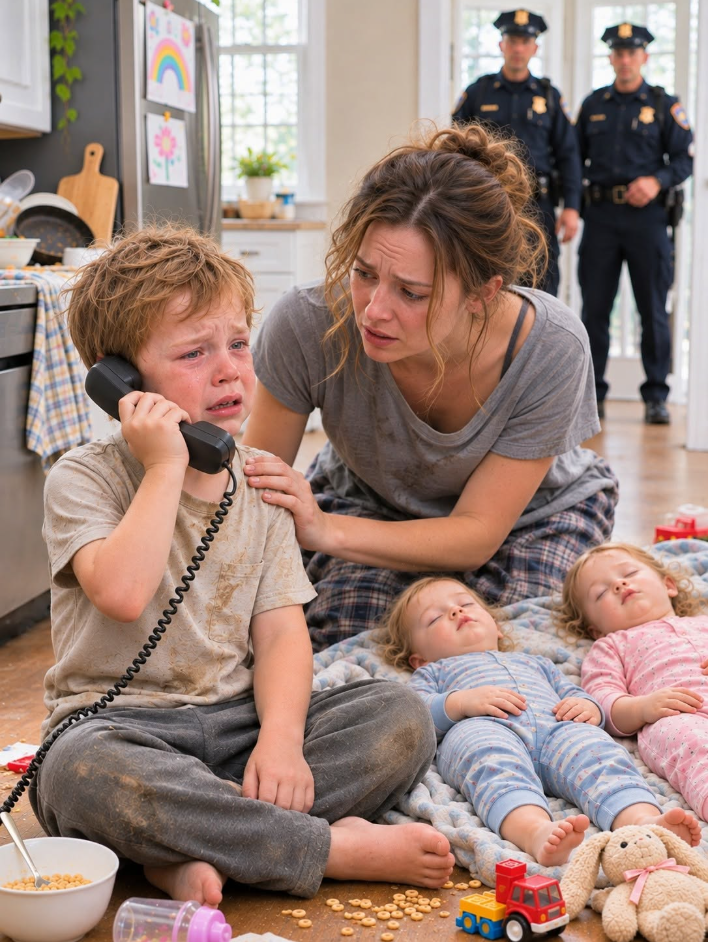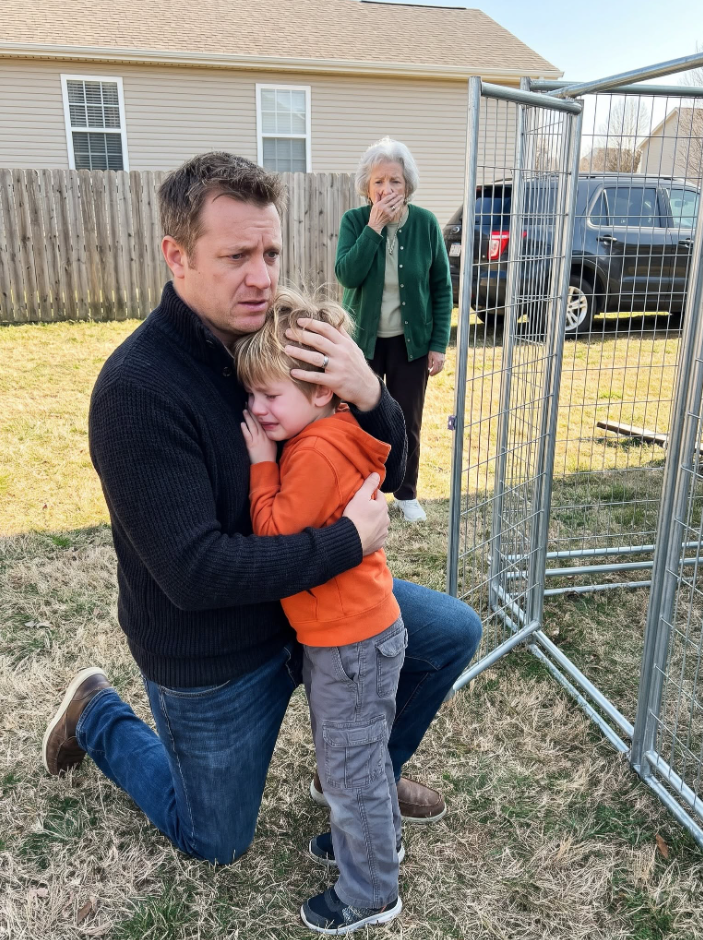
My ten-year-old son had not responded to my calls for three days, so I went straight to his mother’s house and discovered Owen sitting inside a locked metal enclosure in the backyard.
After opening the lock and gathering him into my arms, he looked toward the cloudy swimming pool and whispered, “Daddy, please don’t look.”
That was when I noticed several black bags submerged beneath the surface.
Since our divorce, I had tried my best to prevent every disagreement with Dana from becoming another argument.
She had married Curtis, a man who appeared pleasant whenever other adults were present, although Owen always grew unusually quiet whenever his name came up.
In hindsight, there were warning signs I should have noticed sooner.
Owen frequently asked to spend another night at my home, and whenever I asked about his experiences at Dana’s house, he became tense and offered only uncertain answers.
By Sunday, three complete days had gone by without a message or phone call from him, so I drove there.
Curtis’s SUV sat in the driveway, the curtains remained closed, and a chain had been secured across the entrance gate.
I knocked several times, but nobody answered.
Shortly afterward, their longtime neighbor, Mrs. Doyle, hurried over from her yard and explained that she had heard repeated arguments inside the house during the previous several weeks.
She also mentioned that Owen had completely stopped playing outdoors.
Curtis had recently installed tall privacy screens around much of the backyard, preventing neighbors from easily seeing what was going on.
Then Mrs. Doyle spoke more quietly.
“Last night, I saw Curtis carrying several large black trash bags into the backyard. He threw them into the swimming pool.”
An uneasy feeling spread through me.
Mrs. Doyle showed me a lower section of the fence separating their properties, and I climbed across without another moment of hesitation.
The backyard appeared poorly maintained, with weeds growing between the patio stones and dried leaves scattered across the ground.
The swimming pool was cloudy green, but before I approached it, something near the opposite corner caught my eye.
A blue covering had slipped halfway off a large metal dog enclosure.
Behind its bars, a young boy sat with his knees drawn closely against his chest.
Owen.
His hair was uncombed, his lips appeared dry, and he looked noticeably thinner than I remembered.
More concerning than anything else was the complete stillness and silence with which he sat there.
“Owen, buddy. It’s Dad.”
He slowly raised his eyes toward me.
“Daddy?”
I hurried forward and reached for the enclosure door, discovering that a large padlock kept it closed.
After searching the nearby area, I located some gardening pliers, managed to open the lock, and immediately gathered my son into my arms.
Owen placed both arms around my neck and clung to me.
I had countless questions, but taking him somewhere safe was the only thing that mattered at that moment.
“I’ve got you. We’re leaving.”
I started toward the fence, but Owen suddenly became rigid in my arms.
His attention remained fixed on the swimming pool.
The water looked cloudy and thick, with an unusual film covering parts of its surface.
Underneath, several large dark objects were barely visible, and Mrs. Doyle’s earlier warning immediately returned to my thoughts.
Owen began shaking.
“Daddy, please don’t look at the pool. Just take me away.”
I held him closer and gently asked what had frightened him, but he hid his face against my shoulder.
Whatever he thought was beneath that water appeared to trouble him even more than his experience inside the locked enclosure.
Only three days earlier, I had simply wanted to know why my son had stopped contacting me.
Now Owen was finally in my arms, but the house remained strangely quiet, Dana was nowhere nearby, and several black bags lay beneath the murky swimming pool.
Then Owen moved closer and whispered something that made me stop immediately.
“Daddy… Mommy tried to stop him.”
At that moment, I understood that finding Owen might have been only the first step.
I wanted to carry Owen across the fence and leave that property as quickly as possible, but before I moved, the sound of a car door closing came from the front of the house.
Owen immediately clung more tightly to my neck and whispered Curtis’s name, so I dialed 911 and explained that I had discovered my ten-year-old son inside a locked metal enclosure and feared the person involved might be returning.
The dispatcher advised me not to investigate the property or approach anyone.
I carried Owen toward Mrs. Doyle’s yard, and when we reached the fence, she had already positioned a small ladder to help me pass him across safely without making him climb.
Police officers and an ambulance reached the property within minutes.
Paramedics covered Owen with a blanket and checked his condition while officers documented the backyard, taking photographs of the enclosure, damaged padlock, tarp, and surrounding area where I had discovered him.
Owen kept holding my hand.
“Please don’t make me go back inside.”
“You’re not going back there, buddy.”
The paramedics observed dehydration, some marks around his wrists and ankles, and indications that he had not been receiving adequate meals.
They explained that nothing appeared immediately critical, but recommended a hospital evaluation because they did not yet know how long he had remained there or what had occurred before my arrival.
Before our departure, an officer asked whether Owen had said anything concerning the swimming pool.
I explained that he had repeatedly asked me not to look, and the officer grew visibly more attentive when Mrs. Doyle described seeing Curtis place several black bags into the water the previous evening.
Officers secured the property while Owen and I traveled to the hospital.
During the journey, I avoided questioning him because a detective had explained that a specially trained child interviewer should hear his account without anyone accidentally shaping his recollections.
Dana had still not been located, and Owen’s final words in the backyard continued occupying my thoughts.
He had said his mother tried to stop Curtis, suggesting that Dana might have discovered what was happening only after the situation had already developed.
At the hospital, medical staff provided Owen with fluids and carefully recorded their observations while a social worker stayed close by.
After eating a small amount of soup, he quietly asked whether the officers had located his mother.
“I don’t know yet, buddy. They’re looking for her.”
Owen looked down at the blanket resting over his legs.
“Mom tried to help me.”
Until then, I had worried that Dana might somehow have permitted the situation to continue.
Hearing Owen speak in her defense changed how I understood things, but I resisted asking further questions and assured him that he could share more whenever he was comfortable.
Approximately an hour later, Detective Renata Soto came into the room.
She explained that officers had examined the house and discovered evidence suggesting a serious disagreement had occurred in the kitchen, along with Dana’s d@maged phone beneath a cabinet.
Neither Dana nor Curtis had been found inside.
Detective Soto then mentioned the swimming pool.
Officers had retrieved the black bags from the water and examined their contents during the investigation.
My stomach tightened as several frightening possibilities crossed my mind.
“What was inside them?”
Soto hesitated before responding, almost as though she understood precisely what I feared hearing.
“Clothes,” Detective Soto answered. “Mostly clothes, and some documents.”
I looked at her in disbelief.
“Clothes?”
“Women’s clothing, Owen’s school things, a laptop, and a stack of file boxes. Nothing that was ever alive.”
She allowed me a moment before adding, “I’m sorry. I know what you were bracing for.”
Relief left me feeling unsteady, and I lowered myself into the nearby hospital chair.
For three hours, I had carried an overwhelming fear that I could barely put into words, and its sudden disappearance made my head spin.
“Then why would he throw them in the pool?”
“That’s what we’re trying to understand. The laptop and papers are waterlogged, but our forensic team thinks some of it can be recovered.”
“Mr. Dawson, has your son ever mentioned Curtis’s work?”
“Only that he travels a lot. Dana said he handled accounts for a construction company.”
Soto gave a thoughtful nod, as though the information supported an existing suspicion.
“We’re still looking for both Dana and Curtis. Her car is gone from the driveway, and his SUV was found two blocks away with the engine still warm.”
“Someone slammed that car door, and then he v@nished on foot.”
“He saw the police coming.”
“Possibly. Or he saw you.”
I glanced toward Owen, finally sleeping in the hospital bed while one small hand remained curled around my sleeve.
Whatever had unfolded inside that home, my son had experienced far more than any child should.
The child interviewer was a kind woman named Ms. Okafor, who invited Owen into a quiet room furnished with comfortable chairs and a container of crayons.
I observed through a window beside Soto, although twice I needed to step into the hallway to steady myself.
Owen explained what happened gradually, sharing difficult memories in small pieces.
Three weeks earlier, he was supposed to have been asleep.
He had gone downstairs for water and noticed Curtis inside the study, with the door open, documents covering the desk, and a duffel bag containing cash beside his foot.
Owen asked about the money.
Curtis smiled and described it as a family surprise.
Afterward, however, Owen overheard several disagreements.
His mother began asking questions, initially in a quiet voice.
Where had the money originated?
Why was someone from a company calling so late?
Why did accounts exist under her name when she had never opened them?
“Mom found the papers,” Owen told Ms. Okafor. “She said she was going to call someone. Curtis said she was being dramatic.”
On Wednesday evening, the disagreement escalated into a serious confrontation.
Owen heard something fall in the kitchen.
His mother hurried upstairs, helped him out of bed, and placed her old phone inside his pajama pocket.
“She said, ‘Run to Mrs. Doyle’s. Don’t stop,’” Owen said. “But Curtis caught me at the back door.”
Dana had stepped between them.
Owen returned repeatedly to that memory, his voice becoming uncertain each time.
His mother had reached for Curtis’s arm and urgently asked him to release Owen, and during the commotion, the boy ended up outside on the patio.
Curtis then guided him by the shoulder toward the dog enclosure, a large structure he had purchased months earlier without explaining its purpose.
“He said it was just for a little while,” Owen whispered. “He said I talked too much and needed to learn to be quiet.”
“And your mom?” Ms. Okafor asked gently.
“I don’t know. I heard the car leave. I think he took her.”
Watching from behind the glass, I noticed Soto’s expression become tense.
“Did you see the phone, Owen? The one your mother gave you?”
Owen reached into the pocket of his hospital gown, where a nurse had placed his personal belongings, and produced a small, worn object.
It was an inexpensive prepaid flip phone with a cracked screen.
“She said if I ever needed help, I should call the number saved first.”
The saved number belonged to Dana’s sister, Leah, who lived approximately two hours north in a quiet lakeside town.
Soto contacted her from the hospital corridor while I stood nearby, hardly daring to breathe.
Leah answered after the second ring, sounding exhausted, and when Soto introduced herself, a long and troubling silence followed.
Then Leah began crying.
“She’s here,” she said. “Detective, Dana is here.”
“She turned up on my porch at four in the morning. She’d gotten out of the car at a gas station and walked eleven miles.”
“Her face was bruised, and she kept saying Owen’s name. I wanted to call the police, but she begged me to wait.”
“She said Curtis had friends in the sheriff’s office.”
Soto became completely still.
“I was trying to find a way to reach her ex-husband safely,” Leah said. “She doesn’t have his number memorized.”
“She’s been sitting at my kitchen table for hours, staring at the door.”
“Keep her there,” Soto said. “Lock your doors. I’m sending a unit now.”
I borrowed a phone from a nurse and asked Leah to let me speak with Dana.
Seconds later, I heard uncertain breathing, followed by a voice I had rarely heard without tension during the previous three years.
“Mark?”
“He’s safe, Dana.” My voice trembled.
“Owen’s safe. He’s right here. He’s eating Jell-O and complaining about the hospital blanket.”
Her response was a mixture of relief, tears, and laughter that I would always remember.
“I tried,” she said. “I tried to get to him.”
“He wouldn’t let me. I’m so sorry, Mark. I’m so sorry.”
“You gave him the phone,” I said. “You told him to run. You did everything right.”
I held the phone close enough for Owen, who was now awake, to hear his mother.
What they shared during the following ten minutes is something I will always keep between us.
Authorities located and arrested Curtis Hale that evening at a roadside motel approximately forty miles from the lake.
He had attempted to pay for a room with cash, and the receptionist recognized him from a public alert distributed to local news outlets by Soto’s team.
The investigation eventually revealed a situation far more complicated than any of us had anticipated.
For four years, Curtis had allegedly diverted money from the construction company where he worked, moving funds through shell accounts, including several established under Dana’s name without her permission.
Soto explained that marrying Dana had partly allowed him to conceal the financial records more easily by using a spouse’s identity.
When Dana discovered the documents, he became increasingly desperate, and the confrontation escalated.
The black bags had been part of his effort to dispose of evidence before company auditors arrived.
He had also included Dana’s possessions, intending to suggest that she had packed her belongings before leaving.
His planned explanation was straightforward: Dana had departed voluntarily, left Owen behind, and Curtis was the abandoned husband trying to understand what happened.
Mrs. Doyle’s observations changed everything.
“I’ve lived on that street for twenty-six years,” she told the detectives, arms folded, chin lifted. “I know what a trash bag looks like when it’s full of garbage and what it looks like when somebody’s afraid of what’s inside.”
The sheriff’s deputy Curtis had claimed would protect him turned out to be merely someone he played golf with, and the deputy cooperated fully after learning what investigators had discovered.
No evidence indicated that other officers were involved.
Curtis had apparently exaggerated his connections.
Curtis faced charges involving kidnapping, unlawful confinement of a minor, assault, and financial fraud.
The prosecutor explained that the potential penalties were substantial, and that the evidence included the damaged padlock, photographs of the enclosure, Owen’s recorded interview, Dana’s testimony, and digital records recovered from the laptop.
The length of his possible sentence was not my primary concern.
What mattered to me was the day I could hold my son’s hand again without seeing him become afraid.
It took considerable time before Owen felt comfortable sleeping alone.
During the first two months, he stayed with me, and later Dana spent time with both of us at my house because neither of us wanted him to feel separated from either parent.
We did not discuss rebuilding our marriage.
Instead, our conversations focused on school schedules, counseling sessions, and deciding what Owen wanted for dinner.
Dana and I would never return to the relationship we once shared.
Yet something important had changed between us.
She gradually stopped apologizing for everything and began accepting my support.
I stopped treating our disagreements as a competition.
Somewhere along the way, we became something neither of us had anticipated: two parents completely committed to helping the same child.
Owen attended weekly counseling sessions with Dr. Bell, a patient therapist who kept a bowl of smooth stones on her desk and never pressured him to speak before he was ready.
At first, he communicated through drawings.
Nearly every picture included a small gray enclosure with a little boy sitting inside.
Several months later, his pictures began changing.
The enclosure became smaller.
The little boy appeared outside.
When spring arrived, Owen asked whether we could grow something in the backyard of my house, which had never contained a garden.
We purchased tomato seedlings and a bag of soil, and Owen knelt in the grass with a small trowel, carefully making holes for each plant.
“Dad,” he said, not looking up. “I’m glad you came.”
“Me too, buddy.”
“Even though I told you not to look at the pool.”
I laughed softly, although emotion caught in my voice.
“Especially then.”
He carefully pressed the soil around the young plants with both hands.
“I didn’t want you to see what was in it. I thought it was something bad.”
“I thought if you saw it, you’d stay there and Curtis would come back.”
My throat tightened.
“You were trying to protect me.”
“Mom told me to be brave. So I tried.”
I gently placed an arm around his shoulders.
Together, we remained seated in the grass while the afternoon sunlight stretched across our small garden.
At the sentencing hearing in June, Owen was not required to testify.
Dana spoke clearly and steadily, her hands resting together in her lap.
When she described the confrontation in the kitchen, she remained composed.
When she explained the moment she lost sight of Owen, her emotions finally surfaced.
Mrs. Doyle attended the hearing and sat in the second row wearing her favorite church dress.
She had brought a container of homemade lemon bars for the prosecutor, the detective, and, for reasons she never shared, the court bailiff.
After the proceedings, Soto approached me outside the courthouse.
“I’ve done this job for nineteen years,” she said. “Most of the time, the people who save the day are professionals.”
“Cops, doctors, social workers.”
She glanced toward the parking area, where Dana was helping Owen settle into my car.
“Sometimes it’s a neighbor who notices the wrong trash bags. Sometimes it’s a mother who hands her kid a phone.”
“Sometimes it’s a father who climbs the fence.”
“Or a ten-year-old who doesn’t want his dad to look in the pool,” I said.
She smiled.
“That one too.”
That evening, Owen fell asleep in his own bedroom for the first time without needing the hallway light.
I stood quietly in the doorway for several minutes, listening to his peaceful breathing.
Three days without hearing from him had almost changed our lives forever.
Three days of uncertainty, of knocking at a locked gate, and finally climbing across a fence.
I would climb it again.
I would climb a hundred.