PART 2
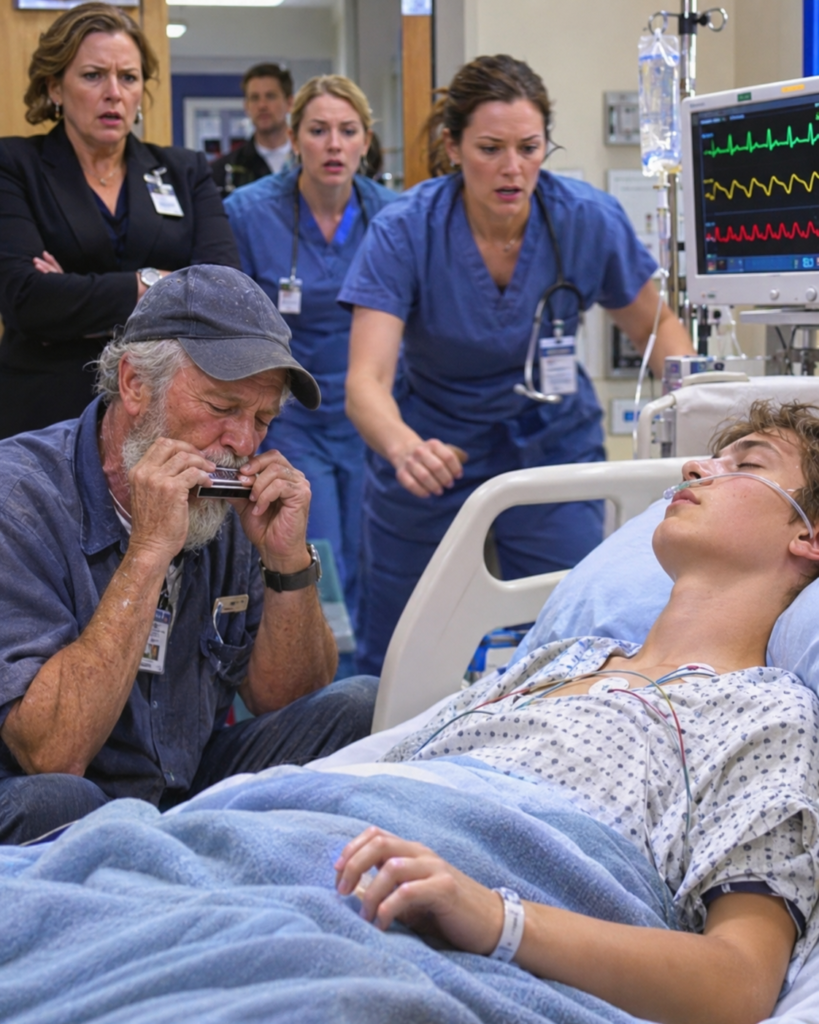
The head nurse saw it too.
She stopped. She stared at his hand. “Wait,” she said. “Everybody stop. Look.”
The room went quiet except for the beeping.
Benicio’s fingers were still tapping. Slowly. Weakly. But in rhythm.
The head nurse turned to me.
“Umberto. Play it again.”
Ms. Verity opened her mouth to argue. The head nurse held up her hand.
“Play it again,” she said. “Please.”
I raised my harmonica with shaking hands. I played my father’s river song from the beginning.
Benicio’s heart rate started to slow down. 140. 120. 100.
His fingers kept tapping.
Then, as I played the last note, his eyelids fluttered.
And opened.
Just a little. Just for a second.
He was looking at the ceiling. Then his eyes slowly moved to the side.
To me.
The head nurse grabbed the phone and called the on-call doctor.
“Room 412 is responding,” she said. Her voice was shaking. “He opened his eyes. Get up here now.”
The doctor came running. She examined Benicio for twenty minutes. She shined a light in his eyes. She squeezed his hand. She said his name.
He squeezed back.
She turned to me with tears in her eyes.
“How long have you been playing for him?”
“Two hundred and fifteen nights,” I said.
She shook her head slowly.
“Music reaches parts of the brain that nothing else can,” she said. “Sometimes it gives patients something to hold on to. Something familiar. I think he’s been listening to you for a long time.”
Benicio’s mother, Tamar, arrived at 5 a.m. She ran down the hallway in her work uniform, crying.
When she walked into the room, Benicio’s eyes were open. He couldn’t talk yet. The breathing tube was still in. But he looked at her.
And a single tear rolled down his cheek.
She fell on her knees next to his bed.
Benicio woke up fully over the next three weeks. They took out his breathing tube. He started moving his arms. Then his legs. Then, on a Tuesday afternoon, he whispered his first word.
His mother was there. So was I. They’d asked me to come in on my day off.
He looked right at me and whispered:
“River.”
Then he smiled.
He told us later, when he could talk again, that he remembered almost nothing about those four months. Just darkness. And sometimes, in the darkness, a sound.
“Like somebody was calling me,” he said. “From really far away. With music. Every night. So I kept trying to get back.”
Ms. Verity came to find me the next day. She looked embarrassed.
“Umberto, I owe you an apology. I was wrong. Completely wrong.”
Then she handed me a piece of paper.
The hospital had created a new volunteer program. Music for long-term care patients. And they’d asked me to lead it.
Now, three nights a week, I still mop floors.
And two nights a week, I walk the long-term care unit with my harmonica, playing for patients who have no visitors.
Benicio is seventeen now. He’s back in school. He walks with a cane, but he walks.
Last month, he came to the hospital to visit me during my shift.
He reached into his backpack and pulled out a brand-new harmonica.
“Will you teach me the river song?” he asked.
So at 3 a.m., in the empty hospital cafeteria, I did.
THE END.