PART 1 — The Price of Leaving the Yard
At 2:04 on Christmas Eve morning, a woman reached our towing company from a ditch west of Grand Forks. The temperature outside was four degrees. Her car would not start, and her two small children were in the back seat with her. My boss gave her the price of sending a truck, and she searched through her purse to see what she could offer. Everything she had came to thirty-six dollars. Before that call was over, I would hear her trying to explain what stood between her children and a warm place. Before the night was finished, my boss would tell me I no longer had a job.
I carried three wool blankets behind my seat, along with a thermos and an old child’s car seat. My wife had put the first blanket there years earlier. I had come home and told her about a woman I had picked up in slippers, on her way to work before daylight. She had spent forty minutes keeping her feet tucked underneath her, trying to hold on to whatever warmth she could. “You never know who you’ll pick up,” my wife told me. As the years went by, she added the other blankets. After she died, I continued taking them home each spring to wash and fold. They always went back before my next shift, even when the temperature outside had reached seventy.
The storm had moved south out of Canada that evening. Highway 2 was closed by midnight, and the snow beyond our yard was thick enough that I could hardly make out the gate. I was finishing my coffee when the dispatch line rang. Calls reached Vic’s cell first, then rolled over to my truck if he did not answer. That time he picked up, and I heard the conversation through my speaker. “Please,” a woman said. “I went into the ditch on Highway 2. I’m about ten miles west of town. I have two little kids with me, and I can’t get the car started.” Vic asked whether she needed a tow. Her answer came so quickly that I wondered how many calls she had already made.
“No payment, no tow,” Vic said. “Call your husband.” Her answer came back across the speaker. “I don’t have a husband anymore. Please, sir. They’re so cold.” Vic told her, “Try 911.” Then the call ended. I rang him immediately, before he could have had much chance to put the phone aside. “Vic, it’s four degrees. That road’s closed. Even if she gets through to somebody, those kids could be out there a long time.” He answered the way he had answered her, as though the question was still only what the truck would cost. “We’re a business, Ernie. A customer wants a truck, she pays for a truck.” I had already heard enough. “I’m going.”
For a second, I thought he might back down. Twenty-eight years around a man teaches you something about the pauses between his words, and this pause lasted long enough for me to hear the wind shaking my truck door. Then he said, “You leave that yard without a paid ticket,” he said, “and you don’t bother coming back.” I put the phone down. Before starting the truck, I reached behind my seat and checked that the blankets were where I always kept them. On a clear night, the stretch ten miles west of town would have been a short drive. That morning, reaching her took forty minutes. The snow swept across Highway 2 so heavily that the next reflector was sometimes the only thing I could see.
I drove from one reflector toward the next, searching for another as soon as the first came alongside the truck. All the while I kept looking down into the ditches. I was afraid I would pass her without ever knowing she was there. Eventually, a faint light appeared below the shoulder. A little red car had gone down the slope nose-first, and snow was building against its front doors. I stopped where I had enough room to work and climbed down toward the driver’s side. Before I could see inside, I had to clear snow from the window. When I knocked, the woman turned toward me and lowered the glass barely an inch. “Did he send you?” she asked.
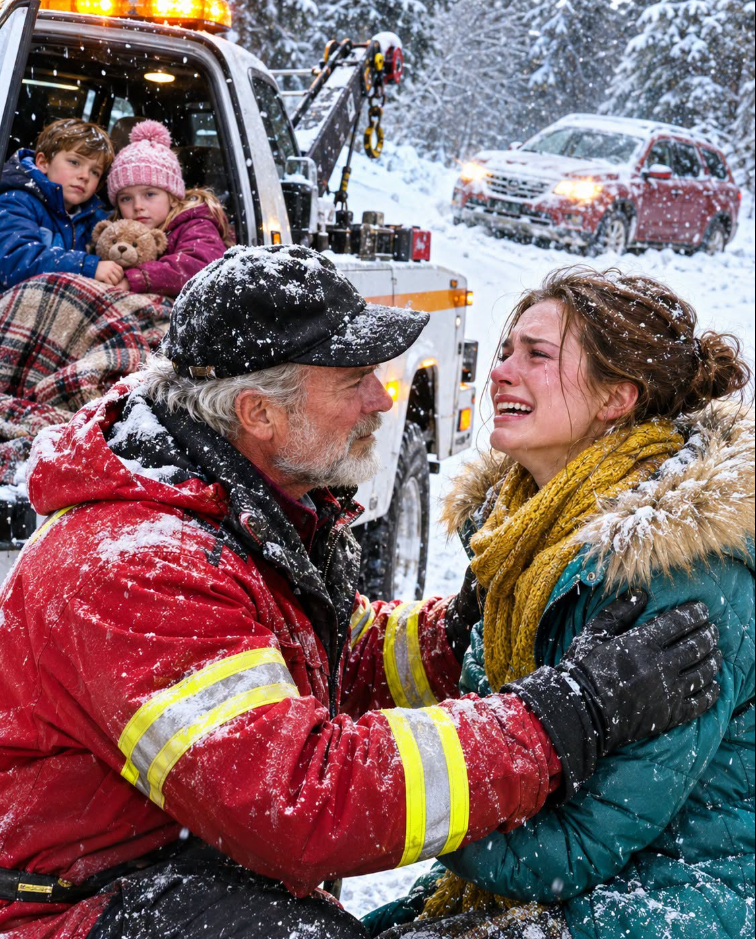
“I heard your call. I’m Ernie. Can you get your door open?” She pulled the handle, but the door opened only a little before catching against the packed snow. I worked at it with my boots until there was enough space to pull it wider. Now that I was close, I could see the bluish color around her lips. Both hands were tucked inside her coat sleeves. “My kids first,” she said. In the back, a boy of about five was pressed against his little sister beneath a blanket so thin that the pattern on the girl’s pants showed through it. He raised a corner and asked whether I was taking them both. “Both of you,” I said. “Your mom’s coming too.”
I brought his sister up the slope first and settled her into the old car seat in my cab. When I wrapped a wool blanket around her legs, she stirred and turned toward the warm air coming from the dashboard. Then I went back for her brother. He was trying to fold the blanket they had been sharing, but his shaking hands could not bring the corners together. I told him to bring it as it was. Their mother followed us up and climbed into the truck. Instead of sitting down immediately, she bent over each child, checking them one after the other, as if she needed to see for herself that both were really there.
Only after that did she settle into her own seat. I poured cocoa into the cap of my thermos and passed it to her. She held it between both hands for a while before taking a drink. “I can give you the thirty-six now,” she said. “I meant what I told the man on the phone. I’ll pay the rest.” I told her, “Keep it in your purse. I’m going to get your car up here.” She began to answer, but her daughter reached toward her, and she turned to hold the little girl’s hand instead. I eased the cab door shut and headed back into the snow with the winch line.
Even with good visibility, bringing a car out of a ditch is not something to rush. I cleared enough snow to reach a sound attachment point and worked the car up the incline a little at a time. Whenever I stopped to check the line, I could see the boy watching from inside the cab. At some point he drew the wool blanket up over his nose, leaving only his eyes showing above it. I kept easing the car toward the road. With the children out of the cold, I could take the time the work required without wondering how much longer their thin blanket would be enough.
I drove them to the truck stop motel on the edge of town. The clerk quoted ninety dollars for a room, and the woman immediately reached toward her purse again. My card was already in my hand. After paying, I waited as she brought the children through the lobby, carrying the girl on her hip while the boy followed with his blanket. Before they went down the hallway, I asked for her name for the call sheet. She gave it, then spelled the children’s names while I recorded their ages. My thoughts were on the heat waiting in that room and whether the little boy had dry socks. I entered the information beside the mileage and the time, just as I had done on thousands of calls.
Then she put her arms around me. Twice she tried to thank me, and twice the words failed before she began crying. “Merry Christmas,” I told her. “Go get some sleep.” Back in the truck, I put the clipboard away and drove to the yard. Vic was there already. As soon as my headlights passed across the office window, he came outside. He stood in the place where I normally parked, so I stopped short and switched off the engine. He waited until I climbed down. There was no question about the road, the woman, or whether I had reached the children. He began with the cost of using his truck.
“Fuel, winch time, and an emergency tow I’ll never get paid for,” he said. “I gave you a direct order. You’re done, Ernie.” During the drive back, I had heard him fire me in my head in more ways than one. None of those imagined conversations felt quite like hearing the words in the yard where I had worked for twenty-eight winters. I knew the office drawer that stuck in damp weather. I knew where to set my coffee so the engine’s vibration would not shake it out of the holder. Until that night, I had expected to return after Christmas and keep doing all those familiar things. “Fair enough, Vic.”
I took the truck key off my ring and placed it in his hand. My wife’s blankets were still inside the cab; one lay across the seat where the little boy had been. I was just about to reach in for them when Vic leaned past me and took the clipboard. “I need to log this,” he said. He turned to the call sheet. I watched him read past the mileage, down toward the line where I had written the customer’s name. His hand stopped moving. Then he lifted the board closer to his face and read that same line again.
PART 2 — The Name He Had Stopped Saying
The entry was as ordinary as every other entry I had made that night: Customer: April Tamblyn. Children: Bodhi, 5. Sage, 2. When I had written it, I had been thinking about a warm motel room, a tired mother, and a boy whose fingers had shaken too badly to fold a blanket. Now Vic stood beside me reading those names as though the rest of the sheet had disappeared. He had taken the clipboard to record what my disobedience had cost him. Instead, he had found something in my handwriting that kept him from turning the page or saying anything about the truck.
“Where did you take her?” His voice was so quiet that I almost asked him to say it again. I looked from the call sheet to his face. There was only one reason that name would make him look as if he had heard from someone he thought he might never see again. “The truck stop motel,” I said. “Room six.” Vic dropped the clipboard into the snow and hurried toward his pickup. I bent down, retrieved it, and brushed the snow away. Then I went to my own car. The truck key was no longer mine, and I had no work left that required me to follow him anywhere.
I could have driven home. I had brought the family out of the ditch, paid for the room, and handed over the key as he demanded. Whatever waited between Vic and his daughter was theirs, not mine. But I kept hearing the first thing April had asked when she lowered her window: whether he had sent me. I remembered her looking at me from the cold car, trying to understand why somebody had come after the conversation she had just had. Instead of going home, I drove after Vic to the motel. I did not know what I could do there. I only knew I was following.
He did not run when he reached the motel walkway. Outside Room 6, his pace slowed, and he stopped in front of the door. Several seconds passed before he lifted his hand to knock. By the time it opened, I had caught up and stopped near the window, a few feet behind him. April still wore the clothes she had been wearing in the car. Sage rested on her hip, her cheek against her mother’s shoulder. April looked at Vic without speaking for so long that I found myself wondering whether she had recognized his voice on the telephone all along.
At last, she pulled the door open a few inches farther. “Dad?” Vic tried to answer, but his mouth moved before any words came. I had watched him handle difficult calls and give people bad news. Usually he never had to search for a beginning. This time, with snow melting on his boots outside his daughter’s motel room, he needed two attempts. “You called my line last night,” he said. “I didn’t know it was you. I heard you say your children were crying, and I still hung up.” There was nothing in those words about rates, equipment, or the expense of sending a truck.
April glanced down at Sage and straightened the sleeve that had slipped up the little girl’s arm. She did not reassure him or tell him that what happened was all right. She remained in the doorway and allowed him to say the rest. “I told you to call your husband,” he said. April answered him plainly. “He left in June. I was coming home to see you.” She paused for a breath before continuing. “I figured if I knocked on Christmas morning, you might let me come in long enough to ask if we could start over.” She had not been passing through Grand Forks. The place she had been trying to reach was his home.
Vic covered his mouth with his hand. I had spent years hearing him explain what an hour of a driver’s time was worth, what a repair had cost, and what it took to keep the company running. Now his daughter stood in front of him with one child in her arms and another somewhere behind her. He was trying to speak about what he had almost allowed to happen because she could not produce four hundred dollars. Nothing about the amount had changed since the telephone call. What had changed was that he could see whose children had been crying on the other end.
Bodhi began to appear behind his mother. First I saw the top of his head, then a foot in a sock as he moved into the narrow space between April and the doorframe. He looked at Vic for a long moment. “Mom,” he asked, “is that Grandpa? The one in the picture?” April nodded. Vic lowered his hand. The boy continued studying him with that serious expression children have when they are trying to decide whether an adult will tell them the truth. He knew the face in front of him, even though this was the first time they had stood together.
“Mr. Ernie came and got us,” he said. “He had cocoa. You should be nicer, Grandpa.” Vic lowered himself to his knees on the wet concrete. He still wore the work pants he had worn back at the yard, and one knee settled directly into the snow that had blown against the doorway. He opened his arms but did not reach out and take the boy. He waited. Bodhi looked up at April before moving. She was right there beside him, holding his sister, while his grandfather knelt on the other side of the threshold with his arms open.
Then Bodhi stepped out and let Vic hold him. It was the first time they had ever touched. Vic closed his eyes and rested one hand flat against his grandson’s back. Bodhi put his arms around Vic’s neck and looked over his shoulder at the falling snow. Sage lifted her head from April’s shoulder, curious about what was happening below her. April shifted her daughter so she could see the man her brother was hugging. A little while earlier, Vic had been waiting in the yard to take back a truck key. Now he was kneeling outside Room 6, holding a child who knew him from a photograph.
I left them there and walked toward my car. Earlier, I had watched April look toward the heater vents in my truck with the same urgency people have when they watch a clock and need to be somewhere else. Now she and both children had a warm room, and her father had finally reached her. There was nothing left that I needed to stand there and witness. I was ready to go home. They remained by the doorway as I walked away, and I left the rest of that morning to them.
April told me afterward that they spent Christmas Day at Vic’s house. He attempted to cook a turkey for the first time in six years and burned it. The children were hungry enough to make a meal of the side dishes. Bodhi wanted to see the family photographs, and whenever Vic stood up to check something in the kitchen, the boy went after him. I had not been there for any of it. I knew because April told me later, when that morning at the motel had become something she could talk about rather than something she was still trying to get through.
One detail from the doorway stayed with me more than the others. Bodhi had recognized his grandfather from a picture. During those six years apart, April had shown her son Vic’s face and explained who he was. The boy had known there was a grandfather before the man knew there was a boy waiting to meet him. When I thought of the empty frame on Vic’s desk, I found myself thinking about the questions Bodhi must have asked his mother. I had watched Vic clean around that frame for years. Until that Christmas, I had never seen the other side of what was missing from it.
On December 26, Vic’s number appeared on my phone. I recognized it and let it ring one extra time before answering. For the first time in years, I had awakened without a truck key to keep track of. I still had not worked out what I would do when evening came and there was no shift for me to begin. “Ernie,” he said, “come back to work. I’ll double your Christmas bonus.” I did not need time to decide how I felt about that offer. “I don’t want a bonus, Vic.” After that he was quiet. Then he asked what I did want, and, unlike during the call from the ditch, he waited to hear the answer.
What came back to me was the sound of April searching through her purse. I could hear that small rustling noise while her children cried nearby, as she tried to find an amount that would persuade a man to send help. “I want a rule for the next driver who hears a call like that,” I said. “If there are kids stranded with their family, we go get them. Nobody has to come up with money before we leave the yard.” Vic asked whether I meant Christmas Eve. “I mean any night. And I want it right over the dispatch phone, where whoever answers can see it.”
He paused long enough that I heard him put something down on his desk. I let the silence remain. I had said what would bring me back, and I wanted him to consider what agreeing to it would mean. I was not asking him to replace the money I had spent or make up for taking my key. I was asking what would happen when another family made the same kind of call. Finally he answered. “All right,” he said finally. “Come in and help me put it up.”
When I arrived at the office, a sheet of paper lay on the desk next to the empty picture frame. Vic had written the rule himself before I got there. He had started the letters too large, so they grew smaller as they approached the right side of the page. Still, he had made room for every word. I had asked for a promise about the next call. Now, beside the frame he had kept empty for six years, was the handwritten answer he intended to hang above the phone.
PART 3 — The Call He Took Himself
FAMILIES WITH CHILDREN — NO CHARGE. Those were the words Vic had written. Not a Christmas exception. Not something a driver would have to ask him to approve while children waited in a car that had stopped running. The rule on the paper was shorter than the conversation we had needed to have, but it said what I had asked him to put above the dispatch phone. I had spent twenty-eight years working out of that office. Before that morning, there had never been a sign telling the person who answered a call like April’s to send a truck without first asking for payment.
Vic stepped onto the bottom rung of a step stool and held the paper against the wall. I stood where I could tell him when it was straight. He taped it above the phone, then pressed each corner firmly with his thumb. When he climbed down, he opened the desk drawer, took out my truck key, and slid it across to me. I put it back on my ring. We had already said what needed saying on the telephone. Now the rule was on the wall, and the key was where it had been before Christmas Eve, ready for the next time I needed to leave the yard.
In the cab, the blanket the boy had used was still spread across the seat. I took it home that morning and washed it. Before my next shift, all three blankets were folded and stowed behind me again. It was the same routine I had kept since my wife died: take them out, wash them, fold them, return them before going back to work. The weather did not decide whether they belonged in the truck. Neither did the season. My wife had put the first one there because I could never know who would need to climb into the cab beside me.
April returned to Grand Forks with Bodhi and Sage in January and took a job at the towing company’s front desk. The first time I walked in and found her there, she was taking the location of a stalled vehicle. She asked the driver what they could see through the window, then repeated the directions before ending the call. Afterward, she turned the page so I could read the information. I had first heard her voice while she was trying to explain where her own car had left Highway 2. Now she was helping somebody else tell us where to find them.
Some afternoons, Bodhi came to the yard. He wanted to understand the winch and why the gloves I used for handling cable were different from the ones I wore while driving. He asked about the things he saw me do, the parts of the truck that had become so familiar I no longer thought about explaining them. Eventually he told me he intended to drive a tow truck himself. One piece of the job was already settled in his mind: he would carry blankets. He also wanted them close enough to reach from the driver’s seat, not somewhere he would have to climb out to find them.
“How many?” I asked. Bodhi leaned in and counted the blankets in my cab before making his decision. “Three,” he decided. Vic heard us from the office doorway and asked where the thermos would go. The boy treated that as a question that needed a proper answer. He climbed onto the running board and pointed out the space he had chosen. Vic stayed beside him while they worked through it together, the place for the blankets and the place for the thermos. Their conversation continued until April called Bodhi inside to put on his coat.
By the next Christmas Eve, one corner of the rule above the dispatch phone had begun to curl. Whenever April reached up to pin a note nearby, she smoothed it flat again. I no longer stopped to look at the sign every time I entered. It had become part of the office, familiar in the way a clock becomes familiar after you have walked past it a thousand times. But I still remembered the morning we put it there whenever I drove that particular stretch of Highway 2. I knew what the words meant without needing to read them each time I came for a call sheet.
Snow was in the forecast. By evening, a blizzard was pushing it against the office windows hard enough for me to hear from the far side of the room. The calls began early and did not let up. Vic took the chair at the dispatch desk and answered them himself. I heard him ask one driver whether the heater would work. With another, he asked where the vehicle had gone off the road and whether everyone could get out. Between calls, he wrote down the answers and handed the sheet to whichever driver was leaving. Through all those conversations, I never once heard him ask what anybody had in their wallet.
At around three in the morning, the phone rang again. I was inside the office, holding a cup of coffee between my hands to warm them. Vic answered and listened. After a few seconds, he drew the clipboard closer. He asked how many people were in the car, then kept his pen above the page until the person finished answering. Next came the question about how far west of town they were. As he repeated the directions, I recognized the road. I set down my coffee and reached for the coat hanging over the back of my chair.
Vic looked up from the sheet and took his own coat off the hook. “I’ve got this one, Ernie.” It had been fifteen years since I had watched him take a truck out on a call. Yet he knew where the keys were, and after all the calls he had handled, he knew what a stranded family needed him to bring. He put the clipboard under his arm and walked into the yard. From the office window, I watched him climb into the cab. Before he settled behind the wheel, he leaned across the seat to check the space behind it.
I remained by the dispatch phone. Outside, the yard light caught the snow as it blew through the chain-link gate. Every so often I looked out toward that opening, then back into the office. Vic had gone to a stretch of road I knew, in weather I knew, after asking questions I had heard him learn to ask differently. A year earlier, I had left that same yard after being told not to return without a paid ticket. This time there had been no argument about whether a family had enough money to make sending a truck worthwhile.
Waiting there, I remembered the red car below the shoulder and how small its taillights had looked from the road. In the darkness and blowing snow, I had been afraid of passing it. I remembered having to clear the window before I could see April inside. Then I thought of Bodhi trying to fold that thin blanket before leaving the car. His hands had been too cold to bring the corners together, but he had kept trying until I told him to bring it however it was. He had been five years old, and somebody had taught him to look after the little he had.
Those were the things I kept coming back to while I watched the gate: not the winch or the mileage, but the child with the blanket and his mother checking the back seat of my cab. She had bent over each of her children before she let herself sit down. Now Vic was the one out on the road, and I was the one waiting near the phone. The sign remained above it with its curling corner pressed back into place. Outside the office window, snow continued blowing through the light over the yard.
Eventually, headlights swung through the gate. I stood and opened the office door. Vic parked, then climbed down slowly. Snow had packed into the folds of his coat. Before stepping inside, he knocked each boot against the step. I watched him remove one glove and work the call sheet out from beneath the clipboard’s clip. Then he held the paper toward me. He had been the one to take the directions, drive west, and go down to the family. Now he was bringing the record of the call back into the office himself.
“Family of four,” he said. “Ditch on Highway 2.” I lowered my eyes to the form. A year earlier, I had written April’s name beside the mileage without realizing what Vic would find there. This time I looked toward the space where we recorded the charge. He had already completed it. As he hung his coat beside mine, he gave me a small smile. The man who once knew exactly what every minute of a truck’s time should bring him had gone out into a Christmas blizzard and returned with his own answer written on the sheet.
“No charge.” That was what he said. I had asked him for a rule that would protect the next family before anyone knew their name, and now he had taken the call himself. Above the dispatch phone, his handwritten words were still there. Beyond the gate was Highway 2, the same road where April had searched her purse while her children cried. I had once listened as thirty-six dollars was judged not enough to send help. Now, with Vic’s call sheet in my hand, the question was no longer what a stranded family could pay. It was who would be on the other end when that phone rang next.