Chapter 1: The Midnight Awakening
The words that ultimately shattered my marriage did not emerge during a heated confrontation, nor were they accompanied by unfamiliar perfume or suspicious financial records.
They came at exactly 1:43 in the morning, spoken in the trembling voice of my six-year-old daughter:
“Mom, it hurts.”
I immediately sat upright in the guest bedroom of our temporary accommodations near Fort Campbell, where the cold moisture of a Kentucky December had settled against the windows. My daughter, Emma, was standing beside the bed.
Her bare feet rested unevenly on the woven rug, while her left hand remained pressed protectively against her lower ribs.
A single tear slowly traveled down her unusually pale face.
Only six hours earlier, she had been happily scattering green decorations across sugar cookies at our battalion’s yearly holiday celebration.
Now, she was trembling so noticeably that her teeth made faint clicking sounds.
“Sweetheart,” I whispered, pushing aside the military-issued wool blanket and kneeling until our faces were level. “What hurts? Did you have a nightmare?”
She looked away, drawing her shoulders inward beneath her loose flannel pajamas as though hoping to make herself smaller. “Daddy said it was just because I fell.”
An unsettling coldness spread through my chest, reminding me of the feeling I had experienced years earlier inside an operations center when a critical intelligence briefing revealed something deeply concerning. My husband, Daniel Bennett, had used precisely that explanation when I collected Emma from our house outside the installation earlier that afternoon.
Just a spill in the living room. Climbing on the arm of the sofa when she was told not to. You know how clumsy kids get when they’re excited.
I had believed him.
I had nodded, kissed his unshaven cheek, and hurried toward the door because we were already running late for the unit celebration.
Remembering how readily I had accepted his explanation now left me with a pa!nful sense of regret.
“Look at me, peanut,” I whispered, relying on years of military training to maintain a calm, reassuring voice.
Her deep brown eyes briefly met mine, carrying a guarded weariness that seemed entirely out of place on the face of a six-year-old child.
Twenty minutes afterward, the heating system inside my crossover was running at full strength, yet the cold still seemed impossible to escape.
Emma sat quietly in the passenger seat, holding her familiar green canvas backpack close against her stomach for comfort.
She neither cried nor complained.
Instead, she watched the road ahead while the headlights illuminated the icy drizzle falling along Fort Campbell Boulevard.
At 2:10 AM, I carried her through the automatic entrance of the emergency department at Blanchfield Army Community Hospital.
After noticing Emma’s cautious breathing and protective posture, the triage nurse immediately directed us toward an examination area.
The physician overseeing her assessment was Dr. Robert Harris. He appeared to be approaching sixty, with neatly trimmed silver hair and the composed manner of an experienced flight surgeon accustomed to handling difficult medical situations.
“Tell me about the mechanism of injury, Major,” Dr. Harris said gently, checking Emma’s vital signs while a pediatric nurse monitored her oxygen levels.
“Her father reported she fell from the armrest of an upholstered couch onto a hardwood floor roughly forty-eight hours ago,” I explained, instinctively falling into the precise, factual reporting style I used as a logistics officer. “I didn’t witness it. I’ve been on duty preparing end-of-quarter accountability rosters all week.”
Dr. Harris acknowledged my explanation without rushing. After warming his stethoscope against his hand, he carefully positioned it beneath Emma’s shirt.
“Deep breath for me, kiddo… good. Now, Emma, I’m going to gently press your tummy and your sides. You tell me if anything feels sharp, okay?”
Emma offered no verbal response. Instead, she tightened her grip around my sleeve, clearly seeking reassurance.
When Dr. Harris carefully raised the edge of her shirt, I noticed a subtle change in his posture.
Someone without my training might have overlooked it, but years of observing reactions under operational pressure had taught me to recognize even the smallest signs of concern.
Several areas of discoloration were visible along Emma’s side and near her shoulder blade. Their appearance immediately changed the atmosphere inside the examination room.
He avoided asking further questions while Emma listened. Turning toward the pediatric nurse, he calmly issued instructions.
“Let’s get portable chest and abdominal films, and call pediatric radiology for a consultation.”
Then he faced me.
“Major Bennett. Could you step out into the corridor with me for half a moment while Nurse Walker helps Emma get into an examination gown?”
“Is she bleeding internally?” I asked, struggling to keep my voice steady.
“Step outside, please.”
The fluorescent lights overhead produced a constant mechanical hum as we entered the quiet hospital corridor.
Dr. Harris closed the heavy examination-room door behind us, waiting until the latch settled securely into place.
He remained standing, his posture straight and his expression unusually serious.
“Major, I am going to ask you this once, and I need your absolute candor. Did you observe this couch incident occur?”
“No,” I answered, my voice noticeably lower. “I was in the battalion tactical operations center until eighteen hundred hours that evening.”
“Has Emma sustained any other falls, sports injuries, or collisions within the past month?”
“Not to my knowledge. Why? What are you seeing?”
Dr. Harris paused briefly before answering.
“I am seeing deep tissue contusions along the left lateral torso that are consistent with blunt force impact, but they are in multiple stages of biological resolution. Some are fresh—perhaps two days old. Others show cellular breakdown consistent with an !njury sustained two or three weeks ago. There is also an older healing periosteal reaction along her clavicle.”
For a moment, the corridor seemed strangely unsteady. I shifted my weight inside my combat boots, trying to understand the medical information he had just shared.
“I don’t… I don’t understand,” I said, hearing the uncertainty in my own voice. “You think she fell weeks ago?”
“Major Bennett,” Dr. Harris continued, speaking with deliberate seriousness. “A single slip from a piece of living room furniture does not generate systemic, multi-directional trauma at various stages of healing. I am required by federal and state statute to notify civilian and military law enforcement immediately. I am strongly advising you not to leave this facility, and to cooperate fully with the authorities.”
I struggled to draw a steady breath. For several seconds, I could hear little beyond the rapid beating of my own heart.
Before I managed to respond, the smartphone inside my fleece jacket began vibrating against my side.
I retrieved it with unsteady fingers. One familiar name appeared across the illuminated display: Daniel.
A message followed beneath his name, its demanding language making the situation feel even more unsettling.
Where the hell are you? I woke up and the house was empty. Claire, don’t make this into something it isn’t. Bring Emma home right now.
Chapter 2: The Architecture of Deception
My phone vibrated once more. Then again. Seven notifications arrived within twenty minutes.
I remained beside the hospital corridor wall, studying the glowing screen with the same caution I might have shown toward an unfamiliar object during a military operation. Dr. Harris briefly examined the messages, maintaining his professional expression, although his lips tightened slightly.
“Do not return that call,” the doctor stated quietly. “Do not disclose our clinical findings. Let the investigating officers establish the perimeter of this situation.”
I could not bring myself to respond. My thoughts were moving rapidly through eleven years of marriage, reconsidering familiar memories that suddenly seemed to carry entirely different meanings.
October 9th. Emma had displayed a purplish mark along her upper arm.
Daniel had casually explained it while drinking his morning coffee.
“Little monkey caught her arm on the kitchen island drawer while chasing the cat. She’s got her mother’s grace.”
I had laughed along with him, privately regretting how much time I had spent working that week.
November 3rd. Emma’s first-grade teacher had emailed to report that she became uncomfortable and started crying during physical education while reaching for a ball above her head.
Daniel had attended the school meeting himself.
“She tumbled off the jungle gym at morning recess,” he explained afterward, carefully preparing chicken at the kitchen counter. “I told the principal they need softer mulch out there. Don’t worry your head about it, Major. I’ve got things handled.”
Handled.
That single word repeated itself inside my thoughts.
Throughout my military career, handling something meant ensuring it was properly managed, documented, and protected.
Now I wondered whether Daniel had been using the same word to discourage further questions.
At 2:38 AM, two Clarksville Police Department patrol officers arrived alongside Detective Melissa Grant, an investigator assigned to the Special Victims Unit. Grant was a confident woman in her forties, with closely cropped hair and observant eyes that quickly registered my military clothing, rank insignia, and exhausted expression.
“Major Claire Bennett?” Grant asked, offering a firm handshake.
“Yes,” I answered quietly.
“Dr. Harris briefed us on the triage assessment,” Detective Grant explained, lowering her voice while guiding me toward a private consultation space away from the nursing station. “A case worker from the Department of Children’s Services, Rebecca Vance, is en route. Before we conduct a specialized forensic interview with your daughter, I need to know your operational status. Where is your husband right now?”
“At our residence off-post. On Peachers Mill Road.”
My hands had begun trembling again, so I positioned them behind my back in the familiar military stance of parade rest.
“He’s texting me. Demanding I bring her back.”
“Let me see the device,” Grant instructed.
I unlocked my phone and passed it to her. She reviewed the growing collection of messages, which had shifted from apparent concern into increasingly forceful warnings.
Answer your damn phone, Claire.
You’re being paranoid again.
If you drag the military into our personal business, you know what happens to your security clearance.
Detective Grant frowned slightly. “He’s threatening your career.”
“He always told me…” I stopped, suddenly understanding how often I had heard similar warnings. “He told me that if our home life seemed unstable, the command would view me as a liability. That I’d lose my promotion to lieutenant colonel. He said… he told Emma that too, didn’t he?”
Grant listened carefully before responding.
“We see this frequently in high-tempo households where one spouse holds high-ranking authority or sensitive status. The domestic partner weaponizes the uniform. They make the child believe that silence is the only thing protecting the parent’s survival.”
A pediatric nurse opened Emma’s door slightly. “Major? She’s asking for you.”
I swallowed, straightened my shoulders, and returned to the examination room. Emma was sitting upright on the hospital bed, almost disappearing beneath an oversized patterned gown.
A small IV access port had been carefully secured to the back of her hand.
The moment she noticed me, her expression softened with unmistakable relief. “Mommy?”
“Right here, baby.”
I leaned across the bed rail and embraced her carefully, avoiding pressure against her left side. She rested her face against my fleece collar, settling into the familiar comfort of being close to me.
“Is Daddy mad?” she whispered against my neck.
Her question left me momentarily speechless.
“Daddy isn’t here, peanut.”
“Is he coming?”
I paused, aware that the pediatric nurse was standing nearby.
“No. Not tonight.”
What happened next challenged the last explanation I had been trying to hold onto. Emma released a long, uneven breath, and the tension that had remained visible throughout her body gradually disappeared.
Her shoulders relaxed, and her fingers loosened their grip on my clothing.
She did not appear disappointed that her father would be absent. Instead, she seemed noticeably reassured by the news.
At approximately 4:15 AM, child protection worker Rebecca Vance arrived. She was a petite, soft-spoken woman whose calm manner conveyed patience and quiet confidence.
While the medical team continued Emma’s imaging assessments, Rebecca invited me into the family consultation room.
“Major Bennett, under Kentucky protocol and military-civilian joint jurisdiction, Emma will undergo a forensic interview this morning at the advocacy center,” Rebecca explained, adjusting her glasses. “You cannot be present in the examination room.”
“I am her mother,” I replied, unable to conceal my immediate concern.
“I know,” Rebecca answered gently. “And your love for her is precisely why you cannot be in the room. Children naturally look to their protective parents for cues. They try to give the ‘correct’ answers to spare you pain. Emma needs an objective, neutral vessel to receive her truth.”
I closed my eyes briefly and concentrated on breathing evenly.
“What do I do?”
“You sit outside. You drink water. And when she walks out of that room, you do not interrogate her. You do not ask ‘Did Daddy hurt you?’ You simply offer her safety. Absolute, unconditional safety.”
The interview began at 8:30 AM inside an ordinary brick building decorated with colorful cartoon murals intended to create a welcoming environment for children. I waited on a blue plastic chair in the corridor, watching the digital clock advance with agonizing slowness.
Thirty minutes passed. Then forty-five. Eventually, fifty-two.
When the wooden interview-room door finally opened, Rebecca emerged first. Her eyes appeared moist, while Detective Grant followed behind, recording observations in a leather notebook.
I stood so quickly that my chair scraped against the polished floor.
“What did she say?”
Rebecca approached and gently held my elbow.
“Major Bennett… the detective is securing an emergency order of protection and an arrest warrant based on physical disclosures and medical corroboration.”
“What did he tell her?” I asked, struggling to control my voice.
Rebecca paused before continuing.
“Emma disclosed that the injuries occurred when she attempted to retrieve her backpack from the high counter to show you her school report. She stated that when she dropped a ceramic mug, her father… disciplined her. And when she cried, he told her that if anyone found out, the Army would take your rank away, send you to another country forever, and put her in a cage.”
Everything around me seemed to become distant. The paper snowflakes decorating the waiting-room window blurred as I tried to process what Rebecca had explained.
“She held all of that inside,” I whispered, struggling to finish the thought. “To protect me.”
“Yes,” Rebecca replied softly. “She thought she was keeping you safe.”
Approximately one hour later, I returned to our home on Peachers Mill Road, accompanied by an armed sheriff’s deputy, to collect Emma’s essential belongings. Daniel was absent, and his truck was no longer parked in the driveway, suggesting that he had left before officers could deliver the warrants.
The familiar scent of old coffee and lemon furniture polish lingered throughout the house. Our Christmas tree remained beside the front bay window, its colorful lights flashing cheerfully according to an automatic timer.
Above the stone fireplace hung our formal family photograph from the previous summer.
Daniel wore a neatly pressed linen shirt, one hand resting across my shoulder. I stood beside him in my Army Service Uniform, while Emma smiled between us for the camera.
The picture presented a beautiful version of family life that now felt painfully incomplete.
I entered Emma’s bedroom and quickly packed clean jeans, socks, and several favorite winter sweaters into a duffel bag.
From the end of her bed, I collected Barnaby, the stuffed rabbit she had loved for years.
While reaching beneath the bed to find her winter boots, my fingertips encountered a firm cardboard object.
I pulled it into view. It was an old shoebox decorated with faded floral patterns, its corners reinforced by strips of aging masking tape.
When I opened the lid, I discovered numerous sheets of construction paper filled with colorful crayon drawings.
I examined the first page. It showed an enormous house shaded almost entirely in dark charcoal.
Far beyond the house, separated by a wide stretch of blank white paper, stood a tiny soldier wearing green camouflage and an unmistakably unhappy expression.
I examined another drawing. Emma had pictured herself sitting alone inside a dark, enclosed space beneath the house.
Then I reached the final page, and my breathing became unsteady.
It was another family portrait. Emma had drawn me wearing my uniform and holding her hand.
Daniel stood beside us, noticeably taller than either of our figures, but his face and upper body had been covered with repeated layers of black crayon.
The heavy markings had worn through portions of the paper.
Near the darkened area where his face would have appeared, Emma had written a short message in the uncertain spelling of a first-grade student.
PLZ DONT LET HIM SEND MOM AWAY.
A sudden noise came from the gravel driveway outside.
I stopped moving, holding the drawing against my chest as approaching footsteps caused the hallway floorboards to creak.
Chapter 3: The Fortress of Paper and Stone
My military instincts responded before I had time to fully consider the sound. Keeping Emma’s shoebox tucked beneath my left arm, I reached into my pocket and pressed the emergency shortcut for Detective Grant.
“Major Bennett?” a familiar voice called from the doorway, alert but controlled.
It was not Daniel.
Deputy Miller appeared at the bedroom entrance, standing with one hand resting near his duty belt.
“Everything alright in here? Heard a car door outside. It’s just the process server delivering civil notices to the front porch.”
I released a breath I had been holding without realizing it.
“I’m finished here, Deputy. Let’s go.”
Rather than returning to the temporary guest accommodations on post, Emma and I relocated with assistance from our family readiness liaison. We moved into a furnished corporate apartment outside the installation, rented through an arrangement that kept our location private.
The apartment had plain beige walls, ordinary furniture, and a sturdy deadbolt that closed with a reassuring metallic click.
By the following afternoon, the pressure from Daniel’s relatives had already begun.
I was seated at the small laminate dining table, watching Emma carefully arrange her miniature plastic horses into a neat row, when my phone displayed an incoming call from Marlene Bennett, my mother-in-law.
I walked into the narrow hallway before answering.
“Marlene.”
“Claire!” Her voice sounded sharp and openly indignant. “What in God’s holy name are you doing? I just had two sheriff’s deputies knocking on my door in Hendersonville looking for Daniel! They’re treating my son like a violent fugitive!”
I rested my forehead against the cool hallway wall.
“Marlene, there is an active criminal warrant and an emergency protective order issued by the Montgomery County court.”
“Over an active child falling off a sofa?” she demanded. “Daniel called me in tears from a motel! He said you’ve completely lost your grip on reality. You’ve been gone for weeks with your logistics drills, you come home exhausted, you find an ordinary bruise on a clumsy six-year-old, and you launch a military tribunal! He is her father, Claire! He gave up his corporate career to support your career!”
“Marlene,” I interrupted, using the controlled, authoritative tone I relied upon when addressing serious safety concerns in my unit. “Listen to me very carefully. Dr. Harris documented !njuries in multiple stages of healing. Emma completed a forensic interview this morning. The state of Tennessee is prosecuting this, not me.”
“You coached her!” Marlene accused. “You always wanted total control! You’re tearing this family apart because you can’t bear the fact that you weren’t there to watch her grow up!”
You weren’t there.
Those words sounded pa!nfully familiar.
Daniel had repeatedly used my demanding military schedule to question my role as a mother, and now his family appeared to be repeating the same criticism.
Their message was unmistakable: because I served in the Army, they believed my judgment as a parent could be challenged.
“Do not call this number again,” I answered firmly. “Direct all communications through the Montgomery County clerk’s office.”
I ended the call and blocked her number.
Twenty minutes afterward, a message arrived from Daniel’s sister, followed by an email from a civilian acquaintance we both knew. It appeared Daniel was contacting people throughout our shared social circle, offering his own version of the events before the legal process could move forward.
In those conversations, he portrayed himself as a devoted stay-at-home father who had sacrificed professional opportunities for his family.
He described me as an excessively controlling military officer whose demanding career had supposedly affected her judgment.
At 2:00 PM, I met with Karen Whitaker, a family law attorney recommended independently by three senior female officers stationed at Fort Campbell. Karen was sixty-one, with iron-gray hair arranged in a precise bob and a tailored tweed blazer that reflected her many years of courtroom experience.
She carefully reviewed Emma’s medical records, the police affidavits, and the crayon drawings without revealing much emotion.
“He’s playing the public relations offensive,” Karen explained, placing the documents inside a neatly organized manila folder. “Men like your husband rely on two primary levers: the mother’s professional vulnerability and the family’s economic reliance. He believes that if he screams loud enough about your duty hours, the family court judge will view this as a ‘troubled household with shared blame’ rather than an acute child protection emergency.”
“What do we do?” I asked. “Do I issue a statement? Do I get character references from my battalion commander?”
“Absolutely not,” Karen replied, leaning forward with her elbows resting on the polished mahogany desk. “Claire, people who are accustomed to manipulating environments become profoundly reckless when their audience disappears. He wants an argument. An argument creates the illusion of two equal sides. We give him silence. We construct a fortress out of paper and stone.”
“Explain.”
“First: financial decoupling. Who pays the household obligations?”
“My military direct deposit covers the mortgage on Peachers Mill, the auto insurance, the medical premiums, and the utility accounts,” I explained. “Daniel works irregular commission sales. When he hits a dry spell, I float his truck note and his personal credit cards.”
Karen gave me a restrained, knowing smile.
“Not anymore. Under Tennessee law, you must maintain the status quo on marital assets—meaning the mortgage and child health coverage remain funded. But you are under no obligation to subsidize his lifestyle while an active protection order is in place. You open an individual account today at an institution where he has no profile. Direct your military salary there. Pay the shelter costs directly to the servicers. Close every secondary credit card where you are the primary guarantor.”
“He’ll claim I’m financially strangling him.”
“Let him claim it to the magistrate,” Karen replied calmly. “A judge will have little sympathy for an able-bodied man facing serious child endangerment charges who complains that his estranged wife is no longer covering the payments on his expensive truck.”
That afternoon, I followed Karen’s recommendations with the organized precision I had developed throughout my military career. By 4:30 PM, the joint checking account had been limited to essential household payments, and I had revoked Daniel’s access to every additional financial authorization under my control.
His response came almost immediately.
At 7:15 PM, an unfamiliar internet-based phone number appeared on my screen.
Following Karen’s instructions, I answered using a speakerphone while a separate tablet recorded the conversation.
“Major Bennett,” I answered steadily.
“You think you’re brilliant, don’t you?” Daniel demanded through the speaker. His familiar pleasant manner had disappeared, replaced by unmistakable frustration. “My fuel card was declined at the pump. My truck financing notification just flagged an insufficient transfer. What kind of psychotic game are you playing?”
“I am funding Emma’s housing, food, and medical necessities,” I explained evenly. “Your personal transport and discretionary expenditures are your responsibility.”
“Claire, listen to me,” he continued, his voice becoming increasingly forceful. “You drop these warrants tomorrow morning, or I swear to God I will take every performance evaluation, every late night you spent at the division headquarters, and every time you left that kid with me, and I will hand it to the local press. I will make sure the Department of the Army reviews your fitness for command. You think you can be a battalion executive officer when the whole state thinks you neglected your kid?”
I glanced at the tablet preserving his statements.
Surprisingly, my heartbeat remained steady, and the anxiety that once accompanied his threats about my military career did not return.
“Daniel,” I said quietly.
“What?”
“For six years, whenever I asked about a bruise, or a torn dress, or why Emma wouldn’t sing in the car, you told me: ‘Don’t worry, Claire. I’ve got it handled.’”
He stopped speaking.
“Handle this,” I replied, ending the conversation.
That evening, Emma and I sat together on the carpet of our temporary apartment, enjoying grilled cheese sandwiches served on paper plates.
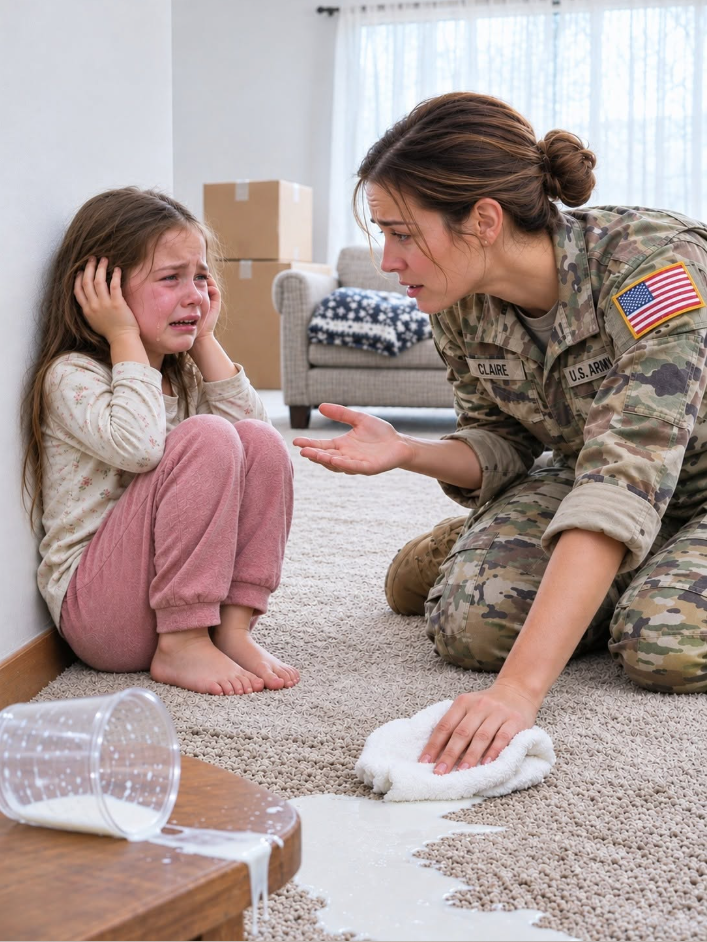
As she reached toward her plastic cup of milk, her elbow accidentally brushed its edge.
The cup overturned, sending milk across the coffee table and onto the beige carpet.
Emma reacted before I could say anything. She scrambled backward toward the wall, raising both arms protectively over her head and drawing her knees close to her body.
“I’m sorry!” she cried, her voice filled with alarm. “I’m sorry, I’m sorry! I’ll clean it! Don’t be mad, Mommy, please don’t be mad!”
Watching her respond to such a small accident left me deeply shaken. The financial disagreements, Daniel’s accusations, and my uncertain professional future suddenly seemed insignificant beside my daughter’s immediate need to feel secure.
The only thing that mattered was helping Emma understand that a spilled drink did not mean something frightening would happen.
Rather than approaching abruptly, I lowered myself onto my hands and knees, keeping my face below her eye level.
“Emma,” I said, speaking slowly and reassuringly. “Look at my hands.”
She cautiously looked through her fingers, still visibly frightened.
I collected a paper napkin and placed it over the spilled milk. “It’s just milk, baby. Milk spills because gravity works. We wipe it up, and the floor is clean. That’s all.”
Her hands remained raised.
“You’re not going to… you’re not going to hit the table?”
“No,” I answered, meeting her eyes. “Nobody is ever going to hit a table, or a wall, or you, in this house ever again. You are safe, Emma. Even when you make a mess. Even when you make a mistake. You are safe.”
Gradually, her arms relaxed and lowered. She studied the damp napkin before looking back toward me, her breathing becoming uneven as she began to cry.
Then she moved across the floor and climbed into my lap. I held her gently on the kitchen floor, rocking her while the spilled milk remained untouched, until her trembling eased and she eventually fell asleep.
Two days afterward, an email arrived from Linda Ruiz, whose husband served as our battalion’s logistics captain. Its subject line read: Christmas party photos – look at Emma.
I opened the attached photograph. The high-resolution image had been taken near the dessert table during our unit celebration, approximately one hour before Emma became distressed in my temporary quarters.
Captain Miguel Ruiz appeared in the photograph, laughing as he reached casually across the table for a stack of napkins near Emma.
Emma was not watching him. Nevertheless, the camera had captured her instinctive reaction: her head lowered toward her red coat, one shoulder lifted protectively, and her forearm raised between herself and the approaching movement.
Captain Ruiz had not even been looking in her direction, yet Emma appeared to have anticipated something frightening simply because an adult raised his arm nearby.
I immediately forwarded the photograph to Karen Whitaker and Detective Grant. It offered another important observation for the ongoing investigation.
Chapter 4: The Crucible of Truth
The preliminary hearing concerning the longer-term protective order was scheduled for early February at the Montgomery County Courts Complex in downtown Clarksville.
Karen Whitaker met me outside Courtroom 3 and briefly examined my clothing: a tailored navy-blue pantsuit, a cream silk blouse, and comfortable flat leather shoes.
“Good,” Karen said approvingly. “We are not presenting you as Major Bennett today. We are presenting you as Claire Bennett, protective mother. The defense will attempt to paint you as a rigid, unyielding military commander who runs her household like an infantry platoon. Do not feed their narrative. Keep your voice measured. Answer only what is asked.”
The courtroom doors opened. Daniel was already sitting beside his attorney, Marcus Vance, a polished local litigator known for his confident courtroom manner.
Daniel wore a carefully tailored charcoal suit, his hair neatly arranged and his expression composed to suggest exhaustion and disappointment. When he noticed me, he maintained eye contact and slowly shook his head.
I recognized the familiar expression. It seemed designed to communicate that I was making a serious mistake and should reconsider my decisions.
Six months earlier, that gesture might have caused me to question myself. Today, it had no effect.
“All rise,” the bailiff announced as Judge Evelyn Thorne entered the courtroom and approached the bench. Judge Thorne was in her late fifties, wore sharply framed glasses, and was known for expecting professionalism rather than dramatic performances from attorneys.
The hearing began with Vance presenting the argument Karen had anticipated.
“Your Honor,” Vance began, gesturing toward Daniel, “what we have before this court is a heartbreaking tragedy of modern dual-career stress. My client, Daniel Bennett, has spent six years acting as the primary domestic pillar for this child. While Major Bennett was deployed to overseas rotations, field training exercises at the Joint Readiness Training Center, and endless overnight duty shifts, it was Mr. Bennett who wiped Emma’s tears, packed her lunches, and managed her daily life.”
Vance presented a substantial collection of medical billing documents.
“Children climb. Children fall. My client dealt with an active, spirited six-year-old while his wife was absent serving her country. Now, Major Bennett returns, discovers the inevitable bumps and scrapes of childhood, panics due to her own parental guilt, and weaponizes the full machinery of the state to eliminate my client from his own daughter’s life!”
Judge Thorne glanced over her glasses, holding her pen above her notes.
“Counsel, I have the forensic interview transcript and the skeletal survey from Blanchfield Army Community Hospital before me. Are you suggesting that pediatric radiology cannot distinguish between an acute fall from a sofa and multiple fractures showing historical periosteal healing?”
Vance maintained his composure.
“We are suggesting that Major Bennett’s absence created an information vacuum, Your Honor. She cannot speak to the home environment because she was simply never there.”
“Thank you, Mr. Vance,” Judge Thorne responded evenly. “Ms. Whitaker, call your witness.”
“I call Claire Bennett,” Karen announced, rising from her chair.
I approached the witness stand, raised my right hand, and completed the oath. Once seated, I rested my hands neatly together in my lap.
“Mrs. Bennett,” Karen began, speaking clearly enough for everyone in the courtroom to hear. “Did your military duties require you to spend significant periods away from the home over the past two years?”
“Yes,” I replied.
“Did you trust your husband to care for Emma during those periods?”
“With my life. And with Emma’s.”
“Why did you place that level of trust in him?”
I turned slightly toward the judge.
“Because marriage is an act of shared vulnerability. When a service member deploys or works long duty hours, you have to believe that the person holding the home front is your partner in safety. You have to believe that when they tell you a scrape is from the playground, they are telling the truth. Because the alternative—the thought that the person sworn to protect your child is the very person harming them—is an unbearable calculation.”
“And when did you realize that trust had been compromised?”
“At one-forty-three in the morning on December twelfth,” I answered, maintaining a steady voice. “When my daughter woke up in agony from an injury her father claimed was minor. When Dr. Robert Harris explained that her body bore the physical history of trauma that spanned months. And when I finally stopped listening to my husband’s explanations—and started listening to my daughter’s silence.”
Karen then submitted the supporting evidence: hospital imaging results, a chronological record of Daniel’s conflicting messages, notes from Emma’s school counselor, and the holiday photograph showing Emma instinctively protecting herself from an ordinary movement nearby.
Finally, Karen approached the judge with one of Emma’s drawings.
“Your Honor, I offer Petitioner’s Exhibit D. A forensic evaluation corroborates that this illustration was created by the child prior to any intervention by social services.”
Judge Thorne studied the construction paper carefully. For almost two minutes, the courtroom remained quiet enough that I could hear the steady ticking of the clock on the wall.
Her attention moved between the heavily darkened figure representing Daniel, the distant soldier, and the handwritten message beneath the drawing.
PLZ DONT LET HIM SEND MOM AWAY.
Judge Thorne placed the paper on her desk and looked toward Daniel. His confident expression briefly faltered before he lowered his eyes toward the polished wooden table.
“This court finds by clear and convincing evidence,” Judge Thorne announced, speaking slowly and deliberately, “that there exists an immediate and ongoing threat of severe physical and psychological harm to the minor child, Emma Bennett. The temporary emergency order is hereby converted to a permanent one-year injunction. The respondent, Daniel Bennett, shall have zero contact—direct, indirect, physical, telephonic, or third-party—with the child. All parental decision-making authority is vested solely in Claire Bennett. The matter of child support and marital property distribution is referred to the chancery division. We are adjourned.”
The judge brought down her gavel, its sharp sound echoing through the courtroom.
I stayed in my seat until Judge Thorne had left. Karen placed a reassuring hand on my shoulder.
“Breathe, Claire. That’s step one.”
As I walked through the broad marble corridor toward the elevators, I heard hurried footsteps approaching from behind.
“Claire!”
I continued walking without turning.
“Claire, look at me!”
Daniel approached, but Deputy Miller, who had been positioned outside the courtroom, calmly stepped between us and maintained several feet of separation.
“Step back, sir,” the deputy instructed.
Daniel continued speaking past the officer, his face visibly flushed with frustration.
“You think you’ve won? You destr0yed our family! You destroyed my life!”
I stopped and turned toward the man who had shared my home and my life for eleven years. To my surprise, I felt neither anger nor hatred.
Instead, there was an unfamiliar emotional distance, as though I were observing someone whose behavior I could no longer recognize.
“I didn’t destr0y your life, Daniel,” I said quietly, keeping my voice low enough that only those standing nearby could hear. “Your actions did that. The only thing I did was stop helping you hide it.”
He appeared ready to answer, but no words followed.
The familiar explanations and attempts to influence my decisions no longer seemed capable of changing what had been documented.
I turned away and entered the waiting elevator. As the stainless-steel doors closed, I saw Daniel standing alone in the marble hallway, facing the consequences of a situation he could no longer control.
Chapter 5: The Blue Door
Restoring a child’s sense of security is not accomplished through a single reassuring moment. It requires patience, consistency, and countless small experiences that gradually rebuild trust.
The legal proceedings eventually reached a resolution. Daniel pleaded guilty to reduced felony charges involving reckless child endangerment, avoiding a lengthy and highly publicized jury trial.
He received a suspended sentence, supervised probation, mandatory behavioral intervention programs, and continuing restrictions on unsupervised parental contact.
The court also ordered restitution and child support, with the required payments collected directly from his earnings.
His relatives eventually stopped contacting me.
Once the criminal judgment became part of the public record, the negative stories circulating through our social circle gradually faded.
Inside our quiet two-bedroom apartment near Fort Campbell, however, Emma’s recovery continued through much smaller steps.
During the first six months, she attended therapy twice each week with Dr. Anjali Patel, a pediatric specialist experienced in helping children recover from distressing experiences. Initially, Emma rarely spoke during the sessions.
Instead, she sat on the braided rug, arranging small plastic blocks into miniature walls and positioning a mother figurine outside the enclosed space.
“Do not rush her, Major,” Dr. Patel advised during one of our monthly meetings. “Trauma teaches a child’s nervous system that the world is inherently erratic. Healing occurs when the environment becomes entirely predictable. Routine, consistency, and low-reactivity are your primary operational tools.”
I approached those recommendations with the same attention to detail I brought to military planning.
Our evenings followed a consistent schedule: dinner at 1730, reading at 1830, bath time at 1915, and bedtime at 2000. When Emma spilled juice, we cleaned it together without making an issue of the accident.
When she accidentally tore a page in her notebook, we repaired it with tape and continued our activities. Whenever nightmares interrupted her sleep, I remained in the armchair beside her bed, offering quiet reassurance until she felt comfortable resting again.
By June, encouraging changes were becoming increasingly visible.
Emma learned to ride her bicycle without training wheels in the nearly empty parking lot behind our apartment building. I jogged beside her, holding the rear of the vinyl seat while the late-afternoon sunlight stretched long golden shadows across the pavement.
“Don’t let go, Mom!” she called over her shoulder, pedaling with determination. “Promise you won’t let go!”
“I’m right here, peanut!” I answered.
After approximately fifty yards, I carefully released my grip. Emma continued forward, maintaining her balance and controlling the bicycle entirely on her own.
She reached the far curb, completed a broad, slightly unsteady turn, and suddenly noticed that I was nearly twenty yards behind her.
She lowered her sneakers to the pavement and stopped, breathing heavily as she looked toward me.
“You let go!”
“You didn’t need me to hold on,” I replied, catching up with my hands resting on my hips and a wide smile on my face. “You were already flying.”
For a moment, she studied me, realizing that she had managed something new without my physical support. Then her face brightened into the happiest smile I had seen since she was four years old.
“Watch me do it again!”
And she did.
By November, I had been selected for promotion to lieutenant colonel and assigned to a senior staff role with the 101st Airborne Division. The new position removed the need for extended field rotations and allowed me to return home by 1730 hours each evening.
The Army had not treated my decision to protect Emma as a professional failure. Instead, our military community had supported us through administrative assistance, housing resources, and the practical kindness of colleagues who understood the importance of family.
When December arrived in Kentucky once again, the air carried the familiar smells of cold rain, burning firewood, and damp pine.
Our battalion’s annual holiday reception was scheduled at the same multipurpose building near Gate 4 where Emma and I had attended the celebration one year earlier.
I stood outside on the damp concrete, holding my daughter’s hand. The double doors opened nearby, allowing warm yellow light and the distant sound of Christmas music played by brass instruments to drift into the cold evening.
For a brief moment, the memories returned with unexpected intensity. I remembered Emma’s red coat, the decorated sugar cookies, her unusual quietness, and the frightening conversation with Dr. Harris in the hospital corridor.
Without thinking, I tightened my grip around her hand.
Emma noticed immediately. She looked up at me, wearing a new sapphire-blue winter coat, her cheeks pink from the chilly air.
“Mom?” she asked softly. “Are you scared?”
I knelt on the damp pavement until we were looking directly at each other.
“A little bit, peanut. Are you?”
Emma tilted her head, thoughtfully considering my question with the seriousness she sometimes displayed beyond her years.
“It’s okay to be scared. But this year is different.”
“How is it different, baby?”
She reached toward the brass rank insignia attached to the collar of my patrol cap and gently touched it.
“Because this year, nobody has secrets.”
Then she wrapped her fingers around my thumb and began guiding me toward the entrance.
“Come on. Captain Ruiz said there are chocolate cookies with the blue frosting.”
I swallowed the emotion rising in my throat and followed her inside.
The room was filled with familiar people: Captain Ruiz and Linda, our battalion commander, soldiers wearing their service uniforms, and families laughing beneath colorful paper decorations and artificial holiday wreaths.
Unlike the previous year, Emma did not remain constantly beside me. Within five minutes, she had recognized several friends from the installation’s elementary school and hurried across the room to join their enthusiastic discussion about decorating cookies.
Linda Ruiz approached and offered me a steaming paper cup filled with spiced cider.
“How are you holding up, Claire?”
I looked across the crowded room toward Emma. She had accidentally dropped a gingerbread cookie onto the table, laughed at the mishap, picked it up, and eaten the broken leg without anxiously checking anyone’s reaction.
“We’re whole,” I answered, allowing the significance of that word to settle. “Not untouched. But whole.”
Later that evening, as the celebration approached its end and families began gathering their coats, Emma hurried toward me carrying a rolled sheet of blue construction paper secured with a small piece of red curling ribbon.
“I made this in art class yesterday,” she explained, bouncing excitedly on her heels. “Dr. Patel said I should give it to you tonight.”
I loosened the ribbon and carefully spread the paper across the tabletop.
Emma had drawn our apartment building with bright yellow walls. Two figures stood together on the grass: a tall mother wearing green camouflage and a little girl with pigtails and a cheerful red smile.
They were holding hands beneath an enormous golden sun that occupied nearly half the page.
But one particular detail immediately captured my attention.
At the center of the building, Emma had drawn an unusually large double doorway, colored a brilliant cobalt blue and decorated with a shiny brass doorknob.
I pointed toward it, struggling to keep my voice steady.
“Emma… that’s an awfully big door for a small house.”
She looked up at me, her brown eyes bright and peaceful.
“I know,” she whispered softly. “I made it big so it’s easy to open. That way, whenever we want to leave, we can just walk right out into the sunshine. And nobody can ever lock it from the outside.”
I gathered my daughter into a warm embrace, resting my face against her strawberry-scented hair as tears slipped quietly onto her winter coat.
For years, I had believed strength was defined by endurance: the ability to withstand hardship, carry responsibilities without complaint, and remain committed to a carefully established mission.
I had misunderstood something essential.
Real strength sometimes means recognizing when a familiar structure can no longer provide safety and finding the courage to build something better. It means questioning confident explanations when quieter voices are asking to be heard.
Above all, it means creating a home where affection does not depend on flawless behavior, where mistakes can be corrected without fear, and where everyone knows they are free to step into the light.
Emma leaned back slightly, brushed a tear from my cheek with her thumb, and smiled.
“Can we get chocolate chip pancakes tomorrow, Mom?”
“Tomorrow,” I laughed, kissing her forehead. “And every Saturday after that.”
She slipped her hand into mine, holding it comfortably and without hesitation.
Together, we walked through the doors and into the cool Kentucky evening.