PART 1 — THE CHILDREN HE REFUSED TO CLAIM
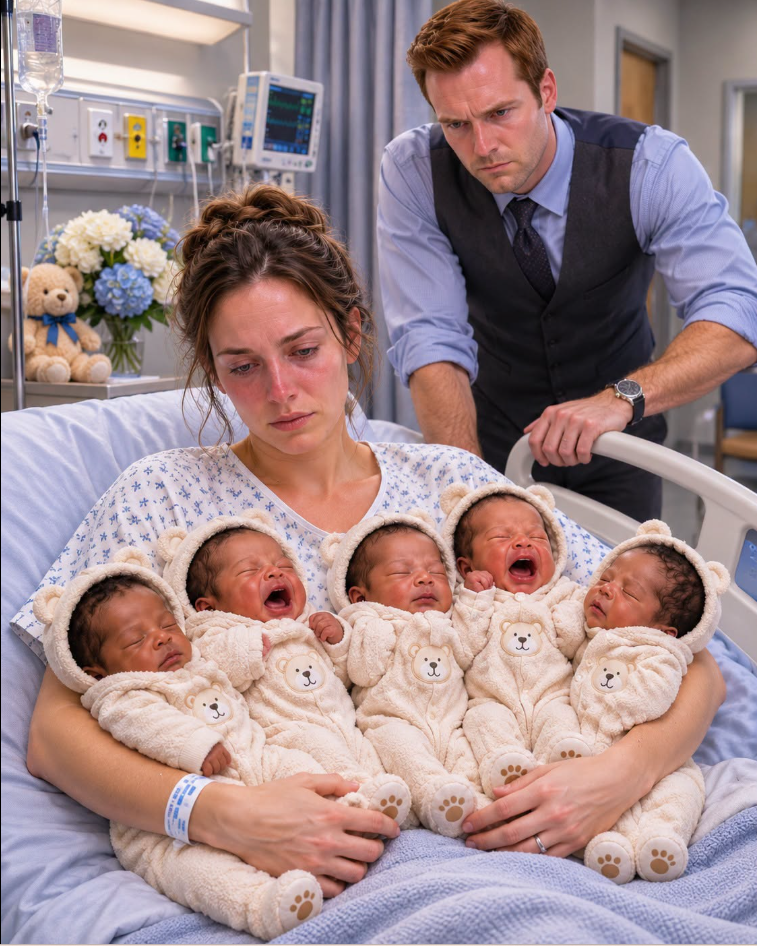
In 1995, only hours after I delivered five beautiful babies, my husband stepped away from their bassinets as though the sight of them had frightened him. “Those babies can’t possibly be mine!” Exhausted from childbirth, I stared at him. “Richard, they’re our children.” He pointed at our newborns. “They’re Black, Emily! How do you expect me to believe they’re mine?” I pleaded with him to settle down, explaining that appearance could not establish parentage. He had already decided otherwise. “You’ve humiliated me! I can’t believe you would do this!” Then he walked out without kissing them, asking about their health, or looking back.
My name is Emily Carter. I was thirty when my quintuplets arrived, and until that day, I believed my marriage was secure. Richard belonged to an established family whose successful businesses provided wealth and influence. His mother, Margaret Carter, spoke constantly about ancestry, social position, and safeguarding their name. My parents had held ordinary jobs. They taught me to value honesty and kindness rather than money. Margaret tolerated me with courteous smiles, but her watchful disapproval was never difficult to recognize. I had hoped the children might soften the distance between us.
That evening, I waited for him. The next morning, his secretary said he was unavailable. When I called his parents, Margaret answered. “Richard doesn’t want to speak with you.” I swallowed my desperation. “Margaret, please. The children need their father.” Her response was icy. “You should have considered the consequences before bringing those babies into our family.” She disconnected. Holding the telephone beside my hospital bed, I replayed her words. She sounded less surprised than prepared, almost as though she had anticipated everything. But five premature newborns needed me. Speculating about Margaret was a luxury I could not afford.
We moved into a cramped apartment over a laundromat because I could afford little else. The heat barely functioned, and the floor trembled whenever the machines below began spinning. Still, the landlord accepted all six of us, and I was grateful. I cared for the babies by day. At night, a trusted neighbor watched them while I cleaned downtown offices. Afterward, I repaired clothes for extra income, sometimes sewing until daylight. My hands roughened, my back ached, and I learned which supermarkets discounted food before closing. I stretched soup across several meals and discovered how little pride mattered when children needed to eat.
Our home lacked comfort, but never love. Daniel watched quietly before offering an opinion. Marcus confronted anyone who mistreated his siblings. Elijah dismantled things to understand their workings, while Sophia could hardly bear another person’s sadness. Grace noticed what everyone else missed and asked questions without end. They were five distinct people, with separate hopes and temperaments, not merely the children a man had rejected. Watching those differences emerge gave me strength. Even during the hardest stretches, they provided five reasons to rise again, return to work, and keep believing our future could hold something better.
When they were four, Daniel interrupted my folding. “Mommy, why don’t we have a daddy?” Marcus looked up. “Everyone at preschool has one.” I sat with them. “Your father made a decision when you were babies.” Grace asked, “What decision?” I answered, “He chose not to stay with us.” Sophia cried. “Was it because we were bad?” I gathered her close. “No, sweetheart. Never.” Drawing all five around me, I explained, “Sometimes grown-ups make terrible choices. But those mistakes belong to the grown-ups, not the children they hurt.” Daniel asked, “Did Daddy love us?” I could not promise what I did not know. “What I can promise is that I love every one of you more than anything in this world.”
At eight, Marcus pushed a classmate who insulted his skin color and repeated gossip about our family. The school called me. Outside the principal’s office, my son sat fighting tears. “Mom, he said you lied about our father.” I knelt until our eyes met. “Marcus, look at me.” When he did, I told him, “There’s nothing wrong with you. There’s nothing wrong with your brothers or sisters. You are not something I need to explain away.” He started crying, and I held him until the storm passed. I could protect him with my arms that afternoon, but I could not undo the questions his father’s absence had planted.
After the children slept, I opened the box of hospital papers: birth certificates, medical documents, insurance records, and a yellowing envelope delivered shortly after their birth. It contained photocopied forms bearing Margaret’s signature. One concerned genetic history; another mentioned corrections to ancestry information. I had never understood her involvement. Once, I had asked someone at the hospital, but received no useful explanation. With five children depending on me, I lacked the money and energy to investigate further. Still, I preserved the envelope. Margaret’s questions about the Carter ancestry before the birth, and those unexplained documents afterward, had never stopped troubling me.
Life continued through homemade birthday decorations, secondhand Christmas presents, and school occasions I missed because work could not wait. Yet there were triumphs everywhere. Daniel earned excellent grades. Marcus won a debate competition. Elijah constructed a small heater when ours failed. Sophia helped younger children learn to read. Grace wrote about people who survived extraordinary hardships. One Christmas, after a long shift, I returned to a spotless apartment. A tiny decorated tree stood near the window. Beneath it waited a wrapped box containing five handmade cards. Each child had written down a promise about the future.
Daniel intended to become a doctor. Marcus wanted to practice law. Elijah hoped to work in engineering, Sophia dreamed of teaching, and Grace wanted to be a journalist. Together, they had added one final message: “One day, Mom, you’ll never have to work this hard again.” I pressed those cards against my chest and cried, not from sorrow, but from a sudden understanding. Richard had not destroyed our family. He had excluded himself from it. The children earned scholarships, attended universities, and built careers. Eventually, each fulfilled the ambition written on those cards. My pride in them was greater than anything I could express.
As my sixtieth birthday approached, they insisted on celebrating. “Nothing expensive,” I warned. Grace laughed. “Mom, you’ve been saying that our whole lives.” Daniel kissed my cheek. “Please let us do something special for you.” I agreed, expecting perhaps dinner, friends, and a cake. Instead, the restaurant held white roses, soft music, and a cake decorated with five golden stars. Former teachers, neighbors, and friends who had helped us were gathered there. Helen, my maternity nurse from 1995, attended too. “You remembered us?” I asked, nearly crying. She embraced me. “Emily, how could I forget you and those five babies?”
For once, the difficult years seemed to have carried us toward something entirely beautiful. Daniel rose. “Our mother raised five children while working harder than anyone I’ve ever known.” Embarrassed, I protested, “Daniel, please.” He smiled and continued. “She taught us that love isn’t measured by what someone promises. It’s measured by who stays when life becomes difficult.” Marcus lifted his glass. “To the woman who never walked away.” Applause surrounded me. Tears blurred the faces of people who had witnessed our struggle. I covered my mouth, overwhelmed by the love in that room.
Then the doors opened. A tall older man entered in an expensive charcoal suit. His hair had grayed and his shoulders had begun to bend, but recognition was immediate. Richard Carter. My body went cold. For a moment, I was back among the hospital bassinets, hearing newborn cries. “Emily?” His voice had aged without becoming unfamiliar. Silence spread through the restaurant. Our children turned toward him, and he studied the adults he had never known, looking from Daniel to Marcus, then Elijah, Sophia, and Grace. Thirty years had passed since he last stood before all five.
“Who invited you?” I demanded. Grace stepped forward. “I did, Mom.” I turned. “Grace?” She looked nervous. “There’s something we need to discuss.” Richard approached, and I moved back instinctively. “Don’t come any closer.” He stopped. “Emily, I know I have no right to be here.” I asked, “Then why are you?” Tears gathered in his eyes. “Because I recently discovered something about my family.” Marcus crossed his arms. “Something that took thirty years to figure out?” Richard bowed his head. “I deserve that.” From his briefcase, he withdrew a folder containing photographs, genealogical documents, and genetic ancestry findings.
A recent medical examination had prompted Richard to investigate his family history. What he found contradicted everything he had been taught. He placed an old photograph before us: a Black woman beside a young man outside a wooden house. “Her name was Sarah Carter,” he said quietly. “She was my great-grandmother.” Grace examined it. “Your family concealed her identity?” He nodded. “My parents always insisted that our ancestry was entirely European. They told us stories about bloodlines, heritage, and preserving the Carter name.” He swallowed. “Those stories weren’t true.”
I stared at the photograph, then at him. “And you think discovering a Black ancestor excuses what you did?” Richard whispered, “No,” and added, “It doesn’t excuse anything.” Daniel stepped closer. “Having a Black ancestor doesn’t establish biological paternity. You understand that, don’t you?” Richard answered, “Yes. I understand.” Marcus glanced at the folder. “Then why are you here?” After a hesitation, Richard said, “Because I want to make amends.” He produced more documents. “I know I can’t restore the years I’ve lost. But I can provide financial security.” Looking at the five of them, he continued, “I’m prepared to give each of you one million dollars.”
The room went utterly still. Marcus laughed bitterly. “Five million dollars?” Richard appeared hopeful. “I know it can’t fix everything.” Marcus stepped forward. “Do you think this is a business negotiation?” Richard began, “No, son—” Marcus cut him off. “Don’t call me that.” Pointing toward me, he said, “That woman worked nights cleaning offices so we could eat. She sewed clothes until sunrise. She worried about paying rent while you lived comfortably.” His voice rose. “And now you arrive at her birthday party offering money as though we’re negotiating the purchase of a house?” Richard lowered his gaze. “I want to help.”
Grace joined Marcus. “Then answer a question.” Richard faced her. “Did your mother know about Sarah Carter?” He hesitated. “I believe she did.” Grace’s expression hardened. “Then why did she tell you our existence was impossible?” The color left his face. “I don’t know.” My daughter opened her handbag. I recognized the yellowed envelope before she had fully withdrawn it—the papers I had kept through thirty years of uncertainty. She looked directly at Richard, holding the evidence his mother had never expected us to examine. “Maybe I do.”
PART 2 — THE TRUTH HIS MOTHER TRIED TO ERASE
Grace set the envelope on the table. “Mom let me examine these old hospital documents,” she explained. “At first, I thought they were simply incomplete medical records.” She arranged the photocopies before Richard. “But the more I investigated, the more troubling they became.” Marcus leaned in. “What did you find?” Grace answered without looking away from their father. “Your mother didn’t merely know about the family ancestry.” She paused. “She may have interfered with records connected to our birth.” Richard stared. “What?”
She placed a document beneath his eyes. Margaret’s signature appeared below a notation about confidential amendments to the paternal family medical history. Richard’s hands trembled. “I’ve seen this handwriting before.” Grace answered, “Of course you have,” then added, “It’s your mother’s.” He studied the page again. “She told me the hospital had evidence that Emily had lied.” I felt my heart stop. “What did you say?” Slowly, he raised his head. “After I left the maternity ward, my mother told me she had spoken to hospital officials. She said there were records supporting my suspicions.”
“And you believed her?” I asked. Crying now, Richard answered, “Yes.” Grace glanced toward the guests before turning back. “Those documents weren’t proof that Mom had cheated.” She touched the envelope. “They were connected to a request to alter your family’s recorded medical history.” His face emptied of color. Then she delivered the possibility none of us could ignore. “Dad, I think Grandma knew we could be your children all along.” Richard left the restaurant in tears. My birthday celebration had opened a door into the past, and none of us could close it again.
The following morning, all five children gathered around my kitchen table. Marcus examined documents while Grace opened her laptop. Daniel interpreted medical terminology, Elijah organized scans, and Sophia held my hand. After thirty years, I no longer faced the Carter family alone. “Mom,” Marcus began carefully, “there are several things we need to establish.” He indicated the paperwork. “First, we need the hospital to confirm what these documents actually represent.” Daniel agreed. “And we need proper DNA testing. Family ancestry records don’t prove paternity.” Whatever Margaret had hidden, we needed evidence rather than another generation of assumptions.
Grace turned her laptop toward us. “There’s something else.” A newspaper article from 1995 pictured Margaret at a fundraiser with the hospital administrator. “Grandma served on the hospital foundation’s board,” Grace explained. I remembered Margaret standing in my hospital doorway after the births. She had not touched the babies or asked about their condition. She had simply watched them. I had interpreted her expression as disgust. Now another possibility troubled me: fear. Her position at the hospital did not answer every question, but it made her involvement with those records harder to dismiss.
Over the following weeks, each child contributed something different. Marcus managed legal correspondence. Daniel identified relevant medical information. Elijah brought order to decades of paperwork. Sophia remained close when the process overwhelmed me. Grace investigated the family’s finances. She discovered a substantial trust established by Richard’s grandfather, holding interests in commercial property, investments, and private businesses. Its estimated assets totaled approximately $38 million. Richard had received distributions for years. The documents also addressed descendants and possible beneficiaries, although their rights depended on specific legal conditions. Suddenly, the family’s secrecy raised questions extending far beyond reputation.
Marcus explained, “Richard’s mother controlled much of the trust administration for years.” Grace added, “And she never disclosed the existence of five grandchildren.” I looked between them. “Are you saying Margaret hid my children because of money?” Marcus shook his head. “We don’t know that yet. We need to review the original trust documents.” His caution mattered, but the possibility horrified me. While I struggled over rent, groceries, and electricity, their wealthy grandmother had lived less than an hour away. Never once had she asked whether her grandchildren needed anything.
A week later, Helen called Grace. “Grace, I think there’s something your mother needs to know.” We invited her over. She arrived carrying a handbag and a folder of personal notes, then sat facing me. “Emily, I’ve regretted staying quiet for thirty years.” My heart pounded. “What happened?” Richard had agreed to attend, and I could feel the tension around the table. Helen explained that the premature quintuplets had required extensive family medical information so doctors could identify inherited health risks. Some questions concerned Richard’s ancestry—the very subject his family had worked so hard to conceal.
“When Margaret learned what the medical team was reviewing, she became extremely upset,” Helen said. I asked, “Why?” Helen’s answer was measured. “She insisted that certain information about the Carter family was incorrect.” She paused before clarifying. “Specifically, she wanted references to a Black ancestor removed.” Richard closed his eyes. Helen continued, “There was a disagreement among the staff. Some believed the requested changes were inappropriate.” Listening to her, I remembered every unanswered question in that old envelope. What had once seemed like confusing paperwork now looked like evidence of a struggle I had never known was happening.
“Did Margaret change the records?” I asked. Helen would not claim more than she knew. “I don’t know exactly what was entered into the official system,” she replied. “But I remember someone expressing concern that she was interfering with family medical documentation.” Grace leaned forward. “Was that why someone placed copies in Mom’s discharge folder?” Helen nodded slowly. “I believe someone wanted her to know the records had been questioned.” Then she looked at me. “Emily, the doctors never considered your babies’ appearance proof that Richard wasn’t their father.” I closed my eyes, overwhelmed by the confirmation I should never have needed.
No responsible medical finding had supported Richard’s accusation. There had been prejudice, assumptions, and a family secret, but no proof of betrayal. Marcus continued examining financial records and obtained documents suggesting Margaret had failed to disclose potentially relevant descendants during trust reviews. Those papers did not automatically establish an inheritance for my children, yet they raised serious questions about withheld information. Grace then found a letter Margaret had sent a former family attorney several months after the births. One sentence stood apart from everything else: “Richard must never be encouraged to acknowledge those children.”
I read that sentence repeatedly. Margaret had not merely failed to help; she had apparently tried to prevent her son from recognizing his own children. Richard stared at the letter. “My mother knew.” Marcus remained careful. “That’s what we’re trying to establish.” Richard shook his head. “No. I remember her telling me to let the divorce proceed. She said acknowledging the children could create enormous problems for the family.” I met his eyes. “And you chose to listen.” He cried. “I did.” Nothing he said could change that choice.
The next morning, Richard called, sounding exhausted. “My mother has agreed to meet with us.” For years, I had imagined that confrontation. Sometimes I pictured shouting; sometimes I imagined demanding an apology. Now that it was possible, I felt unexpectedly calm. “Tell her I’ll come,” I said. “But this time, I’m bringing the truth with me.” Margaret was eighty-seven. Her elegant assisted-living residence stood amid landscaped gardens. Her carefully maintained hair had become white, and her hands shook. Her eyes, however, remained sharp and watchful, accustomed to other people yielding.
Richard sat beside her. Marcus and Grace accompanied me; the others waited nearby. Margaret looked toward the doorway. “Emily.” I answered, “Margaret.” After a long silence, I placed the hospital papers on the table. “Thirty years ago, your son accused me of being unfaithful.” She lowered her eyes. “I remember.” I continued, “You told him there was evidence supporting his suspicion.” She gave no answer. I laid Sarah’s photograph beside the documents. “Did you know about Sarah Carter?” Margaret trembled. Richard leaned toward her. “Mother, answer her.” At last, she whispered, “Yes.”
Richard stared. “You knew our family had Black ancestors?” Margaret nodded. “My father told me when I was young. He made me promise never to discuss it.” Richard asked, “Why?” She looked at the photograph. “Because the family had spent generations protecting its position in society.” Grace leaned forward. “Protecting it from what? The truth?” Margaret began crying. Anger rose inside me. “When my children were born, did you know they could be Richard’s?” Again, she nodded. “Yes.” My hands tightened. “Then why did you let him believe otherwise?”
For a long time, Margaret could not speak. Finally, she whispered, “I thought I was protecting the family.” Richard looked stricken. “From your own grandchildren?” She shook her head. “From the questions people would ask. From the stories that would come out.” Marcus put the trust papers before her. “And from possible claims involving the family fortune?” Margaret became motionless. Fear replaced her practiced composure. “Where did you get those?” Marcus answered by showing her the letter. Richard read it, and his expression collapsed. “Mother, you told the attorney I should never acknowledge the children.”
Margaret sobbed. “I was afraid!” Richard’s voice rose. “Of what?” Her answer finally stripped away the excuses. “Of losing everything your grandfather built!” She had feared that recognizing five additional descendants would complicate the trust, provoke disputes, and threaten the family’s control. That fear had mattered more to her than five newborn children. Marcus pressed on. “Did you interfere with the hospital records?” After hesitating, Margaret nodded. “I asked them to remove inaccurate family-history information.” Grace asked, “Information you knew was true?” Margaret shut her eyes. “Yes.”
Richard covered his face. “Mother, you told me those records proved Emily had betrayed me.” Margaret whispered, “I knew you were already angry,” then continued, “I thought if you believed the children weren’t yours, the questions would stop.” The room seemed to lose its air. Thirty years of hardship, thirty years of my children wondering why their father did not love them, and she had known all along that they might be his. “You let him abandon five babies,” I whispered. She cried harder. “I know.” I continued, “You watched us struggle.” She answered, “I’m sorry.”
“You lived less than an hour away. You never sent a birthday card. You never asked whether they had enough to eat.” Her shoulders shook. “I thought it was better for everyone.” I stood. “Better for whom?” She had no answer. Richard turned to me. “Emily, my mother lied to me.” I faced him. “Yes, Richard. She did.” Hope flickered through his tears until I continued. “But she didn’t force you to walk out of that hospital. You made that decision yourself.” He lowered his head. “You had thirty years to question what happened.” He answered, “I know.”
“You could have asked for a DNA test.” Again, “I know.” I said, “You could have contacted us.” Tears ran down his face. “I was ashamed.” I shook my head. “Your shame didn’t feed our children.” Silence followed. I picked up my handbag. Margaret looked toward the doorway. “Emily, are the children here?” I answered, “Yes.” Her expression brightened slightly. “Will they come in?” I held her gaze. “That’s not my decision.” For once, Margaret had to accept that the people she had rejected owed her nothing—not a visit, not reassurance, not forgiveness.
Several weeks later, the paternity results arrived. Richard had agreed to testing through an accredited laboratory, and each of the five children had independently chosen to participate. We gathered at my kitchen table, where I had once counted grocery money and helped with homework. The same table had held homemade birthday cakes through years when I could afford little else. Now five successful adults sat beside me, while Richard waited near the doorway. Rain tapped against the windows. Marcus opened the laboratory report and read it carefully. Then he looked up at his brothers and sisters.
PART 3 — THE FAMILY NO FORTUNE COULD PURCHASE
“The results confirm that Richard Carter is our biological father.” No one cheered. No one smiled. Rain filled the silence while Richard covered his face. Thirty years earlier, he had looked at five babies and decided they could not be his. Now the evidence confirmed what I had told him from the beginning. When he lowered his hands, he said, “I don’t deserve your forgiveness.” Marcus answered without hesitation. “No. You don’t.” Richard nodded. “I understand.” The truth had finally arrived, but it could not return a single missing year.
Daniel stood. “I spent years wondering whether something about me made my father leave.” Richard looked at him. “There was never anything wrong with you.” Daniel’s voice shook. “I know that now.” He paused. “But I needed to know it when I was five.” Richard cried. Elijah spoke next. “When I was little, I built things because I thought if I became good enough at something, maybe you’d hear about me.” A sad smile crossed his face. “Eventually, I stopped waiting.” Sophia wiped her eyes. “I used to imagine you attending our school concerts.” Richard bowed his head. “I’m sorry.”
Grace rose. “That’s the problem.” Everyone looked at her. “You keep talking about what you wish you’d done.” She faced Richard directly. “But Mom actually did it.” Her voice trembled. “She showed up every day. She worked when she was exhausted. She protected us when people insulted us. She made sure we never believed we were worth less because you left.” Richard had no reply. Marcus placed a legal folder on the table. “Now we need to discuss responsibility.” Richard nodded. “I’ve already told you I’m prepared to give each of you one million dollars.”
Marcus closed the folder. “We’re not here to negotiate a price for our childhood.” Richard answered, “I know.” Marcus asked, “Do you?” Then he continued, “For thirty years, Mom carried the financial burden alone. There may be historical support obligations and other legal issues that need reviewing.” He indicated the documents. “We’re going to address those matters properly, with independent legal advice.” Richard nodded slowly. “I’ll cooperate.” Grace asked, “And the family trust?” Richard drew a breath. “My attorneys are reviewing it.” Marcus remained firm. “We expect full disclosure of the relevant records through the proper process.” Richard agreed.
Grace opened her laptop. “I’ve been investigating the Carter family’s history.” Photographs, letters, and financial records revealed a family carefully presented as wealthy and respectable, while certain ancestors had been erased from its public story. Sarah Carter’s identity had been concealed, and information about her descendants omitted from family publications. Margaret had preserved that false history throughout Richard’s adulthood. Grace looked around the table. “I’m preparing an article.” Uneasy, I said, “Grace, this is our family.” She nodded. “I know, Mom. That’s why I want to tell the truth carefully.”
She would separate verified facts from unresolved questions, avoid allegations of crimes she could not establish, and protect private medical information unless those concerned consented. Her purpose was not to replace secrecy with recklessness. She believed the damage caused by prejudice deserved an honest account. I looked at the five adults around me. They were no longer the frightened babies I had held in the hospital, nor children waiting for me to explain their father’s absence. They were capable, independent people entitled to make their own choices. At last, I nodded. “Then tell it.”
Several weeks later, Grace’s article appeared. It documented concealed ancestry, concerns about hospital-record amendments, our long estrangement, and the life we had built without Richard. The response was widespread. The hospital reviewed surviving records and acknowledged failures in handling certain family-history changes. Separate legal reviews considered whether information relevant to the trust had been withheld. Those inquiries required time. Some documents no longer existed, and not every allegation could be established. Nor did the trust automatically promise my children millions. The facts mattered too much to be embellished, even after everything we had endured.
The evidence did establish Margaret’s deliberate efforts to suppress the family’s ancestry. Richard, meanwhile, could no longer hide his choices behind his mother’s deception. Independent trust administrators agreed to review beneficiaries’ rights and resolve disputes through legal channels. He cooperated and agreed to address the financial consequences of his abandonment under applicable law and negotiated agreements. The children remained clear that money could not purchase forgiveness. Daniel accepted occasional meetings. Sophia took some calls. Elijah wanted more family history. Grace stayed cautious. Marcus chose no personal relationship. For once, Richard respected what they needed rather than demanding what he wanted.
Several months later, Richard asked to see me alone. We sat on a bench overlooking a small lake, with autumn leaves floating on the water. He looked far older than the man I had married. After a silence, he took a photograph from his coat. Our five newborns lay side by side in the maternity ward. “You kept that?” He nodded. “I’ve had it all these years.” I asked, “Then why didn’t you come back?” His eyes filled. “At first, I was angry. Then I was ashamed. Eventually, admitting what I’d done became harder than pretending it had never happened.”
I studied those five tiny faces, then returned the photograph. “You don’t get those years back, Richard.” He answered, “I know.” I added, “Neither do they.” He lowered his head before handing me an envelope containing a proposal from his financial advisers. He wanted to establish a substantial fund for me, enough to remove financial worry. I looked from the documents to his face. “Richard, what is this?” He answered, “It’s for you, Emily.” I asked, “Why?” His eyes remained wet. “Because you raised our children alone. Because I should have been there. Because you deserved better.”
I closed the envelope. “I did deserve better.” Richard nodded. “I know.” I handed it back. “But I won’t accept money as the price of forgiving you.” He looked stunned. “Emily, that’s not what I’m trying to do.” I answered, “Then help your children without expecting anything in return.” He said, “I will.” I continued, “Cooperate with their lawyers. Answer their questions. Respect their boundaries.” He nodded, then whispered, “Do you think you could ever forgive me?” For years, I had imagined hearing those words, sometimes with anger, sometimes with the impossible hope that an apology might restore everything.
Looking across the lake, I understood that nothing could transform him into the father our children had needed. “I don’t want to spend the rest of my life hating you,” I told him. Hope entered his expression. “But forgiveness doesn’t mean you get to return to the life you abandoned.” His face fell. “I understand.” I stood. “Your future relationship with the children belongs to them. Not to me.” Then I walked away without looking back. I did not need revenge to know that our lives had value, and I did not need his money to prove what those years had cost.
Margaret died the following spring. Before her death, she wrote to all five grandchildren, acknowledging that prejudice and fear of losing status had governed her choices. She apologized for rejecting them and admitted that protecting the Carter name had cost her the chance to know people who could have honored it. The children read their letters privately. Daniel kept his. Marcus put his away. Elijah needed time. Sophia cried. Grace preserved hers as family history. None owed Margaret forgiveness, and none was wrong for responding differently. Their grief, anger, and uncertainty belonged to them.
A year after my sixtieth birthday, the children arranged another celebration, this time at my house. There were no costly decorations, reporters, or elaborate speeches—only food, music, laughter, and five siblings teasing one another around the kitchen table. Daniel brought dessert. Marcus arrived with flowers. Elijah repaired the troublesome porch light. Sophia helped prepare dinner. Grace carried a framed photograph taken at the previous birthday party, before Richard entered. I stood in the center, surrounded by all five children, and every one of us was smiling.
Grace handed me the frame. “Look at us, Mom.” I smiled. “I am.” She gently shook her head. “No. Really look.” I studied Daniel, Marcus, Elijah, Sophia, and Grace: five children born beneath the shadow of rejection, now compassionate, accomplished adults. Once, I had feared I could not feed them. Now they stood around me like pillars holding up a house. Grace rested her hand on my shoulder. “You always told us we were lucky to have each other.” I nodded. “We were.” Smiling through tears, she said, “But you were the reason we stayed together.”
I cried as Daniel embraced me. Marcus joined him, then Elijah, Sophia, and Grace. For a few beautiful moments, all five surrounded me, just as they had in that hospital room thirty years earlier. Only now, their arms were strong enough to hold me. Later, after everyone left, I sat in the living room. The new photograph rested on the mantel beside the picture of five newborns sleeping together in 1995. Looking between them, I saw far more than the years Richard had missed. I saw the life we had made.
I remembered the apartment above the laundromat, the nights sewing until dawn, and the choices between groceries and electricity. I remembered questions about their father that broke my heart because I could not answer them without hurting someone I loved. But those memories stood beside first steps, birthdays, laughter, graduations, and dreams becoming real. Richard once possessed wealth, influence, and an admired family name. He had nevertheless discarded what none of those things could replace: thirty years with his children. Margaret had guarded a reputation while helping damage the family she claimed to protect.
For decades, I thought I was merely doing what a mother had to do. Looking at those photographs, I finally recognized something larger. I had not simply endured. I had built a beautiful family by refusing to let cruelty decide its future. The DNA results confirmed paternity. The hospital papers exposed questions long buried. The family history finally emerged into the light. Yet the most important truth had never depended on a laboratory report, a yellowed envelope, or a multimillion-dollar trust. It had existed from the first night those five babies needed someone who would stay.
Family was not measured by wealth, reputation, or skin color. Shared DNA did not automatically make someone a parent. Richard had given the children biological inheritance. I had given them my time, effort, love, and thirty years of my life. I touched the tiny faces in the old photograph. “Daniel. Marcus. Elijah. Sophia. Grace.” Then I whispered what I had always wanted them to understand. “You were never the reason my life fell apart.” Tears slipped down my face. “You were the reason I found the strength to build it again.”
My phone rang. “Mom?” It was Grace, sounding cheerful. “Yes, sweetheart?” I answered. “We forgot to tell you something.” I asked, “What is it?” She said, “We’re planning a family vacation next summer. All five of us. And you’re coming.” I laughed. “Where are we going?” Her reply brought fresh tears. “Somewhere beautiful. You’ve spent enough years working. It’s time we took care of you.” I whispered, “That sounds wonderful.” After we said goodnight, I looked once more at the photographs. I was no longer thinking about the man who had walked away, but about the five people who had always given me reasons to stay—and the beautiful place they had yet to reveal.