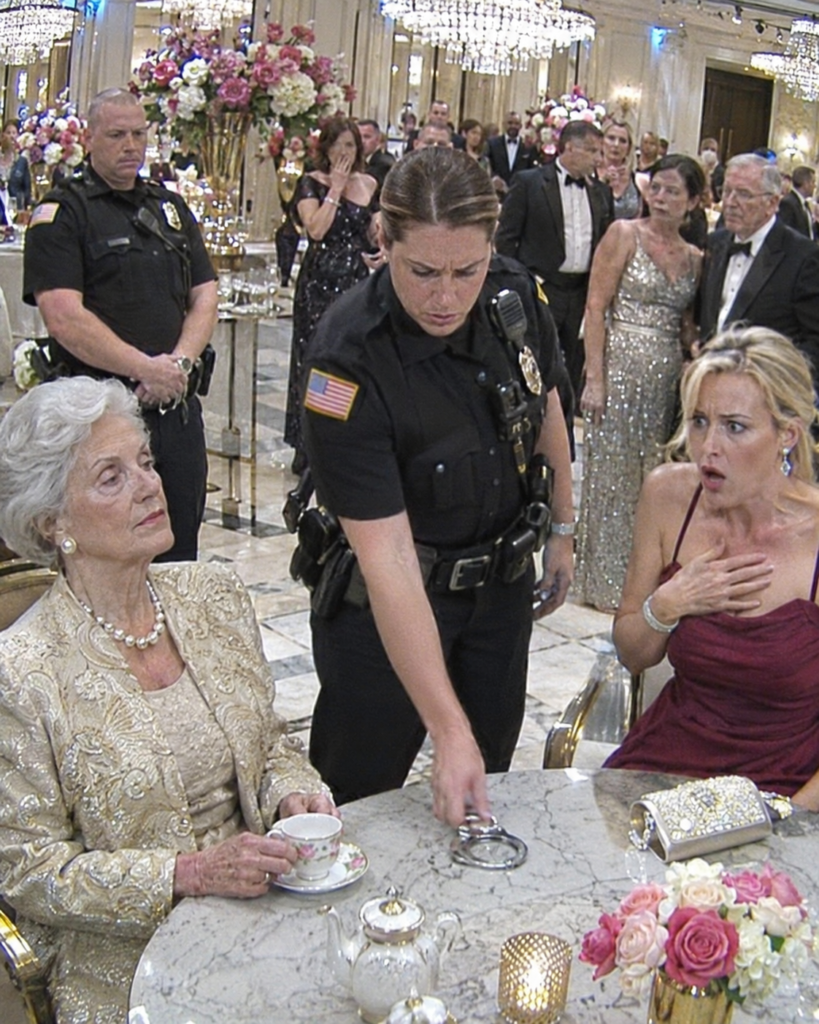
The first time I watched a police detective place a pair of handcuffs on the polished stone table in front of my daughter-in-law, I felt absolutely nothing like the woman I had been taught to be.
I did not gasp.
I did not cry.
I did not ask anyone to reconsider.
I lifted my coffee, took one slow sip, and looked across the table at Caroline.
“That ring has an owner,” I told her. “And that owner is sitting right here.”
Twenty-four hours earlier, Caroline had worn my five-carat pink diamond to a charity gala at the Ashbourne Hotel.
She had posed beneath chandeliers while photographers took pictures.
She had held out her hand when women asked to see the stone.
She had apparently described it as “an old family piece.”
The ring was worth approximately three million dollars.
And while Caroline was showing it off to strangers, I had been home alone in the kitchen, eating tomato soup and watching the light disappear behind a Japanese maple my husband had planted more than fifty years earlier.
Caroline had spent years assuming the quiet old widow in that house was harmless.
What she did not know was that the quiet old widow had been keeping records.
Before I go any further, I should explain something.
I have never thought of myself as a vengeful woman.
I grew up outside Richmond, Virginia, in a house where my mother ironed our Sunday clothes on Saturday evening and considered a thank-you note overdue if it had not been mailed within three days.
She believed good manners were a form of character.
She believed a woman could be firm without being loud.
She believed composure was not weakness.
For most of my seventy-one years, I agreed with her.
For nearly a decade, those beliefs came dangerously close to erasing me.
My name is Eleanor Whitfield.
And this is the story of what happened when I finally understood that dignity and silence are not the same thing.
It began on a Tuesday morning in October.
Tuesdays were my baking days.
Banana bread with walnuts.
The same recipe my husband, James, used to claim was the one earthly pleasure he intended to request in heaven.
“If they don’t have your banana bread up there,” he would say, “I’m filing a complaint.”
James could make death sound negotiable.
He had been gone six years by then.
Six years since I had sat beside his hospital bed holding the same hand that had held mine through forty-three years of marriage.
Six years since I had walked back into our house alone and discovered that grief has a smell.
His shaving soap.
His wool coat.
Coffee in his study.
The faint cedar scent from the drawers where he stored watches, documents, and the strange collection of beautiful objects he had spent most of his adult life acquiring.
For months after his death, every room felt occupied by someone who was no longer there.
Still, I got up every morning.
Women of my generation were very good at getting up.
I had my garden.
My Tuesday bread.
My mystery novels.
My Sunday afternoon calls with my younger sister, June, who lived near Charleston and had never once in her life confused politeness with surrender.
And I had my son, Nathan.
Nathan was fifty-one.
Six foot two, broad through the shoulders, with James’s jaw and James’s tendency to become quiet whenever life grew complicated.
For years I had admired that quality in both of them.
Eventually I learned that the same silence can mean different things in different men.
In James, silence usually meant thought.
In Nathan, it increasingly meant avoidance.
Nathan had married Caroline eight years earlier, not long after James died.
I tried hard to welcome her.
I want that understood.
Caroline was beautiful in an exact way.
Nothing about her appearance seemed accidental. Her blond hair was always the correct shade of blond. Her nails were always neutral and immaculate. Her clothes looked expensive without displaying labels.
She spoke as though she had grown up around considerable money, although whenever anyone asked about her family directly, the details became oddly vague.
I never pressed.
Nathan loved her.
At the time, I believed that should have been enough.
Caroline and Nathan moved into my house temporarily while renovations were being done on a property they owned.
Temporary became six months.
Six months became a year.
Then James became sick.
Then James died.
Somehow the question of when they were leaving stopped being asked.
The first time I heard Caroline refer to me as “the old woman,” I convinced myself I had misunderstood.
I was standing in my kitchen measuring flour.
The kitchen had a yellow tile backsplash James and I installed in 1987. I had selected it from a catalog when I was eight months pregnant with Nathan, and James had complained for thirty-seven years that no sane person installed tile with his wife that pregnant.
Caroline was on the phone.
I was not listening intentionally.
The room is simply not large enough for privacy.
She was trying to get past me toward the refrigerator.
“Oh, hold on,” she said to whoever was on the other end. “The old woman’s in the way.”
She said it casually.
That was what made it hurt.
There was no anger in it.
No argument.
No heat.
Just categorization.
As though she had said the dog was underfoot.
I lowered my measuring cup.
Caroline glanced at me, lifted one finger to indicate that I should wait, and walked into the hallway while continuing her conversation.
I stood there with flour on my hands and a feeling in my chest I could not yet name.
Three years later, I found a name for it.
Disappearance.
Caroline understood something about me before I understood it myself.
A woman who has buried her husband and spent years being grateful for every scrap of family still around can become very skilled at making herself smaller.
Small people are easier to manage.
Small people are less likely to ask where the silver serving tray went.
Small people do not challenge the rearrangement of their own living rooms.
Small people do not say, “My name is on the deed.”
The changes came slowly.
That is important.
People imagine domination arriving like a slammed door.
Often it comes like dripping water.
The first year, Caroline moved furniture without asking.
She replaced two patterned throw pillows James and I had bought during an anniversary weekend in Vermont.
She held the old pillows up between two fingers and laughed.
“These are adorable, Eleanor. Very… nostalgic.”
“What’s wrong with them?”
“Nothing.”
She smiled.
Caroline always smiled.
“I just think the room needs room to breathe.”
The new pillows were white linen.
The room did breathe.
It just stopped looking like mine.
The second year, Caroline developed opinions about my clothes.
Never directly.
She was too careful for that.
She would stand near the stairs while I put on my coat.
“Oh. You’re wearing that?”
Or she would look me over before dinner.
“That is so classic.”
Classic sounded remarkably similar to obsolete when Caroline said it.
By the third year, her friends had begun visiting regularly.
Women with highlighted hair, oversized leather handbags, polished voices, and laughter that always seemed pitched loudly enough to be heard from another room.
No one ever told me to leave.
That would have been crude.
Instead, conversations changed when I entered.
People paused for half a second too long.
Caroline lowered her voice.
Someone would say, “We can talk about it later.”
Eventually I started staying upstairs when her friends visited.
That was Caroline’s greatest talent.
She rarely forced anyone to do anything.
She arranged the room until the other person chose what she wanted.
Every Sunday, June asked how I was.
Every Sunday, I said I was fine.
One afternoon, after I had spent fifteen minutes explaining how Caroline had reorganized half the kitchen because my system was supposedly “confusing,” June interrupted me.
“Ellie.”
I knew that tone.
“What?”
“That woman is eating you alive, and you’re setting the table for her.”
“She’s not.”
“She is.”
“She’s younger than we are. She sees things differently.”
“Caroline is forty-two years old.”
“I know how old she is.”
“That is not youth, Eleanor. That is a fully developed frontal lobe making choices.”
I did not call June again for three weeks.
Not because she was wrong.
Because she was right.
By the October morning when everything changed, I had learned to live around Caroline.
You can adapt to almost anything if it happens gradually.
I woke at five thirty.
By six forty-five, the banana bread was in the oven.
At seven, I heard Caroline coming downstairs.
Caroline did not walk quietly.
Her shoes entered rooms before she did.
“Good morning,” I said.
I always said good morning.
Years earlier I had made one private decision: whatever happened inside that house, I would not be the one who surrendered basic courtesy.
Caroline did not answer.
She was typing on her phone.
She crossed the kitchen, opened the refrigerator, took a bottle of sparkling water, and went back upstairs.
A few minutes later, I heard drawers opening.
I assumed she was searching for something.
Caroline had been searching through rooms that did not belong to her for years.
At seven fifteen, I removed the bread from the oven.
At seven twenty, I poured my second coffee.
At seven thirty, I sat at the table with a detective novel June had mailed me.
It was set in Edinburgh.
I had just found the page I had stopped on the night before when I heard the front door close.
A minute later, my phone buzzed.
Caroline.
I stared at the screen before opening the message.
Sometimes the body senses trouble before the mind has language for it.
The message read:
Borrowed that old pink ring for the gala tonight. Hope you don’t mind. You never wear it anyway.
I read it twice.
Then I set the phone facedown.
Then I picked it up and read it again.
That “old pink ring” was not costume jewelry.
It was a five-carat natural pink diamond set in platinum.
James had acquired it more than a decade earlier through a private sale.
At the most recent appraisal, it had been valued near three million dollars.
More importantly, it was formally documented as part of a protected collection James had transferred into my name before his death.
Photographs.
Certificates.
Provenance.
Appraisal records.
Insurance documentation.
Every identifying detail existed in duplicate.
That was James.
If he owned a twenty-dollar pocketknife, he knew where the receipt was.
If he owned a multi-million-dollar diamond, he had enough documentation to survive a courthouse fire.
The attorney who oversaw the collection was Martin Hale.
Martin had been James’s closest friend for more than forty years.
Two months before Caroline took the ring, Martin had sat across from me in his office and said, “Eleanor, if any cataloged piece disappears, you call me before you call anyone else.”
I sat at my kitchen table for a long time.
The bread cooled.
My coffee went cold.
Outside, the maple tree James planted when Nathan was born had turned red-orange.
James bought that tree as a sapling from a hardware store for twelve dollars.
We planted it ourselves on Memorial Day weekend.
We were both sore afterward.
Nathan was a baby.
James spilled lemonade on his shirt.
I laughed until I could hardly stand.
Now the tree was nearly thirty feet tall.
I looked at it and remembered the day James first showed me the pink diamond.
We were in his study.
He had placed the ring on a square of dark velvet.
He handled valuable objects differently from most people.
Not greedily.
Reverently.
Beauty, to James, created responsibility.
He pushed the velvet toward me.
“This is yours.”
I remember laughing.
“When exactly am I supposed to wear something like that?”
“You’re not.”
“Excuse me?”
He smiled.
“This isn’t a party ring, Ellie.”
“Then what is it?”
“Something kept.”
He reached across the desk and touched my hand.
“There’s a difference between something you display and something you protect. You understand that.”
I had.
Caroline did not.
I picked up my phone.
I did not call Nathan.
I called Martin Hale.
He answered on the second ring.
Martin answered every phone call as though he had been waiting beside the telephone for that specific caller.
“Eleanor?”
“Martin, Caroline took the pink diamond.”
Silence.
“The five-carat stone?”
“Yes.”
“Where?”
“From my jewelry box.”
“Did you give her permission?”
“No.”
“Does she know what it is?”
“She called it an old ring.”
Another brief silence.
I heard his chair move.
“Tell me exactly what happened.”
I read him Caroline’s message.
He listened without interrupting.
When I finished, he said, “Do not respond.”
“I haven’t.”
“Screenshot it.”
“Already done.”
A small breath that might have been a laugh.
“Of course you have.”
Then his voice changed.
“Eleanor, I need to ask you something.”
“All right.”
“Is this the only thing missing?”
That was the question I had been waiting eighteen months for someone to ask.
“No.”
Martin stopped breathing for a second.
“How many?”
“I don’t know exactly.”
“Eleanor.”
“I have a notebook.”
“What notebook?”
“Eighteen months of records.”
That afternoon, for the first time, I told someone the truth about the missing objects.
The first had been a diamond-and-platinum brooch James acquired from an estate in Connecticut.
I had kept it in a velvet case in the hall closet.
One day the case was there.
The brooch was not.
I convinced myself I had moved it.
That was the beginning.
Then the pearl earrings James gave me for our thirtieth anniversary disappeared.
I remembered wearing them to a funeral because I remembered the navy dress I wore with them.
June had told me that dress made me look like a headmistress who frightened children into good grammar.
After that, a carved jade pendant vanished.
Then a gold bracelet with a sapphire clasp.
Then a small brooch that had belonged to my mother.
That piece was not particularly valuable.
My mother’s closest friend had pressed it into my hand after the funeral.
“She wanted you to have this,” she had said.
That brooch was the piece that frightened me most.
Someone stealing an expensive object might be motivated by money.
Someone taking that brooch had simply decided my belongings were available.
I began writing everything down.
Date.
Description.
Last known location.
Last time worn.
Who had been in the house.
Whether Caroline had mentioned the object.
The notebook lived in my bedside drawer.
I had never shown it to Nathan.
I had never shown it to June.
Part of me feared what would happen if I was wrong.
The other part feared what it meant if I was right.
“You’ve been documenting this for eighteen months?” Martin asked.
“Yes.”
“And you never called me?”
“I wasn’t certain.”
“And now?”
I looked at the maple outside.
“Now I’m certain.”
Things moved very quickly after that.
That is often how long-building disasters work.
Nothing happens.
Nothing happens.
Nothing happens.
Then the right person makes three phone calls.
Martin contacted a private investigator named Dana Cross.
I had never met Dana.
Martin described her as “the most relentless human being I know, and I am including myself.”
The pink diamond was registered in the estate inventory.
There was no legal ambiguity about ownership.
No transfer had been authorized.
No loan documented.
No permission given.
The gala Caroline was attending that evening was being held at the Ashbourne Hotel downtown.
By seven, Dana had confirmed Caroline was there.
By seven thirty, photographs from the event were appearing online.
Caroline was wearing the ring.
In one photograph, she had her hand raised near a champagne glass so the stone caught the chandelier light.
At least three guests later confirmed she let them examine it.
One remembered Caroline saying, “It’s been in the family forever.”
At eight twenty, Martin contacted the appropriate authorities.
At nine seventeen, two detectives from the property crimes unit arrived at the hotel.
I sat at home wondering whether I had gone too far.
That question is difficult to admit.
Caroline was my son’s wife.
Maybe she had truly believed the ring was insignificant.
Maybe calling the police was cruel.
Maybe a family should solve family problems privately.
Then I thought about my mother’s brooch.
I thought about the empty velvet cases.
I thought about nine years of being treated as though I occupied my own house by permission.
I thought about Nathan looking away every time I tried to tell him something was wrong.
And I understood something very clearly.
Borrowing requires permission.
What Caroline had done was not borrowing.
At nine forty-seven, Nathan called.
“Mom?”
His voice was tight.
“What’s happening?”
“Hello, Nathan.”
“Caroline just called me. Police are at the gala.”
“I know.”
“You know?”
“Yes.”
His voice dropped.
He had developed a tone with me over the years.
Patient.
Careful.
Slightly patronizing.
“Mom, Caroline says she borrowed a ring. She was bringing it back tonight. Calling the police over that is—”
“She stole it.”
Silence.
“She did not steal it.”
“Nathan.”
I used a voice I had not used since he was seventeen and had lied about where he spent a Saturday night.
“The ring she removed from my bedroom this morning without permission is a registered estate asset valued at approximately three million dollars.”
Another silence.
“Three million?”
“Yes.”
“Mom, what are you talking about?”
“Your father’s collection.”
“I thought Dad collected old jewelry.”
“Your father collected investment-grade objects with documented provenance.”
“Three million dollars?”
“For that ring.”
“Jesus.”
“Martin has the records.”
“You called Martin before you called me?”
“Yes.”
“Why?”
“Because Martin is my attorney, and this is a legal matter. You are my son, and I love you. Those are two different relationships.”
I heard Nathan exhale.
“I’m coming to the house.”
“That would be best.”
“I’m going to get Caroline first.”
“Caroline will probably be occupied for a while.”
“What?”
“She is at the precinct.”
Another pause.
“Nathan, come here first.”
“Why?”
“Because I have something to show you.”
“What?”
“My notebook.”
“What notebook?”
“Eighteen months of missing property.”
He said nothing.
“A notebook?” he finally asked.
“Yes.”
His next silence was different.
For the first time in years, I heard my son begin to understand.
Nathan arrived shortly after ten thirty.
His tie was loosened.
His face looked like it had when he was twelve and discovered adults did not always know what they were doing.
We sat in James’s study.
The notebook was between us.
Nathan looked at it.
Then at me.
“Tell me everything.”
So I did.
The brooch.
The pearls.
The jade pendant.
The bracelet.
My mother’s keepsake.
Other smaller objects.
Dates.
Locations.
Patterns.
Nathan tried to find alternatives.
I watched him doing it.
Maybe I had misplaced something.
Maybe a cleaner moved an object.
Maybe the inventory was wrong.
Maybe I forgot.
One by one, each explanation collapsed.
Eventually he closed the notebook.
“She was going through your things.”
It was not a question.
“Yes.”
“How long?”
“At least eighteen months.”
“Why didn’t you tell me?”
That was the question I had both wanted and feared.
“Nathan, how many times have I tried?”
He stared at me.
“How many times did I begin telling you something about Caroline and you said, ‘Mom, you’re taking it personally,’ or ‘Caroline didn’t mean it that way,’ or ‘Let’s not turn this into a problem’?”
His jaw tightened.
“How many times did I tell you something felt wrong in my own house and you decided keeping the peace mattered more than listening to me?”
He looked down.
“I wasn’t certain,” I said more gently. “And I knew if I came to you without proof, you would choose the easier explanation.”
Nathan’s eyes reddened.
“You’re right.”
I said nothing.
“I’m sorry, Mom.”
For the first time since James died, my son looked at me as though I was not a problem to manage.
I was his mother.
A person.
Someone who had been hurt.
He sat there a long time.
I let the silence remain.
I had spent nine years rescuing people from uncomfortable silences.
I was finished.
Eventually Nathan asked, “How much has she taken?”
“I don’t know.”
“The ring alone is three million?”
“Yes.”
He pressed both hands against the desk.
“Dad had things worth that much in this house?”
“More.”
He stared at me.
“Why didn’t I know?”
“Your father was private.”
“I thought it was a hobby.”
“It was partly a hobby. It was also an investment strategy he spent thirty years building.”
Nathan shook his head slowly.
“And Caroline lived here.”
“Yes.”
“For almost nine years.”
“Yes.”
“And I never saw what she was doing.”
“No.”
“Because I wasn’t looking.”
“You were looking,” I told him. “You simply kept choosing where not to look.”
That hurt him.
I could see that.
I did not say it to punish him.
There are truths that wound because they are cruel.
There are also truths that wound because they are medicine.
An hour later, Caroline’s attorney called Nathan.
He listened.
Mostly said yes or no.
When the call ended, he placed the phone on the desk.
“She’s being released pending further investigation.”
I waited.
“She has to surrender the ring and anything else identified from the estate registry.”
“That sounds right.”
“She wants me to pick her up.”
I said nothing.
Nathan looked at me.
“What do I do?”
There are moments when your grown child asks for an answer and every motherly instinct wants to remove the pain.
Sometimes love means refusing.
“That is yours to decide,” I said. “But what you choose next will tell you something about yourself. Think carefully.”
He sat with that.
Then stood.
“I’ll be back.”
When he left, I called June.
She answered immediately.
“Tell me.”
I did.
When I finished, she was quiet.
Then her voice broke.
“Oh, Ellie.”
“I’m all right.”
“James would be so proud of you.”
I looked toward the dark window.
The maple was a black silhouette against the yard.
“I know,” I said.
That night, I slept better than I had in years.
Not because the problem was solved.
It was not.
I slept because for the first time in nearly a decade, I had stopped pretending there was no problem.
The next morning was gray and cool.
At five thirty, I was in the kitchen.
Shortly before seven, someone knocked.
Three sharp knocks.
Official.
I opened the door.
Martin Hale stood on my porch in a gray suit carrying his leather briefcase.
He looked like a man who had dressed before sunrise.
“Can I come in?”
“You don’t need to ask.”
He sat at the kitchen table.
I poured him black coffee.
Martin had taken his coffee black since sometime in the late 1970s, and I saw no reason to believe he intended to stop.
He opened his briefcase and placed a folder in front of me.
“Dana worked all night.”
“How bad?”
“Bad enough that I wanted to be here.”
I opened the folder.
It took me seventeen minutes to read.
Fifteen pages.
Photographs.
Messages.
Bank records.
Sales documentation.
Correspondence.
Caroline had been communicating with an antique jewelry dealer in Philadelphia named Victor Langley.
The communication went back nearly two years.
Eleven pieces had been sold.
Eleven.
The platinum brooch.
My pearls.
Two sets of cuff links I had not realized were gone.
The jade pendant.
A sapphire piece.
Several items from the climate-controlled storage room James had built in the basement.
Caroline had entered that room.
She had photographed inventory lists.
She knew exactly what was there.
There were also printed emails between Caroline and a woman named Lauren Prescott.
Lauren was one of Caroline’s social friends.
Her husband, David Prescott, was a real estate attorney.
One email was dated fourteen months earlier.
I read it twice.
Caroline had written:
There is much more here than I expected. Eleanor has no idea what she owns. She almost never checks the downstairs storage anymore. If I move slowly, I think a substantial amount can be redirected before anyone understands what’s missing. Patience matters.
I lowered the page.
“Patience matters,” I repeated.
Martin watched me.
“How long?”
“Dana can document direct activity for about twenty-two months.”
“And before that?”
“There are references suggesting earlier planning.”
I looked around my kitchen.
While I baked bread.
While I pulled weeds.
While I called June.
While I questioned whether I was becoming forgetful.
Caroline had been making an inventory.
I had believed she saw an old woman.
What she actually saw was property.
“I want every available legal action pursued,” I said.
Martin nodded.
“I expected you would.”
“Criminal and civil.”
“Yes.”
“And the sold pieces?”
“Dana has contacted Langley. I suspect his attorney is about to improve his memory considerably.”
“What about Nathan?”
Martin’s tone softened.
“Do you think he knew?”
“No.”
“Are you certain?”
“As certain as I can be.”
“You understand investigators may still ask.”
“They should.”
Martin studied me.
“Nathan failed me badly. But I do not believe he participated.”
“That distinction matters.”
“It matters to me.”
Nathan came home at seven fifteen.
He stopped when he saw Martin.
Then he saw the folder.
“Sit,” I said.
He did.
I pushed the file toward him.
He read.
I watched my son age in front of me.
When he reached Caroline’s message about the inventory, the muscle in his jaw tightened.
When he finished, he closed the folder.
“She told me last night it was a misunderstanding.”
I waited.
“She said she had borrowed things before and intended to put them back.”
I said nothing.
“She said you were confused about what was part of Dad’s collection.”
That one almost made me laugh.
Instead I asked, “Did you believe her?”
Nathan stared at the table.
“I don’t know.”
He swallowed.
“I don’t know what I’ve believed for the last eight years.”
Then he looked at me.
“I think I kept believing whatever required the least from me.”
Martin lowered his coffee.
That was the beginning of my son telling the truth about himself.
He asked what would happen legally.
Martin explained that the diamond had been recovered.
The prosecutor would examine theft, fraud, and potentially conspiracy-related charges.
The dealer’s cooperation could help recover property.
A civil suit was possible.
A complete forensic audit was essential.
Nathan listened.
Then he asked quietly, “What happens to my marriage?”
Martin answered carefully.
“That is not Eleanor’s legal matter. It is not mine either. You need your own attorney.”
Nathan nodded.
Then he turned to me.
“I want to help.”
“With what?”
“Everything. Accounts. Records. Messages. Whatever investigators need.”
I studied him.
“Then start by telling me every conversation Caroline ever had with you about my money, this house, your father’s collection, my age or my ability to live here. Especially the comments you dismissed because they seemed harmless.”
Nathan nodded.
I opened the notebook.
For two hours, he talked.
I wrote.
Twelve new pages.
Some information confirmed what I suspected.
Some surprised me.
One piece changed everything.
Six months earlier, Nathan had returned from a work trip and heard Caroline speaking on the phone behind their bedroom door.
She had mentioned square footage.
Market value.
Timing.
When Nathan later asked, she said she was helping a friend evaluate a house.
He believed her.
Dana had found repeated calls from Caroline to a real estate agent specializing in estate transitions and senior downsizing.
Four conversations over roughly eighteen months.
No listing agreement.
No signed authorization.
But repeated inquiries.
I stared at Nathan.
“She was researching the sale of my house.”
Nathan looked sick.
“The agent never formally listed it.”
“That is not what I said.”
“No.”
“She intended to get me out.”
“I think she was building toward it.”
“How?”
He rubbed both hands across his face.
“She kept saying the house was too much for you.”
“Yes.”
“She said the stairs were a risk.”
“Yes.”
“She mentioned senior communities.”
“Many times.”
Nathan lowered his head.
“I thought she was concerned.”
“She was building a narrative.”
I remembered every smiling suggestion.
There are beautiful places now, Eleanor.
Wouldn’t it be nice to have less maintenance?
You might enjoy being around women your age.
Those stairs worry me.
For years I had treated my discomfort as evidence of oversensitivity.
I had not been oversensitive.
I had been observant.
“Martin,” I said.
“Yes?”
“File the civil action.”
“We will.”
“I want the sold items valued at replacement cost. I want every email preserved. Every real estate conversation. Every relevant account.”
“Yes.”
“I want a complete certified inventory of the estate.”
“I’ll have the forensic accountant begin immediately.”
Outside, rain began tapping the windows.
Nathan stared at me.
“Why didn’t you leave?”
The question surprised me.
“When things became bad,” he said. “Why didn’t you go somewhere else?”
“Because this is my home.”
He looked away.
“Your father and I built this life. We planted that tree. We chose this table. You grew up here. Every room contains something of the marriage I had for forty-three years.”
I leaned toward him.
“I was never the person who was supposed to leave.”
His eyes reddened.
“No,” he whispered.
“You weren’t.”
Then my phone rang.
Philadelphia area code.
Martin’s expression changed.
“That may be Langley.”
I answered.
“Eleanor Whitfield.”
A man’s voice.
Careful.
Older.
“Mrs. Whitfield, my name is Victor Langley. I believe we need to have a conversation.”
“I believe we do.”
Martin reached for a legal pad.
Nathan sat straighter.
“Mr. Langley,” I said, “begin with the first item you purchased from Caroline.”
He talked for forty minutes.
By the end of the call, we knew the location of eight pieces.
Three had been resold.
He had contact information for two buyers.
He admitted that on at least two transactions he had requested proof of ownership and accepted explanations he now understood had been inadequate.
“I intend to cooperate fully,” he said.
“My attorney will contact yours today.”
“Of course.”
Then he said, “Mrs. Whitfield, I’m sorry.”
I closed my eyes.
“Yes,” I said. “You should be.”
When the call ended, Nathan looked at me.
“She underestimated you.”
I met his eyes.
“She was not alone.”
He looked down.
“I know.”
By late morning, Dana sent a second report.
Thirty-one pages.
It contained something worse than the jewelry sales.
Lauren Prescott’s husband, David, had been quietly examining publicly available records related to my property for almost a year.
The deed.
Tax records.
Estate filings.
Anything visible from outside the family.
No formal engagement.
No clear illegal access.
Just information gathering.
Nathan recognized his name.
“I’ve had dinner with him.”
“I know.”
“Caroline liked him.”
“I know.”
Nathan stared at the report.
“She had people helping.”
“She had people around her who made the plan easier.”
“How long?”
“Dana believes some form of preparation may have started within the first couple years of your marriage.”
Nathan stood.
He walked to the window.
“She met Dad.”
“Yes.”
“I introduced them.”
I remembered that dinner.
Caroline had worn blue.
James was already ill, though none of us yet understood how serious it would become.
Caroline asked him unusually detailed questions about antique jewelry.
At the time, I had been impressed.
I remember telling James afterward, “She really listened to you.”
He had been less enthusiastic.
“She listens like someone taking inventory,” he said.
I chastised him for being unfair.
Standing in the kitchen years later, I remembered the exact sentence.
“She was learning from the beginning,” I said.
Nathan turned.
“What do I do now?”
“You retain your own attorney.”
“Separate from Caroline’s?”
“Entirely separate.”
He nodded.
“And after that?”
“After that, you stop making decisions from partial information.”
Nathan absorbed that.
Then he asked whether I would be all right alone.
I almost smiled.
“I have lived in this house for six years without your father.”
“I know.”
“I was never incapable of being alone, Nathan.”
“I didn’t mean—”
“I know what you meant.”
He looked around the room.
“It feels different here.”
“It does.”
“Why?”
“Because it feels like my house again.”
Nathan crossed the kitchen and hugged me.
Not the polite shoulder embrace we had fallen into over the years.
A real hug.
For the first time in a very long time, my son held on.
After he left, Martin returned from making a call in James’s study.
“There is one more thing.”
I looked at him.
He turned my tablet toward me.
Dana’s report contained an entry from three weeks earlier.
Caroline had met with an elder-law attorney named Leonard Shaw.
The topic of the consultation was conservatorship.
I read the line again.
Then again.
Caroline had asked about the circumstances under which someone could petition a court for financial control over an elderly relative allegedly unable to manage a substantial estate.
“She was planning to have me declared incompetent.”
Martin chose his words carefully.
“She was investigating how such a petition could be made.”
“That is a lawyer’s way of saying yes.”
“It is a lawyer’s way of saying the evidence supports intent, not outcome.”
“She wanted control of everything.”
Martin said nothing.
Not just jewelry.
Not just money.
Not just my house.
My autonomy.
My right to sign my own name.
My right to decide where I lived.
My right to say no.
For nine years, Caroline had eaten at my table, used my rooms, entertained her friends under my roof and referred to me as the old woman.
Now I understood the destination.
If she could turn “the old woman” into “the confused old woman,” perhaps she could turn that into “the incapable old woman.”
Then someone else could manage what belonged to me.
“File everything,” I told Martin.
“We already are.”
“All of it.”
“Yes.”
I stood.
I was beyond anger.
Anger is hot.
What I felt was cold and extremely clear.
“I want to see the storage room.”
Martin hesitated.
“Don’t touch anything.”
“I won’t.”
We went downstairs.
James had designed the storage space himself.
It was dry, temperature controlled and meticulously organized.
Metal shelves.
Archival boxes.
Typed inventories.
Handwritten labels.
I had not entered in months.
The room did not look disturbed.
That was the disturbing part.
Nothing was overturned.
Nothing torn open.
But I knew James’s system.
One archival box sat two inches too far forward.
Another was replaced at a slight angle.
Tiny errors.
Only visible if you had spent decades watching a precise man line labels along the same invisible axis.
I stood in the doorway.
“She was here.”
Martin nodded.
“She stood exactly here.”
“Yes.”
I looked at the shelves from Caroline’s perspective.
An elderly widow who rarely came downstairs.
A son who avoided conflict.
A lawyer who worked across town.
A dead husband.
Boxes of valuable things.
She had not seen a family.
She had seen undefended inventory.
“Move the collection,” I said.
“All remaining pieces?”
“Every cataloged item that does not need to stay here.”
“To a secure facility?”
“Vaulted, insured and independently inventoried.”
“I’ll arrange it.”
Before the end of the week, James’s collection was out of my house.
That afternoon, Detective Angela Ruiz called.
She was leading the property crimes investigation.
“Mrs. Whitfield, could you come to the precinct at three?”
“Has something happened?”
“We received a statement this morning.”
“From whom?”
“Lauren Prescott.”
I tightened my hand around the phone.
“Caroline’s friend?”
“Yes.”
“What did she say?”
“I would rather discuss it in person.”
Martin drove.
Detective Ruiz was in her mid-forties.
Direct handshake.
Dark jacket.
No wasted movement.
She sat across from us in a conference room.
“Mrs. Whitfield, Ms. Prescott’s statement expands the case considerably.”
I folded my hands.
“Go on.”
Lauren claimed she had not initially understood the full nature of Caroline’s plan.
Ruiz made no attempt to tell me whether I should believe her.
“She says the jewelry sales were phase one.”
“Phase one of what?”
“Generating independent cash.”
“For what?”
“To pay legal expenses and other costs associated with later steps.”
“Conservatorship.”
“Yes.”
Ruiz opened the file.
According to Lauren, Caroline originally intended to wait another year.
Then approximately four months earlier, Caroline became worried I was noticing things.
I thought back.
I had started going downstairs again.
I had checked inventory against my notebook.
I believed I had been discreet.
Apparently Caroline had been watching me as closely as I watched her.
“She moved the timeline forward,” I said.
“Yes.”
“How far?”
“The plan was to explore filing within ninety days.”
Ninety days.
I thought about Caroline’s text.
Borrowed that old ring.
Hope you don’t mind.
Such ordinary language.
Ninety days away from a possible petition telling a judge I could no longer manage my own affairs.
Detective Ruiz continued.
“There’s more.”
I waited.
“Ms. Prescott recorded a conversation with Caroline approximately six weeks ago.”
Martin’s head lifted.
“How long?”
“Forty-three minutes.”
“Why did she record it?”
“She says she became uncomfortable and wanted insurance.”
“Insurance against Caroline?”
“Against being blamed if the plan went wrong.”
“Convenient.”
Ruiz gave a slight nod.
“The prosecutors have listened to it.”
“And?”
“It is explicit.”
“In what way?”
“Caroline describes the jewelry removals, the purpose of the sales, the expected path toward a conservatorship petition and her assumptions regarding your estate.”
Ruiz hesitated.
“She also discusses Nathan.”
Something cold moved through me.
“What does she say?”
“That she expected him to support the petition.”
“Why?”
“Because, in her words, Nathan was manageable.”
Martin’s face changed.
That word affected him more visibly than the theft.
“Manageable?”
Ruiz nodded.
“She believed he had spent years accepting her version of events and saw no reason he would suddenly question it.”
I imagined my son hearing his wife reduce him to a tool.
“Has Nathan heard the recording?”
“No.”
“He should.”
“With your permission, we would like to interview him separately.”
“You have it.”
Ruiz watched me.
“He may find the recording difficult.”
“He needs the whole truth.”
When Martin and I left the precinct, the rain had stopped.
The pavement shone.
The city looked briefly scrubbed clean.
“You’re all right?” Martin asked.
“I am.”
“The recording strengthens everything.”
“I know.”
“It may also affect Nathan’s marriage.”
“I know that too.”
Martin stared toward the street.
“James would have had opinions.”
I nearly smiled.
“James had opinions about breakfast cereal.”
“That is true.”
“He used to say people reveal themselves if you give them enough time.”
Martin looked at me.
“What do you think he would say matters most now?”
I considered it.
“The truth of who you are.”
Martin waited.
“If someone can convince you to surrender that, everything else becomes easier to take.”
He nodded.
“She never managed that.”
“No.”
My phone rang.
Nathan.
“Mom, Detective Ruiz called me.”
“I know.”
“She said there’s a recording.”
“Yes.”
“What’s on it?”
“The truth.”
His breathing changed.
“All of it?”
“All of it.”
He was quiet.
“Okay.”
Such a small word.
Such a large thing to agree to.
Nathan listened to all forty-three minutes that afternoon.
He called me at seven eighteen that evening.
I was in James’s armchair with a book open in my lap.
I had not read a word.
“Mom.”
One syllable told me everything.
“Are you all right?”
“No.”
I waited.
“Not even close.”
“That is allowed.”
“I heard it.”
I closed the book.
“All forty-three minutes.”
“Yes.”
“She talked about the house. Your money. The collection.”
I waited.
“And me.”
His voice broke slightly.
“What did she say?”
“That I was useful.”
I said nothing.
“She said I needed to believe everything was fine. That as long as life looked peaceful on the surface, I would never ask what was underneath.”
He inhaled.
“She said I was the easiest part.”
“Nathan—”
“The worst thing is she was right.”
“No.”
“She was.”
“She was right about the man you were being.”
Silence.
“That matters.”
“How?”
“She believed that man would never look.”
He said nothing.
“But you are looking now.”
“A little late.”
“Late is not the same as never.”
Another silence.
“I spoke with a divorce attorney.”
I leaned back.
“And?”
“He says there are several grounds.”
“What do you want?”
“I don’t know yet.”
“That is honest.”
“Eight years is still eight years.”
“Yes.”
“I don’t hate her.”
“You don’t need to.”
“I’m embarrassed. I’m furious. Mostly I’m tired.”
“All legitimate.”
He breathed.
“Can I come tomorrow?”
“You can come tonight.”
“I think tonight I need to sit alone and be miserable.”
“That sounds reasonable.”
A small laugh escaped him.
Then his voice became serious.
“She was going to take your house.”
“Yes.”
“Everything Dad built.”
“Yes.”
“And I might have helped her.”
“You might have.”
“I could have stopped it.”
“Maybe.”
He became quiet.
“Nathan, listen to me. You are required to live with what you did not see. That is part of becoming better. But you are not allowed to move into that guilt and make a home there.”
“How do I not?”
“You learn.”
“How are you still you?”
I smiled despite myself.
“What?”
“After everything. How are you still exactly yourself?”
I looked around the study.
The books.
James’s chair.
The photograph from our thirtieth anniversary.
“Because Caroline never touched the things that actually made me who I am.”
“What do you mean?”
“She moved furniture. She took jewelry. She changed rooms. She made me feel unwelcome in my own kitchen.”
I paused.
“But what James and I built inside ourselves was not stored in a jewelry box.”
Nathan said nothing.
“She could not steal something she could not locate.”
A long silence.
Then he said, “When I grow up, I want to be more like you.”
I laughed.
“You are fifty-one.”
“I’m aware.”
For the first time since the whole thing began, I heard something in his voice that sounded like a future.
The next morning, Lauren Prescott came to my front door.
I almost did not recognize her.
Without Caroline beside her, she looked smaller.
Tired.
She held her handbag with both hands.
“Mrs. Whitfield, I know I’m probably the last person you want to see.”
“That may be true.”
“I need to say something.”
I waited.
“In person.”
I opened the door.
She sat at the kitchen table.
I poured coffee.
She wrapped both hands around the mug.
“At the beginning, Caroline told me she was worried about you.”
“Worried.”
“She said you were aging, living in a house that was becoming too much for you. She made it sound like a family issue.”
I listened.
“Then she started talking about your estate.”
Lauren looked down.
“She asked David to check public information.”
“You knew.”
“Not everything.”
“But enough.”
“Yes.”
“When did you understand?”
“About six months ago.”
“What happened?”
“She showed me photographs of the storage room.”
My jaw tightened.
“She was excited,” Lauren whispered. “That is what I couldn’t stop thinking about. She looked excited. Like someone who had found treasure.”
“And you still waited.”
“Yes.”
“Why?”
“Because I was a coward.”
No excuse.
No polished defense.
Just the word.
“Caroline was my friend. We had lunch together. I kept telling myself I misunderstood.”
“Until?”
“The conservatorship.”
“Why did that change things?”
Lauren looked directly at me.
“Because my mother is seventy-four.”
I said nothing.
“She lives alone. When Caroline described getting legal control over you, I saw my mother.”
Her eyes filled.
“I’m sorry.”
“That does not erase what happened.”
“I know.”
“You should have spoken sooner.”
“I know.”
“Six weeks of recordings while the plan continued is not heroism.”
“I know.”
I studied her.
“But telling the truth now matters.”
She nodded.
“I’m giving the police everything.”
“Good.”
At the door, Lauren asked, “How long did you know?”
I thought carefully.
“I suspected for eighteen months.”
“And when were you certain?”
“Thirty seconds.”
She frowned.
“What happened?”
“The text about the ring.”
I repeated it.
Lauren’s expression changed.
“That was enough?”
“It was the first time Caroline accidentally documented the behavior herself.”
Lauren looked at me.
“She told me you were getting confused.”
“I know.”
“She said you misplaced things.”
“I know.”
“I believed her.”
“I know.”
“I don’t understand why.”
“Because believing her required less from you.”
Lauren stood there for a moment.
Then she left.
Afterward, I called June.
“Lauren came here.”
“The accomplice?”
“The friend with the recording.”
“What did she want?”
“To apologize.”
“And?”
“Partly to apologize. Partly to understand herself.”
“Did you forgive her?”
“That is a larger word than what happened.”
June approved of that answer.
Then her tone changed.
“How are you?”
“I just told you.”
“No. You told me about Caroline, Lauren, Nathan and four lawyers. I am asking about Eleanor.”
I thought.
“I feel better than I have in ten years.”
June was silent.
“That is a strange sentence,” I admitted, “considering my house was robbed and someone wanted control over my finances.”
“Not that strange.”
“I can breathe.”
“That,” June said, “is what getting your life back feels like.”
Three days later, Caroline came to my house.
She brought her attorney, Rebecca Lang.
The meeting was requested formally.
Martin was present.
We sat across from one another at the kitchen table.
The pink diamond had already been returned to secure custody.
The forensic accountant was conducting a complete audit.
Caroline looked different.
Still beautiful.
But beauty had always been part of her armor, and the armor now seemed slightly misaligned.
Rebecca spoke first.
“My client asked for an opportunity to speak with you. This meeting is not a settlement negotiation.”
“I understand.”
Caroline looked at me.
For days I had imagined this moment.
I thought I might feel victorious.
I did not.
I felt grief.
Not for myself.
For her.
For the intelligent, disciplined woman who could have built almost anything and had instead spent years building a plan around taking another person’s life apart.
“Caroline,” I said.
She looked at me.
“I’m not going to make a speech.”
She seemed surprised.
“I am not going to list what you did. We both know.”
Her attorney shifted slightly.
“I want one answer.”
Rebecca began, “Mrs. Whitfield—”
“One personal question.”
Rebecca looked at Caroline.
Caroline nodded.
I leaned forward.
“When did you decide I was something to take from instead of someone to know?”
The room became still.
For the first time since I met her, Caroline’s face seemed unprepared.
“I don’t know.”
I waited.
“I mean that,” she said. “I don’t know.”
She looked down.
“At first you were just Nathan’s mother. You were… background.”
That word stung less than it should have.
“Then I started noticing the house. The collection. Everything here.”
She swallowed.
“And I started thinking that eventually it would all go somewhere else anyway.”
“Because I would die.”
Rebecca’s head moved.
Caroline answered before her attorney could stop her.
“Yes.”
I sat back.
“It started feeling like everything was already becoming available. Like I was only moving things sooner.”
There it was.
The entire philosophy underneath the theft.
She had mistaken eventual death for present absence.
She had decided my future ending canceled my current ownership.
“I see.”
“I’m sorry.”
No tears.
No performance.
Just exhaustion.
“I know that doesn’t fix anything.”
“No.”
“It probably doesn’t matter.”
“It matters a little.”
Caroline looked at me.
“Not as much as you would like. But a little.”
When they stood to leave, Caroline paused near the kitchen doorway.
She looked at the yellow tile.
The window.
James’s table.
“It’s a beautiful house.”
For once, I heard no calculation.
“Yes,” I said.
“It is.”
After she left, Martin poured the remaining coffee.
He did not ask how I felt.
He simply stayed.
Five minutes later, my phone rang.
North Carolina number.
“Is this Eleanor Whitfield?”
“Yes.”
“My name is Margaret Doyle. I live in Charlotte.”
“All right.”
“I heard about the ring situation from my granddaughter.”
I looked at Martin.
“What can I do for you, Mrs. Doyle?”
Her voice broke.
“It is happening to me too.”
I sat down.
“Are you safe?”
“Yes.”
“Is anyone taking property?”
“No. Not that I know.”
“What is happening?”
“My son’s wife keeps talking about my house being too big. She acts like I’m in the way. My son looks away. She says things that make me feel like I’m difficult.”
Margaret inhaled shakily.
“I started thinking maybe I am difficult.”
“How long?”
“Four years.”
“Mrs. Doyle, I want you to do something.”
“What?”
“Write things down.”
There was silence.
“Everything. Dates. Exact language. Incidents. Things that seem small.”
“Why?”
“Because writing it down gives your own mind a witness.”
She began crying quietly.
“You are not writing because you necessarily need a lawsuit. You are writing because you need a record that your experience happened.”
“All right.”
“And call someone outside the house.”
“My sister lives in Raleigh.”
“Call her tonight.”
“I will.”
“Someone who knew you before this started can remind you who you were before you began doubting yourself.”
“Thank you.”
“You do not need to thank me.”
“I do.”
When I hung up, Martin looked at me.
“There will be more calls.”
“I know.”
“What are you going to do?”
“I don’t know.”
But something had started.
That evening, Nathan brought dinner.
Rotisserie chicken.
Soup.
Bread rolls.
The meal of a man who cannot cook but knows food is needed.
We ate together.
No Caroline.
No social choreography.
Just my son and me.
Halfway through dinner, Nathan said, “I’m filing for divorce.”
I looked up.
“I met with my attorney again.”
“And you’re sure?”
“I thought I needed more time.”
He shook his head.
“But I think I’ve been thinking about this marriage for eight years without admitting I was thinking about it.”
“That sounds possible.”
“Caroline will fight.”
“Probably.”
“Rebecca Lang is supposed to be very good.”
“Martin is better.”
Nathan almost smiled.
Then he became serious.
“I realized something.”
“What?”
“After Dad died, I tried to make everything fine.”
I listened.
“I didn’t want you falling apart. I didn’t want myself falling apart. I wanted the family to keep moving.”
His fork moved through his potatoes without lifting any.
“Caroline was very good at looking fine.”
I understood.
“She never seemed overwhelmed. She never looked grief-stricken. Nothing ever appeared messy around her.”
He swallowed.
“And I was so tired of grief that I leaned on that. I never asked what it cost.”
“Your father never believed grief should be avoided.”
“No.”
“He used to say water has to move or it goes stagnant.”
Nathan looked toward James’s empty chair.
“I think mine went stagnant.”
“That can change.”
“Dad would have figured Caroline out immediately.”
I hesitated.
“What?”
“He noticed something.”
“When?”
“Before he got sick.”
Nathan froze.
“He said Caroline seemed interested in the collection as inventory rather than beauty.”
Nathan set down his fork.
“And you didn’t tell me?”
“I told him he was being unfair.”
Nathan closed his eyes.
“Of course he noticed.”
“He noticed people.”
“He would have approved of your notebook.”
That made me laugh.
“He would have built a spreadsheet.”
“Color coded.”
“With multiple backups.”
Nathan smiled.
Then the smile disappeared.
“I miss him.”
“So do I.”
“I feel like I failed him.”
“You did fail in some ways.”
Nathan looked at me.
I put my hand over his.
“But your father did not spend forty-three years preparing me to be helpless.”
Nathan’s eyes filled.
“The greatest thing James left me was not his collection.”
I squeezed his hand.
“It was the knowledge that I could handle what came next.”
Nathan lowered his head.
“I’m going to do better.”
“I believe you.”
“You do?”
“Yes.”
“After everything?”
“I said I believe you. I did not say I will stop paying attention.”
That time he laughed properly.
Before leaving, he washed the dishes.
He had not voluntarily washed dishes in my kitchen since high school.
The next few weeks were full of lawyers.
Investigators.
Accountants.
Interviews.
Document requests.
The forensic report placed the replacement value of the eleven confirmed missing pieces, excluding the pink diamond because it had been recovered, at roughly four hundred twelve thousand dollars.
Eight pieces remained in Victor Langley’s possession and were returned.
Two items that had been resold were traced to innocent buyers.
Those buyers cooperated after being shown the documentation and were compensated through the appropriate legal process.
One piece was never found.
The jade pendant.
James bought it in Maine in 1993.
It was not the most valuable item.
But I remembered his face when he brought it home.
He had looked like a boy who discovered buried treasure.
Losing that pendant hurt more than some pieces worth ten times as much.
You do not get everything back.
That was another lesson.
Six weeks after the gala, prosecutors filed formal charges.
The evidence included Caroline’s messages, my notebook, the estate records, Victor’s cooperation, Lauren’s statement and the forty-three-minute recording.
Martin called me early one Monday morning.
“The prosecutor described the file as unusually comprehensive.”
I looked toward the drawer upstairs where my notebook lived.
Unusually comprehensive.
Eighteen months of small handwriting from a woman who had repeatedly been told she might be imagining things.
“What happens now?”
“Arraignment Thursday.”
“Trial?”
“Possibly. More likely Rebecca eventually has a very serious conversation with Caroline about what forty-three minutes of recorded admissions does to a defense.”
“And the civil case?”
“Proceeding separately.”
“File everything.”
“It is already filed.”
By November, letters started arriving.
Margaret Doyle called twice.
The second time her voice was stronger.
She had called her sister.
She had started keeping notes.
She had finally spoken to her son.
“He didn’t listen well,” she admitted.
“Listening badly is sometimes the first stage of listening better.”
“He told me I was sensitive.”
“And what did you say?”
“I told him, ‘I’m not asking you whether I’m sensitive. I’m telling you what is happening in my home.’”
I smiled.
“Good.”
Soon other women contacted me.
Tennessee.
Ohio.
Oregon.
Arizona.
Different details.
Same feeling.
Being treated like an obstacle in a life they had built.
Being told they misunderstood.
Being gently encouraged to leave homes someone else wanted.
One woman told me she had kept notes for six months and then thrown them away because she became ashamed of what she thought was paranoia.
I sat at my table for nearly an hour after reading that letter.
June called the Wednesday before Thanksgiving.
“What are you going to do with all this?”
“All what?”
“The women.”
“They are not mine to do something with.”
“You know what I mean.”
“I’m seventy-one, June.”
“Do not attempt to use your age as an argument with me.”
“I am stating a fact.”
“So am I. You have strangers writing to you because they recognized something.”
I sighed.
“I’m tired.”
“You should be.”
“Thank you.”
“But tired people can rest and still matter.”
Thanksgiving was different that year.
June drove up.
Martin came with his wife, Susan, who had known me since before James and I married.
Nathan came alone.
We added two chairs around James’s table.
We ate turkey.
Argued about football.
June told a ridiculous story about a neighbor’s Labrador that escaped carrying an entire pumpkin pie.
Martin fell asleep in James’s armchair after dinner.
At one point, I looked around the table and understood what Caroline had never understood.
The house was not valuable because of its square footage.
It was valuable because of what happened inside it.
Later, Nathan sat beside me in the study.
“I started therapy.”
That surprised me.
“How long?”
“Since the week after the recording.”
“Good.”
“You don’t think that’s strange?”
“I think I am seventy-one and only recently learned how much damage can be caused by refusing to name the obvious.”
He smiled.
“My therapist says I confuse keeping peace with keeping myself.”
“She sounds intelligent.”
“She asked about Dad.”
Nathan looked toward the chair where Martin was sleeping.
“I spent almost the entire first session talking about him.”
“That also sounds intelligent.”
“She said I never really grieved him.”
I thought about James’s water metaphor.
“She may be right.”
“She is.”
Nathan’s voice thickened.
“I let Caroline make Dad smaller in my memory.”
“How?”
“She called the collection eccentric. His habits old-fashioned. His caution excessive.”
He looked down.
“I think it was easier to make him seem outdated than admit how much I missed him.”
I put my arm around him.
“Your father was many things.”
Nathan leaned into me.
“Small was not one of them.”
“No.”
We sat there.
Two people grieving a man six years late and exactly on time.
In February, the criminal case reached a plea agreement.
Caroline pleaded guilty to two theft-related counts and one fraud count.
A conspiracy allegation was reduced as part of the agreement.
She received probation, mandatory restitution, community service and a suspended custodial sentence.
No prison.
I will admit something I am not proud of.
Part of me wanted prison.
Not because it would restore the jewelry.
Not because it would heal Nathan.
I wanted the cleanness of it.
A locked door.
A dramatic consequence.
Something proportional to how violated I felt.
But another part of me understood that Caroline would carry what she had done whether a judge locked a door or not.
Every future employer.
Every relationship.
Every financial disclosure.
Every quiet moment in which she knew exactly why her marriage ended and why her own voice had become evidence against her.
Consequences do not always need bars to be real.
The civil case settled in May.
The amount is private.
It was substantial.
By June, I met Margaret Doyle in person.
She drove from Charlotte on a Tuesday.
I baked banana bread.
We sat at James’s table for four hours.
We did not spend much time discussing legal matters.
We talked about being women who had disappeared inside our own homes without actually going anywhere.
Margaret’s situation never became criminal.
Her daughter-in-law had not stolen property.
But the dynamic changed after Margaret named what was happening.
“She’s more careful around me now,” Margaret said.
“Warmer?”
“No.”
I laughed.
“Careful is not nothing.”
“She knows I’m watching.”
“You are.”
Margaret looked at me.
“Do you still have the notebook?”
“Yes.”
“Why keep it?”
“Because for a long time I needed evidence that I was not imagining my own life.”
I paused.
“Now I keep it to remind myself I was right to pay attention.”
Margaret looked down.
“When you answered my call, you did that for me.”
“What?”
“You reminded me I was allowed to believe myself.”
I was very glad I had answered that unknown number.
Almost one year after the gala, June called me on a Sunday afternoon sounding unusually excited.
“I volunteered you for something.”
“You did what?”
“Before you object, listen.”
“That sentence has never ended well.”
“A woman at my church runs a community center. They do educational programs for older women.”
“No.”
“You haven’t heard the question.”
“I know you.”
“She wants you to speak.”
“To whom?”
“Women who need to hear what happened.”
“June.”
“One afternoon.”
“One.”
“One to start.”
I should have recognized the trap in that wording.
The room held sixty chairs.
Every chair was occupied.
More women stood along the walls.
I had prepared notes.
Organized notes.
Careful points.
Practical recommendations.
I stood at the front of the room, looked at the women facing me and put the notes down.
Instead, I told them the truth.
I told them about Caroline’s text.
I told them about the notebook.
I told them about thirty seconds of certainty after eighteen months of doubt.
I told them about calling Martin before Nathan because one person was my lawyer and one person was my son, and loving someone does not make them the correct person for every problem.
I told them about the storage room.
The shifted box.
James’s handwriting.
Nathan sitting at the table reading what he had refused to see.
I told them about the ring.
And I told them what James said when he gave it to me.
You understand the difference.
When I finished, the room stayed quiet.
A woman in the third row raised her hand.
She looked about sixty-five.
Reading glasses pushed onto her head.
Competent.
Tired.
“How did you keep going?”
I waited.
“All those years,” she said. “How did you keep going when people made you think what you were seeing wasn’t real?”
I considered giving her something polished.
Instead I gave her the answer.
“My husband spent forty-three years treating me like a woman whose mind mattered.”
I swallowed.
“My sister kept calling.”
A few women smiled.
“And eventually I started writing things down.”
I looked across the room.
“But there is something I wish someone had told me earlier.”
No one moved.
“You do not need someone to steal a three-million-dollar diamond before you are allowed to believe yourself.”
The room became completely still.
“You do not need a secret recording.”
I saw one woman wipe her eyes.
“You do not need a forensic accountant.”
Another woman lowered her head.
“If someone is steadily making you disappear inside your own life, that matters before it becomes dramatic.”
I picked up a blank notebook from the table beside me.
“Write things down.”
Dates.
Words.
Small incidents.
Large ones.
The things you are unsure about.
Especially the things you are unsure about.
“And call someone who knew you before.”
I thought of June.
“Someone outside the house. Someone who remembers you clearly.”
I held the notebook up.
“And please do not throw it away.”
That sentence changed the room.
I could see it.
Twelve women waited afterward to speak privately.
Three described situations serious enough that, with Martin’s permission, I gave them his office information.
One woman was seventy-three.
Her husband had died four years earlier.
Her daughter-in-law had recently started talking about the market value of her house.
She had twice recommended senior living communities.
“She smiles when she says it,” the woman told me.
My entire body recognized that sentence.
“Do you keep notes?”
“No.”
“Start tonight.”
“Everything?”
“Everything you can remember.”
Her hands trembled.
“Do you have someone you trust?”
“My sister.”
“Where?”
“Michigan.”
“Call her tonight.”
She nodded.
I drove home through October streets.
The maple had turned orange again.
One year.
One full year since Caroline’s text arrived while banana bread cooled on my counter.
I sat in the driveway for a moment.
I thought about Detective Ruiz.
Dana Cross.
Victor Langley.
Lauren Prescott.
Rebecca Lang.
The investigators.
The prosecutors.
The accountants.
Margaret in Charlotte.
The woman from Arizona who had thrown away her notebook.
Nathan in therapy.
June driving hours for Thanksgiving and calling it nothing.
Martin asleep in James’s chair.
James.
Always James.
Patient.
Precise.
Building things carefully.
Trusting me to understand their value.
I went inside.
My house was quiet.
My house.
No qualifier.
No contested territory.
The yellow tile was still in the kitchen.
James’s chair remained in the study.
The garden outside was settling toward winter.
I went upstairs.
I opened my bedside drawer.
The notebook was exactly where I had left it.
Eighteen months of dates and descriptions in the neat penmanship my mother taught me.
I held it for a moment.
Then I opened to the final written page.
Below the last entry, I added the date.
And one sentence.
They found out.
Then another.
I was right.
I closed the notebook.
For years, I believed the most valuable thing James left me was his collection.
I was wrong.
It was not the jewelry.
Not the pink diamond.
Not the house.
Not the investments.
It was what forty-three years of being loved clearly had built inside me.
James saw me.
Daily.
Ordinarily.
Completely.
Eventually, I learned to see myself with the same accuracy.
Caroline looked at me and saw an old woman who could be managed.
She saw silence and assumed weakness.
She saw age and assumed absence.
She saw grief and assumed surrender.
She mistook patience for permission.
She mistook my son’s avoidance for permanent control.
She mistook the fact that I had not acted yet for evidence that I never would.
She was wrong.
I had never been powerless.
I had simply been waiting until I knew exactly what I was looking at.
And there is something people often fail to understand about a woman who knows who she is.
You can move her furniture.
You can call her difficult.
You can speak over her.
You can make rooms uncomfortable enough that she stops entering them.
You can steal from her.
You can tell other people she is confused.
You can even make her doubt herself for a while.
But if some part of her keeps a record of the truth—on paper, in memory, in the voice of a sister who refuses to flatter her, in the love of someone who once saw her clearly—she is not gone.
She is still there.
And when she finally stands up, she does not need to become someone new.
She only needs to stop pretending she has forgotten who she already was.
Caroline had spent years waiting for me to disappear.
I had spent longer learning how not to.
That was the difference.
And if any part of my story sounds familiar to you—if someone has been making you feel confused, small, difficult, inconvenient or invisible in a life that is yours—do not wait for a three-million-dollar ring to disappear before you decide your own perception matters.
Write things down.
Call someone who knew you before.
Ask questions.
Protect what is yours.