The Little Girl Who Asked a Stranger If He Was Lost
The first time a little girl asked me whether I was lost, I was standing in the middle of an airport with a first-class boarding pass, a perfectly organized schedule, and more money in my savings account than I had ever imagined having when I was young. I knew exactly which gate I needed, how long my flight would take, and what I intended to accomplish when I arrived, yet the question she asked me that morning would eventually make me realize how little any of those things mattered when I no longer knew how to find my way back to the people I loved.
My name is Daniel Whitaker, and I was fifty-eight years old when that happened.
A Small Voice in a Crowded Airport
It was a Thursday morning in early October, and Chicago O’Hare was as busy as I had ever seen it, with travelers hurrying between terminals, rolling suitcases rattling across the polished floors, and announcements echoing above the steady conversations of people heading somewhere important.
I was waiting for a flight to Denver, where I was supposed to meet with the directors of a regional hospital network about a consulting project that had occupied most of my attention for the previous six weeks. After nearly thirty years working in healthcare administration and facility planning, I had developed a reputation for solving expensive problems, negotiating difficult agreements, and keeping complicated projects moving when everyone else seemed ready to give up.
I was good at my work, and for a very long time, I had allowed that to become the most important thing about me.
That morning, I was standing near a row of windows, answering an email on my phone, when someone gently touched the sleeve of my jacket.
I glanced down and found a little girl looking up at me.
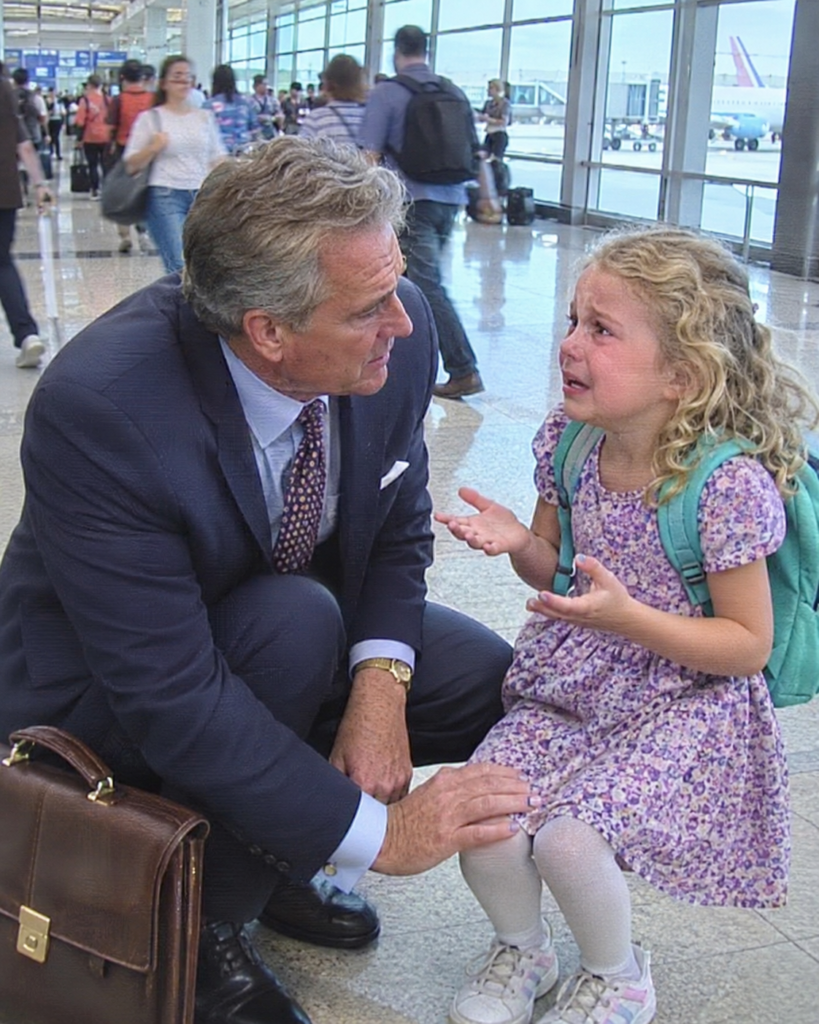
She couldn’t have been more than five or six, with soft blonde curls escaping a crooked ponytail, a pale pink sweater, and a bright turquoise backpack that seemed almost too large for her narrow shoulders. Her cheeks were damp, and although she was clearly trying to be brave, her lower lip trembled as she gathered enough courage to speak.
“Excuse me, mister. Are you lost, too?”
For a moment, I thought I had misunderstood her.
“Lost?” I repeated, lowering my phone.
She nodded solemnly.
“Because you keep looking at that thing, and you look kind of sad. My mommy says people look at their phones when they don’t know what to do.”
I stared at her, uncertain whether to smile or ask why she was wandering around by herself, until I noticed how tightly she was gripping one of her backpack straps.
“Where’s your mom, sweetheart?”
Her eyes immediately filled again.
“I don’t know. She told me to stay near the blue chairs, but there were so many people, and I thought I saw her coat, so I followed it. Then it wasn’t her.”
I put my phone away and crouched until we were at eye level.
“What’s your name?”
“Ellie.”
“Well, Ellie, I’m Daniel. We’re going to find someone who works here, and they’ll help us find your mom. You don’t have to figure this out by yourself.”
She studied my face with the seriousness children sometimes have when deciding whether an adult can be trusted.
“Promise?”
“I promise we’ll get you some help.”
I pointed toward a nearby airline service desk, where two employees were assisting passengers, and explained that we could walk over together without going far from where she had last seen her mother.
Ellie slipped her small hand into mine.
That simple gesture brought back a memory I hadn’t thought about in years.
My daughter, Claire, used to hold my hand exactly that way.
PART 2: The Life I Had Been Too Busy to Notice
Claire was thirty-one now, living in a small town outside Columbus, Ohio, and she hadn’t answered one of my phone calls in nearly seven months.
I knew her address, her birthday, and the name of the elementary school where she taught fourth grade, but I didn’t know what she had eaten for breakfast, whether she was happy, or what she did on Sunday afternoons.
I didn’t even know whether she still kept the old family photographs that had once lined the hallway of our house.
My marriage had officially ended four weeks earlier, after twenty-nine years together, although my former wife, Margaret, had told me that she had felt alone for much longer than that.
When she first said those words, I remember thinking they were unfair.
I had provided a comfortable home, paid for family vacations, made sure Claire could attend college without worrying about tuition, and worked hard enough that Margaret never had to wonder whether we could afford the ordinary things families needed.
What I hadn’t understood was that providing for people and being present for them were not always the same thing.
I missed school concerts because a meeting ran late, birthdays because flights were delayed, and quiet evenings because someone at work needed another report before morning.
Whenever Margaret asked me to slow down, I assured her that things would settle once the next project was finished.
There was always another project.
By the time I began to notice the silence at our dinner table, Claire had moved away, Margaret had stopped asking me to come home early, and I had become a visitor in a house I was still paying for.
Three weeks before the airport encounter, I had stood in our kitchen while Margaret packed the last of her belongings into cardboard boxes.
She had looked around the room and said:
“Daniel, I spent years waiting for you to come home, even when you were already here.”
I wanted to argue, but I couldn’t think of anything to say that would make her wrong.
Now, walking slowly beside a frightened little girl, I found myself remembering all the times Claire had reached for my hand when she was young, and how gradually, without either of us recognizing the moment, she had stopped.
PART 3: The Boarding Call I Didn’t Take
The airline service desk was less than fifty yards away, tucked between a crowded coffee kiosk and a bank of departure monitors flashing yellow and white updates across the concourse. As Ellie and I walked together, I kept my pace slow enough to match her short steps, acutely aware of the small, warm hand resting inside mine. It felt fragile, trusting in a way that made my chest tighten with an unfamiliar ache.
An agent in a navy blazer looked up as we approached, her practiced smile fading slightly when she saw Ellie’s tear-streaked cheeks.
“Good morning,” I said, keeping my voice calm so I wouldn’t frighten Ellie further. “This is Ellie. She got separated from her mother near the blue seating area by Gate B14. Could you make an announcement and call terminal security?”
The agent nodded immediately, reaching for her desk phone. “Of course. Let’s get a description right away.”
While the agent spoke quietly into the receiver and another employee stepped around the counter to kneel beside Ellie with a sticker badge and a small cup of water, I stood just behind them, watching. Ellie answered their questions in a soft, careful voice—telling them her mother was wearing a camel-colored coat, had dark hair pulled back in a clip, and was carrying a brown leather tote bag.
Within two minutes, the overhead speakers crackled to life across Terminal 1.
“Attention in the concourse: Would the mother of Ellie, a five-year-old girl wearing a pink sweater and turquoise backpack, please report immediately to the customer service desk near Gate B14.”
The announcement echoed down the high glass ceiling, blending with the hum of rolling luggage and distant jet engines. Almost at the exact same moment, my phone vibrated sharply inside my coat pocket.
I pulled it out. The screen showed an incoming call from Arthur Vance, the senior vice president of the hospital network in Denver. Below his notification was an automated alert from the airline: Boarding has begun for Flight 418 to Denver. Gate B22.
I stared at the glowing screen. Six weeks of preparation sat inside the leather briefcase resting against my shin. Financial projections, restructuring proposals, staffing models—an entire consulting contract worth more than most people earned in three years. If I missed this flight, there wasn’t another direct departure until late evening, which meant missing the afternoon board presentation and likely losing the account to a competing firm in Boston.
For thirty years, there would have been no hesitation. I would have handed Ellie over to the airline staff, thanked them politely, answered Arthur’s call while walking briskly toward Gate B22, and boarded the plane with twenty minutes to spare.
Instead, I looked down at Ellie. She had turned slightly away from the counter, her eyes fixed on the sleeve of my jacket, as if she were afraid I might vanish before her mother arrived.
“Are you leaving now?” she asked quietly.
Before I could answer, hurried footsteps echoed from the far side of the concourse. A woman in a camel coat rounded the corner at a near sprint, her face pale with panic, a brown leather bag slipping down her shoulder.
“Ellie!“
The relief in that single word cut straight through the noise of the terminal. Ellie let go of my hand and ran forward, throwing her arms around her mother’s knees. The woman dropped to the floor right there on the polished tile, pulling her daughter against her chest with trembling hands, burying her face in Ellie’s blonde curls as she whispered her name over and over again.
I stood a few paces back, watching the two of them hold onto each other as if nothing else in the world existed. Nobody around them cared about flight schedules, quarterly margins, or unopened emails. Everything that mattered in that woman’s universe was right there in her arms.
After a long moment, Ellie’s mother wiped her eyes and looked up at me, still holding her daughter tightly against her hip.
“Thank you,” she said, her voice shaking. “I only turned around for ten seconds to check the departure board, and when I looked back, she was gone. I don’t know what I would have done if someone hadn’t stopped to help her.“
“She’s a very brave girl,” I replied softly. “She knew how to ask for help.“
Ellie peeked over her mother’s shoulder and gave me a small, shy wave. “Bye, mister. I hope you find your way.“
Her mother smiled faintly through her tears, thinking it was just a child’s polite goodbye. She didn’t know how deeply those six words had landed.
My phone buzzed again in my hand. A text message from Arthur: Daniel, boarding closes in ten minutes. Confirming you’re on the flight?
Above me, the speaker chimed once more. “Final boarding call for Flight 418 to Denver at Gate B22. All remaining passengers must board immediately.”
I looked at Gate B22 down the concourse. Then I looked at my phone, where my last unanswered text to Claire—sent three weeks ago on a Sunday night—still sat at the bottom of our message thread without a reply: Hope your week goes well, sweetheart. Call me whenever you have a spare minute.
She hadn’t had a spare minute in seven months. Not because she was cruel, and not because she hated me, but because I had spent twenty years teaching her that she would always come second to whatever waited on the other end of a boarding gate.
Slowly, I opened my email, typed a brief message to Arthur explaining that an urgent personal matter prevented me from taking the Denver contract, and hit send. Then I walked back up to the airline service desk.
“Excuse me,” I said to the agent who had helped Ellie. “I need to cancel my flight to Denver. And I’d like to book the next available seat to Columbus, Ohio.“
PART 4: The Porch Light in Ohio
The regional flight to Columbus took barely an hour, followed by a forty-minute drive in a rental car along a quiet two-lane highway bordered by maple trees turning gold and rust in the October air. With every mile I put between myself and the airport, the familiar armor I had worn for three decades felt heavier—and less useful.
I didn’t have a strategy for this meeting. There were no talking points scribbled on a notepad, no leverage to negotiate with, and no way to fix seven months of silence with a checkbook. For the first time in my adult life, I was walking into a room with nothing to offer except the truth.
It was just past four in the afternoon when I pulled up along the curb outside a modest yellow clapboard house with a wooden porch and potted chrysanthemums flanking the front steps. A dark blue sedan was parked in the driveway. Through the living room window, a warm lamp glowed against the fading autumn daylight.
I sat behind the steering wheel for nearly five minutes, my hands resting on the cold leather, listening to the ticking of the cooling engine. Part of me wanted to turn the car around, drive back to the airport, and retreat into the only world where I knew how to succeed.
Then I remembered a five-year-old girl standing alone in a crowded terminal, holding onto my hand because she believed an adult would keep his promise.
I stepped out of the car, walked up the stone path, and knocked gently on the front door.
Footsteps approached from inside. When the door opened, Claire stood in the doorway wearing an oversized gray cardigan, her hair pulled back loosely, holding a ceramic mug in both hands. She looked so much like Margaret at that age that my throat closed up before I could speak.
The surprise on her face lasted only a second before settling into a guarded, exhausted stillness.
“Dad?” she said quietly. “What are you doing here? Is something wrong with Mom?“
“No, your mother’s fine,” I said, keeping my hands in my coat pockets so she wouldn’t see them shaking. “Nothing’s wrong. I just… I was supposed to fly to Denver this morning, and I realized I was getting on the wrong plane.“
Claire frowned slightly, studying my face the same way Ellie had studied it hours earlier—trying to decide whether the person standing in front of her could be trusted.
“I told you last spring I needed some space,” she said, her voice steady but tired. “Mom told me the divorce was finalized last month. I didn’t think we had much left to talk about.“
“We don’t have to talk if you don’t want to,” I replied honestly. “I didn’t come here to ask you to forgive me, Claire. And I’m not here to make excuses for all the years I wasn’t there.“
She didn’t close the door, though she didn’t step aside either. She just waited.
“This morning in Chicago, a little girl got separated from her mother in the airport,” I continued, looking down at the porch boards before meeting her eyes again. “She asked me if I was lost, because I was staring at my phone and looked like I didn’t know what to do. When she held my hand while we looked for her mom, all I could think about was you when you were five years old.“
Claire’s fingers tightened slightly around her mug, her gaze dropping for the briefest moment.
“I spent my whole life believing my job was to build a safe world for you and your mother,” I said, my voice dropping quieter. “I thought if I worked hard enough, paid for everything, and solved every problem from afar, that would be enough. I didn’t understand until it was too late that you didn’t need a provider, Claire. You just needed your father to show up.“
Silence settled between us, broken only by the dry rustle of leaves blowing across the front yard. For a long moment, neither of us moved. I braced myself for her to tell me it was too late—that twenty-nine years of absence couldn’t be undone by a single afternoon on a front porch. And if she said it, I knew she would be right.
Claire exhaled slowly, looking past me toward the street before turning back to face me.
“You missed my college graduation dinner because of a merger in Seattle,” she said softly, not with anger, just a quiet sorrow that hurt far worse. “You missed the week I moved into my first apartment. Half the time when I called you, you were checking emails while I was talking.”
“I know,” I said. “And I’m sorry. Not because I want you to let me off the hook, just because you deserved better than what I gave you.“
She looked at me for a long time, searching my eyes for the hurried, distracted man who always had one foot out the door. When she didn’t find him, some of the tension in her shoulders finally gave way.
“I only have about forty minutes before I have to grade a stack of spelling tests,” she said, stepping back slightly from the threshold and pulling the door open wider. “And I’m not promising anything, Dad. Seven months is a long time.“
“Forty minutes is more than enough,” I said, blinking back the sudden warmth stinging my eyes. “Thank you, Claire.“
As I stepped inside her house—leaving my briefcase in the trunk of the rental car—I realized that for the first time in longer than I cared to admit, I had nowhere else to be.