PART 2
I slid down into the ravine and pulled out my phone. One bar of signal.
I called 911. “I found Sheriff Rhodes,” I said. “He’s alive. He’s in the ravine behind the elementary school.”
The dispatcher was quiet for a second. Then I heard her shouting to someone in the background.
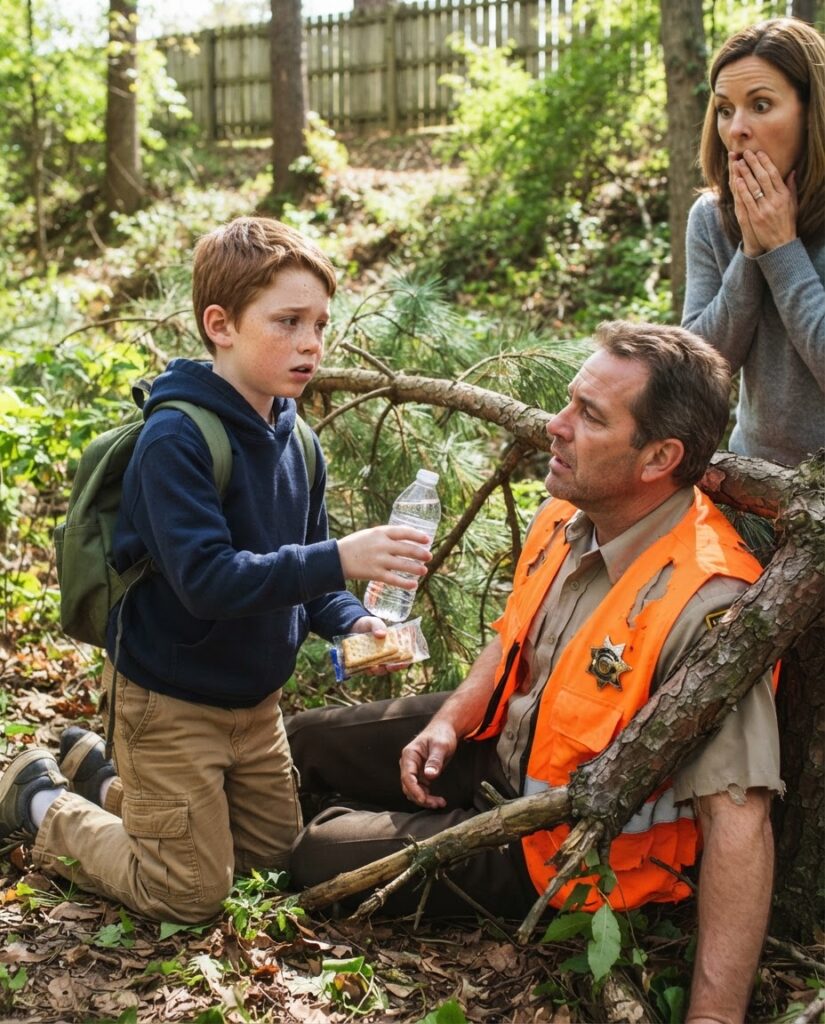
While we waited, I knelt next to the sheriff and held his hand. He was so cold.
“How did this happen?” I asked.
“Slipped on wet rocks up top,” he said slowly. “Fell about thirty feet. Broke my leg. Couldn’t climb out. My radio smashed. No signal down here.”
He looked at Emmett.
“Day two, I heard somebody walking by up there. I yelled until I lost my voice. This little guy came down to look. He was chasing a frog.”
Emmett nodded seriously. “It was a big one.”
“He brought me his own water bottle that day,” the sheriff said. “Then he came back every single afternoon after school. Water. Crackers. A granola bar. Even a blanket from your house.”
So that’s where my old picnic blanket had gone.
“Why didn’t you tell anyone, Emmett?” I asked softly.
His lip trembled.
“I tried to tell Lowell on the second night. I said I found a hurt man in the woods. He said to stop making up stories and go to bed. He said if I went in the woods again, I’d be punished.”
“So you went anyway.”
“He was thirsty, Mom,” Emmett said. “I couldn’t leave him.”
I couldn’t speak.
It took the rescue team ninety minutes to bring Sheriff Rhodes up out of that ravine on a stretcher. Half the town was waiting at the edge of the woods by the time they reached the top. People were crying. Cheering.
The doctors said he’d been severely dehydrated, with a broken leg and a bad infection setting in. They said if he’d gone without water for those four days, he almost certainly would have died.
An eight-year-old boy with a grocery bag saved his life.
Lowell came to the hospital that night. He found me in the hallway.
“Jess, what is this? The whole town is saying Emmett found the sheriff?”
“He tried to tell you,” I said. “On the second night. You told him he was lying. You threw his backpack in the trash for stealing water to keep a dying man alive.”
Lowell’s face went pale.
For the first time since I met him, he didn’t have anything to say.
He went into Emmett’s hospital room, where my son was sitting with the sheriff’s wife, eating ice cream.
He knelt down next to the chair.
“I’m sorry, Emmett,” he said. His voice cracked. “I should have listened. You did the right thing. I was wrong.”
Emmett looked at him for a long time.
Then he gave him a spoonful of ice cream.
Lowell has changed since then. He listens now. He even started going to counseling, to deal with the way his own father raised him. It’s slow. But it’s real.
Two months later, Sheriff Rhodes walked into Emmett’s school on crutches.
There was an assembly. The whole school was there.
He pinned a small gold badge on my son’s shirt.
“Honorary Deputy Emmett,” he said. “The bravest officer in this county.”
Emmett grinned so wide I thought his face would split.
And when the sheriff bent down to hug him, he whispered something in his ear.
Later, I asked Emmett what he said.
“He said, ‘Next time you see a frog in those woods, you call me first.’”
THE END.