PART 2
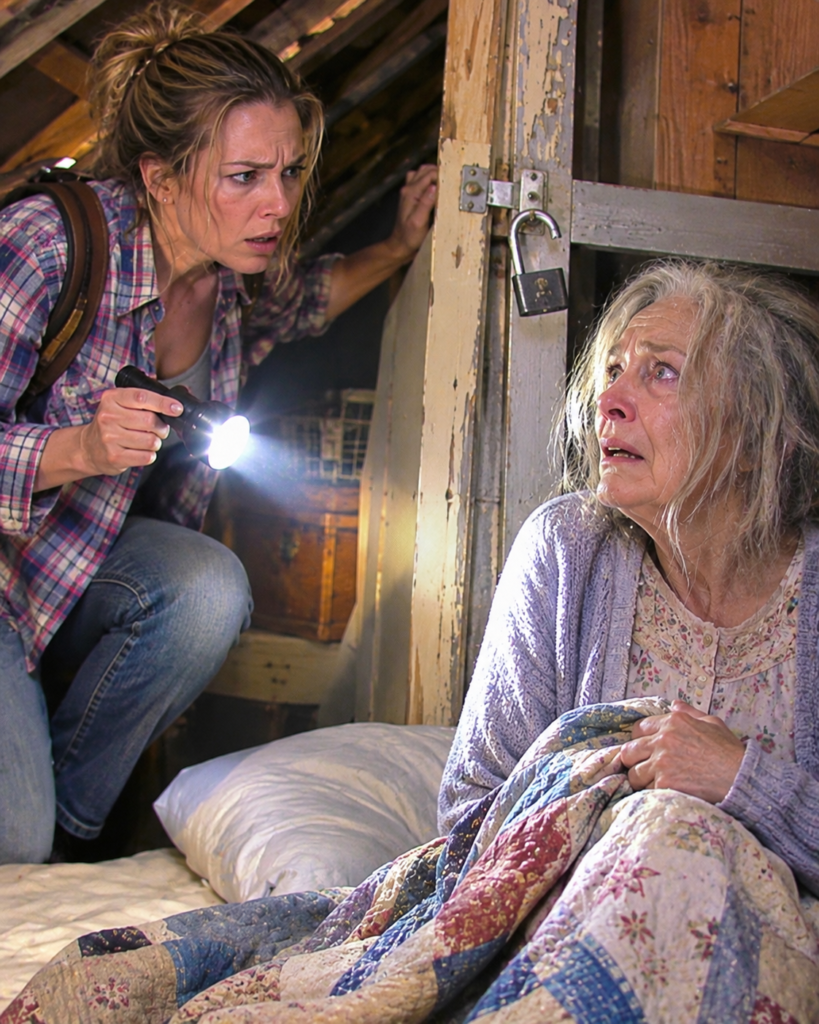
I knelt down next to her slowly, so I wouldn’t scare her.
“Mrs. Haskell? Ernestine?” She nodded. Tears ran down her cheeks.
“How long have you been up here?”
“I don’t know,” she whispered. “Two winters? Maybe more. I stopped counting.”
The attic was freezing. There was a mattress, a bucket, a stack of empty water bottles, and a little electric heater that barely worked. Her ankles were swollen. She was so thin, her wedding ring was taped onto her finger.
On the floor next to the mattress was a juice box. One of Noor’s.
My daughter had been sneaking her snacks.
“Your little girl,” Ernestine said, smiling through her tears. “She slides crackers through the gap in the floorboards. She calls me her ceiling friend. She saved my life.”
I called 911 right there, sitting on the attic floor.
The paramedics carried her down the narrow stairs in a blanket. Noor woke up and stood in her doorway in her pajamas, watching.
When Ernestine saw her, she reached out a shaking hand.
“Little bluebird,” she said.
Noor ran over and held her hand all the way to the ambulance.
At the hospital, the doctors said Ernestine was severely malnourished and dehydrated, but she would recover.
Then the detectives came.
Here’s what they found.
Two years earlier, Graydon had told everyone his mother had died. He’d faked a death notice in the paper. No funeral, no death certificate. He told people it was a private cremation.
Then he locked her in the attic.
Why?
Money.
Ernestine had a pension from forty years as a schoolteacher, plus her late husband’s military benefits. Graydon kept cashing her checks every month. Almost four thousand dollars.
And he rented her house out to people like me, who needed a cheap place and wouldn’t ask questions.
He brought her food once or twice a week. Sometimes less.
The detectives arrested Graydon at his fancy house across the road that same night. He was charged with elder abuse, false imprisonment, and fraud.
When they walked him out in handcuffs, he looked over at my house and shouted, “You had no right to go up there! That was MY property!”
The detective just shook her head.
“No, sir. It was hers.”
Ernestine spent three weeks in the hospital. Noor and I visited her every day. Noor brought her drawings of bluebirds.
When she was ready to leave, she had nowhere to go. Her son was in jail. Her friends all thought she was dead.
So I asked her if she’d like to come home with us.
Not to the attic. To the real house. To the downstairs bedroom with the big window.
“It’s your house, after all,” I said.
She laughed for the first time.
Ernestine lives with us now. She bakes bread on Sundays. She helps Noor with her reading. Her old friends from church cried when they saw her alive.
She refuses to take any rent from me.
“You opened the door,” she says. “That’s payment enough.”
Every night, when Noor goes to bed, Ernestine sits on the edge of her bed and sings.
A song about a bluebird.
But now, she sings it in the same room.
THE END.